Case Study of Spark Plasma Sintering Process
Guddakesh Kumar Chandan1,* R.Soundararajan2 R Balaji2 , Ashoka Varthanan3
PG Scholar, Mechanical Engineering, Sri Krishna College of Engineering &Technology, Coimbatore, Tamilnadu,
India1
Assistant Professor, Mechanical Engineering, Sri Krishna College of Engineering &Technology, Coimbatore,
Tamilnadu, India2
Professor& Head, Mechanical Engineering, Sri Krishna College of Engineering &Technology, Coimbatore, Tamilnadu,
India3
ABSTRACT: In globalization era, customers are looking for products having high accuracy, customized and complex design. For full filling their needs manufacturing industry did a lot of research in finding its solutions. Rapid prototyping is a technology which has such potential. One of the emerging technology in rapid prototyping is spark plasma sintering.it is one of the fastest process through which we can create a model in vacuum state at certain temperature and pressure. Its application is quite promising in aerospace industries. The objective of this paper is to study various challenges involves in spark plasma sintering and their methodology used. The different parameters involved in this paper are cooling rate, laser used, powder particle sizes, temperature and pressure selection, efficiency, cost, process monitoring, tool design and manufacturing of thermoelectric material.
KEYWORDS: Spark plasma sintering, size of powder, fast rapid prototype process
I. INTRODUCTION
Spark plasma sintering is one of latest technique used in rapid prototyping. It is an effective additive technique for large variety of material, at specific temperature and pressure, used in rapid prototyping. It consume less time while manufacturing any product compared with other rapid prototyping techniques used in now a days. It is a sintering technique which uses electric current or spark to give the temperature in a limited and continuous manner as per demand for manufacturing material. The characteristic used of SPS is that the pulsed DC current directly which is passes through the graphite die as well as the powder compact. Heating plays a dominant role in the densification of powder compacts, due to which density at lower sintering of powder is vary with high temperature powder while compared to conventional sintering techniques. The heat generation takes place inside where the heat is provided by external heating elements. Due to use of external heating elements it heat and cool rapidly (up to 1000 K/min) hence the sintering process generally is very fast (within a few minutes). The speed of this SPS process ensures it has the potential of densifying powders with Nano size or nanostructure while avoiding surface roughness which accompanies standard densification routes. This has made SPS a good method for disposition of ceramics based on micro particles with increase piezoelectric, thermoelectric, optical or biomedical properties. SPS is also used for sintering of Carbon Nanotubes for development of field electron emission electrodes. It has been experimentally verified that densification is facilitated by the use of a current has not use of spark or plasma.
II. METHODOLOGY
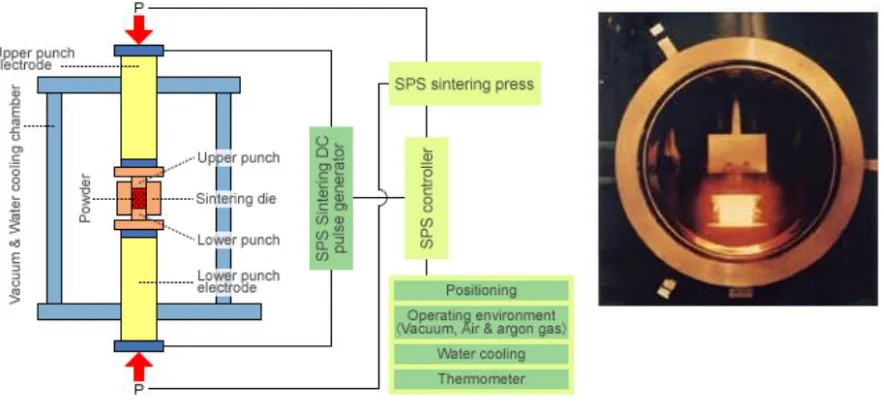
The SPS process is based on the electrical spark discharge phenomenon: a high energy, low voltage spark
pulse current momentarily generates spark plasma at high localized temperatures, from several to ten thousand ℃
between the particles resulting in optimum thermal and electrolytic diffusion. SPS sintering temperatures range from
sintering are completed in short periods of approximately 5 to 20 minutes, including temperature rise and holding times. Several explanations have been proposed for the effect of SPS.
Fig 1 Experimental Setup
2.1 Plasma generation: It was originally claimed by Inoue and the SPS process inventors that the pulses generated sparks and even plasma discharges between the particle contacts, which were the reason that the processes were named, spark plasma sintering and plasma activated sintering. They claimed that ionization at the particle contact due to spark
discharges developed “impulsive pressures” that facilitated diffusion of the atoms at contacts. T. Wangle (1) suggested
that a pulsed current had a cleaning effect on the particle surfaces based on the observation of a grain boundary without oxidation formed between particles. Whether plasma is generated or not has not yet been confirmed directly by experiments. Therefore, there is no conclusive evidence for the effect of a plasma generation in SPS. The occurrence of a plasma discharge is still debated, but it seems to be widely accepted that occasional electric discharges may take place on a microscopic. Metal powders have been observed to exhibit lower yield strength under an electric field. I.V.Koveleva (2), A. Murakami (7) and Ling Wang (9) independently studied electro plastic phenomena.
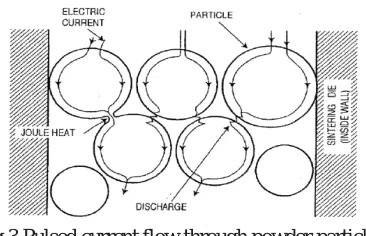
2.2 Joule heating: Joule heating due to the passage of electric current through particles assists in the welding of the
particles under mechanical pressure. The intense joule heating effect at the particle con‐
ducting surface can often result in reaching the boiling point and therefore leads to localized
vaporization or cleaning of powder surfaces [Dimos Paraskos’s(11)]. Such phenomenon ensures
favorable path for current flow.
Fi g 2 Effects of ON-OFF DC
In the SPS process, the powder particle surfaces are more easily purified and activated than in conventional electrical sintering processes and material transfers at both the micro and macro levels are promoted, so a high-quality sintered compact is obtained at a lower temperature and in a shorter time than with conventional processes. Figure illustrates how pulse current flows through powder particles inside the SPS sintering die.
Fig 3 Pulsed current flow through powder particles
Fig 4 ON-OFF pulsed current path through the spark plasma sintering machine
High temperature sputtering phenomenon generated by spark plasma and spark impact pressure eliminates adsorptive gas and impurities existing on the surface of the powder particles. The action of the electrical field causes high-speed diffusion due to the high-speed migration of ions.
2.4 Mechanical pressure
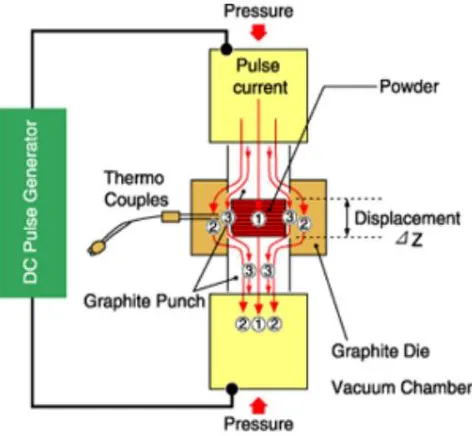
When a spark discharge appears in a gap or at the contact point between the particles of a material, a local high temperature-state (discharge column) of several to ten thousands of degrees centigrade is generated momentarily. This causes evaporation and melting on the surface of powder particles in the SPS process, and "necks" are formed around the area of contact between particles. Figure shows the basic mechanism of neck formation by spark plasma
Fig 5 shown about the pressure applied
III. MATERIAL USED
1. As Cutting Tool:
Titanium nitride, Transition metal carbonitrides, Al2O3–SiC composites, transparent ceramics, Yttrium
aluminium garnet, Zirconia, Magnesium aluminate spinel 2. Biomaterials
3. Materials for nuclear energy applications
4. Materials with low coefficient of thermal expansion
IV. CHALLENGES INVOLVES AND SOLUTION
4.1 Cooling rate: It is one of the major limitation in spark plasma sintering while Zhang(5) suggested that with the use of inert gas quenching system we can quenched metallic material after sintering state which ultimately help in rapid cooling while implementing in the field of metallic powder consolidation.
4.2 Laser used: In SPS, selection of laser plays a crucial role for heating surface. Shishkovsky (6) compared different types of lasers and concluded Nd3YAG lase have superior quality than x-ray while using biocompatible oxide ceramics and bioresorable polymeric powder
4.3 Powder particle sizes: It is a crucial factor in SPS, while Sofia(8) has done research on different particle size distribution as well as different laser scan speed she found a direct relationship between particle size, scan speed and energy consumption she got her best result at 48 micro meter and 1 millimeter per second
4.4 Manufacturing of thermoelectric material: For thermo generator manufacturing the compound needed Bi2Te3
based alloy the problem faced in manufacturing are anisotropic physical property and mechanical weakness. Schmidt (12) purposed that with the help of milling technique and SPS process on microstructure of polycrystalline we can form high quality of starting material which have thrice bending strength compared with coarse crystalline ingots
4.5 Electrical output power: In order to assure a cost effective production, equivalent with high throughput (amongst other things), a sufficient electrical output power must be provided by the system. It is important, that the electric losses in the system are low in order to generate high heating power at the location, where it is needed. The actual value of the required power depends on the size and material of the powder compact and the pressing tool as well as on the intended heating rates and maximum temperatures.
4.6 Precise temperature measurement & control: The correct sintering temperature is the most important process parameter besides time and heating rate. Due to a special design SPS systems are measuring the temperature in the vicinity of the powder compact center, which gives a much more significant value than the measurement of the die temperature (A. Eldesouky, 4)
4.7 Optimized pressing tool systems: Due to the special construction of SPS systems, the pressing tool system, consisting of the two pressing punches, the die and other auxiliary components, is the “heart” of the system, because it not only contains the powder compact but also acts as the “heater” (in interaction with the compact). Even though the temperature gradients in the system are significantly lower than for conventional sintering methods, a design optimization is advantageous anyhow, especially if higher heating rates, minimized dwell time and optimum material quality are desired. A helpful tool for design optimization is the numerical simulation (finite element method “FEM”) of the heating behavior, taking into account the temperature dependent thermal and electrical properties of the applied tool materials as well as the powder (Guangying Guan, 3)
developed, they can be mentioned ultra-stable components for satellite mirrors and high precision and accuracy optical devices, ultra hard protection components, nanostructured cutting tools or biomaterials. (G Model, 10)
V. PURPOSED METHODOLOGY
We should use a uniform shape & size of the particle (better 20-30 micrometer) for getting for getting good efficiency so that we can eliminate the extra energy consumption. As per the gas we should use argon since it not react with any of the material in the closed chamber because at high temperature and pressure even some reaction can cause huge damage to the product as per the cooling rate we know it is hard to achieve in this so we should supply a constant flow of lubricant material which eliminate heat from chamber.
VI. CONCLUSION
There is an enormous amount of reported SPS applications are still in the area of material development and more than enough opportunities for an industrial implementation were generated. Taking the next step forward to an industrial production of novel materials by SPS is currently highly dependent on the availability of suitable equipment. The industrial application of the SPS sintering method for the rapid consolidation of novel materials require special features, which have to be fulfilled by the equipment and are different from the requirements of scientific work to some extent.
REFERENCES
[1]. T. Wangle, Simulated UO2 fuel containing CsI by spark plasma sintering, Journal of Nuclear Materials 466 (2015) 150e153.
[2]. I.V.Koveleva, investigation of nanostructure formation of alumina by magnetic pulse compression and subsequent spark plasma sintering, science direct physics procedia 72(2015) 386-389
[3]. Guangying Guan, Evaluation of selective laser sintering processes by optical
coherence tomography, Materials and Design 88 (2015) 837–846
[4]. A. Eldesouky, Effect of grain size reduction of AA2124 aluminum alloy powder compacted by spark plasma sintering, Journal of Alloys and Compounds 609 (2014) 215–221
[5]. Faming Zhang,The potential of rapid cooling spark plasma sintering for metallic materials, Materials Today Volume 16, Number 5 May 2013 [6]. Shishkovsky I., Selective laser sintering of biopolymers with micro and nano ceramic additives for medicine, science direct, Physics Procedia 39 ( 2012 ) 491 – 499
[7]. A. Murakami, Mechanical properties of MgB2 bulk fabricated by Spark Plasma
Sintering, science direct, Physics Procedia 65 (2015) 77 – 80
[8]. Daniele Sofia, Laser sintering of unimodal distributed glass powders of different size, science direct, Procedia Engineering 102 ( 2015 ) 749 – 758
[9]. Ling Wang, Intensive particle rearrangement in the early stage of spark plasma sintering process, Journal of Asian Ceramic Societies 3 (2015) 183–187
[10]. G Model, Consolidation of B4C-TaB2 eutectic composites by spark plasma sintering, Journal of Asian Ceramic Societies (2015)
[11]. Dimos Paraskevas, The use of Spark Plasma Sintering to fabricate a two-phase material from blended aluminium alloy scrap and gas atomized powder, science direct, Procedia CIRP 26 ( 2015 ) 455 – 460.
[12]. J. Schmidt, Application of Spark Plasma Sintering for Manufacturing of