MenoMachi e Project Meaege[]oat $yate0a For Hew Products 9ovoiopment
Susumu Tsuhara, S u s u m u Seki
Systems D e v e l o p m e n t L a b o r a t o r y , H i t a c h i Ltd. K a n a g a w a , JAPAN
Koji N a k a m u r a , T o s h i r o N a m i k i H i t a c h i Ltd.
A b s t r a c t
M a n - m a c h i n e p r o j e c t m a n a g e m e n t s y s t e m for n e w p r o d u c t s d e v e l o p m e n t has been d e v e l o p e d . It p o s s e s s e s the f o l l o w i n g three f u n c t i o n s . (i) P l a n n i n g the o p t i m u m i n s p e c t i o n p r o j e c t , (2) P r o j e c t s c h e d u l i n g w i t h l i m i t e d r e s o u r c e s and (3) M a n - m a c h i n e p r o j e c t p r e d i c t i o n and e v a l u a t i o n . In this paper, the n e c e s s i t y of these f u n c - tions is d e s c r i b e d . A u t h o r s will also refer to the r e a l i z a t i o n m e t h o d s .
i. I N T R O D U C T I O N
In d e v e l o p i n g new p r o d u c t s , there are m a n y u n c e r t a i n f a c t o r s such as trial and error due to m a n y d i f f i c u l t i e s that have to be o v e r c o m e , T h e r e f o r e , a c t i v i t i e s such as d e s i g n , test p r o d u c t i o n and in- s p e c t i o n are p e r f o r m e d r e p e a t e d l y under the s e v e r e r e s t r i c t i o n of due dates. W h a t is worse, d e v e l o p m e n t p l a n s of new p r o d - ucts are f r e q u e n t l y c h a n g e d to meet shifts in m a r k e t b e h a v i o u r . In m a n a g i n g the d e v e l o p m e n t of new p r o d u c t s under such c o n d i t i o n s , u n c o n v e n t i o n a l and e x c e p t i o n a l m e a s u r e s m u s t o f t e n be taken. C o n s e q u e n t - ly, c o m p u t e r p r o c e s s i n g a l o n e c a n n o t
a l w a y s cope w i t h the s i t u a t i o n s that arise. B a s e d on this p o i n t of view, the a u t h o r s have d e v e l o p e d the f o l l o w i n g m a n - m a c h i n e p r o j e c t m a n a g e m e n t s y s t e m for the
d e v e l o p m e n t of new p r o d u c t s .
2. F U N C T I O N S R E Q U I R E D FOR M A N A G I N G N E W P R O D U C T D E V E L O P M E N T
In m a n a g i n g p r o j e c t s for the d e v e l o p - m e n t of new p r o d u c t s , the f o l l o w i n g three f u n c t i o n s are required.
(i) P l a n n i n g the o p t i m u m i n s p e c t i o n p r o j e c t
In the d e v e l o p m e n t of new p r o d u c t s , f a i l u r e in o n e i n s p e c t i o n a f f e c t s other
inspections. T h e r e f o r e , it is p o s s i b l e that the f o l l o w i n g s i t u a t i o n m a y occur d e p e n d i n g upon the s e q u e n c e of inspections. T h a t is, the s i t u a t i o n of being c o m p e l l e d to inspect test p r o d u c t s again even t h o u g h they p a s s e d in the i n s p e c t i o n before. The f r e q u e n c y of such s i t u a t i o n s increases the
time needed for d e v e l o p m e n t . Thus, it
m u s t be a b s o l u t e l y a v o i d e d f r o m the stand- p o i n t of p r o j e c t m a n a g e m e n t . It is n e c e s - s a r y to d e c i d e the o p t i m u m p r o j e c t n e t w o r k w h i c h m i n i m i z e s the number of a d d i t i o n a l i n s p e c t i o n s m a d e n e c e s s a r y by i n s p e c t i o n failures.
(2) P r o j e c t s c h e d u l i n g w i t h limited r e s o u r c e s
The p r o j e c t d e t e r m i n e d by f u n c t i o n (i) is p e r f o r m e d under the c o n d i t i o n of l i m i t e d r e s o u r c e s such as i n s p e c t i o n rooms, test p r o d u c t s and so on. So, it is n e c e s s a r y to d e c i d e the s e q u e n c e of such i n s p e c t i o n s as they c a n n o t be p e r f o r m e d s i m u l t a n e o u s l y under the l i m i t a t i o n of r e s t r i c t e d re- sources. This is w h y p r o j e c t s c h e d u l i n g w i t h limited r e s o u r c e s is required.
(3) M a n - m a c h i n e p r o j e c t p r e d i c t i o n and e v a l u a t i o n
In m a n a g i n g p r o j e c t s for the d e v e l o p - m e n t of new p r o d u c t s , u n c o n v e n t i o n a l and e x c e p t i o n a l m e a s u r e s are o f t e n n e c e s s i t a t e d by u n c e r t a i n f l u c t u a t i o n f a c t o r s such as i n s p e c t i o n failures, c h a n g e s in d e v e l o p -
m e n t plans and so on. In order to cope
w i t h them, it is n e c e s s a r y to c o m b i n e the f o l l o w i n g two a b i l i t i e s .
(a) H u m a n a b i l i t y to m a k e d e c i s i o n s (b) C o m p u t e r a b i l i t y to p r o c e s s
i n f o r m a t i o n
That is, the f u n c t i o n of p r o j e c t p r e d i c - tion and e v a l u a t i o n by man and c o m p u t e r is indispensable.
M a n - m a c h i n e P r o j e c t M a n a g e m e n t (continued)
The a u t h o r s will d e s c r i b e these three f u n c t i o n s below.
3. P L A N N I N G T H E O P T I M U M I N S P E C T I O N P R O J E C T
3.1 B a s i c m o d e l
Let us e x a m i n e the case of two in- s p e c t i o n s . One of t h e s e i n s p e c t i o n s w i l l be d e n o t e d by t i and the o t h e r one by tj. If the test p r o d u c t s h a v e f a i l e d in i n s p e c t i o n ti, it m u s t be p e r f o r m e d a g a i n after c o u n t e r m e a s u r e s for i m p r o v e m e n t such as d e s i g n c h a n g e s have been i m p l e m e n t e d . It is p r e v i o u s l y known w h e t h e r t h e s e c o u n t e r m e a s u r e s a f f e c t the other i n s p e c -
tion tj or not. If they a f f e c t tj, tj
m u s t be p e r f o r m e d . T h e r e f o r e , in the w o r s t case, i n s p e c t i o n tj m u s t be c o n - d u c t e d a g a i n even t h o u g h the test p r o d u c t s have p a s s e d in tj before.
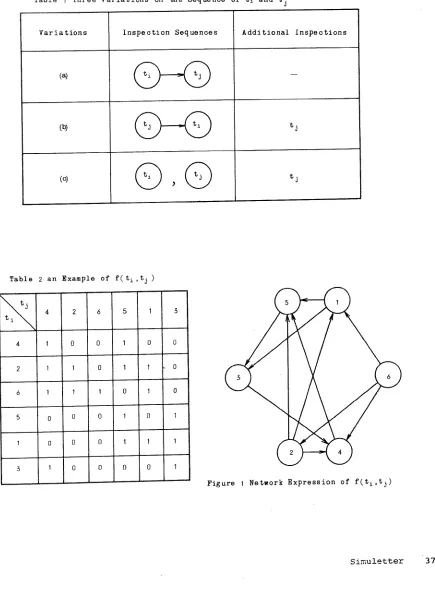
The p r o b l e m is h o w the s e q u e n c e of these two i n s p e c t i o n s t i and t i s h o u l d be decided. F i r s t of all, let u s ' a s s u m e that the c o u n t e r m e a s u r e s c a u s e d by the f a i l u r e in t i affect t i and t i does not a f f e c t t i. T h e r e are [hree v a r i a t i o n s in the s e q u e n c e of t i and tj as shown in T a b l e i. If it is p r e v i 6 u s l y known that the test p r o d u c t s d o n ' t fail in both t i and t~, no a d d i t i o n a l i n s p e c t i o n o c c u r s in
these v a r l a t l o n s (a) to (c). But thls
a s s u m p t i o n is invalid. We should a s s u m e the w o r s t case in w h i c h the test p r o d u c t s fail both t i and t i. A d d i t i o n a l i n s p e c - tions of e a c h v a r i a t i o n (a) to (c) under this a s s u m p t i o n are s h o w n in T a b l e i. In v a r i a t i o n (a), there o c c u r s no a d d i t i o n a l
inspection. But in v a r i a t i o n (b) and (c),
i n s p e c t i o n tj is m a d e n e c e s s a r y by the f a i l u r e in t i. C o n s e q u e n t l y , v a r i a t i o n
(a) s h o u l d be a d o p t e d b e c a u s e the n u m b e r of a d d i t i o n a l i n s p e c t i o n s is m i n i m i z e d . This c o n c l u s i o n shows that the r e l a t i o n w h e t h e r t i a f f e c t s tj or not is e q u i - v a l e n t to the r e l a t i o n w h i c h d e s c r i b e s the i n s p e c t i o n s e q u e n c e .
3.2 E x p a n s i o n to N i n s p e c t i o n s and d e f i n i t i o n of the o p t i m a l i t y
An e x a m p l e of m a t r i x f(ti,tj) " (i = I, 2, ..., n; j = i, 2, ..., n) w h i c h d e s c r i b e s the r e l a t i o n w h e t h e r t i a f f e c t s
tj or not is shown in T a b l e 2. f(ti,tl)
i~ a b i n a r y m a t r i x and if t i a f f e c t s t~ (if t i is p e r f o r m e d a f t e r p a s s i n g t i) let f~ti,ti) be i, and if it does not let it be 0. -f(ti,t j) can be t r a n s f o r m e d into the n e t w o r k shown in F i g u r e i. If the n e t w o r k does not c o n t a i n cycles, we can d e r i v e the o b j e c t i v e p r o j e c t n e t w o r k of i n s p e c t i o n s just by r e m o v i n g the re-
d u n d a n t arcs from the network. And if
each i n s p e c t i o n is p e r f o r m e d based upon this p r o j e c t network, there o c c u r s no
34 S i m u ! e t t e r
a d d i t i o n a l i n s p e c t i o n s . H o w e v e r , t h e s e n e t w o r k s g e n e r a l l y c o n t a i n c y c l e s as s h o w n
in F i g u r e i. T h e r e f o r e , it is n e c e s s a r y to d e r i v e the c y c l e - f r e e n e t w o r k by r e m o v -
ing some arcs from the n e t w o r k (1,2). The
p r o b l e m of w h i c h arcs s h o u l d be r e m o v e d is s o l v e d by the d e f i n i t i o n of the o p t i m u m p r o j e c t network.
Now, the o p t i m u m p r o j e c t n e t w o r k w i l l
be defined. If the arc 4 ~ 5 is r e m o v e d
from the n e t w o r k s h o w n in F i g u r e i, it b e c o m e s a c y c l e - f r e e n e t w o r k and the o b j e c t i v e p r o j e c t n e t w o r k can be d e r i v e d f r o m it. W h e n the i n s p e c t i o n s are p e r - f o r m e d based upon this p r o j e c t n e t w o r k , there occur t h r e e a d d i t i o n a l i n s p e c t i o n s - 5, 3 and 4. T h e n u m b e r o f t h e s e a d d i t i o n a l i n s p e c t i o n s s h o u l d be m i n i m i z e d . Thus, the o p t i m u m p r o j e c t n e t w o r k can be o b t a i n e d by the f o l l o w i n g four p r o c e d u r e s .
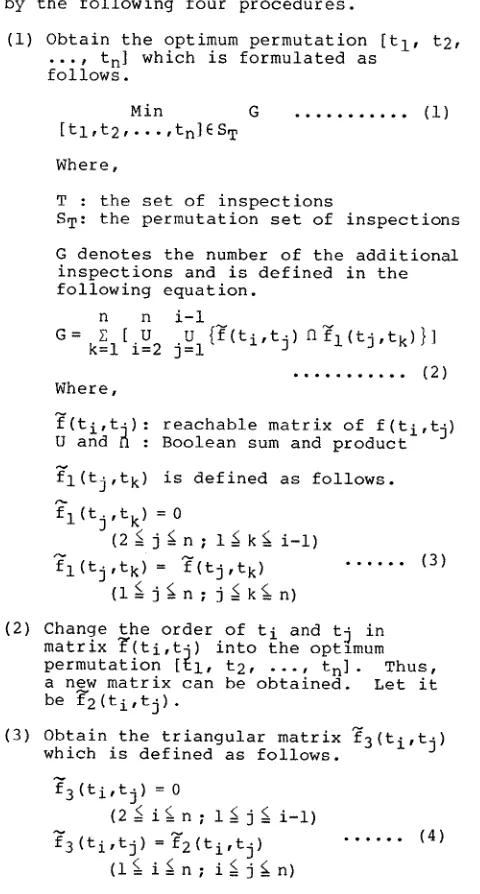
(i) O b t a i n the o p t i m u m p e r m u t a t i o n [tl, t2, ..., t n] w h i c h is f o r m u l a t e d as
follows.
M i n G ... (i)
[tl,t2, .... tn]6S T
W h e r e ,
T : the set of i n s p e c t i o n s
ST: the p e r m u t a t i o n set of i n s p e c t i o n s
G d e n o t e s the number of the a d d i t i o n a l i n s p e c t i o n s and is d e f i n e d in the f o l l o w i n g e q u a t i o n .
n n i-I
G = ~ [ U U {f(ti,t j) flfl(tj,tk) }]
k=l i=2 j=l
... (2) W h e r e ,
f ( t i , t i) : r e a c h a b l e m a t r i x of f (ti,tj) U and f~ B o o l e a n sum and p r o d u c t
fl(tj,tk) is d e f i n e d as follows.
~ l ( t j , t k ) = 0
(2=< j_~n ; i_~ k ! i-l)
~ l ( t j , t k ) = Y ( t j , t k ) ... (3)
(i<= ji_n ; j =< k ~ n)
(2) C h a n g e the order of t i and tj in m a t r i x ~(ti,tj) into the o p t l m u m
p e r m u t a t i o n [[i, t2, .... tn]- Thus,
a new m a t r i x c a n be o b t a i n e d . Let it be ~2 (ti,tj) .
(3) O b t a i n the t r i a n g u l a r m a t r i x ~ 3 ( t i , t j ) w h i c h is d e f i n e d as follows.
~ 3 ( t i , t j ) = 0
( 2 < i l n = - ; 1 < = j = < i - l )
~ 3 ( t i , t j ) = ~ 2 ( t i , t j ) ... (4)
(4) R e m o v e the r e d u n d a n t "i" f a c t o r s from ~ 3 ( t i , t j ) . T h e o b t a i n e d m a t r i x w i l l
be d e n o [ e d by f3(ti,tj), f3(ti,tj)
c a n be t r a n s f o r m e d i n f o the network. A n d this is p r e c i s e l y the o p t i m u m p r o j e c t n e t w o r k being sought.
3.3 M e t h o d of o b t a i n i n g the o p t i m u m s o l u t i o n
T h e o p t i m u m p e r m u t a t i o n [tl, t2, ..., tn] w h i c h has b e e n d e f i n e d in 3.2 (i) can be o b t a i n e d by the B r a n c h and B o u n d M e t h o d
(BBM) .
(i) D i v i s i o n of p e r m u t a t i o n set
S T c o n s i s t s of n~ factors, since S c o n s i s t s of n f a c t o r s . S u b s e t in B B M is d e f i n e d as one in w h i c h all p e r m u t a t i o n s are e q u a l from the ist to the rth (r = 0, i, ..., n-l). T h e n u m b e r of f a c t o r s in
this s u b s e t is (n-r) :. If r = 0, then the
s u b s e t is e q u a l to S T and if r = n-l, then the s u b s e t c o n s i s t s of o n l y one factor.
T h e s u b s e t in w h i c h all p e r m u t a t i o n s are e q u a l from the ist to the rth is
d i v i d e d into (n-r) subsets. A n d in each
s u b s e t , all p e r m u t a t i o n s are e q u a l from
the ist to the (r+l)th. Let {tl, t 2, ...,
tr} d e n o t e the s u b s e t in w h i c h all p e r m u - t a t i o n s are e q u a l to [t I, t 2, ..., t r] from the Ist to the rth.
(2) Lower B o u n d
T h e o b j e c t i v e f u n c t i o n G for the a r b i t r a r y p e r m u t a t i o n [t I, t2, ..., t r, tr+l, .... , t n] o f s u b s e t {tl, t2, ..., tr} c a n be w r i t t e n as follows.
n n i-I
G = Z [ U O {~(ti,tj) o~'fl(tj,tk)~]
k = l i = 2 j = l
n r i-i
= E [( U U { f ( t i , t j) flfl(tj,tk)})- U
k=l i = 2 j = l
n r
( U U { f ( t i , t ~) ~ fl(ti,tk)} ) U
i=r+l j=l J J
n i-i
( U U {f(ti,tj) n ~ ( t j , t ~ ) } ) ]
i=r+2 j = r + l
. . . (5)
T h e first and s e c o n d items inside [ ]
in the r i g h t - h a n d e x p r e s s i o n d o n ' t d e p e n d u p o n the p e r m u t a t i o n s of s u b s e t {t I, t 2,
..., tr}. B u t the third item does.
H o w e v e r ,
n i-i
U U {~(ti,tj) f l ~ l ( t j , t k ) } = 0 or 1
i=r+2 j=r+l
( k = l, 2, ..., n) ... (6)
H e n c e
n n i-i
E [ U U If(ti,tj) ~I f l ( t j , t k ) ~ ]
k=l i=2 j=l
n r i-i
Z [ ( U U {~(ti, [i ~ (tj,tk) }) U
k=l i=2 j=l tj) fl
n r
( O U {~(ti,tj) fl f~] (tj,tk)})] ~ -
i=r+l j=l
... (7)
C o n s e q u e n t l y the lower bound LB{tl, t2, .... tr} is w r i t t e n as follows.
LB{t I , t2 . . . tr}
n r i-i
= E [( U U {~(ti,tj) fl ~l(tj,tk)}) U
k=l i=2 j=l
n r
( U U { ~ ( t i , t j) fl~l(tj,tk)})]
i=r+l j=l
. . . (8)
3.4 C a s e s t u d y
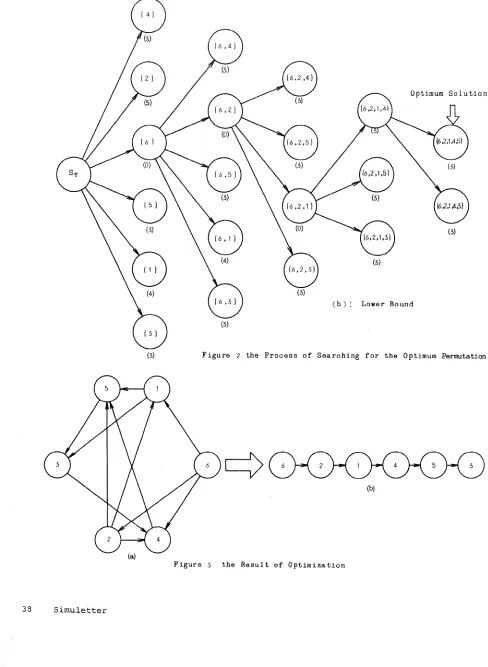
The p r o c e s s of s e a r c h i n g for the o p t i m u m s o l u t i o n is s h o w n in F i g u r e 2 w h e n f(t~,tj) is g i v e n as s h o w n in T a b l e 2. The o p t i m u m p e r m u t a t i o n is [6,2,1,4,5,3]. A n d the m i n i m u m number of a d d i t i o n a l inspec- tions is three. The o b j e c t i v e o p t i m u m p r o j e c t n e t w o r k is o b t a i n e d by the p r o c e - d u r e s d e s c r i b e d in 3.2 (2) to (4). Thus, the o r i g i n a l n e t w o r k shown in F i g u r e 3 (a) can be t r a n s f o r m e d into the o b j e c t i v e n e t w o r k shown in F i g u r e 3 (b).
4. P R O J E C T S C H E D U L I N G W I T H L I M I T E D R E S O U R C E S
To p e r f o r m the p r o j e c t p l a n n e d in chapter 3, r e s o u r c e s such as test products, i n s p e c t i o n rooms, etc. are n e c e s s a r y .
But these are limited. So, the p r o j e c t
c o n t a i n s i n s p e c t i o n s that c a n n o t be per-
formed at the same t i m e (3). Here, the
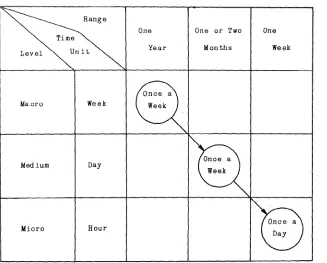
s c h e d u l e s w h i c h m i n i m i z e the p r o j e c t t e r m are m a d e under the r e s t r i c t i o n s of the i n s p e c t i o n s e q u e n c e and l i m i t e d r e s o u r c e s . S c h e d u l e s are m a d e h i e r a r c h i c a l l y by the f o l l o w i n g three steps as s h o w n in F i g u r e 4.
(a) Long range s c h e d u l i n g (term is one year) (b) M e d i u m range s c h e d u l i n g
(term is one or two months) (c) Short range s c h e d u l i n g
(term is one week)
The o u t l i n e of (b) is shown in F i g u r e 5 as a t y p i c a l example. T h e p r o j e c t n e t w o r k as the r e q u i r e m e n t is h i e r a r c h i c a l and
m u l t i p l e . A d e t a i l e d s i n g l e p r o j e c t is m a d e by c o m p a r i n g this r e q u i r e m e n t with the c a p a c i t i e s of the i n s p e c t i o n rooms as r e s o u r c e s . T h e m e t h o d of p r i o r i t y rule o r i e n t e d d i g i t a l s i m u l t a t i o n is adopted.
5. M A N - M A C H I N E P R O J E C T P R E D I C T I O N A N D E V A L U A T I O N
In m a n a g i n g p r o j e c t s for the d e v e l o p - m e n t of n e w p r o d u c t s , there are m a n y un- certain f l u c t u a t i o n factors in the
M a n - m a c h i n e P r o j e c t M a n a g e m e n t (continued)
f u n d a m e n t a l d a t a s u c h as i n s p e c t i o n times, c a p a c i t i e s , etc., b e c a u s e of the f r e q u e n c y of the u n c o n v e n t i o n a l and e x c e p t i o n a l m e a s u r e s e m p l o y e d . Under such c o n d i t i o n s , a m a n - m a c h i n e m a n a g e m e n t s y s t e m w h i c h s u p p l i e s the a n a l y z e d i n f o r m a t i o n to sup- port h u m a n d e c i s i o n m a k i n g is d e s i r e d rather than an a u t o m a t i c d e c i s i o n m a k i n g is d e s i r e d r a t h e r t h a n an a u t o m a t i c d e c i - sion m a k i n g system. F r o m this p o i n t of view, H i t a c h i has a l r e a d y d e v e l o p e d a m a n - m a c h i n e s y s t e m (4). It is named PASS
( P r e d i c t i v e A d a p t i v e S i m u l a t i o n System). PASS is a p p l i c a b l e to the m a n a g e m e n t of p r o j e c t s for the d e v e l o p m e n t of n e w p r o d u c t s .
T h e flow of p r o j e c t m a n a g e m e n t in w h i c h P A S S is a p p l i e d is shown in F i g u r e 6. T h i s c o n s i s t s of the f o l l o w i n g t h r e e
p h a s e s .
(I) P r e d i c t i o n of f u t u r e p r o b l e m s and p u r s u i t of their c a u s e s
F u t u r e p r o g r e s s of the p r o j e c t is s i m u l a t e d . The s i m u l a t i o n r e s u l t s are s u m m a r i z e d and d i s p l a y e d on CRT. T h i s is c a l l e d a g l o s s a r y d i s p l a y . It s h o w s the g e n e r a l p r o g r e s s and the a m o u n t of d e l a y
from d u e dates. For the p u r s u i t of the
c a u s e s w h i c h b r o u g h t on t h e s e d e l a y s , the f o l l o w i n g two f r a m e s are p r o v i d e d .
(a) P r o g r e s s d i s p l a y (b) Load d i s p l a y
T h e s e f r a m e s c l e a r l y s h o w the c a u s e s of the d e l a y s .
(2) D e v i s i n g s o l u t i o n s to f u t u r e p r o b l e m s
T h e f o l l o w i n g t h r e e f r a m e s are p r o - v i d e d as the m e a n s of f o r m u l a t i n g s o l u - tions to the p r e d i c t e d f u t u r e p r o b l e m s .
(a) D i s p l a y for c h a n g i n g c a p a c i t y (b) D i s p l a y for c h a n g i n g d u e d a t e (c) D i s p l a y for c h a n g i n g p r i o r i t y
P r o j e c t m a n a g e r s f o r m u l a t e s o l u t i o n s to the p r e d i c t e d p r o b l e m s and enter them using these frames.
(3) E v a l u a t i o n of s o l u t i o n s
F u t u r e p r o g r e s s is s i m u l a t e d a g a i n
based upon the c h a n g e d model. The results
are s h o w n in a g l o s s a r y d i s p l a y as de- s c r i b e d in (i). Thus, the e f f e c t i v e n e s s of t h e s e s o l u t i o n s can be c o n f i r m e d easily.
6. C O N C L U S I O N
A m a n - m a c h i n e p r o j e c t m a n a g e m e n t s y s t e m for n e w p r o d u c t s d e v e l o p m e n t has been p e r f e c t e d . T h e f e a t u r e s of the
s y s t e m are as f o l l o w s .
(i) The n u m b e r of a d d i t i o n a l i n s p e c t i o n s m a d e n e c e s s a r y by i n s p e c t i o n f a i l u r e s
is m i n i m i z e d by the p l a n n i n g of an o p t i m u m i n s p e c t i o n p r o j e c t n e t w o r k °
(2) The f l e x i b i l i t y for i n s p e c t i o n f a i l u r e s and the c h a n g e s in d e v e l o p m e n t p l a n s is r a i s e d by the i n t r o d u c t i o n of m a n - m a c h i n e p r o j e c t p r e d i c t i o n and e v a l u - ation.
The s y s t e m d e v e l o p e d is now b e i n g a p p l i e d to p r o g r e s s m a n a g e m e n t at an in- s p e c t i o n d e p a r t m e n t in a h o m e a p p l i a n c e factory.
R E F E R E N C E S
i) A. L e m p e l and I. C e d e r b a u m : M i n i m u m F e e d b a c k Arc and V e r t e x Sets of a D i r e c t e d G r a p h . , IEEE T r a n s a c t i o n s on C i r c u i t T h e o r y , D e c e m b e r 1966 Vol. C T - 13, No. 4, 3 9 9 - 4 0 3 .
2) J. H. C h r i s t e n s e n and D. F. Rudd:
S t r u c t u r i n g D e s i g n C o m p u t a t i o n s . , A I C h E J o u r n a l , J a n u a r y 1969, 94-100.
3) R. W. C o n w a y , W. L. M a x w e l l a n d L. W. M i l l e r : T h e o r y of S c h e d u l i n g . , A d d i s o n - W e s l e y , 1967.
4)
K. T a b a t a , et al.: " P A S S " - A n Interactive O n l i n e S i m u l a t o r for P r e d i c t i v eP r o d u c t i o n C o n t r o l . , IFAC S y m p o s i u m o n I n f o r m a t i o n C o n t r o l P r o b l e m s in
M a n u f a c t u r i n g T e c h n o l o g y , O c t o b e r 1977, 271-277.
Table 1 Three V a r i a t i o n s on the Sequence of ti and tj
V a r i a t i o n s
(a)
(o)
Inspection Sequences
© , ©
Additional Inspections
tj
tj
Table 2 an Example of f(t i ,tj )
' tj
t i ~ 4 2 6 5 I
4 I 0 0 I 0
2 I I 0 I I
6 1 1 1 0 1
!
5 0 0 0 1 0
1 0 0 0 1 1
[ 5 1 0 0 0 0
0
. 0
Figure I N e t w o r k E x p r e s s i o n of f(t i,tj)
M a n - m a c h i n e P r o i e c t M a n a g e m e n t (continued)
(3)
(5)
(3)
Optimum Solution
(o)
(o) \
k
--~
\ \ k
(3)
/
/
h
\
(3)
(3) \ / ~ (3)
(5) (o) (5)
(4)
f
\
(3)(4)
(3)
(3)
( b ) : L o w e r B o u n d
(~) Figure 2 the Process of Searching for the Optimum Permutation
Figure 5 the Result of Optimization
•
T
~
e
Level ~
. . . .
Ma cro We e k
Medium Day
Micro H o u r
One
Year
\
One or Two
Months
One
We ek
Figure 4 Method of Hierarchical Scheduling
Project Network
(Hierarchical and M u l t i p l e ) @ @
Product K
Capaoity.~ of Inspection Room .."
s
Ma t nanm
. . . . il
~
M a n u a l . . . .! I ~ , l , I , , T - [ l
Hol i d a y Time(Day)
|
IRoom R
I,,
F i g u r e 5Project
Scheduling
Project Network
Detailed and Single )
the Outline of Medium Range Scheduing
M a n - m a c h i n e Pro-~ect Manaq.pment (continued)
Start
~a n
I n p u t the S i m u i a t i o n Spec,
Corll pu te t'"
Simulation
G1 os sa ry
S e l e c t the
F r a m e s
P r o g r e s s
Load
,, End , ~
Evaluate the
Resuit
' Iyes, ' ~ , -
• L ~ A r e the D e t a i ! s ~
Yes
:)
Seleot theFrame s
Change Capacity
Change Due Date
<i
,< *<i
Change Pr i o r i t y
F i g u r e b Man -~la:~h: ine C o m m u n i c a t i o n Fio~,~ iri t h e P r o j e c t M a n a g e m e n t S y s t e m