An Encryption-Decryption Scheme towards
Higher Level Cyber Security of
Authenticated Data
1
T.Archana, 2K.Aswini , 3P.Susanna, 4Mrs.Sivagami B.E ,M.E,M.B.A,(Ph.d)
Final Year, Department of ECE, Sriram Engineering College, Perumalpattu, Chennai, TamilNadu, India, 1,2,3 Assistant Professor, Department of ECE, Sriram Engineering College, Perumalpattu, Chennai, TamilNadu, India4
ABSTRACT: Internet of things ,internetworking of smart devices, embedded with sensors, software, electronics and net-work connectivity that enables to communicate with each other to exchange and collect data through an uncertain wireless medium. Recently IoT devices are dominating the world by providing it's versatile functionality and real-time data communication. Apart from versatile functionality of IoT devices, they are very low-battery powered, small and sophisticated, and experience lots of challenges due to unsafe communication medium. Despite the fact of many challenges, the energy issue is now becoming the prime concern. Optimization of algorithms in terms of energy consumption has not been explored specifically, rather most of the algorithms focus on hardware area to minimize it extensively and to maximize it on security issue as possible. But due to recent emerge of IoT devices, the main concern is shifting to moderate security and less energy consumption rate. We present MAES, a lightweight version of Advanced Encryption Standard (AES) which meets the demand. A new 1-dimensional Substitution Box is proposed by formulating a novel equation for constructing a square matrix in affine transformation phase of MAES. Efficiency rate of MAES is around 18.35% in terms of packet transmission which indicates MAES consumes less energy than AES and it is applicable for Resource Constraint Environments.
I. INTRODUCTION
Internet of Things (IoT) is the next revolution of the internet which brings profound impact on our everyday lives. IoT is the extension of the Internet to connect just about everything on the planet. This includes real and physical objects ranging from household accessories to industrial engineering.
As such these “things” that are connected to the Internet will be able to take actions or make decisions based on the information they gather from the Internet with or without human interaction. In addition, they also update the Internet with real-time information with the help of various sensors. IoT works with resource-constraint components such as sensor nodes, RFID tags etc. These components have low computation capability, limited memory capacity and energy resources, and susceptibility to physical capture. Also, they communicate through the wireless communication channel which is not secured and transmit real-time information through the treacherous wireless medium. In certain applications, confidentiality, authentication, data freshness, and data integrity might be extremely important. Therefore, encryption of data is becoming a major concern. But due to resource-constraint nature of the components, short-term security can meet the demand. By the term resource-constraint means low battery power, less computational speed etc.
Firstly, designing new lightweight cryptosystem. For instance, are some recently proposed lightweight cryptographic algorithms. Secondly, modifying the existing standard cryptosystem in a lightweight fashion. Possible examples of the second approach are modification of the Advanced Encryption Standard Algorithm.
II. PROPOSED SYSTEM
With respect to the security aspect and implementation complexity, AES is considered as one of the strongest and efficient algorithms. Despite that like other symmetric encryption algorithms, the secret key distribution is still considered as a critical issue. Again to encrypt or decrypt a single block (128-bit) of data, an essential amount of computational processing has to be done which consumes enormous battery power. As components of IoT have resource-constraint characteristics, consuming immense power may cause expiration of such components. Analyzing related work, we come to know that Substitution Layer is the most energy consuming portion of AES in the round based design. Considering energy consumption of resource-constrained components of IoT, we are proposing MAES, a lightweight version of AES where we reduce the computation of Substitution Box (S-Box) of AES.
The contribution of the proposed work can be summarized as follow:
We propose 1-dimensional Substitution Box (S-Box) which is constructed by formulating a novel equation for constructing a square matrix in affine transformation phase of MAES.
We implement both original AES and MAES algorithms on TinyOS 2.1.2 platform in TelosB sensor mote using MTS400 as sensor board along with TI MSP430 microcontroller and CC2420 radio chip.
After analyzing the result of our experiment we conclude that MAES is well efficient than AES in terms of number of packet transmission and latency.
III. RELATED WORKS
In recent years, many research works have been undergone and significant achievements have been found by many renowned researchers with respect to Resource Constraint Environments (RCEs). However, most of them have targeted low area and low power as their concerned aspect and are hardware oriented. To illustrate implementation choice of the block cipher, Bogdanov have investigated how the variation in the architecture of S-Box/MixCloumn, frequency of the clock cycle and unrolling the design can affect the energy consumption. Their model is validated by estimating the energy consumed by several lightweight algorithms. With the help of figures, the proposed model is compared with respect to the different degree of unrolling. Moreover, they have proved that total energy consumption in a circuit during an encryption operation has roughly a quadratic relation with the degree of unrolling and the most energy consuming part is Substitution Box (S-Box) in 2-round unrolled design.
Feldhofer et. al. and Moradi et. al. have proposed an implementation of AES and its basic transformations (such as S-Box) targeting low area and low power. All the implementations are mostly hardware oriented. Design is based on an 8-bit datapath and approximately occupies 3400 Gate Equivalents (GE) and design features a mixed datapath and requires 2400 GE respectively.
IV. PRELIMINARIES
The Advanced Encryption Standard (AES) , a symmetric key block which is published by the National Institute of Standards and Technology(NIST) in December 2001. It is a non-Feistel block cipher that encrypts and decrypts a fixed data block of 128-bits. There are three
different key lengths. The encryption/decryption consists of 10 rounds of processing for 128-bit keys, 12 rounds for 192-bit keys, and 14 rounds for 256-bit keys.
AES performs several rounds where each round is made of several stages. A data block is transformed from one stage to another. Before and after each stage, the data block is referred to as a state. Each round, except the last, performs four trans-formations which are invertible. The last round implements the rest three transformations except the MixColumns stage. Figure 1 shows the AES cipher structure. Each round has four stages to achieve the MAES performance.
FOUR STAGES:
2. Shift Rows: In the encryption, the state bytes are shifted left in each row. It is called ShiftRows operation. The number of the shifts depends on the row number (0, 1, 2 or 3) of the state matrix. Row 0 bytes are not shifted and row 1, 2, 3 are shifted to 1, 2, 3 bytes left accordingly. Figure shows the ShiftRows operation.
4. Add Round Key: AddRoundKeyproceeds one column at a time. It is similar to MixColumns in this respect. Ad-dRoundKey adds a round keyword to each column matrix. Matrix addition operation is performed in the AddRoundKey stage. Figure shows the AddRoundKey operation.
MixColumns: transformation operation isnot performed in the last round of encryption. The decryption process essentially follows the same structure as the encryption, in addition to the nine rounds of Inverse Shift Rows, Inverse Sub Bytes, Inverse Add Round Key and Inverse Mix Columns Transformation. In the final round, Inverse MixColumns is no longer performed.
V. MODIFIED ADVANCED ENCRYPTION STANDARDS
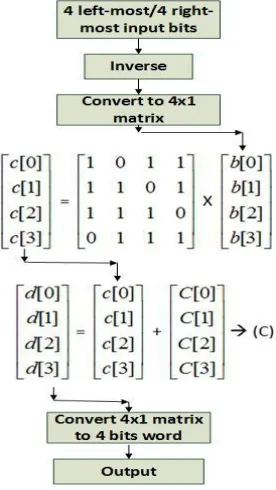
According to previous research observation, we have found out that S-Box and Mix Columns are the most energy consuming stages in encryption and decryption process. We have analyzed the S-Box generation process of the Rijndael AES. The 16x16 2-dimensional lookup table is formed through the multiplicative inverse phase and affine transformation phase in the original AES. We are proposing a new 1-dimensional lookup table as S-Box. It also follows the same generation process as the original one. However, substitution of one complete byte requires two times substitution from the S-Box. First four bits of the state byte is replaced first then the remaining four bits are substituted from the S-Box.
A. Rijndael S-Box Generation Method:
The Rijndael S-Box is a square matrix which is used in the Rijndael cipher. The S-Box serves as a lookup table. It is generated by determining the multiplicative inverse for a given number in GF(28) and then transforming the multiplicative inverse using affine transformation.
1) Multiplicative Inverse Phase: In multiplicative inverse phase, the input byte is inversed by substituting value from multiplicative inverse table.
2) Affine Transformation: Selection ofthe irreducible polynomial and the designated byte are the two most important factors of affine transformation phase. In Rijndael AES, x8 + x4 + x3 + x + 1 is used as the irreducible polynomial and as the constant column matrix 0x63 specially designated byte is chosen. Basically, the affine transformation consists of two operations. Firstly, 8x8 square matrix’s multiplication and secondly, 8x1 constant column matrix addition.
The following figure illustrates the generation process of Substitution Box (S-Box) of the original AES.
B.Modified AES S-Box Generation:
Our modified AES S-Box generation process follows the construction procedure of the original AES. The whole process differs only in the selection of the irreducible polynomial and specially designated byte.
Multiplicative Inverse Table: In theRijndael AES, all the arithmetic operations are performed over the Galois Field (28). In our work, the Galois Field (24) is considered. The
number of irreducible polynomials of degree 4 over GF(2) are x4 + x + 1, x4 + x3 + x2 + x + 1 and x4 + x3 + 1.
All the generated values of the multiplicative inverse table and substitution box depend on the selection of irreducible polynomial. For our experiment purpose, we choose x4 +x+ 1 as our irreducible polynomial but we can select any of the
irreducible polynomials which are mentioned above. Following the Extended Euclidean Algorithm, 1 dimensional multiplicative inverse table is formed.
The following table illustrates the multiplicative inverse table of the proposed algorithm.
Fig. Multiplicative inverse table
The following figure shows the generation process of proposed MAES.
Different S-Boxes and inverse S-Boxes for different values of the constant value C is given below : Fig. Case-1: When C = 0x03
Fig. . Case-3: When C = 0x0A
VI. PERFORMANCE ANALYSIS
A. Environment Setup:
To evaluate our experiment, we have gone through some environmental setup procedures. We have used telosB mote which is fully compatible with IEEE 802.15.4 standard and TinyOS 2.x. It has TI MSP430F1611 microcontroller and CC2420 RF chip. We implement MAES in nesC language which is supported in TinyOS 2.1.2. AA 1.5V batteries are used for the experiment. We integrate MAES in TelosB sensor motes then transmit the encrypted temperature data while the sensor motes are placed in two different locations. Then we run our experiment for a week and analyze the packet transmission rate, the energy consumption rate, and the latency of data transmission.
B. Implementation:
As we propose a lightweight version of AES for RCEs, first analyze the actual mechanism of AES and implement AES in structured programming language before implementing it in nesC. The same process is followed for the proposed MAES. After implementing both the algorithms (AES and MAES) in nesC, we integrate these in telosB sensor mote. Humidity, temperature, and luminance can be sensed by telosB sensor mote. Room temperature is used as our input set for both the algorithms. Our experimental approach construct in two phases. In the first phase, we implement the original AES in the telosB sensor mote and construct two sets of transmitted data packets. The first data set is based on transmitting encrypted data packets using the original AES encryption techniques and the second data set is composed of without encrypted data packets. In the second phase, we implement both the original AES and the proposed MAES in the telosB sensor mote.
C. Comparison:
MAES. Considering the average transmission time, the latency of proposed MAES is less than the original AES. .
Fig.Number of packets comparison between the modified and the original algorithm.
Fig.Number of packets comparison between the encrypted and the unencrypted data
APPLICATIONS:
It is used for confidentiality, authentication, data freshness, and data integrity might be extremely important.
It is used in Internet of Things (IoT), which is the next revolution of the internet which brings profound impact on our everyday lives.
The MAES algorithm gains wide application in our daily life, such as smart cards, cell phones, automated teller machines .
The M.O.S.T.(microprocessor operating system technology) Card C5 leverages the Advanced Encryption Standard (AES) for data encryption
The strongest encryption algorithm to date, so that our data will remain 100% confidential no matter where it is transmitted.
AES has typically been found on card operating systems that support public key infrastructure, but now users can get PKI security at the price of a symmetric key card.
VII. CONCLUSION & FUTURE WORK
In this paper, we present a modified version
of AES for Resource-Constraint Environments. A new Substitution Box is proposed which works over the Galois Field (24) by constructing an unique affine transformation equation. One notable feature of MAES is extending the battery life of low powered devices by consuming less amount of energy. The proposed method shows 18.35% efficiency when encrypted packets are transmitted using the proposed MAES to the sink node and the number of transmitted packets has increased. In addition, 29.983 milliseconds is found in terms of latency. In future, the security issue and space complexity will be considered to make the proposed modification more applicable. Also, we plan to investigate multipath routing scheme while transmitting the encrypted data to the sink node. We will further delve to integrate Public Key Cryptosystem, specially Elliptic-curve cryptography (ECC) to achieve comparable efficiency in terms of number of packet transmission and latency with better security.
VIII. ACKNOWLEDGMENT
Authors of this paper are extremely grateful to the anony-mous reviewers for their rigorous criticism about this work which help the authors to reorganize the work in excellence.
REFERENCES
[1] Madakam, Somayya, R. Ramaswamy, and Siddharth Tripathi. “Internet of Things (IoT): A literature review.” Journal of Computer and Commu-nications 3, no. 05 (2015): p.164
[2] Bogdanov, Andrey, et al. “PRESENT: An ultra-lightweight block cipher.”CHES. Vol. 4727. 2007.
[3] Wu, Wenling, and Lei Zhang.“LBlock: a lightweight block cipher.” In Applied Cryptography and Network Security, pp. 327-344. Springer Berlin/Heidelberg, 2011. [4] Al Hasib, Abdullah, and Abul Ahsan Md Mahmudul Haque. “A comparative study of the performance and security issues of AES and RSA cryptography.”Third International Conference on Convergence and Hybrid Information Technology, 2008. Vol.2.Wenceslao Jr, Felicisimo V., et al.“Modified AES Algorithm Us-ing Multiple S-Boxes.” The Second International Conference on Electrical, Electronics, Computer Engineering and their Applications (EECEA 2015) [5] https://www.sciencedirect.com/science/ article/pii/S2212017316304959.html
[7] https://www.sciencedirect.com/science/article/pii/S2212017316304959.html
[8] https://pdfs.semanticscholar.org/de9f/bdd099760bd82f8bd4d15b0b23a796e8120 7.pdf.html
[9] https://searchsecurity.techtarget.com/definition/encryption.html [10] https://digitalguardian.com/blog/what-data-encryption.com
[11] https://www.tldp.org/REF/INTRO/Secu ringData- INTRO/encryption.html.com [12] https://en.wikipedia.org/wiki/Advanced _EncryptionStandard.com
[13] https://medium.com/@pet3rpan/cryptog raphy-vs-encryption-1881606c400a.com
[14] https://www.springboard.com/blog/cryp tography-basics-the-ins-and-outs-of-encryption/.com
[15] http://www.cyber-rights.org/crypto/cryptog.html
[16] https://www.brighthub.com/computing/enterprisesecurity/articles/65254.aspx.com
[17] https://cheapsslsecurity.com/blog/explai ned-hashing-vs-encryption-vs-encoding/.html
[18] https://ipfs.io/ipfs/QmXoypizjW3WknF
iJnKLwHCnL72vedxjQkDDP1mXWo6 uco/wiki/Rijndael_S-box.html.com