HIGHLIGHTED ARTICLE
| INVESTIGATION
Boosting Gene Mapping Power and Ef
fi
ciency with
Ef
fi
cient Exact Variance Component Tests of Single
Nucleotide Polymorphism Sets
Jin J. Zhou,*,1Tao Hu,†,‡Dandi Qiao,§Michael H. Cho,**,††,‡‡and Hua Zhou§§
*Department of Epidemiology and Biostatistics, Mel and Enid Zuckerman College of Public Health, University of Arizona, Tucson, Arizona 85724,†Bioinformatics Research Center, and‡Department of Statistics, North Carolina State University, Raleigh, North Carolina 27695,§Department of Biostatistics, Harvard School of Public Health, Boston, Massachusetts 02115, **Channing Division of Network Medicine, and‡‡Division of Pulmonary and Critical Care Medicine, Department of Medicine, Brigham and Women’s Hospital, Boston, Massachusetts 02115,††Harvard Medical School, Boston, Massachusetts, and§§Department of Biostatistics, University of California, Los Angeles, California 90095 ORCID ID: 0000-0001-7983-0274 (J.J.Z.)
ABSTRACTSingle nucleotide polymorphism (SNP) set tests have been a powerful method in analyzing next-generation sequencing (NGS)
data. The popular sequence kernel association test (SKAT) method tests a set of variants as random effects in the linear mixed model setting. ItsP-value is calculated based on asymptotic theory that requires a large sample size. Therefore, it is known that SKAT is conservative and can lose power at small or moderate sample sizes. Given the current cost of sequencing technology, scales of NGS are still limited. In this report, we derive and implement computationally efficient, exact (nonasymptotic) score (eScore), likelihood ratio (eLRT), and restricted likelihood ratio (eRLRT) tests, EXACTVCTEST, that can achieve high power even when sample sizes are small. We perform simulation studies under various genetic scenarios. Our EXACTVCTEST(i.e., eScore, eLRT, eRLRT) exhibits well-controlled type I error. Under the alternative model, eScore
P-values are universally smaller than those from SKAT. eLRT and eRLRT demonstrate significantly higher power than eScore, SKAT, and SKAT optimal (SKAT-o) across all scenarios and various samples sizes. We applied these tests to an exome sequencing study. Ourfindings replicate previous results and shed light on rare variant effects within genes. The software package is implemented in the open source, high-performance technical computing language JULIA, and is freely available at https://github.com/Tao-Hu/VarianceComponentTest.jl. Analysis
of each trait in the exome sequencing data set with 399 individuals and 16;619 genes takes around 1 min on a desktop computer.
KEYWORDSSNP set tests; linear mixed effect model; exact tests; next-generation sequencing studies; small sample sizes
S
ingle nucleotide polymorphism (SNP) set analysis, also referred to as gene set, pathway, or region-based analysis, has been widely used in the genetic association analysis (Wang et al.2007, 2010). They examine groups of SNPs, each of which might contribute a small and individually undetectable effect to the phenotype. The hypothesis is that, when examined jointly, the combined effect of all the genes would rise to the detectable level. SNP sets are usually predefined according to slidingwin-dows, exons, or canonical pathways. Compared to SNP-level analysis, SNP set analysis has increased power because it re-duces multiple testing burden and aggregates weak signals. Besides its success in genome-wide association studies (GWAS) (Wanget al.2009; Psychiatric GWAS Consortium Bipolar Dis-order Working Group 2011; Chen and Gyllensten 2015), SNP set analysis plays a paramount role in analyzing rare variants in the next-generation sequencing (NGS) studies.
Burden tests are among thefirst SNP set analysis tools. Burden tests collapse rare variants in a genetic region into a single burden variable, and then regress the phenotype on the burden variable to test for the cumulative effects of rare variants in the set (Morgenthaler and Thilly 2007; Li and Leal 2008; Madsen and Browning 2009; Priceet al.2010). The sequence kernel associ-ation test (SKAT) is thefirst generalized linear mixed model-based method for testing the joint effect of a set of variants on Copyright © 2016 by the Genetics Society of America
doi: 10.1534/genetics.116.190454
Manuscript received April 15, 2016; accepted for publication September 7, 2016; published Early Online September 19, 2016.
Supplemental material is available online atwww.genetics.org/lookup/suppl/doi:10. 1534/genetics.116.190454/-/DC1.
1Corresponding author: Department of Epidemiology and Biostatistics, Mel and Enid
a quantitative/binary trait in an unrelated sample (Wu et al. 2011). It tests a SNP set as random effects using a quadratic form and uses a mixture of chi-squared distributions as its as-ymptotic null distribution. Compared to burden tests, a linear mixed model (LMM)-based method is more powerful when a genetic region has both protective and deleterious variants or many noncausal variants (Leeet al.2012). However, SKAT may still be underpowered at small sample sizes, as it uses an asymp-totic score test based on large sample theory. In this article we consider exact variance component tests that are applicable to genetic studies with small to moderate sample sizes.
Testing variance components in the LMM framework is challenging and has received considerable attention in the statistical literature (Chen and Dunson 2003; Kinney and Dunson 2007; Grevenet al.2008; Saville and Herring 2009; Drikvandiet al.2013; Quet al.2013). Although likelihood ratio test (LRT) and restricted likelihood ratio test (RLRT) are known to be more powerful than score tests in finite samples, they impose serious computational challenges to genome-wide studies, as the alternative model has to be fit for each SNP set and the calculation ofP-values is computationally expen-sive. Previous efforts in genetics studies include Zeng et al. (2014, 2015) and Zeng and Wang (2015).
In summary, our contributions in this work are fourfold. First, we develop the exact score (eScore) test that achieves higher power than SKAT at small sample sizes but maintains computational efficiency. Second, we examine the computa-tional bottleneck of the exact likelihood ratio test (eLRT) and the exact restricted likelihood ratio test (eRLRT) and design new algorithms that are scalable to genomic studies. Third, we investigate the power of three exact variance component tests under various genetic study scenarios and demonstrate that the exact variance component tests have proper type I error rates in small sample sequencing association studies, and that
eLRT and eRLRT significantly boost power in rare variant studies. Last, we develop and freely distribute a user-friendly software for genetic testing using the three exact variance component tests.
Methods
Notations and models
Supposeyis ann31 vector of quantitative phenotypes,Xis ann3pcovariate matrix (e.g., gender, smoking history, prin-cipal components,etc.),Gis ann3mgenotype matrix ofm genetic variants, and W is a prespecified diagonal weight matrix for genetic variants. We consider a standard LMM
y¼XbþGgþe;
g N0;s2
gW
; e N0;s2eIn
; (1)
wherebarefixed effects,gare random genetic effects, and
s2
gands2eare variance component parameters for the SNP set
and environmental effects respectively. Therefore, the phe-notype vectoryhas covariance
V¼s2
gSþs2eIn;
whereS¼GWG9is the kernel matrix capturing effects of the SNP set. The resulting log-likelihood function is
Lb;s2g;s2e¼ 2n
2lnð2pÞ2 1
2lndetðVÞ
21
2ðy2XbÞ9V
21ðy2XbÞ:
(2)
In the following sections, we present the test statistics for the three exact tests along with their null distributions and then outline the computational strategy to scale them to
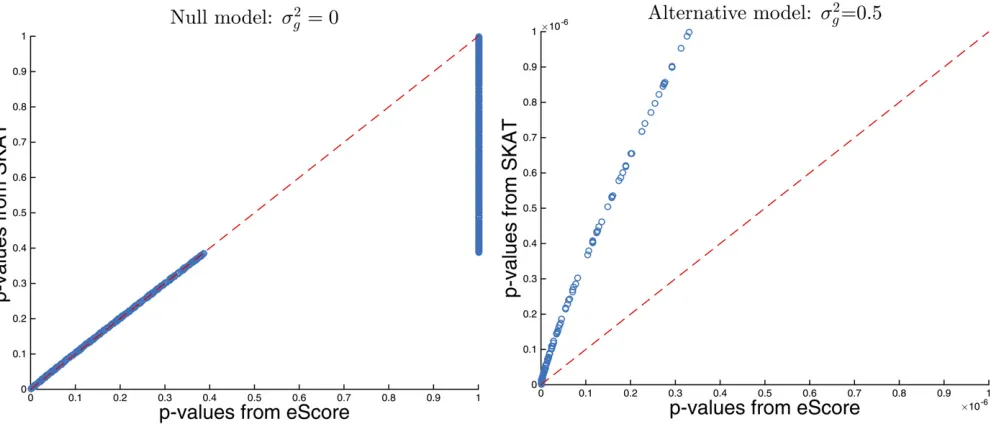
Figure 1 Discrepancy between SKAT and eScore P-values. Left: there is no SNP set effectðnull model; s2
g¼0Þ: Right: there is SNP set effect
ðalternative model; s2
g¼0:5Þ:
genome-wide studies. Detailed derivations are delegated to the Supplemental Material,File S1.
eScore
The classical score test statistic for testingH0:s2g¼0 (no SNP
set effect)vs. HA:s2g.0 takes the form
Sscore¼
J21 s2
g;s2g
@
@s2 gL
2 @
@s2
g
L.0
0 @
@s2
g
L#0 ; 8 > > > < > > > :
whereJis the Fisher information matrix relevant to variance components ðs2
g;s2eÞ and @@s2
gL is the score function, both
evaluated at the maximum likelihood estimate (MLE) under H0:File S1, section S.2, shows that
Sscore¼max ðy2X ^
bÞ9Sðy2Xb^Þ ðy2Xb^Þ9ðy2Xb^Þ;
trðSÞ n
( )
; (3)
whereb^¼ ðX9XÞ21X9yis the least squares estimate offixed effects and trðMÞrepresents the sum of diagonal entries of a square matrixM:The exact score test (eScore) rejects the null hypothesis whenSscoreis large.
Lets¼rankðXÞ;PX¼XðX9XÞ21X9be the projection ma-trix onto the column space CðXÞ; and fm1;. . .;mkg be the
strictly positive eigenvalues of ðIn2PXÞSðIn2PXÞ: Under the null hypothesiss2
g¼0;Sscoreis distributed as max
Pk i¼1mkw2i
Pn2s i¼1w2i
;trðSÞ
n
( )
;
wherew1;. . .;wn2sare independent standard normals. The
P-value of observedSScore¼tequals the tail probability
P
Pk i¼1mix21;i
Pn2s i¼1x21;i
$t
!
¼P X k
i¼1
ðmi2tÞx21;i2tx2n2s2k$0
!
;
wherex2
1;1;. . .;x21;k;x
2
n2s2k are independent chi-square
ran-dom variables. Therefore eScoreP-values can be calculated
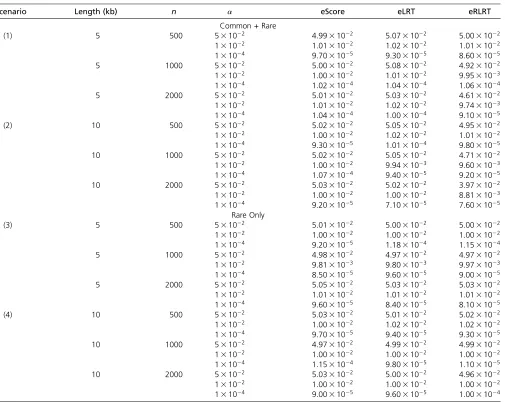
Table 1 Empirical type I error rate of eScore, eLRT, and eRLRT based on 106simulation replicates
Scenario Length (kb) n a eScore eLRT eRLRT
Common + Rare
(1) 5 500 531022 4:9931022 5:0731022 5:0031022
131022 1:0131022 1:0231022 1:0131022 131024 9:7031025 9:3031025 8:6031025 5 1000 531022 5:0031022 5:0831022 4:9231022 131022 1:0031022 1:0131022 9:9531023 131024 1:0231024 1:0431024 1:0631024 5 2000 531022 5:0131022 5:0331022 4:6131022 131022 1:0131022 1:0231022 9:7431023 131024 1:0431024 1:0031024 9:1031025
(2) 10 500 531022 5:0231022 5:0531022 4:9531022
131022 1:0031022 1:0231022 1:0131022 131024 9:3031025 1:0131024 9:8031025 10 1000 531022 5:0231022 5:0531022 4:7131022 131022 1:0031022 9:9431023 9:6031023 131024 1:0731024 9:4031025 9:2031025 10 2000 531022 5:0331022 5:0231022 3:9731022 131022 1:0031022 1:0031022 8:8131023 131024 9:2031025 7:1031025 7:6031025
Rare Only
(3) 5 500 531022 5:0131022 5:0031022 5:0031022
131022 1:0031022 1:0031022 1:0031022 131024 9:2031025 1:1831024 1:1531024 5 1000 531022 4:9831022 4:9731022 4:9731022 131022 9:8131023 9:8031023 9:9731023 131024 8:5031025 9:6031025 9:0031025 5 2000 531022 5:0531022 5:0331022 5:0331022 131022 1:0131022 1:0131022 1:0131022 131024 9:6031025 8:4031025 8:1031025
(4) 10 500 531022 5:0331022 5:0131022 5:0231022
131022 1:0031022 1:0231022 1:0231022 131024 9:7031025 9:4031025 9:3031025 10 1000 531022 4:9731022 4:9931022 4:9931022 131022 1:0031022 1:0031022 1:0031022 131024 1:1531024 9:8031025 1:1031025 10 2000 531022 5:0331022 5:0031022 4:9631022 131022 1:0031022 1:0031022 1:0031022 131024 9:0031025 9:6031025 1:0031024
using the same numerical methods SKAT uses to evaluate the tail probability of a mixture of independent chi-squares. Moreover, whenever the ratio of two quadratic forms in (3) is less than the threshold n21trðSÞ; it represents evidence against the alternative hypothesis and the correct P-value should be 1. This saves considerable computation as most test regions are not associated with the trait.
In contrast, SKAT employs the test statistic
SSKAT¼
ðy2Xb^Þ9Sðy2XbÞ ðy2Xb^Þ9ðy2Xb^Þ=ðn2sÞ¼
ðy2Xb^Þ9Sðy2Xb^Þ ^
s2
e
(4)
and calculates its P-value using the null distribution
Pk
i¼1mix21;iofs2e2ðy2Xb^Þ9Sðy2Xb^Þ:Under the null model,
^ s2
e converges to the true s2e as sample size n increases.
ThereforeSSKATis distributed as
Pk
i¼1mix21;ionly
asymptot-ically. Under the alternative modelðs2
g6¼0Þ;however,s^
2
eis
a biased estimator that tends to overestimate the trues2
e:
This bias potentially affects the power ofSSKAT:
eLRT and eRLRT
In this section wefirst review the eLRT and eRLRT for testing a single variance component proposed by Crainiceanu and Ruppert (2004), and then discuss the computational chal-lenges for applying them to sequencing studies. Section S.3 inFile S1gives self-contained derivation.
The LRT statistic for testingH0:s2g¼0vs. HA:s2g.0 is
SLRT¼2 sup
HA
Lb;s2g;s2e22 sup H0
Lb;s2g;s2e: (5)
Under the null models2
g¼0;SLRT has exact distribution
SLRT¼D sup l$0
nln
Xn2s i¼1w
2
i
Xk i¼1
w2
i 1þlmi
þXn2s
i¼kþ1w 2 i 8 > > > < > > > :
2Xl
i¼1
lnð1þljiÞ
)
; (6)
where w1;. . .;wn2s are independent standard normals,
j1;. . .;jℓ are the strictly positive eigenvalues of S; and
fm1;. . .;mkg are the strictly positive eigenvalues of
ðIn2PXÞSðIn2PXÞ:
The RLRT is based on the restricted/residual log-likelihood
RLs2g;s2e
¼ 2n2s
2 lnð2pÞ2 1 2lndet
Q9VQ
21
2y9Q
Q9VQ21Q9y;
(7)
whereI2PX¼QQ9:The RLRT statistic is
SRLRT¼2 sup
HA
RLs2g;s2e22 sup H0
RLs2g;s2e; (8)
which, under the null models2
g¼0;has exact distribution
SRLRT¼D sup l$0
ðn2sÞln
Xn2s i¼1w
2
i
Xk i¼1
w2i 1þlmi
þXn2s
i¼kþ1w 2 i 8 > > > < > > > : 2X k
i¼1
lnð1þlmiÞ
)
; (9)
where w1;...;wn2s are independent standard normals and
fm1;. . .;mkg are the strictly positive eigenvalues of
ðIn2PXÞSðIn2PXÞ:
Applying eLRT and eRLRT to NGS studies, which routinely test 103106 genes or SNP sets, incurs serious computa-tional challenges. First we need tofind the MLEðb^;s^2
g;s^
2
eÞ
or restricted maximum likelihood estimate (REML)ðs^2g;s^
2
eÞ
for each SNP set, which requires repeatedly invertingn3n matrices, an expensive operation when n is large. Second, computing the P-value of eLRT or eRLRT for each SNP set is nontrivial. Crainiceanu and Ruppert (2004) propose the straightforward way of simulating B points from the null distribution (6) or (9). That involves solving B univariate optimizations, whereBneeds to be at order of 106to obtain P-values at order of 1024with accuracy. This method is hard to scale to genomic scans with a large number of SNP sets.
Implementation
We attack thefirst computational challenges by an efficient and stable algorithm forfitting the alternative model that avoids repeatedly inverting matrices. We resolve the second challenge by using an accurate approximation that only requires simu-lating a small number of points from the null distributions.
Fast algorithm forfitting variance component model
This section describes an efficient algorithm for fitting the variance component Model 2 or restricted-likelihood Model 7. Let S¼Udiagðj1;. . .;jnÞU9be the eigen decomposition of
the SNP set variance matrix. Then
Table 2 Summary of testing regions (average over simulation replicates)
n Total variants Observed variants Rare variants (%)
Causal variants (10%, 30%)
Model I–III Model IV–VI
500 193 84 80.6 6.2 8.25
1000 193 111 84.3 9.27 10.33
2000 194 146 87.9 12.38 14.43
Lb;s2e;s2g¼ 2n
2lnð2pÞ2 1 2
Xn
i¼1
lns2e þs2gji
21
2ðy2X~bÞ9diagðwÞð~y2~XbÞ;
where y~¼U9y; X~¼U9X; and w¼ fðs2
eþs2gj1Þ2 1
;...;
ðs2
eþs2gjnÞ2
1g
Our strategy is to update the mean compo-nents b and variance components ðs2
e;s2gÞ alternately.
Updating b given ðs2
e;s2gÞ is a standard weighted
least-squares problem. To update ðs2
e;s2gÞgivenbð
tÞ;where the
superscripttis iteration number, we denote the residuals by rðtÞ¼~y2X~bðtÞ:The objective is then
21
2
Xn
i¼1
lns2e þs2gji
21
2
Xn
i¼1
rðitÞ2s2e þs2gji
21
;
which can be maximized by a minorization-maximization (MM) technique (Hunter and Lange 2000). The simple MM updates are
s2ðtþ1Þ
e ¼s2eðtÞ
ffiffiffiffiffiffiffiffiffiffiffiffiffiffiffiffiffiffiffiffiffiffiffiffiffiffiffiffiffiffiffiffiffiffiffiffiffiffiffiffiffiffiffiffiffiffiffiffiffiffiffiffiffiffiffiffiffiffiffi Xn
i¼1r
ðtÞ2
i
s2ðtÞ
e þjis2gðtÞ
22
Xn i¼1
s2ðtÞ
e þjis2gðtÞ
21 v u u u u t
s2ðtþ1Þ
g ¼s2gðtÞ
ffiffiffiffiffiffiffiffiffiffiffiffiffiffiffiffiffiffiffiffiffiffiffiffiffiffiffiffiffiffiffiffiffiffiffiffiffiffiffiffiffiffiffiffiffiffiffiffiffiffiffiffiffiffiffiffiffiffiffiffiffiffi Xn
i¼1jir
ðtÞ2
i
s2ðtÞ
e þjis
2ðtÞ
g
22
Xn i¼1ji
s2ðtÞ
e þjis2gðtÞ
21 v u u u u t : (10)
See section S.4 inFile S1for the derivation of the MM up-dates. This algorithm avoids repeatedly invertingn3n ma-trices as only one eigen decomposition is required. Each iteration only involves solving a weighted least squares prob-lem andOðnÞoperations for updating variance components. This algorithm is numerical stable as each update ofband
ðs2
g;s
2
eÞalways increases the log-likelihood value.
For eRLRT, we need tofind the REML for each SNP set. Let B2ℝn3ðn2sÞ be an orthonormal basis of CðXÞt; e.g., obtained from the singular value decomposition ofX:Then B9Yis multivariate normal with mean0n2sand covariance
B9VB¼s2
eB9Bþs2gB9SB¼s2eIn2sþs2gB9SB:
Let the eigen decomposition of the covariance matrixB9SBbe
B9V1B¼Gdiagðj1;. . .;jn2sÞG9:
Then the transformed data Y~¼G9B9Y has independent components
~
Y N0n2s;s2eIn2sþs2gdiagðj1;. . .;jn2sÞ
and the restricted log-likelihood function (7) becomes
2n2s
2 lnð2pÞ2 1 2
Xn2s
i¼1
lns2e þs2gji
21
2
X
n2s
i¼1 ~ y2i
s2
e þs2gji
21
:
It becomes clear that the MM updates (10) remain unchanged forfinding REML except replacingriby~yiandnbyn2s:
Approximating null distributions of eLRT and eRLRT
Calculation of eLRT and eRLRT P-values relies on drawing samples from the theoretical null distributions (6) and (9). Typical genome scans test 103105 SNP sets. An exome-wide significantP-value at a level of 1026 requires drawing about 107 samples from the null distribution and each of them requires solving a univariate optimization problem. Hence theP-value calculation for eLRT and eRLRT is compu-tationally intensive. We propose an approximation scheme that only requires drawing a small number of samples for each SNP set and thus is highly scalable to genomic scans.
We approximate the exact null distributions (6) and (9) by a mixture distribution of formp0x20:ð12p0Þax2b;where the
point mass p0 at 0, scale parameter a, and the degree of freedombfor the chi-squared distribution need to be deter-mined for each SNP set. We illustrate with eLRT. Denote the expression to be maximized in (6) byfðlÞ:The point mass of the null distribution at 0 is well approximated by the proba-bility offðlÞhaving a local maximum at 0
Probf9ðlÞ#0¼Prob
Xk i¼1miw
2
i
Xn2s i¼1w
2
i
#1 n
Xℓ
i¼1 ji ! ¼Prob 0 B B @ Xk
i¼1
0 B B
@mi2n21
Xℓ
i9¼1 ji9
1 C C A
x2
i 2 n21
Xℓ
i9¼1 ji9
!
x2
n2s2k#0
1 C C A:
Thereforep0 is calculated by either numerically evaluating the cumulative distribution function of the mixture of chi-square distribution at 0 or by the simple Monte Carlo method. To approximate the continuous partax2
bof null distribution,
we simulate a small number (300 by default) of SLRT by numerically maximizing fðlÞusing the Newton–Raphson method, and then estimate parametersaandbby matching thefirst two sample moments to those ofax2
b:This
approxi-mation scheme is well known as the Satterthwaite method in statistics (Satterthwaite 1941), which has been used
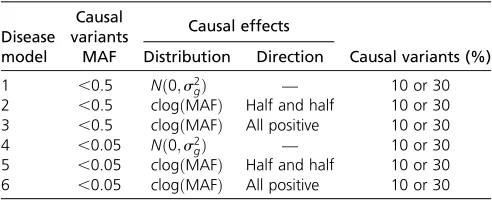
Table 3 Models for simulating phenotypes based on a 10-kb region
Disease model
Causal
variants Causal effects
Causal variants (%)
MAF Distribution Direction
1 ,0.5 Nð0;s2
gÞ — 10 or 30
2 ,0.5 clogðMAFÞ Half and half 10 or 30 3 ,0.5 clogðMAFÞ All positive 10 or 30 4 ,0.05 Nð0;s2
gÞ — 10 or 30
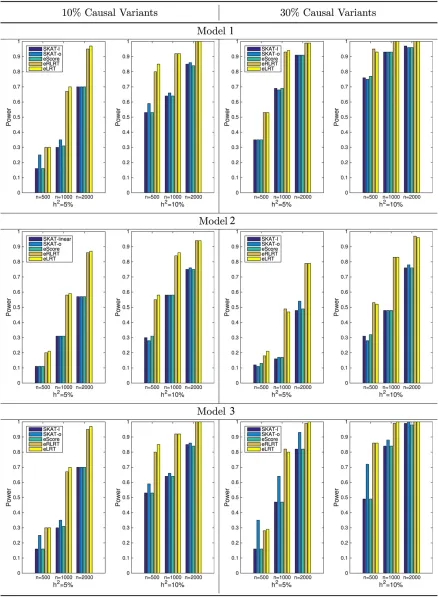
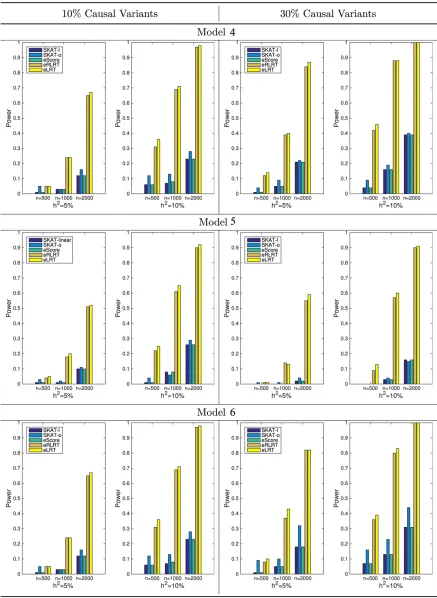
Figure 2 Power comparison when causal variants are both common and rare (Models 1–3). Left panel shows the power when 10% of the variants in the testing region are causal; right panel shows the power when 30% of the variants in the testing region are causal. Heritability is fixed at both 5 and 10%.
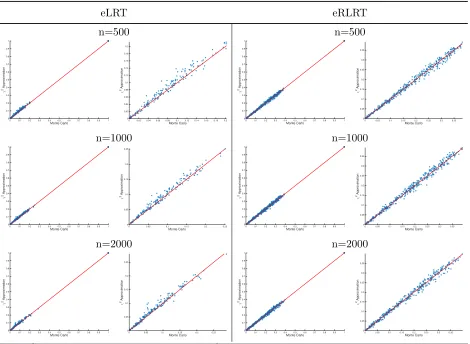
successfully to approximate the null distributions of many test statistics. The performance of our approximation is in-cluded in the section S.5 inFile S1, which indicates that our approximation method works well for generating P-values and reducing computational burden.
Data availability
Simulated data sets are generated using computing language JULIAand are available upon request. COPDGene exome
se-quencing study (http://www.copdgene.org/) is part of the National Heart, Lung, and Blood Institute (NHLBI) Grand Opportunity Exome Sequencing Project (GO-ESP) and has been deposited to database of Genotypes and Phenotypes (dbGaP) (study accession: phs000296.v3.p2).
Results
Wefirst illustrate the subtle differences between SKAT and eScore for the motivation of exact tests. We then conduct a comprehensive simulation study to illustrate the control of type I error rate and the power under various conditions of genetic association. These simulations were designed to eval-uate two primary questions: (1) What is the relative perfor-mance and what are the advantages of using LRT based tests, especially when the causal variants are rare? (2) Can our method still have advantages even when genetic association are not under model assumptions?
Simulation studies
Differences between SKAT and eScore are demonstrated using simulations. Genotypes of n¼200 samples are formed by randomly pairing 400 haplotypes drawn from the haplotype pool distributed with the SKAT software (Wuet al.2011). We used thefirst 5 kb as the test region, which contains 61 monomorphic loci, 20 rare variants with MAF (minor allele frequency) ,0.05 (13 with MAFs
,0:01), and 12 common SNPs. 1000 replicates ofy are generated under the null ðs2
g¼0Þ and alternative model
ðs2
g¼0:5Þ; respectively. Under the alternative
hypothe-ses, causal variants are chosen using criterion MAF
,0:05:For simplicity no covariates are included. Figure 1 displays the discrepancy ofP-values between eScore and SKAT. Under the null model (left panel), SKAT P-values roughly match those from eScore, except 73.1% of the eScore tests haveP-values equal to 1. This reflects the fact that s^2e is a fairly accurate estimate ofs2e under the null
model. Under the alternative model (right panel), how-ever, s^2e is a biased estimate and the SKAT P-values are
systematically larger than those from eScore, especially in the region of small P-values. This can lead to loss of power by SKAT in genome scans where a stringentP-value threshold is necessary to correct multiple testing. The dif-ference is more dramatic at smaller sample sizes or stron-ger effect sizes2
g:
For both type I error and power simulation studies, we use the haplotype pool that comes with the SKAT software
(Wuet al.2011) to generate genotypes of study samples. That is, for each simulation replicate, we pair 2n ran-domly drawn haplotypes to form the genotypes of a sample of n subjects. To assess empirical type I error of eScore, eLRT, and eRLRT, we consider combinations of following factors:
1. test region:first 5 or 10 kb,
2. samples sizen: 500, 1000, or 2000, and 3. significance levela: 0.05, 0.01, or 0.0001.
The average number of variants are 97 and 193 for 5- and 10-kb regions, respectively. We evaluate type I error when both common and rare variants are included in the region as well as when only rare variants (MAF,5%) are included in the region. We generate 106 replicates for each simulation scenario. For each replicate, wefirst simulate four continuous covariates from independent standard normals, one binary covariate from Bernoulli(0.5), and then generate phenotypes from Model 1 with b¼1; s2
g¼0; and s2e ¼1: Results in
Table 1 show that the three exact tests control type I error at allalevels.
For power comparisons, we take the first 10 kb of the haplotype pool as the test region. Over simulation replicates, testing regions include around 193 variants and 80–150 ob-served variants on average (Table 2). Average proportion of rare variants (MAF ,0.05) are 80.8, 84.3, and 87.9% for sample sizes of 500, 1000, and 2000, respectively. The num-ber of causal variants for different models are also shown in Table 2. This is among the settings where we have evaluated protected type I error. Covariates are generated in the same manner as in the last section and we setfixed effects atb¼1: For Models 1 and 4, causal effectsgfollow a normal distri-butionNð0;s2
gIÞ:Models 2, 3, 5, and 6 mimic the simulation
schemes in Wuet al.(2010), where the magnitude of causal effectsgis determined bycjlogðMAFÞj;so that rarer variants have larger effects. In Wuet al.’s (2010) article,cwas set up as 0.4 and in Leeet al.’s (2014) articlecwas set as 0.14, which provides 80% power at levela,1028when the sample size is 50,000. In our simulations, we chose s2
g and c by fixing
heritabilityh2;whereh2¼VarðGgÞ=VarðYÞ;so that power is in the comparable ranges for most of methods given sample sizes. Environmental variances2
e wasfixed at 1. For Models
1 and 4, we choses2
gto be,
s2
g¼
h2 12h2:
Table 4 The number of gene sets that pass genome-wide significant level at FWER 0.05 from the COPDGene exome sequencing study
eScore eRLRT eLRT SKAT SKAT-o
Height 5 8 15 4 3
PackYears 0 0 0 0 0
BMI 0 0 0 0 0
For eScore, eRLRT, eLRT, and SKAT, linear kernel and no weights are adopted.
Similarly,cwas chosen according to the formula
c¼
ffiffiffiffiffiffiffiffiffiffiffiffiffiffiffiffiffiffiffiffiffiffiffiffiffiffiffiffiffiffiffiffiffiffiffiffiffiffiffiffiffiffiffiffiffiffiffiffiffiffiffiffi
h2
12h2
1
VarðGjlogðMAFÞjÞ
s
:
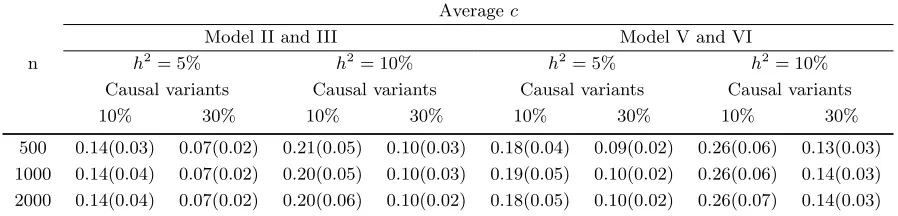
As a comparison we list the mean and standard deviation of our simulatedcover simulation replicated inFile S1(Table S1). It is shown that ourcis smaller compared to Wuet al.(2010) and Leeet al.(2014), which indicates smaller heritability explained by testing regions. We consider the following simulation factors to evaluate power and label them as Models 1–6 in Table 3:
1. sample sizen: 500, 1000, or 2000, 2. heritabilityh2:5 or 10%,
3. MAF of causal variants: common and rare (MAF,0.5) or rare only (MAF,0.05),
4. percentage of causal variants: 10 or 30%, 5. distribution of causal effects:Nð0;s2
gÞorcjlogðMAFÞj;
6. direction of causal effects: half positive and half negative or all positive.
Significant level a is 1024: We simulate 1000 repli-cates for each scenario. Therefore the largest Monte Carlo standard error for power estimate is controlled belowffiffiffiffiffiffiffiffiffiffiffiffiffiffiffiffiffiffiffiffiffiffiffiffiffiffiffiffiffiffiffiffiffiffiffiffiffiffiffiffiffiffiffiffi
0:53ð120:5Þ=1000
p
0:016:
For simplicity, in both simulation and real data analysis, SNP weights are not incorporated and the linear kernel is adopted for both exact tests and SKAT. SKAT optimal (SKAT-o)
uses the default setting in Lee et al. (2012). Note all exact tests can incorporate variant weights or other kernels just as in SKAT or SKAT-o.
Figure 2 displays the results for Models 1, 2, and 3 (common and rare causal variants) and Figure 3 for Models 4, 5, and 6 (rare causal variants only). Left panels of both figures are the results when 10% of the variants in the region are causal, while the right panels show powers when 30% of variants are causal. It is clear that (1) performance of score tests (SKAT and eScore) are comparable in these scenarios; (2) eLRT and eRLRT significantly boosts power over score tests across all scenarios, especially when causal variants are rare only or sample size is small; and (3) when the causal variants are both common and rare, the SKAT-o method can increase power extensively pared with SKAT method with linear kernel. Its power is com-parable to eLRT and eRLRT (Figure 2).
COPDGene exome sequencing study
We further illustrate our methods using the COPDGene exome sequencing study (http://www.copdgene.org/). It is part of
Table 5 Top genes from the COPDGene exome sequencing study usingfive different methods
Gene eScore eRLRT eLRT SKAT SKAT-o Position Chr SetSize
Height**
ANKRD39 5:4731026 8:7731026 1:51310-6
7:4231026 1:4231025 97,521,896 2 2 ATP5D 1:17310-6 1:58310-6 5:19310-7 1:89310-6 4:7431026 1,243,764 19 3 BHMT2 3:6031026 2:5531025 1:92310-6
4:8031026 2:48310-6
78,379,543 5 2
CDC16 8:5031027 2:86310-7
3:45310-7 1:19310-6 1:19310-6 115,028,428 13 1 DOLPP1 5:0831026 8:1931026 1:39310-6
6:9231026 1:2731025 131,848,186 9 2 EVX2 2:4431024 5:3231026 9:53310-6
2:7131024 7:2531025 176,948,416 2 2 FAM204A 8:50310-7 2:86310-7 3:45310-7 1:19310-6 1:19310-6 120,095,908 10 1 FASLG 2:2031025 2:0931025 2:34310-6 2:9231025 6:4831025 172,628,477 1 3 IFNGR1 2:51310-6 2:01310-6 9:91310-7 3:7631026 5:4831026 137,521,195 6 3 KRTAP13-1 1:8331023 2:33310-6 4:5031026 1:9431023 1:6431023 31,768,732 21 4 MN1 9:3331024 2:97310-7 5:57310-7 1:0031023 6:0831024 28,194,819 22 5 NDRG4 3:8431026 7:0931026 1:19310-6 5:3131026 1:0231025 58,529,726 16 2 PLD6 5:3331026 1:6231025 1:52310-6 7:2431026 1:4031025 17,107,768 17 2 RAPH1 1:6931026 5:5231026 6:3231026 2:36310-6 3:2631026 20,432,4540 2 3 TTC1 5:6831026 1:53310-7 7:89310-8 7:5531026 7:7631026 15,947,3903 5 3 ZER1 1:7931024 7:3431026 2:13310-6 2:1131024 1:3431024 131,512,382 9 5 ZNF513 2:16310-6 1:48310-6 4:45310-7 3:7131026 1:0631025 27,601,136 2 7 PackYears*
SIN3A 9:6531024 1:3331025 3:6031025 1:0831023 1:5131023 75,693,827 15 5 BMI*
ADAMTS7 0.10 8:6131024 7:4031024 0.10 7:2331025 79,073,876 15 21 ADRA2A 2:2631024 2:9231024 9:3431025 2:8931024 5:0531024 112,838,638 10 2 APOLD1 9:8231026 1:7831025 1:9831025 1:7331025 1:5731025 12,909,721 12 4 HEPH 5:3031022 3:8831024 2:2531024 6:5731022 6:4631025 65,434,485 23 11 SNAPC5 2:6331025 2:1031024 6:2031025 3:0631025 3:3631025 66,788,877 15 3
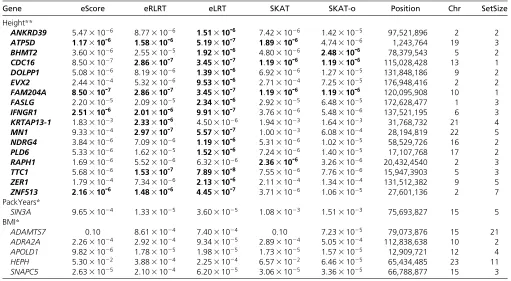
Genes that pass Bonferroni corrected genome-wide significance level of 331026are in boldface font. Position is the base pair position in the middle of the gene. Chr,
chromosome of the test region; SetSize, the number of SNPs in the test region.**P,331026,*P,1024.
Table 6 Runtimes (in seconds) of different methods
Trait SKAT SKAT-o eScore eLRT eRLRT
eight 61.6 4004.1 53.5 64.8 31.9
PackYears 61.2 4041.3 50.3 56.9 28.4
NHLBI GO-ESP project (dbGaP study accession: phs000296. v3.p2). After quality control, 399 individuals remain for the analysis (Qiaoet al.2016). We analyze 16;619 genes along the genome and apply different testing methods to three phenotypes: height, cigarette packages per year (PackYears), and body mass index (BMI). Table S2inFile S1 tabulates their descriptive statistics.
For all three phenotypes, we adjust population substruc-ture using the top three eigenvectors generated by the Eigen-strat software (Price et al. 2006), age, and gender. For PackYears, we additionally adjust for current smoking status. Table 4 shows the numbers of gene sets that pass Bonferroni-adjusted exome-wide significance level 331026: Table 5 contains detailed information of gene sets that pass exome-wide significance level for height. It also lists gene sets with P-value ,1024for trait PackYears and BMI for the purpose of side-by-side comparison ofP-values, as none of the gene sets pass the exome-wide significant level.
We make following observations: (1) For the complex trait height, eLRT and eRLRT identify 8 and 15 genes that pass the Bonferroni-adjusted, genome-wide significant level and eScore identifies 5. In contrast, SKAT and SKAT-o only identify four and three respectively. (2) For the other two traits, no genes pass Bonferroni-adjusted genome-wide significance level in all tests. (3) eScoreP-values are universally smaller than SKAT. This agrees with the simulation results in Figure 1 that the asymptotic test by SKAT can lose power at small samples size and strong signals. (4) The optimal kernel in SKAT-o does not show advantage over SKAT with linear ker-nel and no weight in this analysis (Figure S1).
Computational efficiency of ExactVC
We compare the computational time of different methods. Table 6 records the run times of each method on a desktop with i7-3770 central processing unit of 3.40 GHz and 16 GB RAM. For each trait, exact tests (eScore and eRLRT) complete the analysis in ,1 min, while eLRT uses around a minute. SKAT takes slightly longer than eScore, while SKAT-o takes significantly longer than all of the tests. Note that although LRT and RLRT is considered more computationally intensive compared to the score test, Table 6 shows that the speed of our eLRT test is comparable to eScore and SKAT tests, while eRLRT is even faster.
Discussion
In this report we study and implement computationally effi -cient exact variance component tests (eScore, eLRT, and eRLRT) for testing SNP sets in sequencing studies. Simulation study and real data analysis show that (1) all exact tests control type I error, (2) eScore yields smallerP-values than SKAT at small sample size and strong signal, and (3) eLRT and eRLRT significantly boost power over eScore, SKAT, and SKAT-o, especially when sample size is small or there are plenty of rare variants. By supplying a fast and easy-to-use software package, we hope to boost the power and efficiency
of gene mapping based on current NGS technology. Although the derivation of eLRT and eRLRT require normal assumption of genetic effects within a region, we evaluate the
misspeci-fied distribution and how that will affect power. In all scenar-ios, even without normal assumption, our methods show superior power compared with competing methods. The soft-ware package, EXACTVCTEST, is implemented in the open source, high-performance technical computing language JULIAand is freely available athttps://github.com/Tao-Hu/
VarianceComponentTest.jl.
There are a few directions for future work. One advantage of the asymptotic test by SKAT is that it does not depend on the normality assumption and equally applies to association test-ing of binary traits (Wuet al.2011; Leeet al.2012), while the exact tests depend on the normality assumption. Fortunately many quantitative traits satisfies the normality assumption after suitable transformations. Development of LRT and RLRT for binary trait remains a challenge. Another statistical challenge is to develop LRT or RLRT for testing SNP set in related samples. An asymptotic score test has been developed by Chenet al.(2013). Rigorous testing of multiple variance components still remains a statistical challenge (Crainiceanu 2008; Drikvandiet al.2013).
Acknowledgments
COPDGene study is supported by National Institutes of Health R01 HL-089856 and R01 HL-089897. The whole exome sequencing was supported by the National Heart, Lung, and Blood Institute Exome Sequencing Project. J.J.Z. is supported by National Institutes of Health grant K01 DK-106116, M.H.C. is supported by National Institutes of Health grant R01 HL-113264. H.Z. is partially supported by National Institutes of Health grants HG-006139, GM-105785, GM-53275, and National Science Foundation grant DMS-1055210. Full list of chronic obstructive pulmonary disease investigators unit core and clinical centers are included in theFile S1.
Literature Cited
Chen, D., and U. Gyllensten, 2015 Lessons and implications from
association studies and post-gwas analyses of cervical cancer. Trends Genet. 31: 41–54.
Chen, H., J. B. Meigs, and J. Dupuis, 2013 Sequence kernel
asso-ciation test for quantitative traits in family samples. Genet. Epi-demiol. 37: 196–204.
Chen, Z., and D. B. Dunson, 2003 Random effects selection in
linear mixed models. Biometrics 59: 762–769.
Crainiceanu, C. M., 2008 Likelihood ratio testing for zero variance components in linear mixed models, pp. 3–17 inRandom Effect and Latent Variable Model Selection, Vol. 192, edited by D. B. Dunson. Springer, New York.
Crainiceanu, C. M., and D. Ruppert, 2004 Likelihood ratio tests in linear mixed models with one variance component. J. R. Stat. Soc. Series B Stat. Methodol. 66: 165–185.
Drikvandi, R., G. Verbeke, A. Khodadadi, and V. P. Nia, 2013 Testing multiple variance components in linear mixed-effects models. Biostatistics 14: 144–159.
Greven, S., C. M. Crainiceanu, H. Küchenhoff, and A. Peters, 2008 Restricted likelihood ratio testing for zero variance com-ponents in linear mixed models. J. Comput. Graph. Stat. 17: 870–891.
Hunter, D. R., and K. Lange, 2000 Quantile regression via an MM
algorithm. J. Comput. Graph. Stat. 9: 60–77.
Kinney, S. K., and D. B. Dunson, 2007 Fixed and random effects
selection in linear and logistic models. Biometrics 63: 690–698. Lee, S., M. J. Emond, M. J. Bamshad, K. C. Barnes, M. J. Riederet al., 2012 Optimal unified approach for rare-variant association test-ing with application to small-sample case-control whole-exome sequencing studies. Am. J. Hum. Genet. 91: 224–237.
Lee, S., G. R. Abecasis, M. Boehnke, and X. Lin, 2014 Rare-variant association analysis: study designs and statistical tests. Am. J. Hum. Genet. 95: 5–23.
Li, B., and S. M. Leal, 2008 Methods for detecting associations
with rare variants for common diseases: application to analysis of sequence data. Am. J. Hum. Genet. 83: 311–321.
Madsen, B. E., and S. R. Browning, 2009 A groupwise association
test for rare mutations using a weighted sum statistic. PLoS Genet. 5: e1000384.
Morgenthaler, S., and W. G. Thilly, 2007 A strategy to discover
genes that carry multi-allelic or mono-allelic risk for common diseases: a cohort allelic sums test (cast). Mutat. Res. Fundam.
Mol. Mech. Mutagen. 615: 28–56.
Price, A. L., N. J. Patterson, R. M. Plenge, M. E. Weinblatt, N. A. Shadicket al., 2006 Principal components analysis corrects for stratification in genome-wide association studies. Nat. Genet. 38: 904–909.
Price, A. L., G. V. Kryukov, P. I. de Bakker, S. M. Purcell, J. Staples et al., 2010 Pooled association tests for rare variants in exon-resequencing studies. Am. J. Hum. Genet. 86: 832–838. Psychiatric GWAS Consortium Bipolar Disorder Working Group,
2011 Large-scale genome-wide association analysis of bipolar
disorder identifies a new susceptibility locus near ODZ4. Nat. Genet. 43: 977–983.
Qiao, D., C. Lange, T. H. Beaty, J. D. Crapo, K. C. Barnes et al.,
2016 Exome sequencing analysis in severe, early-onset chronic
obstructive pulmonary disease. Am. J. Respir. Crit. Care Med. 193: 1353–1363.
Qu, L., T. Guennel, and S. L. Marshall, 2013 Linear score tests for variance components in linear mixed models and applications to genetic association studies. Biometrics 69: 883–892.
Satterthwaite, F. E., 1941 Synthesis of variance. Psychometrika 6: 309–316.
Saville, B. R., and A. H. Herring, 2009 Testing random effects in the linear mixed model using approximate bayes factors. Bio-metrics 65: 369–376.
Wang, K., M. Li, and M. Bucan, 2007 Pathway-based approaches
for analysis of genomewide association studies. Am. J. Hum. Genet. 81: 1278–1283.
Wang, K., M. Li, and H. Hakonarson, 2010 Analysing biological
pathways in genome-wide association studies. Nat. Rev. Genet. 11: 843–854.
Wang, K., H. Zhang, S. Kugathasan, V. Annese, J. P. Bradfieldet al.,
2009 Diverse genome-wide association studies associate the
il12/il23 pathway with crohn disease. Am. J. Hum. Genet. 84: 399–405.
Wu, M. C., P. Kraft, M. P. Epstein, D. M. Taylor, S. J. Chanocket al.,
2010 Powerful SNP-set analysis for case-control genome-wide
association studies. Am. J. Hum. Genet. 86: 929–942.
Wu, M. C., S. Lee, T. Cai, Y. Li, M. Boehnke et al., 2011
Rare-variant association testing for sequencing data with the se-quence kernel association test. Am. J. Hum. Genet. 1: 82–93. Zeng, P., and T. Wang, 2015 Bootstrap restricted likelihood ratio
test for the detection of rare variants. Curr. Genomics 16: 194– 202.
Zeng, P., Y. Zhao, J. Liu, L. Liu, L. Zhanget al., 2014 Likelihood ratio tests in rare variant detection for continuous phenotypes.
Ann. Hum. Genet. 78: 320–332.
Zeng, P., Y. Zhao, H. Li, T. Wang, and F. Chen, 2015 Permutation-based variance component test in generalized linear mixed model with application to multilocus genetic association study. BMC Med. Res. Methodol. 15: 37.
eLRT
eRLRT
n=500
n=500
Monte Carlo
0 0.1 0.2 0.3 0.4 0.5 0.6 0.7 0.8 0.9 1
χ
2 Approximation
0 0.1 0.2 0.3 0.4 0.5 0.6 0.7 0.8 0.9 1 Monte Carlo
0 0.02 0.04 0.06 0.08 0.1 0.12 0.14 0.16 0.18 0.2
χ
2 Approximation
0 0.02 0.04 0.06 0.08 0.1 0.12 0.14 0.16 0.18 0.2 Monte Carlo
0 0.1 0.2 0.3 0.4 0.5 0.6 0.7 0.8 0.9 1
χ
2 Approximation
0 0.1 0.2 0.3 0.4 0.5 0.6 0.7 0.8 0.9 1 Monte Carlo 0 0.05 0.1 0.15 0.2 0.25 0.3 0.35
χ
2 Approximation
0 0.05 0.1 0.15 0.2 0.25 0.3 0.35
n=1000
n=1000
Monte Carlo0 0.1 0.2 0.3 0.4 0.5 0.6 0.7 0.8 0.9 1
χ
2 Approximation
0 0.1 0.2 0.3 0.4 0.5 0.6 0.7 0.8 0.9 1 Monte Carlo
0 0.05 0.1 0.15 0.2 0.25
χ
2 Approximation
0 0.05 0.1 0.15 0.2 0.25 Monte Carlo
0 0.1 0.2 0.3 0.4 0.5 0.6 0.7 0.8 0.9 1
χ
2 Approximation
0 0.1 0.2 0.3 0.4 0.5 0.6 0.7 0.8 0.9 1 Monte Carlo 0 0.05 0.1 0.15 0.2 0.25 0.3 0.35
χ
2 Approximation
0 0.05 0.1 0.15 0.2 0.25 0.3 0.35
n=2000
n=2000
Monte Carlo0 0.1 0.2 0.3 0.4 0.5 0.6 0.7 0.8 0.9 1
χ
2 Approximation
0 0.1 0.2 0.3 0.4 0.5 0.6 0.7 0.8 0.9 1 Monte Carlo 0 0.05 0.1 0.15 0.2 0.25
χ
2 Approximation
0 0.05 0.1 0.15 0.2 0.25 Monte Carlo
0 0.1 0.2 0.3 0.4 0.5 0.6 0.7 0.8 0.9 1
χ
2 Approximation
0 0.1 0.2 0.3 0.4 0.5 0.6 0.7 0.8 0.9 1 Monte Carlo 0 0.05 0.1 0.15 0.2 0.25 0.3 0.35
χ
2 Approximation
0 0.05 0.1 0.15 0.2 0.25 0.3 0.35
Figure S1:
Pvalues comparisons with and without 2 approximation for sample size 500, 1000, and 2000. Pvaluesfrom eLRT tests are shown in columns one and two, while pvalues from eRLRT are shown in columns three and four. Second and forth columns are the zoom-in plots when pvalues are less than one. 1000 simulation replicates are included. Phenotypes are simulated under the null hypothesis and 10kb testing region is used for evaluation (e.g., scenario (2) in Table 3 of the manuscript). Red line represents the line with slope 1 and intercept 0.
n
Averagec
Model II and III Model V and VI
h2= 5% h2= 10% h2= 5% h2= 10%
Causal variants Causal variants Causal variants Causal variants
10% 30% 10% 30% 10% 30% 10% 30%
500 0.14(0.03) 0.07(0.02) 0.21(0.05) 0.10(0.03) 0.18(0.04) 0.09(0.02) 0.26(0.06) 0.13(0.03) 1000 0.14(0.04) 0.07(0.02) 0.20(0.05) 0.10(0.03) 0.19(0.05) 0.10(0.02) 0.26(0.06) 0.14(0.03) 2000 0.14(0.04) 0.07(0.02) 0.20(0.06) 0.10(0.02) 0.18(0.05) 0.10(0.02) 0.26(0.07) 0.14(0.03)
Trait
Mean
SD
n
Height
(cm)
168.59
9.59
399
PackYears
50.05
19.73
399
BMI
26.92
5.04
399
Table S2: Descriptive statistics of 3 phenotypes in COPDGene exome sequencing study.
Supplemental Materials for
“ExactVC: Efficient Exact Variance Component Tests of SNP Sets”
Jin J. Zhou
1, Tao Hu
2,3, Dandi Qiao
4, Michael H. Cho
5,6,7, Hua Zhou
81
Division of Epidemiology and Biostatistics
Mel and Enid Zuckerman College of Public Health
University of Arizona
Tucson, AZ 85724
2
Bioinformatics Research Center
North Carolina State University
Raleigh, NC 27695
3
Department of Statistics
North Carolina State University
Raleigh, NC 27695
4
Department of Biostatistics
Harvard School of Public Health
5
Channing Division of Network Medicine
Department of Medicine
Brigham and Women’s Hospital
6
Harvard Medical School
7
Division of Pulmonary and Critical Care Medicine
Department of Medicine
Brigham and Women?s Hospital
Boston, MA 02115
8
Department of Biostatistics
University of California, Los Angeles
Corresponding author:
Jin Zhou
Division of Epidemiology and Biostatistics
Mel and Enid Zuckerman College of Public Health
University of Arizona, Tucson, AZ 85724
Phone: (520) 626-1393
Email: [email protected]
S.1
Model and notations
Suppose
y
is a
n
×
1 vector of quantitative phenotype,
X
is an
n
×
p
covariate matrix (e.g., grand
mean, sex, smoking history, height, principal components, etc),
β
is a
p
×
1 vector of fixed effects,
G
is an
n
×
m
genotype matrix for
m
genetic variants,
γ
is their effects and follows an normal
distribution with variance
σ
g2W
.
W
is the prespecified diagonal weight matrix for the rare variants
of size
m
×
m
.
ε
is the usual normal distributed random errors with mean zero and covariance
σ
e2I
n. We consider a standard linear mixed model
y
=
Xβ
+
Gγ
+
ε
,
γ
∼
N
(
0
m, σ
g2W
), and
ε
∼
N
(
0
n, σ
e2I
n) where
σ
2gand
σ
2eare corresponding variance component parameters for the SNP
set and environmental effects. Therefore, Var(
y
) =
V
=
σ
2gS
+
σ
e2I
n, where
S
=
GW G
0is the
kernel matrix capturing effects from the SNP set.
Throughout the paper, we let
P
X=
X
(
X
0X
)
−1X
0be the projection matrix onto the column
space of
C
(
X
),
I
n−
P
Xbe the projection matrix onto the complimentary null space of
N
(
X
0) =
C
(
X
)
⊥. Let
{
ξ
1, . . . , ξ
`}
be the positive eigenvalues of
S
and
{
µ
1, . . . , µ
k}
be the positive eigenvalues
of (
I
−
P
X)
S
(
I
−
P
X). We denote
l
= rank(
S
),
k
= rank((
I
−
P
X)
S
(
I
−
P
X)) and
s
= rank(
X
)
and define
Q
0∈
R
n×sbe an orthonormal basis of
C
(
X
),
Q
1∈
R
n×kbe an orthonormal basis from
the eigendecomposition of matrix (
I
−
P
X)
S
(
I
−
P
X),
Q
2∈
R
n×(n−s−k)is an orthonormal basis
of
C
(
Q
0,Q
1)
⊥=
C
(
X
,
Q
1)
⊥, and
Q
= (
Q
1,
Q
2)
∈
R
n×(n−s)be an orthonormal basis of the space
C
(
X
)
⊥.
S.2
Derivation of eScore test statistic and null distribution
We derive the exact score test for
H
0:
σ
g2= 0 vs
H
A:
σ
g2>
0 in the variance component model
Y
∼
N
n(
Xb
,
V
), where
V
=
σ
e2I
n+
σ
g2S
.
The log-likelihood function is
L
(
b
, σ
e2, σ
g2) =
−
n
2
ln(2
π
)
−
1
2
ln det(
V
)
−
1
2
(
y
−
Xb
)
0
V
−1(
y
−
Xb
)
.
and its partial derivative with respect to
σ
12is
∂
∂σ
21
L
(
b
, σ
20, σ
12)
=
−
1
2
tr(
V
−1
S
) +
1
2
(
y
−
Xb
)
0
V
−1SV
−1(
y
−
Xb
)
.
The information matrix relevant to variance components has entries
E
−
∂
2∂σ
2 e∂σ
e2L
=
1
2
tr(
V
−2
)
E
−
∂
2∂σ
2 e∂σ
g2L
=
E
−
∂
2∂σ
2 g∂σ
2eL
=
1
2
tr(
V
−2
S
)
E
−
∂
2∂σ
2 g∂σ
g2L
=
1
2
tr(
V
Rao’s score statistic is based on
J
σ−21g,σg2
∂
∂σ
2 gL
2evaluated at the MLE under the null. We evaluate the partial derivatives at the MLE under the
null
ˆ
b
= (
X
0X
)
−1X
0y
,
ˆ
σ
e2=
y
0
(
I
−
P
X)
y
n
.
That is
D1
:=
∂
∂σ
2 gL
(ˆ
b
,
σ
ˆ
e2)
=
−
n
tr(
S
)
2
y
0(
I
−
P
X)
y
+
n
2
y
0(
I
−
P
X
)
S
(
I
−
P
X)
y
2[
y
0(
I
−
P
X)
y
]
2=
−
n
tr(
S
)[
y
0
(
I
−
P
X
)
y
] +
n
2y
0(
I
−
P
X)
S
(
I
−
P
X)
y
2[
y
0(
I
−
P
X)
y
]
2J
σ2g,σ2g
:=
E
−
∂
2∂σ
2 g∂σ
g2L
(ˆ
b
,
σ
ˆ
e2)
=
n
2
tr(
S
2)
2[
y
0(
I
−
P
X)
y
]
2,
from which we form the score statistic
T
=
J
σ−21g,σg2
D
2
1
D
1≥
0
0
D1
<
0
=
h
−
n
tr(
S
) +
n
2y0(I−PX)S(I−PX)yy0(I−P
X)y
i
2 y0(I−PX)S(I−PX)y
y0(I−P
X)y
≥
tr(S) n
0
y0(I−PX)S(I−PX)yy0(I−P
X)y
<
tr(S) n
.
Equivalently the score test rejects when
T
0= max
y
0(
I
−
P
X)
S
(
I
−
P
X)
y
y
0(
I
−
P
X
)
y
,
tr(
S
)
n
is large.
To derive the null distribution of
T
0, let
s
= rank(
X
), the eigen-decomposition of (
I
−P
X)
S
(
I
−
P
X) be
(
I
−
P
X)
S
(
I
−
P
X) =
Q
1diag(
µ
1, . . . , µ
k)
Q
01,
where
k
= rank((
I
−
P
X)
S
(
I
−
P
X)),
Q
2be an orthonormal basis of
C
(
X
,
Q
1)
⊥, and
Q
=
(
Q
1,
Q
2)
∈
R
n×(n−s). Then under the null
T
0=
max
y
0Q
diag(
µ
1, . . . , µ
k,
0
, . . . ,
0)
Q
0y
y
0y
,
tr(
V
1)
n
(1)
D=
max
(
σ
e2P
ki=1
µ
kw
2iσ
2e
P
n−si=1
w
2i,
tr(
S
)
n
)
(2)
D=
max
(
P
ki=1
µ
kw
i2P
n−si=1