STUDIES I N TWIN RESEMBLANCE C. E. LAUTERBACH
University of Wisconsin, Madison, Wisconsin
Received April 11, 1925
PAGE
TABLE O F CONTENTS
Procedure. ... ...
The data collected.. . . . . .
The identification of monozygotic twins. ...
Symmetryreversal . . .
Palm patterns. . .
Younger versus older twins, . . .
Like-sex versus unlike-sex twins. . .
Twins ve~sus other sibs.. . . Native versus acquired traits. . . ...
The intellectual level of a twin population. . . ...
Characteristics of symmetry-reversal groups. . . ...
Physical traits. . .
CONCLUSIONS. . . . . . LITERATURE CITED. . .
Mental and physical traits. . . . . . ...
525 526 528 53 1 542 554 554 555 557 558 561 564 565 566 568
PROCEDURE
These studies concern themselves chiefly with the following questions: (1) Do older twins show a greater degree of similarity than younger (2) Do like-sex pairs show a greater degree of similarity than unlike-sex (3) Do twins show a greater degree of similarity in acquired abilities
(4)
Do
twins suffer any intellectual handicaps?(5)
Can symmetry reversal in handedness and whorl of head-hair be (6) Do palm patterns offer any certain evidence of the monozygotic(7)
Is there any relationship between left-handedness and twinning? Two hundred twelve pairs of twins were examined, divided according to twins?pairs?
than in original nature?
accepted as evidence of the monozygotic origin of twins? origin of twins?
sex, as follows:
Boy-boy pairs. . .
71
Girl-girl pairs. . . 78
Boy-girl pairs. . . 63
Total. . .
-
212526 C. E. LAUTERBACH
These twins varied in age from 90 months to 238 months and were dis- tributed through the school grades from the third to the twelfth.
THE DATA COLLECTED
The data were all collected in the schools of seventeen cities of southern Wisconsin. To insure a random sampling, careful inquiry was made in each school for all the twins enrolled. I n some instances this task was performed by the census officer who compiled a list of twins from his records. This is the best procedure, wherever such records are available. Other investi- gators have called attention to the fact that unlike-sex twins are likely to be overlooked. The ratio between the number of pairs examined,
71 ab : 63 ax : 78 xy, corresponds fairly well with the accepted ratio. With few exceptions the measurements were all taken by the author, who also did most of the scoring of the test papers. While ideal conditions
Measurements il‘umber o j pairs
Terman group test of mental ability. . . 113
National intelligence test. . . 97
Thorndike-McCall reading scale, . . . 203
Courtis standard research tests, series B: Addition . . . 206
Subtraction.. . . 205
Division.. . . 174
Memory span for digits. . . 210
Discrimination for lines. . . . . . 92
Discrimination for ovals. . . . . . 212
0-test for speed of movement. . . . . . 210
Kansas City hand-writing scale. . . . . . 204
Age. . . 211
Grade.. . . 206
Section of grade.. . . . . 206
Height, standing. . . 211
Height, sitting. . . 197
Multiplication.. . . 200
Weight.. . . 208
Cephalic index. . . 204
Color of eyes. . . 206
Color of hair.. . . 205
Whorl of head-hair. . . 186
Handedness.. . . 201
Palm patterns.. . . 200
for testing were not usually encountered, the conditions for any given pair of twins did not vary, so that comparisons from the standpoint of similarities may be made with considerable confidence.
STUDIES I N TWIN RESEMBLANCE 527 individuals of a pair are designated by the letters which denote their sex. Thus, 105-ab means a pair of boys; 217-xy means a pair of girls; while 195-ax means a boy-girl pair, of which 195-a is the boy and 195-x is the girl. The system can easily be extended to include triplets, or any number of multiple births. Thus, 113-xyz in the author's collection means a set of girl triplets. To refer to particular measures, for example, the intelligence quotient (I.Q.) of 113-x is 65; of 113-y, 69; and of 113-2, 76. By this method the identity of the individual is established by the same symbol that indicates his sex, an obviously useful device.
I n figuring correlations the PEARSON coefficient was used. I n all cases where the range was fairly large, the scattergram method was adopted, but with one modification. Like-sex twins are a special case in which correlations are sought between varying amounts of the same trait in different individuals. Ordinarily, the correlation is figured between different traits in the same individuals. It is customary to figure the correlation, for example, between ability in mathematics and language for any particular group, pairing the scores. But in the case of twins it is desired to know the correlation between the abilities of the pair in mathe- matics or in language, pairing the individuals. As a consequence, there is no principle to determine the axis upon which a particular member of a twin pair shall be placed. If numbers are drawn in pairs by chance and the smaller is always placed on one axis and the larger on the other, a spurious correlation results. To avoid such an effect each twin was entered twice in the scattergram, once on each axis. As a result the stan- dard deviation of each scale was the same, a compensation in computation for the extra labor involved in the double entry.
I n cases where the range of the scale was decidedly limited, as in memory span for digits, and in all cases where unlike-sex pairs of twins were involved, HULL'S modification of the THURSTONE formula was used:
( M A B )
-
( M AX M B )
r =
4MA2
-
M 2 A4M.B'
-
h?,
where M A is the mean of one variable and
M B
is the mean of the other variable. The deviations are figured from zero. When applied to the special case of like-sex twins, the formula becomes:M A B - ( M A + M B x M A + M B ) 2
7 A B =
528 C. E. LAUTERBACH
To figure correlations between scores and age to derive coefficients for partialing out age, the formula becomes:
M A C + M R C
-
( M A + M Bx
2 2
Here, again, there are compensations for the extra labor of the double entry, V A C and r B C being equal. The partial correlation, with age held constant, was then computed by the usual formula. All coefficients of correlation reported in this study are coefficients of partial correlation, age having been held constant.
I n all cases of unlike-sex twins, or combinations involving unlike-sex twins, the regular method of computing the
PEARSON
coefficient was used. Double entry was unnecessary, since sex determined the axis upon which each particular twin should be placed. These coefficients have been calculated twice. One hundred sixteen correlations of zero order were computed on HULL'S correlation machine as a check on the original computations. It is therefore apparent that great care has been exercised to insure accurate results.This study was inspired by Doctor V. A. C. HENMON of the UNIVERSITY OF
WISCONSIN
and brought to completion under his direction. Many others have rendered valuable assistance, particularly Doctor CLARKL.
HULL, also of the UNIVERSITY OF WISCONSIN, and R. A. FISHER, M.A., chief statistician of ROTHAMSTED EXPERIMENTAL STATION, Harpenden, England. It is perhaps not amiss to acknowledge with gratitude the cooperation of the twins who, with patience and long-suffering, volun- teered as subjects for these investigations.THE IDENTIFICATION O F MONOZYGOTIC TWINS
STUDIES I N TWIN RESEMBLANCE S29
mother after birth, such evidence is rarely available.
A
common placenta is also considered as proof of one-egg origin, as is a common chorion. It is apparent, of course, that such evidence can not be secured by anyone except the obstetrician, particularly after the twins have reached school age, the period which lends itself most readily to an extensive investiga- tion. If any practical grouping of twins as to their zygotic origin is to be effected, other evidence must be sought.Biologists 'maintain that one-egg twins are always of the same sex. This is due to the fact that sex is determined zygotically a t the time of fertilization. The theory states, that there are two kinds of sperm and but one kind of egg, and the sex of the individual depends on whether a male- producing or a female-producing sperm fertilizes a particular egg. There- fore, a fertilized egg which twins, can produce individuals of one sex only. I n this connection sex ratios among twins are significant. The problem has been carefully considered by several investigators, notably
NEWMAN
(1917), COBB (1915) and MERRIMAN (1924). The data are given in table 1.
TABLE 1
Table sho-wiw sex ratios amow twins.
AB AX XY
Twin population. . . . 234,497 264,098 219,312
Ratio. . . .
.87
1 .oo .93
Ratio. . . .
1023 1193 1118 Twin population.. . . .
.83 1
.oo
.88
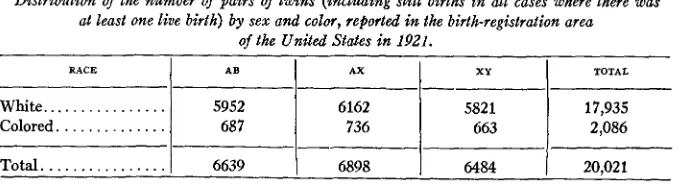
The United States Census affords additional data on sex ratios. I n 1921 there were reported in the birth-registration area of the United States a total of 20,021 cases of twins of which 38,733 were live births and
1309 were still births, making a total of 40,042 twins. It will be noted by
the following tables that the figures approximate the
1
: 1 : 1 ratio more closely than any data heretofore reported.TABLE 2
Distribution o j the number of pairs of t d n s (including still births in a,?,! cases where there was at least one live birth) by sex and C0107, reported in the birth-registration area
of the United States in 1921.
RACE A B A x XY TOTAL
-
White. . . .
2,086 663
736 687
Colored. . . . 17,935
5821 6162
5952
I I" I- I
Total. . . .
1
6639I
68981
6484I
20,021530 C. E. LAUTERBACH
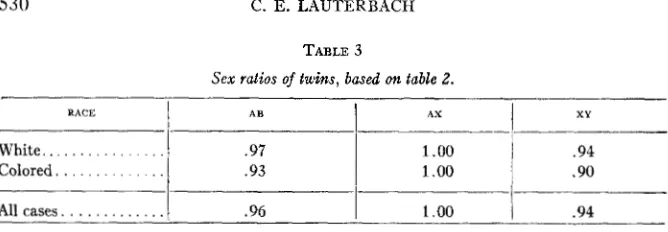
TABLE 3
Sex ratios of twins, based on table 2.
White. . . .97 1.00
1
.94Colored . . .
1
1.00 j .90All cases. . .
l
.96l
1.00l
.94The biological argument is, that if sex is determined a t the time of the fertilization of the egg, then there ought to be, by the law of chance, as many twin pairs of unlike sex as of like sex. But the actual facts are that there are twice as many like-sex pairs as unlike-sex pairs. The actual ratio is approximately 1 : 1 : 1 while the theoretical ratio is 1 : 2 : 1.
NEWMAN
(1917, p. 10) concludes that “the only satisfactory explanation of this discrepancy between the observed and the expected ratios appears to be that nearly half of all same-sexed twins are monozygotic and hence morpho- logically stand for but one individual to a pair.” It follows, then, that about one-fourth of all twin births are of monozygotic origin. MERRIMAN (1924)took the actual ratios instead of the approximate ratio of 1 : 1 : 1 and concluded that the number of monozygotic twins is about three-eighths of the total number of like-sex twins. This, then, is the first clew to the indirect identification of one-egg twins. All twins of unlike sex may be regarded as fraternal; monozygotic twins are found only among like-sex pairs and constitute about three-eighths of that group. While this simpli- fies the problem somewhat, it leaves the zygotic identification of one-half of the twin population a mystery, since it is just as difficult to say with certainty which twins of the like-sex pairs are monozygotic, as which are dizygotic.
For the identification of one-egg twins other characteristics than those of sex must be sought. Among the most promising of these is what is called symmetry reversal or mirror imaging.
STUDIES I N TWIN RESEMBLANCE 5.3 1
“The two phenomena [mirror-imaging and polyembryony] are so closely related that it is my belief that the occurrence of symmetry reversal or mirror- imaging in twins or double monsters may safely be taken as a criterion of their monozygotic origin.”
It seems natural to expect that the product of a single egg which would ordinarily have produced a single bilaterally symmetrical individual, should show symmetry in its halves. Symmetry reversal in conjoined twins, where there is no doubt of monozygotic origin, is a well-attested fact and there is no reason to suppose that the same phenomenon may not manifest itself in separate one-egg twins.
It has been pointed out by
NEWMAN
(1917) that, due to intra-uterine hazards, unequal nutrition and inequality in somatic segregation, it is not safe to conclude that lack of similarity in unit characters is absolute evidence of dizygotic origin. It is quite possible that some unlike twins may be duplicates. On the other hand, it is just as probable that some twins which are very similar, even identical in some traits, are not mono- zygotic.A
summation of all the evidence, sex, symmetry reversal, and striking similarities may lead pretty close to the truth. But with our present knowledge of the facts, any grouping of twins as monozygotic or dizygotic, on the basis of indirect evidence, must be largely experimental. Such an experimental grouping might be effected on the following char- acters :1. Sex.
2. Symmetry reversal:
a. Friction-ridge patterns of fingers, palms and soles. b. Reversal in direction of the whorl of the head-hair.
C. Right- and left-handedness.
d. Birth-marks, moles, freckle patterns, etc.
a. Similarity of features. b. Texture and coloration of skin. c. Color of hair.
d. Color of eyes.
e. Height, standing and sitting. f. Weigh,.
g. Cephalic index.
3. Identity or similarity of physical traits:
SYMMETRY REVERSAL
The phenomenon of symmetry reversal often occurs i n conjoined twins. The asymmetry of the unpaired organs of the normal individual in which the greater curvature of the stomach is to the left, the apex of the heart to the left, the aortic arch to the left, and the vena cava to the right, is
532 C. E. LAUTERBACH
completely or partially reversed in one member of the pair. This condition is called “situs inversus viscerum” in contrast to the normal condition which is known as “situs solitus.” Numerous instances have been re- ported and SPAETH and SCHATZ call attention to small deviations often found in separate one-egg twins (NEWMAN 1923).
The whorl of the head-hair (the crown, as i t is commonly called) of the normal person is from left to right, or clockwise. It is for this reason that most people part their hair on the left; it naturally falls to the right. It is for the same reason that the mother of the boy whose head-hair whorls to the left has such difficulty in making her young son’s hair “stay combed” when she parts it on the left. A slight change in technique would relieve her of her worries. The literature on twins has a few references to reversal of the whorl of the head-hair. NEWMAN (1923) mentions it, as does SANO (1916), but up to the time of this study no attempt seems to have been made to determine the frequency of its occurrence or the variations which the phenomenon manifests.
Sometimes this characteristic can be determined a t a glance, especially
if the hair is short. More frequently the hair requires considerable combing in order to discover the natural ‘whorl. This is especially true in the case of girls. Long, fine hair sometimes assumes a false whorl but the true whorl can always be located close to the scalp. Double crowns are not unusual. My data reveal thirteen such cases. Occasionally, a sort of composite condition is found which is quite puzzling, but careful examination usually resolves it into two crowns lying very close together. No cases were found in which both members of a pair had double crowns.
One hundred eighty-six pairs of twins were examined to determine the whorl of the head-hair. The frequency of occurrence of this type of symmetry reversal is given in table
4.
The plus sign (+) indicates a whorl to the right, or clockwise; the minus ( - ) sign indicates a whorl to the left, or counter-clockwise. Two signs in a parenthesis indicate a double crown, and the position of the signs indicate their position relative to each other on the head. Thus xy (+) ( -+)
means a girl-girl pair, the right-hand member of which has a double crown; and of these two crowns, theleft- hand crown whorls to the left, the right-hand crown to the right.As in the case of whorl of the head-hair, no effort seems to have been made, heretofore, to determine the amount of left-handedness among twins, though the condition in which one member of a pair is right-handed and the other left-handed has been recognized as symmetry reversal
STUDIES I N TWIN RESEMBLANCE 533
TABLE 4
Frequency of occurrence of symmetry reversal in whorl of head-hair i n a total number of ~‘86 cases. FREQUENCY BY PALRS
8 1
2 2 1 0
0 0
5
0 2 0 0 0 0 0
15 3 5
0 0 0
1
0
45
51 56 34
186
FREQUENCY BY GROUPS
14
7
24
45
51 56 34
186
PERCENT
7.53
3.76
12.90
24.19
27.41 30.10 18.27
99.97
sometimes by experiment. Most twins when asked “Are you right- or
left-handed?” replied unhesitatingly, “Right.” When a twin reported
534 C. E. LAUTERBACH
LEGEND FOR PLATE 1
SYMMETRY REVERSAL I N WHORL O F THE HEAD-HAIR
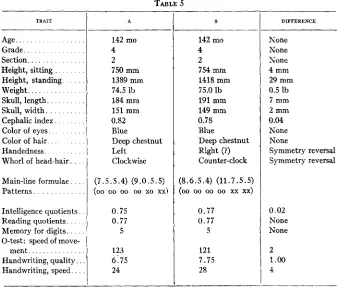
This is a pair of twin boys who show symmetry reversal in whorl of the head-hair and in handedness. They are eleven years of age and both are in the fourth grade. I n height, sitting, “b” is the taller by 4 millimeters, and in weight, the heavier by half a pound. The eyes of both are blue and the hair is a deep chestnut. They have the same intellectual ability. Table 5 below will reveal other resemblances. “a” is fifteen minutes older than his brother. “b” says he was left-handed in childhood but broke his arm about the fourth year. He still chores with the left hand. These twins may be of one-egg origin, but there is no unequivocal evidence of such a genesis.
TABLE 5
TRAIT
Age., . . . . . . . .
Grade.. . . . . . Section. . .
Height, sitting . . . .
Height, standing. . .
Weight. . . Skull, length. . . Skull, width. . .
Color of eyes. . . . Cephalic index. . .
Color of hair. . .
Handedness. . .
Whorl of head-hair . . . .
Main-line formulae. . , .
Patterns. . .
.l
Intelligence quotients. Reading quotients, .
Memory for digits. . .
0-test: speed of move- ment. . . Handwriting, quality. . ,
Handwriting, speed.. . .
A
142 mo 4
I
L
750 mm
1389 mm 74.5 lb 1% mm 151 mm 0.82 Blue
Deep chestnut Left
Clockwise (7.5.5.4) (9.0.5.5)
(00 00 00 00 x0 XXJ
0.75 0.77 5 123 6:75 24 B
142 mo
4
L
754 mm
1418 mm 75.0 lb
191 mm
149 mm 0.78 Blue
Deep chestnut
Right (I)
Counter-clock
(8.6.5.4) (11.7.5.5)
(00 00 00 00 xx xx)
0.77 0.77 5 121 7.75 28 DIFFERENCE None None None 4 mm 29 mm 0.5 lb 7 mm
2 mm
0.04 None None Symmetry reversal Symmetry reversal 0.02 None None 2
,
1.00STUDIES I N TWIN RESEMBLANCE 535
useful with small children. I n some instances a tendency toward ambi- dexterity was found.
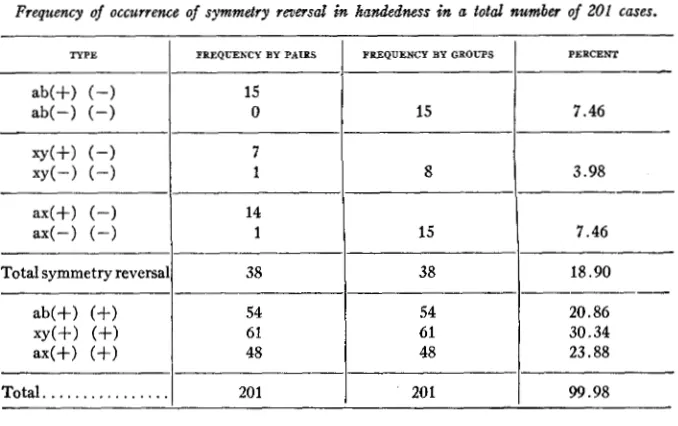
The frequency with which symmetry reversal in handedness occurs is shown in table 6. The same symbolism is used as in the case of the whorl of the head-hair. The plus sign (+) means right-handedness; the minus sign (-), left-handedness.
TABLE 6
Frequency of occurrence of symmetry reversal in handedness in a total nzlmber of 201 cases.
TYPE
I
FREQUENCY BY PAIRSI
FREQUENCY BY GROUPS1
PEECENTTotal symmetryreversal 38 38 18.90
"___-
ab(+) (+l
30.34 61 61
X Y ( + ) (+)
20.86 54
54
ax(+) (+l 48 23.88
, 48
l I I
Total. .
. .
.. .
, .. . .
. .. .
2011
2011
99.98Combining tables
4
and 6 above reveals a surprising frequency of symmetry reversal. Of the 201 pairs of twins examined, 69 pairs, or34.30 percent, show one or the other type of reversal and 14 pairs or
6.96 percent show both types. Of these 69 pairs, twenty-three are ab or
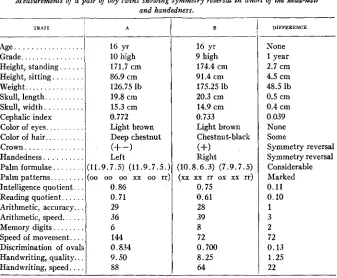
boy pairs; 15 are xy or girl pairs; and 31 are ax or unlike-sex pairs. While the data show an unexpected frequency of symmetry reversal they also reveal an extraordinarily confusing fact; namely, symmetry reversal in unlike-sex pairs. Some biologists look upon symmetry reversal as evidence of the monozygotic origin of twins.
NEWMAN
(1917) has expressed the belief that almost any kind of symmetry reversal may be accepted as evidence of monozygotic origin.WILDER
has attempted536 C. E. L.IUTERHACH
not be accepted as evidence of the monozygotic origin of twins, or else identical twins are frequently of unlike sex.
These apparently irreconcilable facts tempt to speculation. If monozy- gotic twins are always of the same sex, can we find an explanation of symmetry reversal in unlike-sex pairs?
Let us take a specific case, pair 1 5 8 - a ~ ~ in which a, the boy, is right- handed and
x,
the girl, is left-handed. The probabilities are that two eggs were fertilized, one of which produced a, the other, x. The a-egg developed naturally into a normal right-handed boy. The x-egg, however, was retarded in its development, either by the presence of the contempo- raneously fertilized a-egg or some other cause, and lost its axiate organiza- tion, becoming potentially an egg which would have produced a pair of monozygotic female twins. The a- and the x-eggs a t this stage of develop- ment represent a set of triplets in which a is fraternal to x and y, x and y being duplicate to each other, that is, pair 158-ax becomes 158-axy. But for some unknown reason, during the course of early development, the right-hand axis of the x-egg degenerated and lost its potency while the left-hand axis reached maturity. The result is a surviving axis which shows symmetry reversal, not to the a-egg, but to the suppressed axis of the x-egg. The result is clearly a case of fraternal twins of the ax type showing symmetry reversal.STUDIES I N T W I N RESEMBLANCE
537
axes, one of which shows symmetry reversal to the other and only inci- dentally to the b-egg.
The suggestion leads to many complex combinations, but this is exactly what is needed to explain the variable facts which the problem presents. There are in my collection, data on a set of triplets, 113-xyz, of which z is undoubtedly fraternal to x and y. This conclusion is justified both by the circumstances of birth and by the physical and mental measurements.
TABLE 7
Measurements of a pair o j boy turins shozpring symmetry reversal in whorl of the head-hair
and handedness.
TRAIT
Age . . .
Grade. . . Height, standing. . . Height, sitting. . .
Weight. . . Skull, length. . . Skull, width. . . Cephalic index Color of eyes. . . Color of hair.. . . Crown. . .
Handedness. . . -
l-
Palmformulae . . .
Palm patterns.. . .
(11.9.7.5) (11.9.7.5.:
0.71 Reading quotient.. . .
0. 86 Intelligence quotient. . .
(00 00 00 xx 00 rr:
Arithmetic, accuracy.. . 29
Arithmetic, speed.. . . 36 Speed of movement. . . . 144
Discrimination of ovals 0.834
Handwriting, quality.. . 9.50
Handwriting, speed. . . . 88 Memory digits. . . 6
A
16 yr 10 high 171.7 cm 86.9 cm 126.75 Ib 19.8 cm 15.3 cm 0.772 Light brown Deep chestnut Left
(+ -1
B 16 yr 9 high 174.4 cm 91.4 cm 175.25 Ib 20.3 cm 14.9 cm 0.733 Light brown Chestnut-black Right
(+l
:10.8.6.3) (7.9.7.5) (xx xx rr ox xx rr)
0.75 0.61 28 39 8 72 0.700 8.25 64 DIFFERENCE None 1 year 2.7 cm 4.5 cm 48.5 lb 0.5 cm 0.4 cm 0.039 None Some Symmetry reversal Symmetry reversal Considerable Marked 0.11 0.10 1 3 2 72 0.13 1.25 22
538 C. E. LAUTERBACH
development potentially a set of quadruplets derived from two eggs, z being the only surviving axis of one of the eggs?
The intimate relationship between left-handedness and twinning has been mentioned by DANFORTH (1919, p. 400) who says, “Rather a surpris- ing number of twin pairs seem t o be composed of one right- and one left- handed individual.” My data show t h a t a t least 19 percent of all twin pairs are composed of a right- and a left-hander. The probabilities are that the percentage is much larger for the reason that the method of examination would fail to take account of transfers. As indicated before, an attempt was made to determine native left-handedness by requiring the execution of some complex coordination like throwing a ball or holding
a needle while sewing; but to ascertain the actual amount of left-handed- ness among twins, some more scientific method is essential.
JONES (1918) made a study of handedness based on physical measure- ments. His conclusions are based on data secured from a total of 20,000 pairs of arms, half a dozen cadavers and a dozen unpieced skeletons. H e found that the bones of the major arm, that is, the bones of the left arm of a
native left-hander are larger than the bones of the right arm, and vice versa. Transfers can be determined by measuring the muscle swell of the biceps and the fore-arm. An investigation needs to be made by such a method to determine the actual amount of left-handedness among twins.
The intimate relationship between left-handedness and twinning is
also revealed by other inquiries which
I
have just begun. For example, x is a right-handed female twin who married and gave birth to a girl with a crown which whorled to the left, who in turn gave birth to a left- handed daughter. This daughter bore seven children, 4 boys and 3 girls, of whom one boy is left-handed and one has a double crown; and one girl is left-handed. Twin y, the sister of x, bore a left-handed daughter. These genealogies are represented in figure 1 in the symbols used by JORDAN (1911):0
represents a right-handed male represents a left-handed male0
represents a right-handed femalerepresents a left-handed female
STUDIES I N TWIN RESEMBLANCE 539
together indicate a double crown. While incomplete, these genealogies are extremely suggestive.
FIGURE 1
A similar case is found in figure 2, where
x
is a right-handed twin who gave birth to two boys and one girl, one boy being normal as far as handed- ness and crown are concerned, the other boy having a double crown, the girl being left-handed. The boy with a double crown is unmarried; the normal boy has three children, among whom is a left-handed boy.A
fascinating field of investigation, which I think has never before been explored, is opened up here and holds promise of revealing facts which may shed considerable light on left-handedness and twinning.
FIGURE 2 JORDAN (1911, p. 20) says
.
.
.
.
inveterate left-handedness is invariably associated with general left- sidedness, i.e., left-leggedness, left eyedness, etc.,.
. .
.
and.
. .
the cerebral localization of this function (i.e., movement of the left hand) in the sinistro- manual is in the right cerebral hemisphere (next BROCA’S center in the third frontal convolution), the reverse condition obtaining in the dextro-manual.”It is also significant that
HYRTL
(1871) reports situs inversus viscerum, particularly of the vascular system, in left-handed individuals. Here,we have exactly the condition so frequently reported among double monsters and conjoined twins.
The frequency of left-handedness among twins, its occurrence in twin- bearing families, and its apparent relationship to situs inversus viscerum, suggest that the fundamental causes of twinning and left-handedness are the same. Is it not quite possible that we have in the left-handed indi-
( l
540 C. E. LAUTERBACH
vidual of a single birth the surviving axis of a bi-axiate egg which might have produced twins had not one axis been suppressed? Such an explana- tion, it seems to me, would clear up much of the mystery which surrounds the peculiar organization of the neural system of left-handed people.
JONES (1918) reports 4 percent of the population as natively left- handed. His data must have included measurements of some twins, though such a fact is nowhere indicated. If this
4
percent of the population represents in each case the surviving left axis of a bi-axiate egg, then by the law of chance there should be an equal number of individuals who represent the surviving right axes of bi-axiate eggs in which the left axis has degenerated. There is no way of identifying these individuals. But the total number of individuals who are the product of such develop- ment is therefore probably 8 percent, twice the number of left-handed individuals.If
we add to this the 2 percent of the population who are twins, we have in the general population a total of 10 percent of potential twinning. Or perhaps it would be better to say that in 10 percent of the population the same causes operate to interfere with the normal develop- ment of the fertilized egg and the consequent neural organization of the individual. Incidentally, it is interesting to note that of the total numberof 793 left-handed individuals examined by JONES, 498 are males and 295 are females, or in terms of percentage, 63 percent are males and
37
percent females. Of the forty left-handed twins examined by myself 23, or 58 percent are males; 13, or42
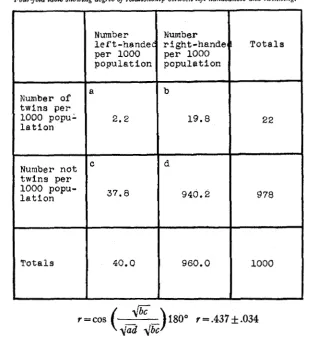
percent, are females. These figures reveal a consistent preponderance of males in both cases.JONES’S figures and my own furnish data upon which the correlation between left-handedness and twinning can be reckoned. The United States Census for 1921 reports a total number of live births in the birth- registration area of 1,714,261 and a total number of live births from twin labors of 38,733.’ According to these figures, the number of twins in each hundred of the population is 2.25, or as DAVENPORT (1920, p. 123) reports, “the average proportion of labors which are twin labors is 1.1 percent for the population as a whole,” that is, 2.2 twins in every 101 of the total number of children born. Bearing in mind that JONES reports
4
percent of the population left-handed and that my data show 10 percentSTUDIES IN TWIN RESEMBLANCE 541
of the twin population left-handed, we can set up a four-fold table (table It has been noted by LOMBROSO that considerable left-handedness exists among lunatics and criminals,-swindlers, murderers and ravishers.
It
would be extremely interesting to know whether twins contribute toTABLE 8
Fourfold table showing degree of relationship between left-handedness and twinning.
8) *
Number
left-handec per 1000 p o p u l a t i o n
€l
2 . 2
C
37.8
Number
right-hande
p e r 1000
p o p u l a t i o n
~
b
19.8
~~ d
940.2
960.0
T o t a l s
22
978
1000
r=cos
(
G
)NOo
r=.437f.034
qGd
dbc
criminality or not and to what extent. The available data seem to indi- cate that there may be a relationship between a disturbed organization of the nervous system and moral lapses.
542 C. E. LAUTERBACH
facts which might indicate such a deranged condition. Almost 25 percent of the twins examined showed reversal of the whorl of the head-hair and i t may be that this type of symmetry reversal has the same significance as left-handedness, namely, some disturbance of the organization of the nervous system. The data show that some twins manifest no symmetry reversal of the type under discussion; that some manifest one type or the other; and that some manifest both types. There may be other kinds of reversal, or less degrees of reversal, which we do not yet recognize.
Certain facts stand out clearly:
1. Symmetry reversal in handedness and whorl of the head-hair cannot be accepted as evidence of the monozygotic origin of twins, assuming that such twins are of like sex.
2. Left-handedness and reversal of the whorl of the head-hair are intimately associated with human twinning.
facts :
The evidence suggests the very probable existence of certain other
1. The causes which operate to produce twins probably also operate to
2. These causes affect about ten percent of the population. produce left-handed individuals.
PALM PATTERNS
The collection of the friction-ridge patterns of the palms of about two hundred twins examined during this study was made possible through the application of an inkless method of finger printing developed by Dr. J. H.
MATHEWS, Professor of Chemistry a t the UNIVERSITY OF WISCONSIN. The method consists in soaking blotter paper in a chemical solution until the blotter is thoroughly impregnated. The blotter is then removed from the tray and the palm pressed firmly upon it so that the solution adheres to the friction ridges. The palm is then placed momentarily upon photo- graphic paper and the result is a beautiful print of the friction ridge patterns. The print is fixed in “hypo” like any ordinary photographic print. The prints illustrated in this study were produced by this method. With materials handy and an assistant to number the prints, an operator can average about a pair of palms a minute. Since the formula leaves no residue on the hands of the subject and since i t is not “mussy” i t has many advantages over the ink method of printing. While the method had not been worked out in detail at the time of this study, it served the purpose so admirably t h a t it is t o be hoped t h a t Doctor MATHEWS will bring
STUDIES I N TWIN RESEMBLANCE 543 The method of classification used is that of
WILDER
(1916), with one deviation.WILDER
uses a small ‘‘X” to denote the absence of a line. But in view of the fact that in designating patterns the “x” is used to indicatethe presence of a pattern, it seems less confusing to use the “ o ’ ~ throughout to indicate absence and the “X” to indicate presence. This is consistent with the method used in plantar designations where the “0” stands for
“open field.”
The purpose of this study in palm patterns was to distinguish the monozygotic twins from the dizygotic on the basis of identical or a t least similar characteristics and mirror-imaging. WILDER (1916) has made such attempts but has met with indifferent success. NEWMAN (1917, p. 157) says,
“It must not be lost sight of,however, that identityin friction-ridge patterns of twins makes their monozygotic origin highly probable. Identity may demonstrate monozygotic origin, but lack of identity does not disprove the possibility of monozygotic origin.”
It would seem, then, that while not all monozygotic twins could be distinguished by similarities in palm patterns, a goodly number could be thus identified.
Naturally the most interesting group of patterns is that of the twins showing symmetry reversal in handedness and whorl of the head-hair. Table 12 gives the main-line formulae and the patterns for fifty-one pairs
of this group, and in addition, the same data for twenty-three like-sex pairs which do not show symmetry reversal in handedness or crown. Probably the first fact to strike the student who studies this table is the frequent occurrence of one aberrant pattern. In many instances where three palms show identical or very similar main-line formulae, the fourth shows a marked variation. WILDER (1916) noted this in his studies and was much puzzled to find an aberrant plantar pattern in the case of Mary, one of the pair of conjoined twins. NEWMAN (1917, p. 157) attributes this phenomenon to somatic segregation:
“In certain monozygotic human twins it might readily happen that by somatic segregation the paternal condition of friction ridges would go to one individual and the maternal to the other, or there might be a partial segrega- tion of important elements of the pattern so that they would be distributed differently in the two.”
544 C. E. LAUTERBACH
LEGEND FOR PLATE 2
DISSIMILARITY I N PALM PATTERNS
These prints are of a pair of boy twins showing symmetry reversal in
STUDIES IN TWIN RESEMBLAXCE 545
sometimes comparatively slight, a t other times it is considerable. Further- more, the phenomenon occurs in all groups.
A
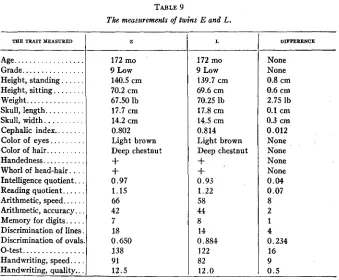
study of the patterns reveals a similar condition. Striking instances are seen in 229-ab, 183-,xy, 185-xy, 222-ax. Slight variations occur more frequently. Of course, variations in palm patterns are to be expected with variations in main-line formulae, since the 2nd, 3rd and 4th interdigital patterns are usually determined by the main lines.But suppose we try to pick out the one-egg twins. Let us take the case of E and L. The formulae for the palms are:
E,
(11.0.7.5) (11.0.7.5) (00 00 00 00 00 xx)L,
(11.0.7.5) (11.0.7.5) (00 00 00 00 00 xx)Here there is complete identity in main-line formulae and patterns. Shall we say that these twins are monozygotic? Before making a decision let us examine other evidence:
TABLE 9
The measurements of twins E and L.
TBE TRAIT MEASURED
Age. . .
Grade. . .
Height, standing. . .
Height, sitting. . .
Weight.. . . Skull, length.. . . Skull, width.. . .
Cephalic index.. . . Color of eyes.. . .
Color of hair.. . .
Handedness. . .
Whorl of head-hair . . . .
Intelligence quotient.. .
Reading quotient.. . . Arithmetic, speed.. .... Arithmetic, accuracy.. .
Memory for digits.
....
Discrimination of lines. Discrimination of ovals. 0-test ... Handwriting, speed.. ..Handwriting, quality.. .
E
172 mo
9 Low 140.5 cm 70.2 cm 67.50 Ib 17.7 cm 14.2 cm 0.802 Light brown Deep chestnut
+
+
0.97 1.15 66 42 7 18 0.650 138 91 12.5 L - 172 mo 9 Low 139.7 cm 69.6 cm 70.25 lb 17.8 cm 14.5 cm 0.814 Light brown Deep chestnut+
0.93 1.22 58 44 8 14 0.884 122 82 12.0+
.
DIFPERENCE None None 0.8 cm 0.6 cm 2.75 lb0.1 cm 0.3 cm 0.012 None None None None 0.04 0.07 8 2 1 4 0.234 16 9 0.5
I n addition to this evidence, my notes, taken a t the time of the examina- tion, say, “Hands alike. Teeth, nose, texture of skin, coloration, eyebrows, same. Identical.” Are these twins identical?
546 C. E. LAUTERBACH
Let us take another case of twins, that of P and
V.
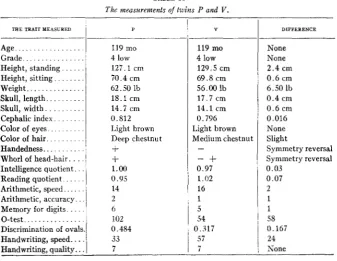
Their main-line formulae and their patterns are:P, (7.5.5.4) (7.5.5.5) (00 00 00 00 xx xx)
v,
(7.5.5.4) (7.5.5.4) (00 00 00 00 xx xx)There is enough asymmetry here to permit us to say that there is sym- metry reversal in main-line formulae. The patterns are identical except in minutiae. Besides,
V
is left-handed and has a double crown ( - +). A study of physical and mental traits likewise shows striking similarity:TABLE 10
The measurements qf twins P and V .
T R E TRAIT MEASURELl
"
Age. . .
Grade. . .
Height, standing. . .
Weight. . . Skull, width. . . .
Cephalic index. . . Color of eyes. . .
Color of hair, . . .
Handedness. . .
Whorl of head-hair . . . . Intelligence quotient. . .
Reading quotient. . . Height, sitting. . . Skull, length.. . . .
Arithmetic, speed.. . .
Arithmetic, accuracy. .
0-test, . . . Discrimination of ovals Handwriting, speed..
.
Handwriting, quality.. Memory for digits. . . .P ___________" 119 mo 4 low 127.1 cm 70.4 cm 62.50 Ib 18.1 cm 14.7 cm 0.812 Light brown Deep chestnut
+
+
1.00 0.95 14 2 6 102 0.484 33 7 V "119 mo
4 low 129.5 cm 69.8 cm 56.00 lb 17.7 cm 14.1 cm 0.796 Light brown Medium chestnut -
- +
0.97 1.02 16 1 5 54 0.317 57 7 DIFFERENCE None None 2.4 cm 0.6 cm 6.50 lb 0.4 cm 0 . 6 cm 0.016 None Slight Symmetry reversal Symmetry reversal 0.03 0.07 2 1 1 58 0.167 24 None-
Perhaps the most significant differences are found in skull measure- ments, but even here the difference in cephalic index is not great. There is a slight difference in color of hair, I n speed of movement the difference is marked; likewise in handwriting speed, though the difference is reversed. In quality of handwriting, the scale shows no difference.
T h a t differences in physical traits must not be taken as conclusive evidence that any particular pair of twins is dizygotic, is pointed out by
NEWMAN (1917, p. 162),
"It should be pointed out, however, that fairly marked dimensional difer-
STUDIES I N TWIN RESEMBLANCE 547
origin of any particular pair of twins; in the armadillo, where the monozygotic origin is specific and unequivocal, there is frequently found a striking differ- ence among the quadruplets of a given set. On the whole, then, it would seem inadvisable to use dimensional measurements, either a t birth or in later life, as data for determining the degree of resemblance (coefficient of correla- tion) between twins.”
Further on he says, (p. 171), speaking specifically of friction-ridge patterns,
“In the light of what I have found in armadillo quadruplets, which are unquestionably monozygotic, i t does not seem safe to exclude from the category of monozygotic twins those that fail to show identity of pattern; the same practice, if applied to armadillo quadruplets, would lead to grave errors. It is probably safer to say that some monozygotic human twins, like some sets of armadillo quadruplets, are nearly identical, while others, like various quadruplet sets, may differ materially from each other.”
I n view of the symmetry reversal manifested in twins P a n d V, the remark- able correspondence in palm patterns, and assuming that differences in
physical traits are not necessarily evidence disproving the monozygotic origin of any particular pair of twins, one is tempted to conclude that P and V are monozygotic.
TABLE 11
The measurements of t w k s A and C. TEE TRAIT MEASURED
Age. . . . Grade. . . . Height, standing . , . .
Height, sittiag . . . Weight. . . .
Skull, length.. . . . Skull, width. . . . Cephalic index. . . . Color of eyes. . . . Color of hair. . . . Handedness. . . .
Whorl of head-hair. . . Intelligence q u o t i a t . . Reading quotient. . . . .
Arithmetic, speed.. . . . Arithmetic, accuracy. ,
Memory for digits. . . . Discrimination of oval 0-test. . . .
Handwriting, speed. ..
Handwriting, quality..
GENETICS 10: N 1925
A
116 mo 4 low 114.8 cm 64.8 cm 47.00 lb 18.1 cm 14.5 cm 0.801 Dark brown Chestnut black
+
+
0.91 0.76 25 17 6 0.40 83 44 9 . 5-
C ”_DIFFERENCE116 mo Marked Light chestnut Marked Blue None 0.801 None 14.5 cm None 18.1 cm 6.25 Ib 53.25 Ib
3 . 2 cm 68.0 cm
6 . 4 cm 121.2 cm
None 4 low
Xone
-
Symmetry reversal+-
Symmetry reversal1.03 0.12
0.91 0.15
21 4
9 8
7 1
0.00 0.40
62 21
39 5
548 C. E. LAUTERBACH
LEGEND FOR PLATE 3
IDENTICAL PALMS I N UNLIKE-SEX TWINS
An examination ofithese patterns reveals that they are almost identical. There is the characteristic suppression of line C in each palm and symmetry reversal, finger for finger, except in the thumbs. I n fact, the only marked difference is in the apical pattern of the thumbs. These twins also show sym- metry reversal, “x” having a double crown (+ -) and being left-handed.
STUDIES I N T W I N RESEMBLANCE 549
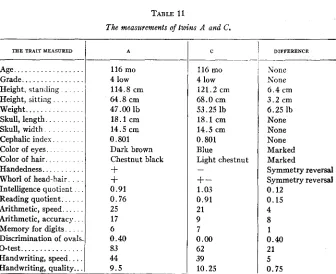
But before we make our decision let us examine another pair of twins, A, (11.0.7.5) (11.0.7.5) (00 00 00 00 00 rr)
C, (11.0.7.5) (11.0.7.5) (00 00 00 00 00 rr)
A
and C. Their main-line formulae and their patterns are:This striking correspondence extends as well to the apical patterns of the fingers (see plate 3), there being almost perfect symmetry reversal, finger for finger, except the thumbs. Not only do we have identical formulae and patterns, but we have also symmetry reversal in handedness,
C,
the left- handed twin, having also a double crown (+-
). The evidence of physical and mental measurement may also favor the theory of one-egg origin: We have some marked differences here, notably in color of eyes andhair,
but we have complete correspondence in skull measurements. #e have, to offset the differences in physical traits, four instances of symmetry reversal, in handedness, in crown, and in both palms. Are A and C mono- We have here, as far as palms are concerned, a case identical with the conjoined twins, Mary and Margaret, reported byWILDER
(1916).
The palms of all four hands are practically alike in pattern, and it may not, therefore, be correct to speak of mirror-imaging in this connection.NEWMAN
(1917, p. 164) says of the case: “Since there is no asymmetry in the hands, there is no chance to observe symmetry reversal or mirror- imaging.”It
seems to me, on the face of the evidence presented, that it is a t least very probable that these three pairs of twins are identical. ‘The evidence of the palm patterns alone seems to be perfectly clear. Add to this the evidence of symmetry reversal and reasonable similarity in physical and mental traits, the conclusion, in view of the theories which have been urged, is almost unavoidable that E and L, P andV,
andA
andC
are monozygotic twins. This would certainly be my conclusion were it not for one fact which has not been considered. P (Paul) and V (Vivian) and A (Anthony) andC
(Charlotte) are unlike-sex twins.E
(Eleanore) andL
(Lucille) are a pair of girl twins. Their numbers are respectively lSS-ax, 232-ax and 274-xy. This does not mean, of course, that pair 274-w is not monozygotic. This may be a pair of one-egg twins. But such a statement could be made on the basis of sex alone. If unlike-sex twins can be so misleading, may not like-sex pairs be even more so? It is evident that a classification of twins as monozygotic or dizygotic on the basis ofpalm patterns, or even a summation of evidence, may lead to very grave errors.
550 C. E. LAUTERBACH
TABLE 12
Showing symmetry reversal i n handedness and crown, and the main-line and palm-pattern formdae of 73 pairs of t-wins.
N U M B E R
103 a
b 115 a
b 140 a b 148 a
b 149 a b 160 a b 166 a b 168 a b 176 a b 189 a b 191 a b 229 a b 238 a
b 244 a b 254 a b
C R O W N
+
-
+-
+
+
+
X X+
+-
+
-
+
+
+
+
-+
+
+
-+
+
+
+
- -+
-+-
+
MAIN LINES (11.9.7.5) (11.8.7.5) (11.9.7.5) (10.8.6.3)( 7.5.5.3)
( 7.5.5.3) (11.0.7.5) (11.0.7.5)
( 9.9.5.5) (10.9.6.5)
( 7.5.5.3)
( 7.5.5.3)
( 9.8.5.4)
( 9.8.5.4)
( 7.5.5.5)
( 9.7.5.5)
( 9.7.5.5)
( 9.0.5.5)
( 7.5.5.4)
( 8.6.5.4)
( 9.9.5.4)
( 7.5.5.5) (11.0.7.5) (11.0.7.5)
( 9.9.5.5) (11.8.7.5)
( 7.5.5.4)
( 7.5.5.5) (11.8.7.5) (10.8.6.5)
(11.9.7.5) (11.9.7.5) (11.9.7.5)
( 7.9.7.5)
( 7.5.5.3)
( 9.7.5.5) (11.8.7.5) (11.9.7.5) (11.9.7.5) (10.9.6.5)
( 7.5.5.3)
( 8.6.5.5) (10.8.6.5)
( 8.6.5.11)
( 9.7.5.5)
( 9.7.5.5)
(11.10.8.5)
( 9. 9.5.5)
( 9.0.5.5) (11.7.5.5) (11.10.6.5) ( 9 . 7.5.5) (12.9.7.6) (11.0.7.5) (11.9.7.5) (11.9.7.5) ( 7.5.5.5)
( 7.5.5.5) (11.8.7.5) (11.8.7.5)
PATTERNS
(00 00 00 xx 00 rr)
(00 00 00 ox 00 rr)
(00 00 00 xx 00 rr) (xx xx rr ox xx rr)
(00 00 00 00 xo rr) (00 00 00 00 xx rr)
(00 00 00 00 rr rr)
(00 00 00 ox ro rr) (00 00 00 xx xo rr) (x0 xo 00 xx xx rr)
(00 00 00 00 xx 00) (00 00 00 00 xx rx)
(00 00 00 ox 00 xx)
(00 00 ox ro ox rr)
(00 00 00 00 xx xx)
(00 00 00 00 xx xx) (xx xx 00 ox xo rr) (rr 00 00 ox xo rr)
(00 00 00 00 x0 xx) (00 00 00 00 xx xx)
(00 00 00 xx 00 rr) (XX xx 00 00 xx rx)
(xx xx 00 ox 00 xu)
(rr 00 00 ox 00 rr) (x0 xo 00 xx rr xx)
(00 00 00 ox xr rr)
(00 00 00 00 xx xr)
(00 00 00 00 xx rr)
(00 00 rx 00 rr rr)
STUDIES I N TWIN RESEMBLANCE 55 1
NUMBER
262 a
b
269 a b
275 a b
276 a b
296 a b
302 a
b
303 a
b
305 a b
159 x
Y
171 x
Y
178 x
Y
181 x
Y
183 x
Y
185 x
Y
196 x
Y CROWN
-
+-
+
X-
-
+
+
-
-
+
+
+
+
+
+
+
+
+
+
4-+
+
-
+
+
+
+
+-
-
TABLE 12 (continued)
XAW LINES :11.7.5.5) 111.9.7.5) :11.9.7.4) :11.8.7.4) :1!.0.7.5) (10.0.6.5) :11.8.7.5) :11.8.7.5) (11.8.7.5) (11.8.7.5)
( 9.0.5.1) (10.8.6.1)
( 9.8.5.4)
( 7.5.5.4)
(10.9.6.5)
( 9.9.5.5)
(11.10.8.5) (11. 9.7.5)
(11.9.7.5) (11.9.7.5) (11.0.7.5) (11.0.7.5) (11.0.7.5) (11.0.7.5) (11.8.7.5) (11.9.7.5)
( 9.7.5.1)
( 8.6.5.4)
(11.8.7.4)
( 7.5.5.4)
(11.9.7.5)
( 9.9.5.5)
(11.8.7.5)
( 9.7.5.3)
(11.9.7.4) (11.9~7.4)
( 9.7.5.4) (10.0.6.4)
(11.9.7.5)
( 7.5.5.1)
(11.9.7.5)
( 9.7.5.5)
(11.9.7.4) (11.9.7.5)
( 9.7.5.5) (10.0.5.5)
( 7.5.5.5) (10.0.6.5)
(11.9.7.5) (11.9.7;4)
(11.9.7.4) (11.9.7.4)
( 8.6.5.5)
( 8.6.5.2)
(11.9.7.5) (11.9.7.5)
(11.9.7.5) (11.9.7.5)
( 9.7.5.5)
( 9.7.5.5)
P A m R N S
(00 00 00 ox x0 xo)
(00 00 00 xx 00 rr)
(00 00 00 xx 00 xx)
(00 00 00 xx 00 xx)
(00 00 00 or 00 rr)
(00 00 00 00 00 m)
(rr 00 ro 00 00 xx)
(rr 00 rr ox rr xx)
(00 00 00 00 00 xx)
(00 00 00 ox 00 rx)
(00 00 00 00 ox xx) (00 00 OB 00 ox-XK)
(00 00 00 00 00 xx)
(00 00 00 00 xx xx)
(xr ?o rr xx xx xx) (rr 00 rr xx rr rr)
(00 00 00 00 ox xx)
(00 00 00 ox xo rr)
(W 00 00 xx 00 xx)
" ( o o o ~ m ~ o o x x )
(00 00 00 ox x0 xx) '
(00 00 00 ox 00 xx)
(00 00 00 xo ox rx)
(00 00 00 xx xx rr)
(00 00 W xx 00 W)
(00 00 00 rr xr xx) (00 00 00 xx 00 xo)
(x0 x0 00 xx 00 00)
(x0 x0 00 ox x0 0 0 )
(xx xx 00 00 ox 00)
552 C. E. LAUTERBACH
NUMBER
211 x
Y
233 x
Y
279 x
Y
293 x
Y
101 a X
132 a X
137 a X
138 a X
155 a X
158 a X
163 a X
172 a X
190 a X
198 a X
207 a
X
222 a X CROWN
+
+
+
+
+-
-
+
-
+
+
+
-
+
-+
+
+-
+
+
-
+
--
- -+
++
, ++
+-
+
-
TABLE 12 (continued)
MAIN LINES
( 9.0.5.3)
( 9.9.5.4)
( 7.5.5.5)
( 7.5.5.3) (11.8.7.4) (11.8.7.4)
( 9.7.5.5) (11.9.7.5) (10.9.6.4) (10.9.6.4)
( 9.7.5.5) (11.8.7.5) (11.7.5.3) (10.9.6.5)
( 7.5.5.3)
( 7.5.5.3)
( 7.5.5.4)
( 7.5.5.4)
( 9.7.5.5)
( 9.9.5.1)
( 7.5.5.5)
( 7.9.5.5)
( 9.7.5.3)
( 9.0.5.5) (11.0.7.5) (11.8.7.5)
( 9.7.5.5)
( 9.7.5.5) (11.8.7.5) (11.7.7.5) (11.9.7.5) (11.9.7.5) (11.9.7.5) (11.9.7.5)
( 7.9.7.5) (10.9.6.5) (11.9.7.4) (11.8.7.4) (11.9.7.5)
( 9.9.5.5) (11.9.7.4) (11.9.7.4)
( 9.9.5.5) (10.7.6.5) (11.9.7.5) (11.9.7.5)
( 8.6.5.3) (10.9.6.3)
( 7.5.5.5)
( 7.5.5.4)
( 9.7.5.5) (11.9.7.1)
( 9.7.5.5)
( 7.5.5.5)
( 9.8.5.3) (11.0.7.5) (11.9.7.5) (11.9.7.5)
( 9.7.5.5) (11.9.7.5) (11.9.?.$ (11.9.7.5) (11.11.9.5) (11. 9.7.5)
PATTERNS
(00 00 00 ox 00 rr)
(00 00 00 xx 00 rr)
(xx xx 00 xx xx rr)
(00 00 00 ox xo rr)
(00 00 00 ox 00 xx)
(00 00 00 00 00 xx)
(xx xx 00 ox xr rr)
(00 00 00 xx rr xx)
(00 00 00 xx rr xx)
(00 00 00 xx rr xx)
(00 00 00 ox xx xx)
(00 00 00 ox xx xx)
(00 00 00 ox xo rr)
(00 00 00 ox rr rr)
(00 00 00 00 xx rr)
(00 00 00 ox xo rr)
(00 00 00 00 xx xx)
(00 00 00 00 M xx)
(00 00 00 00 xr rr)
(00 00 00 m 00 rr)
(ro 00 00 00 xx 00) (00 00 00 xo xx rr)
(00 00 00 00 xo rr)
(00 00 00 ox 00 rr) (x0 x0 00 ox 00 rr)
(00 00 00 ox 00 rr)
(00 00 00 00 xx rr) (00 00 00 ox xo rr) (x0 xo xx ox xo rr)
STUDIES I N TWIN RESEMBLANCE 553
H A N D
-
N T X B E B CBOWN
-~
+
-+
+
+
+
+-
+
-+
+
+
+
+
--
+
+
+
+
+
+
+
+
+
+
+
+
+
+
+
+
+
+
+
+
+
+
+
+
+
+
+
+
+
+
+
- I - +
+
+
+
+
+
+
+
+
+
+
+
+
+
+
224 a
X
232 a
X
246 a
X
272 a
X
287 a
X
102 a
b 150 a
b
162 a
b
179 a
b
180 a
b 214 a
b
253 a
b
308 a
b
107 x
Y 109 x
Y
110 x
Y
TABLE 12 (continued)
MAIN LINES
(11.8.7.5)
( 7.8.5.5) (1 1.0.7.5) (11.0.7.5)
( 9.7.5.5)
( 7.7.5.5)
( 9.7.5.5) (11.9.7.1)
( 9.9.5.3)
( 9.7.5.4)
( 9.7.5.5) (11.8.7.5)
( 9.0.5.5) (1 1.0.7.5)
( 9.9.5.5)
( 9.7.5.4)
( 8.6.5.4)
( 8.6.5.4)
( 7.5.5.3)
( 7.5.5.4)
( 9.9.5.5)
( 9.9.5.3)
( 9.9.5.5) (11.9.7.5)
(11 .O. 7.5) (11.9.7.5)
(1 1.9.7.5) (11.9.7.5) (1 1.0.7.5) (11.0.7.5)
( 7.5.5.4) (11.9.7.5) (11.9.7.5) (11.8.7.5)
( 9.9.5.3) (10.9.6.5) (11.9.7.5)
( 75.5.5) (11 .O. 7.5) (11.0.7.5)
( 9.9.5.5)
( 9.7.5.5)
( 8.6.5.4)
( 8.6.5.4)
( 7.5.5.4)
( 7.5.5.4) (11.9.7.5) (11.9.7.5) (10.9.7.5)
( 9.9.5.5) (1 1.0.7.5)
(1 1.9.7.5)
( 8.6.5.4) ( 8.6.5.4)
( 7.5.5.4) ( 8.6.5.4) (10.0.6.5) ( 8.6.5.5)
( 7.5.5.5) (11.0.7.5)
( 9.7.5.5) ( 9.7.5.5)
( 7.5.5.5) ( 7.5.5.5)
PATTEBNS
(00 00 00 xx 00 rr) (00 00 00 xx xx rr)
(00 00 00 00 00 rr)
foo 00 00 00 00 rr)
(00 00 00 00 xx rx)
(00 00 xx xx xx rr)
(00 00 00 ox 00 rr) (00 00 00 olo xo xr)
(00 00 00 xx 00 rr)
(00 00 00 xx 00 rx)
(00 00 00 ox xo xx)
(00 00 00 00 ox rr)
(00 00 00 00 00 rr) (00 00 00 ox 00 rr) (00 00 00 xx 00 xx)
(00 00 00 00 xx xx) (00 00 00
do
xx xx)(00 00 00 00 xx rx) (00 00 00 00 xx rx)
(00 00 00 00 xx xr)
(00 00 00 xx 00 xr)
(00 00 00 xx 00 xr)
(00 00 00 xx 00 00) (00 00 00 xx 00 00)
(00 00 00 00 00 xx)
(ro xo xx xx rr rx)
(00 00 00 00 xx xx)
(00 00 00 00 xx xx) (xx xx 00 00 ox 00) (xx xx 00 00 xo xo) (00 00 00 00 xx xx) (00 00 00 00 xx xx)