| INVESTIGATION
Parent-of-Origin-Effect
rough endosperm
Mutants in Maize
Fang Bai,* Mary Daliberti,* Alyssa Bagadion,* Miaoyun Xu,†Yubing Li,* John Baier,* Chi-Wah Tseung,* Matthew M. S. Evans,‡and A. Mark Settles*,1
*Horticultural Sciences Department and Plant Molecular and Cellular Biology Program, University of Florida, Gainesville, Florida 32611,†Biotechnology Research Institute, National Key Facility for Gene Resources and Genetic Improvement, Chinese Academy of Agricultural Sciences, Beijing 100081, China, and‡Department of Plant Biology, Carnegie Institution for Science, Stanford, California 94305
ABSTRACTParent-of-origin-effect loci have non-Mendelian inheritance in which phenotypes are determined by either the maternal or paternal allele alone. In angiosperms, parent-of-origin effects can be caused by loci required for gametophyte development or by imprinted genes needed for seed development. Few parent-of-origin-effect loci have been identified in maize (Zea mays) even though there are a large number of imprinted genes known from transcriptomics. We screenedrough endosperm(rgh) mutants for parent-of-origin effects using reciprocal crosses with inbred parents. Sixmaternal rough endosperm(mre) and threepaternal rough endosperm (pre) mutants were identified with threemreloci mapped. When inherited from the female parent,mre/+ seeds reduce grainfill with a rough, etched, or pitted endosperm surface. Pollen transmission ofpremutants results inrghendosperm as well as embryo lethality. Eight of the mutants had significant distortion from the expected one-to-one ratio for parent-of-origin effects. Linked markers for mre1,mre2, andmre3indicated that the mutant alleles have no bias in transmission. Histological analysis ofmre1,mre2,mre3, and pre*-949showed altered timing of starch grain accumulation and basal endosperm transfer cell layer (BETL) development. Themre1 locus delays BETL and starchy endosperm development, whilemre2andpre*-949cause ectopic starchy endosperm differentiation. We conclude that many parent-of-origin effects in maize have incomplete penetrance of kernel phenotypes and that there is a large diversity of endosperm developmental roles for parent-of-origin-effect loci.
KEYWORDSparent-of-origin effect; gametophyte; imprinting; seed; endosperm
T
HE maternal and paternal parents have different genetic and epigenetic contributions to angiosperm seed devel-opment. Angiosperm seeds result from the double fertilization of two multicellular gametophytes (Walbot and Evans 2003). In diploid species, gametophytes grow from the haploid prod-ucts of meiosis with the male and female gametophytes follow-ing different developmental programs. The male gametophyte or pollen grain, delivers two haploid sperm cells through the pollen tube to fertilize the female gametophyte. Fertilization of the egg forms a diploid zygote, and fertilization of the two central cell nuclei forms a triploid endosperm cell. The central cell and egg cell provide the vast majority of cytoplasm for thenascent endosperm and the zygote. In addition, the central cell genome has more open chromatin, and there is substantial evi-dence for a dominant maternal role to initiate the coordinate development of the endosperm and embryo (Baroux and Autran 2015; Borg and Borg 2015; Del Toro-De Leonet al.2016).
Mutations in loci specific to the development of either gametophyte are expected to show non-Mendelian inheri-tance such as reduced transmission and maternal effect seed phenotypes. Only a few maize seed mutants have been iden-tified with maternal effects, and most of these mutants pri-marily affect gametophyte development. The indeterminate gametophyte1 (ig1) locus encodes a LATERAL ORGAN BOUNDARIES (LOB) domain transcription factor that is re-quired to limit cell divisions in the female gametophyte (Kermicle 1971; Evans 2007). Plants that are heterozygous forig1give a high frequency of defective kernels when pol-linated with normal inbred lines. Similarly, baseless1(bsl1) heterozygous plants will segregate near 1:1 defective kernels when pollinated with inbred pollen (Gutierrez-Marcoset al. Copyright © 2016 by the Genetics Society of America
doi: 10.1534/genetics.116.191775
Manuscript received May 19, 2016; accepted for publication July 12, 2016; published Early Online July 18, 2016.
Supplemental material is available online atwww.genetics.org/lookup/suppl/doi:10. 1534/genetics.116.191775/-/DC1.
2006). The polar nuclei of thebsl1central cell are not posi-tioned correctly in the female gametophyte, indicating de-fective embryo sac development is likely to alter kernel development. The maizestunter1 (stt1) locus shows a low frequency of small kernels when fertilized with normal pollen (Phillips and Evans 2011). Mutant stt1 embryo sacs are re-duced in size and appear delayed in development. Bothbsl1 andstt1show reduced transmission through the male, suggest-ing additional roles in the development of male gametophytes. As the seed grows, the endosperm supplies nutrients and signals to promote embryo development (Yanget al.2008; Xinget al.2013; Costaet al.2014). The two maternal copies of the genome in the endosperm create a gene dosage differ-ence, with maternal alleles expected to provide twice as much gene product as paternal alleles. Despite these differ-ences in gene dosage, mutations in loci required for seed development typically segregate at ratios consistent with Mendelian recessive mutations (Neuffer and Sheridan 1980; Scanlon et al.1994; McElveret al.2001; McCarty et al.2005). This pattern of inheritance indicates that a single dose of a normal allele from pollen is expressed sufficiently for most genes essential for seed development. Detailed anal-ysis of recessive seed mutants in Arabidopsisindicates that wild-type paternal alleles are in some cases delayed in ex-pression, as measured by genetic complementation of mutant phenotypes, relative to the maternal allele (Del Toro-De Leon et al. 2014). Thus, maternal allele expression can be domi-nant immediately after fertilization, but most genes required for seed development are supplied by both parents.
By contrast, there are genes that have parent-of-origin specific patterns of seed expression known as imprinting (Gehring et al. 2011; Hsieh et al. 2011; Luo et al. 2011; Waters et al. 2011, 2013; Wolff et al. 2011; Zhang et al. 2011, 2014; Xinet al.2013). Imprinted genes are epigenet-ically regulated such that gene expression is biased as either paternally expressed genes (PEGs) or maternally expressed genes (MEGs). Like gametophyte mutants, mutations in imprinted loci required for seed development are expected to show non-Mendelian segregation. In Arabidopsis, these parent-of-origin effects can manifest as mutants with half seed set, such as 1:1 segregation for defective seeds or aborted ovules. Molecular studies of Arabidopsis maternal-effect loci identified the FERTILIZATION INDEPENDENT SEED Polycomb Repressor Complex 2 (FIS-PRC2) as a pri-mary regulator of early endosperm development (Ohadet al. 1996; Chaudhuryet al.1997; Grossniklauset al.1998; Kiyosue et al.1999; Kohleret al.2003). FIS-PRC2 trimethylates lysine 27 on histone H3 to add repressive chromatin marks, which are required for imprinted patterns of gene expression (Kohler et al.2012). Mutants in FIS-PRC2 allow central cell divisions prior to fertilization and cause aberrant endosperm and embryo development. Even though most of theArabidopsis FIS-PRC2 subunits have a MEG pattern of gene expression, the primary seed defect results from the loss of the complex in the female gametophyte (Leroyet al.2007). Mutations in additional Arabidopsis MEG and PEG loci have been identified with
few showing seed phenotypes (Bai and Settles 2015; Wolff et al.2015).
In maize, thematernally expressed gene1(meg1) is im-printed during the early stages of basal endosperm transfer layer (BETL) development and is expressed from both ma-ternal and pama-ternal alleles later in development (Gutierrez-Marcoset al. 2004). The BETL transfers nutrients from the maternal tofilial tissues, andmeg1encodes a small peptide that promotes differentiation of the BETL (Costaet al.2012). Maternal control ofmeg1provides a mechanism to determine the size of the BETL, thereby influencing sink strength of in-dividual developing kernels. The maternal effect lethal1 (mel1) locus in maize may also identify a maternal factor that determines grainfill (Evans and Kermicle 2001). Plants het-erozygous for mel1 show a variable frequency of reduced grain-fill kernels, but these are unlikely to be caused by the female gametophyte, as no embryo sac defects are apparent in the mutant. Molecular studies ofmel1have been limited, because the mutant is only expressed in a single inbred back-ground and requires at least two sporophytic enhancer loci.
Despite being maternal effect loci, bothstt1andmel1can have a frequency of defective kernels well below the 1:1 ratio expected for a parent-of-origin-effect locus. Here we report a systematic genetic approach to identify maize parent-of-origin-effect loci even with a variable expressivity and low penetrance of seed developmental defects. A screen of 193 defective kernel mutants showing rough endosperm (rgh) phenotypes identified six maternal-effect (mre) and three paternal-effect (pre) loci. Mapping of threemremutants indi-cates that these are new parent-of-origin-effect loci with all loci having normal transmission through both male and female gametes. Characterization of the mutant developmental phe-notypes reveals that parent-of-origin-effect mutants can result in aberrant differentiation of specific endosperm cell types as well as delayed endosperm differentiation.
Materials and Methods
Genetic stocks
All genetic experiments were completed at the University of Florida Plant Science Research and Education Unit in Citra, FL or greenhouses located at the Horticultural Sciences Depart-ment in Gainesville, FL. For the parent-of-origin-effect screen, normal seeds were planted from segregating self-pollinations of 193 independentrghmutants isolated in the UniformMu transposon-tagging population (McCarty et al.2005). Each mutant isolate was self-pollinated and crossed onto the B73 and Mo17 inbred lines. Pollen from B73 and Mo17 was crossed onto the second ears of mutant isolates when possi-ble. All crosses were screened forrghkernel phenotypes, and the frequency ofrghphenotypes were compared between in-bred crosses and segregating self-pollinations. Putativemreand premutants were sown in a subsequent generation and recip-rocal crosses were completed with the W22 inbred line.
Backcross (BC1) mapping populations were developed by
example, Mo173mre1/+ F1progeny were crossed
recipro-cally with Mo17 and W22. BC1ears that segregated for the
mrephenotype were then used for molecular mapping and transmission analysis.
Mature and developing kernel phenotype analysis was com-pleted with mutant by W22 inbred crosses with plants segre-gating formreorpregenotypes. Themre/+3W22 pollinations were dated and sampled; second ears were crossed and scored formrephenotypes at maturity. For W22 3pre*-949/+ de-velopmental analysis, plants segregating forpre*-949/+ geno-types were crossed onto two W22 plants with one pollination scored forpre*-949phenotypes at maturity.
Mature kernel phenotypes
Segregatingmre/+ and +/precrosses with the W22 inbred were visually sorted into mutant and normal sibling kernels. Single-kernel near-infrared reflectance (NIR) spectroscopy was used to predict quantitative kernel traits for 96 normal
and 96 mutant kernels of each isolate (Gustinet al.2013). Predicted traits include: weight (milligrams), % oil, % pro-tein, % starch, seed density (grams per cubic centimeters), material density (grams per cubic centimeters), seed volume (cubic millimeters), and material volume (cubic millimeters). Sagittal sections of mature kernels were cut with a fi xed-blade utility knife and imaged on aflatbed scanner.
Molecular mapping
BC1progeny from crossesmre1/+3Mo17,mre2/+3B73,
andmre3/+3Mo17 were sorted forrghphenotypes. DNA was extracted as described (Settleset al.2004) from individ-ualrghkernels as well as normal sibling pools of 12 kernels per pool. For mre1, simple sequence repeat markers (SSRs) were selected from prescreened SSRs to have one polymorphic marker per chromosome arm (Martinet al.2010). Each marker was amplified from 24rghkernels and scored for recombina-tion. Segregation distortion was found for umc1294. Two linked markers, umc1164 and phi021, were amplified and scored to determine the region for fine mapping. For mre2 andmre3, DNA was extracted from 36 BC1rghkernels for each
mutant. Each DNA sample was genotyped using the Sequenom MassARRAY platform at the Iowa State University Genomic Technologies Facility as described (Liuet al.2010) except that a subset of 144 distributed single nucleotide polymorphism (SNP) markers were genotyped for each sample. Recombina-tion frequencies for each marker were used to identify regions that had significant distortion forfine mapping. Additional SSR markers and insertion–deletion polymorphism (InDel) markers were screened for thefine-mapping regions on chromosomes 4, 6, and 10 as described (Settleset al.2014). DNA was extracted from expanded BC1populations, amplified, and scored for
re-combination. Primer sequences for SSR and InDel markers are given in Supplemental Material,Table S2.
Transmission assay
F1hybrids ofmre1with Mo17,mre2with B73, andmre3with
Mo17 were reciprocally crossed to generate BC1 progeny
with heterozygotes as either the male or female parent. The crosses were screened formrephenotypes to select het-erozygous F1individuals for transmission analysis. For each
cross, 100 BC1kernels were systematically sampled from
ker-nel rows along the tip-to-base axis of the ear. Transmission of Figure 1 Genetic screen formreandpremutants. Parent-of-origin-effect
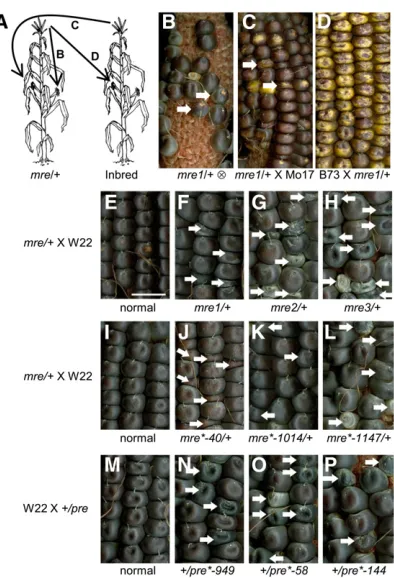
mutants identified from 193 UniformMurghisolates. Reciprocal crosses re-veal sixmremutants and threepremutants. (A) Schematic of pollinations used to screen for parent-of-origin-effect mutants. Self-pollination identified plants heterozygous forrghmutations. Reciprocal crosses with inbred lines were screened forrghkernels in the F1generation. (B) Self-pollination of mre1/+segregates forrghkernels. (C)mre1/+crossed with Mo17 pollen segregates forrghkernels. (D) B73 crossed withmre1/+pollen has all normal kernels. Arrows indicaterghkernels. (E) Normal sibling ofmre13W22, (F)
mre1/+3W22, (G)mre2/+3W22, (H)mre3/+3W22, (I) normal sibling of
mre23W22, (J)mre*-40/+3W22, (K)mre*-1014/+3W22, (L)mre* -1147/+3W22, (M) W223normal sibling ofpre*-949, (N) W223+/pre* -949, (O) W223 +/pre*-58, and (P) W22 3+/pre*-144. White arrows indicate mutant seeds. Bar, 1 cm (shown in E) also applies to F–P.
Table 1 Segregation ofmreandpremutants in W22 crosses
Cross Isolate rgh Normal %rgh Ratio
P(x2) for
1:1 ratio
mre/+3W22 mre1 351 436 44.6 1:1.24 2.431023 mre2 276 450 38.0 1:1.63 1.1310210
mre3 302 333 47.6 1:1.10 0.22
mre*-40 69 162 29.9 1:2.35 9.4310210 mre*-1014 151 280 35.0 1:1.85 5.2310210 mre*-1147 25 121 17.1 1:4.84 1.9310215
the mutant locus was scored using linked markers proximal and distal to each mutant locus. Primer sequences for the molecular markers are inTable S2.
Histochemical staining of developing seeds
Developing ears were harvested from 6 to 19 days after pollination (DAP) of mre1/+ 3 W22, mre2/+ 3 W22, mre3/+3W22, and W223+/pre*-949. Harvest dates were adjusted in the spring and fall season due to temperature differences during the June and November kernel development periods. Kernels were fixed in FAA solution (3.7% formalde-hyde, 5% glacial acetic acid, and 50% ethanol) at 4°overnight. Kernels were dehydrated in an ethanol series and then embed-ded in paraffin or JB-4 plastic embedding media (Electron Mi-croscopy Sciences, Hatfield, PA). Paraffin-embedded sample were cut into 8-mm longitudinal sections close to the sagittal plane, deparaffinized, rehydrated, and counterstained with 1% safranin O and 0.5% Fast Green as described (Baiet al. 2012). Resin-embedded samples were cut into 4-mm sec-tions. The sections were treated with 1% periodic acid for 10 min, rinsed in the running water for 5 min, and then placed in Schiff’s reagent for 30 min. The sections were transferred through three successive baths of 2 min each of 0.5% sodium Figure 3 Map positions for three parent-of-origin-effectrghloci. Inte-grated physical-genetic maps for (A)mre1/+3Mo17, (B)mre2/+3B73, and (C)mre3/+3Mo17 BC1mapping populations. Molecular markers
are not positioned to scale. Each schematic indicates chromosome coor-dinates from the B73_v2 genome assembly for the markers. Recombina-tion frequencies with the mutant phenotypes are given in centimorgans with the number of recombinants and meiotic products scored. The black arrow indicates the mutant locus position.
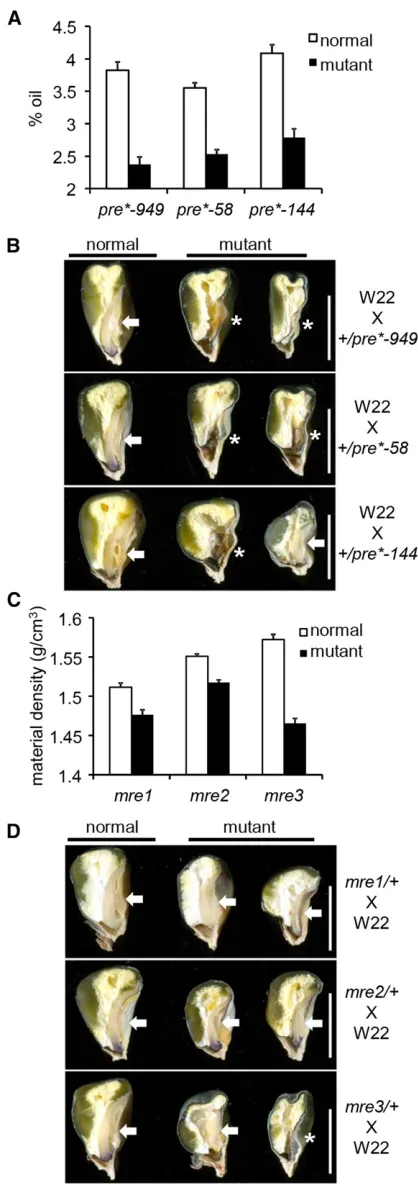
Figure 2 NIR kernel traits and sagittal sections ofmreandpremature seeds. (A) NIR-predicted % oil inpre*-949,pre*-58, andpre*-144. (B) Sagittal sec-tions ofpre*-949,pre*-58, andpre*-144. (C) NIR-predicted material density (grams per cubic centimeter) inmre1,mre2, andmre3. (D) Sagittal sections of
metabisulfite in 1% HCl. Sections were then rinsed in running water for 5 min, counterstained in 1% aniline blue-black in 7% acetic acid for 20 min, rinsed in 7% acetic acid, and rinsed in water. Sections were dried, mounted, and examined by light microscopy. Images were captured with an AmScope digital camera.
Quantitative RT- PCR
Developing kernels ofmre1/+,mre2/+,and mre3/+crossed with W22 were sampled at 14 DAP in the fallfield season. Kernels were cut in half with a transverse section as described (Gomezet al.2009). Total RNA was extracted from the basal section of the kernel. Briefly, 100 mg of ground tissue was mixed with 200ml of RNA extraction buffer (50 mM Tris-HCl, pH 8, 150 mM LiCl, 5 mM EDTA, 1% SDS in DEPC-treated water). The slurry was then extracted twice with 1:1 phenol: chloroform and once with chloroform at 4°for 5 min for each extraction. The aqueous phase was then extracted with TRI-zol (Invitrogen, Carlsbad, CA) and chloroform. RNA was pre-cipitated from the aqueous fraction using isopropanol and washed with 70% ethanol. RNA pellets were resuspended in nuclease-free water (Sigma, St. Louis, MO) treated with Purelink DNAase (Invitrogen). RNA was then further purified using an RNeasy MinElute Cleanup Kit (QIAGEN, Valencia, CA), and 1mg total RNA was used to synthesize complemen-tary DNA (cDNA) with M-MLV reverse transcriptase (Promega, Madison, WI). Quantitative RT-PCR used a StepOnePlus real-time PCR machine (Applied Biosystems, Foster City, CA) with 13SYBR Green PCR Master Mix (Applied Biosystems) as de-scribed (Fouquetet al.2011). The normalized expression level of each gene represents the average of three replicates of three distinct kernel pools relative toUbiquitinusing the comparative cycle threshold (Ct) method (Livak and Schmittgen 2001). The
primers for each marker gene are listed inTable S2.
Data and reagent availability
All data necessary for confirming the conclusions are de-scribed within the article and Supplemental Material.Table S2contains the primer sequences for the molecular markers used in the study. Mutants are available upon request.
Results and Discussion
Parent-of-origin-effect screen
We reasoned that parent-of-origin-effect mutants with low penetrance could be confused with recessive mutations in
large-scale genetic screens, such as the UniformMu genetic screen for defective kernel mutations (McCartyet al.2005). To identify parent-of-origin effects, we reciprocally crossed plants segregating for UniformMu rough endosperm (rgh) seed phenotypes with B73 and Mo17 inbred pollen. Most rgh mutants are seed lethal, and second ears were self-pollinated to identify rgh heterozygotes for each isolate. Parent-of-origin effects were distinguished from dominant mutations by comparing self-pollinations to the reciprocal crosses (Figure 1). Mutants were scored as maternal rough endosperm(mre) if both the self-pollination and cross with inbred pollen segregated for rghphenotypes at similar fre-quencies, while thergh/+pollen failed to cause seed mutant phenotypes. The paternal rough endosperm (pre) mutants segregated forrghphenotypes in self-pollinations and crosses onto inbred ears, while crosses ofpre/+with inbred pollen developed all normal seeds. This strategy requires two ears to be successfully pollinated on individualrgh/+plants. A total of 146rghisolates had sufficient crosses to be screened for both mre and pre phenotypes. An additional 47 isolates lacked thergh/+by inbred cross and were screened for pu-tativeprephenotypes, which could also have been dominant mutations.
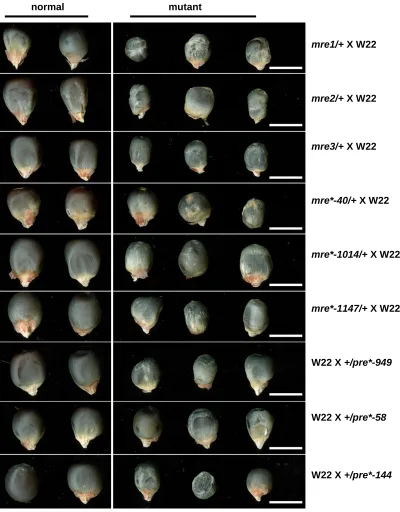
Eight putative mre and seven putativepreisolates were identified and additional reciprocal crosses were completed with the W22 inbred. These crosses showed that sixmreand threepreisolates had consistent parental effects with multi-ple inbred parents (Figure 1 andFigure S1). We found a wide range of segregation ratios for defective kernels in themre andpreisolates (Table 1). Onlymre3had a 1:1 ratio of de-fective to normal seeds, suggesting that mre and pre loci either have reduced transmission or reduced penetrance of therghkernel phenotype.
Mature seed traits of mre and pre mutants
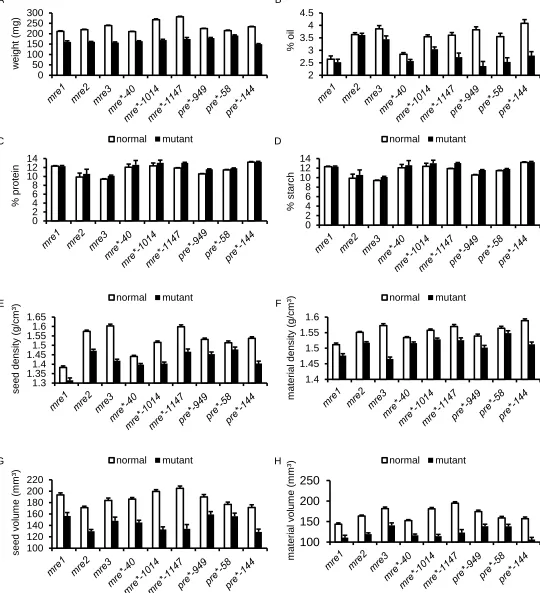
Single-kernel NIR spectroscopy was used to predict kernel composition traits of the mre and preisolates (Spielbauer et al. 2009; Gustin et al. 2013). All mutants reduced seed weight and volume without affecting relative protein and starch content (Figure S3). The threepremutants had signif-icantly reduced oil content, and sagittal sections of mature premutants revealed embryo development defects (Figure 2, A and B). Total and material densities were reduced in most of themreandpremutants (Figure S3). Endosperm storage molecule packing influences seed density, and these reduc-tions are consistent with alterareduc-tions in the mature endosperm Table 2 Transmission ofmreandpremutant alleles in BC1crosses using linked molecular markers
Mutant isolate Reciprocal cross W22 (mutant) Inbred (normal) Ratio Expected ratio Recombinants P(x2) for 1:1
mre1 mre1/+3Mo17 51 44 1.16:1 1:1 5 0.47
Mo173mre1/+ 49 46 1.07:1 1:1 5 0.76
mre2 mre2/+3B73 45 44 1.02:1 1:1 0 0.92
B733mre2/+ 48 50 0.96:1 1:1 2 0.84
mre3 mre3/+3Mo17 53 46 1.15:1 1:1 1 0.48
such as reduced vitreous endosperm inmre1or larger central endosperm air spaces inmre3(Figure 2, C and D).
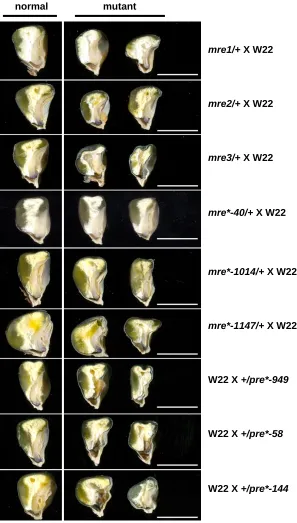
Sagittal mature kernel sections frommreorpremutants showed variable severity in embryo defects, suggesting that many of themreorpreseeds would fail to germinate (Figure S2). However, oil content was not entirely predictive ofmre and premutant germination. Even though mre1and mre2 had no significant reduction in kernel oil content, phenotyp-ically mutant seeds frequently fail to germinate and only a small fraction of themre1/+ andmre2/+ seedlings grow and develop normally (Figure S4). Similarly,mre*-40andmre* -1014 have significantly reduced oil content, yet all mutant seeds germinated withmre/+ seedlings being indistinguish-able from +/+ siblings (Figure S4). All three pre isolates have both low oil and low germination frequency (Figure S4). Theseprephenotypes are surprising, because the muta-genic parents for the UniformMu population were crossed as males, andpremutants that fail to germinate would not be
expected to survive past the initial mutagenic cross (McCarty et al.2005). All threepreisolates have a low frequency ofrgh kernels when crossed onto inbred ears (Table 1), and it is likely that thepremutants have low penetrance of the mutant phe-notype. Both the inheritance patterns and the mature kernel phenotypes of the isolates suggest different developmental mechanisms underlie eachmreandpremutant phenotype.
Mapping of mre1, mre2, and mre3
Complementation groups of parent-of-origin-effect mutants are not possible to determine with traditional allelism tests. We took a molecular mapping approach to identify specificmreandpre loci from this screen. F1crosses between each mutant and B73
or Mo17 were then backcrossed to the respective inbred or to the W22 parent of the UniformMu population. These experi-ments generated BC1backcross mapping populations. Formre1
andmre3, Mo17 was the recurrent mapping parent, and B73 was the recurrent mapping parent formre2. All other isolates failed to segregate for seed phenotypes in any of the BC1
crosses. Themre*-40, mre*-1014,mre*-1147,pre*-58,pre* -144, andpre*-949isolates all showrghkernel phenotypes in F1crosses with B73, Mo17, and W22, suggesting complex
ge-netic mechanisms suppress the phenotypes. Allele-specific im-printing is found in a small fraction of maize genes, which could explain suppression of therghphenotype in BC1crosses to the
B73 or Mo17 inbred lines (Waters et al.2013). If the sup-pressed phenotypes were due to allele-specific imprinting, the parent-of-origin effect is expected to be recovered when F1
plants are crossed with W22 parents, suggesting that inbred variation at the mutant loci is unlikely to explain the loss ofmre andprephenotypes. Presence/absence variation (PAV) can also explain loss of parent-of-origin effects. Inbred differences in gene content and expression contribute significantly to maize phenotype diversity (Springer et al. 2009; Lai et al. 2010; Hansey et al. 2012). It is estimated that up to one-third of endosperm transcripts show PAV expression in diverse geno-types (Jinet al.2016). Thus, there is a large number of poten-tial genetic modifiers forrghkernel phenotypes.
To obtain initial map positions, DNA from individual mu-tant kernels in the BC1 populations was genotyped using
distributed SSR or SNP markers (Liu et al. 2010; Martin et al.2010). Recombination frequencies were calculated for each marker and the physical position of linked markers iden-tified is listed inTable S1. Expanded mapping populations were scored with additional markers. Figure 3 shows the results of these fine-mapping experiments. Themre1 locus was mapped to a 3.33-Mbp interval on the short arm of chro-mosome 4, whilemre2was mapped to a 0.82-Mbp interval on the long arm of chromosome 6. Themre3locus maps to a 2.07-Mbp interval on the long arm of chromosome 10 (Figure 3). None of these mutants overlap with the genetic position of published maternal effect mutants, includingig1,bsl1,stt1, andmel1. These data indicate thatmre1,mre2, andmre3are new maternal effect loci. Interestingly, the mre1 mapping interval overlaps with a known PEG, the maize sbp3 locus (GRMZM2G106798), which has been detected as a PEG in Figure 4 Endosperm defects in mre3. (A–D) Longitudinal sections
multiple inbred combinations (Waters et al. 2011, 2013; Zhanget al.2014). Thesbp3locus encodes a predicted tran-scription factor that is associated withflowering time traits in maize diversity populations (Liet al.2016). As a PEG,sbp3 may also function in seed development, but a hypomorphic allele of a PEG is not expected to cause a maternal effect phenotype. The mre2 and mre3 mapping intervals do not contain previously identified imprinted genes.
Transmission of mre1, mre2, and mre3
Themre1andmre2loci segregate for less than the 1:1 expected ratio ofrghkernels (Table 1), which could indicate incomplete penetrance of the defective kernel phenotype or reduced trans-mission of the mutant loci. We determined the transtrans-mission of each of the mapped loci using linked molecular markers.
Re-ciprocal BC1crosses with heterozygous mutants were sampled
along the length of the ear and genotyped withflanking markers (Table S2). Recombinants between theflanking markers were not included as these kernels could have trans-mitted either the mutant or normal locus. Ratios close to 1:1 of normal tomutantwere observed regardless of the direction of the cross (Table 2). These results indicate that the threemreloci transmit fully through both gametes. Based on the frequency of rghkernels inmre1andmre2crosses, both mutants have in-complete penetrance and a subset of phenotypically normal kernels are expected to be heterozygous for themreloci.
Contrasting endosperm defects in mre3 and mre1
mutant is fully penetrant for the mature rghkernel pheno-type. We compared endosperm cell morphology in mutant mre3/+kernels and normal siblings at two stages of devel-opment (Figure 4). The cellularized maize endosperm differ-entiates into internal starchy endosperm and three epidermal cell fates: aleurone, BETL cells, and embryo surrounding region
(ESR) cells (Sabelli and Larkins 2009). The starchy endosperm cells inmre3mutants are smaller in both developmental stages, but themre/+ cells initiate starch accumulation with similar timing to normal (Figure 4, E and F).
The BETL shows more severe defects inmre3/+ kernels. The BETL can be clearly identified in normal sibling kernels as multiple layers of elongated transfer cells with extensive secondary cell wall ingrowths at 12 DAP and 19 DAP (Figure 4, C and G). The secondary cell wall ingrowths were not found in the BETL region ofmre3/+ kernels, and the internal layers of cells in the BETL region expand isotropically to re-semble starchy endosperm cells (Figure 4, D and H). These cellular phenotypes suggestmre3causes a specific defect in BETL differentiation and bears some similarity with the maize bsl1mutant. BETL cells differentiate in patches of the basal endosperm region inbsl1mutants (Gutierrez-Marcoset al. 2006).
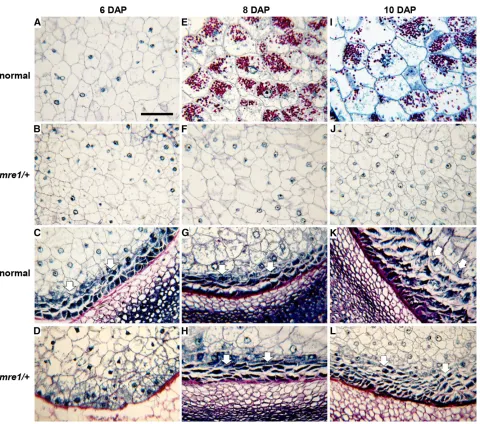
Similar comparisons between mutant and normal endo-sperm show a more global endoendo-sperm development defect in mre1(Figure 5). Themre1/+mutants have a general delay in endosperm development with smaller starchy endosperm cells in all developmental stages. Starchy endosperm cells started to accumulate starch granules at 8 DAP in normal sibling seeds (Figure 5E), but no starch granules formed in mutants by 10 DAP (Figure 5J). Maturemre1/+ kernels do eventually accumulate starch, because they have equivalent levels of starch and protein to normal siblings at maturity (Figure S3). The endosperm development delay is more clearly seen in the BETL region. At 6 DAP, normal sibling kernels have two layers of elongated transfer cells with ex-tensive secondary cell wall ingrowths (Figure 5C), while no BETL cells are observed in mre1/+ mutants (Figure 5D). BETL development is clear in bothmre1/+ and normal sib-lings after 8 DAP (Figure 5, G–K and H–L). These phenotypes are similar to thestt1locus, which causes reduced grainfill through a delay in endosperm growth and differentiation (Phillips and Evans 2011).
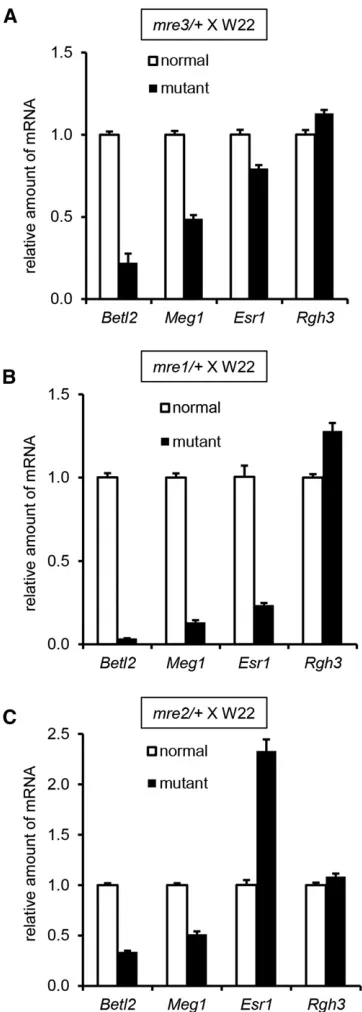
We analyzed RNA expression levels of several endosperm cell type markers inmre1/+ andmre3/+ mutant seeds (Fig-ure 6). BothBetl2andMeg1are specific to BETL cells, while Esr1 is specific for ESR cells. The Rgh3 gene encodes the maize ZRSR2 RNA splicing factor and shows constant expres-sion for the region of the messenger RNA (mRNA) amplified (Fouquetet al.2011). Formre3/+,Betl2andMeg1have large reductions in expression, whileEsr1is significantly reduced albeit to a lesser extent with75% the level of normal ker-nels (Figure 6A). These data are consistent with a primary mre3 defect in BETL differentiation. In mre1/+ kernels, Betl2,Meg1, andEsr1all have fourfold or greater reductions, which are consistent with developmental delay of allmre1 endosperm cell types (Figure 6B).
Ectopic endosperm cell differentiation in mre2 and
pre*- 949
Endosperm cell type marker gene expression inmre2/+ kernels showed reductions inBetl2andMeg1, but more than twofold Figure 6 Quantitative RT-PCR of endosperm cell type marker genes in
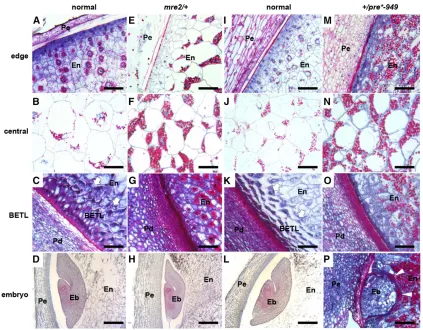
increasedEsr1expression (Figure 6C). These results indicate thatmre2confers defects in BETL development and has ectopic Esr1expression. Longitudinal sections of developingmre2/+ kernels showed multiple cell differentiation defects (Figure 7, A–H). In normal seeds, the exterior edge of the endosperm has an epidermal layer and six to eight starchy endosperm cells with progressive cell expansion toward the center of the endo-sperm (Figure 7A). The mre2/+ mutants greatly expanded starchy endosperm cells are found within two to three layers of the endosperm epidermal layer (Figure 7E). Starch granules are larger in themre2/+ starchy endosperm cells, including in central regions of the endosperm (Figure 7, B and F). In the BETL region, mre2/+ does not develop BETL cells and cells immediately interior to the epidermal layer of the endosperm accumulate starch granules, indicating a starchy endosperm cell fate (Figure 7, C and G). Near the embryo,mre2/+ endo-sperm cells were smaller and without starch granules (Figure 7, D and H). Combined withEsr1expression data, it is likely that mre2causes a greater number of ESR cells to differentiate in the endosperm.
Surprisingly, sections of +/pre*-949 mutant kernels showed similar endosperm development defects as inmre2. The +/pre*-949mutants had expanded starchy endosperm cells with starch granules within one to three layers of the endosperm epidermis (Figure 7, I and M). Starch granules are significantly larger in mutants in the central starchy en-dosperm (Figure 7, J and N). Moreover, +/pre*-949kernels had defective BETL development with the internal cells dif-ferentiating into starchy endosperm like inmre2/+ mutants (Figure 7, K and O).
However, +/pre*-949andmre2/+show contrasting phe-notypes in the ESR region. The +/pre*-949ESR differenti-ates into starchy endosperm and accumuldifferenti-ates large starch granules around the embryo, which is arrested at the globular stage (Figure 7, L and P). Mutant mre2/+ embryos are smaller but normal in morphology with an enlarged ESR domain (Figure 7, D and H). The ESR expresses numerous small peptides of the CLE gene family, which are likely in-volved in cell-to-cell signaling (Opsahl-Ferstad et al.1997; Bonelloet al.2002; Balandinet al.2005). Moreover, ESR cell Figure 7 Kernel development defects inmre2andpre*-949. Longitudinal sections of normal siblings (A–D and I–L),mre2/+(E–H), and+/pre*-949
differentiation defects are associated with embryo develop-ment defects in the maizergh3mutant (Fouquetet al.2011). In Arabidopsis, the EMBRYO SURROUNDING FACTOR1 (ESF1) gene family is required for normal embryo development and is expressed in the micropylar endosperm (Costaet al.2014). En-dosperm expression of ESF1 promotes suspensor cell growth and normal basal development in the embryo proper, indicating an important role for ESR-like endosperm domains in angiosperm embryo development. Thus, it is likely that ectopic starchy cell differentiation in +/pre*-949kernels leads to aborted embryo development. However, the expansion of the ESR in mre2/+ kernels does not appear to alter embryo developmental pattern-ing. These data suggest that a minimum number of ESR cells is necessary to promote embryo development, but that excess ESR is not inhibitory to normal embryo development.
Conclusions
Our screen formreandpremutants has revealed that many parent-of-origin-effect loci show reduced penetrance of de-fective kernel phenotypes. These results help explain the low number of mutant isolates segregating for 50% defective ker-nels in large-scale genetic screens (Neuffer and Sheridan 1980; McCartyet al.2005). Phenotyping of reciprocal crosses with inbred lines appears to be a robust method to identify parent-of-origin-effect kernel mutants in maize.
The mre and pre endosperm defects suggest several developmental mechanisms that can give rise to parent-of-origin kernel defects. Defective or delayed BETL cell differentiation was observed in all mutants. The BETL trans-fers nutrients to the developing seed, and transfer cell defects are likely to limit grain fill. BETL defects appear to be the primary cause of reduced grainfill inmre3and thebsl1loci (Gutierrez-Marcoset al.2006). A more general delay in en-dosperm differentiation was found formre1, which is similar to thestt1locus and the recessivergh3locus (Fouquetet al. 2011; Phillips and Evans 2011). By contrast, multiple endo-sperm cell differentiation defects were found in mre2 and pre*-949, with pre*-949 illustrating the importance of the ESR for maize embryo development. Even thoughmre3and mre1 have some similarity tobsl1 andstt1, these new loci show no bias in transmission. These data indicate that the female gametophyte is fully functional in the mreloci. We believe the most parsimonious explanation for the maternal effects ofmre1,mre2, andmre3is that these mutants encode imprinted, maternally expressed genes. However, no known MEGs overlap with the map locations of these loci. Alterna-tively, the mregene products may be stored in the female gametophyte for later seed development functions, or the mreendosperm phenotypes result from interactions between themrefemale gametophyte andmre/+ endosperm. Molec-ular cloning of themreloci would resolve these models.
Acknowledgments
We thank Wei Wu and Mitzi Wilkening at the Iowa State University Genomic Technologies Facility for genotyping
services. This work is supported by National Science Founda-tion (awards IOS-1031416 and MCB-1412218) and the National Institute of Food and Agriculture (awards 2010-04228 and 2011-67013-30032).
Note added in proof: See Chettoor et al. 2016 (pp.233–248) in this issue, for a related work.
Literature Cited
Bai, F., and A. M. Settles, 2015 Imprinting in plants as a mechanism to generate seed phenotypic diversity. Front. Plant Sci. 5: 780. Bai, F., R. Reinheimer, D. Durantini, E. A. Kellogg, and R. J.
Schmidt, 2012 TCP transcription factor, BRANCH ANGLE DEFECTIVE 1 (BAD1), is required for normal tassel branch angle formation in maize. Proc. Natl. Acad. Sci. USA 109: 12225–12230. Balandin, M., J. Royo, E. Gomez, L. M. Muniz, A. Molina et al., 2005 A protective role for the embryo surrounding region of the maize endosperm, as evidenced by the characterisation of ZmESR-6, a defensin gene specifically expressed in this region. Plant Mol. Biol. 58: 269–282.
Baroux, C., and D. Autran, 2015 Chromatin dynamics during cel-lular differentiation in the female reproductive lineage offl ow-ering plants. Plant J. 83: 160–176.
Bonello, J. F., S. Sevilla-Lecoq, A. Berne, M. C. Risueno, C. Dumas
et al., 2002 Esr proteins are secreted by the cells of the embryo surrounding region. J. Exp. Bot. 53: 1559–1568.
Borg, E., and B. Borg, 2015 New perspectives on counselling in audiological habilitation/rehabilitation. Int. J. Audiol. 54: 11–19. Chaudhury, A. M., L. Ming, C. Miller, S. Craig, E. S. Denniset al., 1997 Fertilization-independent seed development in Arabi-dopsis thaliana. Proc. Natl. Acad. Sci. USA 94: 4223–4228. Costa, L. M., J. Yuan, J. Rouster, W. Paul, H. Dickinson et al.,
2012 Maternal control of nutrient allocation in plant seeds by genomic imprinting. Curr. Biol. 22: 160–165.
Costa, L. M., E. Marshall, M. Tesfaye, K. A. Silverstein, M. Mori
et al., 2014 Central cell-derived peptides regulate early em-bryo patterning inflowering plants. Science 344: 168–172. Del Toro-De Leon, G., M. Garcia-Aguilar, and C. S. Gillmor,
2014 Non-equivalent contributions of maternal and paternal genomes to early plant embryogenesis. Nature 514: 624–627. Del Toro-De Leon, G., D. Lepe-Soltero, and C. S. Gillmor,
2016 Zygotic genome activation in isogenic and hybrid plant embryos. Curr. Opin. Plant Biol. 29: 148–153.
Evans, M. M., 2007 The indeterminate gametophyte1 gene of maize encodes a LOB domain protein required for embryo Sac and leaf development. Plant Cell 19: 46–62.
Evans, M. M., and J. L. Kermicle, 2001 Interaction between ma-ternal effect and zygotic effect mutations during maize seed development. Genetics 159: 303–315.
Fouquet, R., F. Martin, D. S. Fajardo, C. M. Gault, E. Gomezet al., 2011 Maize rough endosperm3 encodes an RNA splicing factor required for endosperm cell differentiation and has a nonauton-omous effect on embryo development. Plant Cell 23: 4280–4297. Gehring, M., V. Missirian, and S. Henikoff, 2011 Genomic analysis of parent-of-origin allelic expression in Arabidopsis thaliana seeds. PLoS One 6: e23687.
Gomez, E., J. Royo, L. M. Muniz, O. Sellam, W. Paulet al., 2009 The maize transcription factor myb-related protein-1 is a key regulator of the differentiation of transfer cells. Plant Cell 21: 2022–2035. Grossniklaus, U., J. P. Vielle-Calzada, M. A. Hoeppner, and W. B.
Gagliano, 1998 Maternal control of embryogenesis by MEDEA, a polycomb group gene in Arabidopsis. Science 280: 446–450. Gustin, J. L., S. Jackson, C. Williams, A. Patel, P. Armstronget al.,
using microcomputed tomography and single-kernel near-infrared spectroscopy. J. Agric. Food Chem. 61: 10872–10880. Gutierrez-Marcos, J. F., L. M. Costa, C. Biderre-Petit, B. Khbaya, D.
M. O’Sullivan et al., 2004 maternally expressed gene1 is a novel maize endosperm transfer cell-specific gene with a maternal parent-of-origin pattern of expression. Plant Cell 16: 1288–1301. Gutierrez-Marcos, J. F., L. M. Costa, and M. M. Evans, 2006 Maternal gametophytic baseless1 is required for development of the central cell and early endosperm patterning in maize (Zea mays). Genetics 174: 317–329.
Hansey, C. N., B. Vaillancourt, R. S. Sekhon, N. de Leon, S. M. Kaeppleret al., 2012 Maize (Zea mays L.) genome diversity as revealed by RNA-sequencing. PLoS One 7: e33071. Hsieh, T. F., J. Shin, R. Uzawa, P. Silva, S. Cohen et al.,
2011 Regulation of imprinted gene expression in Arabidopsis endosperm. Proc. Natl. Acad. Sci. USA 108: 1755–1762. Jin, M., H. Liu, C. He, J. Fu, Y. Xiao et al., 2016 Maize
pan-transcriptome provides novel insights into genome complexity and quantitative trait variation. Sci. Rep. 6: 18936.
Kermicle, J. L., 1971 Pleiotropic effects on seed development of the indeterminate gametophyte gene in maize. Am. J. Bot. 58: 1–7. Kiyosue, T., N. Ohad, R. Yadegari, M. Hannon, J. Dinneny et al.,
1999 Control of fertilization-independent endosperm develop-ment by the MEDEA polycomb gene in Arabidopsis. Proc. Natl. Acad. Sci. USA 96: 4186–4191.
Kohler, C., L. Hennig, R. Bouveret, J. Gheyselinck, U. Grossniklaus
et al., 2003 Arabidopsis MSI1 is a component of the MEA/FIE Polycomb group complex and required for seed development. EMBO J. 22: 4804–4814.
Kohler, C., P. Wolff, and C. Spillane, 2012 Epigenetic mechanisms underlying genomic imprinting in plants. Annu. Rev. Plant Biol. 63: 331–352.
Lai, J., R. Li, X. Xu, W. Jin, M. Xu et al., 2010 Genome-wide patterns of genetic variation among elite maize inbred lines. Nat. Genet. 42: 1027–1030.
Leroy, O., L. Hennig, H. Breuninger, T. Laux, and C. Kohler, 2007 Polycomb group proteins function in the female game-tophyte to determine seed development in plants. Development 134: 3639–3648.
Li, Y. X., C. Li, P. J. Bradbury, X. Liu, F. Lu et al., 2016 Identification of genetic variants associated with maize
flowering time using an extremely large multi-genetic back-ground population. Plant J. 86: 391–402.
Liu, S., H. D. Chen, I. Makarevitch, R. Shirmer, S. J. Emrich et al., 2010 High-throughput genetic mapping of mutants via quantita-tive single nucleotide polymorphism typing. Genetics 184: 19–26. Livak, K. J., and T. D. Schmittgen, 2001 Analysis of relative gene expression data using real-time quantitative PCR and the 2(-Delta Delta C(T)). Method. Methods 25: 402–408. Luo, M., J. M. Taylor, A. Spriggs, H. Zhang, X. Wu et al., 2011 A
genome-wide survey of imprinted genes in rice seeds reveals imprint-ing primarily occurs in the endosperm. PLoS Genet. 7: e1002125. Martin, F., S. Dailey, and A. M. Settles, 2010 Distributed simple
sequence repeat markers for efficient mapping from maize pub-lic mutagenesis populations. Theor. Appl. Genet. 121: 697–704. McCarty, D. R., A. M. Settles, M. Suzuki, B. C. Tan, S. Latshawet al., 2005 Steady-state transposon mutagenesis in inbred maize. Plant J. 44: 52–61.
McElver, J., I. Tzafrir, G. Aux, R. Rogers, C. Ashby et al., 2001 Insertional mutagenesis of genes required for seed de-velopment in Arabidopsis thaliana. Genetics 159: 1751–1763. Neuffer, M. G., and W. F. Sheridan, 1980 Defective kernel
mu-tants of maize. I. Genetic and lethality studies. Genetics 95: 929–944.
Ohad, N., L. Margossian, Y. C. Hsu, C. Williams, P. Repettiet al., 1996 A mutation that allows endosperm development without fertilization. Proc. Natl. Acad. Sci. USA 93: 5319–5324.
Opsahl-Ferstad, H. G., E. Le Deunff, C. Dumas, and P. M. Rogowsky, 1997 ZmEsr, a novel endosperm-specific gene expressed in a re-stricted region around the maize embryo. Plant J. 12: 235–246. Phillips, A. R., and M. M. Evans, 2011 Analysis of stunter1, a
maize mutant with reduced gametophyte size and maternal ef-fects on seed development. Genetics 187: 1085–1097. Sabelli, P. A., and B. A. Larkins, 2009 The contribution of cell
cycle regulation to endosperm development. Sex. Plant Reprod. 22: 207–219.
Scanlon, M. J., P. S. Stinard, M. G. James, A. M. Myers, and D. S. Robertson, 1994 Genetic analysis of 63 mutations affecting maize kernel development isolated from Mutator stocks. Genet-ics 136: 281–294.
Settles, A. M., S. Latshaw, and D. R. McCarty, 2004 Molecular analysis of high-copy insertion sites in maize. Nucleic Acids Res. 32: e54. Settles, A. M., A. M. Bagadion, F. Bai, J. Zhang, B. Barron et al.,
2014 Efficient molecular marker design using the MaizeGDB Mo17 SNPs and Indels track. G3 (Bethesda) 4: 1143–1145. Spielbauer, G., P. Armstrong, J. W. Baier, W. B. Allen, K. Richardson
et al., 2009 High-throughput near-infrared reflectance spec-troscopy for predicting quantitative and qualitative composition phe-notypes of individual maize kernels. Cereal Chem. 86: 556–564. Springer, N. M., K. Ying, Y. Fu, T. Ji, C. T. Yehet al., 2009 Maize
inbreds exhibit high levels of copy number variation (CNV) and presence/absence variation (PAV) in genome content. PLoS Genet. 5: e1000734.
Walbot, V., and M. M. Evans, 2003 Unique features of the plant life cycle and their consequences. Nat. Rev. Genet. 4: 369–379. Waters, A. J., I. Makarevitch, S. R. Eichten, R. A. Swanson-Wagner, C. T. Yehet al., 2011 Parent-of-origin effects on gene expres-sion and DNA methylation in the maize endosperm. Plant Cell 23: 4221–4233.
Waters, A. J., P. Bilinski, S. R. Eichten, M. W. Vaughn, J. Ross-Ibarra
et al., 2013 Comprehensive analysis of imprinted genes in maize reveals allelic variation for imprinting and limited conser-vation with other species. Proc. Natl. Acad. Sci. USA 110: 19639–19644.
Wolff, P., I. Weinhofer, J. Seguin, P. Roszak, C. Beisel et al., 2011 High-resolution analysis of parent-of-origin allelic expression in the Arabidopsis Endosperm. PLoS Genet. 7: e1002126.
Wolff, P., H. Jiang, G. Wang, J. Santos-Gonzalez, and C. Kohler, 2015 Paternally expressed imprinted genes establish postzygotic hybridization barriers in Arabidopsis thaliana. eLife 4: e10074. Xin, M., R. Yang, G. Li, H. Chen, J. Laurieet al., 2013 Dynamic
expression of imprinted genes associates with maternally con-trolled nutrient allocation during maize endosperm develop-ment. Plant Cell 25: 3212–3227.
Xing, Q., A. Creff, A. Waters, H. Tanaka, J. Goodrich et al., 2013 ZHOUPI controls embryonic cuticle formation via a sig-nalling pathway involving the subtilisin protease ABNORMAL LEAF-SHAPE1 and the receptor kinases GASSHO1 and GAS-SHO2. Development 140: 770–779.
Yang, S., N. Johnston, E. Talideh, S. Mitchell, C. Jeffree et al., 2008 The endosperm-specific ZHOUPI gene of Arabidopsis thaliana regulates endosperm breakdown and embryonic epi-dermal development. Development 135: 3501–3509.
Zhang, M., H. Zhao, S. Xie, J. Chen, Y. Xuet al., 2011 Extensive, clustered parental imprinting of protein-coding and noncoding RNAs in developing maize endosperm. Proc. Natl. Acad. Sci. USA 108: 20042–20047.
Zhang, M., S. Xie, X. Dong, X. Zhao, B. Zenget al., 2014 Genome-wide high resolution parental-specific DNA and histone methyl-ation maps uncover patterns of imprinting regulmethyl-ation in maize. Genome Res. 24: 167–176.
GENETICS
Supporting Information
www.genetics.org/lookup/suppl/doi:10.1534/genetics.116.191775/-/DC1
Parent-of-Origin-Effect
rough endosperm
Mutants in Maize
Fang Bai, Mary Daliberti, Alyssa Bagadion, Miaoyun Xu, Yubing Li, John Baier, Chi-Wah Tseung, Matthew M. S. Evans, and A. Mark Settles
normal mutant
mre1/+ X W22
mre2/+ X W22
mre3/+ X W22
mre*-40/+ X W22
mre*-1014/+ X W22
mre*-1147/+ X W22
W22 X +/pre*-949
W22 X +/pre*-58
W22 X +/pre*-144
Figure S1:
Abgerminal kernel phenotypes of
mre
and
pre
mutants with normal siblings. The
mre1/+ X W22
mre2/+ X W22
mre3/+ X W22
mre*-40/+ X W22
mre*-1014/+ X W22
mre*-1147/+ X W22
W22 X +/pre*-949
W22 X +/pre*-58
W22 X +/pre*-144
normal mutant
Figure S2:
Sagittal sections of mature
mre
and
pre
mutants compared with normal siblings.
0 50 100 150 200 250 300 normal mutant w ei gh t (m g) A 2 2.5 3 3.5 4 4.5 normal mutant % oi l B 0 2 4 6 8 10 12 14 normal mutant % s tarc h D 0 2 4 6 8 10 12 14 normal mutant % protei n C 1.3 1.351.4 1.451.5 1.551.6 1.65 normal mutant s ee d de ns ity ( g/c m ³) E 1.4 1.45 1.5 1.55 1.6 normal mutant m ate ri al de ns ity ( g/c m ³) F 100 120 140 160 180 200 220 normal mutant s ee d v ol um e (m m ³) G
100
150
200
250
normal mutant m ate ri al v ol um e (m m ³) HFigure S3:
Single-kernel NIR spectroscopy analysis of kernel traits for the
mre
and
pre
mutants. Spectra were
pre*-58 mre1
mre2
mre3 mre*-1147
pre*-949
pre*-144
normal mre/+ normal +/pre
A
C F
B E
G D
normal mre/+
H
I
mre*- 40
mre*-1014
Figure S4:
Germination and seedling phenotypes of a subset of
mre
and
pre
mutants from
W22 crosses. Normal and mutant siblings are shown in each panel at 7-8 days after planting.
Scale bars are 4 cm in all panels. (
A
)
mre1
, (
B
)
mre2,
(
C
)
mre3,
(
D
)
mre*-40,
(
E
)
mre*-1014
,
(
F
)
mre*-1147
, (
G
)
pre*-949,
(
H
)
pre*-58,
(
I
)
pre*-144
, (
J
) Germination frequency of
mre
normal rgh
cross Isolate planted seedlings % germination planted seedlings % germination
mre/+ X W22
mre1 18 18 100 18 4 22
mre2 18 18 100 18 10 56
mre3 18 18 100 18 3 17
mre*-40 54 54 100 54 54 100
mre*-1014 36 36 100 36 36 100
mre*-1147 18 18 100 18 4 22
W22 X pre/+
pre*-949 18 18 100 18 7 39
pre*-58 18 18 100 18 4 22
Table S1. Linked markers identified from genome-wide screens
Mutant
Marker
Chromosome
B73_v2
Coordinate
Recombination
with mutant (cM)
mre1
umc1164
4
3,260,660
8.3
mre1
umc1294
4
9,800,434
8.3
mre1
phi021
4
13,398,639
4.2
mre2
64263W15
6
117,227,383
13.3
mre2
58953W25
6
121,929,056
8.8
mre2
93673W41
6
142,819,756
5.7
mre3
55983W47
10
14,908,972
11.1
mre3
11881W13
10
124,321,080
0.0
Table S2. Primers for molecular markers used in this study
Marker Name Left Primer Sequence Right Primer Sequence Use Chr
umc1073 CACCAACGCCAATTAGCATCC GTGGGCGTGTTCTCCTACTACTCA map mre1 1
bnlg182 AGACCATATTCCAGGCTTTACAG ACAACTAGCAGCAGCACAAGG map mre1 1
umc1798 TATAACAACGTAGCAAAGCACGGG GATCGACCCTAATCGTCCTCCTAC map mre1 2
bnlg1144 TACTCGTCGTGTGGCGTTAG AGCCGAGGCTATCTAACGGT map mre1 3
bnlg1798 AAGTTGGTGGTGCCAAGAAG AAAAGGTCCACGTGAACAGG map mre1 3
umc1148 AAAATTACAGAGCATTTTGAAAGAAGAA TAGCCGTGTCAGTTTGTAGATCCT map mre1 3
bnlg1754 TACCCGAAGGATCTGTTTGC CCATCGCTGTACACATGAGG map mre1 3
umc1164 AAATAAACGCTCCAAAGAAAGCAA GCACGTGTGTGTGTGTTGTTTTTA map mre1 4
umc1294 GCCTCCAGCTCTCTCGTCTCTT GCCGTCAACGGGCTTAAACT map mre1 4
phi021 TTCCATTCTCGTGTTCTTGGAGTGGTCCA CTTGATCACCTTTCCTGCTGTCGCCA map mre1 4
UFID4-16.21 ATCAAAAACCACTCCCATCG ATAGCTTCCACATCGCTTGC map mre1 4
UFID4-17.722 ATGCAGGGTCTGAAGCTGTT CCTCTGTGGTGATTCGAAGG map mre1; transmission 4
UFID4-20.39 ATGATCCGGTGGACCAATTA GAGTCGACCAGAAGCAGACC transmission 4
UFID4-21.047 CGAGCATCTTGATCCGTTAAA AGAAACGCTATCGCTTGGTC map mre1 4
UFID4-22.71 TGTGCAGACCTAAGCAAGGA CCACGTTGTTGGTCTTAGCC map mre1 4
umc1117 AATTCTAGTCCTGGGTCGGAACTC CGTGGCCGTGGAGTCTACTACT map mre1 4
umc1856 CATGCCTTTATTCTCACACAAACG AGATCTGTTTTGCTTTGCTCTGCT map mre1 4
bnlg105 GACCGCCCGGGACTGTAAGT AGGAAAGAAGGTGACGCGCTTTTC map mre1 5
umc1019 CCAGCCATGTCTTCTCGTTCTT AAACAAAGCACCATCAATTCGG map mre1 5
bnlg1043 TTTGCTCTAAGGTCCCCATG CATACCCACATCCCGGATAA map mre1 6
bnlg345 CGAAGCTAGATGTAGAAAACTCTCT CTTACCAACCAACACTCCCAT map mre1 6
umc1327 AGGGTTTTGCTCTTGGAATCTCTC GAGGAAGGAGGAGGTCGTATCGT map mre1 8
dupssr14 AGCAGGTACCACAATGGAG GTGTACATCAAGGTCCAGATTT map mre1 8
bnlg244 GATGCTACTACTGGTCTAGTCCAGA CTCCTCCACTCATCAGCCTTGA map mre1 9
umc1231 CTGTAGGGCTGAGAAAAGAGAGGG CGACAACTTAGGAGAACCATGGAG map mre1 9
umc1366 GTCACTCGTCCGCATCGTCT CCTAACTCTGCAAAGACTGCATGA map mre1 9
umc1804 GCGGCGAGGTTAAAGGAAAA GGTGTTTAGACACGCAGACACAAC map mre1 9
umc1077 CAGCCACAGTGAGGCACATC CAGAGACTCTCCATTATCCCTCCA map mre1 10
umc1196 CGTGCTACTACTGCTACAAAGCGA AGTCGTTCGTGTCTTCCGAAACT map mre1 10
umc1979 AATTTCGGGAAACAGGCCAT GAGTCCCCGAAACTGAACACC map mre2 6
umc1413 CATACACCAAGAGTGCAGCAAGAG GGAGGTCTGGAATTCTCCTCTGTT map mre2, transmission 6
UFID6-130.13 CTGCTGGAACACCAAACTCA CCAAAGGGAACTTGTGGAAA map mre2, transmission 6
UFID6-132.06 TGACGAGATGGTGCAGAAAG GGATGGGCAACATCATCAAC map mre2 6
UFID6-141.61 ACAACCCTTTGCTTGTCAGC ACAGTCGCCTTTGGTTCAAG map mre2 6
umc1805 TGTGACCTGTGTGGTCTGTGG AGTGCACCAGCTTTTAATCACCTC map mre2 6
umc1246 TCGAGTTTGCTTCTCTCCAGTTTC TGCAGCATATGGCTCTTTATTCAA map mre3, pre1 10
umc1453 AATACCAAGCTGCACTCAGAAACC CGTCAAATCCAGCCTAAGCATC map mre3 10
umc1697 CAACACGTACGAAGCGCAGTC TGCAGCTACCAAGTTAGCAGGAAC map mre3, transmission 10
UFID10-124.08 TGATTTTCTCGAGGATGTTCC CGAATTCCGAGTTGTGAGGT map mre3 10
umc2003 CTCATCGGTTAGCAGCAGCAG GTTCTTAATCGGCACTCCTCGTC map mre3, transmission 10
bnlg1250 CCATATATTGCCGTGGAAGG TTCTTCATGCACACAGTTGC map mre3 10
Betl2 TGCACGCACAACAAGTGGGC AGCATGGCCCGTCGTCATT qRT-PCR
ESR1 ATGCTGTGATGCATGTGGTC TGAGGCATAGCAACATGGAG qRT-PCR
Meg1 TTTGCTGCTCATGCGCATGG GCATGCATGACTACACTGAGCC qRT-PCR
Rgh3 TGAAAAGGCGAGTCATACCC TGTGGCTACTTCGTTCTTGC qRT-PCR