Copyright to IJIRSET www.ijirset.com 681 ISSN (Online) : 2319 - 8753
ISSN (Print) : 2347 - 6710
I
nternationalJ
ournal ofI
nnovativeR
esearch inS
cience,E
ngineering andT
echnology An ISO 3297: 2007 Certified Organization, Volume 2, Special Issue 1, December 2013Proceedings of International Conference on Energy and Environment-2013 (ICEE 2013)
On 12th to 14th December Organized by
Department of Civil Engineering and Mechanical Engineering of Rajiv Gandhi Institute of Technology, Kottayam, Kerala, India
INFLUENCE OF USE OF CONTROLLING, IT USAGE,
LEARNING AND TRAINING ON SME PERFORMANCE
Firoz N, Divyanjaly C K, Biju Augustine P
3rd Semester M.Tech in IEM, Department of Mechanical Engineering, RIT Kottayam, Kerala, India 3rd Semester M.Tech in IEM, Department of Mechanical Engineering, RIT Kottayam, Kerala, India
Associate Professor, Department of Mechanical Engineering, RIT Kottayam, Kerala, India
ABSTRACT
This article explores the interaction between SME performance and firm specific variables including control methods, effect of training, learning and IT usage. Data has been collected by means of a questionnaire survey administered among the selected SMEs. Analysis shows that the perceived use of controlling, IT usage and learning orientation influences SME performance and take a role in classifying firms between the above performing and below performing groups. Limited resources and autocratic decision making by the key persons attribute the less efficient control by SMEs. Updating the knowledge resources and use of modern tools of loading and scheduling are suggested to improve the SME performance. Use of IT and IS are to be encouraged to improve the controlling function.
KEYWORDS: SMEs, Production Control, Information technology, SWOT analysis
NOMENCLATURE:
SME Small and Medium Enterprises IT Information Technology
IS Information Systems
PPC Production Planning and Control
1. INTRODUCTION
Copyright to IJIRSET www.ijirset.com 682 area of modernising the PPC usage in SMEs can contribute much to improve SME performance. Most of the research literature in the advancement of PPC is reported from large firms. But the importance of modern PPC in SMEs and the related benefits derived from improved SME performance to the economy are being realizing by the business world [3].
2. OBJECTIVE OF THIS STUDY AND ORGANIZATION OF ARTICLES IN THIS PAPER
This paper reports the exploratory findings that link the use of control methods, IT, learning and training with SME performance. A frame work to improve Production Control, IT, Standardization, Learning and Training has been formed after reviewing the SWOT analysis conducted in the SME context. The framework shows the way in which the SMEs can work within their constraints and pressures to use their PPC effectively and thereby improve the production performance.
A questionnaire survey tool was developed to rate the awareness of modern PPC techniques, IT usage, learning, training facilities and SME performance.
Data has been collected by directly approaching the selected SME key personnel. Analysis was carried out using appropriate statistical tools. Linkages between the variables are explained and weaker areas are identified for improvements. Paper ends with the conclusions for improving the use of control in SME.
3. FINDINGS OF THE SWOT ANALYSIS CONDUCTED AMONG THE SMEs
Major opportunities for SMEs included the supportive measures by the government and opportunity to grow and to reap benefits from the supply chain partnership opportunities with large firms [4]. Chance to get outside exposure and IT benefits are also observed as the major opportunities [5]. The offer to join as an ancillary firm is an opportunity to a competent SME, at the same time a threat for a non-competent SME because of the rapid rate of internationalization and further growth opportunities. Major weaknesses/ threats faced by the SMEs included extreme competition in the global market, scarcity of the resources, power shortage and shortage of manpower. Need to modernize with increased learning, standardization and IT are the environment pressures and challenges to Indian SMEs [6].
FIGURE 1. MODEL LINKING PPC USAGE AND SME PERFORMANCE
Copyright to IJIRSET www.ijirset.com 683
4. DESCRIPTION OF THE RESEARCH METHODOLOGY
After having discussion with experts and based on extensive literature review, a diagnostic questionnaire schedule was prepared. The SMEs in the membership list of the Small and Medium Enterprise Association of Kerala State has been selected as the sampling frame. A convenience cum cluster sampling was adopted because of the lack of feasibility of e-mailed or telephonic survey. The questionnaire was administered among the selected SMEs to reveal the demographics, firm performance, awareness of modern PPC methods, current use of production control, IT usage and extent of learning and training. After editing and screening, 382 responses were used for the analysis.
Standard indicators for measuring the variables were selected from published research [8] and are properly validated [8], [9], [10]. Most of the questions are of five point Likert scale type and few open ended questions are also used. Awareness of modern PPC tools is linked with the use of control and the nature of linkage is explained. Similarly, the link between use of control and firm performance has been studied. Similar studies have been conducted by linking the use of control with IT usage, learning and training. Factors influencing the use of control in SMEs are explored, their influence is studied in detail and alternatives for improving the situation are proposed.
5. ANALYSIS OF THE DATA
5.1 Attention given to Modern PPC Techniques
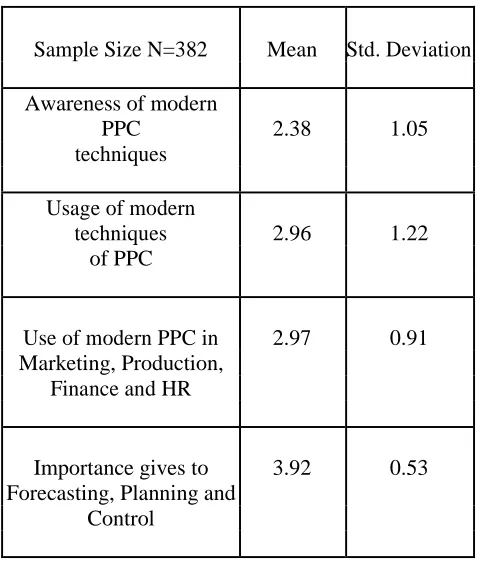
Extent of use of modern PPC techniques in production, HR and budgeting has been measured using a five point scale. Table 1 shows the mean scores.
TABLE 1.AWARENESS OF MODERN PPC TECHNIQUES
Sample Size N=382 Mean Std. Deviation
Awareness of modern
PPC 2.38 1.05
techniques
Usage of modern
techniques 2.96 1.22
of PPC
Use of modern PPC in 2.97 0.91
Marketing, Production, Finance and HR
Importance gives to 3.92 0.53
Forecasting, Planning and Control
5.2 Extent of Use of Control Measures
Copyright to IJIRSET www.ijirset.com 684 scores of each field are shown in Table 2.
a)Use of scheduling, b)Use of sequencing, c)Critical ratio, d)Schedule violations
e)Gap between forecast and actual figures, f)Gap between forecast and planned g)Gap between planned and produced
The scores of the items, except for the “use of scheduling” are found satisfactory (average scores are more than the benchmark value of 3, based on the research work of Singh et al. [7]). T – test results except for the item - scheduling differ from standard value (to the higher or acceptable side).
TABLE 2.USE OF CONTROL MEASURES IN SMEs
Sample Size N=382 Mean Std.
Deviation
Usage of Scheduling 2.90 1.126
Critical Ratio 3.58 .647
Violation of Production
Schedules 3.40 .588
Gap between Forecast and
Demanded 3.08 .536
Gap between Forecast and
Planned 3.14 .494
Gap between Planned and
Produced 3.40 .570
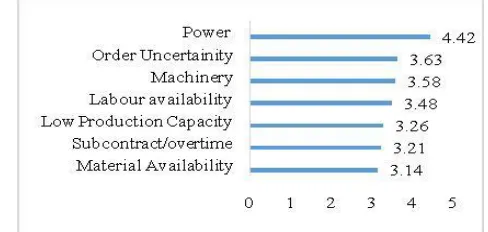
Figure 2 shows the factors influencing the effectiveness of control measures in SMEs. Availability of power, managing order uncertainty, out dated machinery and availability of labour were ranked as the important factors influencing control.
Copyright to IJIRSET www.ijirset.com 685
5.3 IT Usage
To measure the usage of IT in SME, questions for revealing the extent of use of computers, computer proficiency and number of computers used in the firm were asked. Average item scores are shown in Figure 3. All the items recorded low scores (compared to the standard score of 3). Scores less than the bench mark figures indicates that the SMEs are lagging in the area of e –literacy and computer usage.
FIGURE 3AVERAGE SCORE OF IT USAGE
5.4 Learning and Training by the Firm
FIGURE 4. AVERAGE SCORE OF LEARNING AND TRAINING ORIENTATION
The general perception on learning orientation and training needs were revealed by means of six questions [12]. Except for the item “general perception on the worth of training”, all other items recorded above the bench mark scores. The low scores (shown in Figure 4) of the worth of training shows the limitation of SMEs to utilize the benefits of training facilities.
5.5 Firm Performance
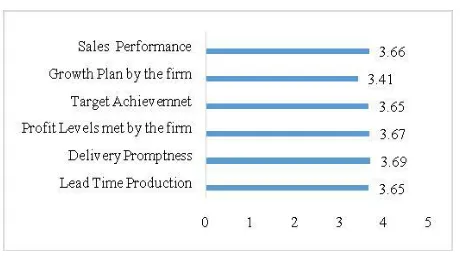
Following indicators were used for measuring firm performance: Sales performance, Growth plan by the firm, Target achievement, Profit levels met by the firm and Delivery promptness [13]. Mean scores are shown in Figure 5.
Copyright to IJIRSET www.ijirset.com 686 FIGURE 5 AVERAGE SCORE OF FIRM PERFORMANCE
5.6 Linking Firm Performance and Use of
Control
A structural equation model (SEM) has been developed to test the linkage between the use of control and firm performance. The construct “Use of Control” included six items and the construct “firmper” included Chifour-squareitms=54.3after(53df)conducting the tests of validity and reliability. Face validity of the p = .42 constructs are established from previous research works. Unidimensionality of the constructs were ensured from the high factor loading scores and inter item correlation. Satisfactory values of discriminant validity were established by comparing the variance– extracted estimates for each factor with the squared values of inter construct correlations.
FIGURE 6 STRUCTURAL MODEL LINKING USE OF CONTROLLING AND FIR PERFORMANCE
Relation between firm performance and use of control is confirmed by the SEM model. A medium level of relationship (.49) is found from the value of the standardized regression coefficient. Overall model fit was tested using the three measures, namely Chi – Square (χ2) Goodness of Fit (GOF) index, Absolute Fit Index – Root Mean Square Error of Approximation (RMSEA) and Incremental Fit Index – Comparative Fit Index (CFI). An acceptable χ2
value of 54.3 significant at p = .42 is obtained. RMSEA value of .11 and CFI value of .986 indicate that the model fits very well. The SEM output is shown in Figure 6.
5.4 Mediating Role of Learning
Copyright to IJIRSET www.ijirset.com 687 From the values of correlation between IT Usage, Use of planning and Firm Performance, it is concluded that the Learning Orientation is of very much importanceChito-squarethe =SME137.2 (88to df)improve the firm
FIGURE 7DIRECT AND INDIRECT EFFECTS DUE TO THE MEDIATION OF LEARNING
6. CONCLUSION AND IMPLICATIONS OF THE STUDY
Important findings from the study are summarized as follows:
Lack of infrastructural resources like power, machinery and capacity influence the use of controlling.
Learning orientation, IT usage and e –literacy are of lower levels but they are very important to the firm.
Attitudes on the worth of learning, innovation and training are of low level.
SMEs have satisfactory level of competencies to manage in the local level, but need updating the practice of modern techniques to compete in the global level.
From the study of use of controlling in SMEs and other variables, it can be concluded that the process of imparting education and training to the key person and the supporting staff are recommended. Importance of learning, training and better usage of IT to improve the PPC usage and the firm performance is to be highlighted. The study indicates very limited level use of controlling tools by the SMEs. Awareness of the proper usage of the PPC tools should be given to the people concerned.
REFERENCES
[1] Saini, D. S., 2008. “Managing the human resources in Indian SMEs”. Journal of World Business, 43, 2008, pp. 417-434
[2] Garengo, P., 2009. “A performance measurement system for SMEs taking part in quality award programmes”. Total Quality Management, Vol. 20, No. 1, pp. 91-105
[3] Panizzolo, R., Garengo, P. and Sharma, M. K., 2012. “Lean Manufacturing in developing countries: Evidence from Indian SMEs”, Production Planning and Control, Vol. 23, Issue 10-11., pp 769-788.
[4] Kalpande, S.D., Gupta, R.C., and Dandekar, M. D., 2010. “A SWOT Analysis of SMEs implementing TQM”. International Journal of Business, Management and Social Sciences”, Vol. 1, No. 1, pp 59-64.
[5] Islam, M., and Karim, A., 2011. “Manufacturing practices and performance”. International Journal of Quality and Reliability Management, Vol 28, No. 1, pp 43-61.
[6] Dangayach, G.S., and Deshmukh, S.G., 2001. “Manufacturing strategy: literature review and some issues”. International Journal of Operations and Production Management, Vol. 21, No. 7, pp. 884-932.
[7] Singh, R. K., Garg, S. K., and Deshmukh, S. G., 2010. “Comparative Study of strategies of Indian SME and large scale organizations”. South Asian Journal of Management, Jul-Sep
[8] Mc Dermott, C. M. and Prajogo, D. I., 2012. “Service innovation and performance in SMEs”, International Journal of Operations and Production Management, Vol. 32, No. 2, pp. 216-237..