WEIGHTED AVERAGE ANALYSIS APPROACH FOR
HAND GESTURE RECOGNITION USING ANN
Mrs. Meenakshi Marathe
1, Dr. Shantanu Dixit
21,2
Electronics Department, wit/Solapur University (India)
ABSTRACT
The Gesture recognition interface acts as a communication channel between humans and machines. The human-machine interaction is similar to human-human interaction, in which, the valuable information are communicated using the human organs like hand gesture, head movement, face expression, voice communication and overall body posture. Gestures are physical positions or movements of a person's fingers, hands, arms or body used to convey information. A primary goal of hand gesture recognition research is to create a system which can identify specific human hand gestures for counting number of fingers and use them to convey information or for device control. Gesture recognition is the process by which gestures formed by a user are made known to the system. There are different methods of Gesture Recognition. Here we are using feature extraction and Neural Network for hand Gesture recognition.
Keywords
:
Hand Gesture Recognition, Image Processing, Matlab, Neural Network, Pattern
Recognition.
I.INTRODUCTION
Gestures are physical positions or movements of a person's fingers, hands, arms or body used to convey
information. Hand gestures, i.e. gestures performed by hand fig.1 shows different hand gestures. Gesture
recognition is the process by which gestures formed by a user are made known to the system. Since the
introduction of the most common input computer devices not a lot have changed. This is probably because the
existing devices are adequate. It is also now that computers have been so tightly integrated with everyday life,
that new applications and hardware are constantly introduced. The means of communicating with computers at
the moment are limited to keyboards, mice, light pen, trackball, keypads etc.
These devices have grown to be familiar but inherently limit the speed and naturalness with which we interact
with the computer. In recent years there has been a great deal of studies aimed at the inconvenience of human
computer intercommunication tools such as keyboard & mouse. As one of the alternative gesture recognition
methods have been developed by which a variety of commands can be used naturally. Since conventional input
devices need a great deal of technical education, many researches feel a great interest in & attach importance to
hand gesture recognition. In the present day, framework of interactive, intelligent computing, an efficient human –computer interaction is assuming utmost importance in our daily life [1].The major tools used for this purpose
are extracted from a sequence of video images. But the major disadvantage of HMMs is that it is based on
probabilistic framework [4]. For large data sets ANNs have been used for representing & learning the gesture
information. ANNs is mostly used for recognizing a static posture.
Fig.1 Different Hand Gestures
A pattern recognition system will be using a transform that converts an image into a feature vector, which will
then be compared with the feature vectors of a training set of gestures. The final system will be implemented
with a neural network.
Gesture recognition has a wide range of applications. It finds it suitability for the peoples with physical
disabilities [4]. It enables very young children to interact with computers. It also helps for recognizing sign
language [5]. It can be also effectively used in communicating in video conferencing [6]. Limited set of hand
gestures from hand images can be used for controlling the robot motions [7].
The goal of this project is to develop a program implementing gesture recognition. At any time, a user can
exhibit his hand doing a specific gesture for counting number of fingers in front of a video camera linked to a
computer. The program has to collect pictures of this gesture, analyse it and to identify the sign shown by the
user in the input picture.
II.PROPOSED METHODOLOGY:
The proposed technique depends on the following approach
2.1 Image creation
The images are taken by database.
2.2 Pre-processing
It is used to filter out noise from the image. Image captured by the camera contains noise like impulse noise &
Salt-pepper type noise. Salt –pepper noise is one of the types of the saturated impulse noise. This type of noise
is removed by using Median filter.
2.3 Feature Extraction
2.3.1 Subtraction
Hand detection: To identify the hand gesture, the first needed step is detecting the hand from the input frame.
Two commonly used techniques are background subtraction and skin color filter. In the proposed solution, we
use the first method. In background subtraction method, the image of background is captured as a reference
image. The plain background image is subtracted .from the image having hand with background that is the
Target image. The resulting image is only hand. This is the simple & easiest method of extraction.
2.3.2 Segmentation
Thresholding is used for clarity. Thresholding by Hysteresis method is used. The hysteresis will give the
information regarding which point is to select as the threshold. Also it will convert the image into the binary
form. So that it will be easy for further processing.
2.3.3 Thinning
Thinning is a operation that is used to remove selected foreground pixels from binary images. In this object is
converted into the set of digital arcs. These arcs are lying roughly along the medial axis. That is it will give
reduced amount of the data, reducing the time required for processing. The border pixel having more than one
neighbour is removed, converting into the thin line. It can be used for several applications, but is particularly
useful for skeletonization. In this mode it is commonly used to tidy up the output of edge detectors by reducing
all lines to single pixel thickness. Thinning is normally only applied to binary images, and produces another
binary image as output.
2.4 Pattern Recognition
CreatingTrainingsets: The pattern recognition block consists of creating the training sets from the images. Here
the input & its expected output are known & according to that the neural network is trained, which calculates the
weight & bias? This creates the Training sets.
Testing: For testing, the unknown image is given as the input to network, which is then compared with the
training set. Depending upon the match it gives the output.
III. THE DIFFERENT ISSUES:
3.1 Collecting the pictures
First of all, and obviously, it will be necessary to collect pictures. There is a choice to do concerning the way we
want to collect these pictures, given that it depends on how we implement the main program. Running in the
MATLAB environment requires the pictures to be saved in memory and called back when running the program,
because the Image Acquisition Toolbox is not available on the MATLAB version used for the design of the
program.
3.2 Finding the hand
Now, let‘s suppose that a set of representative pictures is provided. We need then to analyse the picture and find
the relevant part of the picture. Indeed the user will never put his hand in the same area of the picture.
3.3 Zooming on the hand
According to the requirements, the video camera is not supposed to move. This piece of information gives a
huge advantage that allows simplifying the zooming process. Indeed, it implies that the background is more or
less always the same. In all what follows, it will be supposed that in the picture, we can just find the hand and
the background: no other object should be present. As a consequence, it will be impossible to exhibit
simultaneously the two hands and expect the program to process them both.
For hand cropping scanned the image from left to right or vice-versa and from top to bottom or vice-versa in
order to detect the wrist and then the minimum and maximum positions where the white pixels end was
determined and based on that cropping is done.
IV.NEURAL NETWORKS
When speaking about image recognition or sign classification, the most widespread solution is the neural network. It‘s a highly efficient method that has been proven able to distinguish and classify with an amazing rate
of performances. There are few issues linked to neural network solutions. First of all, it will be necessary to
choose a network, say: How many hidden layers? How many neurons per layer? Then, it will be required to
choose some learning parameters, say: How many epochs? How many learning examples?
Then, it will be possible to train the network with a full set of examples and finally to use in real time
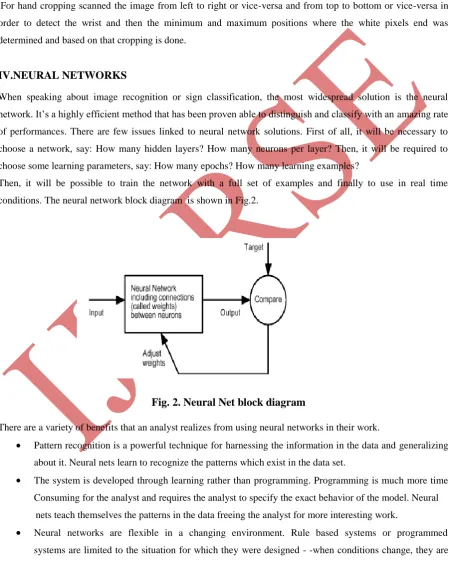
conditions. The neural network block diagram is shown in Fig.2.
Fig. 2. Neural Net block diagram
There are a variety of benefits that an analyst realizes from using neural networks in their work.
Pattern recognition is a powerful technique for harnessing the information in the data and generalizing
about it. Neural nets learn to recognize the patterns which exist in the data set.
The system is developed through learning rather than programming. Programming is much more time
Consuming for the analyst and requires the analyst to specify the exact behavior of the model. Neural
nets teach themselves the patterns in the data freeing the analyst for more interesting work.
Neural networks are flexible in a changing environment. Rule based systems or programmed
no longer valid. Although neural networks may take some time to learn a sudden drastic change,
they are excellent at adapting to constantly changing information.
Neural networks can build informative models where more conventional approaches fail. Because
neural networks can handle very complex interactions they can easily model data which is too difficult
model with traditional approaches such as inferential statistics or programming logic.
Performance of neural networks is at least as good as classical statistical modeling, and better on most
problems. The neural networks build models that are more reflective of the structure of the data in
significantly less time.
V. ARCHITECTURE
In this section we study one of the most used type of neural networks, the multi-layer feedforward network, known also as the multi-layer perceptron. Fig.3 shows the basic architecture of the multi-layer feedforward neural network. It consists of a set of neurons, also called processing units, which are arranged into two or more
layers. There is always an input layer and an output layer, each containing at least one neuron. Between them
there are one or more ‗hidden‘ layers. The neurons are connected in the following fashion: inputs to neurons in
each layer come from outputs of the previous layer, and outputs from these neurons are passed to neurons in the
next layer. Each connection represents a weight. In the example shown in Fig. 3, we have four inputs (for
example four seismic attributes: A1, A2, A3, A4), one ‗hidden layer‘ containing three neurons and an output
neuron (for example, measured porosity). The number of connections is 15, i.e. we have 15 weights.
Fig 3: Feed forward neural network architecture
The neurons are information-processing units that are fundamental to the operation of a neural network. Fig. 4
shows the model of a neuron. We may identify three basic processes of the neuron model:
each of the input signals xj is multiplied by the corresponding synaptic weight wj
summation of the weighted input signals
Mathematically the process is written as:
Neuron‘s output = f ( )
Where:
Wj– synaptic (connection) weights
Xj– neuron inputs
f (.) – Activation function
The activation function defines the output of a neuron in terms of the activity level at its input. The sigmoid function is by far the most common form of activation function used in the construction of artificial neural networks. It is defined as a strictly increasing function that exhibits smoothness and asymptotic properties.
Fig 4: A model of a neuron
VI.WEIGHTED AVERAGING ANALYSIS
In order to understand the basic idea that is discussed here, let‘s consider the differences and the common points
between the methods that have already been introduced:
The Pixel Counting method and the Edges Counting method were some very simple solutions, but their
problem was they were not efficient enough. Their advantage was their low-complexity level for the
implementation, given that they were geometrical solutions.
The Neural Networks solution has been proven quite more efficient, but it requires training, and special
management and processing of the binary picture. Moreover, when looking at the weights of the
input layer, it appears that the neural network just realizes a kind of weighted averaging.
Hence, the motivation in this section is to try to realize weighed averaging by a simpler way to increase
efficiency of algorithm.
That is to say that the algorithm has to realize the following operations:
WA=
Estimate the number of fingers in the picture using:
If WA< 30 then
Number _of _fingers=1
If 30<WA< 30 then
Number _of fingers=2
If 170<WA< 470 then
Number _of fingers=3
If 470<WA< 30 then
Number _of fingers=4
If WA< 30 then
Number _of fingers=5
NOTE: In such calculus, the bound for the three and a fourth finger, for example, has been determined using
3*100*3 and 4*100*4, say the general equation is:
WA=100[No. of edges/2]
The consequence is that the distance between typical WA values (values of the weighted averaging) increases at
an exponential rate, and that makes the classification less sensitive to errors. Indeed, in this case, the bound
between two close possibilities is always large: for example it has been said that the typical WA when 5 fingers
is (960+1600)/2=1280. An error can occur only if the calculated WA, which should be 1280, is under 930, the
calculation error has to be bigger than 350. This can happen only if there are a lot of errors on the number of edges in each column and if the relative dimensions of the fingers are ―strange‖: one finger very thick, and three
fingers very thin and the thumb.
In order to understand the efficiency of this method, let‘s compare it to the bound that would have been
considered in a simple pixel counting algorithm: for four fingers, the sum of the pixel will be about 3*60=180,
and for five fingers, it would be equal to 4*60=240. The bound between 4 and 5 fingers would be
(180+240)/2=210. An error on five fingers happens when less than 210 pixels are counted in the columns 15 to
25. The margin is: 240-210=30.
When comparing the error margins, it appears that without any weights, it is equal to 30, and that with weights
chosen as number of edges in the column of the analysed pixel, this margin tend to 350, so more than 10 times the previous margin! That‘s why this method is quite better the simple pixel counting one: different number of
fingers lead to different ranges that are separated by very large spaces that only huge errors can get through, and
Without weights, confusion may occur when several fingers are exhibited (three, four or five fingers). The use
of weights makes these confusion quite rarer because three four and five fingers pictures turn into WA values
that are very distant one to the other.
VII CONCLUSION
For the neural network, 100% of the training set was correctly classified and 96% of new inputs were also
classified. Such results are quite good given that it does not use any training, any standard-deviation calculus or
any save of any net-matrix. The processing is quite fast given that no sophisticated calculus is required when
running the program. As a conclusion, it appears that there are plenty of ways to solve such problems. If the
neural network method is the most efficient solution when considering the rate of errors, another method based
on attributing weights to each column of the input picture, is quite easier to develop and manipulate, and has
also been proven very efficient.
REFERENCES
[1]. Sushmita Mitra, Tinku Acharya, 2007,‖ Gesture Recognition: A Survey‖, IEEE Transactions on
Systems, Man, And Cybernetics— Part C: Applications and views, Vol. 37, No. 3, pp311-323.
[2]. Sebastein Marcel, Oliver Bernier, 2005, ― Hand gesture recognition using input-output Hidden Markov
models‖, IEEE Transactions on Pattern recognition & Machine intelligence, Vol. 27, No. 8. pp-347-362.
[3]. Yu Yuan, Ying Liu, Kenneth Barner, 2005, ―Tactile gesture recognition for people with disabilities‖,
International conference on Accoustic, speech & Signal Processing, Vol. 5,pp. 461-464.
[4]. Kenji Oka, Yoichi Sato, Hideki Koike, 2002, ―Real-Time Fingertip Tracking and Gesture Recognition‖,
IEEE trans. Computer Graphics & Applications, pp 64-71.
[5]. Sylvie, C.W., Ong & Surendra Ranganath, 2005, ―Automatic Sign Language analysis: A survey & the future beyond Lexical Meaning.‖, IEEE Transaction on Pattern recognition & Machine intelligence, Vol.
27, No. 6. Pp-873-891.
[6]. Jose Antonio Monteno, Luis Enrique Sucar, 2006, ― A decision theoretic video conference system based
on gesture recognition‖, Proceedings of the 7th Intrnational conference on Automatic face & gesture
recognition, Issue 10, pp. 387-392.
[7]. Asanterabi Malima, Erol Özgür, and Müjdat Çetin, 2006, ― A Fast Algorithm for vision based hand
gesture recognition for robot control ―, IEEE transaction on signal processing & communication
Applications. pp. 1 – 4
[8]. Akio Ogihara, Hirishi Matsumoto & Akira Shiozaki, 2006, ―Hand region extraction by background
subtraction with renewable background for hand gesture recognition‖, IEEE International symposium on