Meet-in-the-Middle Attacks and Structural
Analysis of Round-Reduced PRINCE
Patrick Derbez1 and Léo Perrin2? [email protected]
1 IRISA, University of Rennes 1 2 SnT, University of Luxembourg
Abstract. NXP Semiconductors and its academic partners challenged the cryptographic community with nding practical attacks on the block cipher they designed, PRINCE. Instead of trying to attack as many rounds as possible using attacks which are usually impractical despite being faster than brute-force, the challenge invites cryptographers to nd practical attacks and encourages them to actually implement them. In this paper, we present new attacks on round-reduced PRINCE includ-ing the ones which won the challenge in the 4, 6 and 8-round categories the highest for which winners were identied. Our rst attacks rely on a meet-in-the-middle approach and break up to 10 rounds of the cipher. We also describe heuristic methods we used to nd practical SAT-based and dierential attacks.
Finally, we also present an analysis of the cycle structure of the internal rounds of PRINCE leading both to a low complexity distinguisher for 4-round PRINCE-core and an alternative representation of the cipher valid in particular contexts and which highlights, in these cases, a poor diusion.
Keywords: PRINCE, practical attacks, meet-in-the-middle, SAT-solver, statistical analysis
1 Introduction
When tasked with assessing the security of a block cipher, cryptanalysts have now a broad range of tools at their disposal: dierential attack [1], linear at-tack [2], meet-in-the-middle attack [3], etc. The main purpose of a security anal-ysis is usually to identify aws in the design of a primitive and then to illustrate their gravity through the description of an attack covering as many rounds as possible. However, applicability of said attacks in a realistic situation is usually not the rst objective of the cryptanalyst. A simple reason for this is that as
?Patrick Derbez and Léo Perrin were supported by the CORE ACRYPT project from the Fond National de Recherche (Luxembourg).
c
IACR 2015. This article is the full version of the article published by
our understanding of the design of block ciphers improved, the ease of identify-ing practical attacks decreased. Furthermore and in accordance with the famous maxim attacks only get better, an impractical attack submitted at a given time may later be improved.
While impractical attacks provide the academic community with valuable insights into the security provided by dierent block ciphers, their components, their design strategies, etc., crypanalysis in the industry is more focused on prac-tical attacks. In order to promote this view, the Technical University of Denmark (DTU), NXP Semiconductors and the Ruhr University of Bochum challenged the cryptographic community [4] with nding low data complexity attacks on the block cipher PRINCE [5]. More precisely, they accept attacks requiring only at most220chosen plaintexts or230known plaintexts. Furthermore, extra rewards (from 1000 to 10000e) are given for attacks on at least 8 rounds which require at most245 bytes of memory (about 32 Terabytes) and at most264 encryptions of the round-reduced variant attacked.
Studying PRINCE in this setting may provide valuable data on multiple ac-counts. First of all, PRINCE is a lightweight block cipher, meaning that it is intended to be run on processors with little computing power to devote to secu-rity related algorithm or on hardware where every logical gate counts. Research on this topic is intense nowadays as the need for such primitives becomes increas-ingly pressing, see [6] for an extensive review of the algorithms that have been proposed. Second, PRINCE implements a simplied version of the so-called FX construction: encryption under key (k0||k1) consists in xor-ingk0 to the plain-text, applying a block cipher called PRINCE-core keyed withk1and then output the result xor-ed with L(k0)where Lis a simple linear bijection. This strategy allows for a greater key size without the cost of a sophisticated key schedule. However, it is impossible to make a security claim as strong as for a more classical construction. Finally, PRINCE-core has a unique property calledα-reection. If
we denote byEc,k1 the encryption under PRINCE-core with subkeyk1, then the corresponding decryption operation isEc,k1⊕αfor a constantα. In other words, decryption is merely encryption under a related-key. The consequences of this property have already been studied and, in particular, some values ofαdierent
from the one used have been showed to lead to weaker algorithms [7].
PRINCE has already been the subject of several cryptanalyses, notably [8] where the security of the algorithm against multiple attacks was assessed, [7] which investigated the inuence of the value of α, [9] which described
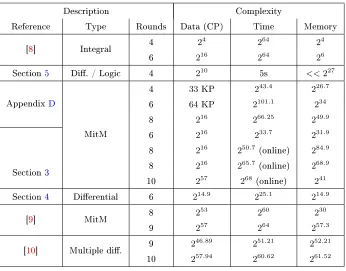
Meet-in-the-Middle attacks on the block cipher and, nally, [10] proposed the best attack to date in terms of number of rounds attacked. A list of the cryptanaly-ses of round-reduced PRINCE is provided in Table 1. Attacks working only on PRINCE-core or for modied versions of PRINCE (dierentαor S-Box) are not
shown.
Description Complexity
Reference Type Rounds Data (CP) Time Memory
[8] Integral 4 2
4
264 24
6 216 264 26
Section5 Di. / Logic 4 210 5s <<227
AppendixD
MitM
4 33KP 243.4 226.7
6 64KP 2101.1 234
8 216 266.25 249.9
Section3
6 216 233.7 231.9
8 216 250.7 (online) 284.9
8 216 265.7 (online) 268.9
10 257 268 (online) 241
Section4 Dierential 6 214.9 225.1 214.9
[9] MitM 8 2
53 260 230
9 257 264 257.3
[10] Multiple di. 9 2
46.89
251.21 252.21
10 257.94 260.62 261.52
Time complexity is measured in encryption units Memory complexity is measured in 64-bit blocks
Table 1: The best attacks on round-reduced PRINCE in the single-key model.
with little computer and, hence, a small throughput. Therefore, we focused our eorts on Meet-in-the-Middle (MitM) attacks, algebraic/logic attack where the fact that a ciphertext is the encryption of a plaintext is encoded as an equation which is fed to a solver and, surprisingly, dierential attack for which we found a heuristic method decreasing signicantly the data complexity.
modied so as to make an attack on 4 rounds practical, and how to simplify our 6-round dierential attack by using a SAT-solver to take care of the tedious details of the key recovery. We nally present in Section 6 some observations about the cycle structure of the internal rounds of PRINCE and how it implies the existence of alternative representations of the cipher highlighting a poor dif-fusion in some subsets of the input space. While we do not use these to attack PRINCE directly, we show that the size of these subsets remains reasonable and actually nd such sets for 4-round PRINCE-core.
2 Specication of PRINCE
2.1 Description of PRINCE
PRINCE is a 64-bit block cipher with a 128-bit key. It is based on a variant of the the FX-construction which was proposed by Kilian and Rogaway as a generalization of the DESX scheme. The master key k is split into two 64-bit
parts k = k0 k k1 and k0 is used to generate a third subkey k00 = (k0 ≫ 1)⊕(k0 63). Both k0 and k00 are used as pre- and post- whitening keys respectively. The full version of the cipher has 12 rounds and is depicted on Figure1.
k0k1
RC0 R1 RC1 k1 R2 RC2 k1 R3 RC3 k1 R4 RC4 k1 R5 RC5 k1
S M0 S−1 R05
RC0
5
k1
R04
RC0
4
k1
R03
RC0
3
k1
R02
RC0
2
k1
R01
RC0
1
k1
RC0
0
k1k00
S M
x3 y3 k1RC3 RC
0
3k1
M−1 S−1
y0 3 x03
Fig. 1: the PRINCE cipher.
The encryption is quite similar to the AES and consists of a nibble-based substitution layer S and a linear layer M. The operation M can be divided
into a ShiftRows operations and a matrix multiplicationM0 operating
indepen-dently on each column but not nibble-oriented. Furthermore the matrix M0 is
an involution and, combined to the fact that the round constants satisfy the re-lation RCi⊕RCi0 =αwhere α=C0AC29B7C97C50DD, the decryption process
Dk0,k1,k00 is equal to the encryption processEk00,k1⊕α,k0. For further details about PRINCE we refer the reader to [5].
Notations. In the sequel we denote both the plaintext and the ciphertext byp
internal state just before (resp. after) ther-th SubNibble layer byxr(resp.yr) while for the last R rounds those internal states are denoted by yr0 andx0r
re-spectively as shown on Figure1. Given a collection of messages{p0, . . . , pm, . . .}, the notation xm
r[i]holds for the nibble iof the state xr of the messagepm. As PRINCE is not fully nibble-oriented we use the notation xr[i]b to refer to the biti of the statexr and the following relation holds for alli∈ {0, . . . ,15}:
xr[i] =xr[4i+ 3]bkxr[4i+ 2]bkxr[4i+ 1]bkxr[4i]b.
0 1 2 3 4 5 6 7 8 9 10 11 12 13 14 15 16 17 18 19 20 21 22 23 24 25 26 27 28 29 30 31 32 33 34 35 36 37 38 39 40 41 42 43 44 45 46 47 48 49 50 51 52 53 54 55 56 57 58 59 60 61 62 63 bits 0 4 8 12 1 5 9 13 2 6 10 14 3 7 11 15 nibbles
Fig. 2: Ordering of bits/nibbles in PRINCE.
Finally, we use the following notations for some functions.
R The composition ofS andM so thatR(x) =M S(x)
=SR M0(S(x)).
Er
k0||k1 PRINCE reduced torrounds. Ec,k1 full PRINCE-core.
Ekc,r
1 PRINCE-core reduced torrounds.
3 Meet-in-the-Middle Attacks
In this section we present both the 6-round attack and the 8-round attack which won the PRINCE Challenge in the chosen-plaintext category together with a new attack on 10 rounds. The aim of the challenge was to nd the best attacks using at most220 chosen plaintexts and thus we decided to follow the strategy used by Demirci and Selçuk on AES in [3], later improved by Dunkelman et al. in [12], Derbez et al. in [13,14] and by Li et al. in [9]. While our 10-round attack does not t the restriction on the data complexity it shows that this kind of attacks is one of the most powerful on SP-Network.
First we give the denition of an orderedδ-set which is a particular structure
of messages used in our attacks.
Denition 1. Let a δ-set be a set of 16 PRINCE-states that are all dierent
In the sequel we considerδ-sets such that nibble 7 is the active one. For such
a particular set we made the following observations which are the core of our new attacks.
Observation 1 Consider the encryption of a collection {p0, p1, . . . , p15} of 16 messages through 6-round PRINCE. If the set {y0
2, y21, . . . , y152 } is an ordered
δ-set then the ordered sequence
y201[7]⊕y200[7], y022[7]⊕y020[7], . . . , y0215[7]⊕y020[7]
is fully determined by the following 8 nibble parameters:
x0
3[0,7,10,13] x300[0,7,10,13]
Consequently, there are at most28×4= 232 possible sequences when we con-sider all the possible choices of keys and ordered δ-sets (out of the 24×15= 260 of the theoretically possible 15-nibble sequences).
Proof. The proof is straightforward. The goal is to propagate the dierences from the state y2 (which are known) to the state nibble y20[7]. At each intermediate round, each S-box is either a parameter, not required or constant (so output dierences are equal to zero).
Observation 2 Consider the encryption of a collection {p0, p1, . . . , p15} of 16 messages through 8-round PRINCE. If the set {x0
2, x12, . . . , x152 } is an ordered
δ-set then the ordered sequence
x021[7]⊕x020[7], . . . , x0215[7]⊕x020[7], y021[6]⊕y020[6], . . . , y2015[6]⊕y020[6]
is fully determined by the following 42 nibble parameters:
x0 2[7] x0
3[0,7,10,13] x0
4[0..15]
x00 4[0..15] x00
3[0,7,10,13] x00
2[7]
Furthermore, those 42 state nibbles can be directly computed from the full statex4 and 4 nibbles ofM−1(k1). Consequently, there are at most24×(16+4)= 280 possible sequences when we consider all the possible choices of keys and or-dered δ-sets (out of the 24×30 = 2120 of the theoretically possible 30-nibble se-quences).
Proof. The proof is similar to the one of Observation 1 except the parameters are related. Indeed, from the full state x4 one can directly compute x04 as no keys are involved. Then we note that the 4 nibblesM−1(k
1)[4..7]are enough to computex0
3[0,7,10,13]from x4 andx300[0,7,10,13]from x04. Finally, the knowl-edge of M−1(k
1)[7]allows to compute x02[7] and x020[7] from x03[0,7,10,13] and
x00
3.1 6-round Attack
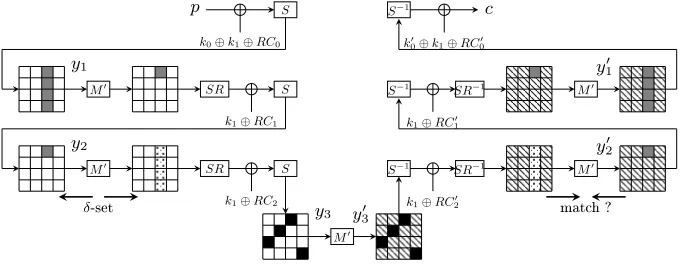
The 6-round attack is depicted on Figure 3 and its scenario is straightforward. First the232possible sequences given in Observation1are computed and stored in a hash table during a preprocessing phase. Then during the online phase, we begin by asking for the encryption of a structure of 216 chosen plaintexts such that nibbles from 4 to 7 take all the possible values while the other ones are constant, and pick one of them denoted p0. Now the goal of the adversary is to identify an ordered δ-set containing y0
2. To do so, he has to guess the ves nibbles x0
1[4..7]and x02[7] and propagate the dierences from the state y2 to the plaintext. Then he gets the corresponding ciphertexts, guess the ves nibbles x00
1[4..7] and x020[7] and propagates the dierences from the ciphertexts toy02[7]. Finally he discards all the guesses which do not lead to a match in the previously built hash table. The probability for a wrong guess to pass the test is 232×2−60= 2−28so we expect25candidates to remain at the end of the attack. The wrong ones can be discarded by replaying the attack with an other choice forp0without increasing the overall complexity of the attack.
p
k0⊕k1⊕RC0
S
M0 SR
k1⊕RC1
S
y1
M0 SR
k1⊕RC2
S
δ-set
y2
M0
y3 y30
S−1
k1⊕RC20
SR−1 M0
match ?
y02
S−1
k1⊕RC10
SR−1 M0
y01
S−1
k0
0⊕k1⊕RC00
c
Fig. 3: 6r attack. No dierence in white nibbles. Nibbles required in online (resp. oine) phase are in gray (resp. black). Dierences in dotted nibbles are known during the oine phase. Hatched nibbles play no role.
The data complexity of this attack is216 chosen plaintexts and the memory requirement is around232×4×15×2−3≈234.9bytes. During the online phase 10 state nibbles are guessed however they can assume only233 values once the plaintext/ciphertext pair is given. Indeed, the knowledge of the 33 bits
{(k0⊕k1)[16..27]b,(k00⊕k1)[16..27]b, k1[28..31]b, k0[28..32]b},
is enough to compute all of them frompandc. Thus the time complexity of the
successively. For instance, one could begin by running the attack depicted on Figure12in AppendixAwhich has an overall complexity below228as most key bits required in the online phase are already known.
3.2 8-round Attack
The 8-round attack is similar to the one on 6 rounds and is depicted on Figure4. It relies on Observation2so the memory complexity is around280×15×8×2−3≈ 283.9 bytes. In the online phase, the data complexity remains unchanged to216 chosen plaintexts but the number of state variable to guess is increased. The identication step requires to guess the four nibblesx0
1[4..7] and then the nine nibblesx00
1[0..7]andx020[6]are guessed to build the sequence from the ciphertexts. Those 13 nibbles can assume only249 values once the plaintext/ciphertext pair (p0, c0)given as they all can be derived from
{(k0⊕k1)[16..24,28..31]b,(k00 ⊕k1)[0..23,27..31]b, k0[25..27]b, k1[24..27]b}.
Thus the time complexity of the online phase is approximately16×249×52/(8× 64)≈249.7encryptions and we expect249×280×2−120= 29candidates to remain at the end of the attack.
p
k0⊕k1⊕RC0
S
M0 SR
k1⊕RC1
S
y1
M0 SR
k1⊕RC2
S
y2
M0 SR
k1⊕RC3
S
y3
M0
y4 y40
S−1
k1⊕RC30
SR−1 M0
y03
S−1
k1⊕RC20
SR−1 M0
y02
S−1
k1⊕RC10
SR−1 M0
y01
S−1
k0
0⊕k1⊕RC00
c
Fig. 4: 8r attack. No dierence in white nibbles. Nibbles required in online (resp. oine) phase are in gray (resp. black). Dierences in dotted nibbles are known during the oine phase. Hatched nibbles play no role.
of x1. Then the search space would be small enough to perform an exhaustive search without increasing the overall complexity.
Trade-o. It is possible to trade some memory against time without increasing the data complexity by noticing that for a considered structure of216plaintexts the 4 active nibbles ofx3 take all the possible values. Thus we can x them to 0 during the oine phase and save a factor216 in memory. In the other hand, we now need to run the attack for all the possible choices forp0 increasing the
time complexity by the same factor of216.
A more sophisticated attack against 8-round PRINCE, requiring much less memory, is described in AppendixE.
3.3 10-round Attack
We now investigate PRINCE reduced to 10 rounds. While we were unable to nd an attack requiring less than220 chosen plaintexts for the PRINCE Challenge, we found one competitive with the current best known attack. To describe it we rst extend the denition of aδ-set as it was done in [13], then we show a
meet-in-the-middle attack as the two ones above and nally we apply the dierential enumeration technique ([12]).
δ-set. In [13] Derbez et al. shown that the notion of δ-set can be extended to
set of states such that some linear combinations of state bits are constant. In the sequel we denote byδ-set a set of 16messages such thaty2[0..4,6,8..12,14] and M0(y2)[0..4,6,8..12,14] are constant, exploiting the fact that the matrix operating on the columns are not MDS.
10-round attack. The basis of our attack on 10 rounds is depicted on Figure5. The meet-in-the-middle is performed on the four bit-equations described above. The state bytes required as the parameters of the hash table can be computed from the whole state x5 and 8 nibbles of the equivalent subkey M−1(k1) and thus approximately 296 60-bit sequences are stored. In the online phase the 24 state nibbles needed can be computed from the following 66 key bits:
{k0[0,20..24,28..32,52..56,60..63]b, k1[20..23,28..31,52..55,60..63]b, (k0⊕k1)[16..19,24..27,48..51,56..59]b,
(k00 ⊕k1)[16..19,24..26,48..51,56..58]b}.
Note that this attack does not actually work because the number of sequences stored is higher than the number of possible 60-bit sequences and thus no key candidates are ltered. The aim of the next section is to show how to reduce the memory requirement.
p
k0⊕k1⊕RC0
S
M0 SR
k1⊕RC1
S
y1
M0 SR
k1⊕RC2
S
y2
M0 SR
k1⊕RC3
S
y3
M0 SR
k1⊕RC4
S
y4
M0
y5 y50
S−1
k1⊕RC40
SR−1 M0
y04
S−1
k1⊕RC30
SR−1 M0
y03
S−1
k1⊕RC20
SR−1 M0
y02
S−1
k1⊕RC10
SR−1 M0
y01
S−1
k0
0⊕k1⊕RC00
c
Fig. 5: 10r attack. No dierence in white nibbles. Nibbles required in online (resp. oine) phase are in gray (resp. black). Dierences in dotted nibbles are known during the oine phase. Hatched nibbles play no role.
belongs to a pair(p0, p1)following a well-chosen dierential characteristic. In our case the truncated dierential characteristic is depicted on Figure5 assuming a zero dierence in hatched nibbles. Thus we expect to store only296+4−60= 240 sequences in the oine phase. However generating them is not as trivial as for the basic attack. We propose the following procedure which has a time complexity around272 operations:
1. Consider a pair(p0, p1)following the dierential characteristic.
2. S−1◦M0◦S can be seen as 4 invertible super Sboxes §0, . . . , S3 operating on 16-bit words. Build 4 hash tables such that one can retrieve(x, y) from (x⊕y, Si(x)⊕Si(y)).
3. Guess the dierence in the active nibbles of bothy4andy04and retrieve the actual value ofx5andx05for both messages of the pair.
4. Guess the dierence in the two active nibbles of the rst column ofy3 and get back the actual values ofy4[2,5,8,15].
5. Combined with the knowledge ofx5this leads to the knowledge of the four key nibblesM−1(k1)[2,5,8,15]. Use them to partially encryptx05 and check if the dierence in the rst column ofy0
3 is correct.
6. UseM−1(k1)[15]to partially decrypty4and get the dierence inx2[15]and check its correctness. Do the same for the dierence inx02[15].
7. Guess the dierence in the two active nibbles of the third column of y3 and get backM−1(k
8. Compute the value of the missing parameters and check whether the pair follows the characteristic or not. If it does then build the 60-bit sequence fromp0 and store it in the hash table.
The complexity of this procedure is dominated by the complexity of steps 4-5 which is 272 simple operations that we estimate to be equivalent to 269 encryptions. Now that the table is built the online phase is quite similar to the one of the oine phase:
1. Ask for a structure of232chosen plaintexts and store the ciphertexts in a hash table to identify the pairs that may follows the dierential characteristic. 2. For each pair (p0, p1):
(a) Guess the dierence in the rst column of y1 and of y2, deduce the corresponding value of(k0⊕k1)[12..15]andk1[15]. Store them in a hash tableT0 indexed byk1[15], k0[61..63]b.
(b) Similarly compute(k00⊕k1)[12..15]andk1[15]from the ciphertexts and useT0and the linear relations betweenk0andk00to get back the22×4+2· 2−7= 23 corresponding values of the key nibbles above. Store those213 key candidates in a hash table T1 indexed by (k0⊕k1)[12..15], (k00 ⊕
k1)[12..15]andk0[55]b⊕k0[60]b (= (k0⊕k1)[55]b⊕. . .⊕(k0⊕k1)[60]b⊕ (k00⊕k1)[55]b⊕. . .⊕(k00⊕k1)[59]b⊕k1[60]b).
(c) Repeat the two steps above but now by guessing the third column of
y2 and use T1 to obtain the 22×13−8−8−1 = 29 and store them in a hash table T2 indexed by the dierence in y2. (While the match is on 33 bits,(k0⊕k1)[12..15]and(k00 ⊕k1)[12..15]only depend on four 4-bit parameters.)
(d) Repeat the three steps above but now by guessing the third column of
y1 and useT3to nally retrieve all the29+9−8= 210 key candidates. (e) For each key candidate identify aδ-set fromp0, build the 60-bit sequence
and check whether it belongs to the table constructed in the oine phase. If it does then try the key candidate.
3. Repeat the procedure until the right key is found.
As each structure contains263 pairs and each of these pairs follows the dif-ferential with probability 2−28−60 = 2−88, we need 225 structures on average. Then, for each structure we have to study only263−32= 231 pairs and for each of them we have to perform 4×213+ 210×24 simple operations estimated to approximately 212 encryptions. Thus this procedure has a the time complexity of 225+31+12 = 268 encryptions and requires 225+32 = 257 chosen plaintexts. At the end of the attack 266×240×2−60 = 246 key candidates remain. As 62 key bits are also missing performing an exhaustive search is not a valid option. Instead, the best way to recover the key is to apply several meet-in-the-middle attacks. For instance, we can assume that when a match happens we get back the corresponding values of the red nibbles in Figure5and then deduce step by step each key bits ofM−1(k
1)by completing the rst and the third columns of
4 Dierential Attack
In this section we describe a new dierential attack against 6-round PRINCE. There has already been some dierential cryptanalyses of PRINCE, see for ex-ample [10], which is the best attack to date, and also [15]. Our attack uses a new method to increase the power of the lter by considering groups of pairs. This allows a rather low data complexity considering that 6-rounds are attacked and that dierential attacks usually demand large amounts of chosen plaintexts.
4.1 Amplied Dierential Trails
Our attack rely on some dierences propagating identically in dierent pairs. To better describe this, we introduce the following denitions.
Encryption We call encryption a couple plaintext/ciphertext encrypted under a xed key.
Pair A pair is a set of two encryptions where the plaintexts are separated by a known dierence.
Family A family is a group of pairs with a particular structure. They are gen-erated from a single pair
(p[0], ..., p[b−1]),(p0[0], ..., p0[b−1]) , where p[i] andp0[i]are nibbles. Suppose that the input dierence covers the rst three
nibbles so that p[3] = p0[3] = c[3], ..., p[b−1] = p0[b−1] = c[b−1] for some constantsc[i]. Then the family corresponding to this pair is made by exchanging some nibbles between the two encryptions in the pair so as to obtain the following pairs:
(p[0], p[1], p[2], c[3], ..., c[b−1]) (p0[0], p0[1], p0[2], c[3], ..., c[b−1])
(p0[0],p[1], p[2], c[3], ..., c[b−1]) (p[0],p0[1], p0[2], c[3], ..., c[b−1])
(p[0],p0[1],p[2], c[3], ..., c[b−1]) (p0[0],p[1],p0[2], c[3], ..., c[b−1])
(p[0], p[1],p0[2], c[3], ..., c[b−1]) (p0[0], p0[1],p[2], c[3], ..., c[b−1]).
Overall, if there arennibble with non-zero dierences in the input then a
family is made of2n−1 pairs and2n encryptions.
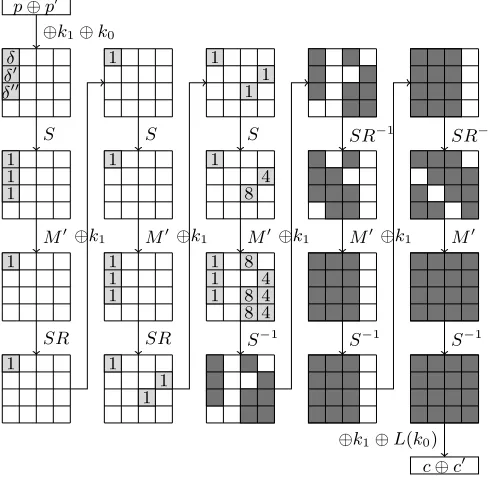
In the case of PRINCE, we consider dierential trails where the input dif-ferences are only over one column and such that all the pairs in a family follow the same trail for the rst three rounds. For example, the trails we describe in Section 4.2are either followed by all the elements in a family or none of them. A similar heuristic is used in [16] to perform a multiset attack on the SASAS structure.
4.2 Our Trails
We consider trails which are completely specied during the rst 3 rounds and then propagate with probability 1 for 2.5 rounds before having spread to the full internal state. Figure6shows a rst trail covering 5.5 rounds in this way which we denoteT1. Each array corresponds to the dierences between the internal states of two encryptions under 6-round PRINCE and each cell gives the value of the dierence: light gray corresponds to a fully specied non-zero value at the nibble level (e.g. a dierence of 1), dark gray to an unkown non-zero dierence and white to a zero dierence. A very similar trail with a probability 2 times smaller, T2, is given in Figure14 (see AppendixC). To compute their probabilities, we use the dierence distribution matrix of the S-Box. If we let the input dierence be (1,1,1,0, ...,0), thenT1has a probability of 2−2·3·2−2·2−2−2−3= 2−15andT2 has a probability of2−2·3·2−2·2−2−3−3= 2−16.
S
M0
SR
⊕k1
S
M0
SR
⊕k1
S
M0
S−1
⊕k1
SR−1
M0
S−1
⊕k1
SR−1
M0
S−1 δ δ0 δ00 1 1 1 1 1 1 1 1 1 1 1 1 1 1 1 1 1 8 4 1 1 1 8 8 8 4 4 4
p⊕p0
⊕k1⊕k0
c⊕c0
⊕k1⊕L(k0)
Fig. 6: The 5.5 rounds trailT1.
Querying enough families at random to nd one right family for any of these would require (2−15+ 2−16)−1 = 214.41 families with an input dierence over 3 nibbles, i.e. 214.41·23 = 217.41 encryptions. However, we can use structures to decrease this complexity.
in little-endian notation is only involved in 0x2 and 0xb which, taken together, only have a probability of 1/4 of leading to a dierence of 1. Hence, we use the following structures wherebis a bit taking all possible values and c is constant accross the structure:
bbcb bbcb bbcbcccc cccc...cccc.
We found experimentally that such structures contain several3 right families
with probability2−5.9 on average when we take into account all possible input dierences, i.e.(δ, δ0, δ00,0, ...,0)whereδ,δ0,δ00∈ {1,4, c, d}. Hence, obtaining at
least 2 right families only requires about29+5.9= 214.9queries to the encryption oracle on average.
Table 2: Input dierences which might be mapped to a dierence of 1 by the S-Box of PRINCE.
Hexadecimal Binary Probability
0x1 0001 1/4
0x2 0010 1/8
0x4 0100 1/8
0xb 1011 1/8
0xc 1100 1/4
0xd 1101 1/8
4.3 Filtering Right Pairs
Full diusion has been achieved by the 6-th round. Thus, we guess 12 bits to be able to partially invert the last round on one column. More precisely, we rst guess the dierence in one column before the last MixColumns for one pair. Each guess leads to a candidate for the corresponding column of k00⊕k1 that we try against the three other pairs of the family. A guess leads to the correct nibble having a zero dierence in every pair of the family with probability2−3·4= 2−12. We repeat this independently over each column and obtain either 64 bits of key material or none at all. Since there are either several right families or none at all in the structures we consider, we only return the key guesses which come from several families as well as the corresponding families.
3 Actually, a structure of size 212 where the rst three nibbles take all values con-tains 64 right families with probability about2−5.9. If we reduce these to form the
Note this is a powerful lter: while we expect each family from the structure to yield about one 64 bits candidates, the probability to have a collision is very small4.
The same procedure is then used one round earlier to recover 48 bits ofk1, corresponding to its three rst columns. They allow us to partially decrypt the family and check whether dierences after the third MixColumns are correct for the three rst columns. The probability for a wrong family to pass this test is 2−6·4·4 = 2−96, so we expect to be left with right families only. Finally, the missing 16 bits of k1 are recovered by performing an exhaustive search.
Complexity: Querying25.9structures of29chosen plaintexts to obtain at least 2 right families, the time complexity of the key recovery procedure is around 25.9+9 ·212 ·7 partial encryptions, which is equivalent to 229.7· 4
6·16 ≈ 2 25.1 encryptions. The memory complexity is dominated by the storage of the 214.9 required to run this attack.
5 Combining Dierential Attack with a SAT-Solver
5.1 Attacking 4-Round PRINCE with a SAT-Solver
Encoding PRINCE as a CNF Formula The idea is to generate a CNF formula where a set p of boolean variables correspond to the 64 bits of the
plaintext,cto the 64 bits of the ciphertext andkto the 128 bits of the key, and
such that there exists a unique assignment of the variables satisfying the CNF corresponding to the caseEk(p) =c.
Hence, if we generate such a formula, set the variables inpandkto a chosen
value and use a SAT-solver to nd an assignment satisfying the CNF formula, the variables in c will correspond to the ciphertext. Solving such a formula is
easy, an observation which we can relate to the fact that the evaluation of a block cipher has to be "easy" from the point of view of complexity theory.
Another way to use such a formula is to x the variables in p and in c
according to a known plaintext/ciphertext pair, solve the CNF and recover the key from the variables corresponding to it. Unless the number of rounds is very small (at most 3 in the case of PRINCE), solving such a system is impractical. Again, we can relate this observation to the fact that recovering the key given one or several plaintext/ciphertext pair has to be "hard". Our approach consists in using some knowledge about the internal state of the cipher to simplify the task of the SAT-solver and make such a resolution possible for a higher number of rounds.
In order to encode a PRINCE encryption as a CNF formula, we introduce several sets of 64 Boolean variables corresponding to each step of each round: one for the internal state at the beginning of the round (xr), one for the internal
4 Each structure yields29−3
= 26 families for each of the 43 interesting input
dier-ences so that we consider the families by groups of212. This implies that a collision has a probability of about 212
2
state after going throught the S-Box (yr), etc. We also use boolean variables corresponding to the key bits.
Our task is then to create a CNF formula connecting these variables in such a way as to ensure that, for instance ifk[0, ...,63]is xed, it has only one solution whereyr[0, ...,63]is indeed the image ofx[0, ...,63]r byS, etc.
In order to encode the linear layer, we use the alternative representation of
M0 from [10] where it was shown that M0 operates on columns of 4-bits
inde-pendently by rst rotating them by a column-dependent number of bit and then xor-ing the hamming weight of the column in each bit. We thus add variables corresponding to the hamming weights of the columns and encode the corre-sponding xor's as CNF formulas. TheSRoperation is only a permutation of the
bits so we simply set the corresponding bits to be equal.
The encoding of the S-Box is less simple to obtain. In order to nd the best one, we chose to look for it directly instead of using the ANF as an intermediate step. Indeed, since the S-Box is 4x4, it is small enough for us to brute-force all clauses5 involving input and output bits and check if they hold for every input.
Doing this lead us to nd 29 clauses with 3 variables. However, they are not sucient to completely specify the S-Box so we used a greedy algorithm to nd the best clauses with 4 variables to add to this encoding. In the end, we have 29 clauses with 3 variables and 9 clauses with 4 variables which are such that the only solutions of the CNF made of all these clauses are all the assignments corresponding to pairs x, S(x)for all
x∈[0,15].
These clauses with 3 variables can be interpreted as simple implications. For example, if o[3, ...,0]b =S(i[3, ...,0]b) then the following two clauses hold with probability 1 :
i[1]b∨o[2]b∨o[3]b∧ i[1]b∨o[1]b∨o[2]b.
They are logically equivalent to the following implication:
i[1]b =⇒ (o[2]b∨o[3]b)∧(o[1]b∨o[2]b)
.
Dierential Over Denition The approach consisting in using the knowledge from a dierential trail to ease the task of a SAT-solver used to attack a cryp-tographic primitive has been explored in [17] in order to attack MD4 and MD5. The authors of this paper rst use heuristic methods to nd a high probability dierential trail leading to a collision and then use a SAT-solver to nd a pair of messages which satises this trail. In the same paper, we can nd the following observation:
An interesting result of our experiments with SAT solvers is the impor-tance of having a dierential path encoded in the formula.
As we shall see, this also holds for block ciphers. Attacking 4 rounds PRINCE-core takes more than 10 hours if we simply encode as a CNF that some plaintext
are encrypted into known ciphertexts but we can both drastically reduce this time while breaking PRINCE with its whitening keys using dierential over-denition.
Denition 2. We call Dierential Over Denition (or DOD) the following al-gorithm which simplies a CNF formula knowing that the variables correspond to bits of the internal state of an encryption following a certain trail.
For all pairs of variables in the CNF, proceed as follows:
If they are assumed to be equal, replace all occurrences of the rst one by the second one.
If they are assumed to be dierent, replace all occurrences of the rst one by the negation of the second one.
While the idea behind this algorithm is simple, it is necessary for cryptogra-phers to implement it eciently by hand. Indeed, the only input of a SAT-solver is a CNF formula, i.e. merely a list of clauses from which deriving what variables are equal to each other without knowledge of the structure of the problem is far from trivial. For instance, it would be necessary for the SAT-solver to under-stand that the set of clauses used to model one S-Box call all correspond to a unique function so that identical inputs lead to identical outputs; all this without having any distinction between the input and output bits. That is why dieren-tial over-denition, an easy algorithm for the cryptographer to implement, is a valuable pre-processing step when using a SAT-solver for cryptography leading to gains in time complexity of several orders of magnitude.
This algorithm can be implemented eciently using a hashtable containing the correspondences between the variables. Once this algorithm has been run, the CNF is over dened: the solution would have been such that the equalities hold anyway but there are less variables and less clauses in the CNF. However, if the pair actually does not follow the trail, the CNF has become unsatisable. This is a dierence between our work and the one described in [17]: we do not always know before hand if the CNF has a solution. We can think of this as a trade-o between solving one CNF known to be true and solving many over-dened CNF's which may or may not be true: the second approach loses time by requiring several calls to a SAT-solver but these calls take less time thanks to the over-denition.
Such an over denition can be used in dierent ways.
1. Propagating only the zero dierences holding with probability 1 inside a group of 8 encryptions with many zero dierences is enough to reduce the time complexity of an attack on 4 rounds from more than 10 hours to a few seconds (see below). Furthermore, such a formula is always true.
We implemented the attack described in Algorithm 1 to attack 4-round PRINCE (with its whitening keys) using the SAT-solver Minisat [18] and ob-tained an average total time of 5.13s and average time spent solving the CNF of 3.06s. The designers of PRINCE did not consider SAT-based attacks but they did investigate algebraic attacks. They manage to attack 4-round PRINCE-core in less than 2s while our attack requires about 5s to attack 4-round PRINCE, a cipher which uses twice as much key material.
Algorithm 1 Using Dierential over-Denition to enable an attack on 4-round PRINCE.
Query210plaintext/ciphertexts where the rst 10 bits take all possible values. Select a subset of 8 plaintext/ciphertext maximizing the number of 0-dierences in the output.
Encode the 8 encryptions as a CNFA.
OverdeneAby propagating zero-dierences with probability 1.
Use a SAT-solver to retrieve the key bits fromA
returnk0||k1
5.2 Dierential Attacks on 6-Round PRINCE
Another use possible use for a SAT-solver is the handling of the tedious details of an actual attack implementation, e.g. the nding of an ecient guessing strategy. We illustrate this by performing the recovery of the second chunk of the master key in our 6-round dierential attack using a SAT-solver. Pseudo-code describing this attack on 6-round PRINCE is provided in Algorithm2.
We ran this attack 10 times and found that about25.75structures were needed on average. The ltering step is the most time consuming: nding a right pair requires about 6 minutes while the SAT-solver requires about 0.5s to recover the full key or (rarely) to discard the pair. For this reason, we approximate the complexity of this attack by the complexity of its ltering step. Memory complexity is dominated by the SAT-solver but is (well) below 1 Go, i.e. (well) below227 64-bits blocks.
6 Structural Analysis of PRINCE
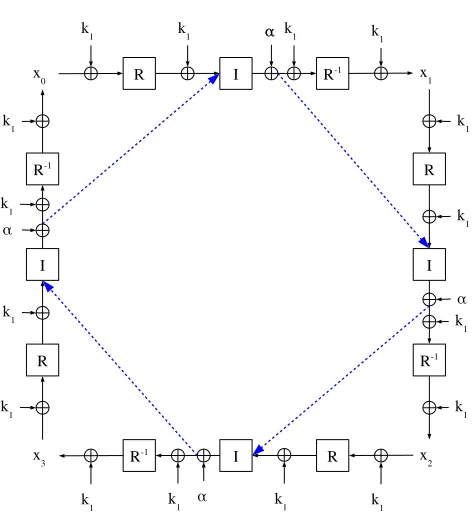
The α-reection introduced along with PRINCE [5] is the name given to the
following property of a block cipherEk:Ek−1=Ek⊕α. In other words there is a constantαsuch that decryption for a keykis the same operation as encryption
under keyk⊕α. PRINCE-core implements this property by having a three-parts
structure as decribed here:
Ec,k1 =F
−1
where Fk corresponds to 5 rounds of a classical Substitution-Permutation Net-work construction and where Iis an involution.
Since we are going to study the structure of the cycles of dierent functions in a fashion similar to the way Biryukov analysed the inner-rounds of some involutional ciphers in [19], we dene the cycle type of a permutation.
Denition 3. The cycle type of a permutationπ is an (ordered) multiset
con-taining the cycle lengths of the permutation. The cycle type of π is denoted by
L(π).
In what follows, we do not represent the round constants for the sake of simplicity. However, not only do our result hold in their presence but we could actually generalize them to any key schedule preserving the fact that the subkeys of symmetric rounds have a XOR equal toα.
6.1 Small Cycles in Round-Reduced PRINCE
The central involution isI=S−1◦M0◦S. Therefore, it is isomorphic toM0, a
linear involution operating on each column of the internal state independently. It is easy to check experimentally the result given in [7] stating that M0 has
exactly 232 xed points, meaning thatI also has232 xed points. Therefore,I has232 cycles of length 1 and263−231cycles of length 2.
The cycle type ofIα:x7→I(x)⊕αis more sophisticated but still contains
a fair amount of small cycles. After noting that bothI andx7→x⊕αoperate
on each column of the internal space independently, we denoteIiαthe restriction
of x7→I(x)⊕αto column i and Ii that of I. Since each of theIiα's operates only on a space of size216, it is easy to generate their complete cycle structures independently by searching the whole space. EachIα
i has a cycle type made of many small cycles, the largest having a length of 2844. This is explained by the fact that both I and x7→x⊕αare involutions and each column of I has
exactly 28 xed points. Thus, most of the cycles have a particular structure6 described in [20] which we recall in Figure 7. We remark that to each cycle of
Iα
i correspond two xed points of Ii.
After generating the cycle type for eachIα
i , we combine them to obtain the cycle type ofx7→I(x)⊕αusing Algorithm3. The cycle type of this function is
too complex to be printed completely but some information extracted from it is given in Table 3. If we pickxuniformly at random, the expected length of the
cycle it is on is230.7. Recall thatEkc,4
1 is the permutation of{0,1}
64corresponding to an encryption under keyk1by PRINCE-core reduced to 4 rounds. Thenx7→Ekc,41(x)⊕αhas the same cycle type asIαdue to the cancellation of the last round of one encryption with the rst round of the next. Indeed, to each cycle of this function corresponds one ofIα, as illustrated in Figure 8where a cycle (x
0, x1, x2, x3)of length 4 of
x7→Ekc,4
1 is represented along with the corresponding cycle ofI
α (dashed line).
Ii Ii
Ii Ii
⊕α ⊕α ⊕α
Iiα Iiα
Iiα Iiα
Iiα Iα
i
Fig. 7: The structure of a cycle ofIα
i fori∈[0,3].
Cycle Length`#{cycles of length`}P
`(x) =`, xdrawn uniformly
1 0 0
2 27 2−57
4 210.25 2−53.75
8 215.46 2−48.54
10080 233.06 2−17.63
110880 231.96 2−15.27
≤210 2−22.4
≤215 2−12.4
≤224 2−4.1
Table 3: Information about the cycle type ofIα, where`(x)is the length of the cycle on which xis.
A rst consequence of these observations is the existence of a distinguisher for 4-round PRINCE-core requiring about 227.4adaptatively chosen plaintexts. As stated in Table2, an element picked at random is on a cycle of length at most 215with probability2−12.4. Therefore, we repeat multiple times the experiment consisting in picking an element x uniformly at random and then check if it
is on a cycle of length at most 215 by iteratingx 7→ Ec,4
k1(x)⊕α at most 2 15 times. The experiment is a success ifxis on a cycle of length at most215. If the permutation isEc,4k
1 for somek1, then its probability of success is2
12.4but if the permutation is a random permutation7, then the probability of success becomes
2−49. We conrmed experimentally the success probability of this experiment forEkc,4
1 .
A second consequence is the existence of small sets of plaintext/ciphertext encryptions where the set of the ciphertexts is the image of the set of the en-cryptions by a function signicantly simpler than a PRINCE encryption. This topic is studied in the next section.
7 Recall that the probability forxto be on a cycle of length `for a permutation of
[0, N−1]is equal to1/N. Hence, the probability that the length is smaller than215 for a permutation of[0,264−1]isP215
`=12
−64
Fig. 8: Correspondance between a cycle ofx7→Ekc,4
1(x)⊕αand a cycle ofI α.
6.2 Simplications of PRINCE's Representation
The particular cycle types of the round-reduced versions of PRINCE studied above lead to simpler alternative representations of the encryption algorithm.
Consequences of the Cycle Type of I Suppose that an encryption is such
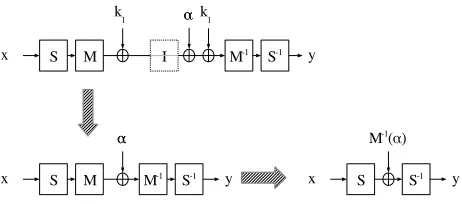
that the input ofI is one of the232 xed-points of this function. Then the key addition before and after this function cancel each other so that only the addition ofαremains. Then, since M is linear, the operations M−1◦(⊕α)◦M become simply the addition ofM−1(α). Thus, the 4 center rounds minus the rst and last key addition become a simple S-Box layer which we denoteS0 and which
is dened by
S0(x) =S−1 S(x)⊕M−1(α).
This simplifying process is summarized in Figure9. Note that ifM−1(α)has any nibble equal to 0 then the functionS0 is the identity for this nibble. However,
Fig. 9: Simplication of the 4 center-rounds if the input ofI is a xed point.
The simplication goes further. Indeed, sinceS0 operates only at the nibble
level, it commutes with the operationsSRandSR−1(up to a reordering of the S-Boxes inS0). Therefore, if we add one round before and one round after S0,
we can replaceSR−1◦S0◦SR byS00 where S00 is another S-Box layer. Hence,
6-round of PRINCE operate on each column of the internal state independently: each output bit depends only on 16 bits of the input, 28 bits8 ofk1 and at most
18 bits ofk0. This simplication is summarized in Figure10.
Fig. 10: Simplication of the 6 center-rounds if the input ofI is a xed point.
Similar simplications occur if instead of having a xed point we have a particular collision between two encryptions. This setting corresponds to the so-called mirror slide attack described by Dunkelman et al. in [21]. Consider two
8 In each column, 16 bits from the corresponding column ofk
encryptions(p0, c0)and(p1, c1)by PRINCE-core as follows
c0=Ec,k1(p
0) = F−1
k1⊕α◦I◦Fk1
(p0)
c1=Ec,k1(p
1) = F−1
k1⊕α◦I◦Fk1
(p1)
which are such thatFk1(p
0) =I F k1(p
1). In this case, we have that
c0 = Fk−1
1⊕α◦Fk1
(p1)
c1= Fk−1
1⊕α◦Fk1
(p0),
where 6 rounds ofFk−1
1⊕α◦Fk1can be simplied exactly as described and therefore only operate on each column separately.
In conclusion, if an encryption is such that the input of I is a xed-point
of this function or if two encryptions form a mirror slide pair, then 4 rounds of PRINCE consist simply in 16 parallel operations on each nibble and 6 rounds of PRINCE in 4 parallel operations on each column.
Consequences of the Cycle type of Iα Consider a sequence of plaintexts (p0, . . . , p`−1) and their corresponding ciphertexts (c0, ..., c`−1) such that the input xi5⊕k1 of the sixth round for the plaintext pi is the image ofxi5−1⊕k1 byIα. We call such a sequence a cycle set and we give a representation of such
a sequence on Figure11: if two values are equal then they are connected by a line; red lines correspond to the cycle ofIαthis set is built out of and blue lines
correspond to the propagation of these equalities through identical operations, namelyx7→k1⊕R−1(x⊕k1).
There is a unique function mappingpitoci−1in every cycle set which corre-sponds to the encryption algorithm where the 4 center-rounds have been removed and replaced by a simple addition of α. This means that this function
under-goes the simplications described above except that these cover 2 more rounds. In particular, for 6-round PRINCE-core, the function mappingpi to ci−1 only operates at the nibble level and, for 8-round PRINCE-core, it operates at the column level. At least 10 rounds are necessary to obtain full diusion out of the 12 PRINCE has.
The cycle sets we consider cover the 4 center-rounds of PRINCE but it is possible to generalize this construction to an arbitrary amount of rounds. How-ever, the cycle set sizes are abnormaly small in this case because of the cycle type of Iα. Indeed, a random plaintext/ciphertext pair is in a cycle set of size230.7 and in a cycle set of size smaller than215with probability2−12.4. In other cases, including a priori if we have a cycle covering at least 6 rounds, the expected size of a cycle set is the expected size of the cycle of a random permutation a random element is on, namely263.
Fig. 11: A cycle set of 6-round PRINCE-core.
7 Conclusion
We looked for practical attacks which would hinder the security provided by round-reduced versions of PRINCE in a realistic framework provided by the de-signers of this cipher. We found that approaches based on a Meet-in-the-Middle, SAT-based or, surprisingly, dierential framework can all lead to practical at-tacks on up to half of the rounds. We checked our results by actually implement-ing one of our attacks. As a matter of fact, our attacks were the best submitted to the PRINCE-challenge for 4, 6 and 8 rounds. Furthermore, during our inves-tigations on PRINCE we discovered a new attack on 10 rounds which despite its data complexity of257 chosen plaintexts has a reasonable complexity and a very (very!) motivated adversary could run it.
We also identied some simplications of the encryption occurring because of the small cycles of the inner-rounds of this block cipher, thus shedding new light on the consequences of theα-reection as it is implemented in PRINCE.
8 Acknowledgement
References
1. Biham, E., Shamir, A.: Dierential cryptanalysis of DES-like cryptosystems. Jour-nal of CRYPTOLOGY 4(1) (1991) 372
2. Matsui, M.: Linear cryptoanalysis method for DES cipher. In: Advances in Cryp-tology - EUROCRYPT 93, Workshop on the Theory and Application of of Crypto-graphic Techniques, Lofthus, Norway, May 23-27, 1993, Proceedings. (1993) 386 397
3. Demirci, H., Selçuk, A.A.: A meet-in-the-middle attack on 8-round AES. In: Fast Software Encryption, Springer (2008) 116126
4. Semiconductors, N.: The PRINCE challenge. https://www.emsec.rub.de/ research/research_startseite/prince-challenge/(2014)
5. Borgho, J., Canteaut, A., Güneysu, T., Kavun, E.B., Knezevic, M., Knudsen, L.R., Leander, G., Nikov, V., Paar, C., Rechberger, C., et al.: PRINCE a low-latency block cipher for pervasive computing applications. In: Advances in CryptologyASIACRYPT 2012. Springer (2012) 208225
6. Biryukov, A., Perrin, L.: State of the art in lightweight cryptography. http: //cryptolux.org/index.php/Lightweight_Cryptography
7. Soleimany, H., Blondeau, C., Yu, X., Wu, W., Nyberg, K., Zhang, H., Zhang, L., Wang, Y.: Reection cryptanalysis of PRINCE-like ciphers. Journal of Cryptology (2013) 127
8. Jean, J., Nikoli¢, I., Peyrin, T., Wang, L., Wu, S.: Security analysis of prince. In: Fast Software Encryption: 20th International Workshop, FSE 2013, Singapore, March 11-13, 2013. Revised Selected Papers. Volume 8424., Springer (2014) 92 9. Li, L., Jia, K., Wang, X.: Improved meet-in-the-middle attacks on aes-192 and
prince. Cryptology ePrint Archive, Report 2013/573 (2013)http://eprint.iacr. org/.
10. Canteaut, A., Fuhr, T., Gilbert, H., Naya-Plasencia, M., Reinhard, J.R.: Multiple dierential cryptanalysis of round-reduced PRINCE (full version). Cryptology ePrint Archive, Report 2014/089 (2014)http://eprint.iacr.org/.
11. Rechberger, C.: Update on the 10000 euro PRINCE cipher-breaking challenge: Results of round-1. http://crypto.2014.rump.cr.yp.to/ d037206eda8f9278cef1ea26cd62e51f.pdf(2014)
12. Dunkelman, O., Keller, N., Shamir, A.: Improved single-key attacks on 8-round AES-192 and AES-256. In: Advances in Cryptology - ASIACRYPT 2010 - 16th International Conference on the Theory and Application of Cryptology and Infor-mation Security, Singapore, December 5-9, 2010. Proceedings. (2010) 158176 13. Derbez, P., Fouque, P.: Exhausting Demirci-Selçuk meet-in-the-middle attacks
against reduced-round AES. In: Fast Software Encryption - 20th International Workshop, FSE 2013, Singapore, March 11-13, 2013. Revised Selected Papers. (2013) 541560
14. Derbez, P., Fouque, P.A., Jean, J.: Improved Key Recovery Attacks on Reduced-Round AES in the Single-Key Setting. In Johansson, T., Nguyen, P.Q., eds.: EU-ROCRYPT. Volume 7881 of Lecture Notes in Computer Science., Springer (2013) 371387
15. Abed, F., List, E., Lucks, S.: On the security of the core of prince against biclique and dierential cryptanalysis. Cryptology ePrint Archive, Report 2012/712 (2012)
http://eprint.iacr.org/.
17. Mironov, I., Zhang, L.: Applications of sat solvers to cryptanalysis of hash func-tions. In Biere, A., Gomes, C., eds.: Theory and Applications of Satisability Testing - SAT 2006. Volume 4121 of Lecture Notes in Computer Science. Springer Berlin Heidelberg (2006) 102115
18. Eén, N., Sörensson, N.: An extensible SAT-solver. In: Theory and applications of satisability testing, Springer (2004) 502518
19. Biryukov, A.: Analysis of involutional ciphers: Khazad and Anubis. In: Fast Software Encryption, Springer (2003) 4553
20. Moore, J.H., Simmons, G.J.: Cycle structure of the DES with weak and semi-weak keys. In: Advances in CryptologyCRYPTO'86, Springer (1987) 932
Algorithm 2 Using trailsT1,T2 and a SAT-solver to recover the complete key
k0||k1of 6-round PRINCE.
while the key has not been retrieved do
Query a structureS = (p0, c0), ...,(p212−1, c212−1
H←empty hashtable of lists of families indexed by 64-bits integers
for all familiesF inS do
for one pair inF do
for all columns of the internal state do for all the212 possible dierences do
Deduce the corresponding 16-bit key materialk16 for all remaining pairs inF do
Invert key addition for the column usingk16 InvertS−1 for the column
InvertM0 for the column
end for
if correct nibble has zero dierence in all pairs then storek16 end for
end for end for
Combine all guesses from each column into 64-bits guesses for all 64-bits guesses k64appendF toH[k64]
end for
for allk64among the keys ofH do
if H[k64]contains strictly more than 1 element then for all familiesF inH[k64]do
Generate a CNFAencoding all encryptions inF with same key such
thatk1+L(k0) =k64.
for all trailsTin{T1,T2}do
B←DoD(A,T)
if B is satisable then retrievek0||k1 from the solution ofB and return it
end for end for end if end for end while
Algorithm 3 Generating the cycle type ofIαfrom those of its columns. fori∈[0,3]do
Li←List of the cycle length ofIiα end for
L ←Hashtable indexed by integers
for(`0, `1, `2, `3)∈ L0× L1× L2× L3 do
`←lcm `0, `1, `2, `3
L[`]← L[`] +`−1·Q3 i=0`i end for
A The Second 6-round Attack
p
k0⊕k1⊕RC0
S
M0 SR
k1⊕RC1
S
y1
M0 SR
k1⊕RC2
S
δ-set
y2
M0
y3 y30
S−1
k1⊕RC20
SR−1 M0
match ?
y02
S−1
k1⊕RC10
SR−1 M0
y01
S−1
k0
0⊕k1⊕RC00
c
Fig. 12: 6r attack. No dierence in white nibbles. Nibbles required in online (resp. oine) phase are in gray (resp. black). Dierences in dotted nibbles are known during the oine phase. Hatched nibbles play no role.
B The Second 8-round Attack
p
k0⊕k1⊕RC0
S
M0 SR
k1⊕RC1
S
y1
M0 SR
k1⊕RC2
S
y2
M0 SR
k1⊕RC3
S
y3
M0
y4 y40
S−1
k1⊕RC30
SR−1 M0
y03
S−1
k1⊕RC20
SR−1 M0
y02
S−1
k1⊕RC10
SR−1 M0
y01
S−1
k0
0⊕k1⊕RC00
c
C The Second 5.5 Rounds Trail
S
M0
SR
⊕k1
S
M0
SR
⊕k1
S
M0
S−1
⊕k1
SR−1
M0
S−1
⊕k1
SR−1
M0
S−1 δ
δ0 δ00
1 1 1
1
1
1
8
8 8 8
8 8 8
8 8 8
8 4
2
2 2
2 8
8 8 4 4 4
p⊕p0
⊕k1⊕k0
c⊕c0
⊕k1⊕L(k0)
Fig. 14: The second 5.5 rounds trailT2.
D Simple Meet-in-the-Middle Attacks
In this section we describe two attacks on round-reduced Prince. Both are simple meet-in-the-middle attacks requiring only few known plaintext/ciphertext pairs to work.
D.1 4-round Attack
Simple Attack. We begin by presenting a simple attack on 4-round Prince with a complexity around240which is depicted on Figure15. It is based on the two following equations involving few bits of the middle states yandy0:
y[38]b⊕y[46]b=y0[38]b⊕y0[46]b
y[39]b⊕y[43]b⊕y[47]b=y0[47]b
LetKp (resp.Kc) be the key bits required to compute y[38]b⊕y[46]b and
1. Ask fornknown plaintext/ciphertext pairs.
2. LetT be an empty hash table.
3. For all possible values of Kp do (a) forj from 1 toncomputeyj[38]
b⊕yj[46]b andyj[39]b⊕yj[43]b⊕yj[47]b from thej-th plaintext
(b) make the sequences=
y1[38]
b⊕y1[46]b, y1[39]b⊕y1[43]b⊕y1[47]b, . . . (c) add the value ofKp toT[s]b
4. For all possible values of Kc do (a) for j from 1 to n computey0j[38]
b⊕y0j[46]b and yj[47]b from the j-th ciphertext
(b) make the sequences=y01[38]b⊕y01[46]b, y01[47]b, . . .
(c) check whether T[s] is empty or not. If T[s] is empty then the guess of
Kc is wrong. Otherwise,T[s] contains the possible value(s) forKp and, ifnis large enough, this will happen only for the right guess.
p
k0⊕k1⊕RC0
S M k1⊕RC1
S M0 S−1
y y0
c
k00⊕k1⊕RC3
S−1 M−1 k1⊕RC2
Fig. 15: 4r attack. Hatched bits play no role.
In our case, bothKp andKc can assume only240 values and thus 40 plain-text/ciphertext pairs are enough to get only one candidate for Kp∪Kc with high probability. Thus the complexity of this attack is 40 known plaintexts and around240 for both time and memory.
Saving data and memory. First we stress that KP (resp.KC) can be safely replaced by any basis of the vector space spawned by itself so let consider it as a vector space overF2. Now we are interested by the vector spaceKP∩KC. Here a basis of this vector space is:
{k1[36..39]b, k1[44..47]b, k0[37..39]b, k0[45..47]b, k0[40]b⊕. . .⊕k0[44]b⊕k1[40]b⊕. . .⊕k1[43]b}.
Thus only 33 plaintext/ciphertext pairs are needed to discard the wrong guesses and the attack scenario becomes:
1. Ask fornknown plaintext/ciphertext pairs.
(b) Partially encrypt/decrypt the plaintext/ciphertext pairs. (c) For all possible values ofKp do
i. forj from 1 ton computeyj[38]b⊕yj[46]b and yj[39]b⊕yj[43]b⊕
yj[47]
b from thej-th plaintext ii. make the sequences=
y1[38]
b⊕y1[46]b, y1[39]b⊕y1[43]b⊕y1[47]b, . . . iii. add the value of Kp to T[s]
(d) For all possible values ofKc do i. forjfrom 1 toncomputey0j[38]
b⊕y0j[46]bandyj[47]b from thej-th ciphertext
ii. make the sequences=
y01[38]
b⊕y01[46]b, y01[47]b, . . .
iii. check whetherT[s] is empty or not. IfT[s]is empty then the guess ofKc is wrong. Otherwise,T[s]contains the possible value(s) forKp and, ifnis large enough, this will happen only for the right guess.
All in all the memory requirement is approximately25×225×2−3≈226.7bytes and the time complexity around33×2×240×40/(4×64)≈243.4encryptions. Key recovery. At the end of the attack we know (or have very few candidates for)Kp∪Kc. But we still need 128−65 = 63key bits to fully recover k0 and
k1. Performing an exhaustive search at this point would increase the overall complexity of the attack and thus is not a good idea. Instead, it is better to perform another meet-in-the-middle attacks successively. For instance, the attack depicted in Figure16allows to recover 20 more key bits with a time complexity around220.
p
k0⊕k1⊕RC0
S M k1⊕RC1
S M0 S−1
y y0
c
k00⊕k1⊕RC00
S−1 M−1 k
1⊕RC10
Fig. 16: 4r attack. black bits are known. Hatched bits play no role.
D.2 6-round Attack
p
k0⊕k1⊕RC0
S M k1⊕RC1
S M k1⊕RC2
S M0 S−1
y y0
c
k00⊕k1⊕RC00
S−1 M−1 k1⊕RC0
1
S−1 M−1 k
1⊕RC20
Fig. 17: 6r attack. Hatched bits play no role.
bytes and a time complexity of approximately2×64×296×104/(6×64)≈2101.1 encryptions.
Finally, an exhaustive search can be perform to retrievek0 and k1 without increasing the overall complexity.
E Improved 8-round Attack
In this section we concisely describe a second attack against 8-round PRINCE, still based on Demirci and Selçuk technique, requiring much less memory than the attack described Section3.2.
Step 1
The rst step of the attack is depicted on Figure18. This is a classical Demirci and Selçuk attack against 8-round PRINCE. The nibble requiblack in the online phase are in gray and can take 28×4 = 232 values. In another hand, nibbles requiblack in the oine phase are in black and can assume280 values thanks to the (lack of) key schedule.
Hereδ-sets contain24= 16messages and the check is performed on sequences of(16−1) = 15dierences in one nibble, i.e. on 60-bit sequences. As more than 260 sequences are computed during the oine phase, the attack does not lter values of gray nibbles.
Step 2
p
k0⊕k1⊕RC0
S
M0 SR
k1⊕RC1
S
y1
M0 SR
k1⊕RC2
S
y2
M0 SR
k1⊕RC3
S
y3
M0
y4 y40
S−1
k1⊕RC30
SR−1 M0
y03
S−1
k1⊕RC20
SR−1 M0
y02
S−1
k1⊕RC10
SR−1 M0
y01
S−1
k0
0⊕k1⊕RC00
c
Fig. 18: Step 1. No dierence in white nibbles. Nibbles required in online (resp. oine) phase are in gray (resp. black). Dierences in dotted nibbles are known during the oine phase. Hatched nibbles play no role.
of the black nibbles, we compute the corresponding 60-bit sequence and check whether it belongs to the hash table. Only 280−60+32 = 252 values should pass this test.
Step 3
We notice that, given a structure of 216 plaintexts such that the rst column is active while the other ones are constant, each column of state y3 takes all the possible values too. Hence we can x the value to 0 of 4 black nibbles ofy4 (shiftrows of a column), decreasing the time complexity by a factor 216. As a result, the hash table now has to contain248 sequences,232 for each of the 216 plaintext/ciphertext pairs.
Step 4
To decrease further the number of possible values for the black nibbles, we apply the same attack but we change the nibble on which the check is performed as shown on Figure 19. So we have to store an other table containing248 60-bit sequences and guess the value of the black nibble ofy02. Only252+4−60+48= 244 values should pass this test.
Step 5
p
k0⊕k1⊕RC0
S
M0 SR
k1⊕RC1
S
y1
M0 SR
k1⊕RC2
S
y2
M0 SR
k1⊕RC3
S
y3
M0
y4 y40
S−1
k1⊕RC30
SR−1 M0
y03
S−1
k1⊕RC20
SR−1 M0
y02
S−1
k1⊕RC10
SR−1 M0
y01
S−1
k0
0⊕k1⊕RC00
c
Fig. 19: Step 4. No dierence in white nibbles. Nibbles required in online (resp. oine) phase are in gray (resp. black). Dierences in dotted nibbles are known during the oine phase. Hatched nibbles play no role.
Step 6
We switch again online and oine phases, coming back to a classical Demirci and Selçuk attack. We run successively the four previous attacks to retrieve a unique plaintext/ciphertext pair together with a unique value for the rst column of y1 and the whole state y01. Indeed, we did not check whether the plaintext/ciphertext pair and the rst column of y1 are the same for the four attacks, while they have to. Thus only the right ones should remain at the end of the attack.
Step 7
The missing 48 bits of the key can be exhausted.
Complexity




![Fig. 7: The structure of a cycle of Iαi for i ∈ [0, 3].](https://thumb-us.123doks.com/thumbv2/123dok_us/7942163.1318405/20.612.166.448.225.355/fig-structure-cycle-iai-i.webp)