A Monthly Journal of Computer Science and Information Technology
ISSN 2320–088X
IJCSMC, Vol. 2, Issue. 9, September 2013, pg.1 – 7
RESEARCH ARTICLE
© 2013, IJCSMC All Rights Reserved
1
INTRUSION DETECTION ON
CLOUD APPLICATIONS
A. Venkat Reddy
1, K. Sharath Kumar
2, V. Hari Prasad
3 1M.Tech (CSE), Sphoorthy Engineering College, JNTU, Hyderabad, India 2
Associate Professor, Sphoorthy Engineering College, JNTU, Hyderabad, India 3
Head of the Department (CSE & IT), Sphoorthy Engineering College, JNTU, Hyderabad, India 1
Abstract— Cloud computing has grown from being a promising business concept to one of the fastest growing segments of the IT industry. So, cloud environment always remains vulnerable to attacks. The framework serves as an excellent platform for making cloud services intrusion tolerant. The feasibility of the framework has been tested by making cloud’s Infrastructure as a Service (IaaS) and Data Storage Service intrusion tolerant. The proposed framework has been validated by integrating
Intrusion Tolerance via Threshold Cryptography (ITTC) mechanism in the simulated cloud’s IaaS. For this, the data centre authentication key is distributed among the hosts using Shamir Secret Sharing algorithm. Performance of the new simulated service model is measured using various performance metrics such as total execution time, intrusion detection time, recovery time, number of cloudlets etc. It involves, using proposed Cloud Intrusion Tolerance framework for securing cloud Data Storage. The correctness of user’s data is ensured by using erasure-correcting code in the file distribution preparation to provide redundancy parity vectors. Performance analysis using erasure-correcting code for securing data storage is also done. We are also implementing the different networks such as SHIM (System Health and Intrusion Monitoring) is used as an exemplary host-based IDS to validate our approach, DRCP (Dynamic Registration and Configuration Protocol) is an auto configuration protocol in mobile AdHoc networks, OLSR (Optimized Link State Routing) protocol is a proactive, table-driven routing protocol in MANETs.
Keywords: - Cloud Computing; Data Storage; DRCP; Framework; Intrusion Tolerance; OLSR; Reed-Solomon Encoding; Shamir Secret Sharing; SHIM; Security; Threshold Cryptography
I. INTRODUCTION
© 2013, IJCSMC All Rights Reserved
2
For secure data storage, we have used erasure-correcting code in the file distribution preparation to provide redundancy parity vectors and guarantee data dependability. Erasure-correcting code i.e. Reed-Solomon codes are used to provide intrusion tolerance for data servers in the cloud. Performance of the proposed intrusion tolerant data storage is measured in terms of Storage time, Intrusion detection/localization time, recovery time etc. Performance analysis shows that the proposed scheme is highly efficient and resilient against malicious data modification attack. The rest of the paper includes following structure, Related Work provides a brief summary of the related work in this area. In Frame Work, we propose our framework. Frame Work Validation gives the validation of our proposed framework.II. RELATED WORK
An intrusion detection and tolerance is a system that is capable of self-diagnosis, repair, and reconfiguration while continuing to provide a correct service to legitimate users in the presence of intrusions.
A. Security Framework for Cloud Environment:
Security framework for cloud environment consists of,
a. Secure Channels and Envelopes includes Communicating in a secure way and dispatching information
in a secure way
b. Authentication includes ensuring what we deal with is genuine: end-users, data, servers, etc.
c. Protection and Authorization
i. Protecting resources from unauthorized access
ii. Ensuring the users are authorized to do just what they should
d. Auditing and Intrusion Detection
i. Following the system execution for a posterior analysis
ii. Detecting anomalous usage in runtime
B. Cloud Simulation Toolkit:
Evaluating the performance of Cloud provisioning policies, application workload models, and resources performance models in a repeatable manner under varying system and user configurations and requirements is difficult to achieve. To overcome this challenge, CloudSim is proposed: an extensible simulation toolkit that enables modeling and simulation of Cloud computing systems and application provisioning environments. The CloudSim toolkit supports both system and behavior modeling of Cloud system components such as datacenters, virtual machines (VMs) and resource provisioning policies. It implements generic application provisioning techniques that can be extended with ease and limited efforts. Currently, it supports modeling and simulation of Cloud computing environments consisting of both single and inter-networked clouds (federation of clouds). Moreover, it exposes custom interfaces for implementing policies and provisioning techniques for allocation of VMs under inter-networked Cloud Computing scenarios.
III. THE FRAME WORK
A. Overview of Framework:
© 2013, IJCSMC All Rights Reserved
3
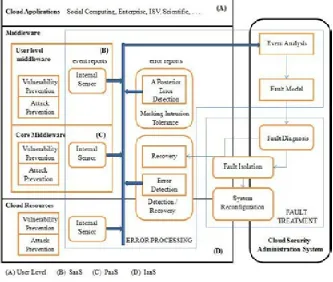
Figure 1: Intrusion Tolerance Framework based on Layered Design of Cloud Computing ArchitectureB. Attack and Vulnerability Prevention:
The Attack prevention consists of the introduction of mechanisms such as authentication, authorization and firewalls, which “prevent” attacks in that they “push back” the attacks. With attack taken in the human sense, this includes deterrence measures such as social pressure, laws and their enforcement. Vulnerability includes measures going from semi-formal and formal specification, rigorous design and system management procedures, up to and including user education (e.g., choice of passwords). Attack and Vulnerability Prevention mechanisms must be incorporated in both middleware level and system level.
IV. FRAME WORK VALIDATION
Through this we are representing different techniques for implementing Intrusion detection and tolerance on Cloud computing:
SHIM (System Health and Intrusion Monitoring) is used as an exemplary host-based ID to validate our approach. We formalized all specifications of SHIM which together with a trusted file policy enabled us to reason about the soundness and completeness of the specifications by proving that the specifications satisfy the policy under various assumptions.
DRCP (Dynamic Registration and Configuration Protocol) is an auto configuration protocol in mobile Ad Hoc networks. With respect to this protocol, our approach defines a global security requirement for a network that characterizes the “good” behavior of individual nodes to assure the global property. We formally prove that the local detection rules (identifying activity that is monitored) imply the global security requirement.
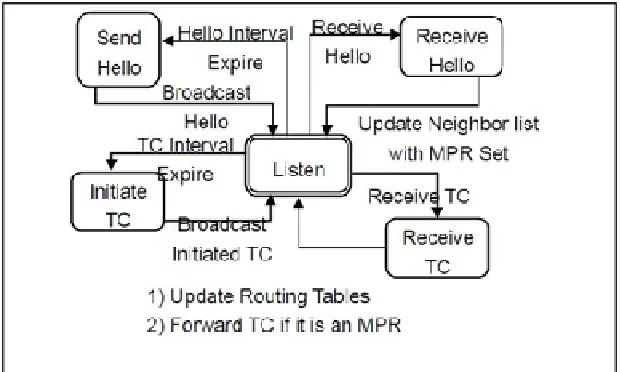
OLSR (Optimized Link State Routing) protocol is a proactive, table-driven routing protocol in MANETs. We analyze a specification-based intrusion detection mechanism to detect insider attacks in the OLSR protocol. We proved that the intrusion detection approach, which focuses on monitoring of local behavior, achieves a global integrity of network routing information.
© 2013, IJCSMC All Rights Reserved
4
significant energy and bandwidth. These factors motivate the design of a distributed and local specifications focused intrusion detection system geared towards ad hoc networks.We propose a distributed intrusion detection architecture that allows cooperative detectors to promiscuously monitor all Hello and TC messages by propagating limited control messages. These detectors monitor behavior of their neighbors according to specifications that describe correct behavior of the protocol.
In general, specification-based detection recognizes attacks by comparing the behavior of a system with specifications describing correct behavior of the system. Specification-based detection is particularly suitable for detecting attacks on network protocols because the correct behavior of a protocol is well defined and documented in the protocol specification. The challenge is to extract a suitable correct behavior model from the protocol specification that can be checked at runtime using network monitoring.
A. Simulation Environment:
The feasibility of the proposed framework of Cloud Computing is shown in Figure 2 was simulated using CloudSim toolkit. The computing power in Cloud environments is supplied by a collection of Datacenters that are typically installed with hundreds to thousands of hosts.
© 2013, IJCSMC All Rights Reserved
5
B. Design of CloudSim:
a. Datacenter: This class models the core infrastructure level services (hardware) that are offered by Cloud providers (Amazon,Azure, App Engine). It encapsulates a set of compute hosts that can either be homogeneous or heterogeneous with respect to their hardware configurations (memory, cores, capacity, and storage). Furthermore, every Datacenter component instantiates a generalized application provisioning component that implements a set of policies for allocating bandwidth, memory, and storage devices to hosts and VMs.
b. Cloud Coordinator: This component is instantiated by each cloud in the system, whose responsibility is to undertake thefollowing important activities,
i) Exporting Cloud services, both infrastructure and platform-level, to the federation;
ii) Keeping track of load on the Cloud resources (VMs, computing services) and undertaking negotiation with other Cloud providers in the federation for handling the sudden peak in resource demand at local cloud; and
iii) Monitoring the application execution over its lifecycle and overseeing that agreed SLAs are delivered.
c. Datacenter-Broker or Cloud-Broker: This class models a broker, which is responsible for mediating negotiations betweenSaaS and Cloud providers; and such negotiations are driven by QoS requirements. The broker acts on behalf of SaaS providers. It discovers suitable Cloud service providers by querying the Cloud Information Service (CIS) and undertakes on-line negotiations for allocation of resources/services that can meet application’s QoS needs. The researchers and system developers must extend this class for evaluating and testing custom brokering policies. The difference between the broker and the Cloud Coordinator is that the former represents the customer (i.e., decisions of this components are made in order to increase user-related performance metrics), while the latter acts on behalf of the data center, i.e., it tries to maximize the overall performance of the data center, without considering needs of specific customers. Cloud brokers are also called as user broker (U-broker) and datacenter broker is D-broker.
d. Host: This class models a physical resource such as a compute or storage server. It encapsulates important information suchas the amount of memory and storage, a list and type of processing cores (to represent a multi-core machine), an allocation of policy for sharing the processing power among virtual machines, and policies for provisioning memory and bandwidth to the virtual machines.
e. VM: This class models a virtual machine, which is managed and hosted by a Cloud host component. Every VM componenthas access to a component that stores the following characteristics related to a VM: accessible memory, processor, storage size, and the VM‟s internal provisioning policy that is extended from an abstract component called the Cloudlet Scheduler.
f. Cloud Exchange (CEx): It acts as a market maker by bringing together Cloud service (IaaS) and SaaS providers. CEx aggregates the infrastructure demands from the Cloud brokers and evaluates them against the available supply currently published by the Cloud Coordinators.
C. Intrusion Tolerance via Threshold Cryptography (ITTC):
© 2013, IJCSMC All Rights Reserved
6
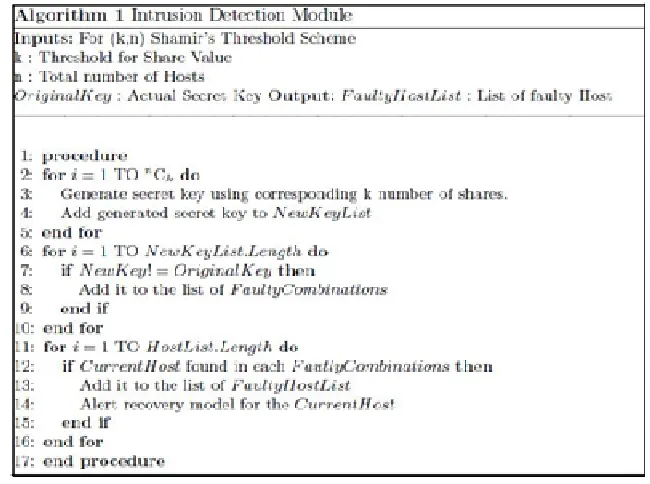
Figure 3: Intrusion Detection Moduleb. Recovery Module: In recovery process, reconfiguration module reallocates all the virtual machines running on the penetratedhost(s), and the fault isolation module removes compromised host(s) machine from the Host group constituting a datacenter. Recovery module then invokes key management module for generating and redistributing new secret shares. Figure 4 shows the algorithm used for recovering data center when a faulty host is detected.
Figure 4: Recovery Module
V. CONCLUSION AND FUTURE WORK
© 2013, IJCSMC All Rights Reserved
7
REFERENCES[1] Avizienis, A., Laprie, J.C., Randell, B., Landwehr, C.: Basic Concepts and Taxonomy of Dependable and Secure Computing. IEEE Trans., Dependable and Secure Computing 1(1), 11–33 (2004)
[2] Shamir, A.: How to share a secret. Comm. of the ACM 22, 612–613 (1979)
[3] Saidane, A., Nicomette, V., Deswarte, Y.: The Design of a Generic Intrusion-Tolerant Architecture for Web Servers. IEEE Trans. 6, 45–58 (2009)
[4] Powell, D., Stroud, R.: Malicious-and Accidental-Fault Tolerance for Internet Applications: Conceptual Model and Architecture. Technical Report 03011, Project IST-1999-11583 MAFTIA, Deliverable D21, LAAS-CNRS (January 2003)
[5] Information Technology Infrastructure Library, http://www.itil-officialsite.com/home/
[6] Intrusion Tolerance via Threshold Cryptography,http://crypto.stanford.edu/~dabo/ITTC/
[7] Reynolds, J.C., Just, J., Clough, L., Maglich, R.: On-Line Intrusion Detection and Attack Prevention Using Diversity, Generate-and-Test, and Generalization. In: HICSS 2003, Track -9, vol. 9 (2003)
[8] Pal, P., Schantz, R., Atighetchi, M., Loyall, J.: What Next in Intrusion Tolerance. BBN Technologies, Cambridge