IJARSE, Vol. No.4, Issue 06, June 2015 ISSN-2319-8354(E)
PERFORMANCE ANALYSIS OF
PRIVACY-PRESERVING MINING OF ASSOCIATION RULES
FROM OUTSOURCED TRANSACTION DATABASES
Ms. Supriya S. Borhade
1, Dr. S. V. Gumaste
21
M.E. Student,
2Professor & Head, Computer Engineering Department,
SPCOE, Dumberwadi, Pune MS, (India)
ABSTRACT
There has been significant recent interest in the paradigm of data mining as-a-service. A company (data owner) lacking in proficiency or computational resources can outsource its mining needs to a third party service provider (server). In spite of this, both the items and the association rules of the outsourced database are considered private property of the company (data owner). To protect corporate or individuals privacy, the data owner transforms its data and ships it to the server, sends mining queries to the server, and recovers the true patterns from the extracted patterns received from the server. In this paper, experiment evaluation of outsourcing the association rule mining task within a corporate privacy-preserving framework. Proposed an attack model based on background knowledge and devise a approach for privacy preserving outsourced mining. Represented approach ensures that each transformed item is indistinguishable with respect to the attacker’s
background knowledge, from at least k−1 other transformed items. These comprehensive experiments on a very large and real transaction database demonstrate that these techniques are effective, scalable, and protect privacy.
Keywords: Association Rule Mining, Privacy Preserving Outsourcing.
I. INTRODUCTION
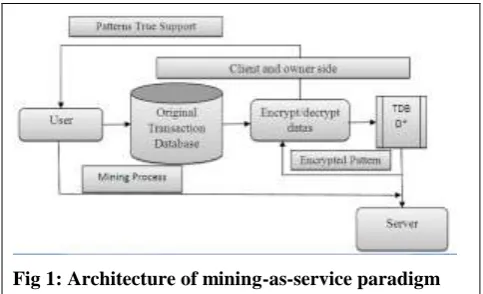
Fig 1: Architecture of mining-as-service paradigm
The problem of outsourcing the association rule mining task within a corporate privacy preserving framework is
difficult. A construction body of work has been done on privacy preserving data mining (PPDM) in a variety of
framework. A common attribute of most of the earlier studied frameworks is that the patterns mined from the
data (which may be unclear, encrypted, anonymized or transformed) are intended to be shared with parties other
underlying data and the mined results are not intended for sharing and must remain private to the data owner.
For this adopted a traditional frequency based attack model in which the server knows the exact set of items in
the owner’s data and additionally, it also knows the exact support of every item in the original data. Wong et al.
[1] was one of the near the beginning works on defending against the frequency based attack in the data mining
outsourcing scenario. Wong et al.[1] introduced the idea of using fake items to guard against the frequency
based attack; however, it was lacking a formal theoretical analysis of privacy guarantees, and has been shown to
be flawed very recently in [5], where a method for breaking the proposed encryption is given. Therefore, in
Giannotti et al.[ 4] previous and preliminary work, Giannotti et al.[4 ] proposed to solve this problem by using
k-privacy, i.e., each item in the outsourced dataset should be indistinguishable from at least k − 1 items
regarding their support. In this paper, the goal is to devise an encryption approach which enables formal privacy
guarantees to be proved, and to validate this model over large-scale real-life transaction databases (TDB). The
architecture behind this model is illustrated in Fig. 1. The client/owner encrypts its data using an encrypt/decrypt
(E/D) module, which can be essentially treated as a black box from its perspective. This model is responsible for
transforming the input data into an encrypted database. The server conducts data mining and sends the
(encrypted) patterns to the owner. This encryption approach has the property that the returned supports are not
true supports. The E/D module recovers the true identity of the returned patterns as well their true supports. It is
trivial to show that if the data are encrypted using 1–1 substitution ciphers (without using fake transactions),
many ciphers and hence the transactions and patterns can be broken by the server with a high probability by
launching the frequency-based attack. Thus, the major focus of this paper is to devise encryption approaches
such that formal privacy guarantees can be proven against attacks conducted by the server using background
knowledge, while keeping the resource requirements under control. First, formally defining an attack model for
the adversary and make the background knowledge the adversary may possess precise. The notion of privacy
requires that, for each cipher-text item, there are at least k−1 distinct cipher items that are indistinguishable from
the item regarding their supports. Secondly, developed an encryption approach, called Rob Fruga,l that the E/D module can employ to transform client data before it is shipped to the server. Third, to allowing the E/D module
to recover the true patterns and their correct support, it is proposed that it creates and keeps a compact structure,
called synopsis. For this providing the E/D module with an efficient strategy for incrementally maintaining the
synopsis against updates in the form of appends. Also conducted a formal analysis based on this attack model
and prove that the probability that an individual item, a transaction, or a pattern can be broken by the server can
always be controlled to be below a threshold chosen by the owner, by setting the anonymity threshold k. This result holds unconditionally for the Rob Frugal approach. Then conduct experimental analysis of this schema using a large real dataset from the Coop store chain in Italy. The result shows that these encryption schemas is
effective, scalable, and achieve the desired level of privacy. Providing here the key theoretical results which
concern the complexity and privacy guarantees the privacy. Also discusses the results of a comprehensive set of
experiments conducted using real and synthetic datasets.
II. PATTERN MINING TASK
The reader is familiar with the basics of association rule mining. let be the set of items and a of transactions,
IJARSE, Vol. No.4, Issue 06, June 2015 ISSN-2319-8354(E)
items, is also called the item support table of represented in tabular form [support table in Fig. 2(b)] Thewell-known frequent pattern mining problem [13] is: given a and a support threshold find all itemsets whose support
in is at least .
III. MODEL PRIVACY
Consider denote the original TDB that the owner has. to protect individual identification of items, when the
owner applies an encryption function to and transforms it to ,the encrypted database. Refer items in as plain
items and items in as cipher items. The term item shall mean plain item by default. The notions of plain item
sets, plain transactions, plain patterns, and their cipher counterparts are defined in the obvious way. use to
denote the set of plain items and to refer to the set of cipher items.
a) Adversary Knowledge: The server or an opponent might gains access to it may possess some prior or background knowledge using which opponent can conduct attacks on the encrypted database . Generically
refer to any of these agents as an attacker. Here adopting a conventional model and assuming that the attacker
knows exactly the set of (plain) items in the original and their true supports in, i.e., , . The attacker may have
access to similar data from a competing organization, may read published reports, etc. In reality, the opponent
may be having approximate knowledge of the supports or may know the exact/approximate supports of a subset
of items in D. However, to make the analysis robust, one can adopt the conventional assumption that he knows the exact support of every item. Remember, that as the opponent has access to the encrypted database D*, he also knows the supports, where is the set of cipher items in the encrypted database D*.
The encryption schema used in this paper is based on:
1) Replacing each plain item in D by a 1–1 substitution cipher and
2) Adding fake transactions to the database.
Consider, that the opponent knows this and thus he knows that | | = |I|. Essentially, compared to [2], adversary
knowledge model corresponds to a (100%, 0%) knowledge model, confined to single items. Assume that the
opponent neither has the knowledge of plaintext transactions nor the frequency of item sets and the distribution
of transaction lengths in the original database.
b) Attack Model: By assuming that the service provider (who can be an opponent) is semi-honest in the sense that although he does not know the details of encryption algorithm, opponent can be curious and he can use his
prior knowledge to make assumption on the encrypted transactions. Also considered, that the opponent always
returns (encrypted) item sets together with their exact support. The data owner considers the true identity of:
1) Every cipher item;
2) Every cipher transaction;
3) Every cipher frequent pattern;
As intellectual property which should be protected. The following attack model will considers all these.
1) Item-based attack: ∀ cipher item e ∈, the attacker constructs a set of candidate plain items Cand(e) ⊂ I. The probability that the cipher item e can be broken prob(e) = 1/|Cand(e)|.
2) Set-based attack: Given a cipher itemset E, the attacker constructs a set of candidate plain itemsets Cand(E),
Refer to prob(e) and prob(E) as crack probabilities. From the point of view of the owner, minimizing the probabilities of crack is desirable. Intuitively, Cand(e) and Cand(E) should be as large as possible. Ideally, Cand(e) should be the whole set of plaintext items. This can be achieved if one can bring each cipher item to the
same level of support, e.g., to the support of the most frequent item in D. Unfortunately, this option is impractical, as it will lead to a large size of the fake transactions, which in turn leads to a dramatic explosion of
the frequent patterns and making pattern mining at the server side computationally prohibitive. This motivates
us of relaxing the equal-support constraint and introducing item k-anonymity as a compromise.
Definition 1: Let D be a TDB and D* its encrypted version. D* satisfies the property of item k-privacy provided
for every cipher item e ∈ , if there are at least k−1 other distinct cipher items ∈ such that .
The concept of item anonymity is similar to the support anonymity [11] (based on the well-known
k-anonymity) as also require that for each cipher text item e, there are at least k−1 distinct cipher items that are
indistinguishable from e regarding their supports.
c) Problem Statement: To compute the privacy guarantees of an encrypted database, Here define the following notion.
Definition 2: Given a database D and its encrypted version D*, say D* is k-private if: 1) for each cipher item e ∈D*,;
2) for each cipher itemset E with support
The problem studied here is as follows.
Problem studied: Given a plain database D, construct a k-private cipher database D* by using substitution ciphers and adding fake transactions such that from the set of frequent cipher patterns and their support in D*
sent to the owner by the server, the owner can reconstruct the true frequent patterns of D and their exact support. Additionally, like to minimize the space and time incurred by the owner in the process and the mining overhead
incurred by the server.
IV. ENCRYPTION/DECRYPTION APPROACH
A. Encryption: In this section, introducing the encryption approach, called Rob Frugal, which transforms a TDB
D into its encrypted version D*. This approach is parametric with respect to k > 0 and consists of three main steps:
1) Using 1–1 substitution ciphers for each plain item;
2) Using a specific item k-grouping method; and
3) Using a method for adding new fake transactions for achieving k-privacy.
The constructed fake transactions are added to D (once items are replaced by cipher items) to form D *, and transmitted to the server. A record of the fake transactions, i.e., , is stored by the E/D module in the form of a
compact synopsis, as discussed in previous sections.
B. Decryption: When the client requests the execution of a pattern mining query to the server, specifying a minimum support threshold σ, the server returns the computed frequent patterns from D*.
Clearly, for every itemset S and its corresponding cipher itemset E, have that ≤ . For each cipher pattern E
returned by the server together with, the E/D module recovers the corresponding plain pattern S. It needs to
reconstruct the exact support of S in D and decide on this basis if S is a frequent pattern. To achieve this goal,
IJARSE, Vol. No.4, Issue 06, June 2015 ISSN-2319-8354(E)
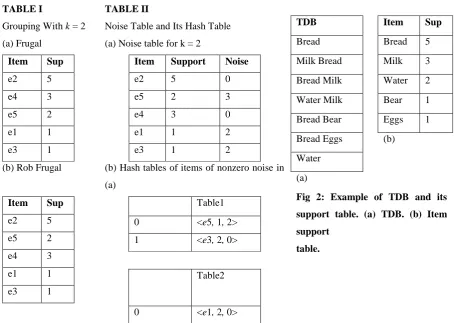
TABLE I
Grouping With k = 2 (a) Frugal
TABLE II
Noise Table and Its Hash Table
(a) Noise table for k = 2
TDB Item Sup
Bread Bread 5
Milk Bread Milk 3
Bread Milk Water 2
Water Milk Bear 1
Bread Bear Eggs 1
Bread Eggs (b)
Water
(a)
Fig 2: Example of TDB and its
support table. (a) TDB. (b) Item
support
table.
Item Sup
e2 5
e4 3
e5 2
e1 1
e3 1
Item Support Noise
e2 5 0
e5 2 3
e4 3 0
e1 1 2
e3 1 2
(b) Rob Frugal (b) Hash tables of items of nonzero noise in
(a)
Item Sup
e2 5
e5 2
e4 3
e1 1
e3 1
Table1
0 <e5, 1, 2>
1 <e3, 2, 0>
Table2
0 <e1, 2, 0>
(E)., this follows from the fact that support of an itemset is additive over a disjoint union of transaction sets.
Finally, the pattern S with adjusted support is kept in the output if ≥ σ. The calculation of (E) is performed by
the E/D module using the synopsis of the fake transactions in D * \D.
The proposed encryption/decryption approach is a viable solution for privacy-preserving pattern mining over
outsourced TDB, provided that a correct and efficient implementation exists. On the efficiency side, it is not
practical to store the support (E) for every cipher pattern. In order to realize the encryption approach efficiently,
need to address the following technical issues.
1) How do cluster items into groups of ?
2) How do create the needed fake transactions?
3) How is the synopsis represented and stored?
C. Grouping Items for k-Privacy
Given the items support table, several strategies can be adopted to cluster the items into groups of size k. Start
from a simple grouping method called Frugal. By assuming the item support table is sorted in descending order
of support and refer to cipher items in this order as , etc.
Definition 3: The Frugal method consists of grouping together cipher items into groups of k adjacent items in the item support table in decreasing order of support, starting from the most frequent item . Assume. . . is the
list of cipher items in descending order of support (with respect to D), the groups created by Frugal are {e1, . . . ,
}, {, . . . , }, and so on. The last group, is less than k in size, is merged with its previous group. By denoted the
grouping obtained using the above definition as G frug. For example, consider the example TDB and its
associated (cipher) item support shown in Fig. 2. For k = 2, has two groups: {} and { , , }. This corresponds to
Frugal grouping is optimal among all the groupings with the item support table sorted in descending order of
support. This means, it minimizes ||G||, the size of the fake transactions added, and hence the size ||D*||. But is Frugal a robust grouping, i.e., will it guarantee that itemsets (or transactions) cannot be cracked with a
probability higher than k ? The answer is no, in general. To see this point, consider the item support table in Table I: the first group created by Frugal for k = 2, {} [see Table I(a)] is supported in D, because occur together in a transaction of D. Therefore, there only exists one itemset candidate of {e2, e4}, i.e., the privacy guarantee is
1-privacy.To fix the privacy vulnerabilities of Frugal, introduce the RobFrugal grouping method, which
modifies Frugal by requiring that no group is a supported itemset in D.
Definition 4: Given a TDB D and its Frugal grouping = , the grouping method RobFrugal consists in modifying the groups of Gfrug by repeating the following operations, until no group of items is supported in D: 1) select the smallest such that find the most frequent item such that, for the least frequent item i of have: swap with
in the grouping.
For example, given the item support table in Fig. 2, the grouping illustrated in Table I(b), obtained by
exchanging e4 and e5 in the two groups of Frugal, is now robust: none of the two groups, considered as
itemsets, is supported by any transaction in D. The aim of Step 2 in Definition 4 is to obtain a robust grouping while maintaining as small as possible the number of fake transactions that are added to achieve k-privacy. In
particular, It will show the information about fake transactions can be maintained by the data owner using a
compact synopsis. This step is used to ensure the synopsis is as small as possible.
The key property of Rob Frugal is that, by construction, it is a robust grouping for any input TDB D. It is immediate to note that if the support in D of each group of the initial grouping Gfrug is 0, then RobFrugal produces a robust and optimal grouping, where optimal means that it minimizes the number of the fake
transactions that are created by this encryption approach. On the other hand, it should be noted that a grouping
according to Rob Frugal may not exist, depending on the extent of density in the TDB. For example, in a TDB where each pair of items occurs at least once together, Rob Frugal will not find a grouping for k = 2. In this case, a simple solution is to keep increasing the value of k until a Rob Frugal grouping approach exists. The intuition is that as k gets larger it is less likely that there is a real transaction containing all items in a group.
However, with a large k, the number of fake transactions increases. This affects storage and processing at the
server side although the data owner can always maintain information about fake transactions using a compact
synopsis of size n being the number of items. In practice, It has been found that even for small values of k = 10
to 50, a Rob Frugal grouping approach does exist. This was the case in all these experiments with real transaction data. In the Rob Frugal encryption approach, the output of grouping can be represented as the noise table. It extends the item support table with an extra column “Noise” indicating, for each cipher item e, the difference among the support of the most frequent cipher item in e’s group and the support of e itself, as
reported in the item support table. Denoted the noise of a cipher item e as N(e). Continuing the example, the noise table obtained with Rob Frugal is reported in Table II(a). The noise table represents the tool for generating
the fake transactions to be added to D to obtain D*.
V. CONSTRUCTING FAKE TRANSACTIONS
IJARSE, Vol. No.4, Issue 06, June 2015 ISSN-2319-8354(E)
group or to other items with support equal to the maximum support of a group. Then the remaining rows aresorted in descending order of noise. Let , . . . , be the obtained ordering of (remaining) cipher items, with associated noise N(), . . . ,N(). The following fake transactions are generated:
1) N() − N() instances of the transaction {}; 2) N() − N() instances of the transaction {, }; 3) . . . ;
4) N(−1) − N() instances of the transaction {, . . . , }; 5) N() instances of the transaction {, . . . , }.
Suppose cipher items of nonzero noise in Table II(a). The following two fake transactions are generated: two
instances of the transaction {} and one instance of the transaction {}. Note that even though the attacker may
know the details of the construction method, he/she is not able to distinguish these fake transactions from the
true ones, since the attacker does not have any background knowledge of frequency of item sets or of original
transaction length distribution. It can be shown that this method yields a minimum number
of different types of fake transactions that equal the number of cipher items with distinct noise. This observation
yields a compact synopsis for the client of the introduced fake transactions. The purpose of using a compact
synopsis is to reduce the storage overhead at the side of the data owner who may not be equipped with sufficient
computational resources and storage, which is common in the outsourcing data model. In order to implement the
synopsis efficiently, need to use a hash table generated with a minimal perfect hash function [16]. Minimal perfect
hash functions are widely used for memory efficient storage and fast retrieval of items from static sets. A minimal
perfect hash function is a perfect hash function that maps n keys to n consecutive integers, usually. Hence, h is a minimal perfect hash function over a set S if and only if implies and there exists an integer p such that the range of
h is . A minimal perfect hash function h is order-preserving if for any keys j and i, j < i implies h(j) < h(i). In this approach, the items of the noise table with N() > 0 are the keys of the minimal perfect hash function. Given function h computes an integer in denoting the position of the hash table storing the triple of values _, timesi,
occi, where timesi represents the number of times that the fake transaction {e1, e2, . . . , } occurs in the set of fake transactions, and occi is the number of times that ei occurs altogether in the future fake transactions after the transaction {, , . . . , }. Given a noise table with m items with non null noise, this approach generates hash tables for the group of items. In general, the ith entry of a hash table HT containing the item ei has = N() − N(), =, where
g is the number of items in the current group. Note that each hash table HT represents concisely the fake transactions involving all and only the items in a group of g ≤ items. The hash tables for the items of nonzero
noise in Table II(a) are shown in Table II(b). Finally, use a (second-level) ordinary hash function H to map each item e to the hash table HT containing e. Note that after the data owner outsources the encrypted database (including the fake transactions), he/she does not need to maintain the fake transactions in its own storage .Instead the data owner only has to maintain a compact synopsis, which stores all the information needed on the fake
transactions, for later recovery of real supports of item sets. The size of the synopsis is linear in the number of
items and is much smaller than that of the fake transactions.
With the above data structure, one can define the function RS that allows an efficient computation of the real
VI. EXPERIMENTS
In this section, presenting report on experimented empirical evaluation to assess the encryption/decryption
overhead and the overhead at the server side incurred by the proposed schema.
A. Datasets: For analysis purpose experimented on a large real-world database. The real world database is donated to us by Coop, a cooperative of consumers that is today the largest supermarket chain in India. Selected the transactions occurring during four periods of time in a subset of Coop stores, creating in this way four different databases with varying number of transactions: from 100k to 300k transactions. In all the datasets the transactions involve 15713 different products grouped into 366 marketing categories. Transactions are itemsets,
i.e., no product occurs twice in the same transaction. Assume two distinct kinds of TDBs:
1) Product-level Coop TDBs, denoted by Coop-Prod, where items correspond to products, and
2) Category level Coop TDBs that is denote by CoopCat, where items correspond to the category of the products in the original transactions. In these datasets, = 188 for CoopProd, while = 90 for CoopCat. Also, the two kind of TDBs exhibit very different density properties. The number of frequent patterns found in CoopCat
tends to explode for higher support thresholds, compared to CoopProd. Also experimented with this algorithms for both CoopProd and CoopCat.
B. Experimental Evaluation: Implemented Rob Frugal encryption & decryption approach in Java. All experiments were performed on an intel Core2 Duo processor with a 2.66 GHz CPU and 3GB RAM over a Win
7 platform. Adopted the a priori implementation by Christian Borgelt,2 written in C and one of the most highly optimized implementations.
VII. ENCRYPTION OVERHEAD
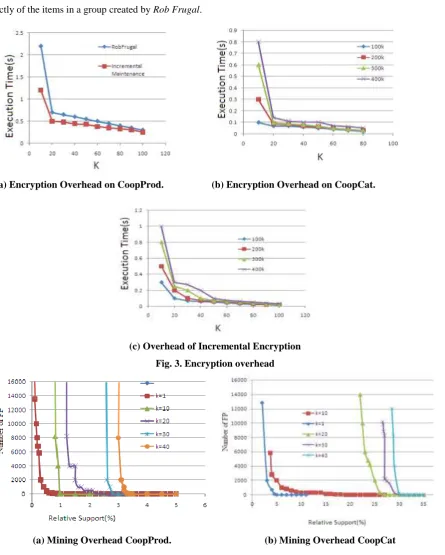
First assessed the total time needed by the ED module to encrypt the database (grouping, synopsis construction,
creation of fake transactions): timings are reported in Fig. 3 for CoopProd and CoopCat, for different values of
k and different number of transactions. The results show that the encryption time is always small; it is under 1 s for the biggest CoopProd TDB, and below 0.8 s for the biggest CoopCat TDB. Indeed, it is always less than the time of a single mining query, which is at least 1 s by Apriori, as shown in Fig. 4(d). Therefore, when there are
multiple mining queries, which is always the case for the outsourcing system; the encryption overhead of this
approach is negligible compared with the cost of mining. It is worth noting that these experiments provide
empirical evidence that the theoretical complexity upper bound of O(n2) is indeed over pessimistic. To see this point, counted the number of queries (to check that each group is unsupported)
performed by the ED module (Rob Frugal), over the two TDBs for the different values of k, and discovered that such number always coincides with n k , except for CoopCat TDBs in the cases k = 10 and k = 20: for example, for k = 10 and number of transactions 400K (the biggest TDB), an additional 3790 item swaps are needed to find a robust grouping and only 10 for k = 20. This is a strong empirical evidence that in real life databases Rob Frugal reaches a solution very fast, with complexity far below the O(n2) worst case: e.g., for CoopCat with k = 10 and 400 transactions, Rob Frugal only needs to check a total of 3826 queries, while 3662 = 133, 956! Second assessed the size of fake transactions added to the databases after encryption. It is observed that the size of fake
IJARSE, Vol. No.4, Issue 06, June 2015 ISSN-2319-8354(E)
incremental encryption is also assessed , which occurs when a new TDB is appended; to this end, then splitCoopProd with 500k transactions into two-halves and , and treat as the original TDB and as the appended one. The non-incremental method is considered here in which to encrypt ∪ from scratch, and compare its
encryption time with that of the incremental approach. Here, the time for transmitting TDBs between the client
and server ignore as it is assumed that the TDB streams into the ED module and the client can send the data that
has been encrypted to the server while encrypting the remaining data. The results, shown in Fig. 3(c), are
positive: essentially, for any value of k, the incremental procedure always achieves better performance than the non-incremental approach. Furthermore, thanks to the incremental procedure, the client avoids to send different
encrypted versions of the same set of transactions to the server. This reduces the cost for data retransmission and
makes this approach more robust against the possible attack based on the comparison of multiple versions of the
encrypted TDB.
Mining Overhead: The overhead at the server side for the pattern mining task over CoopProd∗ with respect to
CoopProd with 300K transactions is studied. Instead of measuring performance in run time, measure the increase in the number of frequent patterns obtained from mining the encrypted TDB, considering different
support thresholds. Results are plotted in Fig. 4(a), for different values of k; notice that k = 1 means that the original and encrypted TDB are the same. The x-axis shows the relative support threshold in the mining query, wrt the total number of original transactions (300k); the number of frequent patterns obtained is reported on the
y-axis. The number of frequent patterns are observed , at a given support threshold, increases with k, as expected. However, mining over CoopProd∗ exhibits a small overhead even for very small support thresholds, e.g., a support threshold of about 1% for k = 10 and 1.5% for k = 20. Mining over CoopCat with 300k
transactions and CoopCat∗ is more demanding, given the far higher density, but have similar observation, although at higher support thresholds [see Fig. 4(b)]. In either case, it is found that, for reasonably small values
of the support threshold, the incurred overhead at server side is kept under control; clearly, a tradeoff exists
between the levels of privacy, which increases with k, and the minimum affordable support threshold for
mining, which also increases with k. Note that, the client for extracting patterns from CoopProd∗ has to consider the number of fake transactions when he specifies the minimum support threshold in his query. Indeed, the
increasing of the number of transactions in CoopProd∗ requires using a smaller support threshold to have the same patterns that one could have from the original data. For example, for k = 10 CoopProd∗ has 306k transactions so, to have the patterns obtained from the original data (300k trans.) with a support of 2% the client has to use the support threshold equal to 1.9%, obtained by the computation 2 × 300k/306k. The need to use a smaller support could make harder the discovery of frequent patterns. But in these experiments, given the
sparsity of the real TDBs, It is found that the number of fake transactions does not change the support threshold
too much, making the problem still tractable.
3) Decryption Overhead by the ED Module: Now assumed that the feasibility of the proposed outsourcing model. The ED module encrypts the TDB once which is sent to the server. Mining is conducted repeatedly at the
server side and decrypted every time by the ED module. Thus, need to compare the decryption time with the
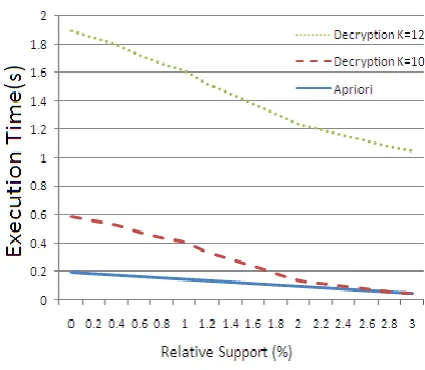
time of directly executing a priori over the original database. This comparison is particularly challenging, as chosen one of the most optimized versions of a priori (written in C), while these decryption method is written in Java without particular optimizations, except for the use of hash tables for the synopsis. Nevertheless, as shown
in Fig. 4(d), the decryption time is about one order of magnitude smaller than the mining time; for higher
Crack Probability: The crack probability for transactions and patterns over the Coop TDBs is also analyzed. Discovered that in both CoopCat and CoopProd TDBs encrypted by Rob Frugal, around 90% of the transactions can be broken with probability strictly less than 1 k . For example, considering the encrypted version of
CoopProd with 300K transactions, from experiments the following facts has been discovered, even for small k. For instance, for k = 10, every transaction E has at least 10 plain itemset candidates, i.e.,prob(E) ≤ 110 . Around 5% of transactions have exactly a crack probability 110 , while 95% have a probability strictly smaller than 110 .
Around 90% have a probability strictly smaller than 1100 . No single transaction contains any pattern consisting
exactly of the items in a group created by Rob Frugal.
(a) Encryption Overhead on CoopProd. (b) Encryption Overhead on CoopCat.
(c) Overhead of Incremental Encryption
Fig. 3. Encryption overhead
IJARSE, Vol. No.4, Issue 06, June 2015 ISSN-2319-8354(E)
(c) Decryption Versus Mining Time
Fig. 4. Overhead at Server Side and Decryption Overhead.
VIII. ANALYSIS
The main technical results on the robustness and the effectiveness of this encryption/decryption schema is
provided here as follows:.
A. Complexity: The complexity analysis shows that the encryption method requires O(n) storage and O(n2) time, where n is the number of distinct items. These complexity figures essentially concern the space and time needed
for the creation and maintenance of the synopsis representing the fake transactions. Concerning decryption,
finding here that the procedure to recover the true support of a pattern by using the synopsis requires O(m) time,
where m is the size of the patterns.
B. Privacy: Against the item-based attack: Recall that here assumed the attack does not know the details of these encryption algorithms. However, when the attacker tries to map plaintext and cipher-text items based on their
frequencies, he may observe that for every cipher-text item e, there always exist a plaintext item whose frequency is no larger than that of e. Then he may guess that fake transactions are inserted into the original dataset. Assume that he does so. Then, he can infer that for every cipher item e, , where i is the true plain item corresponding to e. For each cipher item e, the attacker tries to infer the true plain item i corresponding to e. Recall that the attacker knows and , and that . Based on this, for each cipher item e, he can construct a set of candidate items which could have been transformed by the owner to e. It is tempting to think that all items i
such are candidates for e. However, this can be narrowed down substantially as follows. Let en be any cipher item with the smallest support in D *. Consider the set of all cipher items e that have the same support in as and let S = {i’ | }. By the grouping established using RobFrugal, have and , the set of candidate items must be S. Now, consider any cipher item e with support. It is easy to see that any item corresponding to en cannot be in
the candidate set of e, since mapping e (back) to i would make it infeasible to map all cipher items consistently
to an item, while respecting the support constraints. Using this notion, the attacker can prune the set of candidate
sets of items as follows. Let {i’ | } be the initial candidate set . The attacker can sort the cipher items in non
decreasing order of their frequency in . Let be the set of cipher items with the smallest support in D*. He can
infer and . Clearly, every cipher item ∈S must be mapped to a plain item in, and no cipher item in can be mapped to a plain item in , since doing so makes it impossible to map all cipher items consistently back to some
for every cipher item. The attack can repeat the procedure on the remaining list of until he prunes the initial
candidate set of every cipher item. Denote the set of candidates for a cipher item e as . Define a mapping to be consistent provided. An assignment of an item to a cipher item is feasible if there is a consistent mapping such
that . A candidate set for a cipher item is minimal provided assigning any item from the candidate set to the
cipher item is a feasible assignment.
Theorem 1: For every cipher item e ∈ , let Cand(e) be the corresponding candidate set computed by the above pruning procedure. Then, every candidate set Cand(e) is minimal. Furthermore, , where is the true plain item corresponding to e .The proof of Theorem 1 is straightforward from the pruning procedure. Following the construction details of fake items for Rob Frugal, it is easy to see that for each cipher-text item must contain at least k items. Assuming every candidate item is equally likely to be the true plain item corresponding to a given cipher item.
Theorem 2: Let D be a TDB and D ∗ the encrypted database produced by the Rob Frugal scheme. Then, for every cipher item e, the probability of its crack is bounded by where k is a given parameter for item k -anonymity. The theorem shows that the probability that an individual item is broken can always be controlled to
be below a threshold chosen by the owner. By controlling the parameter k, the owner can control the crack probability of cipher items. This is exactly in the same spirit as in the classical notion of k-anonymity in the case of micro-data [14].
Against the set-based attack: Consider a cipher itemset E = {, . . . , } in D ∗, and suppose that this itemset
has\support (patterns with zero support are uninteresting). Note that the itemset can be a transaction or a
pattern. The attacker can construct the possible candidate sets for E as follows.
Definition 5: The set of possible plain item candidate sets Cand(E) for E are defined as follows: ∀ cipher item
ej ∈ , pick any plain item from Cand(), making sure that for any , ∈E, , the chosen plain items are distinct. A plain itemset belongs to Cand(E) iff it is generated using the above step. It is worth emphasizing that Cand(e) for a cipher item is a candidate set of items whereas Cand(E) for a cipher itemset denotes the set of candidate itemsets for E. Note that by the construction of D ∗, each cipher item is indistinguishable from at least k − 1
other cipher items, based on support. Thus, given a cipher itemset E, the attacker can map each cipher item ∈E
independently to some distinct item plain item i such that is indistinguishable from ej . This is the intuition behind the candidate set of itemsets Cand(E) .Given a cipher itemset E, the attacker finds the candidate set of itemsets Cand(E). Assuming equal likelihood, he can guess the correct itemset corresponding to the given cipher itemset with probability. The probability as the crack probability of E is referred. Given an encrypted database, determining the crack probability for a cipher itemset E requires that determine the size of its candidate set of possible itemsets. The following notion was used here as follows:
Definition 6: Let E be any cipher itemset and, ∈E any two cipher items. Then, ei ≡j iff Cand(ei) = Cand(ej ).
Denote by [ei] the equivalence class containing ei, i.e., the set {e ∈ E | e ≡ ei}. To determine the size of
Cand(E), consider the hyper-graph HE with nodes E whose edges are the sets Cand(e), where e ∈E and Cand
(e) denote the set obtained by replacing every plain item in Cand(e) by its substitution cipher. Clearly, E is a transversal of this hyper-graph, i.e., it has a nonempty overlap with every edge of the hypergraph. The size of
IJARSE, Vol. No.4, Issue 06, June 2015 ISSN-2319-8354(E)
equivalence class includes all cipher items in the set Cand(e). Clearly, the contribution of a complete equivalence class to the size of Cand(E) is a factor of 1. Let C be an equivalence class in E. Denote by Cand(E) the set Cand(e) for any element e ∈C. This is well defined, it have Cand(e) =Cand(e).Theorem 3: Given a cipher itemset E = {}, let C1, ...,Ct be the collection of equivalence classes of E. Then, the size of the candidate set of itemsets is |Cand(E)| = .
Proof: Recall that E is a union of one or more equivalence classes. Since construction of candidate itemsets for all equivalence class is independent of each other, equals to product of, the size of candidate itemsets
constructed from the equivalent class Ci. Since |Cand(Ci)| > |Ci| and |Cand(Ci)| ≥ k, the result follows. In Rob Frugal, cipher itemsets that are complete cannot exist with nonzero (fake) support.
Theorem 4: Given the original TDB D, let D r be its encrypted version obtained using any robust grouping scheme. Then ∀ itemset E with nonzero support in D ∗r , the crack probability , where k is the given threshold for k-anonymity. The key to prove the correctness of Theorem 4 is to show that no cipher itemset can be complete under the Rob Frugal scheme. Assume there is a complete cipher itemset. Then, E must be the union of one or more complete equivalence classes. In other words, every equivalence class in E has nonzero support in D ∗r . This contradicts the property ensured by the construction of Rob Frugal. Thus, there must exist at least one equivalence class that is not complete. Theorem 3 has shown that the bound of the candidate itemset for
each incomplete equivalence class is at least k. Thus the size of candidate itemset for E must be at least k. The theorem follows From Theory to Practice. Although the theoretical results demonstrate a remarkable guarantee of protection against the two kind of attacks and the practicability and the effectiveness of the proposed schema,
through these experiments on both real-world and synthetic transactional databases it is observed that both
privacy protection and run time performance are much better than the theoretical worst cases suggested by the
above results. Why? Concerning privacy, the explanation is that the probability of crack generally decreases
with the size of the itemset: 1k is an upper bound that essentially applies only to individual items, not itemsets (under the hypothesis that the adopted grouping is robust). Concerning performance, the explanation is in the
item support distribution. In real-life transaction datasets, the item support distribution (as well as the itemset
support distribution) follows a power law: the item at rank x in the item support table has a support that is proportional to α x β for some parameters α and β. This is a natural assumption in real-life TDB, studied in depth in [12]; in experiments over the Coop TDB, described, it is found β ≈ 0.5and α ≈ 30.000. The power-law distribution implies that there are a few items with large support and a heavy right-skewed tail of items with
very low support. Concerning the run time performance, the power-law distribution also facilitates the search for
a robust grouping: the identification of robust k-groups becomes quicker and quicker while proceeding from left to right in the item distribution, as the probability that k items in the same group do not co-occur in any transactions grows fast. All experiments confirm that for all values of k, the actual incurred overhead of using
Rob Frugal is negligible, far below the theoretical worst-case O(n2) complexity.
IX. CONCLUSION AND FUTURE WORK
In this paper, presenting a conservative model result , where the adversary knows the domain of items and their
exact frequency and can use this knowledge to identify cipher items and cipher itemsets. An encryption
synopsis of the fake transactions from which the true support of mined patterns from the server can be
efficiently recovered. A strategy for incremental maintenance of the synopsis against updates consisting of
appends and dropping of old transaction batches is also proposed. Unlike previous works, such as [1] and [8],
this formally proved that this method is robust against an adversarial attack based on the original items and their
exact support. Our experiments based on both large real and synthetic datasets yield strong evidence in favor of
the practical applicability of this approach. Currently, this privacy analysis is based on the assumption of equal
likelihood of candidates. It would be interesting to enhance the framework and the analysis by appealing to
cryptographic notions such as perfect secrecy [7]. Moreover, this work considers the cipher-text-only attack
model, in which the attacker has access only to the encrypted items. It could be interesting to consider other
attack models where the attacker knows some pairs of items and their cipher values. For example, the privacy
guarantees of this method in case of known-plaintext attacks is studied in this paper, chosen-plaintext attacks
(where the attacker knows some item and cipher pairs for selected items), and chosen-cipher-text attacks (where
the adversary knows some itemset and cipher pairs for selected ciphers).Another interesting direction is to relax
these assumptions about the attacker by allowing him to know the details of encryption algorithms and/or the
frequency of item sets and the distribution of transaction lengths. Our current framework assumes that the
attacker does not possess such knowledge. Any relaxation may break this encryption approach and bring privacy
vulnerabilities. One can investigate encryption approaches that can resist such privacy vulnerabilities. One can
also explore how to improve the Rob Frugal algorithm to minimize the number of spurious patterns.
REFERENCES
[1] W. K. Wong, D. W. Cheung, E. Hung, B. Kao, and N. Mamoulis, “Security in outsourcing of association
rule mining,” in Proc. Int. Conf.Very Large Data Bases, 2007, pp. 111–122.
[2] L. Qiu, Y. Li, and X. Wu, “Protecting business intelligence and customer privacy while outsourcing data
mining tasks,” Knowledge Inform. Syst.,vol. 17, no. 1, pp. 99–120, 2008.
[3] C. Clifton, M. Kantarcioglu, and J. Vaidya, “Defining privacy for data mining,” in Proc. Nat. Sci. Found.
Workshop Next Generation Data Mining, 2002, pp. 126–133.
[4] Fosca Giannotti, Laks V. S. Lakshmanan, Anna Monreale, Dino Pedreschi, and Hui (Wendy) Wang,”
Privacy-Preserving Mining of Association Rules From Outsourced Transaction Databases”, IEEE
SYSTEMS JOURNAL, VOL. 7, NO. 3, SEPTEMBER 2013,pg385-395.
[5] I. Molloy, N. Li, and T. Li, “On the (in)security and (im)practicality of outsourcing precise association rule
mining,” in Proc. IEEE Int. Conf Data Mining, Dec. 2009, pp. 872–877.
[6] F. Giannotti, L. V. Lakshmanan, A. Monreale, D. Pedreschi, and H. Wang, “Privacy-preserving data
mining from outsourced databases,”in Proc. SPCC2010 Conjunction with CPDP, 2010, pp. 411–426.
[7] C. E. Shannon, “Communication theory of secrecy systems,” Bell Syst.Tech. J., vol. 28, pp. 656–715,
1948.
[8] C. Tai, P. S. Yu, and M. Chen, “K-support anonymity based on pseudo taxonomy for outsourcing of
frequent itemset mining,” in Proc. Int.Knowledge Discovery Data Mining, 2010, pp. 473–482.
[9] M. Kantarcioglu and C. Clifton, “Privacy-preserving distributed mining of association rules on
horizontally partitioned data,” IEEE Trans. Knowledge Data Eng., vol. 16, no. 9, pp. 1026–1037, Sep.
IJARSE, Vol. No.4, Issue 06, June 2015 ISSN-2319-8354(E)
[10] B. Gilburd, A. Schuster, and R. Wolff, “k-ttp A new privacy model for large scale distributedenvironments,” in Proc. Int. Conf. Very LargeData Bases, 2005, pp. 563–568.
[11] P. K. Prasad and C. P. Rangan, “Privacy preserving birch algorithm for clustering over arbitrarily
partitioned databases,” in Proc. Adv. DataMining Appl., 2007, pp. 146–157.
[12] K.-T. Chuang, J.-L. Huang, and M.-S. Chen, “Power-law relationship and self-similarity in the itemset
support distribution Analysis and applications,” Very Large Data Bases J., vol. 17, no. 5, pp. 1121–
1141,2008.
[13] R. Agrawal and R. Srikant, “Fast algorithms for mining association rules,” in Proc. Int. Conf. Very Large
Data Bases, 1994, pp. 487–499.
[14] P. Samarati, “Protecting respondents’ identities in microdata release,”IEEE Trans. Knowledge Data Eng.,
vol. 13, no. 6, pp. 1010–1027, Nov. 2001.
[15] V. Ciriani, S. D. C. di Vimercati, S. Foresti, and P. Samarati, “k-anonymity,”in Proc. Secure Data Manage.
Decentralized Syst., 2007, pp. 323–353.
[16] T. H. Cormen, C. E. Leiserson, R. L. Rivest, and C. Stein, Introduction to Algorithms. Cambridge, MA:
MIT Press, 2001.
[17] F. Giannotti, L. V. Lakshmanan, A. Monreale, D. Pedreschi, and H. Wang, “Privacy-preserving