© 2014, IJCSMC All Rights Reserved
392
Available Online atwww.ijcsmc.comInternational Journal of Computer Science and Mobile Computing
A Monthly Journal of Computer Science and Information Technology
ISSN 2320–088X
IJCSMC, Vol. 3, Issue. 3, March 2014, pg.392 – 396
RESEARCH ARTICLE
INTRUSION DETECTION AND PREVENTION
BY USING LIGHT WEIGHT
VIRTUALIZATION IN WEB APPLICATIONS
J.Angeline Linora
1, M.Nava Barathy
21
PG Student, Embedded system technologies, Regional centre of Anna University, Tirunelveli, India
2
Assistant Professor, Department of computer science, Regional centre of Anna University, Tirunelveli, India
1
Abstract— Web services and applications is an important part of our daily life providing communication and
management of information from anywhere. With the increase in web services, the applications of web
moved to a multitier design. These services have web server at front end that runs the applications and data
server at back end. Due to their abundant use in managing information, the web services have always been
the target of attacks such as future session attack, sql injection attack, cross site scripting attack etc. To
prevent such attacks in web services, IDS based on anomaly detection that depends on honey pot can be used
to detect the unknown attacks by identifying the anomalous behavior that differs from the behavior of
legitimate user.
Keywords— multitier, web services, honey pot, IDS
I. INTRODUCTION
The usage of web services and applications has increased ranging from individual to large organizations. It
allows the users to interact remotely with the information using the web browser. Our day to day tasks such as
banking, travel, social networking etc are all done through web. These applications have always been the target
of attacks that exploit the confidentiality and integrity of services delivered to the users. These attacks use the
web request to destroy the back end data. To protect the web services several security mechanisms have been
© 2014, IJCSMC All Rights Reserved
393
It can be used to detect the abnormal behavior that deviates from the normal network behavior. If an attacker log
into the web server using the normal user access can find a way to issue privileged database query. In this paper,
we present an approach that create models of isolated user sessions that includes front end(http) and back
end(sql) network transactions. Each of the user session is assigned to a dedicated container. We can use the ID
of the container to match the web request with the data base queries. The isolated user sessions prevents the
attacker from compromising the session.
II. INTRUSIONDETECTIONSYSTEM
Intrusion detection system monitors network traffic and suspicious activity and also responds to malicious
traffic by blocking the user or IP address from accessing the network. Intrusion detection is based on the
assumption that the behavior of the intruder differs from that of a legitimate user. The classes of intruder are Masquerader: An individual who does not have authorized to use computer penetrates system’s access control to
exploit legitimate user account. Misfeasor: A legitimate user accesses the data, programs and resources of the authorized user’s privileges. There are two types of intrusion detection system Anomaly detection and misuse
detection. Anomaly detection involves collection of data relating to the behavior of legitimate user over a period
of time. The statistical tests are applied to the observed behavior to determine with a high level of confidence
whether the behavior is not legitimate user behavior. Threshold detection: This approach involves defining
thresholds, independent of user. Profile based: A profile of activity of each user is developed and used to detect
changes in the behavior of individual accounts. Our approach belongs to anomaly detection depends on training
phase to build correct model. Misuse detection: It is the reverse approach of the anomaly detection by defining
the abnormal behavior first and then the normal behavior uses the attack signatures. The previous approaches
have detected intrusions by analysing the source code. Our approach does not require knowing the application
logic or analysing the source code.
III. TYPES OF ATTACKS
1. Privilege escalation attack
Privilege means what is allowed to do. Common privileges include viewing, modifying and editing the files of
the system. Privilege escalation is the process of exploiting a bug in an operating system or software
applications to gain access to resources that protected from an application or user and perform unauthorized
actions. The attacker logs into the web server as the normal user and upgrades the privileges, triggers the queries
to obtain the data of the administrator.
2. Hijack future session attack
This type of attack uses the http request to take over the web server. This is also known as cookie hijacking,
exploiting the valid computer session to gain authorized access in a computer system and hijack all the
legitimate user session to launch the attacks. The attacker can also eavesdrop or drop the user requests. Session
hijacking attack can also be categorized as spoofing, man in the middle attack, denial of service attack and
© 2014, IJCSMC All Rights Reserved
394
3. Injection attack
This type of attack takes the advantage of the improper coding to execute attacker commands. Using sql the web
applications interact with backend data base to retrieve the user’s
data.
An attacker deliver malicious sql querysegments in order to alter the query sent to the back end data base. This is a technique to attack the websites.
IV. RELATED WORK
Intrusion detection systems work in isolation from access control for the applications to protect the system. The
lack of coordination between the components prevents detecting and responding to ongoing attacks in real-time
before they cause damage. To overcome this problem in detection dynamic authorization technique used to
support fine-grained access control and application level intrusion detection and response capabilities,
experience with integration of the Generic Authorization and Access Control API to provide dynamic intrusion
detection and response for the Apache Web server. This [1] paper describes the implementation of the
Vulnerability &Attack Injector Tool that allows the automation of the entire process. This tool is used to run a
set of experiments that describes the feasibility and the effectiveness of the proposed method. The experiments
include the evaluation of coverage and false positives of an Intrusion Detection System for SQL Injection
attacks and the assessment of the effectiveness of two top commercial web application vulnerability scanners.
This [5] paper proposes a system composed of a web-based anomalydetection system that is a reverse HTTP
proxy and a database anomaly detection system. The process of combining web-based anomaly detector and
SQL query anomaly detector increases the detection rate of our system. To address the increase in the false
positive rate, an anomaly-driven reverse HTTP proxy to serve anomalous requests that does not require access
to sensitive information. We developed a prototype and evaluated its applicability with respect to several
existing web-based applications. Results show that our approach is feasible and effective in reducing both false
positives and false negatives.
V.
SYSTEM ARCHITECTURE© 2014, IJCSMC All Rights Reserved
395
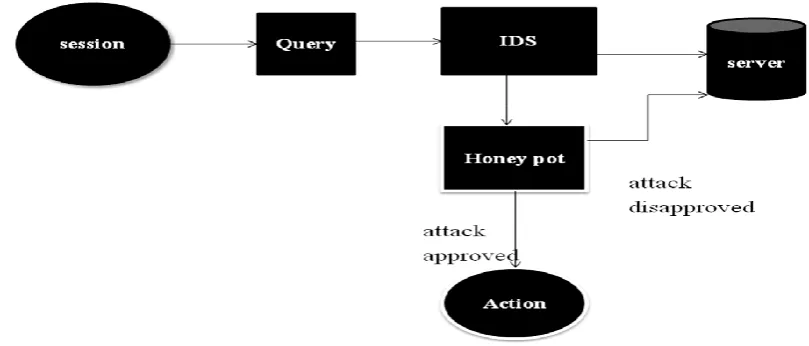
Fig 1: Shows the block diagram of intrusion detection system with honey pot. The user enters into the login or a
particular session. The http request of user is analysed by the IDS before sent to the server.IDS is based on the
assumption that the behavior of the intruder deviates from the normal behavior. If no suspicious activity is
detected the query for database will be sent directly to the server. When the IDS detect the malicious activity, it
will be sent to honey pot for approval. If the attack is approved, then the honey pot tracks the activity of the
intruder and responds to it. It will block the intruder from accessing the privileges.
1. Traffic collection
In this module each user session is assigned to a different container and this was a design decision. For instance,
a new container per each new ip address of the client is assigned. In this containers are recycled based on events
or when sessions time out.
2. Building honey pot
This container based and session-separated web server architecture not only enhances the security performances
but also provides us with the isolated information flows. It allows us to identify the mapping between the web
server requests and the following DB queries, and use such a mapping model to detect abnormal behaviors on a
session.
3. Attack scenarios
At the web server, Honey pot is deployed on the host system and cannot be attacked directly. These Honey pots
will not be attacked at the database server either that the attacker cannot completely take control of the database
server. The IDS analyzes the information it gathers and compares it to normal users behaviour essentially, the
IDS looks for specific attack that has already been documented like an SQL injection attack, cross scripting
attack. Then, it classifies normal user and abnormal user by behavior and detects the intruder and also takes a
necessary action based on intrusion.
VI. CONCLUSION
We proposed an intrusion detection system that depends on honey pot builds the models of normal behavior for
multitier web applications considering both front-end requests and backend db queries. It provides a container
based IDS with multiple input streams to produce the alerts and can identify a large number of attacks with the
minimal false positive rate. This achieves better characterization of the system for anomaly detection and it is
more effective for both the static and dynamic web service.
REFERENCES
[1] Jose Fonseca, Marco Vieira, Henrique Maderia, “Evaluation of Web Security Mechanisms using Vulnerability & Attack Injection”,IEEE transactions on dependable and security computing, 2013.
[2] William G.J. Halford, Alesaandro Orso, “WASP: Protecting Web Applications Using Positive Tainting
and Syntax-Aware Evaluation”, IEEE transactions on software engineering, January 2008.
© 2014, IJCSMC All Rights Reserved
396
[4] Fredrik Valeur, Giovanni Vigna, “A Comprehensive Approach to Intrusion Detection Alert Correlation”,
IEEE transactions on dependable and security computing, vol 1 September 2004.
[5] William Robertson, Christopher Kreugal,”Reducing errors in the anomaly-based detection of web-based attacks through the combined analysis of web requests and SQL queries”, Journal of computer society, 2009.
[6] T.Venkat, Narayana Rao, V.Tejaswini. “Defending against vulnerabilities and cross site scripting”, Journal
of Global Research in Computer Science, vol 3, may 2012.
[7] Peyman Kabiri, Ali A.Ghorbani,”Research on Intrusion Detection and Response: A survey”, International
Journal of Network Security, vol.1, 2005.
[8] C.Anley, Advanced SQL injection in SQL server applications, Next generation security software Ltd, 2002
[9] Paul K Harmer, Paul D.Williams,”An artificial immune system for computer security applications”, IEEE
transactions on evolutionary computation, vol 6, 2002.
[10] Jose Fonseca, Marco Viera, Henrique Maderia,”Analysis of field data on web security vulnerabilities”,