Article
Effects of Vehicle-Induced Vibrations on the Tensile
Performance of Early Age PVA-ECC
Xiaodong Zhang 1, Shuguang Liu 1,2 *, Changwang Yan 2 *, Xiaoxiao Wang 3 and Huiwen Wang 4
1 School of Materials Science and Engineering, Inner Mongolia University of Technology, Hohhot 010051,
China; [email protected]
2 School of Mining and Technology, Inner Mongolia University of Technology, Hohhot 010051, China;
3 School of Civil Engineering, Inner Mongolia University of Technology, Hohhot 010051, China;
4 Beijing Tuowei Times Architectural Design Co., Ltd., Beijing 100020, China; [email protected]
* Correspondence: [email protected] (S.L.); [email protected] (C.Y.)
Abstract: Polyvinyl alcohol-engineering cementitious composites (PVA-ECC) has been widely applied in bridge deck repairing or widening, the common practice for doing this is that a portion of a bridge is left open to traffic while the closed portion is constructed, which expose the early age PVA-ECC to the vehicle-induced vibrations. However, whether vehicle-induced vibrations affect the tensile performance of early age PVA-ECC remains unknow. The purpose of this study was to conduct laboratory test programs on how much vehicle-induced vibrations during early ages affected the tensile performance of PVA-ECC. A self-improved device was used to simulate the vehicle-induced vibrations, and after vibrating with the designed variables, both a uniaxial tensile test and a grey correlation analysis were performed. The results indicated that: the effects of vehicle-induced vibrations on the tensile performance of early age PVA-ECC were significant, and they generally tended to be negative in this investigation. In particular, for all of the vibrated PVA-ECC specimens, the most negative age when vibrated occurred during the period between the initial set and the final set. We concluded that although vehicle-induced vibrations during the setting periods had no substantial effects on the inherent strain-hardening characteristics of PVA-ECC, the effects should not be ignored.
Keywords: PVA-ECC; vehicle-induced vibrations; setting periods; tensile performance; grey correlation analysis
1. Introduction
PVA-ECC exhibit remarkable strain-hardening characteristics, and feature outstanding tensile ductility and energy dissipation properties with the strategically designed method of the performance driving design method (PDDA) based on micromechanics [1,2]. Their ultimate tensile strain can steadily stay above 3.0% under a uniaxial tensile load [2,3]. By reducing the brittle nature of concrete, PVA-ECC has opened a new world of possibilities to enhance the safety [4], durability [5,6], and sustainability [7,8] of civil infrastructure.
PVA-ECC has been widely applied in bridge deck pavements [9,10], overlays [11,12], and link slabs[13,14]. However, PVA-ECC does not have obvious economic advantages if it is utilized as the main structural material of a bridge. This material seems more practical and economical if it is used as part of bridge deck repairs. Completed studies have shown that PVA-ECC repairs could effectively deal with bridge deck defects [15] and greatly improve mechanical performance [13] and durability [6]. Nonetheless, the question remains, whether vehicle-induced vibrations affect the tensile performance of PVA-ECC bridge deck repairs. In particular, PVA-ECC is most vulnerable to vibrations at setting periods when vibrations might disrupt its states or physicochemical processes.
The series of physicochemical processes of PVA-ECC might be affected by vehicle-induced vibrations at different setting periods. The severe traffic pressure in modern cities increases the
possibility that vehicle-induced vibrations will take place adjacent to the setting processes of newly placed PVA-ECC. This will result the ingredients, such as the hydrates, free water, and fibers in the matrix, being subjected to a continuous disturbance of “inertial force” or a certain extent of acceleration caused by the driving force of vehicle-induced vibrations. Similar to normal concrete, early age PVA-ECC has rheological properties [16,17], and thus presents different physicochemical states at different setting periods. Therefore, it could be speculated that, a series of processes, such as the transportation of water between the pores in the matrix or the interface of the fiber/matrix, the lapping of the structural bonds among hydrates, and the connection of the solid-phase skeleton, might be affected by vehicle-induced vibrations at different setting periods ranging in time from before the initial set, to during the period between the initial set and the final set, and after the final set.
There are possible effects of vehicle-induced vibrations on PVA-ECC before the initial set. On the one hand, due to good flowability of the PVA-ECC before the initial set [18], the continuous disturbance of vibration at this period might induce a certain degree of bleeding for the PVA-ECC slurry. On the other hand, due to the hydrophilic characteristics of PVA fibers [19], the bleeding process might be accompanied by the floatation of the PVA fibers, resulting in a different distribution density for PVA fibers along the transverse section. Therefore, the tensile performance of PVA-ECC may be affected by the two possible effects before the initial set.
There are possible effects of vehicle-induced vibrations on PVA-ECC during the period between the initial set and the final set. The period during the initial set and the final set, is the key period for the growth of hydrates and the formation of microstructures [20]. If vibrated at this period, the
“inertial force” will probably inhibit the agglomeration of C-S-H particles, which is the main process
for low-density C-S-H gel transfers to high-density C-S-H gel [21]. Additionally, the vibration will probably damage the bonds of C-S-H gel and result in a certain degree of physical damage or obstruction to the connecting of the solid-skeleton. Moreover, due to the good water absorbability of PVA fibers [22], if they are vibrated at this period, the vibration disturbance could promote free water aggregating surround the surface of PVA fibers. This would probably make the water-cement ratio around the interface of the interface of the fibers/matrix larger than that of other parts of the matrix, and then causes bond reduction for the interface of the fibers/matrix. Furthermore, a large number of ettringite (AFt) precipitates will have formed in the matrix at this stage [23], sufficient free water will make it more conducive to the hydroscopic expansion of the AFt at the interface of the fiber/matrix [24], resulting in a larger porosity at the fiber/matrix interface, which would cause further bond reduction for the fibers/matrix interface.
There are possible effects of vehicle-induced vibrations on the PVA-ECC after the final set. After the final set, the remnants of anhydrous cement grains, gradually consumed by hydration, will be enveloped by contiguous, gradually thickening, spherical barrier shells of calcium-silicate hydrate (C-S-H) [25]. The hydration progress of cement is controlled by the transport of water from capillary pores through the barrier shells toward the interface with anhydrous cement [25]. The continuous disturbance of vibration during this period will probably promote the consumption of anhydrous cement grains, thereby increasing the degree of hydration, and then enhancing the strength of the matrix.
As commonly known, C-S-H gel is the main source for the strength of a cement matrix, and good properties of a cement matrix and the bond of a fiber/matrix interface are necessary for PVA-ECC to exhibit its excellent tensile performance. The above possible effects of vehicle-induced vibrations have a great probability to affect the tensile performance of PVA-ECC at different setting periods. Therefore, it is necessary to clarify how much vehicle-induced vibrations affect the tensile strength and deformation of PVA-ECC at different setting periods ranging in time from before the initial set, to during the initial set and the final set, and after the final set.
fact, some of the results indicated that if high quality, low slump concrete was used, both the compressive and bond strength appeared to increase slightly [28]. However, the “early age”, in most of the related studies, was actually the period after the final set of concrete bridge deck repairs.
Some of the current studies, have focused on the effects of vehicle-induced vibrations on the compressive and bond strengths of concrete bridge deck repairs at the setting periods that were before the final set. Their results showed that if the vibration occurred before the final set, there would be a considerable reduction of the compressive and bond strengths of early age bridge deck repairs [29]. In particular, studies have shown that, when subjected to vehicle-induced vibrations during the period between the initial set and the final set, concrete bridge deck repairs experienced tensile strength and elastic coefficient losses [30]. Fernandes J F pointed out that special care must be taken with regard to the tensile strength of concrete repairs because its reduction can have a negative effect on the usability of a bridge deck, and it can result in a greater deflection [30]. The results of Zhang X [31] further confirmed that both the visible cracks and internal damage of concrete repairs occurred seriously when the concrete was vibrated during the period between the initial set and the final set. He defined this period as the disturbance-sensitive period and inferred that when the concrete was at the disturbance-sensitive period, the bond strength between the cement and the aggregate was incapable of resisting vibration. Therefore, microdefects were induced by vibration that degraded the performance of concrete repairs. However, he did not provide direct evidence for this explanation. Similar conclusions were drawn by Kwan A K H [32] and Ng P L [33]. Their results showed that if a vibration disturbance started immediately when the concrete repairs were just poured, and when the vibration amplitudes caused by a moving vehicle were greater than 4.5 mm, both the bond and contraflexure strengths were significantly affected (20% reduction). Only one study showed that vehicle-induced vibrations had no substantial effects (less than 10%) on the splitting strength of concrete bridge deck repairs during various setting periods [34].
To summarize, most of the previous studies showed that when vibration occurred after the final set, the effects of vibration had no substantial effects on the strengths of concrete bridge repairs, but when vibration occurred during the period between the initial set and the final set, there was a significant negative impact.
However, prior to our work, to the best of our knowledge, few of the completed studies, paid attention to the effects of vehicle-induced vibrations on the tensile performance of early age PVA-ECC, even though it has bright prospects and it has been widely applied in bridge deck repairs. Among various vibration sources, vehicle-induced vibrations would be the most likely to cause continuous disturbance during the setting periods of PVA-ECC, and among many methods, the uniaxial tensile test might be the most convenient and effective way to identify the strain-hardening characteristics of PVA-ECC bridge deck repairs. Therefore, in order to determine how much vehicle-induced vibrations affect the tensile performance of early age PVA-ECC, we conducted a laboratory test program through a self-improved vibration device that simulated vehicle-induced vibrations. A total of 324 “dog-bone” shaped PVA-ECC specimens with sizes of 330 mm × 60 mm × 15 mm in 36 groups were cast and subjected to vibration tests up to different levels of vibration frequency combined with different lengths of vibration duration at different ages ranging in time from before the initial set, to during period between the initial set and the final set, and after the finial set. After being vibrated with the designed variables, the specimens were tested with a uniaxial tensile test to determine their cracking strengths, ultimate tensile strengths, and strains.
2. Materials and Methods
2.1. Materials
China, and its chemical composition is listed in Table 3. The silica sand with particle sizes in the range from 75 μm to 135 μm was provided by Hohhot Quartz Sand Group Co., Ltd.
The matrix additives that were used to modify the properties of the matrix included 3301E modified polycarboxylate-type superplasticizer (PCSP), JXPT-1206 high-efficiency defoamer (HED), MK-100000S viscosity modifying admixture (VMA), and K-Ⅱpolyvinyl alcohol (PVA) fiber. The PCSP, produced by Dalian Sika Building Materials Co., Ltd., China, had a water-reducing efficiency of about 33.0 %. The VMA, produced by Shandong Chuangyao Biotechnology Co., Ltd., China, was added to enhance the cohesiveness and water holding capacity of the matrix. The HED, produced by Beijing Jinliangbo Technology Co., Ltd., China, was used to reduce the air content in the matrix. The physical properties of the PVA fiber, provided by Kuraray in Japan, are shown in Table 4. The volume fraction of the PVA fiber was maintained at 2.0 % in this investigation. In the mixture design, a water-to-binder ratio of 0.24 was used. The mixture proportions are listed in Table 5.
Table 1. Basic physical indexes of PO 42.5R cement
Initial setting/ Final setting(h
)
Water requirement of normal consistency
(%)
Flexural strength
(MPa)
Compressive strength
(MPa)
1.95/2.98 26.9 3.0 days 28.0 days 3.0 days 28.0 days
5.8 8.1 28.9 47.6
Table 2. Chemical composition of PO 42.5R cement (%)
Al2O3 SiO2 CaO Fe2O3 MgO SO3 Loss on Ignition
7.19 23.44 55.01 2.96 2.24 2.87 2.86
Table 3. Chemical composition of class-I fly ash (%)
SiO2 Al2O3 CaO Fe2O3 CO2 MgO SO3 K2O Na2O TiO2 SrO Others 40.28 18.15 18.08 8.56 5.18 2.34 2.08 1.76 1.31 0.95 0.73 0.58
Table 4. Physical properties of K-Ⅱ PVA fiber
Fineness (dtex)
Density (g/cm3)
Diameter (μm) Elongation rate (%) Tensile strength (MPa) Length (mm) Elastic modulus (GPa)
15 1.3 40 6 1600 12 40
Table 5. Mixture proportions of PVA-ECC (kg/m3)
Cement Fly ash Water Silicon sand PCSP HED VMA PVA fiber
254 1016 304 457 15.24 2.60 0.64 26
2.2. Methods
2.2.1. Preparation of the specimens
The mix procedure of the PVA-ECC mixture was as follows: First, the weighed dry composition including the cement, fly ash, silicon sand, and VMA were mixed for two minutes in the cement mortar mixer. Second, the weighted PCSP and HED were dissolved into the weighted water, and then the solution was mixed into the dry mixture and mixed for 6 min in the cement mortar mixer. Finally, the PVA fibers were scattered artificially slowly into the mixture while the mixer was working and then mixed for 6 min after all of the PVA fibers were added.
To meet the designed vibration variables, 333 “dog-bone” shaped specimens with sizes of 330 mm × 60 mm × 15 mm were cast in 37 groups (9 in each group), including one group of control specimens that was not subjected to vibration. After being subjected to the designed vibration variables, the PVA-ECC specimens were cured in a laboratory environment, and the uniaxial tensile test was performed 28 days after the cement-water contact. To eliminate the variation caused by the individuals, all the specimens were cast by one test operator.
2.2.2. Vibration device and variables
In order to simulate vehicle-induced vibrations, a vibration device was improved based on the cement mortar vibration table, as shown in Figure 1. The driving force of the vibration device was provided by a triphasic variable speed motor. The speed of the motor could be adjusted by the frequency converter, and the vibration frequency of the device would then be converted. To ensure that the vibration model was presented as simple harmonic vibration, two rotating bearings with circular eccentricity were added for the vibration device.
Figure 1. Self-improved vibration device based on cement mortar vibration table
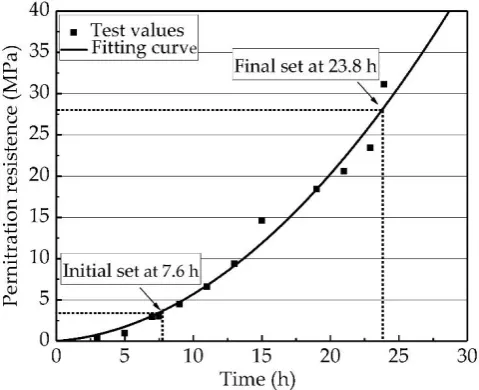
Figure 2. Results from the penetration test showing times of the initial set and the final set.
final set were obtained, which were 7.6 h (penetration resistance ≤ 3.5 MPa) and 23.8 h (penetration resistance ≤ 28.0 MPa), respectively.
Three variables were considered to be of the greatest interest for the experimental program: age when vibrated, vibration frequency, and vibration duration.
The age or time when vibrated is a certain amount of setting time after water-cement contact. This variable was selected to determine the effects of vehicle-induced vibrations on the tensile performance of the PVA-ECC at different ages ranging in time from before the initial set to during the initial set and the final set and after the final set. The ages when vibrated that we chose in this investigation were 2.0 h, 8. 0 h, 15.0 h, 23.0 h, 36.0 h, and 48.0 h. These six ages ensured that the PVA-ECC would be vibrated throughout the three setting periods.
The vibration frequency was selected to determine the effects of vehicle-induced vibrations on the tensile performance of the PVA-ECC under different levels of dynamics. The vibration frequencies we chose in this investigation were 2.0 Hz, 3.0 Hz, 4.0 Hz, and 5.0 Hz, and the corresponding amplitude was maintained at 5.0 mm.
The vibration duration is the time of maintaining continuous and uninterrupted vibration under the disturbance of one of the four levels of frequency. This variable was selected to explore whether the length of vibration affected the tensile performance of the PVA-ECC. The vibration durations we chose in this investigation were 2. 0 h, 5. 0 h, 8. 0 h, and 11. 0 h.
2.2.3. Uniaxial tensile test
The uniaxial tensile test was performed using an electronic universal testing machine with a range of 10 KN. The loading rate was maintained as 0.05 mm/s during loading, and the experimental data were collected by a static test analysis system.
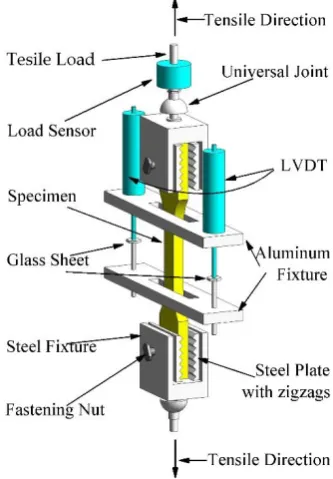
Figure 3. Schematic diagram of the loading device
the axis of the specimen. Before loading, two LVDTs were fixed on the sides of the tested specimen with an aluminum fixture, and the measuring distance was maintained at 90 mm in the middle of specimen.
2.2.4. Statistical analysis
In order to minimize the discreteness of the tested data, for the 36 groups of vibrated specimens and the one group of control specimens, the Winsorized mean of the tested stress and strain values of the nine specimens were taken to represent the stress and strain values of the corresponding group. If a certain specimen among the nine specimens had an ultimate tensile strain value that was the closest to the Winsorized mean, then its stress-strain curve was taken to represent the stress-strain curve of the corresponding group.
3. Results and Discussions
3.1 Effects of age when vibrated on the tensile performance of PVA-ECC
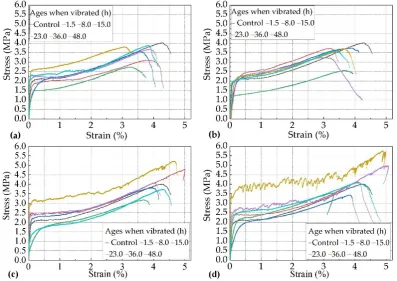
The strain- stress curves of the twenty-four groups of vibrated specimens and the one group of control specimens at different ages when vibrated for 1.5 h, 8.0 h, 15.0 h, 23.0 h, 36.0 h, and 48.0h, subjected to the combination of a constant duration of 5.0 h and different levels of vibration frequency of 2.0 Hz, 3. 0 Hz, 40 Hz, and 5.0Hz, are shown in Figure 4. The rates of cracking strength (σcc),
ultimate tensile strength (σcu), and strain (εcu) of the variated specimens over the cracking strength
(σvc), ultimate tensile strength (σvu), and strain (εvu) of the control specimens with the increase of ages
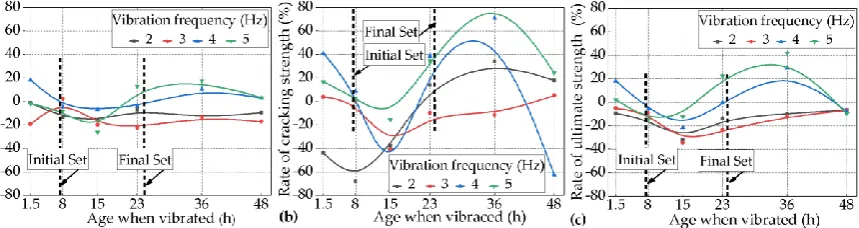
when vibrated are shown as Figure 5.
3.1.1. Effects of age when vibrated on the ultimate tensile strain of the PVA-ECC
Figure 4. The strain- stress curves of the vibrated PVA-ECC groups and the control group at the ages
of 1.5 h, 8.0 h, 15.0 h, 23.0 h, 36.0 h when vibrated subjected to the combination of a constant duration of 5.0 h and different levels of frequency of (a) 2.0 Hz, (b) 3. 0 Hz, (c) 4.0 Hz, and (d) 5.0Hz.
could stay steady above 3.0%, indicating that vehicle-induced vibration had no substantial effects on the strain-hardening characteristics and super-high toughness of early age PVA-ECC for this condition. Even so, according to the statistics of the twenty-four groups of vibrated specimens and one group of the control specimen, the probability of εvu being lower than εcu was approximately
greater than 70 %. This indicates that the trend of vehicle-induced vibration on the ultimate tensile strain of early age PVA-ECC was negative overall.
Figure 5. Rates of (a) the ultimate tensile strain, (b) the cracking strength, and (c) the ultimate tensile strength for the vibrated groups over the control group with the increase of the age when vibrated subjected to the combination of different levels of frequency and a constant duration of 5.0 h.
It can be seen from Figure 5(a) that for the PVA-ECC specimens subjected to the frequency level of 2.0 Hz, their εvu values were lower than εcu throughout the three setting periods, and the most
negative effect occurred at the age of 15.0 h when the specimens were vibrated, where εvu changed
by -16.55 % over εcu.
For the PVA-ECC specimens subjected to the frequency level of 3.0 Hz, their εvu changed slightly
by 2.10 % over εcu at the age of 8.0 h when the specimens were vibrated, but at the rest of ages when
vibrated, the corresponding εvu changed by -13.29 % to -22.38 %, and the most negative effect occurred
at the age of 23.0 h when the specimens were vibrated, where εvu changed by -22.3 8% over εcu.
For the PVA-ECC specimens subjected to the frequency level of 4.0 Hz, their εvu increased by
18.18% and 10.13% over εcu at the ages of 1.5 h and 36.0 h when the specimens were vibrated, and
their εvu changed by -3.96% to -6.67% during the period between ages of 1.5 h and 36.0 h when the
specimens were vibrated. This indicates that the effects of vehicle-induced vibrations on the ultimate tensile strain of PVA-ECC tended to be slightly negative during the period between the initial set and the final set, and there was some extent of positive effect before the initial set or after the final set.
For the PVA-ECC specimens subjected to the frequency level of 5.0 Hz, their εvu changed
approximately linearly from -1.86% to-26.11% over εcu at relatively lower ages when vibrated (1.5 h
to 15.0 h), and the most negative effect occurred at the age of 15.0 h when the specimens were vibrated, where εvu changed by -26.11% over εcu. By contrast, their εvu increased within 20% at
relatively greater ages (above 23.0 h). These results indicate that the effects of the vehicle-induced vibrations on the ultimate tensile strain of PVA-ECC tended to be negative at relatively earlier ages when vibrated, and it tended to be positive at relatively later ages when vibrated under the frequency level of 5.0 Hz.
To summarize, the effects of vehicle-induced vibrations on the ultimate tensile strain of almost all of the vibrated groups tended to be negative before the final set, while the effects tended to be positive to a certain extent (within 20.0 %) for some of the vibrated groups after the final set. In particular, for all of the vibrated groups, the most negative effects occurred during the period between the initial set and the final set if based on the rate of ultimate tensile strain. For these results, the following explanations can be made.
the transportation of free water from the fiber/cement interface to the surface of the anhydrous cement grains, which might enhance the strength of the matrix to some extent and at the same time decreased the bond strength of the fiber/cement interface, therefore improving the tensile deformation capacity of the PVA-ECC. However, if vibrated during the period between the initial set and the final set, a series of negative effects might be caused: Inhibiting the agglomeration of the C-S-H particles, which was the crucial process to the formation of high-density C-C-S-H gel, damaging the bonds of C-S-H gels or obstructing them to form a solid-skeleton, and promoting free water aggregation and the convenient hydroscopic expansion of AFt around the interface of the fibers/matrix. These negative effects induced by vibrations might resulted in a reduction of the bond strength of the interface of fibers/matrix. Therefore, the most negative age when vibrated occurred during the period between the initial set and the final set if based on the rate of ultimate tensile strain.
3.1.2. Effects of the age when vibrated on the tensile strength of the PVA-ECC
It can be seen from Figure 5(a)-(c) that the impact trends of the vibrations on both the cracking strength and the ultimate tensile strength of vibrated PVA-ECC groups were approximately equal to that of ultimate tensile strain. The differences of the impact degree of vibrations on the strengths were more significant than that of ultimate tensile strain.
It can be seen from Figure 5(b) that for the vibrated PVA-ECC group subjected to the frequency level of 2.0 Hz, the most negative age when vibrated occurred at age of 8.0 h when vibrated for cracking strength. Except for this, it can be seen from Figure 5(b) and (c) that for all of the vibrated groups subjected to the frequency levels of 3.0 Hz to 5.0 Hz, the most negative ages when vibrated occurred at 15.0 h for cracking or ultimate tensile strength. This result indicates that for all of the twenty- four vibrated groups in this section, the most negative age when vibrated for the strength of the PVA-ECC occurred at the periods during the initial set and the final set.
Furthermore, it could be calculated that, for all of the vibrated PVA-ECC groups subjected to the frequency levels of 2.0 Hz to 5.0 Hz, at the most negative ages when vibrated, the cracking strength changed by -68.2 %, -41.04 %, -75.14 %, and-15.61 % over the control average, and the ultimate tensile strength changed by -31.84 %, -34.58 %, -21.39 %, and -14.93 % over the control average. This result indicates that the impacts degree of the vibrations on the cracking strength of the PVA-ECC were more significant for the combination of different levels of vibration frequency and a constant duration length of 5.0 h at the most negative age when vibrated compared with that of the ultimate tensile strength. Additionally, Figure 5 also show that the cracking strength was the most sensitive to the variables in this section, and then it followed the ultimate tensile strength and strain.
3.2. Effects of the vibration duration on the tensile performance of the PVA-ECC
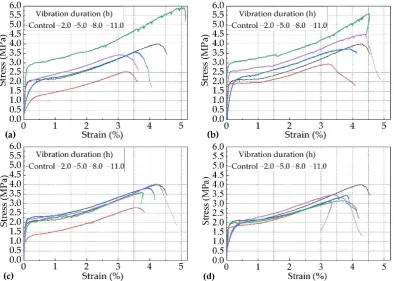
Figure 6. Strain-stress curves of the vibrated PVA-ECC groups subjected to different lengths of vibration duration under the combination of different levels of vibration frequency and the age of 8.0 h when vibrated and, (a) 2.0 Hz; (b) 3.0 Hz; (c) 4.0Hz; (d) 5.0 Hz
3.2.1. Effects of vibration duration on the ultimate tensile strain of the PVA-ECC
Figure 6 shows that every group of PVA-ECC specimens described in in this section exhibited remarkable strain-hardening characteristics and super-high toughness. Their ultimate tensile strain could stay steady above 3.0% even if the vibrations occurred during the period between the initial set and the final set with different lengths of vibration duration ranged from 2.0 h-11.0 h. Combined with the results in section 3.1, it can be further concluded that vehicle induced-vibrations had no substantial effects on the inherent tensile properties of the PVA-ECC within this investigation.
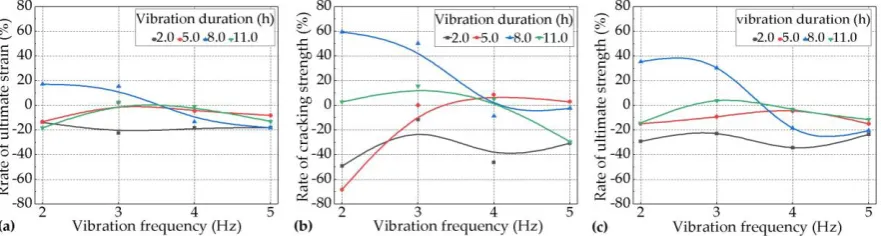
Figure 7. Rates of (a) the ultimate tensile strain, (b) cracking strength, and (c) ultimate tensile strength for the vibrated groups over the control group with the increase of the length of vibration duration under different levels of vibration frequency during the period between the initial set and the final set.
h and 11.0 h, their εvu decreased by 13.75% and 18.18% over εcu, respectively. However, when the
vibration duration was 8.0 h, their εvuincreased by 17.25% over εcu.
For the vibrated PVA-ECC groups subjected to the frequency level of 3.0 Hz, the rate of the ultimate tensile strain over the control group also presented the same trend as that for 2. 0 Hz. When the vibration duration was 5.0 h, their εvuslightly increased by 2.10% over εcu, and when the vibration
durations were 8.0 h and 11.0 h, their εvu increased by 15.38 % and 2.56 % over εcu, respectively.
However, when the vibration duration was 2.0 h, their εvu decreased by 22.38 % over εcu.
When the vibration frequency was 4.0 h or 5.0 h, the curves of the rates of the ultimate tensile strain-vibration durations were relatively smooth for 2.0 Hz or 3.0 Hz, and both of them were below the zero-axis. This result indicates that the effects of the vehicle-induced vibrations on the ultimate tensile strain of the PVA-ECC tended to be negative, but they were not obvious during the period between the initial set and the final set when subjected to relatively higher levels of vibration frequency (4.0 Hz or 5.0 Hz).
To summarize, the above results indicate that the effects of the vibration duration on the ultimate tensile strain of the PVA-ECC tended to be negative overall during the period between the initial set and the final set, but the impact trend and the degree varied for the corresponding lengths of vibration duration and levels of vibration frequency.
3.2.2. Effects of the vibration duration on the tensile strength of the PVA-ECC
It can be seen from Figure 7 that the impact trend of the vibration duration on the cracking and ultimate tensile strength of the PVA-ECC tended to be coincident with that of the ultimate tensile strain for the period during the initial set and the final set under different levels of frequency ranging from 2.0 Hz to 5.0 Hz, so this trend will not be repeated here.
The difference was that except for the individual variation group, the impact degree of the vibration duration on the strengths, including the cracking strength and the ultimate tensile strength, was greater than that of the ultimate tensile stain for the same vibration variables overall. The impact degree of the vibration duration on the cracking strength was greater than that of the ultimate tensile strength. If the defined value of the impact degree was the vibration sensitivity, then combined with section 3.1, it can be concluded that the cracking strength was the most sensitive to the variables of both the age when vibrated and the vibration duration, and then it followed the ultimate tensile strength and the ultimate tensile strain.
It can also be seen from Figure 7(b) and (c) that for all of the vibrated groups of the PVA-ECC, if they were subjected to relatively higher levels of vibration frequency (4.0 Hz or 5.0 Hz), the effects of the vehicle-induced vibrations on their strengths, including the cracking strength and the ultimate tensile strength, tended to be negative but not obvious when they were subjected to different lengths of vibration duration during the period between the initial set and the final set compared to the relatively lower levels of vibration frequency (2.0 Hz or 3.0 Hz). In addition, a similar trend was obtained to that of the ultimate tensile strain.
3.3. Effects of the vibration frequency on the tensile performance of the PVA-ECC
The results in sections 3.1 and 3.2 show that the most negative age when vibrated occurred during the period between the initial set and the final set, and at this period, the effects of the vibration duration on the tensile performance of the PVA-ECC were related to the corresponding levels of the frequency. Therefore, it was necessary to further study the effects of the vibration frequency on the tensile performance of the PVA-ECC.
Figure 8. Rates of (a) the ultimate tensile strain, (b) cracking strength, and (c) ultimate tensile strength for the vibrated groups over the control group with the increase of the levels of vibration frequency at different ages with a duration of 5.0 h (Var. 1).
It can be seen from Figure 8 that for most of the vibrated groups of the PVA-ECC for Var. 1, the effects of vehicle-induced vibrations on the tensile performance (cracking strength, ultimate tensile strength and strain) of the PVA-ECC tended to be negative at relatively lower levels of frequency and to be positive at relatively higher levels of frequency, except for the groups that vibrated during the period between the initial set and the final set, which tended to be negative throughout the levels of frequency.
Furthermore, it can be seen from Figure 9 that for most of the vibrated groups of the PVA-ECC for Var. 2, the effects of vehicle-induced vibrations on the tensile performance of the PVA-ECC tended to be negative throughout the levels of frequency, except for the groups subjected to a duration of 8.0 h, which tended to be positive at relatively lower levels of frequency.
It can be seen from Figure 8 that for the vibrated groups of the PVA-ECC for Var. 1, the impact degrees of the vibrations on the cracking strength, ultimate tensile strength, and strain were weaker at relatively lower levels of frequency than those of relatively higher levels of frequency. While it can be seen from Figure 9 that for the vibrated groups of the PVA-ECC for Var. 2, the impact degrees of the vibrations on the cracking strength, ultimate tensile strength, and strain were greater at relatively lower levels of frequency than those of relatively higher levels of frequency.
Figure 9. Rates of (a) the ultimate tensile strain, (b) cracking strength, and (c) ultimate tensile strength for the vibrated groups over the control group with the increase of the levels of vibration frequency during the period between the initial set and the final set under different lengths of durations (Var. 2).
3.4. Gray correlation analysis of the factors affecting the tensile performance of the PVA-ECC
First, the system behavior characteristics 𝑋𝑗= {𝑥𝑗(𝑘)} were set as the reference sequences, where k = 1, 2, ···, n, j = 1, 2, ···, l. Similarly, the factors that affected the system behavior characteristics 𝑋𝑖= {𝑥𝑖(𝑘)} were set as comparative sequences, where k= 1, 2, ···, n, i =, 2, ···, m.
Second, the reference and comparative sequences were initialized as 𝑥𝑖,(𝑘) = 𝑥𝑖(𝑘) 𝑋⁄̅𝑖 and
𝑥𝑗,(𝑘) = 𝑥𝑗(𝑘) 𝑋⁄̅𝑗, respectively. Then the gray correlation coefficients 𝜉𝑖𝑗(𝑘) of the reference and comparative sequences at the k moment could be expressed as
𝜉𝑖𝑗(𝑘) =
𝑚𝑖𝑛
𝑖 𝑚𝑖𝑛𝑘 |𝑥0𝑗 , (𝑘) − 𝑥
𝑖
,(𝑘)| + 𝜌𝑚𝑎𝑥
𝑖 𝑚𝑎𝑥𝑘 |𝑥0𝑗 , (𝑘) − 𝑥
𝑖 ,(𝑘)|
|𝑥0𝑗, (𝑘) − 𝑥𝑖,(𝑘)| + 𝜌𝑚𝑎𝑥
𝑖 𝑚𝑎𝑥𝑘 |𝑥0𝑗 ,
(𝑘) − 𝑥𝑖,(𝑘)| (4)
where 𝜌 ∈ (0,1) is the distinguishing coefficient, which is used to improve the significance of difference for correlation coefficients, and it is generally taken as 0.5.
Finally, the gray correlation degree 𝑟𝑖𝑗(𝑘) of the comparative sequence 𝑋𝑖 of the reference sequence 𝑋𝑗 could be expressed as
𝑟𝑖𝑗(𝑘) = 1 𝑛∑ 𝜉𝑖𝑗(𝑘) 𝑛 𝑘=1 (5)
For all of the 36 groups of the PVA-ECC specimens in this investigation, the corresponding cracking strength, ultimate tensile strength, and strain were taken as reference sequences and recorded successively as 𝑋𝑗, j=1, 2, 3. Three vibration factors, the age, duration, and frequency were taken as comparative sequences and recorded successively as 𝑋𝑖, i=1, 2, 3. The grey correlation degrees of the comparative sequence 𝑋𝑖 of the reference sequence 𝑋𝑗 were calculated as shown in Table 7.
The cracking strength, ultimate tensile strength, and strain of the control specimens were taken as reference sequences, and those of the 24 groups of vibrated specimens for Var. 1 were taken as comparative sequences. The grey correlation degrees were calculated as shown in Table 8. Similarly, the grey correlation degrees for Var. 2 were calculated as shown in Table 9.
It can be seen from Table 7 that the gray correlation degrees of the vibration factors for the tensile performance of the PVA-ECC were greater than 0.6, indicating that the changing curves of the vibration factors were highly correlated to those of the corresponding strengths and strains of PVA-ECC. In other words, the vibration factors dad closer geometry similarity to the tensile performance of PVA-ECC. The gray correlation degrees of the ages for the tensile performance of PVA-ECC were the lowest compared to those of the durations and frequencies, which means that the tensile performance of the PVA-ECC was more sensitive to ages when vibrated.
Table 7. Gray correlation degrees of the vibration factors on the tensile performance of PVA-ECC
Gray correlation degree 𝒓𝒊𝒋 Age 𝒓𝟏𝒋 Duration 𝒓𝟐𝒋 Frequency 𝒓𝟑𝒋
Cracking strength 𝑟𝑖1 0.6819 0.9512 0.9607 Ultimate tensile strength 𝑟𝑖2 0.6674 0.9810 0.9549 Ultimate tensile strain 𝑟𝑖3 0.6668 0.9800 0.9513
Table 8. Gray correlation degrees of the ages when vibrated on the tensile performance of PVA-ECC
with a constant of duration of 5.0 h.
Gray correlation degree 𝒓𝒊𝒋, 1.5h 𝒓𝒊𝒋, 15.0h 𝒓𝟐𝒋, 23.0h 𝒓𝟑𝒋, 36.0h 𝒓𝟒𝒋,
Cracking strength 𝑟𝑖1 ,
0.6514 0.6242 0.7045 0.6539 Ultimate tensile strength 𝑟𝑖2, 0.6620 0.5764 0.5264 0.8298 Ultimate tensile strain 𝑟𝑖3, 0.6514 0.6242 0.7045 0.6539
Table 9. Gray correlation degrees of the durations of vibration on the tensile performance of
Gray correlation degree 𝒓𝒊𝒋,, 2.0h 𝒓𝒊𝒋,, 5.0h 𝒓𝟐𝒋,, 8.0h 𝒓𝟑𝒋,, 11.0h 𝒓𝟒𝒋,,
Cracking strength 𝑟𝑖1,, 0.7237 0.6110 0.6463 0.8182 Ultimate tensile strength 𝑟𝑖2, 0.7861 0.8450 0.3946 0.6928
Ultimate tensile strain 𝑟𝑖3 ,,
0.8105 0.6815 0.3676 0.5182
4. Conclusions
A self-improved vibration device was made that simulated the vehicle-induced vibrations and accounted for different vibration variables including the age when vibrated, vibration duration, and vibration frequency that early age PVA-ECC bridge repairs would be subjected to with great possibility. An experimental program was followed to investigate the effects of vehicle-induced vibrations on the tensile performance of early age PVA-ECC. A total of 324 PVA-ECC specimens in 36 groups were cast and subjected to vibration tests up to different levels of vibration frequency combined with different lengths of vibration durations at different ages when vibrated ranging in time from before the initial set, to during the period between the initial set and the final set, and after the finial set. After the vibration tests, the specimens were tested with a uniaxial tensile test to determine their cracking strengths, ultimate tensile strengths, and strains. According to the results obtained, the following conclusions were drawn.
(1) The effects of vehicle-induced vibrations on the tensile performance including the cracking strength, ultimate tensile strength, and strain of almost all of the vibrated PVA-ECC groups that were subjected to a constant vibration duration of 5.0 h tended to be negative before final setting. However, the effects were positive to a certain extent for some of them after the final set. In particular, the most negative ages when vibrated occurred during the period between the initial set and the final set.
(2) During the period between the initial set and the final set, the effects of different lengths of the vibration duration on the tensile performance of the PVA-ECC tended to be negative overall, but the impact trend and the degree varied for the corresponding lengths and levels of vibration. The cracking strength, ultimate tensile strength, and strain tended to be negative if the corresponding groups were subjected to relatively greater levels of frequency and shorter lengths of duration, and they tended to be positive to a certain extent for individual groups if the corresponding groups were subjected to relatively lower levels of frequency and longer lengths of duration.
(3) The cracking strength was the most sensitive to the variables of both the age when vibrated and the vibration duration in this investigation, and then it followed the ultimate tensile strength and the ultimate tensile strain.
(4) The grey correlation analysis was applicable in analyzing the effects of vehicle-induced vibrations on the tensile performance of early age PVA-ECC.
Author Contributions: Conceptualization, C.Y., and S.L.; Methodology, X.Z., X.W., and H.W.; project
administration, S.L., and H.W; writing-original draft preparation, X.Z. Writing-review and editing, S.L., C.Y., and X.W.
Funding: This research was funded by the National Natural Science Foundation of China, grant numbers 51368041 and 51768051, the Inner Mongolia Natural Science Foundation, grant number 2017MS0505, and the Inner Mongolia Science and Technology Innovation Guidance Project, grant number KCBJ2018016.
Acknowledgments: The authors are grateful for the Mechanical Laboratory of College of Science, Inner
Mongolia University of Technology, for suppling the mechanical testing system used in this work.
References
1. Mihai, I.C.; Jefferson, A.D. A micromechanics based constitutive model for fibre reinforced
cementitious composites. International Journal of Solids & Structures 2017, s 110–111, 152-169,
doi:10.1016/j.ijsolstr.2017.01.032.
2. Lu, C.; Leung, C.K.Y. Effect of fiber content variation on the strength of the weakest section in Strain
Hardening Cementitious Composites (SHCC). Construction & Building Materials 2017, 141, 253-258,
doi:10.1016/j.conbuildmat.2017.03.020.
3. Yang, E.H.; Li, V.C. Strain-rate effects on the tensile behavior of strain-hardening cementitious
composites. Construction And Building Materials 2014, 52, 96-104, doi:10.1016/j.conbuildmat.2013.11.013.
4. Li, V.C. Integrated structures and materials design. Materials And Structures 2007, 40, 387-396,
doi:10.1617/s11527-006-9146-4.
5. Zhang, P.; Wittmann, F.H.; Zhang, S.L.; Muller, H.S.; Zhao, T.J. Self-healing of Cracks in Strain
Hardening Cementitious Composites Under Different Environmental Conditions. Rilem Bookser 2018,
15, 600-607, doi:10.1007/978-94-024-1194-2_69.
6. Muzenski, S.; Flores-Vivian, I.; Sobolev, K. Hydrophobic engineered cementitious composites for
highway applications. Cement Concrete Comp 2015, 57, 68-74, doi:10.1016/j.cemconcomp.2014.12.009.
7. Yang, G.; Yu, J.T.; Luo, Y. Development and Mechanical Performance of Fire-Resistive Engineered
Cementitious Composites. J Mater Civil Eng 2019, 31, doi:10.1061/(Asce)Mt.1943-5533.0002666.
8. Lim, I.; Chern, J.C.; Liu, T.; Chan, Y.W. Effect Of Ground Granulated Blast Furnace Slag on Mechanical
Behavior Of Pva-Ecc. J Mar Sci Tech-Taiw 2012, 20, 319-324.
9. Wu, C.; Pan, Y.; Ueda, T. Characterization of the abrasion resistance and the acoustic wave attenuation
of the engineered cementitious composites for runway pavement. Construction And Building Materials
2018, 174, 537-546, doi:10.1016/j.conbuildmat.2018.04.152.
10. Zhang, Z.G.; Zhang, Q.; Qian, S.Z.; Li, V.C. On the use of low-cost PVA fiber to develop ECC material
for pavement use. Functional Pavement Design 2016, 150-150.
11. Sahmaran, M.; Yucel, H.E.; Yildirim, G.; Al-Emam, M.; Lachemi, M. Investigation of the Bond between
Concrete Substrate and ECC Overlays. J Mater Civil Eng 2014, 26, 167-174,
doi:10.1061/(Asce)Mt.1943-5533.0000805.
12. ChiaHwan, Y.; Wei, L. Application of Interfacial Propagation and Kinking Crack Concept to
ECC/Concrete Overlay Repair System. Adv Mater Sci Eng 2014, doi: 10.1155/2014/623467.
13. Hou, M.J.; Hu, K.X.; Yu, J.T.; Dong, S.W.; Xu, S.L. Experimental study on ultra-high ductility
cementitious composites applied to link slabs for jointless bridge decks. Composite Structures 2018, 204,
167-177, doi:10.1016/j.compstruct.2018.07.067.
14. Lepech, M.D.; Li, V.C. Application of ECC for bridge deck link slabs. Materials And Structures 2009, 42,
1185-1195, doi:10.1617/s11527-009-9544-5.
15. Van den Heede, P.; De Belie, N.; Pittau, F.; Habert, G.; Mignon, A. Life cycle assessment of Self-Healing
Engineered Cementitious Composite (SH-ECC) used for the rehabilitation of bridges. Life-Cycle Analysis
And Assessment In Civil Engineering: Towards an Integrated Vision 2019, 2269-2275.
16. Cao, M.L.; Li, L.; Xu, L. Relations between rheological and mechanical properties of fiber reinforced
mortar. Comput Concrete 2017, 20, 449-459, doi:10.12989/cac.2017.20.4.449.
17. Li, M.; Li, V.C. Rheology, fiber dispersion, and robust properties of Engineered Cementitious
18. Felekoglu, B.; Tosun-Felekoglu, K.; Ranade, R.; Zhang, Q.; Li, V.C. Influence of matrix flowability, fiber
mixing procedure, and curing conditions on the mechanical performance of HTPP-ECC. Compos Part
B-Eng 2014, 60, 359-370, doi:10.1016/j.compositesb.2013.12.076.
19. Georgiou, A.V.; Pantazopoulou, S.J. Effect of fiber length and surface characteristics on the mechanical
properties of cementitious composites. Construction And Building Materials 2016, 125, 1216-1228,
doi:10.1016/j.conbuildmat.2016.09.009.
20. Wang, Z.C.; Wang, Z.C.; Xia, H.C.; Wang, H.F. Analysis of Hydration Mechanism and Microstructure
of Composite Cementitious Materials for Filling Mining. J Wuhan Univ Technol 2017, 32, 910-913.
21. Chen, J.; Li, Z.J.; Jin, X.Y. Morphological effect of C-S-H gel on the elastic behaviour of early-age
cement-based materials. Mag Concrete Res 2017, 69, 629-640.
22. Lu, Z.Y.; Hanif, A.; Lu, C.; Sun, G.X.; Cheng, Y.; Li, Z.J. Thermal, mechanical, and surface properties of
poly(vinyl alcohol) (PVA) polymer modified cementitious composites for sustainable development. J
Appl Polym Sci 2018, 135, doi: 10.1002/app.46177.
23. Salvador, R.P.; Cavalaro, S.H.P.; Segura, I.; Hernandez, M.G.; Ranz, J.; de Figueiredo, A.D. Relation
between ultrasound measurements and phase evolution in accelerated cementitious matrices. Mater
Design 2017, 113, 341-352.
24. Nocun-Wczelik, W.; Bochenek, A.; Migdal, M. Calorimetry and other methods in the studies of
expansive cement hydrating mixtures. J Therm Anal Calorim 2012, 109, 529-535.
25. Rahimi-Aghdam, S.; Bazant, Z.P.; Qomi, M.J.A. Cement hydration from hours to centuries controlled
by diffusion through barrier shells of C-S-H. J Mech Phys Solids 2017, 99, 211-224.
26. Weatherer, P.J.; Fargier-Galbadon, L.B.; Hedegaard, B.D.; Parra-Montesinos, G.J. Behavior of
Longitudinal Joints in Staged Concrete Bridge Decks Subject to Displacements during Curing. J Bridge
Eng 2019, 24, doi: 10.1061/(Asce)Be.1943-5592.0001433.
27. Wang, W.; Liu, S.; Wang, Q.Z.; Yuan, W.; Chen, M.Z.; Hao, X.T.; Ma, S.; Liang, X.Y. The Impact of
Traffic-Induced Bridge Vibration on Rapid Repairing High-Performance Concrete for Bridge Deck
Pavement Repairs. Adv Mater Sci Eng 2014, doi: 10.1155/2014/632051.
28. Harsh, S.; Darwin, D. Traffic-induced vibrations on bridge deck repairs.NCHRP Synthesis: No.86, 1981.
29. Hong, S.; Park, S.K. Effect of vehicle-induced vibrations on early-age concrete during bridge widening.
Construction and Building Materials 2015, 77, 179-186, doi: 10.1016/j.conbuildmat.2014.12.043.
30. Fernandes, J.; Bittencourt, T.; Concrete subjected to vibrations in early-ages; 2011; Vol. 4, pp. 592-600.
31. Zhang, X.; Zhao, M.; Zhang, Y.J.; Lei, Z.; Zhang, Y.R. Effect of vehicle-bridge interaction vibration on
young concrete. KSCE Journal of Civil Engineering 2015, 19, 151-157, doi: 10.1007/s12205-014-0509-z.
32. Kwan, A.K.H.; Ng, P.L. Effects of traffic vibration on curing concrete stitch: Part I-test method and
control program. Engineering Structures 2007, 29, 2871-2880, doi: 10.1016/j.engstruct.2007.01.029.
33. Ng, P.L.; Kwan, A.K.H. Effects of traffic vibration on curing concrete stitch: Part II-cracking, debonding
and strength reduction. Engineering Structures 2007, 29, 2881-2892, doi: 10.1016/j.engstruct.2007.01.033.
34. Jianjun, W.; Xing. Effect of traffic load induced bridge vibrations on concrete tensile properties. Journal