96 |
P a g e
IMPLEMENTATION OF DEVICE AUTHENTICATION
IN WIRELESS NETWORKS
Archana K
1, Archana M N
2, Architha Shastry P
3, Chaithra N T
41,2,3,4
Information Science and Engineering, the National Institute of Engineering, Mysore, (India)
ABSTRACT
Objective- Identifying trustable devices and establishing secure tunnels between them in ad hoc network
environments is a difficult task because it has to be quick, inexpensive and secure. Hence the objective is to
develop the device authentication mechanism for secured communication in wireless networks.
Design / Methodology/ Approach- Design involve identification of classes, their relationships as well as their collaborations.
Findings- Implementation of device authentication in wireless networks is important for securing devices. We propose a simple, efficient authentication mechanism where in the devices authenticated at first and then the
user in a particular group will be authenticated to share data or information.
Limitations- When the devices are to be checked preliminarily whether they belong to the same Organisation or not they have to be checked manually.
Practical implications- The paper is useful wherever the communication has to be done between a groups of devices.
Originality/Value-This paper can be implemented in various organizations such as companies, colleges where devices need to be communicated in group.
Scope of the future work- The scope of the future work would actually be an enhancement to provide the same authentication for other mobile devices like mobile phones, tablets etc(e.g. A person’s phone number cannot be added to any group without his consent) which can provide better security.
Keywords: Authentication, group authentication, Smart Card, Seed Box, Nonce Process, OTP
I INTRODUCTION
Wireless Internet access technology is being increasingly deployed in both office and public environments, as
well as by internet users at home. Security in Computer world determines the ability of the system to manage,
protect and distribute sensitive information. Security cannot rely on central servers, as there are no guarantees
that they will be in radio range all times - devices’ availability and motion are quite unpredictable in mobile ad
hoc networks. Authentication for Devices is a new technique to provide security for networks. This project
proposes and implements a device authentication mechanism in which the devices that need to communicate
with each other must belong to the same group and should be authenticated for communication by using
97 |
P a g e
II LITERATURE REVIEW
2.1. Device Authentication Using Novel Smart Card Software [1]
It is a simple device authentication framework which provides device-oriented authentication and authorization
mechanisms for non-PC Internet-ready information appliances. The purpose of the framework is to prevent
device spoofing, and to restrict unauthorized access to the device in a future ubiquitous network. Here the smart
card will be attached to a device such as an information appliance.
Disadvantage: If the card gets tampered or damaged then the device authentication will be a problem in this
system.
2.2. Gesture based user authentication and face recognition system [2][3]
Here the user authentication is based on gestures and facial expression captured by a video camera. Unlike pure
biometrics, such as fingerprints, iris scans, and faces, gesture-based authentication combines irrevocable
biometric information, such as the shapes and relative sizes of body parts, with voluntary movements which can
be revoked.
Disadvantage: Movements and expressions need not always be same. So authentication using this method is not
reliable
III OBJECTIVES
In day-to-day life, providing security for devices is very important as the intruders are finding ways to access
the data in networks especially in wireless networks. When the communication takes place between two or more
devices and if the devices are not authenticated, then it becomes very easy for the intruders to access the data
that leads to fatal circumstances. This situation needs to be tackled and a solution is to be provided. So, we
propose and implement a simple, efficient authentication mechanism wherein the devices authenticated at first
98 |
P a g e
IV METHODOLOGY/SYSTEM ARCHITECTURE
4.1. Device authentication and group authentication
Each device in a group should be registred from the seedbox separately. Once the registration is successful each
device will be having preshared key within it. When two devices trying to communicate for any data exchange
then we should allow only those devices within the group using nonce process. So that even though
devices are “authenticated, it requires to authorise” for data exchange.
Seedbox performs Group Creation in that process, admin should give Group name & Group key and for each group,’N’ number of polynomials will be generated.
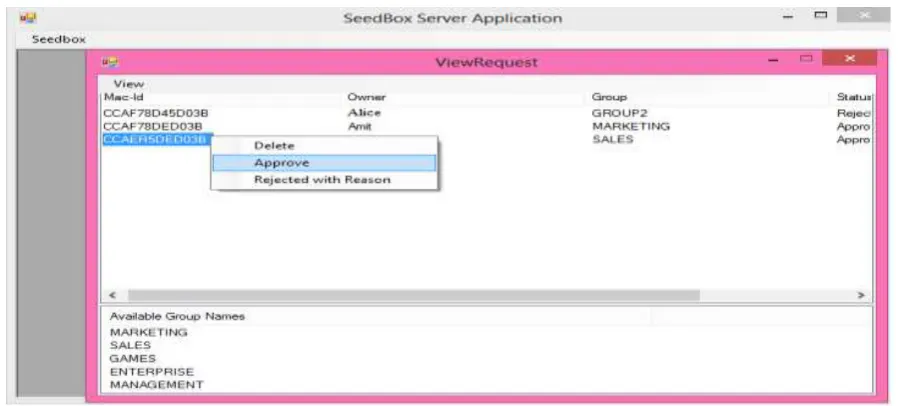
Seedbox is responsible to view requests and take appropriate action.
Client node send a registration request for a particular group to seedbox/admin by providing its
MACID,Owner Name and Group Name.
Once the node approved for a particular group by the seedbox and get its key-value pairs, a node
should be authorized to communicate with another node which is of same group.
4.2. User authentication
Through login id and password, user authentication is done.4.3. Modules used
The proposed mechanism should be placed between the internal system (e.g. software application) and the
external communication (e.g. wireless interfaces), as a security middleware. The figure 3a shows the
architecture of the proposed mechanism and its internal building blocks.
The Seed Box is a storage unit responsible to hold all known pre-shared keys kn, where each kn
corresponds to one different secure cluster. Each kn receives a mnemonic name, assigned by the
device’s owner, to be easily associated to a secure cluster.
The I/O is the building block responsible for the communication of the mechanism with the network communication interfaces (the layer just below the mechanism).
The Control Unit involves the functions, wherein a device enrolls itself for authentication( which involves nonce process which means generation of an arbitrary number called cipher text) for thepurpose of communication .
Shamir’s Secret Sharing (SSS) implementation for secure key, authentication and Validation process.
One Time password (OTP) is used to generate a challenge message.
For encryption and decryption we use Symmetric Ciphering.V HARDWARE AND SOFTWARE REQUIREMENTS
99 |
P a g e
2GB RAM
80GB Hard Disk
Pentium IV and above processor
At least 4 machines , 1 for administrator, 2 from one group cluster and another from different group
cluster
5.2. Software requirements
Operating System : Windows Version
Software : Visual Studio 2010
Language : C#
Application : Windows Forms
VI FLOW DIAGRAM
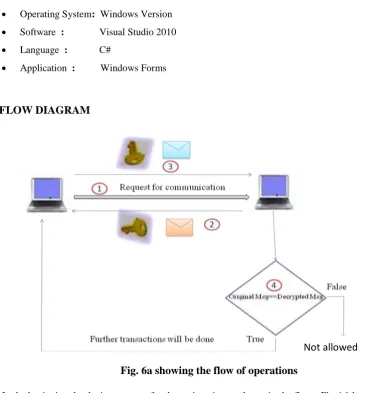
Fig. 6a showing the flow of operations
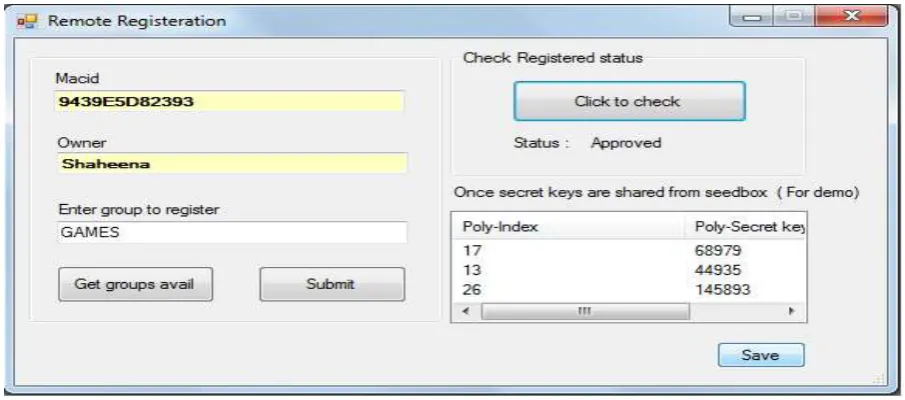
In the beginning the device requests for the registration as shown in the figure Fig 4.1 by sending its MAC
id, group name to which it wants to join.
Resource manager manually checks for the presence of the device
If device is present then he sends he is approval to the device indicating that it is registered. Seed box
contains the pre shared sets along with the unique pre shared key for a particular group.
Once the device is registered for a particular group, seed box gives the pre shared set using which pre
shared key has to be generated.
Another device say D2 which is also registered sends the request for communication, with this device say
D1 as shown in the figure Fig 4.1.
D1 generates the one time password (OTP).
100 |
P a g e
This OTP generated is encrypted using the pre shared key to form cipher text.
D1 then sends the Cipher text to D2, D2 using its own pre shared sets generates pre shared key.
Then using the pre shred key cipher text is decrypted and it is sent back to D1.
D1 checks if received message is equal to its own message. If same, two devices are allowed to
communicate further.
VII FINDINGS
Implementation of device authentication in wireless networks is important for securing devices. We propose a
simple, efficient authentication mechanism where in the devices authenticated at first and then the user in a
particular group will be authenticated to share data or information.
VIII IMPLEMENTATION
System implementation is that stage of development life cycle, when the theoretically designed system is turned
in actual working system. This phase is very critical so it must be carefully planned and controlled. Otherwise it
can cause chaos. All possible constraints must be taken into consideration before implementing the system
because the new system must assure the users about its effective working.
8.1. Modules Implementation
Our project is divided into two main sub parts or divisions- Node, Seed box.
8.1.1. Group Creation
At the server side the admin can create the different groups along with its secret key.
101 |
P a g e
8.1.2. Remote RegistrationIn the beginning the device requests for the registration by sending its MAC id, group name to which it wants to
join. This information is sent to seed box or admin for the approval.
8.1.3. View Request
The admin can view the pending request and can either approve, reject, delete the request.
Fig 8.1.1 b. Group creation snapshot
102 |
P a g e
Fig 8.1.3a.View Request Snapshot
8.1.4 Join Group
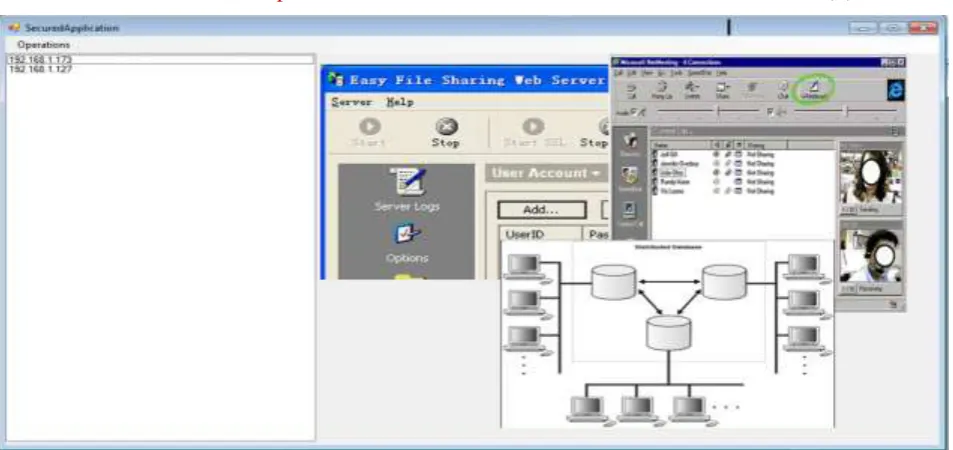
Join Group screen displays list of IP address and corresponding group name. The Group Joining process is done
between the two nodes which are in same group and without the interaction of SEEDBOX or ADMIN. Clicking
on the IP address of the device allows the further communication with it.
103 |
P a g e
Fig 8.1.4b Further Communication SnapshotIX SCOPE OF THE WORK
The present paper has been implemented in personal computers, laptops. The implementation can be extended to
mobile phones, tablets. ( For example applications like whatsapp a person’s phone number cannot be added to
any group without his consent which can provide better security)
X CONCLUSION
The authentication mechanism provided eases out the work of the people who spend a lot of time in monitoring
their devices. The proposed mechanism thwarts security attacks, such as Man in the Middle (MitM) and replay
attacks. The proposed mechanism is not only an ad hoc networks secure solution, and can be set on any kind of
computer networks, offering a light and distributed security solution.
REFERENCES
[1] Applications and the Internet Workshops 2007, International Symposium, 15-19, Jan. 2007.
[2] Advanced Video and Signal-Based Surveillance (AVSS), 2012 IEEE Ninth International Conference, 18-21
Sept. 2012.
[3] Biometrics, Identity and Security (BIdS), 2009International Conference on date of conference, 22-22
Sep.2009.
[4]Wireless Security Wikipedia Link:http://en.wikipedia.org/wiki/Wireless_security
About the authors
Archana K, Archana M N, Architha Shastry P, Chaithra N T currently perceiving Bachelor of Engineering
degree in Information Science in The National Institute of Engineering Mysore. They are passionate about the