© 2014, IJCSMC All Rights Reserved 907
Available Online at www.ijcsmc.com
International Journal of Computer Science and Mobile Computing
A Monthly Journal of Computer Science and Information Technology
ISSN 2320–088X
IJCSMC, Vol. 3, Issue. 6, June 2014, pg.907 – 912
RESEARCH ARTICLE
Different QoS Based TORA Reactive
Routing Protocol using OPNET 14.5
Priyanka Dahiya
1, Manoj
2, Kuldeep Vats
3, Kamini Jaswal
4M.Tech, Department of Computer Science and Engg, SGT Institute of Engineering and Technology,
Gurgaon, Haryana, India
1[email protected]
1Assistant Professor, Department of Computer Science and Engg, SGT Institute of Engineering and
Technology, Gurgaon, Haryana, India
2[email protected]
2M.Tech, Department of Computer Science and Engg, Sonipat, Haryana, India
3[email protected]
3Assistant Professor, Department of Electronics and Communication, South Point Institute of Engineering
and Technology, Sonepat, Haryana, India
4[email protected]
4Abstract- MANET consists of mobile nodes which exchange information dynamically among them over wireless
links. The most important element of MANET is Routing Protocols which are needed to handle dynamic
communication and also find route so as to deliver data packets to the correct destination. Performance of routing
protocols is an important issue because of dynamic nature of MANET. In this paper performance of TORA routing
protocols is evaluated for FTP based application traffic on IEEE 802.11b WLAN Standard and one Mbps data rate.
The network performance is evaluated by using OPNET simulator based on various quantitative metrics- Network
Load, Throughput, Delay, upload and Download response time and Media Access Delay by varying physical
characteristics and number of nodes.
Keywords: MANET, Reactive Protocol, TORA, OPNET, WLAN
I. INTRODUCTION
according to the transmission requirements. For this reason the network topology of MANET is not static as it tends to change rapidly. For a communication of any two nodes, the destination node must lies within the radio range of the source node that wants to initiate the communication.
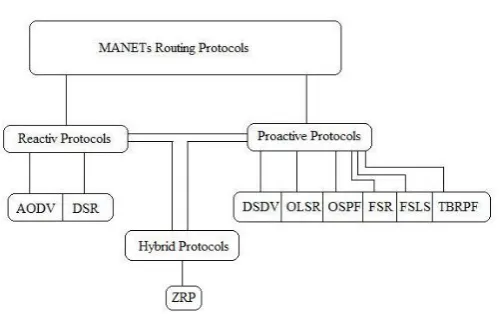
According to the researches in past years, various routing protocols for MANET have been proposed to improve the routing performance and reliability. Some of the promising MANET routing protocols among them are classified into three different categories according to their functionality.
1. Reactive protocols. 2. Proactive protocols. 3. Hybrid protocols.
The hierarchy of these protocols is shown below in the figure 1.
Fig. 1 MANETs Routing Protocols
In our paper, focus is on the reactive protocols of MANET only which are discussed further.
II. REACTIVE OR ONDEMAND PROTOCOLS
Reactive protocols are also known as on demand driven reactive protocols [3]. The fact they are known as reactive protocols implies that they do not initiate route discovery by themselves, until they are requested to find a route [4]. Thus these protocols setup routes when demanded. When a node wants to communicate with another node in the network, and the source node does not have a route to the node it wants to communicate with, reactive routing protocols will establish a route for the source to destination node.
2.1 TORA (Temporally Ordered Routing Algorithm)
TORA is also an on-demand reactive routing protocol. Its main objective is to limit control message propagation in the highly dynamic mobile computing environment. Each node has to initiate a query when it needs to send data to a particular destination thus TORA is a source-initiated routing protocol. TORA mainly performs three tasks and uses three kinds of messages to perform these tasks:
a) Route creation: Set up a route from a source to a destination using QRY message.
b) Route maintenance: Maintenance of the route during data transfer using UPD message. UPD message is used both for creating and maintaining the routes.
© 2014, IJCSMC All Rights Reserved 909
III. SIMULATION MODEL
This paper represents two scenarios of 20 and 30 mobile nodes which are simulated for 1 hour by taking Reactive routing Protocols DSR and TORA and compared for evaluating the better performance between the two protocols using few QoS. All the simulations are conducted using discrete event simulation software known as OPNET Modeler, which is just one of several tools provided from the OPNET Technologies suite. In order to undertake the experimental evaluation, the most recently available version, namely the OPNET Modeler 14.5 has been adopted in our study [7].
IV. PARAMETERSSETUP
The parameters that have been used in the following experiments are summarized in following tables. Table1. Wireless parameter values
WLAN MAC Address Auto assigned BSS identifier Auto assigned
Physical characteristics
Direct Sequence(802.11b) DATA rate 1 Mbps Transmit power(W) 0.005
Packet reception power threshold
-95
Short retry limit 7 Long retry limit 4
AP beacon interval(sec) 0.02 Maximum receiver lifetime(sec) 0.5
Buffer size(bits) 2560000 Simulation time 1 hour
Memory used 70 Mb
Table2. TORA parameter values.
Parameter Value
Mode of operation On-demand OPT transmit internal(sec) 300
IP packet discard timeout(sec)
10
V. SIMULATIONRESULTS
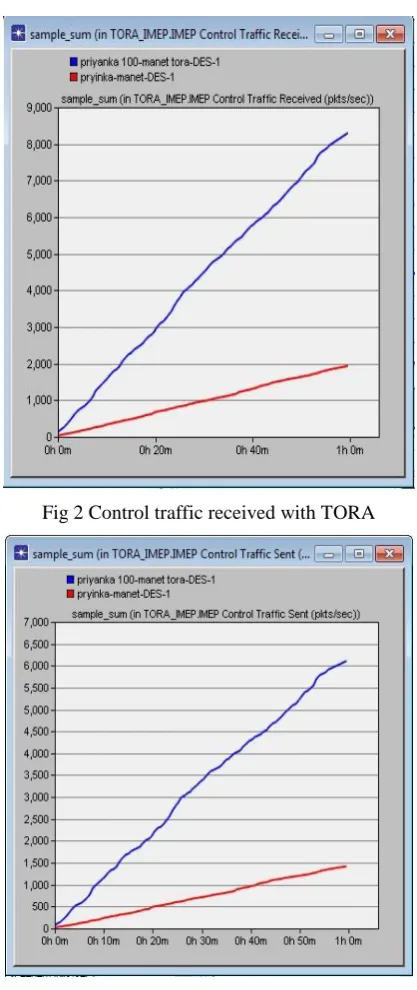
Fig 2 Control traffic received with TORA
Fig 3 Control traffic sent with TORA.
From figures (2-3), we conclude that Control traffic sent and from one user to another user and received by the another users and greater in large TORA 100 nodes network and smaller in small TORA 50 nodes network where number of users is more.
© 2014, IJCSMC All Rights Reserved 911
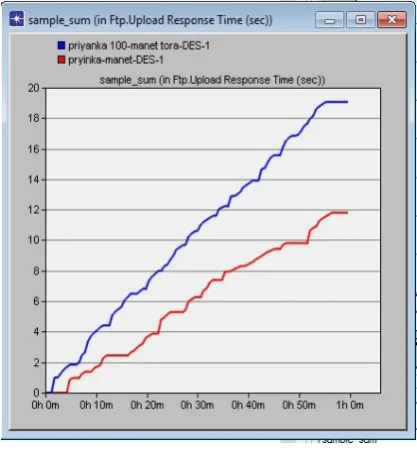
Fig 5 Upload response time with FTP load.
AS shown in figures 4 and 5, upload Received time from one user to another user and download response times by another users and greater in large TORA 100 nodes network using FTP and smaller in small TORA 100 nodes network where number of users is more in large network with TORA using FTP.
Fig 6 Delay(sec)
From figures 6, 7, we conclude that end to end Delay from one user to another user and Network load by the another users and greater in large with TORA 100 nodes network and smaller in small TORA 50 nodes network where number of users is more. Thus it concludes that as no. of nodes increases in a network, end to end delay, MAC delay and network load gradually increases.
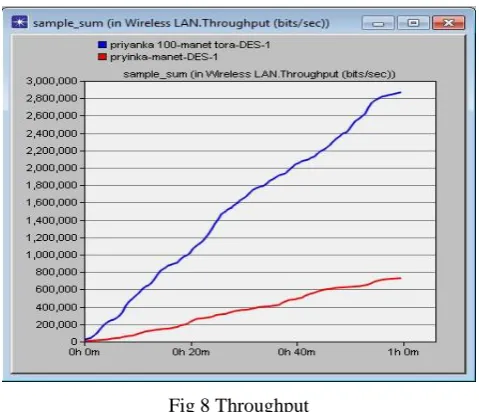
Fig 8 Throughput
From figure 8, it is clear that throughput is higher with TORA 100 nodes than that with TORA 50 nodes. Also throughput increases with the maximum no. of mobile nodes.
VI. CONCLUSION
In this paper performance of Reactive TORA is evaluated for metrics like Network Load, Throughput, Delay, Upload and Download response time, TORA Control traffic sent and received by varying number of nodes and version of IEEE 802.11 WLAN Standard. From the above discussion we find out that TORA small network performs best in each case in terms of Delay andNetwork load and TORA large Network perform best in each case in terms of Throughput, Upload and Download Response Time, TORA Control Traffic Sent and Received are showing better results with 802.11b technology.
REFERENCES
[1] Pankaj Palta, Sonia Goyal,” Comparison of OLSR and TORA Routing Protocols Using OPNET Modeler”, International Journal of Engineering Research & Technology (IJERT), Vol. 1 Issue 5, July – 2012, ISSN: 2278-0181
[2] Perkins.C.E. Ad hoc Networking, Boston, Addison Wesley (2001)
[3] Zhou, L.D. and Haas, Z.J. (1999) “Securing Mobile ad hoc network”, IEEE Network Magazine, Vol. 8, 2, pp. 16-23.
[4] Perkins, C.E. and Royer, E.M. (1999) “Ad-Hoc on Demand Distance Vector Routing”, Proceedings of the 2nd IEEE Workshop
on Mobile Computing Systems and Applications, pp.90-100.
[5] Johnson, D.B. and Maltz, D.A. (2001) „„DSR: The Dynamic Source Routing Protocol for Multi-Hop Wireless Ad Hoc Networks‟‟, Computer Science Department Carnegie Mellon University Pittsburgh, PA 15213-3891.
[6]