© 2015, IJCSMC All Rights Reserved 607 Available Online atwww.ijcsmc.com
International Journal of Computer Science and Mobile Computing
A Monthly Journal of Computer Science and Information Technology
ISSN 2320–088X
IJCSMC, Vol. 4, Issue. 4, April 2015, pg.607 – 612
RESEARCH ARTICLE
ANALYSIS OF INVARIANT FEATURE BASED MULTISTAGE
CLASSIFIER FOR COMPRESSED-DOMAIN SHIP
DETECTION AND RECOGNITION
A.PON SELVA KUMAR
1, D. SHANKAR
21PG student, Department of Computer Science & Engineering, St. Joseph College of Engineering, Chennai, India 2Assistant Professor, Department of Computer Science & Engineering, St. Joseph College of Engineering, Chennai, India
1
[email protected], 2 [email protected]
Abstract- Ship detection from satellite imagery is a valuable tool for the identification of illegal oil spills and monitoring maritime traffic in the fisheries, and the commercial transportation sector. The purpose of this project is to investigate invariant features of ship detection with multistage classifier. The proposed system is, to analyze the ship detection in optical spaceborne images with different rotation, scaling and illuminations conditions using compressed domain and wavelet transform with DNN (Deep neural network) and ELM. These approaches are used to analyze the optical spaceborne images (Spot5, Quickbird, Ikonos image database) with different scale and illumination conditions and their results are applied to the classification using SVM. By using compressed domain with DNN to provide invariant scaling and also spatial resolution analysis. Getting these features from these methods is used to train the system. It combines properties of structural and statistical. These features are then used for classifications by using different classifier. The experiments are carried out on the Spot5, Quickbird, and Ikonos image database. The reported experiment results are to prove the effectiveness of the proposed method. Furthermore improvement of using different classifier as well as performance analysis of the results is also going to be discussed. The comparison of different recognition techniques with the proposed technique is also projected. The performance analysis of the system is done with classification accuracy for each technique.
Index Terms−Compressed domain, Deep Neural Network (DNN), Extreme learning machine (ELM), Optical spaceborne image, Stacked denoising autoencoder (SDA).
I. INTRODUCTION
Ship detection in spaceborne remote sensing images is of vital importance for maritime security and wide array of applications, e.g., traffic surveillance, protection against illegal fisheries, oil discharge control, and sea pollution monitoring.
Satellite can capture a wide range of area and during the cloudy seasons clear images cannot be captured by satellite due the presence of moisture and noise so in order to overcome this new noisy compression algorithm called fractal compression algorithm has been proposed in this work.
© 2015, IJCSMC All Rights Reserved 608
lead to larger data quantity than other remote sensing images, thus optical images cannot be used in the real-time applications. Ship detection and recognition from airborne infrared images with sky-sea backgrounds. Burgess introduced vessels detecting algorithm in satellite Pour l‟Observation de la Terre (SPOT) Multispectral and Landsat Thematic Mapper images. Also analysed the characteristics of different satellite remote sensing images. The first issue can‟t be overcomes due to low complexes.
Morphological filtering is combined with wavelet analysis and radon transform to better distinguish ships from surrounding turbulence. Each of this technique improves a specific procedure in either preprocessing or classification and achieves better performance then classical methods.
Neural network is used to classify small ship candidates from SPOT-5 High Resolution Geometric 5-m images and presented a complete processing chain for ship detection. Increased false alarm rates were obtained when this approach on particular types of images with a high percentage of cloud covers and a cluttered sea background. The approach consists of three main steps: (1) a preprocessing stage involving clod masking and local contrast enhancement, (2) a prescreening stage including automatic threshold estimation and connected filtering using component trees for the detection of potential ship targets and (3) a postprocessing stage where membership probabilities to the „ship‟ category are estimated using a logistic model based on the variables obtained from wavelet transform (WT)and Radon transform (RT).
Image compression effects in face recognition systems and proposed a face recognition method in JPEG 2000 compressed domain with independent component analysis and principal component analysis. The main focus of this work is to show how subband can be modelled accurately in order to capture the properties of non-uniformly textured images better. Work already done in this area mainly focuses on uniform texture images or homogeneous areas in general images.
Zargari et al exploited packet header information for JPEG 2000 image retrieval, including the number of nonzero bit planes, the number of coding passes, and the code block length. However, the aforementioned approaches face difficulty in handling ship detection under various conditions, and particularly high-frequency subbands are not effectively utilized.
In the proposed work, low and high frequency subbands are exploited for feature extraction using two DNNs. An important issue is to understand how much information is carried by the local maxima of a wavelet transform modulus. The singularities of LL are extracted to train the first DNN. DNN based detection; we can generate masks for the full object as well as portions of the object. A single DNN detect can give us masks of multiple objects in an image.
As the LH, HL, and HH describe the image details in different orientations these subbands are combined before training the second DNN. This paradigm was successfully used within a discriminatively trained Deformable Part Model to achieve state-of-art results on detection tasks.
Then, the outputs of the two DNNs are fetched for final decision making by Extreme Learning Machine. The choice of network architecture, Weight initialization and number of iterations required for training are some of the important parameters the affects the learning performance of these classifiers.
The contributions of the Main works are 1) a new compressed-domain framework is developed for fast ship detection 2) DNN is employed for hierarchical ship feature extraction in wavelet domain 3) the ELM, is adopted for feature fusion and classification. Using these novel techniques the proposed work achieves the following advantages.
1) Faster detection. Compressed domain achieves much faster detection than pixel domain
2) More reliable results. High-level feature representation are extracted to ensure more accurate classification
3) Better utilization of information. Two DNNs are trained with multisubbands coefficients to make full use of the wavelet information
II. PROPOSED METHOD
The proposed approach using compressed- domain ship detection framework using DNN and ELM for optical
spaceborne images.
This approach achieves better classification by deep learning feature extraction and faster detection with high accuracy in compressed domain. Compressed domain is anywhere in the compression or decompression procedure, after transform or before inverse transform. For arbitrary image databases of natural scenes, color and texture features are considered most important. We compute and compare and getting two individuals two rankings for the best matches. To consider the scores for each image in both ranking are combined and take the final decision base d on the color and texture factors.
The main features of the proposed work is image preprocessing (Image Enhancement) and Postprocessing (feature representation and Classification)
© 2015, IJCSMC All Rights Reserved 609
III. PREPROCESSING
There is sometimes a dark gray distribution of ships, which has a negative effect on ship segmentation. To evaluate the distinction between the ship and sea to extract the whole ship, a new mixed is proposed.Suppose that f ( i, j) is the gray value of a point ( i, j) in an image. The sobel operator is applied to and edge Magnitu de Mag ( i,j)
( ) ( ) ( )
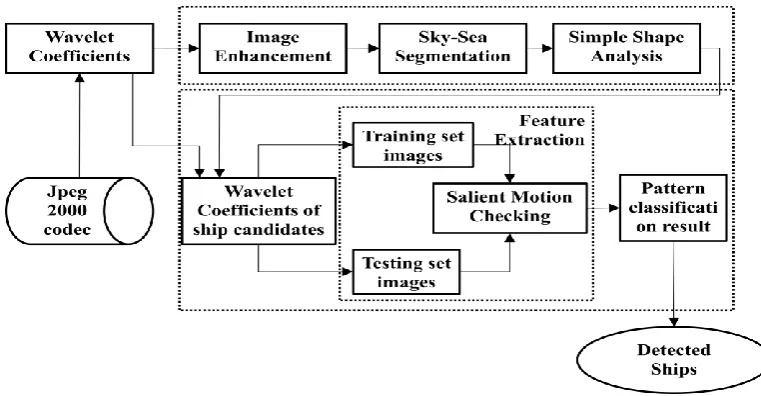
Fig. 1 Ship detection Architecture
A. Image Enhancement
There are two transforms are used to enhance the image. Those techniques are Top-Hat transform and Bottom-Hat Transform.
These techniques are used for Ship extraction and background suppression. As the ships are brighter than their surroundings, the white THT is used. As the ships are darker than their surroundings, the block THT is used.
The Expression of white THT is as follows:
( )
( )
B. Sky-Sea Segmentation
Ship candidates can be obtained by coarse image segmentation of the mixed image with a proper threshold. Stastical Gaussian model is adopted to ensure the probabilistic distribution of the sea regions.
The resulting µ and σ are used to compute a threshold (T) for image binarization, as follows:
µ
C. Simple Shape Analysis
© 2015, IJCSMC All Rights Reserved 610
IV. FEATURE EXTRACTION AND CLASSIFICATION
Feature extracted by these methods generally have poor performances when the images are corrupted by blur,
distortion, or illumination which commonly exist in the remote sensing images.
A. Introduction of SDA
It is based on the traditional autoencoder but uses the corrupted inputs rather than the original ones. Practically, denoising autoencoder is used as the building block of SDA, each level has representation of the input pattern that is more abstract form of the previous output.
Before training the input data need to be initialized by zero-mean or z-score normalization
( ) ( )
1) SDA1-Low Frequency Module: Wavelet transform provides localized information about the image based on the certain point.
The singularities and irregular structures often contain the most important information, and thus, they are particularly meaningful for object recognition.
2) SDA2-High Frequency Module: They reflect the sparse of the original image. Particularly high-frequency subbands
are set equally to avoid artificially intervening the weights of each subband.
B. Feature Extraction of Ship candidates
The state-of-the-art approaches extract complicated features and combine them with deep-learning based representation and classification. In our approach, besides commonly used features such as texture features, wavelet based features, and shape features, anew texture operator LMP, is introduced to enhance the representation ability of the feature set.
Ship detection is usually under complicated conditions, and the processed images may contain various pseudotargets, such as islands, clouds, mists, etc.
Images, which are obtained from image segmentation, readily provide geometric characteristics such as perimeter and area which are listed as follows:
Compactness: Compactness measures the degree of circular similarity, and it is defined as
Area: It equals to number of pixels in the corresponding connected region. Area is used to cut off the lands, clouds, mists and other false features.
Rectangularity and Eccentricity: The simplest eccentricity is the ratio of the major and minor axes of an object approximated by its best fit ellipse.
Rectangularity is the maximum ratio of region area to the area of a bounding rectangle according to its different direction.
C. Classification of Ship Candidates
A hierarchical ship classification approach based on the abstract pattern analysis of ship and nonships are presented for analysis and comparison. The support vector machine is adopted as the classifier in our classification approach due to its capability of great results in the classification of high-dimensional datasets and has been found competitive with the best machine learning algorithm.
© 2015, IJCSMC All Rights Reserved 611 In this method there are three techniques are used, which are listed as follows:
1)Supervised Binary Classification: This method is a direct classification as a two-class recognition problem. In this approach the objects are classified are divided into two classes: 1) Ship 2) other factors. For every candidate, classifiers with the simple combination of features are classified.
2)Supervised Several Subclass Classifications: This method is a general multiclass recognition problem. The other ship class includes many subclasses. E.g., cloud, ocean waves, and islands. There usually exist in the gray level distributions. In this classification approach, we divide all samples into several subclasses such as ships without wakes, ship with one wake, clouds, ocean waves and coastlines.
There are two classification hierarchies in this method. First, subclass classification is conducted based on the SVM classifier. Second, class identification is performed based on the whether the outcome of subclass classification is a ship or any other nonship factors.
3)Supervised Multiple Miniclass Classification: In this approach many subclasses are divided into multiple miniclasses based on their feature distribution to improve the performance as follows. First, every feature of the training samples in every subclass is computed. Second, the miniclasses are generated using feature-fusion algorithm. The minimum between miniclass distances in different numbers of miniclasses are first computed. Then, the corresponding number with the largest minimum between-miniclasses distance is adopted as the number of miniclasses.
D. Pretraining and testing
In this method SDA is used to train the samples in low and high frequencies. In this method layer-by-layer pretraining used to achieve good result and low variance of testing error. Once all of the layers are pretrained, the networks need a next stage of supervised training called testing. The testing is used to minimize the prediction error. After the SDA training and testing, ELM is used for the fusion of ship features obtained from low and high frequencies, and the fused 100-dimensional feature vector is then utilized for classification and final decision making.
V. EXPERIMENTS AND RESULT ANALYSIS
SDA-based feature extraction, ELM-based feature fusion, and classification are adopted with the relevant
state-of-the-art methods. The performance of ship candidate segmentation is first tested; then, SDA-based feature extraction is matched with other features. Finally, the overall ship detection accuracy is compared to demonstrate the advantages of the testing and fine tuning conditions.
VI. CONCLUSION
The proposed system is to develop the different scale and illumination of invariant ship detection and recognition in
optical spaceborne images using compressed domain with DNN based feature extraction operator and ELM. These methods are achieves better classification by deep-learning-based feature extraction with faster detection. These methods are used to train the system for efficient ship detection from remote sensing images overcome the problems occur in different weather conditions, like clouds and ocean waves, and the higher resolution results in larger data volume, which makes processing more difficult. The system achieves, less detection time, higher detection accuracy.
REFERENCES
[1] C. Zhu, H. Zhou, R. Wang, and J. Guo, “A novel hierarchical method of ship detection from spaceborne optical image based on shape and texture features,” IEEE Trans. Geosci. Remote Sens., vol. 48, no. 9, pp. 3446–3456, Sep. 2010.
[2] C. Corbane, L. Najman, E. Pecoul, L. Demagistri, and M. Petit, “A complete processing chain for ship detection using optical satellite imagery,” Int. J. Remote Sens., vol. 31, no. 22, pp. 5837–5854, Jul. 2010.
[3] G.-B. Huang, H. Zhou, X. Ding, and R. Zhang, “Extreme learning machine for regression and multiclass classification,” IEEE Trans. Syst., Man, Cybern. B, vol. 42, no. 2, pp. 513–529, Apr. 2012.
[4] M. Tello, C. L. Martıacute;nez, and J. J. Mallorqui, “A novel algorithm for ship detection in SAR imagery based on the wavelet transform,” IEEE Geosci. Remote Sens. Lett., vol. 2, no. 2, pp. 201–205, Apr. 2005.
© 2015, IJCSMC All Rights Reserved 612
[6] M. Tello, C. López-Martínez, and J. J. Mallorqui, “A novel algorithm for ship detection in SAR imagery based on the wavelet transform,” IEEE Geosci. Remote Sens. Lett., vol. 2, no. 2, pp. 201–205, Apr. 2005.
[7] K. Eldhuset, “An automatic ship and ship wake detection system for spaceborne SAR Images in coastal regions,” IEEE Trans. Geosci. Remote Sens., vol. 34, no. 4, pp. 1010–1019, Jul. 1996.
[8] J. W. Lu, Y. J. He, H. Y. Li, and F. L. Lu, “Detecting small target of ship at sea by infrared image,” in Proc. IEEE Int. CASE, Oct. 8–10, 2006, pp. 165–169.
[9] Y. Bengio, “Learning deep architectures for AI,” Found. Trends Mach. Learn., vol. 2, no. 1, pp. 1–127, 2009.