Available Online at www.ijcsmc.com
International Journal of Computer Science and Mobile Computing
A Monthly Journal of Computer Science and Information Technology
ISSN 2320–088X
IJCSMC, Vol. 4, Issue. 4, April 2015, pg.532 – 540
RESEARCH ARTICLE
SVD and DWT Based Iris Recognition
Using Beagleboard-xM
Mahesh Patil
1, Raghuveer K
2¹
Master of Engineering in Electronics and Communication, UVCE, Bangalore University, Bangalore, India²
Master of Engineering in Electronics and Communication, UVCE, Bangalore University, Bangalore, India1 [email protected]; 2 [email protected]
Abstract— Iris recognition is one of the most accurate biometric methods in use today. However, the iris recognition algorithms are currently implemented on general purpose sequential processing systems, such as generic central processing units (CPUs). One of the remaining problems in iris recognition is the implementation of its efficient hardware systems. This proposed work uses a hardware Beagleboard-xM, which is designed specifically to address the Open Source Community. Unlike regular iris recognition systems, the proposed method also involves pre-processing, normalization, feature extraction and matching. Here the iris normalization is performed using a new method called Circular Masking technique. And for feature extraction, Biorthogonal Wavelet Transform and Singular Value Decomposition (SVD) algorithms are used. And Euclidean distance measure is used in order to find similarity between the iris images. And the results demonstrate significant improvements in iris recognition accuracy. And all these operations are implemented on Beagleboard-xM using OpenCV library functions.
Keywords— Circular Masking, Biorthogonal Wavelet, SVD, Euclidean Distance, Beagleboard-xM, OpenCV
I. INTRODUCTION
Image Aquisition
Iris Pre-processing
Iris Normalization Segmentation
Feature Extraction
Matching
Fig.1.1 Stages of Iris Recognition Algorithm
Iris recognition appears to be a very attractive method in use today because of the following properties. Iris is an internally protected organ, which is complex, unique and very stable throughout life. Also human iris is immutable over-time. These properties make iris recognition a one of accurate and reliable human identification technique.
Human iris identification process is basically divided into following steps and is shown in figure 1.
Image Acquisition
Iris Pre-processing
Segmentation
Iris Normalization
Feature Extraction
Matching
A. Image Acquisition
In this step, the images from the Chinese Academy of Sciences Institute of Automation (CASIA) iris database version 1 are used. It has database for 108 distinct persons which includes seven grey scale eye images for each person with image dimensions 320x280 pixels.
B. Iris Pre-processing
For any biometric identification technique before extracting the features some set of operations should be performed in order to improve the quality of the image. In the current work the iris database images are resized manually before loading in to the database.
i) Resizing: In order to standardize the inputs to the system all the images in the database are resized to a uniform size of 256x256. This operation is applied on each image of the database and the images are resized manually.
C. Segmentation
Iris segmentation or localization segments the iris from the rest of the acquired image. Main objective of segmentation is to remove redundant information present in the eye image. The main step in iris localization is to detect inner and outer circles, i.e. pupil boundary and iris-sclera interface. Generally Hough transform is used to localize the iris. For the proposed method there is no need to locate pupil and iris.
D. Iris Normalization
extracted using different feature extraction algorithms. In the proposed work, a new technique called circular masking is used for the iris normalization.
E. Feature Extraction
Iris texture provides abundant information which can be used for the feature extraction process. For the iris template generated from the normalization, various feature extraction algorithms are applied to obtain a final feature vector. For the proposed work, Biorthogonal wavelet transform and singular value decomposition (SVD) techniques are used for feature extraction.
F. Matching
Matching allows us to verify whether the person is in database or not. For this, we make use of Euclidean distance measure. Test image is taken from the database and Euclidean distance is calculated by comparing the feature vector of one test image and feature vectors of all images in the database. A smaller Euclidean distance represents a better match. The Euclidean distance is calculated using equation 1.
….. (1)
Where,
( pi, ) - The feature values of database image.
(qi,qj ) - The feature values of test image.
For all iris recognition algorithms we need to carry out all these steps on the database and at last depending upon match/mismatch count results are tabulated. In common, iris recognition algorithms are implemented using MATLAB and for the hardware implementation many of them prefer FPGA. But for the proposed work Beagleboard-xM is preferred over FPGA because compared to FPGA, Beagleboard-xM is designed to function on a much higher level. With already integrated hardware that takes care of things like ethernet, video and audio processing, large quantity of RAM and a maximum amount of storage space, they are really mini-computers. On this you are able to run complete operating systems, like Linux and Android and develop programs within those operating system functions and the IO that are made available. Beagleboard-xM shown in figure 1.2 has a DSP on board and a camera interface, which can be used to boost the image processing power. We can get real time performance on Beagleboard-xM by using OpenCV(C/C++ library). MATLAB will definitely not match the performance, what we get from OpenCV.
Fig.1.2 Beagleboard-xM
This paper is organized as follows. In section 2, some well-known previous papers of iris recognition are described. Further, the outline of the proposed algorithm is presented in section 3. In section 4, the implementation of the proposed work on Beagleboard-xM is explained. Experimental results are provided in section 5. And in next section, some conclusions and future work are discussed.
II. PREVIOUS WORKS
and P. B. Mane, [3] proposed a method for iris recognition based on Haar wavelet approach of Iris texture extraction. The proposed algorithm has less computational complexity compared to other methods hence can be used for implementing high accuracy iris recognition system. Swanirbhar Majumder et al., [4] proposed a singular value decomposition and wavelet based iris biometric watermarking. The algorithm has been tested with popular attacks for analysis of false recognition and rejection of subjects. N. F. Shaikh et al., [5] proposed a Multi Algorithmic Approach and Score Fusion Model to improve Iris Recognition Efficiency. The method uses 2D Gabor wavelet, Euler Number and Principle Component Analysis for feature extraction. Ujwalla Gawande et al., [6] proposed a method for Improving Iris Recognition Accuracy by Score Based Fusion Method. The proposed method combines the zero-crossing 1D wavelet Euler number and genetic algorithm based for feature extraction. V.Saravanan and R.Sindhuja, [7] proposed a method of Iris Authentication through Gabor Filter Using DSP Processor. This paper uses Gabor filters for feature extraction methods for iris authentication, which is more advantageous than already available methods. After the Features are extracted it is implemented successfully on the DSP platform which has a Blackfin processor. M. Lopez et al., [8] proposed architecture for Hardware-software co-design of an iris recognition algorithm. The whole iris recognition algorithm has been implemented on a low-cost Spartan-3 FPGA, achieving significant reduction in execution time when compared with a conventional software based application. Hentati Raida et al., [9] proposed a HW/SW implementation of iris recognition algorithm in the FPGA. In this paper three different methods are proposed to accelerate the simulation of biometric systems based on iris recognition with performance analysis. The implementation results demonstrate the hardware accelerator is an effective way to increase the processing rate of time execution. B. Umarani et al., [10] proposed an Enhanced Approach for Iris Recognition Using Fusion of FWT with Gabor Wavelet Transform and Daugman Encoding. This paper suggests a better way to enhance the accuracy using the Fast Wavelet Transform with the use of Gabor Wavelet Transform and Daugman algorithm. Lenina Birgale et al., [11] proposed a method for Iris Recognition without Iris Normalization to improve system performance and reliability of a biometric system which avoided the iris normalization process used traditionally in iris recognition systems. It reduces the false acceptance rate and false rejection rate and improves the system efficiency with minimum process and recognition time.
III.PROPOSED METHOD
The proposed method is implemented using OpenCV library functions on Beagleboard-xM. The iris images are pre-processed and normalized using circular masking technique. The features are extracted using Biorthogonal wavelet transform and singular value decomposition techniques. The block diagram of proposed model is given in Figure 3.1. And can be explained in the following steps:
3.1. Iris Database
Here CASIA V1 iris database is considered. It has database for 108 distinct persons. And for each person it has total seven eye images of size 320x280 respectively. For the proposed method we have considered total 14 persons with 3 images each for in database and we have considered 4th image of each person as test image to calculate TSR and FRR. And to calculate FAR we have taken 4th image of another 14 persons as test image (which are considered as out of database persons).
3.2. Pre-processing
For all the iris images present in the database, pre-processing is performed as described in section 1.
3.3. Normalization
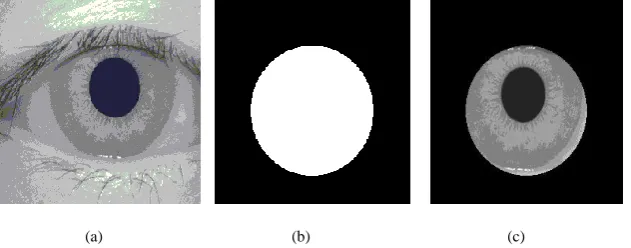
In the current work a new technique called Circular Masking is proposed for normalization. And is shown in figure 3.2.
3.3.1. Circular Masking:
The various steps involved in this technique are shown in figure 3.2. At first, the input image (a) is read. Then mask image (b) for the corresponding input image is generated using OpenCV built-in functions. And figure (c) shows the resultant image after performing „bitwise_AND‟ operation between figure (a) and figure (b) respectively.
Initially the input image is read. Using OpenCV built-in library functions, blank image is created automatically of size that of input image. Then using „ellipse‟ built-in function draw an ellipse on the mask image as shown in figure 3.2(b). And the resultant image (c) is generated after performing „bitwise_AND‟ operation between the elements of input image and mask image. Store the elements of resultant image in variable „res‟. Then the threshold is set for these elements to remove unwanted data (pupil part, eye-lashes, bright pixels and sclera portion) present in the eye image. This threshold is set for our database using formal verification method. And the resultant iris data obtained can be used further for various feature extraction techniques.
3.4. Feature Extraction
In the proposed work the feature extraction was done in two different phases. In the first phase, Biorthogonal wavelet transform is applied and LL-band is considered as feature vector. While in second phase, SVD coefficients are generated for the extracted iris data. The processes involved in extracting the two different features are explained as follows.
(a) (b) (c)
Fig.3.2. Circular Masking (a) Input eye image; (b) Mask image created for corresponding input image; (c) Resultant image.
3.4.1. Biorthogonal Wavelet Transform features:
Biorthogonal wavelets require two different filters one for the analysis and other for synthesis of an input. The first number indicates the order of the synthesis filter while the second number indicates the order of the analysis filter. And are represented by the equations given below.
Synthesis: The original sequence can be reconstructed from the transformed sequence using the relations
Analysis:
Only LL-sub band is considered for feature vector. And the wavelet computations can be explained in three steps.
i) Splitting: In this step, total number of elements can be grouped into even and odd components. i.e, Xe= S1= {s1, s2, s3,……. sN/2,}; and
Xo= D1= {d1, d2, d3,……… dN/2,}; ii) Prediction: Here predicted values are obtained using the equation,
dN/2
= dN/2 – [
0.5(sm+ sm+1) +
0.5]
; Where, „m‟ varies from 1 to N/2And D1 is given by, D1= {d1, d2, d3,…. dN/2,};
iii) Updation: And updated values are obtained using the equation,
sN/2
= sN/2 – [
0.25(dp+ dp+1) +
0.5];
Where, „p‟ varies from 1 to (N/2 +1)
And S1 is given by, S1=
{s1, s2, s3,……. sN/2,}
;And these updated values of LL-band are used as feature vector for further calculations.
3.4.2. Singular Value Decomposition:
The Singular Value Decomposition (SVD) is a well-known matrix factorization technique that factors a
m by n matrix X into the product of three matrices as,
i) An orthogonal matrix U
ii) A diagonal matrix S
iii) And the transpose of an orthogonal matrix V i.e. (VT) and is given by,
X
mxn= U
mxrS
rxrV
T
rxn …(2)
Where,
UTU = Imxm
VTV = Inxn (i.e. U and V are orthogonal)
The SVD represents an expansion of the original data in a coordinate system where the covariance matrix is diagonal. Calculating the SVD consists of finding the eigenvalues and eigenvectors of XXT and XTX. The eigenvectors of XTX make up the columns of V, the eigenvectors of XXT make up the columns of U. Also, the singular values in S are square roots of eigenvalues from XXT or XTX. The singular values are the diagonal entries of the S matrix and are arranged in descending order. The singular values are always real numbers. If the matrix X is a real matrix, then U and V are also real. In the proposed method, SVD coefficients are generated for normalized iris data and this feature vector is further used for calculations. And the detailed representation of equation 2 is shown below.
3.5. Matching
As explained in section 1, Euclidean distance measure is used to compare final feature vectors. Depending upon the match/mismatch count, performance parameters like FAR, FRR, TSR and EER are calculated.
IV.IMPLEMENTATION ON BEAGLEBOARD-XM
In this section, procedure to run a program on Beagleboard-xM is explained. For this, Microsoft Visual Studio 2012 IDE, OpenCV 2.4.8 and Beagleboard-xM hardware is used.
Procedure to run a program on Beagleboard-xM:
1. Write a C or C++ program in Microsoft Visual Studio 2012 using OpenCV built-in library functions.
2. Build and run the program in Visual Studio and see the results.
3. Create your project folder in ‘root home’ folder in desktop of Beagleboard and copy the ‘source.c’ or
‘source.cpp’ with relative image files to the same ‘root home’ folder. 4. And also copy the ‘buildall.sh’ file in the same folder.
5. Now go to ‘Terminal’ and type the command – ‘cd project folder’ and press enter.
6. Next build the source_code using – ‘./buildall.sh’ command. (This command will compile your
source_code)
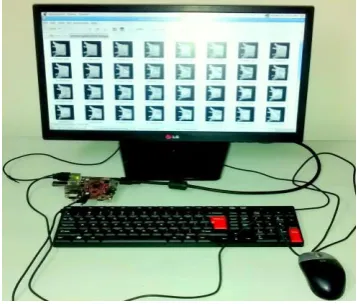
Fig.4. Beagleboard-xM setup for iris recognition system
V. EXPERIMENTAL RESULTS
The performance parameters like FAR, FRR, EER, TSR are computed using Beagleboard-xM. For computations we have considered the database of 14 persons from CASIA V1 with 3 images each for in database and we have considered 4th image of each person as a test image to calculate TSR and FRR. And to calculate FAR we have taken 4th image of another 14 persons as test images (which are considered as out of database persons). The values of FAR, FRR and TSR for 14 persons are tabulated and are represented in the Figure 5.1 and 5.2.
From the figure 5.1, it is observed that the value of EER is 0.1428. The TSR at the optimum threshold of 0.37 is obtained as 0.71428 or 71.428% and maximum TSR with 0.8571 or 85.71%. From the figure 5.2, it is observed that the value of EER is 0.0714. The TSR at the optimum threshold of 0.23 is obtained as 0.9285 or 92.857% and maximum TSR with 1.0000 or 100%. From the table 1 it is observed that, the values of TSR and EER are better in the case of Singular Value Decomposition technique compared to Biorthogonal wavelet transform technique and it is observed that the simulation results and the results obtained from the Beagleboard are comparably same.
Fig.5.2. FAR, FRR and EER representation for SVD
5.1. Comparison of SVD and Biorthogonal wavelet transform technique results:
TABLE 1
COMPARISON WITH BIORTHOGONAL WAVELET AND SVD
Method TSR(%) EER
Biorthogonal
Wavelet 71.428% 0.1428
SVD 92.857% 0.0714
CONCLUSION AND FUTURE WORK
In the proposed work, iris normalization is performed using Circular Masking technique. Here, mask image is generated for each image during run-time. The occlusions present in the image (i.e, bright pixels, eye lashes, pupil part and some portion of sclera) are eliminated by setting threshold. By this technique, the effective iris data from the input eye image can be easily extracted and Euclidean distance measure is used for comparing feature vectors generated from Biorthogonal Wavelet transform and SVD. And it is observed that SVD algorithm gives better matching results both on hardware and simulation. In the future, the results on hardware can be improved for larger database. And further using new techniques, an efficient feature extraction can be done.
REFERENCES
[1] Raida Hentati, Manel Hentati, and Mohamed Abid, “Development a New Algorithm for Iris Biometric Recognition”, International Journal of Computer and Communication Engineering, Vol. 1, No. 3, pp. 283 - 286, September 2012.
[2] Mahmoud Elgamal and Nasser Al-Biqami, “An Efficient Feature Extraction method for Iris Recognition Based on Wavelet Transformation”, International Journal of Computer and Information Technology, Vol. 2, Issue 03, pp. 521-527, May 2013.
[3] S. M. Rajbhoj and P. B. Mane, “Haar Wavelet Approach of Iris Texture Extraction for Personal Recognition”, International Journal of Innovative Technology and Exploring Engineering, Vol. 3, Issue-2, pp. 22-25, July 2013.
[4] Swanirbhar Majumder, Kharibam Jilenkumari Devi and Subir Kumar Sarkar, “Singular Value
Decomposition and Wavelet-based Iris Biometric Watermarking”, IET Biom., 2013, Vol. 2, Iss. 1, pp. 21-27, Jan 2013.
[6] Ujwalla Gawande, Mukesh Zaveri and Avichal Kapur, “Improving Iris Recognition Accuracy by Score Based Fusion Method”, International Journal of Advancements in Technology, Vol. 1, No 1, pp 1-12, June 2010.
[7] V.Saravanan and R.Sindhuja, “Iris Authentication through Gabor Filter Using DSP Processor”, IEEE Conference on Information and Communication Technologies, pp. 568 -571, 2013.
[8] M. Lopez, J. Daugman and E. Canto, “Hardware-software co-design of an iris recognition algorithm”, IET
on Information Security, Vol. 5, Iss. 1, pp. 60-68, 2011.
[9] Hentati Raida, YassineAoudni and Mohamed Abid, “HW/SW implementation of iris recognition algorithm
in the FPGA”, International Journal of Engineering Science and Technology, Vol. 4 No.02, pp. 805 - 810, February 2012.
[10] B. Umarani, V. Krishnamurthi and S.M. GiriRajkumar, “An Enhanced Approach for Iris Recognition Using Fusion of FWT with Gabor Wavelet Transform and Daugman Encoding”, International Journal of Advanced Software Computer. Applications, Vol. 6, No. 2, pp. 1 - 18, July 2014.
[11] Lenina Birgale and M. Kokare, “Iris Recognition without Iris Normalization”, Journal of Computer Science, pp. 1042-1047, 2010.
[12] The CASIA Database:. [online]. Available: http://biometrics.idealtest.org/ [13] [online]. Available: http://docs.opencv.org/
[14] [online]. Available: http://opencvlibrary.sourceforge.net/