Diffusion bonded Be neutron target using 8MeV proton beam
Toshikazu Kurihara, Hitoshi Kobayashi
High Energy Accelerator Research Organization (KEK), Tsukuba, Ibaraki 305-0801, Japan
Abstract. The development of the high intensity compact neutron source is mainly conducted by using accelerators for medical purposes. Recently, a lot of compact neutron sources have been developed, and most of them are for boron neutron capture therapy (BNCT). Compared with the common accelerators used for industries, accelerators for BNCT have to accelerate a 100 times larger current of charged particles because of the low conversion efficiency of neutron moderators. To attain a reliable target for the BNCT neutron source, two obstacles have to be overcome; radiation damage (blistering) and heat issue. We introduce diffusion bonding method aiming to make defect free Be neutron target and 1 MPa latent heat water-cooling system. We also install beam expansion optics using quadrupole and octupole magnets to reduce the charge density. Our facility has been operating for more than three years from the commissioning period and we report the recent situation as following. 1) Diffusion bonding method was applied to the solid neutron target of Be with latent heat cooling system. 2) Amount of integrated coulomb value of protons implanted to the Be target is nearly 3000 C now 3) Amount of neutron dose rate was measured. 4) A laser reflection microscope (LRM) method has been developed to observe the neutron target condition (especially radiation damage) through viewport with a few meters working distance. 5) Direct observation of the surface of the Be target was done during the period of improving nearly target vacuum and residual radiation conditions. From these evidences, we conclude our neutron target already produces neutrons capable to treat nearly 500 patients of malignant melanoma.
1 Introduction
After the 3.11, 2011 earthquake and tsunami in Japan, new demand to construct compact accelerator driven neutron source occurred. One comes from universities and one comes from hospitals. In 1980’s, Prof. Fukumoto and his group joined together with University of Tsukuba group to establish proton therapy using the KEK booster synchrotron [1]. The upstream of this accelerator was used to study initial phenomena of radiation damages (blisterings) of neutron target related materials in the later years [2].
Compared with the common accelerators used for industry, accelerators for boron neutron capture therapy (BNCT) have to accelerate a 100 times larger current of charged particles because of the low conversion efficiency of neutron moderators. To attain a reliable target for the BNCT neutron source, two obstacles have to be overcome; the heat issue and defects control (blistering). And we have solutions. Cooling with latent heat and bonding with diffusion. First of all, existing neutron source is presented. Design concept of our neutron target is as following: Separate function target. Top layer consists of neutron production materials. Middle layer consists of mitigation materials for hydrogen embrittlement (blistering tolerant materials). Bottom layer consists of heat sink with water cooling. Usually these layers consist of different materials. That
requires joining dissimilar metals. To satisfy this goal, we try to introduce diffusion bonding method with hot isostatic pressing (HIP) in care of defect control. Direct observation of a blistering phenomenona under irradiation of incident proton beam reveals us an initial stage of blisterings [2]. The combination of blistering tolerant materials does not always enables us to make blistering tolerant neutron target. It is necessary to take much care about the newly coming reaction layers with diffusion bonding method. Selection of blistering tolerant materials and estimation of the quality of newly emerged reaction layer is important.
2
Neutron target
Design concept is simple. Separate function target is our keyword. Our target component composed of three parts. The nuclear reaction part (beryllium), the proton implantation part (palladium) and the heat removal part (copper with water for cooling). For each part combination of suitable materials and methods are applied. Figure 1 shows a rough sketch of our neutron target.
Fig. 1. Design of the separate function three-tier target. Three tier of different metals are used. The Bragg curve of 8 MeV proton in beryllium has its peak at the path length of 0.54 mm. It is proposed to use 0.5 mm beryllium for neutron production and stop proton beam in palladium for blistering tolerance. Thickness of 0.5 mm beryllium is not suitable mechanically to sustain high-pressure differences.
2.1. Cooling with latent heat
Cooling with latent heat is one of the established heat management methods. One can see a lot of example in the field of modern power plants and fusion reactors [4]. Critical heat flux and minimum heat flux of Nukiyama curve are key words for modern heat exchange [5]. Three parts exists in its curve, nucleate boiling, transition boiling and film boiling. The heat will be transported in the domain of nucleate boiling. In other word latent heat cooling [6] will be applied to the neutron target. Designed beam power at our neutron target will be 4.5 MW/m2.
Available beam current density on the target material will be 0.02 ~ 0.05 mA/cm2, special method to reduce beam
current density is necessary. Two methods exist. One is to scan beams and the other is to expand beam diameter. Beam expansion optics [7] is applied for this purpose. It is difficult to obtain average low current density, spatial density minimum was selected in this case.
Fig. 2. Cooling with latent heat - high pressure, high speed, microchannel water flow.
Simulation results by CST is presented (Fig. 2). 10m/s fast speed water flow together with high pressure will enable to attain latent heat cooling.
2.2. Defects control and diffusion
Fig. 3. Potential for proton in a lattice near a vacancy.
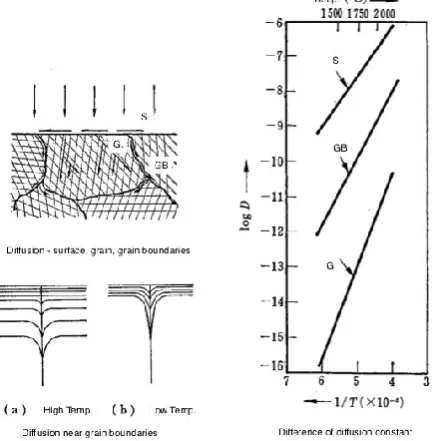
Let us change the viewpoint from nanometer scale to micrometer scale. Proton or hydrogen atoms diffuse in the bulk of metals. Figure 4 shows the state of diffusion of impurity atom. Three stage of diffusion process (G:grain, GB:grain boundaries, S:surface) is represented. Diffusion of impurity atom in a grain is slow, that at a grain boundary is faster and diffusion on the surface is very fast. The difference between the grain boundary diffusion and the grain diffusion is not so different at high temperature. This is a generally accepted opinion. It is important to point out that the diffusion of hydrogen is different from that of impurity metal or atom. For example diffusion of hydrogen in metal is the fastest of all the atomic diffusion in solids. Diffusion in grain boundaries and dislocations for large atom is easier with vacancy mechanism. On the contrary, the diffusion of hydrogen is slower owing to the trapping mechanism of hydrogen [9].
Fig. 4. State of diffusion of impurity atom [8].
Experimental results with electrons, positrons, muons and also protons will introduce new perspectives to leptons and hadrons.
2.3. Diffusion bonding with defect control
Joining dissimilar metals by HIP aims for few defects in the intermediate boundary region. Figure 5 shows the schematic diffusion bonding process. Five marked regions reveal the vacant space between two dissimilar metals. After the suitable time and pressure of HIP process, these vacant space shrink and vanish.
Fig. 5. Bonding interface tends to disappear over time. [9].
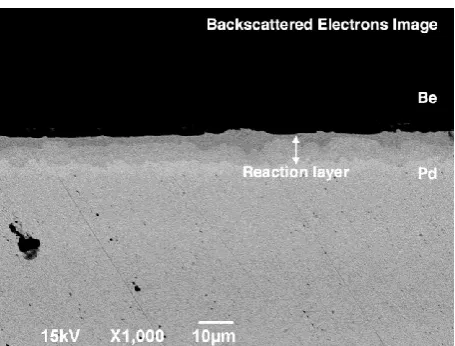
Joining dissimilar metals by HIP is possible by this process. Dissimilar metals can be joined together. But it does not mean the completion of the blistering tolerant neutron target. Again, let us change the viewpoint from micrometer scale to nanometer scale. Are there any other defects exist at the interface? After the HIP process, thin newly emerged layers were observed (Fig.6). We call them reaction layers. Testing and estimation for neutron target related materials were done to select the suitable combination of materials. Optical microscope, Scanning Electron Microscope, UT, Laser Flash Measurement, Tensile Stress Measurement and other experiments were performed [3]. Backscattered electron image of scanning microscope was shown (Fig.7). After these observations and measurements, combination of optimal three dissimilar metals (beryllium, palladium and copper) and parameters of the HIP process were fixed.
Fig. 7. Newly emerged reaction layer (Be/Pd interface).
Tantalum, niobium, and other candidate materials were also tested and observed. For those samples, the quality of the interfaces were inferior to palladium. There were voids, intermetallic compounds, precipitations.
2.4. Beam expansion optics
Beam expansion optics is composed of two quadrupole (QM) magnets and two octupole(OM) magnets (Fig.8). The area of the typical normal distribution beam upper stream is 200mm2. Owing to this optics, we can get 140 mm x 140mm square beam. The ratio of the beam intensity of expanded beam is 1/100 compared with that of normal distribution beam. 20kW beam power on the neutron target was established on Feb. 2019.
Fig. 8. Beam expansion optics.
Fig. 9. Calculated beam expansion optics.
Figure 9 shows the calculated beam profile on the neutron target. Actual profile was monitored by FLIR thermo camera and temperature measurement with thermo couples. Due to a lack of spatial resolutions for this method, it is difficult to compare with experimental results.
3 Performance and Conclusions
Recent performance of iBNCT is shown (Fig.10). Average beam power on the target is 21.7 kW.
Fig. 10. Operation parameter of iBNCT.
Integrated charge from ion source and on neutron target, average current and normalized neutron flux are presented (Fig.11). Recorded time started from Jan. 01, 2017 to April 2019. The integrated charge (Coulomb), the average current for Ion source and Be target (mA) and the normalized neutron flux (n/cm2/s/mA) are presented.
Fig. 11. Operation parameter of iBNCT.
Our three-tier beryllium neutron target has sustained integrated proton fluences on the order of 3000C during 2years and there is no degradation of the neutron flux or the neutron yield.
4 Summary
Three tier diffusion bonding HIP beryllium target, its performance and its basic strategy are presented. The target has sustained integrated proton fluences on the order of 3000C during 2years and there is no degradation of the neutron flux. The author wants to write down that palladium is selected for blistering tolerant materials, but it is not the only one candidate. Please refer Supplement. Surface potential, nano structure, electronic structure and relativistic effects from the reconstruction of inside wall of void surface might play an important role.
Acknowledgments The author wish to thank H. Kumada, F. Naito, M. Sato, T. Sugimura and other members of the Ibaraki iBNCT group. This work was supported by the JSPS Grant-in-Aid for Scientific Research (B) Grant Number 23340080 and Scientific Research (B) Grant Number 26293136.
References
1. S. Fukumoto, CYCLOTRON VERSUS
SYNCHROTRON FOR PROTON BEAM
THERAPY Proceedings of the 14th International Conference on Cyclotrons and their Applications, Cape Town, South Africa , pp.533-536 (1995) 2. T. Kurihara, H. Kobayashi, H. Matsumoto, M.
Yoshioka, J. Radioanal. Nucl. Chem. 305, 3 (2015) 3. H. Kumada, T. Kurihara, M. Yoshioka, H.
Kobayashi, H. Matsumoto, T. Sugano, H. Sakurai, T. Sakae, A. Matsumura, Appl. Radiat. Isot. 106, 78 (2015)
4. T. D. Marchall, D. L. Youchison, L. C. Cadwallader, Modeling the Nukiyama curve for water-cooled fusion divertor channels, Proceedings of the Fourteenth Tropical Meeting on the Technology of Fusion Energy. October 15-19, 2000. Park City, Utah, pp.849-855 (2001)
5. S. Nukiyama, Maximum and Minimum Values of Heat Transmitted from Metal to Boiling Water under Atomspheric Pressure, Journal of the Japanese Society of Mechanical Engineers, 37, 367 (1934) 6. S. Yu. Taskaev, Physics of Particles and Nuclei, 46,
956 (2015)
7. Y. Yuri, T. Ishizaka, T. Yuyama, I. Ishibori, S. Okumura, K. Yoshida,Nucl. Instr. and Meth. Phys. Res. Sect. A, 642, 10 (2011)
8. S. Kouda , Introduction to Metal Physics, CORONA PUBLISHING CO., LTD. TOKYO (1964)
9. T. Mutsschele, R. Kirchheim, Scripta Metall., 21, 135 (1987)
10. I. Kawakatsu, S. Kitayama, J. Japan Inst. Metals, 40, 96 (1976)