and multiplicative relations
?Ramiro Mart´ınez1 and Paz Morillo1
Universitat Polit`ecnica de Catalunya, Barcelona, Spain??
{ramiro.martinez,paz.morillo}@upc.edu
Abstract. We present efficient Zero-Knowledge Proofs of Knowledge (ZKPoK) for linear and multiplicative relations among secret messages hidden as Ring Learning With Errors (RLWE) samples. Messages are polynomials inZq[x]/hxn+ 1iand our proposed protocols for a ZKPoK are based on the celebrated paper by Stern on identification schemes us-ing codus-ing problems (Crypto’93). Our 5-move protocol achieves a sound-ness error slightly above 1/2 and perfect Zero-Knowledge.
As an application we present Zero-Knowledge Proofs of Knowledge of re-lations between committed messages. The resulting commitment scheme is perfectly binding with overwhelming probability over the choice of the public key, and computationally hiding under the RLWE assumption. Compared with previous Stern-based commitment scheme proofs we de-crease computational complexity, improve the size of the parameters and reduce the soundness error of each round.
Keywords: zero-knowledge proofs of knowledge·commitment scheme
·ring learning with errors
?The final authenticated version is available online at https://doi.org/10.1007/
978-3-030-35199-1_13.
1
Introduction
The goal of this paper is to present new and more efficient ways of proving lin-ear and multiplicative relations between elements hidden in lattice-based struc-tures, such as commitment schemes, without revealing any additional informa-tion about the elements themselves. These kind of proofs play an important role in many applications, from authentication protocols to electronic voting.
Lattice-based cryptography offers a high level of security. Its assumptions rely on the hardness of problems for which there is no known efficient quantum algorithm. This contrasts with classical factorization and discrete logarithm re-lated problems, as they are quantum efficiently solvable by Shor’s algorithm [20]. When long term privacy is concerned this is specially important, as public com-munications could be stored until quantum computers are available. To handle this issue, new protocols whose security is based on post-quantum safe assump-tions are required. Code-based and lattice-based cryptography are two families of primitives widely believed to be quantum-resistant, and extensively used in the literature.
In this article we propose improvements on a classical code-based protocol to use it in a lattice context based on the Ring Learning With Errors (RLWE) problem. Then we apply this construction to build exact proofs of knowledge of a valid opening for a commitment, and to prove that messages inside valid openings of different commitments satisfy linear or multiplicative relations.
1.1 Related work
In 1993 Stern proposed one of the first post-quantum protocols in his seminal paper on a new identification scheme based on coding theory [24]. His identifica-tion protocol was a Zero-Knowledge Proof of Knowledge (ZKPoK) of a soluidentifica-tion of an instance of the Syndrome Decoding problem (SD). The syndrome works as a public key and the user can authenticate himself interacting with a verifier and proving knowledge of a solution (a binary vector with small Hamming weight).
The original proposal by Stern was a 3-move protocol with a soundness error of 2/3, but he also presented alternative variants with 5-moves. One reduced the computational complexity and the other reduced the soundness error to almost 1/2. However, the size of the proof increased and it turned out to be less efficient for practical cases. Many variants and applications have been published since then, addressing this lack of efficiency and providing new features (different signature schemes, possibility of building secrets with integers moduleqinstead of only bits, applications to lattice-based cryptography, commitment schemes, . . . ). We describe some of them in the following paragraphs.
In 2007 the use of cyclic codes was proposed in [10], later implemented in [6]. It was adapted to lattices in [14] in 2008, preserving a binary secret. Efficiency was improved in 2010 reducing the soundness error in [9]. And many applications have used it [7,8,1,4,21].
Learning Parity with Noise (LPN) problem, proving knowledge of openings, linear and multiplicative relations between committed messages using 3-move and 2/3 soundness error Stern-based protocols. Then in 2013 Linget al.showed in [17] how the original Stern protocol could be run several times in parallel to prove that a solution has small infinity norm (and not only small Hamming weight). Xieet al.[26] adapt these techniques to the commitment construction of [12], to be able to prove linear and multiplicative relations between polynomials with coefficients in Zq. However the size of their proofs require an overhead
proportional to log2(q). All of them still have a soundness error of 2/3.
In 1997 V´eron published a dual version of Stern’s identification scheme [25], working with the generator matrix instead of the parity check matrix, and claimed that it was more efficient. We mention it as many subsequent papers were based on this approach. However its proof was flawed and his protocol did not achieve Zero-Knowledge, as two probability distributions for the output were uniformly random but not independent uniformly random as required, and leaked information about the secret, as was pointed out by Jain et al. in [12], who correctly used a generator matrix.
In this paper we specially benefit from the adaptation of Stern’s protocol to lattices from Ling et al. [17], the modification of Cayrel et al. [9] for reducing the soundness error increasing the number of rounds and the proposals of Jain et al.[12] and Xieet al.[26] for proving linear and multiplicative relations, that we further improve.
It is also important to mention the contributions of Benhamoudaet al. [3] and Baumet al.[2], who generalized the commitment idea of [26] without using Stern’s approach. They instead use Fiat-Shamir with aborts, a technique that requires relaxing the definition of commitment (so that the set of valid openings is larger than the set of openings generated by an honest prover, with more elements and less tighter bounds for the error terms) obtaining more efficient proofs with the cost of having stronger restrictions that require larger parameters. Therefore if the relaxed ZKPoK are used as a building block in a different protocol (for example for proving that an encryption public key is well formed), then the restrictions on the parameters imposed by the relaxation might have an impact on the efficiency of other parts of the protocol.
Exact Lattice-Based ZKPoK are therefore an active field of research, with very recent efficient constructions for some lattice statements including linear equations with short solutions and matrix-vector relations [27] by Yang et al., new techniques when a cyclotomic polynomial fully splits in linear factors [5] by Bootle et al. and new recent Stern-based contributions for proving integer relations [15] and matrix-vector relations [16] by Libertet al.
1.2 Our contribution
commited using a commitment scheme with Benhamoudaet al.notation, as it is the most natural adaptation of [12] to the RLWE setting, encoding an element as a lattice point and adding a perturbed random point from a different lattice. We get rid of the relaxations and limitations that were necessary in Ben-hamouda et al. commitment scheme without needing the quadratic logarithm of q overhead from Xie et al. For the linear relation case we apply standard improvements to the original Stern protocol, but adding some original modifi-cations to carefully reduce some constants in the communication cost. For the multiplicative relation we construct a new efficient proof. We achieve this by asking the verifier for two challenges in order to get soundness. Honest-Verifier Zero-Knowledge is obtained as we explicitly provide a perfect simulator for each protocol. Notice that simulations can skip the generation of never opened aux-iliary commitments, as they can just be computed as commitments to 0, indis-tinguishable from honestly computed commitments.
Many applications demand to evaluate arbitrary arithmetic circuits on secret elements. Fully Homomorphic Encryption could be a solution (which can be achieved with lattices by means of the Gentryet al.scheme [11]). An alternative is to apply our proofs for linear and multiplicative relations to prove knowledge of valid evaluations of the gates. The first lattice-based Attributed Based Signature scheme for unbounded circuits [13] uses this strategy with the ZKPoK from [26]. Directly replacing their construction with our proposal greatly improves the efficiency of the signature scheme.
Our proposal is a 5-move protocol with a soundness error slightly above 1/2. It allows us to prove exact knowledge of the secret inside a RLWE sample, that is, the secret is a polynomial with coefficients inZq. The proposed commitment
scheme is perfectly binding with overwhelming probability over the choice of the public key and computationally hiding under the RLWE assumption, widely believe to be post-quantum.
The organization of this paper is as follows. We explain the notation and the basic primitives that we are going to use in Section 2. We present the commit-ment in Section 3, along with a proof of knowledge of a valid opening in 3.1. We then give proofs of a linear relation and a multiplicative relation in Sections 3.2, 3.3, respectively. We finally end with some conclusions in Section 4.
2
Preliminaries
2.1 Notation
Column vectors are denoted asa and row vectors asaT. We denote by 1
n the
vector of dimension n with all its coordinates equal to 1. Matrices are repre-sented as M. Let q be prime, given a vector v ∈ Zn
q we define the infinity
norm askvk∞= max1≤i≤n|vi| wherevi are the coordinates of vectorv taking
−q
2
, . . . ,0, . . . ,q
2
Whenais sampled uniformly at random from setAwe writea←−$ A,a←−$ D whenais sampled according to a probability distributionDanda←− A$ whena is the output of a probabilistic algorithmA.
PPT denotes the class of Probabilistic Polynomial-Time algorithms. A functionf isnegligible if|f(n)| ∈ O(n−c), ∀c∈
Z+. A functionf isoverwhelming if|f(n)−1| ∈ O(n−c), ∀c∈
Z+.
When an honest prover should send an elementawe denote byeathe element actually disclosed by the (possibly malicious) prover and we callbato the element alleged to play the same role in the simulated conversation.
2.2 Zero-Knowledge Proofs
The goal of this paper is to prove the truthness of an statement without revealing anything else besides what can be efficiently deduced from the fact that the statement is indeed true. To do so we use Public Coin Honest-Verifier Zero-Knowledge Proofs of Zero-Knowledge. LetR ⊂ {0,1}∗× {0,1}∗ be a binary relation
with one restriction. If (x, w) ∈ R satisfies the relation then the size |w| is at mostp(|x|) for some fixed polynomialp.
Definition 1 (Zero-Knowledge Proofs of Knowledge).
A(2n+1)-move Public Coin Honest-Verifier Zero-Knowledge Proof of Knowl-edge is a protocol between a prover P and a verifierV in which, given an x,P
tries to convinceV that he knows a witnesswsuch that (x, w)∈ R. We use the following notation ZKP
w(x, w)∈ R
.
P andV engage in an interaction whereP consecutively sends a messageai
answered by V with a random challenge bi for i from 1 to n. Finally P gives
a final answer z and V accepts or rejects the proof checking the conversation (x,{ai}i,{bi}i, z). And has the following properties:
– Completeness: if an honest prover P knows a valid witness w such that (x, w)∈ Rand follows the protocol, then an honest verifierV always accepts the conversation.
– k-Special Soundness: fromk accepted conversations
x,{ai,j}i,{bi,j}i,
z kj=1, and{bi,j}i 6={bi,j0}
i forj6=j
0, it is possible to efficiently extract a
witnesswsuch that (x, w)∈ R.
– Honest-Verifier Zero-Knowledge: there exists a polynomial-time simu-lator that takes as inputxand random{bi}iand outputs an accepted
conver-sation(x,{ai}i,{bi}i, z)with the same probability distribution as
conversa-tions between honestP andV.
This is a variant of standardΣ-protocols, as it is also pointed out by of Jain et al.[12] and Xie et al.[26].
it is only possible to extract a valid witness from answers to all possible chal-lenges (three in his particular protocol), then the prover could cheat with all but one (and therefore the protocol has 2/3 soundness error). Soundness is achieved repeating the protocol as many times as required until the cheating probability is negligible. In our case, increasing the number of challenges, we prove how to obtain a valid witness from valid answers to approximately one half of the possi-ble challenges, reducing the soundness error and therefore reducing the number of repetitions required.
2.3 Ring Learning With Errors
Considering a ringR=Z[x]/hf(x)iandRq=R/qR, principal idealsha(x)i ⊆
Rq can be identified with lattices generated by structured matricesAthat only
depend on polynomialsa(x) andf(x), called ideal lattices [19].
The ideal latticeL(a) generated by a vector of polynomials a∈Rk q is then
L(a) = {ar|r ∈Rq}. We choose f(x) to be xn+ 1, with n a power of 2, and
thenRq=Zq[x]/hxn+ 1i, as it gives nice security reductions.
Definition 2 (Ring Learning With Errors (RLWEn,q,χ)).Letχbe a
distri-bution over R (tipically a Gaussian distribution). The decisional ring learning with errors assumption states that {(ai, ai·s+ei)} is indistinguishable from
{(ai, ui)} for any polynomial number of samples where ai
$
←− Rq, ei
$
←− χ, ui
$
←−Rq ands∈Rq is secret.
The search RLWE assumption states that no PPT adversary can recover s from a polynomial number of samples with a non-negligible probability.
Hardness of RLWE. If parameters are chosen properly the RLWE problem
becomes as hard as well known hard ideal lattice problems such as the ideal Shortest Vector Problem (SVP) [18]. With a discrete Gaussian error distribution χ where its standard deviation σ≥ω(√logn), and for any ring, there exists a quantum reduction from theγ(n)-SVP problem to the RLWE problem to within an approximation factorγ(n) =O(√n·q/σ). Additionaly, RLWE becomes no easier to solve even if the secret sis chosen from the error distribution, rather than uniformly [18].
2.4 Stern Identification Scheme
The original Zero-Knowledge interactive identification scheme by Stern allows a prover to convince a verifier that given a parity check matrix H ∈ Fn2×m and a syndrome y∈Fn2 he knows a binary vector e∈Fm2 of small fixed Hamming weightkekH=wsuch that it has this syndromey=He.
The original Stern protocol [24] hidese with a masking vector x←−$ Fm
2, a masking syndrome y0 ∈ Fn
2 (an honest prover will compute y0 = Hx) and a permutationπ←−$ Sm. Notice thatx+ereveals no information aboute, while
(a) the syndrome ofxisy0
(b) the syndrome ofx+eisy0+y (c) the Hamming weight ofπ(e) isw
All the properties combined imply that there is an e with Hamming weight w and syndromey.
Many of the subsequent variants turn this scheme into a lattice-based setting by just using a matrix A∈Znq×m and a secrete∈Zmq with m/2 entries equal
to 0 andm/2 entries equal to 1, obtaining a special instance of the ISIS problem Ae=y.
Ling et al. [17] propose to use a bounded infinity norm secret. In order to prove this restriction on the norm they show that the secret element has a fixed length binary decomposition. To hide the binary decomposition they extend it so that it has the same number of −1, 0 and 1. Then running the protocol in parallel for each of the vectors of the decomposition allows to prove knowledge of a solution of a general instance of the Inhomogeneous Short Integer Solution (ISIS) problem. We have to adapt their setting to the dual version and prove knowledge of a solution of a RLWE problem.
In order to prove that something has small norm we prove that it can be written with a constant number of bits. An ad-hoc basis could be used, but we prefer to keep notation simple and decompose the elements in binary assuming that the bound is a power of two.
The paper of Cayrelet al.[9] combines the secret and the masking element with a random challenge α ∈Zq to obtain (π(x+αe)), reducing the
commu-nication cost and the soundness error. We extend their approach with more challenges so that we can prove knowledge of linear and multiplicative relations.
3
Commitment scheme
Now we define a lattice-based commitment scheme, for this we can encode a message m ∈ Rq as the coordinates of a point in an ideal lattice defined by
a ∈ Rkq. To hide this lattice point am we add a RLWE sample from another
latticebr+e, whereb∈Rkq defines this other lattice, the randomness r←−$ Rq
is chosen uniformly at random and the error terme ←−$ χnk is chosen from the appropriate bounded discrete Gaussian distribution.
This structure am+br+e is used by Benhamouda et al. in [3], and it is very similar to the one proposed by Xieet al. in [26]. As we use their structure we can use some of the parameters proposed by Benhamouda et al.
The degree of the polynomial n = 2κ is a power of two, usually κ = 9 or
κ= 10.γis an integer parameter controlling the size of the modulusq, a prime number such thatq≡3 mod 8 andq≥nγ. Integerkwould be the multiplicative
overhead (the length ofaas a vector of polynomials). Finally as in their case our errors obtained from χwill have a standard deviation σ∈ O(n3/4) and will be bounded byn= 2κ. We will restrict our coefficients to [−2κ, . . . ,2κ) but abuse
While the commitment algorithmComwe present in this paper is the same as the one that was presented in [3] our proofs of openings and relations do not require any relaxation (in our case the set of valid openings is exactly the set of openings obtained following the commitment algorithm). Therefore our proposal is different as a commitment scheme, our verification algorithm Ver is simpler and our parameter conditions required to prove security are less strict.
Proposition 1. If n≥256,γ≥3 andk≥ 82γγ+4−5 then the following is a secure commitment scheme under the assumption that RLWE is hard.
– Gen: the generator algorithm takes a security parameter 1λ and outputs a
public key pk = (a,b) ∈ (Rkq)
2
, where Rq = Zq[x]/hxn+ 1i and k are
defined so that the difficulty of solving the RLWE problem is related to 1λ.
In particular the size ofnis also related to 1λ.
(a,b)←−$ Gen 1λ
– Com: the commitment algorithm takes as input a message m ∈ Rq and a
public key pk = (a,b) and produces a commitment c = am+br+e and an openingd= (m, r,e), where r←−$ Rq and e
$
←−χnk conditioned to have infinity norm smaller thann= 2κ.
(c=am+br+e, d= (m, r,e))←−$ Com(m;pk= (a,b))
– Ver: the verification algorithm takes as input a commitment c, a message m, an openingd= (m, r,e)and a public key pk = (a,b)and accepts, 1, if (c=am+br+e)∧(kek∞<2κ), or rejects, 0, otherwise.
Ver:{(c, m, d;pk)} → {0,1}
It satisfies the properties of a secure commitment scheme:
– Correctness: if the commitment has been built correctly and the valid mes-sage and opening are published the verifier algorithm always accepts:
pk←−$ Gen 1λ,(c, d)←−$ Com(m;pk) =⇒ 1←Ver(c, m, d;pk).
– Perfectly Binding: a commitment can only be opened to one message:
1←Ver(c, m, d;pk)∧1←Ver(c, m0, d0;pk) =⇒ m=m0.
– Computationally Hiding: a well constructed commitmentcdoes not leak any relevant information about the message m. For any PPT adversary (A1,A2):
Pr
"
b=b0
pk←−$ Gen(1λ), (m
0, m1, aux) $ ←− A1(pk)
b←− {$ 0,1}, (c, d)←−$ Com(mb;pk), b0←− A$ 2(c, aux) #
−1
2
∈negl(λ).
3.1 Knowledge of a Valid Opening
We first propose an Interactive Honest-Verifier Zero-Knowledge Proof of Knowl-edge of a valid opening for the commitment presented before. The difficult part is to prove that the error term is small enough, for which we adapt Stern-based protocols to this particular RLWE based commitment. While SD problem and ISIS problem are very similar, in order to prove that the commitment has been constructed with a RLWE sample we need several auxiliary elements. What we obtain is a 5-move protocol with a soundness error of q2+1q , really close to 1/2 as qis usually a very large prime.
Let a = (a1, . . . , ak),b = (b1, . . . , bk)∈ Rkq, a message m ∈ Rq, a random
element r in Rq and e ∈ Rkq a vector of polynomials with their coefficients
sampled from a discrete Gaussian distribution conditioned to have norm smaller thann= 2κ. We want to prove knowledge of a valid opening for the commitment c=am+br+e.
We identify a polynomialuwith a vectoru that has as elements the coeffi-cients of the polynomial. For convenience we also identify a vector of polynomials with the concatenation of its associated vectors.
ϕ:Znq −→Rq
u= (u0, u1, . . . , un−1)7−→u=u0+u1x+· · ·+un−1xn
−1
φ:Znkq −→R k q
u= (u0, . . . , unk−1)7−→u= (ϕ(u0, . . . , un−1), . . . , ϕ(un(k−1), . . . , unk−1)) Lets consider the vector ¯e =φ−1(e) + 2κ1
nk and its binary decomposition
¯ e =Pκ
j=02
j¯e
j, ¯ej ∈ {0,1}nk (notice that ¯e has only positive representatives
because we have added 2κ1
nk). From now on indexjwill always belong to [0, . . . ,
κ]. Choose extensions e0j = (¯ej||e00j)∈ Bnk, where Bnk ⊂ {0,1}2nk are vectors
with the same number of 0 and 1’s. The extended error term is e0 =P
j2je0j.
LetI0 be annk-identity matrix attached tonk columns of 0’s. Then we have:c=am+br+φ((I0P
j2 je0
j)−2κ1nk).
With this notation we can define an interactive protocol to prove knowledge of a valid opening for commitment c. This extension is an adaptation of the idea from Ling et al. in [17] to the dual ring setting (we also shift the error to only have 0’s and 1’s, while their protocol also included −1’s, this way we only have a factor two overhead instead of a factor three). Notice that each error decomposition element in Bnk with the same number of 0 and 1’s can be
completely randomized with a permutation, as it was done in the original Stern protocol with fixed Hamming weight vectors.
The complex structure of the commitment scheme requires more subtle de-tails than the original Stern proposal, but the underlying intuition is the same. We want to prove knowledge of some elementsm, r,e, of some masking elements µ, ρ,f and a of vector of polynomialsysuch that:
(a) πj(e0j)∈ Bnk (b) y=aµ+bρ+f
(c) y+c=a(µ+m) +b(ρ+r) + (f+e), wheree=φ(I0P
j2 j
e0j−2 κ1
All three properties imply knowledge of a valid opening for the commitment. In order to improve efficiency we can add one more round where we ask the verifier for an elementα∈Zq and then prove only these two properties:
(a) πj(e0j)∈ Bnk
(b’) y+αc=a(µ+αm) +b(ρ+αr) + (f+αe), wheree=φ(I0P
j2 j
e0j−2κ1nk)
Since the relevant elements were commited in the first round (using an auxil-iary commitment scheme) beforeαwas chosen we can ensure with high probabil-ity that property (b’) implies both properties (b) and (c). This is an adaptation of the idea used in [9] and allows us to reduce the soundness error to almost 1/2. With this intuition in mind we can provide our protocol (1) for proving knowledge of valid openings. Let (aCom,aVer) denote an auxiliary commitment scheme that can be instantiated using our construction or a different one.
The proverP choosesκ+ 1 permutationsπ0, . . . , πκ
$
←−S2nk,κ+ 1 random
vectorsf0, . . . ,fκ
$
←−Z2nk
q and 2 random polynomials µ, ρ
$
←−Rq.
Then computes the following commitments:
c1=aCom{πj}j,aµ+bρ+φ(I0Pj2 jf
j)
c2=aCom
{πj(fj)}j,{πj(e0j)}j
The prover sends these commitments to the verifier. The verifier V chooses an integer α∈Zq and sends it to the prover. Then the prover computes:
gj =πj(fj+αe0j)
The prover sends {gj}j to the verifier. The verifier V chooses a bit b
$
←− {0,1}
and sends it to the prover. Caseb= 0.
–P reveals {eπj =πj}j,ye =aµ+bρ+φ(I0Pj2jfj),se=ρ+αr and an
opening of commitmentc1 to ({πej}j,ey).
–V checks c1.
He also checks thatey+α(c+φ(2κ1nk))−bes−φ(I0Pj2 j
e
πj−1(gj))∈ L(a)
and writes it asaet.
Caseb= 1.
–Preveals{ee0j =πj(e0j)}jand openings of commitmentsc2to ({gj−αee0j}j,
{ee0j}j).
–V checks c2 and that eachee0j belongs toBnk.
ZKP "
m,r,e
c=am+br+e
kek∞<2κ #
P((a,b),c;m,r,e) V((a,b),c))
π0,...,πκ←−S$ 2nk
f0,...,fκ
$
←−Z2qnk
µ,ρ←−$Rq
(c1,d1)=aCom
{πj}j,aµ+bρ+φ(I0Pj2 jf
j)
(c2,d2)=aCom
{πj(fj)}j,{πj(e0j)}j
c1,c2
−−−−−−−−−−−−−→
α←−$Zq
α
←−−−−−−−−−−−−−
gj=πj(fj+αe0j)
{gj}j −−−−−−−−−−−−−→
b←−{$ 0,1}
b
←−−−−−−−−−−−−−
ifb=0 e
πj=πj
e
y=aµ+bρ+φ(I0P
j2 jf
j)
e
s=ρ+αr
e
d=d1
ans=({eπj}j,ey,es,de) ifb=1
ee 0
j=πj(e0j)
e
d=d2
ans=({ee 0
j}j,de)
ans
−−−−−−−−−−−−−→
ifb=0 1←−?aVerc1,({eπj}j,ey),de
e
y+α(c+φ(2κ1nk))−bes−φ(I 0P
j2 j
e
π−j1(gj))
?
∈L(a)
ifb=1 1←−?aVerc2,({gj−αee
0
j}j,{ee 0
j}j),de
e e0j∈Bnk?
Completeness: If P knows a valid witness and both the prover and the
ver-ifier correctly follow the protocol then the verver-ifier always accepts at the end, immediate as all relations hold by construction.
Soundness: If a (possibly malicious) prover Pe is able to provide accepted
answers to δ rounds of interaction with an honest verifier V with probability (q+ 1/2q)δ+, wereis non-negligible, then he is able to efficiently extract a wit-ness with probability 2(/3)3. Details on how to find valid answers to the required number of different challenges are skipped here and explained in appendix B.
property ofc1, c2 ensures that openings toeπj,eyandee 0
j are fixed.
aet=ey+α(c+φ(2κ1nk))−bes−φ(I0P
j2 j
e
π−1
j (gj))
aet0=ey+α
0
(c+φ(2κ1nk))−bes
0
−φ(I0P
j2 j
e
π−j1(g
0
j)) ∆αc=a(et−et
0
) +b(es−es
0
) +φ(I0P
j2 j
e
πj−1(gj−g0j)−∆α2κ1nk)
c=a(∆−α1(et−et
0
)) +b(∆−α1(es−es
0
)) +φ(I0P
j2 j
e
πj−1(∆−1
α (gj−g0j))−2κ1nk)
gj−αee
0
j=g
0
j−α
0
e e0j
e e0j=∆
−1
α (gj−g0j)
c=a(∆−α1(et−et
0
)) +b(∆−α1(es−es
0
)) +φ(I0P
j2 j
e
π−1
j (ee
0
j)−2κ1nk)
As these elements come from accepted answers we know that ee0j ∈ Bnk ⊂
{0,1}2nk and therefore φ(I0P
j2 j
e
π−j1(ee0j)−2κ1
nk) has norm smaller than 2κ.
Then (∆−α1(et−et0), ∆−
1
α (es−es
0), φ(I0P
j2 j
e
πj−1(ee0j)−2κ1nk)) is a valid opening. Zero-Knowledge:
Caseb= 0
b
t,sb←−$ Rq, bgj←−$ Z2qnk, πjb $ ←−S2nk c1=aCom({bπj}j,abt+bbs
+φ(I0X
j
2jbπ−j1(gbj))−α(c+φ(2 κ1
nk)))
P reveals{gbj}j,{eπj =πbj}j,
e
y=abt+bbs+φ(I 0P
j2 j
b
πj−1(bgj))−αc,
e
s = bs. Indistinguishable from a real conversation with the same πj = πbj
and where µ = bt−αm, ρ = bs−αr
andfj =bπ −1
j (gbj)−αe 0
j.
gj=πj(fj+αe0j) =πj(πbj−1(bgj)) +πj(αe
0
j−αe
0
j) =bgj
aµ+bρ+φ(I0P
j2 j
fj) = =a(bt−αm) +b(bs−αr)
+φ(I0P
j2 j
(bπ
−1
j (bgj)−αe
0
j)) =abt+bbs+φ(I
0P
j2 j
b
π−j1(gbj))
−α(am+br+φ(I0P
j2 je0
j)) =abt+bbs+φ(I0P
j2 j
b
π−j1(gbj))
−α(c+φ(2κ1nk))
Caseb= 1
b e0j
$
←− Bnk, fbj $
←−Z2qnk, bπj $ ←−S2nk c2=aCom({bπj(fbj)}j,{
b
πj(be
0
j)}j)
b
gj=bπj(fbj+α b e0j)
Preveals{bgj}j,{ee 0
j =πbj(be 0
j)}j.
Equiv-alent to an honest conversation were πj is such that πj(e0j) = πbj(be
0
j) and
fj =π−j1(πbj(fbj)).
gj=πj(fj+αe0j)
=πj(πj−1(bπj(fbj))) +αbπj(be
0
j) =bπj(fbj+α
b e0j) =bgj
3.2 Linear relation
The analyzed commitment scheme is not homomorphic, since the sum of two commitments may not be a commitment to the sum as the errors may grow. However it is possible to prove knowledge of openings to different commitments proving that the committed messages satisfy a given linear relation. As in the proof for the opening we have a,b∈Rk
q, messages m1, m2, m3 ∈Rq such that
m3 = λ1m1+λ2m2 with λ1, λ2 ∈ Rq, random elements r1, r2, r3 in Rq and
e1,e2,e3 ∈ Rkq vectors of polynomials with their coefficients sampled from a
discrete Gaussian distribution conditioned to have norm smaller than n= 2κ.
We want to prove knowledge of valid openings for the commitmentsci=ami+
bri+ei satisfying the relation. From now on indexiwill belong to{1,2,3}.
Consider the extended error decomposition termse0ij ∈ Bnk so that:
ci=ami+bri+φ(I0
X
j
2je0ij−2κ1nk).
With this notation we can define the interactive protocol (2) to prove knowl-edge of valid openings for commitmentsci holding the required relation.
This can be done analogously as the previous case, reproducing protocol (1) three times in parallel imposing that the message masking elements hold the same linear relation.µ3 is computed asµ3=λ1µ1+λ2µ2and in caseb= 0 the verifier needs to check whetheret3=λ1te1+λ2et2.
ZKP
mi, ri,ei
ci=ami+bri+ei
keik∞<2κ, m3=λ1m1+λ2m2
.
Completeness: The relationbt3=λ1bt1+λ2bt2 is satisfied asbti=µi+αmi,mi
hold the relation andµ3 is computed such that it holds the relation too.
Soundness: If a (possibly malicious) prover Pe is able to provide accepted
answers to δ rounds of interaction with an honest verifier V with probability (q+ 1/2q)δ +, were is non-negligible, then he is able to efficiently extract a witness. The same argument for the knowledge of a valid opening applies here and provides us with three valid openings
{(∆−1
α (eti−et0i), ∆−α1(esi−se 0
i), φ(I0
P
j2 j
e
π−ij1(ee0ij)−2κ1 nk))}i.
We know that et3 =λ1et1+λ2et2 and the same applies toet03 =λ1et01+λ2et02. Therefore we have that the required linear relation holds:
∆−1
α (et3−et03) =λ1∆−α1(et1−et01) +λ2∆−α1(et2−et02).
Zero-Knowledge: The same simulator for protocol 1 works repeated 3 times,
with the only exception that in caseb= 0 we randomly choosebt1,bt2
$
←−Rq but
b
3.3 Multiplicative relation
In this subsection we present the main contribution of this paper, an efficient proof of knowledge of a multiplicative relation. That is, indexibelongs again to
{1,2,3} and we haveci=ami+bri+ei three valid commitments wherem3= m1·m2. We want to prove knowledge of valid openings for the commitmentsci
satisfying this relation.
If we mask the messages (m1+µ1) and (m2+µ2) with randomµ1, µ2 $
←−Rq,
as we did before, and then multiply them, some crossed terms appear: (m1+ µ1)(m2+µ2) =m3+ (m1µ2+m2µ1) +µ1µ2. Following the notation from [3] we define m+=m1µ2+m2µ1 andm× =µ1µ2. If we want to getm3 =m1m2 we need to prove a similar equality involving two challenges α, β ←−$ Zq chosen by
the verifier. In [3] they use a challenge to prove the relation, while [9] introduces the challenge to reduce the soundness error of each round as we did in section 3.1. The particular requirements of our proofs, where we try to achieve both goals at the same time, imply that we need a much more involved analysis in order to prove the soundness of this strategy. This efficient interactive protocol to prove knowledge of a valid opening for commitments ci holding the required
relation is the main contribution of this paper.
The proverPchooses 3(κ+1) permutationsπi0, . . . , πiκ
$
←−S2nk, 3(κ+1)
ran-dom vectorsfi0, . . . ,fiκ
$
←−Z2qnkand 6 random polynomialsµ1, µ2, µ3, ρ1, ρ2, ρ3
$
←−
Rq.P computesm×=µ1µ2 andm+=µ1m2+µ2m1. Then he chooses 2
addi-tional random polynomialsµ×, µ+ $
←−Rq.
Then computes the following commitments:
c1=aCom{πij}i,j,{aµi+bρi+φ(I0Pj2jfij}i)
c2=aComµ3, µ×, µ+
c3=aCom{πij(fij)}i,j,{πij(e0ij)}i,j
c4=aComµ×+m×, µ++m+
The prover sends these commitments to the verifier. The verifier V chooses a pair of integers (α, β)←−$ Z2
q and sends it to the prover.
Lets define the following auxiliary constants to simplify notation:
δi=
(
α, fori∈ {1,2}
β, fori∈ {3}
NowP computes the following elements and sends them toV:
gij =πij(fij+δie0ij)
c5=aCom
(βµ×) +α(βµ+) +α2(µ3)
The prover sends {gij}i,j and c5 to the verifier. The verifier V chooses a bit b←− {$ 0,1} and sends it to the prover.
Caseb= 0.
–P reveals{eπij =πij}i,j,{eyi =aµi+bρi+φ(I0Pj2 jf
ij)}i,et× =µ×+
m×, et+ = µ++m+, {esi = ρi+δiri}i. The prover could also compute e
ti =µi+δimi, but does not send them as the verifier can compute them
as the coordinates ofeyi+δi(ci+φ(2κ1nk))−besi−φ(I 0P
j2 j
e
π−ij1(gij))∈
L(a). Then he sends openings of commitmentsc1 to ({eπij}i,j,{eyi}i), c4
to (et×,et+) andc5 toβet×+αβet++α2et3−βet1et2.
–V checks thatyei+δi(ci+φ(2κ1nk))−besi−φ(I0Pj2jπeij−1(gij))∈ L(a)
and writes them asaeti. ThenV checksc1, c4 andc5.
Caseb= 1.
–P reveals {ee0ij =πij(e0ij)}i,j,µe3 =µ3,µe× =µ×,µe+ =µ+ and openings
of commitmentsc2to (µ3,e µe×,µ+),e c3to ({gij−δiee 0
ij}i,j,{ee0ij}i,j) andc5
to (βµe×) +α(βµ+) +e α
2(
e
µ3).
–V checks c2,c3,c5and that eachee0ij belongs toBnk.
The multiplicative relation protocol (3) can also be seen as parallel executions of protocol (1), this time taking into account the crossed terms.
Completeness: We should check the alternative openings of commitmentc5.
βet×+αβet++α2et3−βet1et2=
=β(µ×+m×) +αβ(µ++m+) +α2(µ3+βm3)−β(µ1+αm1)(µ2+αm2)
=β(µ×+m×−µ1µ2) +αβ(µ++m+−µ1m2−µ2m1) +α2(µ3+β(m3−m1m2))
= (βµ×) +α(βµ+) +α2(µ3)
Soundness: If a (possibly malicious) prover Pe is able to provide accepted
answers to δ rounds of interaction with an honest verifier V with probability (q2+ 3q−2)/(2q2)δ
+, wereis non-negligible, then he is able to efficiently extract a witness. Ifq is such that log(q2/(q2+ 3q−2))≥ −1/9 (which is true ifq≥37) we should be able to find more thanq2+ 3q−2 accepted answers (by an argument analogous to that of appendix B).
Then the pigeonhole principle ensures that we can find six pairs (α(1), β(1)), (α(2), β(2)),(α(3), β(3)),(α(4), β(4)),(α(5), β(5)),(α(6), β(6)), with allα(l)different forl∈ {1,2,3}, allα(l)different forl∈ {4,5,6}andβ(1) =β(2)=β(3)6=β(4)= β(5) =β(6) that induce accepted answers for bothb= 0 andb= 1.
Assume there only exist oneβ for which there exists at least 3 differentα(i) with accepted answers forb= 0 andb= 1. This particularβ belongs to at most 2qanswers, 2 for each possible α. All other β0 contribute each of them with at
ZKP
mi,ri,ei
ci=ami+bri+ei
keik∞<2
κ, m3=λ1m1+λ2m2
(2)
P((a,b),ci;mi,ri,ei) V((a,b),ci))
πi0,...,πiκ
$
←−S2nk
fi0,...,fiκ
$
←−Z2qnk
µ1,µ2,ρ1,ρ2,ρ3←−$Rq
µ3=λ1µ1+λ2µ2 (c1,d1)=aCom
{πij}i,j,{aµi+bρi+φ(I0Pj2 jf
ij)}i
(c2,d2)=aCom
{πij(fij)}i,j,{πij(e0ij)}i,j
c1,c2
−−−−−−−−−−−−−→
α←−$Zq
α
←−−−−−−−−−−−−−
gij=πij(fij+αe0ij)
{gij}i,j −−−−−−−−−−−−−→
b←−{$ 0,1}
b
←−−−−−−−−−−−−−
ifb=0 e
πij=πij
e
yi=aµi+bρi+φ(I0Pj2 jf
ij)
e
si=ρi+αri
e
d=d1
ans=({eπij}i,j,{eyi}i,{esi}i,de) ifb=1
e e0
ij=πij(e0ij)
e
d=d2
ans=({ee 0
ij}i,j,de)
ans
−−−−−−−−−−−−−→
ifb=0 1←−?aVerc1,({eπij}i,j,{eyi}i),de
e
yi+α(ci+φ(2κ1nk))−besi−φ(I 0P
j2 j
e
π−ij1(gij))
?
∈L(a) e
t3 ?
=λ1et1+λ2et2
ifb=1 1←−?aVerc2,({gij−αee
0
ij}i,j,{ee 0
ij}i,j),de ee 0 ij ? ∈Bnk ZKP "
mi,ri,ei
ci=ami+bri+ei
keik∞<2
κ
,m3=m1m2 #
(3)
P((a,b),ci;mi,ri,ei) V((a,b),ci)
πi0,...,πiκ←−S$ 2nk
fi0,...,fiκ
$
←−Z2qnk
µi,µ×,µ+,ρi
$
←−Rq
m×=µ1µ2, m+=µ1m2+µ2m1
(c1,d1)=aCom{πij}i,j,{aµi+bρi+φ(I0Pj2 jf
ij)}i
(c2,d2)=aComµ3,µ×,µ+
(c3,d3)=aCom{πij(fij)}i,j,{πij(e0ij)}i,j
(c4,d4)=aComµ×+m×,µ++m+
c1,c2,c3,c4
−−−−−−−−−−−−−→
α,β←−$Zq
α,β
←−−−−−−−−−−−−−
δ1=α, δ2=α, δ3=β gij=πij(fij+δie0ij)
(c5,d5)=aCom(βµ×)+α(βµ+)+α2(µ3)
{gij}i,j,c5
−−−−−−−−−−−−−→
b←$−{0,1}
b
←−−−−−−−−−−−−−
ifb=0 e
πij=πij
e
yi=aµi+bρi+φ(I0Pj2 jf
ij)
et×=µ×+m×, et+=µ++m+, esi=ρi+δiri e
d1=d1, de4=d4, de5=d5
ans=({eπij}i,j,{yei}i,et×,te+,{esi}i,de1,de4,de5) ifb=1
e
e0ij=πij(e0ij)
e
µ3=µ3, µe×=µ×, µe+=µ+ e
d2=d2, de3=d3, de5=d5
ans=({ee 0
ij}i,j,eµ3,eµ×,µe+,de2,de3,de5)
ans
−−−−−−−−−−−−−→
ifb=0 1←−?aVer c1,({πeij}i,j,{eyi}i),de1 1←−?aVer c4,(te×,et+),de4
1←−?aVer c5,βet×+αβet++α2et3−βet1et2,de5
e
yi+δi(ci+φ(2κ1nk))−besi−φ(I 0P
j2 j
e
π−ij1(gij))
?
∈L(a) ifb=1 1←−?aVer c2,(eµ3,µe×,µe+),de2
1←−?aVerc3,({gij−αee 0
ij}i,j,{ee 0
ij}i,j),de3 1←−?aVer c5,(βµe×)+α(βeµ+)+α
2( e
µ3),de5
e e0ij∈Bnk?
The binding property of all commitments ensures that openings to the same elements are equal. Therefore we have fixedeπij,eyi,µe3,µe×,µe+,ee
0
ij,et× andet+. For each pair (α(l), β(l)) we haveg(l)
We know thatyei+δi(l)(ci+φ(2κ1nk))−bise
(l)
i −φ(I0
P
j2 j
e
π−ij1(g(ijl)))∈ L(a) and call et
(l)
i to its coordinates. Let l and l0 in {1,2,3,4,5,6} such that ∆δi =
δ(il)−δ(l 0)
i 6= 0. Then we will be able to compute valid openings ofci:
aet(il)=eyi+δ
(l)
i (ci+φ(2 κ1
nk))−bes(il)−φ(I0P
j2 j
e
πij−1(g(ijl)))
aet(il0)=eyi+δi(l0)(ci+φ(2κ1nk))−bse (l0)
i −φ(I
0P
j2 j
e
π−1
ij (g
(l0)
ij )) ∆δici=a(et
(l)
i −et (l0)
i ) +b(se (l)
i −es (l0)
i ) +φ(I
0P
j2 j
e
πij−1(g(ijl)−gij(l0))−∆δi2κ1nk)
ci=a(∆
−1
δi (et
(l)
i −et (l0)
i )) +b(∆
−1
δi (se (l)
i −es (l0)
i )) +φ(I
0P
j2 j
e
πij−1(∆−δ1 i(g
(l)
ij −g
(l0)
ij ))−2 κ1nk)
g(ijl)−δi(l)ee
0
ij=g
(l0)
ij −δ
(l0)
i ee
0
ij
e e0ij=∆
−1
δi (g
(l)
ij −g
(l0)
ij )
ci=a(∆
−1
δi (et
(l)
i −et (l0)
i )) +b(∆
−1
δi (se (l)
i −es (l0)
i )) +φ(I
0P
j2 j
e
πij−1(ee0ij)−2κ1nk)
As these elements come from accepted answers we know that ee0ij ∈ Bnk ⊂
{0,1}2nkand therefore φ(I0P
j2 j
e
π−ij1(ee0ij)−2κ1
nk) has norm smaller than 2κ.
This implies that (∆−δ1
i (et
(l)
i −et
(l0)
i ), ∆
−1
δi (es
(l)
i −es
(l0)
i ), φ(I0
P
j2 j
e
πij−1(ee0ij)−2κ1nk))
are valid openings.
We know that these openings do not depend on (l) and (l0), as the
commit-ment scheme is binding. Therefore we can call them (mi=∆−δi1(et
(l)
i −et
(l0)
i ),rei=
∆−δ1
i (se
(l)
i −se
(l0)
i ),eei = φ(I 0P
j2 j
e
πij−1(ee0ij)−2κ1
nk)). It only remains to prove
that m3=m1m2.
We can defineµ(il)=et
(l)
i −δ
(l)
i mi andρe
(l)
i =es
(l)
i −δ
(l)
i rei.
Claim. This newly defined elements do not depend on l and we can omit the superindex (l) as µi=µ(il)=µi(l0)andρei=ρe
(l)
i =eρ
(l0)
i for any pairl andl
0.
Proof. Assume that we havel andl0 such thatµ(il)6=µi(l0) orρe(il)=6 ρe(il0). We could rewrite the expression ofaet
(l)
i in terms of this new variables.
aet(il)=yei+δ
(l)
i (ci+φ(2κ1nk))−bes (l)
i −φ(I
0P
j2 j
e
π−ij1(g
(l)
ij))
a(µ(il)+δi(l)mi) =yei+δ
(l)
i (ami+beri+φ(I
0P
j2 j
e
π−ij1(ee0ij)))
−b(ρe(il)+δi(l)eri)−φ(I0P
j2 j
e
π−1
ij (g
(l)
ij))
aµ(il)+bρei(l)=yei−φ(I
0P
j2 j
e
πij−1(gij(l)−δ(il)ee
0
ij))
Notice thatg(ijl)−δ(il)eeij0 is open tofeij, that was commited beforeα(l) andβ(l)
were chosen and therefore does not depend onl: aµ(il)+bρei(l)=yei−φ(I
0P
j2 j
e
πij−1(feij)).
Since the right handside does not depend onlnorl0 from two equations we get:
We can apply a similar argument as we do in appendix A to prove that the commitment was binding. In this particular case there exist nonzero elements satisfying equation (4) with probability:
Pr (a,b)
h
∃µ, ρ(not both 0)
aµ+bρ= 0 i
≤ q
2n
qkn/2 ∈negl(1
λ).
Then both differences have to be 0 and the elements do not depend onl.
We can also define me× = et×−µe×,m+e = et+−eµ+. This time there is no
dependence with l as the elements were committed previously. With all these discussions now we are ready to prove the relationm3=m1m2.
α(l)2(µe3) +α(l)(β(l)µe+) + (β (l)
e
µ×) =β(l)et×+α(l)β(l)et++α(l)2et3−β(l)et1et2
= β
(l)
(eµ×+me×) +α(l)β(l)(eµ++me+) +α(l)2(µ3+β (l)
m3) −β(l)(µ
1+α (l)m
1)(µ2+α (l)m
2)
!
α(l)2(µe3−µ3+β (l)
(m1m2−m3))
+α(l)(β(l)(µ1m2+µ2m1−me+))
+(β(l)(µ
1µ2−me×))
= 0
If we restrict ourselves to the cases with equalβ we can see this expression as a two degree polynomial in α (the coefficients were committed before the challenges were chosen), that is equal to 0 for three evaluationsα(1), α(2), α(3) or α(4), α(5), α(6). This implies that it is the 0 polynomial and that all its coefficients are 0, providing us with the equalitiesµe3−µ3+β(l)(m1m2−m3) = 0. Given that this equality is satisfied by two different β we have that (β(l)−β(l0))(m1m2− m3) = 0 and finally m3 =m1m2 as we wanted to prove, the relation holds for the extracted witness.
Zero-Knowledge :
Caseb= 0
b
ti,bsi←−$ Rq, bt×,bt+ $ ←−Rq
b gij
$
←−Z2qnk, πijb $ ←−S2nk
c1=aCom
{πijb }i,j,{abti+bbsi
+φ(I0P
j2 j
b
π−ij1(gbij))
−δi(ci+φ(2κ1nk))}i
c4=aCom(bt×,bt+)
c5=aCom(βbt×+αβbt++α2bt3−βbt1bt2)
Preveals{gbij}i,j,{eπij=bπij}i,j,{eyi=
abti+bbsi+φ(I 0P
j2 j
b
πij−1(bgij))−δi(ci+
φ(2κ1
nk))}i,et×,et+,{esi}i.
Caseb= 1
b
µ3,µb×,µb+ $
←−Rq, be0ij
$ ←− Bnk
b fij
$
←−Z2qnk, πijb $ ←−S2nk c2=aCom(µb3,µb×,µb+)
c3=aCom({πij(b fbij)}i,j,{πij(b be
0
ij)}i,j) c5=aCom(βµb×+αβµb++α2µb3)
b
gij=bπij(fbij+δibe
0
ij)
Preveals{bgij}i,j,{ee 0
ij =bπij(be 0
ij)}i,j,
e
Indistinguishable from a real con-versation with the sameπij =bπij and
where µi =bti−δimi, µ× =bt×−m×,
µ+ = bt+ −m+, ρi = bsi −δiri and
fij =bπij−1(bgij)−δie 0
ij.
gij=πij(fij+δie0ij) =πij(bπ−ij1(bgij)) =bgij
aµi+bρi+φ(I0P
j2 j
fij) = =a(bti−δimi) +b(sib −δiri)
+φ(I0P
j2 j(
b
π−1
ij (bgij)−δie
0
ij)) =abti+bbsi+φ(I0P
j2 j
b
π−1
ij (bgij))
−δi(ami+bri+φ(I0P
j2 j
e0ij)) =abti+bbsi+φ(I0P
j2 j
b
πij−1(bgij))
−δi(ci+φ(2κ1nk))
Equivalent to an honest conversation with equalµ3=µb3, µ× =µb×, µ+=µb+
and were πij is such that πij(e0ij) =
b
πij(be 0
ij) andfij=π−ij1(bπij(fbij)).
gij=πij(fij+δie
0
ij)
=πij(πij−1(bπij(fbij))) +δibπij(be
0
ij) =bπij(fbij+δibe
0
ij) =bgij
Notice again that simulated conversations follow the proper distributions.
4
Conclusions
To sum up, we have proposed a new protocol for proving linear and multiplica-tive relations between secret elements hidden inside RLWE samples. The direct applications are new Zero-Knowledge Proofs for proving knowledge of the eval-uations of arithmetic circuits with committed inputs.
Xieet al. [26] proposed exact Stern-based proofs for lattice-based commit-ments, but they had a factor log(q)2 overhead to the messages. We are able to build exact proofs with a constant factor overhead, thus further improving effi-ciency. Besides that, our scheme is compatible with the techniques that reduce the soundness error to 1/2, so that it requires less repetitions to achieve the same confidence level. Several constructions using Xieet al.Zero-Knowledge Proofs for relations between committed messages (as the recently presented lattice-based Attributed Based Signature scheme for unbounded circuits [13]) could benefit from this improvement directly replacing their proofs with our proposal.
used as a building block in larger protocols where it would be much less efficient (or even unfeasible) to increase the modulusqfor the whole protocol. That could be the case for electronic voting, where heavy ZKPoK could be performed on some servers but votes have to be encrypted using resource constrained voting devices. More detailed comparisons and cost analysis can be found in appendix C.
We think that these properties represent a major improvement on construc-tions based on Stern protocol and might be useful in applicaconstruc-tions that heavily require this kind of proofs, as electronic voting. We think that our ideas are flexible enough to be applied as building blocks for other different construc-tions besides commitment schemes. We consider that it would be interesting to implement the protocol presented in this paper and leave it as future work.
References
1. Aguilar Melchor, C., Cayrel, P.L., Gaborit, P., Laguillaumie, F.: A new efficient threshold ring signature scheme based on coding theory. IEEE Transactions on In-formation Theory57(7), 4833–4842 (July 2011),DOI: 10.1109/TIT.2011.2145950 2. Baum, C., Damg˚ard, I., Lyubashevsky, V., Oechsner, S., Peikert, C.: More efficient commitments from structured lattice assumptions. In: Catalano, D., De Prisco, R. (eds.) Security and Cryptography for Networks. pp. 368–385. Springer Interna-tional Publishing, Cham (2018),DOI: 10.1007/978-3-319-98113-0 20
3. Benhamouda, F., Krenn, S., Lyubashevsky, V., Pietrzak, K.: Efficient zero-knowledge proofs for commitments from learning with errors over rings. In: Pernul, G., Ryan, P.Y.A., Weippl, E.R. (eds.) ESORICS 2015, Part I. LNCS, vol. 9326, pp. 305–325. Springer, Heidelberg, Germany, Vienna, Austria (Sep 21–25, 2015), DOI: 10.1007/978-3-319-24174-6 16
4. Bettaieb, S., Schrek, J.: Improved lattice-based threshold ring signature scheme. In: Gaborit, P. (ed.) Post-Quantum Cryptography. pp. 34–51. Springer Berlin Hei-delberg, Berlin, Heidelberg (2013),DOI: 10.1007/978-3-642-38616-9 3
5. Bootle, J., Lyubashevsky, V., Seiler, G.: Algebraic techniques for short(er) ex-act lattice-based zero-knowledge proofs. In: Boldyreva, A., Micciancio, D. (eds.) CRYPTO 2019, Part I. LNCS, vol. 11692, pp. 176–202. Springer, Heidelberg, Germany, Santa Barbara, CA, USA (Aug 18–22, 2019),DOI: 10.1007/978-3-030-26948-7 7
6. Cayrel, P.L., Gaborit, P., Prouff, E.: Secure implementation of the stern authen-tication and signature schemes for low-resource devices. In: Grimaud, G., Stan-daert, F.X. (eds.) Smart Card Research and Advanced Applications. pp. 191–205. Springer Berlin Heidelberg, Berlin, Heidelberg (2008), DOI: 10.1007/978-3-540-85893-5 14
7. Cayrel, P.L., Lindner, R., R¨uckert, M., Silva, R.: Improved zero-knowledge iden-tification with lattices. In: Heng, S.H., Kurosawa, K. (eds.) ProvSec 2010. LNCS, vol. 6402, pp. 1–17. Springer, Heidelberg, Germany, Malacca, Malaysia (Oct 13–15, 2010)
9. Cayrel, P.L., V´eron, P., Alaoui, S.M.E.Y.: A zero-knowledge identification scheme based on the q-ary syndrome decoding problem. In: Biryukov, A., Gong, G., Stin-son, D.R. (eds.) SAC 2010. LNCS, vol. 6544, pp. 171–186. Springer, Heidelberg, Germany, Waterloo, Ontario, Canada (Aug 12–13, 2011),DOI: 10.1007/978-3-642-19574-7 12
10. Gaborit, P., Girault, M.: Lightweight code-based identification and signature. In: 2007 IEEE International Symposium on Information Theory. pp. 191–195 (June 2007),DOI: 10.1109/ISIT.2007.4557225
11. Gentry, C., Sahai, A., Waters, B.: Homomorphic encryption from learning with errors: Conceptually-simpler, asymptotically-faster, attribute-based. In: Canetti, R., Garay, J.A. (eds.) CRYPTO 2013, Part I. LNCS, vol. 8042, pp. 75–92. Springer, Heidelberg, Germany, Santa Barbara, CA, USA (Aug 18–22, 2013),DOI: 10.1007/ 978-3-642-40041-4 5
12. Jain, A., Krenn, S., Pietrzak, K., Tentes, A.: Commitments and efficient zero-knowledge proofs from learning parity with noise. In: Wang, X., Sako, K. (eds.) ASIACRYPT 2012. LNCS, vol. 7658, pp. 663–680. Springer, Heidelberg, Germany, Beijing, China (Dec 2–6, 2012),DOI: 10.1007/978-3-642-34961-4 40
13. Kaafarani, A.E., Katsumata, S.: Attribute-based signatures for unbounded circuits in the ROM and efficient instantiations from lattices. In: Abdalla, M., Dahab, R. (eds.) PKC 2018, Part II. LNCS, vol. 10770, pp. 89–119. Springer, Heidelberg, Ger-many, Rio de Janeiro, Brazil (Mar 25–29, 2018), DOI: 10.1007/978-3-319-76581-5 4
14. Kawachi, A., Tanaka, K., Xagawa, K.: Concurrently secure identification schemes based on the worst-case hardness of lattice problems. In: Pieprzyk, J. (ed.) ASI-ACRYPT 2008. LNCS, vol. 5350, pp. 372–389. Springer, Heidelberg, Germany, Melbourne, Australia (Dec 7–11, 2008),DOI: 10.1007/978-3-540-89255-7 23 15. Libert, B., Ling, S., Nguyen, K., Wang, H.: Lattice-based zero-knowledge
argu-ments for integer relations. In: Shacham, H., Boldyreva, A. (eds.) CRYPTO 2018, Part II. LNCS, vol. 10992, pp. 700–732. Springer, Heidelberg, Germany, Santa Barbara, CA, USA (Aug 19–23, 2018),DOI: 10.1007/978-3-319-96881-0 24 16. Libert, B., Ling, S., Mouhartem, F., Nguyen, K., Wang, H.: Zero-knowledge
argu-ments for matrix–vector relations and lattice-based group encryption. Theoretical Computer Science759, 72 – 97 (2019),DOI: 10.1016/j.tcs.2019.01.003
17. Ling, S., Nguyen, K., Stehl´e, D., Wang, H.: Improved zero-knowledge proofs of knowledge for the ISIS problem, and applications. In: Kurosawa, K., Hanaoka, G. (eds.) PKC 2013. LNCS, vol. 7778, pp. 107–124. Springer, Heidelberg, Germany, Nara, Japan (Feb 26 – Mar 1, 2013),DOI: 10.1007/978-3-642-36362-7 8
18. Lyubashevsky, V., Peikert, C., Regev, O.: On ideal lattices and learning with errors over rings. In: Gilbert, H. (ed.) EUROCRYPT 2010. LNCS, vol. 6110, pp. 1–23. Springer, Heidelberg, Germany, French Riviera (May 30 – Jun 3, 2010), DOI: 10.1007/978-3-642-13190-5 1
19. Peikert, C., et al.: A decade of lattice cryptography. Foundations and Trends in Theoretical Computer Science10(4), 283–424 (2016),DOI: 10.1561/0400000074 20. Shor, P.W.: Polynomial-time algorithms for prime factorization and discrete
loga-rithms on a quantum computer. SIAM J. Comput.26(5), 1484–1509 (1997),DOI: 10.1137/S0097539795293172
22. Stehl´e, D., Steinfeld, R., Tanaka, K., Xagawa, K.: Efficient public key encryption based on ideal lattices. In: Matsui, M. (ed.) ASIACRYPT 2009. LNCS, vol. 5912, pp. 617–635. Springer, Heidelberg, Germany, Tokyo, Japan (Dec 6–10, 2009),DOI: 10.1007/978-3-642-10366-7 36
23. Stern, J.: A new paradigm for public key identification. IEEE Transactions on Information Theory 42(6), 1757–1768 (Nov 1996),DOI: 10.1109/18.556672 24. Stern, J.: A new identification scheme based on syndrome decoding. In: Stinson,
D.R. (ed.) CRYPTO’93. LNCS, vol. 773, pp. 13–21. Springer, Heidelberg, Ger-many, Santa Barbara, CA, USA (Aug 22–26, 1994),DOI: 10.1007/3-540-48329-2 2
25. V´eron, P.: Improved identification schemes based on error-correcting codes. Appli-cable Algebra in Engineering, Communication and Computing 8(1), 57–69 (Jan 1997),DOI: 10.1007/s002000050053
26. Xie, X., Xue, R., Wang, M.: Zero knowledge proofs from ring-LWE. In: Abdalla, M., Nita-Rotaru, C., Dahab, R. (eds.) CANS 13. LNCS, vol. 8257, pp. 57–73. Springer, Heidelberg, Germany, Paraty, Brazil (Nov 20–22, 2013),DOI: 10.1007/ 978-3-319-02937-5 4
A
Commitment security proof
Proposition 2. If n≥256,γ≥3 andk≥ 82γγ+4−5 then the following is a secure commitment scheme under the assumption that RLWE is hard.
– Gen: the generator algorithm takes a security parameter 1λ and outputs a
public key pk = (a,b) ∈ (Rk q)
2
, where Rq = Zq[x]/hxn+ 1i and k are
defined so that the difficulty of solving the RLWE problem is related to 1λ.
In particular the size ofnis also related to 1λ.
(a,b)←−$ Gen 1λ
– Com: the commitment algorithm takes as input a message m ∈ Rq and a
public key pk = (a,b) and produces a commitment c = am+br+e and an openingd= (m, r,e), where r←−$ Rq and e
$
←−χnk conditioned to have
infinity norm smaller thann= 2κ.
(c=am+br+e, d= (m, r,e))←−$ Com(m;pk= (a,b))
– Ver: the verification algorithm takes as input a commitment c, a message m, an openingd= (m, r,e)and a public key pk = (a,b)and accepts, 1, if (c=am+br+e)∧(kek∞<2κ), or rejects, 0, otherwise.
Ver:{(c, m, d;pk)} → {0,1}
Proof. We can check that all properties are verified.
– Correctness: it immediate follows by the definitions ofComandVer.
– Binding: a commitment can only be correctly opened to one message.
It is perfectly binding with overwhelming probability as:
1←Ver(c, m0, d0;pk)∧1←Ver(c, m00, d00;pk) =⇒ m0 =m00 We redo here the proof from [3] since our simpler verification algorithm implies that we require less restrictions on the parameters.
Two accepted openings to the same commitment would be:
c=am0+br0+e0 c=am00+br00+e00
Therefore ifm06=m00we have thata(m0−m00) +b(r0−r00) + (e0−e00) = 0. Ifq≡3 mod 8, with overwhelming probability over the choice ofa andb, there are nom, r∈Rq and e∈Rqk small such that am+br+e= 0 holds
andm6= 0.
We bound the probability that this solution exists. For a fixedm, r and e we count the proportion of pairs (a,b) for which the equality holds. In order to estimate the overall probability of choosing a pair (a,b) such that there exists a solution we use a union bound adding up all previous probabilities. We finally see that it is negligible if parameters are carefully selected.
polynomials p1(x), p2(x) of degree n/2 (lemma 3 in [22]). We know that m6≡0 modxn+ 1, thereforem6≡0 modp
1(x) orm6≡0 modp2(x).
In either case we know thatajm takes at leastqn/2 different values. There
areqn/2 equivalence classes modp
i(x) and only one of them is−bjr−ej
modpi(x), therefore at most 1/qn/2of the possibleajhold the equation. As
this is independently true for each j we have that the probability of (a,b) to fit the equation for these particularm,randeis at most 1/qnk/2.
If we want to consider the possibility that there exists a solution we can bound this probability with a union bound. There are qn possible m, qn possiblerand (4n)nk possiblee. Therefore if (a,b)←−$ Gen(1λ):
Pr (a,b)
∃m, r,e
am+br+e= 0
∧ kek∞≤n
≤ q
2n(4n)nk
qnk/2 ∈negl(1
λ).
The conditionn≥256 implies (4n)≤n5/4:
q2n(4n)nk
qnk/2 ≤
q2nn5nk/4 qnk/2
≤ q
2nq5nk/(4γ) qnk/2
=qn(2+5k/(4γ)−k/2)
becauseγ≥3 andk≥ 82γγ+4−5 ≥ 2γ8−γ5 we know that 2 + 5k/(4γ)−k/2≤0:
qn(2+5k/(4γ)−k/2)≤nnγ(2+5k/(4γ)−k/2)
becauseγ≥3 andk≥ 28γγ+4−5 we know thatγ(2 + 5k/(4γ)−k/2)≤ −1:
nnγ(2+5k/(4γ)−k/2)≤n−n = 2−nκ
≤ 1
2n
– Hiding: a well constructed commitmentcdoes not leak any relevant
infor-mation about the messagem.
It is computationally hiding asbr+e arek RLWE samples, indistinguish-able from independent uniformly random polynomials under theRLWEn,q,χ
assumption. Any adversary able to break the hiding property would then also be able to solve the decisionalRLWEn,q,χ. Notice that the probability
thate←−$ χnk haskek
∞> nis negligible and then original and conditioned
B
Soundness extractor
Let ω ∈Ω be the random coins used by the prover in its interaction with the verifier. We call T(ω) to the execution tree of all possible interactions between
e
P andVdepending on the verifier challenges. Many authors [9] that face similar
problems simply argue that a probability larger than q2+1q
δ
+ implies that there is a node with at leastq+ 2 accepted answers, meaning that there existc1, c2, two α, α0 andgj,g0j that induce accepted answers for bothb= 0 andb= 1,
from which it is possible to extract a witness.
However, merely proving existence implies that the extractor should explore the whole tree rewinding the proverPe until he finds this particular node. It is
possible to do so in polynomial-time ifqis polynomial in the security parameter and the number of nodes inT(ω) is O(qδ), but is very inefficient and provides
us boundsO(qδ/) that are far from tight.
We prefer to analyze it as Stern did in an extension of its original paper [23], that gives us a more detailed insight and requires at most an expected number of O(1/3) attempts to find such a node and extract a witness. For this to be true we have to assume thatqis large enough so that logq+1q >−1/9 (which only impliesq≥13).
We start defining a subset of the possible random coins:
X=nω∈Ω
T(ω) has at least (q+ 1)
δ+
2(2q)
δ branches at levelδo
Claim. X has probability at least/2.
Proof. Assume Pr[X]< 2. Then we arrive at a contradiction with the fact that
e
P has a success probability of more thanq2+1q
δ
+.
PrhPe(ω) i
= PrhPe(ω) ω∈X
i
PrhXi+ PrhPe(ω) ω6∈X
i
PrhΩ\Xi
≤PrhXi+ PrhPe(ω) ω6∈X
i
We are under the assumption of Pr[X]< /2:
< 2+ Pr
h e
P(ω)
ω6∈X
i
If ω 6∈ X there are less than (q+ 1)δ +
2(2q)
δ branches and (2q)δ possible
challenges:
< 2+
q+ 1 2q
δ
+ 2
2q 2q
δ
=
q+ 1
2q
δ
+
From now on considerT(ω) withω∈X. For any index 0≤d≤δwe denote by nd the number of vertices at leveld, and for 0≤d < δ we defineγd=nd+1/nd.
δ−1
Y
d=0
γd≥(q+ 1)δ+
2(2q)
δ
Taking binary logarithms:
δ−1
X
d=0
log(γd)≥log
(q+ 1)δ+ 2(2q)
δ
≥log1−
2
(q+ 1)δ+ 2(2q)
δ
By convexity of the log function:
≥δ1−
2
log (q+ 1) +
2log (2q)
This implies that there exists an 0≤i≤δ−1 such that:
log(γi)≥
1−
2
log(q+ 1) +
2log(2q)
= log(q+ 1) + 2
1 + log
q
q+ 1
Given that logq+1q ≥ −1/9:
≥log(q+ 1) +4 9 Undoing logarithms:
γi≥2log(q+1)+4/9
= (q+ 1)24/9
≥(q+ 1)(1 +4 9 ln(2))
≥(q+ 1) +8(q+ 1) 27
≥(q+ 1) +8(q−1) 27
If we define ni,≤q+1 as the number of nodes on level i that have less or equal thanq+ 1 children andni,>q+1as the number of nodes on levelithat have more thanq+ 1 children we can also boundγi:
γi≤
(q+ 1)ni,≤q+1+ (2q)ni,>q+1 ni,≤q+1+ni,>q+1
Combining all we have:
(q+ 1) +8(q−1)
27 ≤(q+ 1) + (q−1)
ni,>q+1 ni,≤q+1+ni,>q+1 8
27≤
ni,>q+1 ni,≤q+1+ni,>q+1
That is, the fraction of nodes withq+ 2 children or more is larger than 8/27.
Therefore, we know thatω belongs to X with probability at least /2. We know thatT(ω) has at least (q+ 1)δ+/2(2q)δ branches, that is, the probability
of choosing a successful branch isq2+1q
δ
+
2. Once we have chosen at random a successful branch, if we look at its leveli the probability of finding a node with at leastq+ 2 children is at least8/27. Combining all these probabilities we have
that the probability of a success is greater than (/2)(/2)(8/27) = 2(/3)3.
C
Comparisons with other proposals
In this appendix we compare our proposal of Zero-Knowledge proofs for com-mitments with those presented by Xieet al.[26] and Benhamoudaet al.[3]. All these commitments are adaptations of the LPN commitment scheme of Jainet al.[12] to the RLWE problem.
We first compare the size of the commitments (table 1). Benhamouda et al. directly adapt the structure from [12], and we use their same notation for commiting to a polynomial of degreenwith coefficients inZq. The commitment is
a vector ofkpolynomials. Xieet al.do not commit to a single polynomial but to l polynomials of smaller degreed. Their commitment is made ofmpolynomials of degree d, but as their construction requires m to be linear in l, the size is asymptotically the same.
Table 1: Commitment size
Xieet al.Benhamoudaet al.our proposal
Commitment Size (in bits) mdlogq knlogq knlogq
In order to be able to relate these sizes we have to compare the restrictions on the parameters (table 2). Xieet al.impose that the overhead factor (the ratio between the size of the commitment and the size of the original message) has to be of the order of the logarithm of the security parameter. We can directly compare our and Benhamoudaet al.proposal as we both require this ratiokto be greater than a quotient related to a constantγ, whereq≥nγ. Our restriction
Table 2: Parameter restrictions
Xieet al. Benhamoudaet al.our proposal
overhead factorm/l∈ω(logλ) k > 3γ18−γ16 k > 82γγ+4−5
nandqrelation – γ≥6 γ≥3
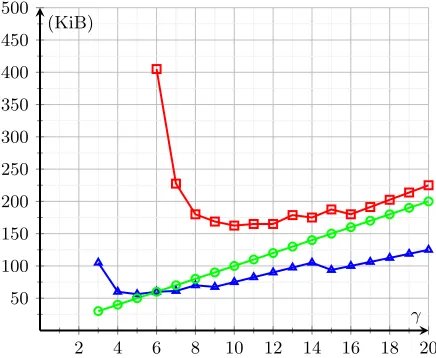
In figure 1, for a fixed valuen= 210, we represent the size of the commitment of Xieet al., Benhamoudaet al.and ours for different values ofγ(that is, different values ofqsinceq≥nγ).
Fig. 1: Commitment’s size of Xie et al. ( ), Benhamouda et al. ( ) and our proposal ( )
2 4 6 8 10 12 14 16 18 20
50 100 150 200 250 300 350 400 450 500
γ (KiB)
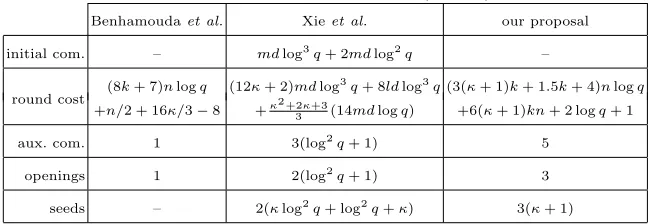
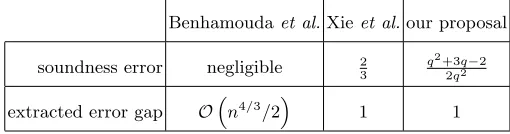
Finally we can compare the communication cost of the Zero-Knowledge Proofs of multiplicative relations (table 3), as this is the most interesting case and the major contribution of this paper. In table 4 we compare soundness and completeness properties for one round of each protocol.
We separately show what are the initial communication costs (in bits), the cost per round (in bits), the number of auxiliary commitments, the number of openings of these auxiliary commitments and the number of seeds for the pseudorandom generation of the permutations. The last three items depend on the final implementation. Random seeds could be 256 bit strings. If the auxiliary commitment scheme is implemented using a hash function (secure in the random oracle model) then the size of each of these auxiliary commitments could also be 256 bits.