Coherence Dynamics of Two Interacting Bosonic Modes
in a Thermal Environment
AurelianIsar1,2,3,
1Department of Theoretical Physics, National Institute of Physics and Nuclear Engineering, 077125 Bucharest-Magurele, Romania
2Faculty of Physics, University of Bucharest, 077125 Bucharest-Magurele, Romania 3Academy of Romanian Scientists, 3 Ilfov str., 050044 Bucharest, Romania
Abstract.
We describe the time evolution of the quantum coherence in an open system consisting of two coupled bosonic modes embedded in a thermal reservoir. We discuss the influence of the environment in terms of the covariance matrix for initial squeezed thermal states. The coherence is quantified using the relative entropy as a measure, and its dynamics is studied in the framework of the theory of open systems based on completely positive quantum dynamical semigroups. We show that the evolution of the quantum coherence strongly depends on the initial state of the system (squeezing parameter and thermal photon numbers), the parameters characterizing the thermal reservoir (temperature and dissipation coefficient) and the intensity of the coupling between the two modes.
1 Introduction
Quantum coherence arises from the superposition principle, which represents the essential point of departure of quantum physics from the classical views of the reality. Presently coherence is identified as a quantum resource for applications in science and quantum technologies [1, 2]. Resource theories provide a powerful framework for the understanding of quantum physical phenomena, with fruitful applications in quantum information processing tasks [3, 4], quantum thermal engine [5, 6], quantum computing [7], cryptography [8], quantum metrology [9, 10] as well as in biological systems [11, 12]. Recently, Baumgratz et al. [13] proposed a framework for quantifying coherence, in which coher-ence is considered a quantum resource, in a similar axiomatic way like the approach to the quantifica-tion of entanglement and other quantum correlaquantifica-tions or types of nonclassicality [14–20].
Most of the measures of the quantum coherence assume a finite-dimensional Hilbert space, how-ever, some recent papers introduced a resource-theoretic framework for coherence in continuous vari-able systems, and, in particular, coherence of Gaussian states has been investigated [21–23].
In order to obtain a realistic description of the quantum processes it is necessary to take decoher-ence and dissipation into consideration. Recently we studied, in the framework of the theory of open systems, the dynamics of quantum correlations of two, both uncoupled and coupled, bosonic modes embedded in a common thermal bath, for initial Gaussian states of the system [24–30].
In this work we use the axiomatic formalism of the theory of open quantum systems based on completely positive dynamical semigroups [31] to address the quantification of the coherence, fol-lowing Ref. [22], for an open system consisting of two coupled bosonic modes embedded in a thermal environment. We study the time evolution of the coherence of the system and show that it has a strong dependence on the initial state and the parameters characterizing the open system and the en-vironment. Previously we described the evolution of quantum coherence of two uncoupled bosonic modes interacting with a thermal bath [32]. Likewise, in Refs. [33, 34] the authors considered a system of two non-interacting bosonic modes, but they addressed a more general scenario, including a nonclassical contribution from the environment.
The paper is organised as follows. In Sec. 2 we write the Markovian master equation for the density operator of the open system interacting with a general environment and solve the evolution equation for the covariance matrix of the state of the bimodal bosonic system [35]. In Sec. 3 we provide a coherence measure for Gaussian states based on the relative entropy. In Sec. 4 we describe the time evolution of the coherence of the open system of two coupled bosonic modes as a function of the parameters of the considered system and environment. The conclusions are given in Sec. 5.
2 Master equation for two bosonic modes interacting with the environment
In order to study the dynamics of the subsystem consisting of two coupled bosonic modes (harmonic oscillators) weakly interacting with a thermal reservoir, we use the axiomatic formalism based on completely positive quantum dynamical semigroups. In this framework the Markovian irreversible time evolution of an open system is described by the following Gorini-Kossakowski-Sudarshan-Lindblad master equation for the density operatorρ(t) [31, 35–37]:
dρ(t) dt =−
i
H, ρ(t) + 1
2
n
2Bnρ(t)B†n−ρ(t),B†nBn+
, (1)
whereH denotes the Hamiltonian of the open system and the operatorsBn, B†n are defined on the
Hilbert space ofH, and describe the interaction of the subsystem with a general environment. The Hamiltonian of two coupled in coordinates non-resonant harmonic oscillators of identical massmand frequenciesω1andω2is given by
H= 1 2m
p2
x+p2y
+m
2
ω21x2+ω2 2y2
+qxy, (2)
wherex, yare the coordinates and px,py are the momenta of the two modes,qis the coupling
pa-rameter, and we take the operators Bj as polynomials of first degree in the canonical variables of
coordinates and momenta.
The equations of motion for the quantum correlations of the canonical observables are the follow-ing (T denotes the transposed matrix) [35]:
dσ(t)
dt =Zσ(t)+σ(t)ZT+2D, Z=
−λ 1/m 0 0
−mω2
1 −λ −q 0
0 0 −λ 1/m
−q 0 −mω2
2 −λ
, (3)
with real diffusion matrixDand dissipation coefficientλ. We introduced the 4×4 bimodal covariance matrixσ,with the elements defined asσi j=Tr[(AiAj+AjAi)ρ],i,j=1, . . . , 4, withA={x,px, y,py},
In this work we use the axiomatic formalism of the theory of open quantum systems based on completely positive dynamical semigroups [31] to address the quantification of the coherence, fol-lowing Ref. [22], for an open system consisting of two coupled bosonic modes embedded in a thermal environment. We study the time evolution of the coherence of the system and show that it has a strong dependence on the initial state and the parameters characterizing the open system and the en-vironment. Previously we described the evolution of quantum coherence of two uncoupled bosonic modes interacting with a thermal bath [32]. Likewise, in Refs. [33, 34] the authors considered a system of two non-interacting bosonic modes, but they addressed a more general scenario, including a nonclassical contribution from the environment.
The paper is organised as follows. In Sec. 2 we write the Markovian master equation for the density operator of the open system interacting with a general environment and solve the evolution equation for the covariance matrix of the state of the bimodal bosonic system [35]. In Sec. 3 we provide a coherence measure for Gaussian states based on the relative entropy. In Sec. 4 we describe the time evolution of the coherence of the open system of two coupled bosonic modes as a function of the parameters of the considered system and environment. The conclusions are given in Sec. 5.
2 Master equation for two bosonic modes interacting with the environment
In order to study the dynamics of the subsystem consisting of two coupled bosonic modes (harmonic oscillators) weakly interacting with a thermal reservoir, we use the axiomatic formalism based on completely positive quantum dynamical semigroups. In this framework the Markovian irreversible time evolution of an open system is described by the following Gorini-Kossakowski-Sudarshan-Lindblad master equation for the density operatorρ(t) [31, 35–37]:
dρ(t) dt =−
i
H, ρ(t) + 1
2
n
2Bnρ(t)B†n−ρ(t),B†nBn+
, (1)
whereH denotes the Hamiltonian of the open system and the operators Bn,B†n are defined on the
Hilbert space ofH, and describe the interaction of the subsystem with a general environment. The Hamiltonian of two coupled in coordinates non-resonant harmonic oscillators of identical massmand frequenciesω1andω2is given by
H= 1 2m
p2
x+p2y
+m
2
ω21x2+ω2 2y2
+qxy, (2)
wherex, yare the coordinates and px,pyare the momenta of the two modes,qis the coupling
pa-rameter, and we take the operators Bj as polynomials of first degree in the canonical variables of
coordinates and momenta.
The equations of motion for the quantum correlations of the canonical observables are the follow-ing (T denotes the transposed matrix) [35]:
dσ(t)
dt =Zσ(t)+σ(t)ZT+2D, Z=
−λ 1/m 0 0
−mω2
1 −λ −q 0
0 0 −λ 1/m
−q 0 −mω2
2 −λ
, (3)
with real diffusion matrixDand dissipation coefficientλ. We introduced the 4×4 bimodal covariance matrixσ,with the elements defined asσi j =Tr[(AiAj+AjAi)ρ],i,j=1, . . . , 4, withA={x,px, y,py},
which fully characterize any Gaussian state of a bimodal system (up to local displacements).
The time-dependent solution of Eq. (3) is given by [35]
σ(t)=S(t)[σ(0)−σ(∞)]ST(t)+σ(∞), (4)
whereS(t)≡exp(Zt).The values at infinity are obtained from the equationZσ(∞)+σ(∞)ZT=−2D. The covariance matrix, which is a real, symmetric and positive matrix entirely specifying a two-mode Gaussian state, has the following block structure, where 2×2 Hermitian matricesAandBare the covariance matrices for the single modes, andCcontains the cross-correlations between the modes:
σ(t)=
A C CT B
. (5)
3 Coherence of Gaussian states
A state is called incoherent if it is diagonal in a fixed orthonormal basis. We denote the set of all incoherent states byI. In Ref. [13] there have been proposed the following postulates that any proper measure of the coherenceC(ρ) for finite-dimensional statesρmust satisfy.
(C1)C(ρ)≥0 andC(δ)=0 if and only ifρ∈ I.
(C2a)Monotonicity under all incoherent completely positive and trace-preserving (ICPTP) maps: C(ρ)≥C(ΦICPTP(ρ)),whereΦICPTP(ρ)=nKnρK†n,nKn†Kn =I,KnIKn† ⊂ Ifor alln,with†the
adjoint andIidentity operator.
(C2b)Monotonicity for average coherence under the subselection based on measurement out-comes:C(ρ)≥npnC(ρn), whereρn =KnρKn†/pnandpn =Tr(KnρKn†),nKn†Kn =I,KnIKn† ⊂ I
for alln.
(C3)Nonincreasing under the mixing of quantum states:npnC(ρn)≥C(npnρn).
We note that (C2b) and (C3) together imply C(2a).
In Ref. [22] Xu gives the following definition of an incoherent Gaussian channel (IGC): it is a Gaussian channel that maps thermal states into thermal states. Instead of (C2a) and (C2b) it is required that any coherence measureCfor Gaussian states satisfies
(C2)C(ρ)≥C(ΦIGC(ρ)) for any Gaussian stateρand any incoherent Gaussian channel IGC. The coherence measure for Gaussian states
C(ρ)=inf
δ {S(ρ||δ) :δis an incoherent Gaussian state}, (6)
where inf runs over all incoherent Gaussian states, is given in terms of the relative entropy for two density matricesρandδ:
S(ρ||δ)=Tr(ρlog2ρ)−Tr(ρlog2δ). (7) Here the first term represents the von Neumann entropy ofρ,S(ρ) =−Tr(ρlog2ρ).In the case of a bipartite system we have
S(ρ)=− 2
i=1 k
i−1
2 log2 ki−2 1 −ki +1 2 log2ki
+1 2
, (8)
wherek1,k2are the symplectic eigenvalues of the covariance matrixσ(t) defined as [38]
2k2 1,2= ∆∓
∆2−4 detσ(t) (9)
Using the definition (6) of the coherence, one obtains the following expression of the relative entropy of the coherence for Gaussian states [22]:
C(ρ)=infδ−S(ρ)−Trρlog2δ =−S(ρ)+sup δ Tr
ρlog
2δ =S(ρdiag)−S(ρ), (10)
whereρdiagis the density matrix of the closest Gaussian thermal state to the given stateρand has a covariance matrix described by the average number of thermal photons
nth
1 = 14(A11+A22−2), nth2 =14(B11+B22−2). (11)
Thus, the final expression for the relative entropy of coherence is
C(ρ)= 2
i=1
g2nthi +1−gki, (12)
with
g(x)= x+1 2 log2 x
+1
2 −
x−1
2 log2 x−21. (13)
4 Time evolution of the quantum coherence
We take an initial two-mode squeezed thermal state, with the covariance matrix given by [39]
σst(0)=
a 0 c 0
0 a 0 −c
c 0 b 0
0 −c 0 b
, (14)
where
a=2n1cosh2r+2n2sinh2r+cosh 2r, b=2n1sinh2r+2n2cosh2r+cosh 2r, c=(n1+n2+1) sinh 2r.
Here n1,n2 denote the mean thermal photon numbers associated with the two modes and r is the squeezing parameter. Forn1 = 0 andn2 =0, (14) becomes the covariance matrix of the two-mode squeezed vacuum state.
We suppose that the only non-zero quantum diffusion coefficients have the following form (we put m==1) [31]:
ω21Dxx=Dpxpx =ω1λcoth
ω1
2T, ω22Dyy=Dpypy=ω2λcoth
ω2
2T, (15)
whereT is the temperature of the thermal reservoir (we have set the Boltzmann constantk=1). We have analyzed the time evolution of the coherence of the two coupled bosons as a function of the squeezing parameterr, dissipation constantλ, coupling constantqand temperature of the reservoir T for fixed values of the average number of photonsn1,n2in the resonant case.
Using the definition (6) of the coherence, one obtains the following expression of the relative entropy of the coherence for Gaussian states [22]:
C(ρ)=infδ−S(ρ)−Trρlog2δ =−S(ρ)+sup δ Tr
ρlog
2δ =S(ρdiag)−S(ρ), (10)
whereρdiagis the density matrix of the closest Gaussian thermal state to the given stateρand has a covariance matrix described by the average number of thermal photons
nth
1 = 14(A11+A22−2), nth2 =14(B11+B22−2). (11)
Thus, the final expression for the relative entropy of coherence is
C(ρ)= 2
i=1
g2nthi +1−gki, (12)
with
g(x)= x+1 2 log2 x
+1
2 −
x−1
2 log2 x−21. (13)
4 Time evolution of the quantum coherence
We take an initial two-mode squeezed thermal state, with the covariance matrix given by [39]
σst(0)=
a 0 c 0
0 a 0 −c
c 0 b 0
0 −c 0 b
, (14)
where
a=2n1cosh2r+2n2sinh2r+cosh 2r, b=2n1sinh2r+2n2cosh2r+cosh 2r, c=(n1+n2+1) sinh 2r.
Here n1,n2 denote the mean thermal photon numbers associated with the two modes and r is the squeezing parameter. Forn1 =0 andn2 =0, (14) becomes the covariance matrix of the two-mode squeezed vacuum state.
We suppose that the only non-zero quantum diffusion coefficients have the following form (we put m==1) [31]:
ω21Dxx=Dpxpx =ω1λcoth
ω1
2T, ω22Dyy=Dpypy =ω2λcoth
ω2
2T, (15)
whereT is the temperature of the thermal reservoir (we have set the Boltzmann constantk=1). We have analyzed the time evolution of the coherence of the two coupled bosons as a function of the squeezing parameterr, dissipation constantλ, coupling constantqand temperature of the reservoir T for fixed values of the average number of photonsn1,n2in the resonant case.
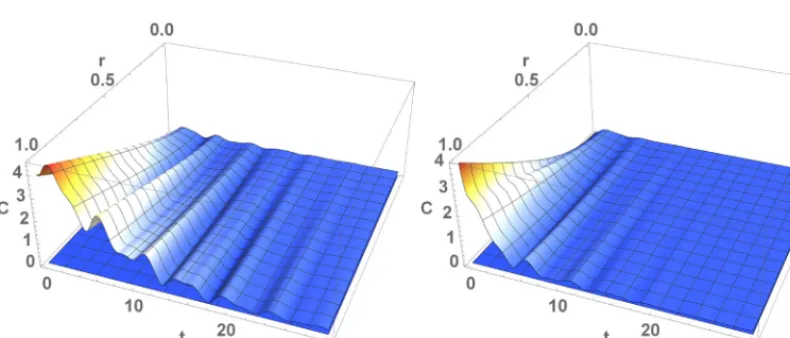
In Fig. 1 we plot the time variation of the coherence as a function of the squeezing parameterr. The relative entropy of coherence increases with the increase of the squeezing parameter, but has a slower increase at a higher temperature. The coherence decays asymptotically in time to small, but non-vanishing values, and presents a non-monotonic evolution.
Figure 1.(Color online) Relative entropy of coherenceCfor two bosonic modes withn1 =1,n2 =2,λ=0.1, q=0.5 as a function of timetand squeezing parameterrfor the resonant caseω1=ω2=1 and forT =0 (left)
andT =5 (right). Prevailing trends: Slow variation withrat fixedt(almost constant values at larget, slow to moderate decay at larget). Quasi-periodic variation withtalong constantr, with increasing amplitudes withr.
Figure 3.(Color online) Relative entropy of coherenceCfor two bosonic modes withn1 =1,n2 =2,r =0.5,
λ=0.1 as a function of timetand couplingqfor the resonant caseω1 =ω2=1 and forT =0 (left) andT =5
(right). Prevailing trend: radial wavy behaviour of increasing amplitude under increasingqbut decreasingt.
Figure 4.(Color online) Relative entropy of coherenceCfor two bosonic modes withn1 =1,n2 =2,r =0.5,
λ=0.1,q=0.5 as a function of timetand temperatureT for the resonant caseω1 =ω2 =1. General trends:
monotonic increase under decreasingT at fixedt; wavy behaviour withtat fixedT (of increasing amplitude toward lowT).
Figure 3.(Color online) Relative entropy of coherenceCfor two bosonic modes withn1 =1,n2=2,r=0.5,
λ=0.1 as a function of timetand couplingqfor the resonant caseω1=ω2=1 and forT =0 (left) andT =5
(right). Prevailing trend: radial wavy behaviour of increasing amplitude under increasingqbut decreasingt.
Figure 4.(Color online) Relative entropy of coherenceCfor two bosonic modes withn1 =1,n2=2,r=0.5,
λ=0.1,q=0.5 as a function of timetand temperatureT for the resonant caseω1 =ω2 =1. General trends:
monotonic increase under decreasingT at fixedt; wavy behaviour withtat fixedT (of increasing amplitude toward lowT).
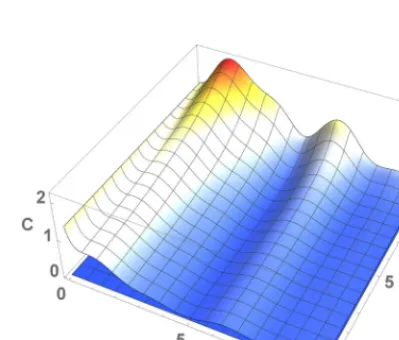
An almost periodic behaviour can be observed in the time evolution of the relative entropy of coherence as a function of the dissipation parameter λ. See Fig. 2, where we plot the coherence for fixed average thermal photon numbers, squeezing parameter and coupling constant, as a function of time and dissipation parameterλ. As expected, the coherence increases with the decrease of the dissipation constant and for small values ofλfluctuates around positive values.
One can observe the the relative entropy of coherence increases with the strength of the interaction between the bosonic modes (see Fig. 3) and decreases with the temperature of the environment (see Fig. 4). Therefore, in the resonant case it is possible to generate coherence in the system by increasing the coupling between the modes and decreasing the temperature. The direct interaction between the modes favours also the preservation in time of the coherence in the resonant case, as seen from Fig. 3.
5 Summary and conclusions
We have investigated the Markovian evolution of the quantum coherence of a system composed of two coupled bosonic modes embedded in a thermal environment using the axiomatic formalism based on completely positive quantum dynamical semigroups. The dynamics of the coherence is studied for an initial two-mode squeezed thermal state. We used the measure of coherence defined in terms of the relative entropy of the given state and of the closest Gaussian thermal state.
We have shown that the quantum coherence is increasing with the squeezing parameter of the initial state and the strength of the coupling between the modes, and it is decreasing by increasing the dissipation constant and temperature of the thermal bath. However, unlike in the previous study [32], where the system formed of two non-coupled bosonic modes in a thermal environment exhibited a quantum coherence asymptotically decreasing to zero, in the present model the quantum coherence tends to a non-zero asymptotic value, due to the interaction between the two bosonic modes, that sustains the coherence.
In the context of the debate relative to the physical interpretation of the quantum resources, the present results might be useful in controlling quantum coherence in open systems and also for appli-cations in protocols of quantum information processing and communication.
Acknowledgments
The author acknowledges the financial support received from the Romanian Ministry of Research and Innovation, through the Project PN 19 06 01 01/2019.
References
[1] A. Streltsov, G. Adesso, M. Plenio, Rev. Mod. Phys.89, 041003 (2017) [2] E. Chitambar, G. Gour, Rev. Mod. Phys.91, 025001 (2019)
[3] R. Horodecki, P. Horodecki, M. Horodecki, K. Horodecki, Rev. Mod. Phys.81, 865 (2009) [4] H. Ollivier, W. H. Zurek, Phys. Rev. Lett.88, 017901 (2001)
[5] M. O. Scully, M. S. Zubairy, G. S. Agarwal, H. Walther, Science299, 862 (2003)
[6] M. O. Scully, K. R. Chapin, K. E. Dorfman, M. B. Kim, A. Svidzinsky, Proc. Nat. Acad. Sci.
108, 15097 (2011)
[7] T. D. Ladd, F. Jelezko, R. Laflamme, Y. Nakamura, C. Monroe, J. L. O’Brien, Nature464, 45 (2010)
[8] V. Scarani, H. Bechmann-Pasquinucci, N. J. Cerf, M. Dusek, N. Lütkenhaus, M. Peev, Rev. Mod. Phys.81, 1301 (2009)
[9] V. Giovannetti, S. Lloyd, L. Maccone, Nature Photonics5, 222 (2011) [10] G. Tóth, I. Apellaniz, J. Phys. A: Math. Theor.47, 424006 (2014) [11] S. Lloyd, J. Phys.: Conf. Series302, 012037 (2011)
[13] T. Baumgratz, M. Cramer, M. B. Plenio, Phys. Rev. Lett.113, 140401 (2014) [14] V. Vedral, M. B. Plenio, M. A. Rippin, P. L. Knight, Phys. Rev. Lett.78, 2275 (1997) [15] V. Vedral, M. B. Plenio, Phys. Rev. A57, 1619 (1998)
[16] A. Streltsov, U. Singh, H. S. Dhar, M. N. Bera, G. Adesso, Phys. Rev. Lett.115, 020403 (2015) [17] K. C. Tan, H. Jeong, Phys. Rev. Lett.121, 220401 (2018)
[18] M.-L. Hu, X. Hu, J.-C. Wang, Y. Peng, Y.-R. Zhang, H. Fan, Phys Rep.762, 1 (2018)
[19] X. Yuan, M.-A. Côté, A. Sordoni, R. Laroche, R. T. des Combes, M. Hausknecht, A. Trischler, arXiv:1706.04853 (2017)
[20] N. Killoran, F. E. S. Steinhoff, M. B. Plenio, Phys. Rev. Lett116, 080402 (2016) [21] Y.-R. Zhang, L.-H. Shao, Y. Li, H. Fan, Phys. Rev. A93, 012334 (2016) [22] J. Xu, Phys. Rev. A93, 032111 (2016)
[23] D. Buono, G. Nocerino, G. Petrillo, G. Torre, G. Zonzo, F. Illuminati, arXiv:1609.00913 (2016) [24] A. Isar, Phys. Scr. T140, 014023 (2010)
[25] A. Isar, Phys. Scr. T143, 014012 (2011) [26] A. Isar, Phys. Scripta T153, 014035 (2013) [27] I. Ghiu, A. Isar, Rom. J. Phys.61, 768 (2016)
[28] A. Isar, Open Sys. Information Dyn.23, 1650007 (2016) [29] A. Isar, T. Mihaescu, Eur. Phys. J. D71, 144 (2017) [30] T. Mihaescu, A. Isar, Eur. Phys. J. D72, 104 (2018)
[31] A. Isar, A. Sandulescu, H. Scutaru, E. Stefanescu, W. Scheid, Int. J. Mod. Phys. E3, 635 (1994) [32] S. Suciu, A. Isar, Rom. J. Phys.61, 1474 (2016)
[33] S. Olivares, M. G. A. Paris, R. Bonifacio, Phys. Rev. A67, 032314 (2003) [34] A. R. Rossi, S. Olivares, M. G. A. Paris, J. Mod. Optics51, 1057 (2004) [35] A. Sandulescu, H. Scutaru, W. Scheid, J. Phys. A: Math. Gen.20, 2121 (1987) [36] V. Gorini, A. Kossakowski, E. C. G. Sudarshan, J. Math. Phys.17, 821 (1976) [37] G. Lindblad, Commun. Math. Phys.48, 119 (1976)