Available Online atwww.ijcsmc.com
International Journal of Computer Science and Mobile Computing
A Monthly Journal of Computer Science and Information Technology
ISSN 2320–088X
IMPACT FACTOR: 6.017
IJCSMC, Vol. 6, Issue. 11, November 2017, pg.48 – 53
ENHANCED EDGE DETECTION TECHNIQUES
FOR IDENTIFICATION OF FISH THROUGH ITS
MORPHOLOGICAL FEATURES
Dr. G.T.Shrivakshan
1Head and Assistant Professor, P.G. and Research Department of Computer Science, Swami Vivekananda Arts and Science College, Villupuram, Tamilnadu, India
Abstract - In image analysis the Edge detection technique is the most frequently used operations. The edges of the image defined the boundaries and regions of the image. Image of different categories of Fishes like Fresh water fish, Salt water fish, Poisonous Fish, Dangerous fish and all fishes are belongs to different fish family and fish classification in image processing using different filters which are basically based on gradient method like Sobel, Prewitt ,Roberts ,Log Based and Canny edge detector . This paper classifying shark fishes based on image processing using Wavelet Transformation for detecting the edges, specially the two dimensional Haar wavelet transformation of images. The morphological features of various types of sharks compared with the given sample shark that is being identified to which category it belongs to. This paper proposes the enhanced edge detection technology and uses the concept of concurrency to identify the shark image. The body length of the fish is calculated through which the age of the fish is calibrated. The length of the fish is being calculated using edged detection technology. The proposed method uses the edged detection algorithm, Sober Filter and Gabor Filter. Gabor filter for texture, projection segmentation and geometrical shape feature extraction to find the fish’s distinctive dark lines that mark the body and tail, through which the age of the fish can be computed. Finally very important problem is taken to understand the fundamental concepts of various filters and apply these filters in identifying a shark fish type which is taken as a case study. The experimentation done in software MATLAB 12.0.
Keywords- Image analysis, Edge detection, Sobel, Prewitt, Roberts, Haar wavelet transformation, Gabor Filter.
I. INTRODUCTION
1.1 Steps that are used as a part of Edge Detection Image Smoothing
Image smoothing is a noise reduction step and it is used to reduce the noise by filtering the image for improving the performance of edge detector.
Detection
This step involves extracting all points that are possible to become edge point.
Edge localization
This step involves identifying true set of member points and that comprises an edge [1].
The fish image can be classified using edge detection system that is proposed in this work. Digital image recognition has been particularly found and studied. Various approaches in image processing and pattern recognition have been established by scientists and engineers to solve this problem [5]. In this system for recognizing a fish image is built, which may be benefited by the various fields, the system concerning an isolated pattern of interest, the input is considered to be an image of specific size and format, the image is processed and then recognized by the given shark fish into its cluster and categorize from the clustered fish.
II. REVIEW OF LITERATURE
In the edge detection scenario [5] describes boundaries and were therefore a problem of fundamental importance in image processing. Image Edge detection significantly reduced the amount of data and filters out useless information, while preserving the important structural properties in an image. Since edge detection was in the forefront of image processing for object detection, it was crucial to have a good understanding of edge detection algorithms. In this work the comparative analysis of various Image Edge Detection techniques where presented. It had been shown that the Canny’s edge detection algorithm performed better than all those operators under almost all scenarios. Evaluation of the images had shown that under noisy conditions Canny, LoG( Laplacian of Gaussian), Robert, Prewitt, Sobel exhibited better performance[3], respectively. 1. It had been observed that Canny’s edge detection algorithm was computationally more expensive compared to LoG( Laplacian of Gaussian), Sobel, Prewitt and Robert’s operator.
In the latest survey [2], Two-dimensional (2-D) compactly supported, orthogonal wavelets and filter banks having linear phase were presented. In another work it provided an advanced algorithm based on classical Sobel operator whose defect was rough effect for edge detection and extremely sensitive to the noise [8]. This work proposed an improved algorithm which used the improved Sobel operator with a combination of median filtering method[4]. This algorithm made the edge detection for the Salt and pepper noise images and it effectively overcame the problem that the Sobel operator was only sensitive to vertical and horizontal direction. It combined the advantage of the median filter to remove salt-pepper noise. The effect of the experiment was better than the classical edge detection method. In another work it presented efficient hardware architecture of Prewitt edge detection for high speed image processing applications [7]. The hardware design was implemented by using Verilog hardware description language, whereas the software part was developed by using Matlab. The zero computational error analysis indicated that the proposed architecture produced similar outputs with ideal result obtained by Matlab software simulation. The architecture was capable of operating at a clock frequency of 145 MHz at 550 frames per second (fps), which implied that the system was suitable for both image processing and computer vision applications. In this work it proposed a method which combined Sobel edge detection operator and soft-threshold wavelet de-noising to do edge detection on images which included White Gaussian noises [7]. In recent years, a lot of edge detection methods were proposed. The commonly used methods which combined mean de-noising and Sobel operator or median filtering and Sobel operator could not remove salt and pepper noise very well. In this synopsis, we firstly used soft-threshold wavelet to remove noise [9], then used Sobel edge detection operator to do edge detection on the image. This method was mainly used on the images which included White Gaussian noises.
III. PROPOSED WORK
3.1 Identification of Shark Fish Type Using Edge Detection
There are several ways to perform the edge detection. However, the gradient and Laplacian are most widely used edge detection methods. The gradient method detects the edges by looking for the maximum and minimum in the first derivative of the image. The Laplacian method searches for zero crossings in the second derivative of the image to find edges. This first figure shows the edges of an image detected using the gradient method (Roberts, Prewitt, Sobel) and the Laplacian method (Marrs-Hildreth). It can then compare the feature extraction using the Sobel Edge detection with the feature extraction using the Laplacian.
3.1.1 Algorithm for finding the threshold value in the Wavelet Transformation
Step-1: An initial threshold (T) is chosen, this can be done by taking one of the edge pixels which has high intensity.
Step-2: The image is segmented[6] into object and background pixels as described above, creating two sets:
a)G1 = {f(m,n):f(m,n)>T} (object pixels)
b)G2 = {f(m,n):f(m,n) T} (background pixels) (note, f(m,n) is the value of the pixel
located in the mth column, nth row)
Step-3: The average of each set is computed.
a)m1 = average value of G1
b)m2 = average value of G2
Step-4: A new threshold is created that is the average of m1 and m2
Step-5: T’ = (m1 + m2)/2
Step-6:Go back to step two, now using the new threshold computed in step four, keep repeating until the new threshold matches the one before it (i.e. until convergence has been reached).
3.1.2. Result and discussions
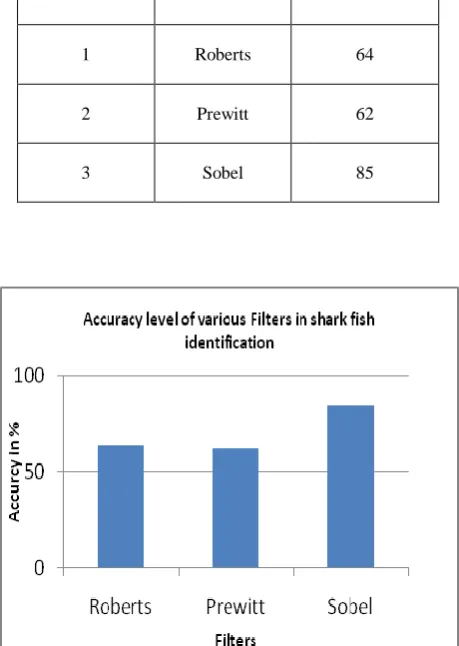
Notice that the shark features (fins, tails, gills and mouth) have very sharp edges. These also happen to be the best reference points for identifying between two images. The low-pass filtering it uses distorts the actual position of the shark features. Due to the nature of the Sobel and Prewitt filters. The next pair of images shows the horizontal and vertical edges selected out of the group shark images with the Sobel method of edge detection. It may be noticed the difficulty it had with certain shark features, such as the gills, mouth, fins and tails of different sharks. The graph depicting the accuracy level of various filters in identifying Shark fish Type . The sample dataset are taken from the UCI repositories the filter performance is analyzed as shown in Table 1 and figure1.
Table 1 : Performance of Various Filters
Figure 1: Graph representing accuracy level of various filters
S.No Filters Accuracy
1 Roberts 64
2 Prewitt 62
3.2 Finding the age of the Fish using edge detection and segmentation
This iterative algorithm is a special one-dimensional case of the enhanced k-means clustering algorithm, which has been proven to converge at a local minimum meaning that a different initial threshold may give a different final result. In this wavelet algorithm it imposes multi-threading concept which is the modification concept that is done in the existing algorithm to identify the age coilia fish in this work. The Wavelet transformation is being applied in the sample coilia fish. The age can be computed by finding the length of the fish. Projection Curve Segmentation is one step of the vision processing, the body and tail features are extracted from the remaining back-ground. After the image is processed by the Gabor Filter, a threshold is applied to force pixels to take on values of 0 or 1. In observing the resulting image (see Fig. 17 a), only the fish tail pattern, body center pattern, and some background patterns (i.e. under-water grass) remain. The fish patterns have limited overlap with the background. Projecting the threshold image into a vertical histogram Hv(y) i.e. summing the number of black pixels in each row of the image, results in two separate shapes. The first is the background curve with no defining shape. The second is a sharp and narrow spike protruding from a smooth and low curve. This second shape is a projection of the tail and body features, (Fig. 17 b). With this histogram, a search for the tail and body patterns is conducted to produce an interval of rows in which the fish is located. If A is a predetermined threshold that characterizes the tail width, the tail interval is defined as rows belonging to [Ytailstart, Ytailstop] such that a scan from the top of
the image produces. If the slope of the histogram within intervals [ymax- δ, ymax] and [ymax, ymax+δ] have magnitudes less
than mmin, it is determined that the fish tail feature is found. If the slope conditions are satisfied, rows outside the interval
[ytailstart,ytailstop] are subtracted from the image, effectively eliminating background in the top and bottom portions of the
image, (see Fig. 16c). In a similar fashion, the image is projected into a horizontal histogram Hh(x),i.e. summing the number
of black pixels in each column of the image. The tail pattern dominates the histogram with an obvious spike. The body pattern is also evident as a region of constant amplitude adjacent to the tail spike. In this case, a search for these two features is conducted to define an interval of columns in which the fish resides. Columns outside this interval are subtracted to remove background on the two sides of the fish.What remains is an image with only the tail and body features.
3.2.1 Results and Discussions
The graph depicting the age of the fish relating to its length as shown in figure 2. The graph shows the accuracy level of various filters in finding the length of the fish. The dataset was obtained from the UCI repositories and the statically data are taken and tabulated as in Table 2.
Table 2 : Body length(mm) of Coilia by age (years)
Figure 2: Graph representing the accuracy in finding the length of the Fish
3.3 Finding the shark age and its type
It wishes to build a morphing algorithm which operates on features extracted from target images automatically. It can be a good beginning to find the edges in the target images. Here, we have accomplished this by implementing a Laplacian Edge Detector to find the age and type of the shark fish.
Age 1 2 3 4 5
The body length 102 179 230 272 284
Back calculated
length 103 176 226 268 289
Theoretical
3.31 Algorithm:
Step 1: Start with an image of a Shark as a sample Fig. 19(a) that is compared with the various types of other Sharks images.
Step 2: Blur the image Fig. 19(b). On identifying the Shark type, the edges are selected to perform a morph, it is not really needed to detect the "every" edge in the image, but only in the main features Fig. 19(c). Thus, the image has been blurred prior to edge detection. This blurring is accomplished by convolving image with a Gaussian.
Step 3: Perform the laplacian on this blurred image. It is necessary to perform the laplacian transformation. Using this method we can compute the length of the shark and try to find the age of the shark. This method combines the previous methodologies in 3 and 4.
3.4 Comparison of the Various Edge Detectors
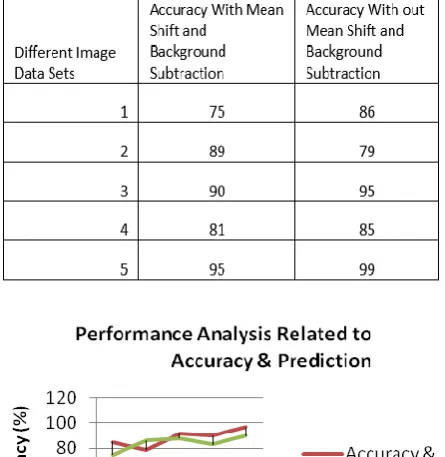
As edge detection is a fundamental step in computer vision, it is necessary to point out the true edges to get the best results from the matching process. That is why it is important to choose edge detectors. In this respect, we first present some advantages and disadvantages of Edge Detection Techniques like Classical (Sobel, Prewitt), Zero Crossing (Laplacian), Gaussian (Gabor Filter), Gaussian (Canny), Marr-Hildreth, Silhouette Detection Algorithm. The dataset was obtained from the UCI repositories and the statically data are taken and tabulated as in Table 3. The performance analyzed in figure 3.
Table 3 : Performance Analysis
Figure 3: performance analysis related to prediction of the shark fish.
3.4.1 Implementation and Experimental Results
IV. CONCLUSION
The different methodologies of using edge detection techniques namely the Gradient and Laplacian transformation. It seems that although Laplacian does do better for some features (i.e. the fins), it still suffers from mismapping some of the lines. To overcome this problem, in this work proposes Haar Wavelet Transformation for better results incorporating multi-threading concepts and enhancing the performance of the Haar Wavelet transformation which does horizontal and vertical detection of edges and finally brings the image without noise. The algorithm uses a Gabor filter to extract texture, a new filter called projection curve segmentation to find the length of the fish . The length of the fish by the above two methods will give the length of the fish from which the age of the fish can be calculated. The limitation is while the uncertainty in fish size and feature lengths decreased the accuracy of relative range estimation is expected that the errors will be small enough to allow fish tracking. A novel edge-detection algorithm is necessary to provide an errorless solution that is adaptable to the different noise levels of these images to help in identifying the valid image contents produced by noise. The performance of the Canny algorithm relies mainly on the changing parameters which are standard deviation for the Gaussian filter, and its threshold values. The size of the Gaussian filter is controlled by the greater value and the larger size. The larger size produces more noise, necessary for noisy images, as well as detecting larger edges. The larger scale of the Gaussian then we have the lesser accuracy of the localization of the edge. For the smaller values we need a new algorithm to adjust these parameters. The user can modify the algorithm by changing these parameters to suit to different environments. Canny’s edge detection algorithm is more costly in comparing to Sobel, Prewitt and Robert’s operator. The various methodologies of using edge detection techniques are namely the Gradient and Laplacian transformation. It seems that although Laplacian does the better for some features (i.e. the fins), it still suffers from mismapping some of the lines. In future this draw back can be rectified.
REFERENCES
[1] Ashutosh Dwivedi, et. al., “A novel hybrid image compression technique: wavelet-MFOCPN”, Proc. of 9th ID’06 Asia chapter, New Delhi, India, pp. 492-495, 2006.
[2] Chappell S.G, Blidberg D.R and Tumer R.M, “Autonomous underwater vehicles: Current activities and research opportunities. Robotics and Autonomous Systems” , International conference IEEE OCEANS '02 MTS/IEEE, vol. 1, pp. 325-330. 2002.
[3] Chen, L. et.al, “Laplacian Embedded Regression for Scalable Manifold Regularization”, Neural Networks and Learning Systems, IEEE Transactions, Volume: 23, pp. 902 – 915, June 2012.
[4] Chunxi Ma, et.al. , “An improved Sobel algorithm based on median filter”, Institute of Electrical and Electronics Engineers, 2nd International IEEE conference, China, Volume: 1, pp. 88-93, Aug 1, 2010.
[5] David Stanhill and Yehoshua Y. Zeevi, “Two-Dimensional Orthogonal Filter Banks and Wavelets with Linear Phase”, IEEE transactions on signal processing, vol. 46, no. 1, pp. 183-190, 1998.
[6] Deepak Mishra, N. S. C Bose, A. Tolambiya, A.Dwivedi, P. Kandula,A. Kumar, and Prem K.Kalra, “Color image compression with modified forward-only counter propagation neural network: improvement of the quality using different distance measures”, Proc. of the 9 IEEE International Conference on Information Technology, ICIT’06, India, pp. 139-140, 2006.
[7] Eduardo Morales, Frank Y. Shin, “Wavelet coefficients clustering using morphological operations and pruned quad trees”,Pattern Recognition , Elsevier, volume 33, pp. 1611-1620, issue 10, 2000.
[8] Raman Maini Dr. Himanshu Aggarwal , “Study and Comparison of Various Image Edge Detection Techniques” International Journal of Image Processing (IJIP), Volume 3, Issue 1, pp. 1-12, 2002.
[9] Terzija Nataša , Geisselhardt Walter, “Robust digital image watermarking based on complex wavelet transform”,