EPJ Web of Conferences 30, 05002 (2012) DOI: 10.1051/epjconf/20123005002
© Owned by the authors, published by EDP Sciences, 2012
Organized by
Thibault Charpentier
[email protected]
Patrick Berthault
[email protected]
Constantin Meis
[email protected]
džƉĞƌŝŵĞŶƚ ĂŶĚDŽĚĞůůŝŶŐ ŝŶ^ƚƌƵĐƚƵƌĂůEDZ
EŽǀĞŵďĞƌ ϮϴƚŚʹ ĞĐĞŵďĞƌ Ϯ
ŶĚ
ϮϬϭϭ
/E^dEʹ ^ĂĐůĂLJ͕&ƌĂŶĐĞ
Nicolas Giraud
Université Paris-sud, France
Fast NMR
Fast NMR
N. Giraud1
1Equipe de RMN en milieu orienté, ICMMO, UMR 8182 CNRS, Université Paris-Sud, bât 410, 91405 Orsay cedex,
France.
Abstract.Three major contributions to the field of Fast NMR techniques are presented. They aim at allowing
chemists or biologists to probe structural changes occurring in their sample, on a time scale that is adapted to the observation, the description and the understanding of the (bio)chemical processes under study: (i) the SOFAST approach has been developed to acquire experiments on macromolecules with a high acquisition rate, when band-selective excitation schemes are used; (ii) ultrafast NMR allows to record multi-dimensional spectra within a single scan; and (iii) in gradient frequency encoded NMR, the higher resolution of the correlation spectra makes a straightforward assignment and measurement of spin interactions possible, which leads to an acceleration of the whole analytical process.
1 Introduction
Nuclear Magnetic Resonance has become a particularly well-suited spectroscopy for observing, describing and understanding structure, dynamics and ever more complex reactivity of the molecules that are of the greatest interest nowadays. Most of the methodological developments that have been accomplished over the last 50 years have aimed at pushing the limits of NMR sequences in terms of resolution and acquisition rate.
In this context, multidimensional experiments have proved to be essential to high-resolution studies of large or complex molecular assemblies, in which the observation of resolved correlations provides a detailed insight into their structure, at an atomic level. Unfortunately, the time needed to acquire these multidimensional datasets is a major limitation that prevents scientists from using the NMR spectrum as snapshot of the molecule when it is involved in a dynamic process. Indeed, even in the case of slow processes (protein folding, exchange reaction …), the time scale of these chemical events is not suitable for monitoring structural changes through the variations of correlations on a 2D spectrum.
Along the last decades, several groups have taken up the challenge for shortening the experimental time required to record 2D (3D, 4D …) spectra. Different approaches have been successfully introduced since then, ranging from a shortening of the duration of each scan (SOFAST …) to a reduction of the number of scans needed to sample time domain (non-linear data sampling, Hadamard NMR spectroscopy, parallel acquisition …).
This lecture will focus on three contributions made in the field of Fast NMR: (i) SOFAST spectroscopy, (ii) ultrafast (or single scan) NMR, and (iii) gradient encoded spectroscopy (gNMR).
2 SOFAST NMR
One major limitation on the overall time required to record a multidimensional experiment is the duration of the recycling time that is needed to acquire the NMR signal, and then let the magnetization return to equilibrium before the next scan. For a given experiment, the sensitivity is limited by the fraction of the initial longitudinal magnetization that is converted into transverse coherences that will evolve during the pulse sequence, and the ability of the observed nucleus to relax in a time that is short enough, regarding the desired acquisition rate.[1]
In 2005, Brutscher et al. have made an ingenious use of the relaxation properties of macromolecules, in the frame of correlation experiments based on the use of selective irradiations schemes.[2] In large molecular assemblies such as proteins, the dense proton network offers particularly efficient magnetization transfer pathways (spin diffusion, exchange with water, cross relaxation …) that add to the classical nuclear relaxation mechanisms (spin-lattice relaxation which is basically sensitive to the stochastic fluctuations of spin interactions induced by molecular dynamics). For macromolecules in solution, they have shown that a longitudinal relaxation enhancement is observed, that leads to shorter apparent T1’s for amide protons when these nuclei are selectively
EPJ Web of Conferences
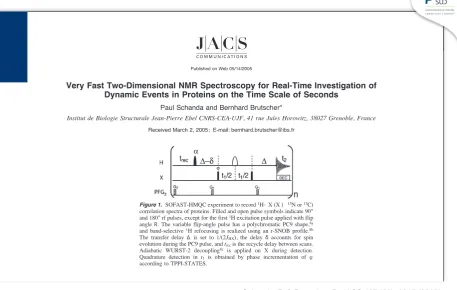
They have thus proposed to implement sequences in which the initial polarization step is built with selective pulses, in order to acquire correlation spectra involving amide protons from proteins on the time scale of few seconds.[3] The resulting SOFAST-HMQC experiment (SOFAST : band-Selective Optimized Flip-Angle Short-Transient) allowed for instance a real-time investigation of a proton/deuterium exchange process in small proteins dissolved in deuterated water.[3, 4]
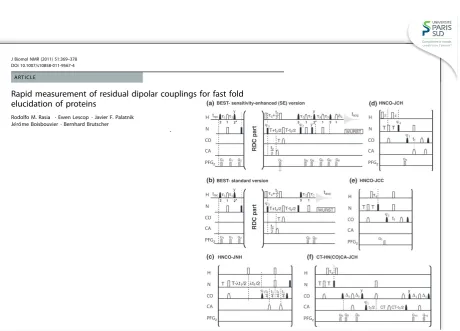
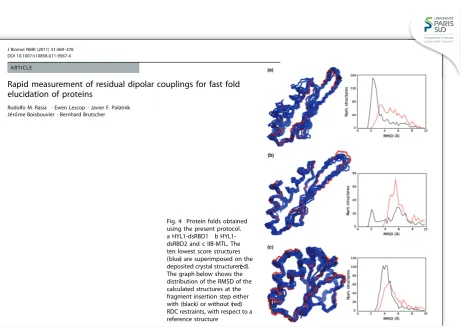
It has to be noted that in this approach, the flip angle of the initial selective excitation pulse can be optimized so that either a higher sensitivity (BEST sequences), or a shorter recycling delay (SOFAST sequences) is achieved. This fast-pulsing approach has also been implemented in 3D correlation experiments designed for the measurement of residual dipolar couplings, that allow the rapid measurement of RDC’s within a few hours, opening the way to an incorporation of these precious structural probes into computational protocols, and thus a more efficient determination of protein folding within a reduced computation time. [5]
3 Ultrafast NMR
Ultrafast NMR[6] (also known as single-scan NMR) has revolutionized the way of acquiring multidimensional experiments. Indeed, the observation of correlations on a spectrum requires that the evolution of nuclear magnetization be recorded during (at least) two independent evolution delays in the pulse sequence. In a conventional 2D NMR experiment for instance, the indirect domain is sampled over the acquisition of the same 1D experiment repeated N times, each time varying an indirect evolution time (t1).[7] In this classical approach, the overall acquisition time is proportional to the number N of t1 increments needed to sample evolution frequencies with a satisfying resolution. This acquisition scheme can result in very long experimental times (up to a few days).
Ultrafast NMR consists in acquiring simultaneously these N experiments (i.e. corresponding to each t1
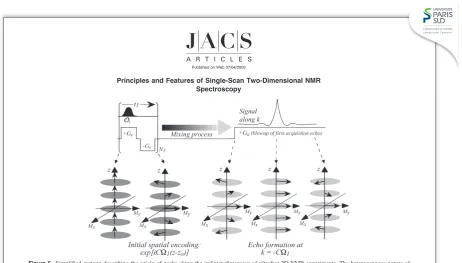
increment) in different “slices” of the NMR sample.[8] In a way that is similar to Magnetic Resonance Imaging (MRI) techniques, the sample is spatially encoded by a pulsed field gradient. The evolutions of spin nuclei that are located in different cross sections are then triggered one after the other by an adequate frequency swept irradiation scheme, leading to a spatial encoding of the corresponding (indirect) evolution time. This protocol allows a single receiver coil to perform a parallel acquisition of all the signals that were generated with different t1 increments. After these initial excitation and evolution steps, single-scan 2D pulse sequences are followed by the appropriate mixing block, and finally by a detection of the NMR signal (similarly to classical multi-dimensional sequences). The resulting NMR signal has a double (t1, t2) dependency, and needs thus to be decoded. During detection, decoding gradients are then applied, that induce a position dependent phase for
that have been evolving at a given resonance frequency Ω during t1, at times that are proportional to Ω. The spectrum along the indirect domain is thus directly reconstructed in the final signal, and takes the form of a series of echoes that still contain a time dependence (according to spin evolutions during the acquisition delay
t2). A single Fourier transform along t2 is then required to
obtain the desired 2D spectrum. [8]
Over the recent years, different methodological developments have been devoted to the enhancement of this technique. The excitation scheme, which was originally composed of a train of bipolar gradients and frequency selective pulses to create a discrete series of “slices” with different evolution times t1, has been
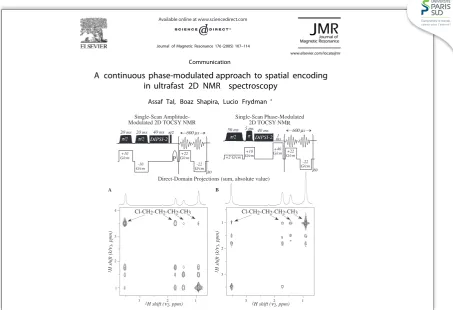
completed with an alternative scheme employing adiabatic pulses to generate a continuous spatial encoding of t1.[9, 10] Novel acquisition strategies, consisting for instance in interleaving scans, have also been proposed to enhance both resolution and sensitivity. More recently, several approaches have been proposed, that range from excitation schemes allowing to encode a continuous phase modulation of the signal along the sample[11], J-resolved detection schemes[12], to the combination of the ultrafast approach with ex situ dynamic nuclear polarization (DNP) techniques.[13] These developments have allowed to implement most of the classical homonuclear correlation spectra (COSY, TOCSY, J-resolved …), as well as heteronuclear experiments (HMQC, HSQC …) that have become essential to any NMR study, in particular in the field of biological macromolecules.[13]
The substantial gain in acquisition rate promised by this methodology has encouraged several groups to write single-scan versions of their pulse programs in order to observe, sometimes at Hertz rate, dynamic events involved in their chemical or biological systems. New applications have been successfully developed, that range from the study of the fast hydrogen-deuterium exchange characterizing amide sites in small model proteins[14], real-time monitoring of organic reactions[15], or the accurate quantification of isotopic enrichments in mixtures of metabolites.[16, 17] Finally, ultrafast NMR could in the future be the key to noticeable evolutions in the field of magnetic resonance imaging itself. Frydman and his co-workers have shown that this approach allows potentially extracting from each voxel sampled during an MRI experiment the spectroscopic information (i.e. the
chemical shift) that is associated to molecules that are present in the analysed tissues.[18]
4 Gradient frequency-encoded (gNMR)
spectroscopy
Fast NMR
designed, that allow gathering all the interactions between active nuclei together on the same correlation spectrum. However, even for rather small compounds, the overlap of signals, as well as the complexity of their multiplet structure, can overwhelm the resolution of the correlation spectra.
The resolution of any NMR spectrum relies heavily on the action of the pulse sequence on spin dynamics. Remarkably, this property depends above all on the kind of radiofrequency fields that are applied to handle nuclear magnetization, whatever the detail of the pulse sequence is.[19, 20]
On the one hand, sequences which employ hard pulses (short, high power radiofrequency fields) can be designed so that they give rise to different evolutions for different kinds of interactions in the spin network (chemical shift, dipolar or scalar coupling …).[21-24] Unfortunately, the use of hard pulses creates as many coherences as there are spin interactions, and yields often overcrowded spectra.
On the other hand, one way to reduce the number of correlations that contribute to the structure of NMR spectra consists in using semi-selective pulses (low power r.f. fields).[25] These soft pulses allow handling coherences involving a single spin nucleus. In this latter case however, reducing the number of interactions that contribute to the multiplet structure of a given signal, without reducing the number of signals is almost impossible.
Finally, the combination of hard and soft pulses, and notably the implementation of refocusing blocks or filters, cannot get rid of this limitation.
The idea behind the gradient frequency encoding approach is to fully control the number of spin interactions that contribute to each correlation on an NMR spectrum, in order to (i) enhance resolution by limiting the line width, and (ii) make the analytical content of the spectrum more accessible (i.e. easily assignable and measurable).[26]
This methodology has given birth to powerful applications such as “pure shift” NMR[26-28], or more recently the Gradient encoded homonuclear SElective ReFocusing experiment (G-SERF). [29] A spatial frequency encoding is created along the sample, which allows to select, in separate cross sections, each spin-spin interaction that is involved in the coupling network around a given proton site. On the resulting 2D spectrum, each coupling can be straightforwardly assigned and measured, on a fully resolved multiplet, at the resonance frequency of the coupling partner.
The high resolution that is obtained on spectra recorded on a spatially frequency encoded sample, as well as the extreme simplicity of their analytical content, has changed this technique into a particularly promising tool. This spatial frequency encoding approach has been applied to the visualisation of enantiomers dissolved in a chiral liquid crystal: the complete set of 1H-1H residual
dipolar couplings (RDC) could be measured and assigned for a model racemate, within an experimental time that
References
1 D. L. Rabenstein, J. Chem. Educ., 61, 909-913, (1984)
2 P. Schanda, B. Brutscher, J. Am. Chem. Soc., 127, 8014-8015, (2005)
3 P. Schanda, V. Forge, B. Brutscher, Proc. Natl. Acad. Sci. U. S. A., 104, 11257-11262, (2007) 4 P. Schanda, E. Kupce, B. Brutscher, J. Biomol.
NMR, 33, 199-211, (2005)
5 R. M. Rasia, E. Lescop, J. F. Palatnik, J. Boisbouvier, B. Brutscher, J. Biomol. NMR, 51, 369-378, (2011)
6 L. Frydman, T. Scherf, A. Lupulescu, Prog. NMR Spec., 99, 15858-15862, (2002)
7 J. Jeener, in International Ampere Summer School, Basko Polje, Yugoslavia, 1971.
8 L. Frydman, A. Lupulescu, T. Scherf, J. Am. Chem. Soc., 125, 9204-9217, (2003)
9 P. Pelupessy, J. Am. Chem. Soc., 125, 12345-12350, (2003)
10 Y. Shrot, B. Shapira, L. Frydman, J. Magn. Reson., 171, 163-170, (2004)
11 A. Tal, B. Shapira, L. Frydman, J. Magn. Reson., 176, 107-114, (2005)
12 P. Giraudeau, S. Akoka, J. Magn. Reson., 186, 352–357, (2007)
13 P. Giraudeau, Y. Shrot, L. Frydman, J. Am. Chem. Soc., 131, 13902–13903, (2009)
14 M. Gal, P. Schanda, B. Brutscher, L. Frydman, J. Am. Chem. Soc., 129, 1372-1377, (2007) 15 A. Herrera, E. Fernández-Valle, R.
Martínez-Álvarez, D. Molero, Z. D. Pardo, E. Sáez, M. Gal, Angewandte Chemie-International Edition, 48, 6274-6277, (2009)
16 M. Pathan, S. Akoka, I. Tea, B. Charrier, P. Giraudeau, Analyst, 136, 3157-3163, (2011) 17 P. Giraudeau, S. Massou, Y. Robin, E.
Cahoreau, J.-C. Portais, S. Akoka, Anal. Chem., 83, 3112-3119, (2011)
18 A. Tal, L. Frydman, Prog. NMR Spec., 57, 241– 292, (2010)
19 T. C. Farrar, Anal. Chem., 42, 109A-112A, (1970)
20 R. R. Ernst, G. Bodenhausen, A. Wokaun, in Principles of Nuclear Magnetic Resonance in One and Two Dimensions, Second ed., Clarendon Press, Oxford, 1987.
21 W. P. Aue, J. Karhan, R. R. Ernst, J. Chem. Phys., 64, 4226-4227, (1976)
22 D. Marion, K. Wüthrich, Biochem. Biophy. Res. Com., 113, 967-974, (1983)
23 M. Ottiger, F. Delaglio, A. Bax, J. Magn. Reson., 131, 373-378, (1998)
24 B. L. Marquez, W. H. Gerwick, R. T. Williamson, Magn. Res. Chem., 39, 499-530, (2001)
EPJ Web of Conferences
27 K. Zangger, H. Sterk, J. Magn. Reson., 124, 486-489, (1997)
28 G. Morris, J. Aguilar, R. Evans, S. Haiber, M. Nilsson, J. Am. Chem. Soc., 132, 12770-12772, (2010)
29 N. Giraud, L. Beguin, J. Courtieu, D. Merlet, Angewandte Chemie-International Edition, 49, 3481-3484, (2010)
FAST NMR
Nicolas Giraud - NMR in Oriented Media Group
Quick Overview ...
... Fast Methods in NMR
Experiment and Modelling in Structural NMR Advanced Concepts - Fast NMR
• FDM (Filter Diagonalisation Method)
• Hadamard
• Red. Dimensionality:
GFT* / MWD- / APSY
• Projection Reconstruction
• Non-Linear Sampling
• Ultrafast 2D
• Covariance NMR
• Spectrum Folding
• Sharc NMR
• Rapid Pulsing
• Simultaneous Data Acquisition
• gNMR
(Mandelshtam & Shaka) (Kupce & Freeman)
(Szyperski, Wüthrich, Brutscher, (Gronenborn, Billeter, Markley, ...) (Kupce & Freeman)
(Wagner, Orekhov, Marion, ...) (Frydman, Pelupessy) (Brüschweiler, ...) (Sidebottom, Berger, ...) (Sakhaii)
(Ross, Pervushin, Brutscher,...) (Soerensen, Griesinger, Parella, ...) (Giraud, Merlet,...)
Quick Overview ...
... Fast Methods in NMR
Experiment and Modelling in Structural NMR Advanced Concepts - Fast NMR
• FDM (Filter Diagonalisation Method)
• Hadamard
• Red. Dimensionality:
GFT* / MWD- / APSY
• Projection Reconstruction
• Non-Linear Sampling
• Ultrafast 2D
• Covariance NMR
• Spectrum Folding
• Sharc NMR
• Rapid Pulsing
• Simultaneous Data Acquisition
• gNMR
(Mandelshtam & Shaka) (Kupce & Freeman)
(Szyperski, Wüthrich, Brutscher, (Gronenborn, Billeter, Markley, ...) (Kupce & Freeman)
(Wagner, Orekhov, Marion, ...) (Frydman, Pelupessy) (Brüschweiler, ...) (Sidebottom, Berger, ...) (Sakhaii)
(Ross, Pervushin, Brutscher,...) (Soerensen, Griesinger, Parella, ...) (Giraud, Merlet,...)
from R. Weisemann, NMR Application Laboratories, Bruker Biospin Rheinstetten, DE
FAST NMR : why always faster ?!
Time Scales in NMR ...
Experiment and Modelling in Structural NMR Advanced Concepts - Fast NMR
ps ns μs ms s min. hour week year
1 Hz 1 kHz
1 MHz 1 GHz
FAST NMR : why always faster ?!
Time Scales in NMR ...
Experiment and Modelling in Structural NMR Advanced Concepts - Fast NMR
ps ns μs ms s min. hour week year
1 Hz 1 kHz
1 MHz 1 GHz
From A. Krushelnitsky, D. Reichert PNMR 47 (2005) 1–25
Enzyme Catalysis Domain Motions
Bond Vibrations
Local Flexibility
Molecular (Brownian) Tumbling Methyl Group Rotation
Protein Folding
H Transfer INTERNAL MOTION
Diffusion Chemical Reactions / Exchange
FAST NMR : why always faster ?!
Time Scales in NMR ...
Experiment and Modelling in Structural NMR Advanced Concepts - Fast NMR
ps ns μs ms s min. hour week year
1 Hz 1 kHz
1 MHz 1 GHz
From A. Krushelnitsky, D. Reichert PNMR 47 (2005) 1–25
Enzyme Catalysis Domain Motions
Bond Vibrations
Local Flexibility
Molecular (Brownian) Tumbling Methyl Group Rotation
Protein Folding
H Transfer INTERNAL MOTION
Diffusion Chemical Reactions / Exchange
Exchange NMR
Averaged Anisotropic Couplings
Line Shape Analysis
Spin-Lattice Relaxation in the Rotating Frame Spin-Lattice Relaxation
FAST NMR : why always faster ?!
Time Scales in NMR ...
Experiment and Modelling in Structural NMR Advanced Concepts - Fast NMR
ps ns μs ms s min. hour week year
1 Hz 1 kHz
1 MHz 1 GHz
From A. Krushelnitsky, D. Reichert PNMR 47 (2005) 1–25
Enzyme Catalysis Domain Motions
Bond Vibrations
Local Flexibility
Molecular (Brownian) Tumbling Methyl Group Rotation
Protein Folding
H Transfer INTERNAL MOTION
Diffusion Chemical Reactions / Exchange
Exchange NMR
Averaged Anisotropic Couplings
Line Shape Analysis
Spin-Lattice Relaxation in the Rotating Frame Spin-Lattice Relaxation
in the Labratory Frame
Chemical Shift J Coupling
T1,T2 , NOE
FAST NMR : why always faster ?!
Time Scales in NMR ...
Experiment and Modelling in Structural NMR Advanced Concepts - Fast NMR
ps ns μs ms s min. hour week year
1 Hz 1 kHz
1 MHz 1 GHz
From A. Krushelnitsky, D. Reichert PNMR 47 (2005) 1–25
Enzyme Catalysis Domain Motions
Bond Vibrations
Local Flexibility
Molecular (Brownian) Tumbling Methyl Group Rotation
Protein Folding
H Transfer INTERNAL MOTION
Diffusion Chemical Reactions / Exchange
Exchange NMR
Averaged Anisotropic Couplings
Line Shape Analysis
Spin-Lattice Relaxation in the Rotating Frame Spin-Lattice Relaxation
in the Labratory Frame
Chemical Shift J Coupling
T1,T2 , NOE
Experiment and Modelling in Structural NMR Advanced Concepts - Fast NMR
NMR: A Time Consuming Process ...
Delays in a Multidimensional Pulse Sequence
t2 (φrec)
t1
1H
π/2 (φ1) π/2 (φ2)
D1
recycling delay indirect evolution delay acquisition delay
x NS scans
• Overall experimental time :
D
expNS TD D
1+
t
1 max2
+
t
2Experiment and Modelling in Structural NMR Advanced Concepts - Fast NMR
SOFAST
NMR: A Time Consuming Process ...
Delays in a Multidimensional Pulse Sequence
t2 (φrec)
t1
1H
π/2 (φ1) π/2 (φ2)
D1
recycling delay indirect evolution delay acquisition delay
x NS scans
• Overall experimental time :
D
expNS TD D
1+
t
1 maxExperiment and Modelling in Structural NMR Advanced Concepts - Fast NMR
SOFAST
Ultra FAST
NMR: A Time Consuming Process ...
Delays in a Multidimensional Pulse Sequence
t2 (φrec)
t1
1H
π/2 (φ1) π/2 (φ2)
D1
recycling delay indirect evolution delay acquisition delay
x NS scans
• Overall experimental time :
D
expNS TD D
1+
t
1 max2
+
t
2NMR: A Time Consuming Process ...
Overall Experimental & Analytical Process
Experiment and Modelling in Structural NMR Advanced Concepts - Fast NMR
The overall experimental and analytical process is limited by the high number of experiments required to:
• measure every relevant NMR probe of the structure and/or its dynamics • extract their analytical content (assignment, measurement ...)
• This limitation is linked to intrinsic properties of irradiation schemes that are used to handle spin magnetization ...
SOFAST
Ultra FAST
t2 (φrec)
t1
1H
π/2 (φ1) π/2 (φ2)
D1
recycling delay indirect evolution delay acquisition delay
x NS scans
Experiment and Modelling in Structural NMR Advanced Concepts - Fast NMR
band-Selective Optimized Flip-Angle Short-Transient
(SOFAST) Spectroscopy
Experiment and Modelling in Structural NMR Advanced Concepts - Fast NMR
Fast Data Acquisition : SOFAST Approach
Repetition Rate vs Longitudinal Relaxation
• Longitudinal relaxation is limiting the repetition rate for
π
/2 flip angles ...
AQ
1H π/2
D1 = 5 x T1
My
Mz
π/2
...
Fast Data Acquisition : SOFAST Approach
Euler Angle: Optimization of Sensitivity and Repetition Rate
Experiment and Modelling in Structural NMR Advanced Concepts - Fast NMR
AQ
1H
θ
D1
x NS scans AQ
My = M0.sin(θ).e-Trec/T2
Mz = M0.(1-{1-cos(θ)}.e-Trec/T1)
• For short T
rec, a maximum (non quantitative)
sensitivity is obtained for the Ernst Angle
Trec
cos(
θ
Ernst) =
e
-Trec / T1θ
Fast Data Acquisition : SOFAST Approach
Euler Angle: Optimization of Sensitivity and Repetition Rate
Experiment and Modelling in Structural NMR Advanced Concepts - Fast NMR
AQ
1H
θ
D1
x NS scans AQ
Trec
θ (deg)
Trec
10 s 1 s
0.1 s 0.01 s
My
S
N
1
e
TrecT1sin
1
e
TrecT1cos
M
0• The steady-state value of transverse
magnetization after a pulse is a function of both the repetition time and the flip angle.
• Unfortunately, sensitivity is dramatically reduced when short transients need to be acquired ...
0 20 40 60 80
0.0 0.5
Fast Data Acquisition : SOFAST Approach
Longitudinal Relaxation Mechanisms in Macromolecules
Experiment and Modelling in Structural NMR Advanced Concepts - Fast NMR
• Pure longitudinal relaxation
• Cross-relaxation
• Spin diffusion
• Chemical exchange with water ...
d I
(
zI
0)
dt
=
1
T
1I
zI
0(
)
SI(
I
zS
z)
SIS
(
S
zS
0)
SFor a given proton spin in a protein, additional sources of relaxation can influence the return to equilibrium of its longitudinal magnetization ...
Fast Data Acquisition : SOFAST Approach
Longitudinal Relaxation Mechanisms in Macromolecules
Experiment and Modelling in Structural NMR Advanced Concepts - Fast NMR
For macromolecules in solution, a longitudinal relaxation enhancement is observed, that leads to shorter apparent 1H T
1’s for amide protons
when they are selectively excited. 1HN acq.
acq.
1H
HN
2 4 6 8 10
0.2 0.4 0.6 0.8 1.0
1H polarization
Recovery time (s)
Schanda, P. & Brutscher, B. JACS 127 (22), 8015 (2005)
Very Fast Two-Dimensional NMR Spectroscopy for Real-Time Investigation of Dynamic Events in Proteins on the Time Scale of Seconds
Paul Schanda and Bernhard Brutscher*
Institut de Biologie Structurale Jean-Pierre Ebel CNRS-CEA-UJF, 41 rue Jules Horowitz, 38027 Grenoble, France
Received March 2, 2005; E-mail: [email protected]
Figure 1.SOFAST-HMQC experiment to record1H-X (X) 15N or13C)
correlation spectra of proteins. Filled and open pulse symbols indicate 90°
and 180°rf pulses, except for the first1H excitation pulse applied with flip
angleR. The variable flip-angle pulse has a polychromatic PC9 shape,8a
and band-selective1H refocusing is realized using an r-SNOB profile.8b
The transfer delayΔis set to 1/(2JJJHX), the delayδaccounts for spin
evolution during the PC9 pulse, andtttrecis the recycle delay between scans.
Adiabatic WURST-2 decoupling8cis applied on X during detection.
Quadrature detection int1is obtained by phase incrementation of
according to TPPI-STATES.
Published on Web 05/14/2005
Experiment and Modelling in Structural NMR Advanced Concepts - Fast NMR
Schanda, P. & Brutscher, B. JACS 127 (22), 8015 (2005)
Very Fast Two-Dimensional NMR Spectroscopy for Real-Time Investigation of Dynamic Events in Proteins on the Time Scale of Seconds
Paul Schanda and Bernhard Brutscher*
Institut de Biologie Structurale Jean-Pierre Ebel CNRS-CEA-UJF, 41 rue Jules Horowitz, 38027 Grenoble, France
Received March 2, 2005; E-mail: [email protected]
Published on Web 05/14/2005
S N t
1 e
Trec T1 sin
1 e
Trec T1cos
1
Tscan
Tscan
Recovery time (s)
Sensitivity per unit exp. time
90° 120°
Very Fast Two-Dimensional NMR Spectroscopy for Real-Time Investigation of Dynamic Events in Proteins on the Time Scale of Seconds
Paul Schanda and Bernhard Brutscher*
Institut de Biologie Structurale Jean-Pierre Ebel CNRS-CEA-UJF, 41 rue Jules Horowitz, 38027 Grenoble, France
Received March 2, 2005; E-mail: [email protected]
Published on Web 05/14/2005
Figure 2.1H-15N correlation spectrum (central part) of ubiquitin (2 mM,
pH 4.7) recorded at 800 MHz in only 5 s using the sequence of Figure 1. The acquisition parameters were set to:R ) 120°,Δ) 5.4 ms,δ) 1.2 ms,t2max) 40 ms, andtrec) 1 ms. Forty complex points (n) 80+4 dummy scans) were recorded fort1max) 22 ms. The band-selective1H pulses were centered at 8.0 ppm covering a bandwidth of 4.0 ppm. SOFAST-HMQC yields good water suppression in a single transient. The peak pattern surrounded by a box arises from Arg side chain resonances.
Figure 3. H/D exchange kinetics measured in the small protein MerAa
(pH 7.5). On the right, the cross-peak intensities measured in a series of SOFAST-HMQC spectra are plotted as a function of exchange time for V25 (9), L53 (b), and A43 (2). A fit to the functionI(t)) a0exp(-t/τex)
+a1yields exchange time constantsτex) 69 s for V25 andτex) 53 s for L53. No reliable fit is possible for A43, but the upper limit can be estimated toτex<15 s. On the left, the measured exchange rates, divided in three classes (i)τex<15 s (yellow small spheres), (ii) 15 s<τex<40 s (red medium-size spheres), and (iii)τex > 40 s (blue large spheres), are represented on the ribbon structure of MerAa.5
Experiment and Modelling in Structural NMR Advanced Concepts - Fast NMR
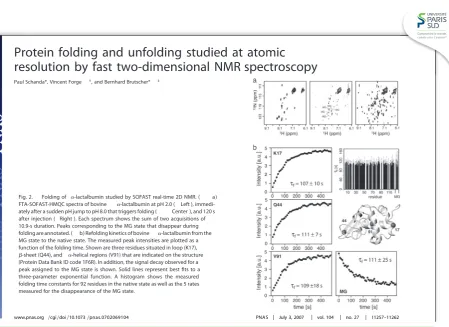
Protein folding and unfolding studied at atomic
resolution by fast two-dimensional NMR spectroscopy
Paul Schanda*, Vincent Forge †, and Bernhard Brutscher* ‡www.pnas.org cgi doi 10.1073pnas.0702069104 PNAS July 3, 2007 vol. 104 no. 27 11257–11262 Fig. 2. Folding of -lactalbumin studied by SOFAST real-time 2D NMR. ( a)
Experiment and Modelling in Structural NMR Advanced Concepts - Fast NMR
Protein folding and unfolding studied at atomic
resolution by fast two-dimensional NMR spectroscopy
Paul Schanda*, Vincent Forge †, and Bernhard Brutscher* ‡www.pnas.org cgi doi 10.1073pnas.0702069104 PNAS July 3, 2007 vol. 104 no. 27 11257–11262 Fig. 3. H/D exchange data obtained for human ubiquitin at pH 11.95 by using
SOFAST real-time 2D NMR. ( Upper) The measured exchange rates are color-coded on the ubiquitin structure. ( Lower) Examples of exchange curves cor-responding to different exchange regimes together with the fitted exchange time constants. For residues color-coded in white, no signal decay was ob-served because the cross-peak intensity has decreased to its plateau value during the dead time of the experiment.
A R T I C L E
Rapid measurement of residual dipolar couplings for fast fold elucidation of proteins
Rodolfo M. Rasia tEwen LescoptJavier F. Palatnik
t
Je´roˆme BoisbouviertBernhard Brutscher
Experiment and Modelling in Structural NMR Advanced Concepts - Fast NMR A R T I C L E
Rapid measurement of residual dipolar couplings for fast fold elucidation of proteins
Rodolfo M. Rasia tEwen LescoptJavier F. Palatnik
t
Je´roˆme BoisbouviertBernhard Brutscher
J Biomol NMR (2011) 51:369–378 DOI 10.1007/s10858-011-9567-4
Fig. 2 Part of1H–13C planes
extracted from 3D data sets of BEST-HNCO-JNH ( a), BEST HNCO-JCH (b), BEST HNCO-JCC (c), and BEST HN(CO)CA-JCH ( d), showing
cross-peakpatterns of ubiquitin residue Gln62. The spin couplings that can be extracted from the different spectra are indicated ontop. RDC correlationplotsfor each coupling measured on ubiquitin aligned in a bicelle medium are shown at thebottomof each spectrum [calculated RDC values are predicted from the high resolution solution structure of ubiquitin (PDB code : 1D3Z)] (Cornillescu et al.
1998)
A R T I C L E
Rapid measurement of residual dipolar couplings for fast fold elucidation of proteins
Rodolfo M. Rasia tEwen LescoptJavier F. Palatnik
Je´roˆme BoisbouviertBernhard Brutscher
J Biomol NMR (2011) 51:369–378 DOI 10.1007/s10858-011-9567-4
Experiment and Modelling in Structural NMR Advanced Concepts - Fast NMR
Ultra FAST (or Single Scan)
NMR Spectroscopy
Fast Data Acquisition : Ultra Fast NMR
Acquisition of a 2D experiment : classical approach
Experiment and Modelling in Structural NMR Advanced Concepts - Fast NMR
In a conventional 2D NMR experiment, the indirect domain is sampled over the acquisition of the same 1D experiment repeated N times, each time varying the evolution time t1 ...
t1 = 0 t1 = Δt t1 = 2.Δt
t1 = 3.Δt
t1 = n.Δt
Fourier Transform t1
t2
ν1
ν2
...
Fast Data Acquisition : Ultra Fast NMR
Acquisition of a 2D experiment : classical approach
Experiment and Modelling in Structural NMR Advanced Concepts - Fast NMR
In a conventional 2D NMR experiment, the indirect domain is sampled over the acquisition of the same 1D experiment repeated N times, each time varying the evolution time t1 ...
t1
t2
D
expNS TD D
1+
t
1 max2
+
t
21D
2D
3D
4D
5D
seconds minutes hours weeks years
Fast Data Acquisition : Ultra Fast NMR
Acquisition of a 2D experiment : spatial time encoding
Experiment and Modelling in Structural NMR Advanced Concepts - Fast NMR
Frydman and coworkers have proposed to perform a parallel acquisition of the different sampled
Δt1 increments through a spatial time encoding of the NMR sample ...
t1 = Δt
t1 = 3.Δt t1 = 2.Δt
t1 = n.Δt
Spatially encoded evolution Mixing Acquisition
Experiment and Modelling in Structural NMR Advanced Concepts - Fast NMR
The acquisition of multidimensional NMR spectra
within a single scan
Lucio Frydman†‡, Tali Scherf§, and Adonis Lupulescu†
Departments of†Chemical Physics and§Chemical Services, Weizmann Institute of Science, 76100 Rehovot, Israel
Communicated by Alexander Pines, University of California, Berkeley, CA, October 23, 2002 (received for review August 6, 2002)
15858 –15862 PNAS December 10, 2002 vol. 99 no. 25 www.pnas.org cgi doi 10.1073 pnas.252644399
Fig. 3. (A) Generic scheme capable of affording 2D NMR spectra within a single scan. A train of frequency-shifted excitation pulses is applied in the presence of alternating field gradients to achieve an incremented evolution of spins throughout different positions in the sample (t1); precession frequencies during the acquisition period then are monitored for each of these positions by using an EPI-type protocol (t2). The nature of the mixing sequence is arbitrary. Throughout our experiments theBofield heterogeneities were introduced along the main axis of a conventional sample tube by using thez
gradients that are currently available in a majority of solution NMR systems.
The acquisition of multidimensional NMR spectra
within a single scan
Lucio Frydman†‡, Tali Scherf§, and Adonis Lupulescu†
Departments of†Chemical Physics and§Chemical Services, Weizmann Institute of Science, 76100 Rehovot, Israel
Communicated by Alexander Pines, University of California, Berkeley, CA, October 23, 2002 (received for review August 6, 2002)
15858 –15862 PNAS December 10, 2002 vol. 99 no. 25 www.pnas.org cgi doi 10.1073 pnas.252644399
Fig. 4. Phase-sensitive single-scan 2D1H NMR spectra recorded within 0.22 s on a 20% (vol vol) solution ofn-butylchloride, CH
3CH2CH2CH2-Cl, dissolved in
CDCl3. The pulse sequences used for acquiring these spectra are shown (Upper), with set to 20 ms in the COSY and a 74-ms-long WALTZ sequence used for the TOCSY. Data were acquired withN1 40 initial Gaussian pulses being applied at 4-kHz offset increments, while in the presence of HGe 150 kHz cm, and an
Experiment and Modelling in Structural NMR Advanced Concepts - Fast NMR Principles and Features of Single-Scan Two-Dimensional NMR
Spectroscopy
Lucio Frydman,*,†Adonis Lupulescu,†and Tali Scherf‡ Published on Web 07/04/2003
Figure 4. (A) Basics of the echo-planar spectroscopic imaging (EPSI) protocol employed throughout the present work to detect the spins’ frequencies in a spatially resolved fashion. Signals are monitored as a function ofkandt2variables;Oandbdots symbolize the coordinates of points digitized during the course of positive and negative acquisition gradients. Such a gradient echo module is then repeatedN2times, withN2 defining the number of effective points alongt2. (B) As data stemming from an EPSI scheme employing a constant rate of digitization are not arrayed within a regular grid ready to be 2D FT, points need to be sorted out into two independent bidimensional data sets that are then individually processed. Both 2D data sets can then be co-added for the sake of improving the overall S/N.
J. AM. CHEM. SOC.9VOL. 125, NO. 30, 2003 9207
S k
(
,t2)
= P z(
, 1, 2)
ei1t1( )zei2t2eikz d
1 2
z
1d 2dz
S k
(
,t2)
= I(
1, 2)
ei1t1( )zei2t2d1 2
1d 2
Principles and Features of Single-Scan Two-Dimensional NMR Spectroscopy
Lucio Frydman,*,†Adonis Lupulescu,†and Tali Scherf‡ Published on Web 07/04/2003
J. AM. CHEM. SOC.9VOL. 125, NO. 30, 2003 9208
Figure 5. Simplified cartoon describing the origin of peaks along the indirect dimension of ultrafast 2D NMR experiments. The heterogeneous nature of
Experiment and Modelling in Structural NMR Advanced Concepts - Fast NMR Principles and Features of Single-Scan Two-Dimensional NMR
Spectroscopy Published on Web 07/04/2003
J. AM. CHEM. SOC.9VOL. 125, NO. 30, 2003 9210
Figure 8.Acquisition strategies capable of easing the gradient demands of ultrafast NMR, based on extending the single-transient 2D experiment to a small number of interleaved scans spanning thek-space trajectories illustrated to the right of each spectrum. 2D TOCSY spectroscopy (50 ms WALTZ mixing, magnitude plotting) was chosen to illustrate these acquisition modes, using a solution of the indicated hexapeptide dissolved in D2O (whose residual water resonance was largely eliminated using a 1.5 s presaturation pulse). Acquisition parameters for the various ultrafast experiments includedN1)61,Nk)66,
N2)256,ΔO)12 kHz,γeGe)300 kHz/cm,γaGa)300 kHz/cm, 1μs dwell times, and 80μs Gaussian excitation pulses for the single-scan acquisition;
N1)23,Nk)23,N2)256,ΔO)8 kHz,γeGe)110 kHz/cm,γaGa)97 kHz/cm, 8μs dwell times, and 100μs Gaussian excitation pulses for the two-scan acquisition;N1)35,Nk)35,N2)256,ΔO)8 kHz,γeGe)180 kHz/cm,γaGa)90 kHz/cm, 8μs dwell times, and 100μs Gaussian excitation pulses for the three-scan acquisition. Most remaining experimental conditions were as in Figure 7. The differingν1resolution observed among the various spectra is a consequence of the different number ofN1slices chosen to carry out the acquisitions, and not of the increasing number of scans that were used. Asterisks in the single-scan acquisition indicate peaks arising from the “ghosting” phenomena further described in the text. A conventional 2D NMR spectrum showing a tentative assignment of the resonances is also illustrated for completion on the top-right panel.
Principles and Features of Single-Scan Two-Dimensional NMR Spectroscopy
Published on Web 07/04/2003
J. AM. CHEM. SOC.9VOL. 125, NO. 30, 2003 9210
Figure 6. Summary of events involved in the single-scan acquisition of phase-sensitive 2D NMR spectra, illustrated with1H data recorded on a
solution ofn-butyl chloride dissolved in CDCl3and utilizing a 2D NMR
sequence devoid from the actual mixing process. (A) Time-domain data collected using the spatially selective excitation/detection procedures illustrated in Figures 3 and 4; the magnified inset shows the signal (magnitude) arising from an individualTaperiod, depicting in essence the
compound’s unidimensionalν1spectrum. (B) 2D contour plot of the unidimensional data set illustrated in (A), following a rearrangement of its 2NkN2points according to theirkandt2coordinates. Interleaved data sets
acquired with+Gaand-Gagradients are still present at this point, thus
resulting in a mirror-imaging of the signal along thek-axis. (C) Pairs of data sets resulting upon separating the interleaved+Ga/-Gaarrays in (B)
into two (k,t2) signals possessingNkN2points each. The signals shown in
Experiment and Modelling in Structural NMR Advanced Concepts - Fast NMR Adiabatic Single Scan Two-Dimensional NMR Spectrocopy
Philippe Pelupessy*,†
Contribution from the De´partement de Chimie, associe´au CNRS, Ecole Normale Supe´rieure, 24 rue Lhomond, 75231 Paris Cedex 05, France
Published on Web 09/13/2003
Figure 1.(a) Original excitation scheme proposed by Frydman et al.3to
obtain the frequency labeling in the indirectω1dimension in
Frydman-Scherf-Lupulescu experiments (FSL experiments). A train of bipolar gradients and frequency selective pulses, the carrier frequency of which is stepped from the minimum to the maximum frequency that is induce by the gradientsGE, is applied. This causes the evolution timet1of the spins
Sto depend on the sample position. (b) Excitation scheme for modified adiabatic FSL-experiments based on the use of frequency swept pulses during a constant time evolution period. After a nonselectiveπ/2 pulse, a bipolar gradient pair is applied, while a frequency modulated adiabatic pulse is present during each gradient. In this scheme, the whole sample contributes to the signal and off-resonance effects of the pulses do not deteriorate the excitation profile. Heteronuclear decoupling can be introduced as shown in (c) by repeating the scheme twice, with aπpulse on theI-spins in between. Theπpulse does not affect the chemical shift evolution of the
S-spins but inverts the effect of the heteronuclear scalar couplingJIS. The
extra blocks in gray can be appended to shift the refocusing of the middle of the chemical shift range of theS-spins to the middle of the gradients applied during detection.
J. AM. CHEM. SOC. 2003,125, 12345-12350 12345
Adiabatic Single Scan Two-Dimensional NMR Spectrocopy
Philippe Pelupessy*,†
Contribution from the De´partement de Chimie, associe´au CNRS, Ecole Normale Supe´rieure, 24 rue Lhomond, 75231 Paris Cedex 05, France
Published on Web 09/13/2003
J. AM. CHEM. SOC. 2003,125, 12345-12350 12345
Experiment and Modelling in Structural NMR Advanced Concepts - Fast NMR
Communication
Ultrafast 2D NMR spectroscopy using a continuous spatial
encoding of the spin interactions
Yoav Shrot, Boaz Shapira, Lucio Frydman*
www.elsevier.com/locate/jmr
Journal of Magnetic Resonan ce 171 (2004) 163–170
Fig. 1. Compa rison betweentwo schemes capable of creating the kind of spatially encoded spin states demanded for the execution of amplitude-modulated 2D NMR spectroscopy within a single scan. (A) Original protocol whereby indirect-domain X1 interactions are encoded by a discrete train ofN1RF pulses, applied at constant frequency incrementsDOand spaced by constant delaysDt1. Each excitation pulse is applied in combination with its own ±Geexcitation gradient echo; following the mixing process interactions are decoded using an oscillatory ±Ga acquisition gradient. (B) New scheme discussed in this work whereby the train of excitation pulses/gradient echoes in scheme (A) is replaced by a pair of continuous irradiatio n pulses in combination with a single bipolar gradient. Although both RF pulses are here identical the purpose of the first of these RF sweeps is to sequentially excite spins throughout the sample, whilst the purpose of the second one is to store thet1-encoded coherences. See the text for additional details.
Fig. 2. Simplifie d description of the effects introduced by pre-mixing events in the pulse sequenceshown inFig. 1B, on the spins evolution. RF offsetsOare assumed swept betweenan initial valueOiand a final valueOf= Oiat a constant rateRduring both the ‘‘excitatio n’’ (+Ge) and the ‘‘storage’’ ( Ge) portions of the sequence. For either the excitation or storage sweeps the RF will nutate by 90 spins whosez positions fulfill theO(s±) =Oi+Rs±= ±ceGezcondition, as illus-trated for the center spin-packet. The evolution timetþ
1undergone by
spin coherences during the course of the excitation sweepbecomesthen identical to thet1free evolution period experienced over the storage
sweep, for everyzcoordinate in the sample. This results in anX1z dependence for the amplitude-modulated spin states stored at the conclusion of the sequence.
J. AM. CHEM. SOC. 2003,125, 12345-12350
Figure 3.Scheme of Figure 1b followed by a TOCSY mixing sequence and the EPI-detection block. The experiment has been applied to a sample of 10% (vol/vol)n-butylbromide in CDCl3.
Journal of Magnetic Resonance 171 (2004) 163–170
Fig. 3. Single-scan 2D TOCSY NMR spectrum acquired on an
n-butylchloride/CDCl3sample, utilizing a sequence like the one illustrated onFig. 1B with the following parameters:Ge= 15 G/cm,
Oi= Of= 50 kHz, tmax
1 ¼70 ms,Ga= 55 G/cm, N2 = 256,Ta= 0.31 ms sampled with a constant dwell of 2ls, and a ±210 kHz filter bandwidth (derived from ±caGaL/2;Lbeing the sample length). All
gradient-switching times were set to 10ls, and a 100ls purging gradient pulse (P) was applied just prior to beginning data digitizatio n in order to clean up undesired residual signals. The frequency-chirped RF pulses involved in this sequence were programmed in real time using the Pbox Varian software package, with a WURST-50 ampli-tude-modulated pulse shape, an adiabaticity parametera 0.068, and a 2ls digital resolution. A 40 ms long DIPSI-2 type sequence, applied in the absence of gradients and over a 10 kHz bandwidth, was employed for the mixing. The acquired data points were separated for their off-line processing into +Gaand Gacontributions[10]; the
contour plot illustrated in (B) then resulted from subjecting one of these sets to a suitable shearing, zero-fillin g to 256·512 (k,t2)-points,
Experiment and Modelling in Structural NMR Advanced Concepts - Fast NMR
Communication
A continuous phase-modulated approach to spatial encoding
in ultrafast 2D NMR spectroscopy
Assaf Tal, Boaz Shapira, Lucio Frydman*
www.elsevier.com/locate/jmr
Journal of Magnetic Resonance 176 (2005) 107–114
Fig. 1. Schemes capable of affording the spatial encoding pattern required for ultrafast 2D NMR acquisitions. (A) Discrete phase-modulated encoding protocol composed of a train ofN1RF pulses, applied at constant frequency incrementsDO= (ceGeL)/(N1 1) in combination with multiple ±Gegradient oscillations . (B) Continuo us amplitude-modulated scheme where a pair of identical frequency-swept irradiation pulses is applied over a range ceGeLin combination with a single bipolar gradient, to achieve the storage of a cos (CX1z) longitudinal magnetization pattern. (C) New encoding scheme pro-posed in the present study, capable of yielding a phase-modulated exp(iCX1z) transverse evolution without requiring the applicatio n of rapidly oscillating ±Gegradients. Schemes are illustrated for a single-channel excitation for the sake of simplicity; see the text for further definitions.
One example of limitation of amplitude-modulated sequences: transfering of x and y components of magnetization in a transfer from I to S spin:
I
xS
xI
yS
yI
S
Amplitude-Modulation Phase-Modulation
Communication
A continuous phase-modulated approach to spatial encoding in ultrafast 2D NMR spectroscopy
Assaf Tal, Boaz Shapira, Lucio Frydman*
www.elsevier.com/locate/jmr
Experiment and Modelling in Structural NMR Advanced Concepts - Fast NMR
Communication
A new detection scheme for ultrafast 2D J-resolved spectroscopy
Patrick Giraudeau *, Serge Akoka
www.elsevier.com/locate/jmr
Journal of Magnetic Resonance 186 (2007) 352–357
G R F
G R F
Geπ
-Ge τπ +Ge π π π/2 -Ge Gc Ga π 2.N2 2.N2 Ta τπ τπ G R F
Oiπ Ofπ
Geπ/2
π/2 π
Gc
Ga
π
Ta
τπ/2
G R F
Oiπ/2 Ofπ/2Oiπ Ofπ
Geπ
Oiπ Ofπ
τπ +Ge π π π/2 Gc +Ga N2 Ta τπ τπ
Oiπ Ofπ
Geπ/2
π/2 π
Gc
τπ/2
Oiπ/2 Ofπ/2Oiπ Ofπ
Oiπ Ofπ
-Ga Ta +Ga N2 Ta -Ga Ta mix mix
Fig. 1. (a and b) Pulse sequences for the acquisition of ultrafast 2D spectra, with phase-modulated encoding schemes proposed by Pelupessy (a) and Tal et al. (b), followed by the usual EPI detection block. (c and d) New ultrafast J-resolved detection scheme preceded by phase-modulated encoding schemes proposed by Pelupessy (c) and Tal et al. (d). TheGcgradient prior to acquisition is adjusted to set the middle of the chemical shift range in the middle of the detection periodTa. The 180 pulse phase is alternated as described in the text. Note that the detection loop is repeated 2ÆN2times in the new scheme to
obtain the same number of FIDs than with the original EPI scheme.
Communication
A new detection scheme for ultrafast 2D J-resolved spectroscopy
Patrick Giraudeau *, Serge Akoka
www.elsevier.com/locate/jmr
Journal of Magnetic Resonance 186 (2007) 352–357
Fig. 3. Comparison between 500 MHz J-resolved spectra acquired on a 100 mmol L1
3-ethyl bromopropionate sample in CDCl3at 298 K. (a)
Conventional spectrum acquired in 3 h 8 min with 32t1increments and 16 scans. (b) Ultrafast spectrum obtained in 500 ms using Pelupessy’s (b) or Tal’s
Experiment and Modelling in Structural NMR Advanced Concepts - Fast NMR Research Article
Received: 28 October 2008 Revised: 15 December 2008 Accepted: 18 December 2008 Published online in Wiley Interscience: 24 February 2009
(www.interscience.com) DOI 10.1002/mrc.2403
New developments in the spatial encoding
of spin interactions for single-scan 2D NMR
‡Yoav Shrot,†Assaf Tal†and Lucio Frydman
RF
G +Ge
-Ge
π/2 chirp
π/2 chirp
+Ge
-Ge
π/2 chirp
π/2 chirp
-Oi
-Oi +Oi
+Oi -Oi +Oi -Oi +Oi π
(A) “First-in, last-out” encoding (B) “First-in, first-out” encoding
t1
max t
1 max
Figure 1.Comparison between (A) the original amplitude-modulated scheme yielding a ‘first-in, last-out’ linear spatial encoding (12) and (B) the new ‘first-in, first-out’ scheme discussed in this work, whereby spins at all positions spend equal times precessing in the transverse plane (and thereby are affected to the same extent by theT2decay) yet a linearC1z
RF
G +Ga
-Ga N 2
Mix
νt2
Ge
Prepare t1max
k k
Acqui sition time
t2
Wavenumber k
Digitize and Rearrange
Phase correct along k
Acquisition time t2
Wavenumber k
2D FT
Indirect-domain ν1
Direct-domain
ν2
Figure 3.Top: new encoding scheme proposed for the execution of single-scan 2D NMR, based on the use of a single encoding-gradient/RF-pulse module. Bottom: various stages of data manipulation involved in the retrieval of the single-scan 2D spectrum including removal of the second-degreekdependence and 2D FT of the resultingS(k,t2) data, as described in the text.
Research Article
Received: 28 October 2008 Revised: 15 December 2008 Accepted: 18 December 2008 Published online in Wiley Interscience: 24 February 2009
(www.interscience.com) DOI 10.1002/mrc.2403
New developments in the spatial encoding
of spin interactions for single-scan 2D NMR
‡Yoav Shrot,†Assaf Tal†and Lucio Frydman
TOCSY-based single-scan correlations
(B) “First-in, first-out” AM encoding (A) “First-in, last-out” AM encoding
0.15
40 0.15
40
0.15 20 6 6 0.54
2 π MIX 128 12.5 12.5 -30 30 -3.6 3.6
20 2.7 2.520 6 6 0.54
2 π MIX 128 -18 12.5 12.5 -30 -30 30 12 -3.6 3.6 20 π G 1H
Figure 2.Outcomes observed upon applying the single-scan 2D NMR principles introduced in Fig. 1, to ann-butylchloride/CDCl3sample. Shown on top
are the traditional (left) and newly proposed (right) encoding sequences used in these tests, with gradients and timing parameters (in G/cm and ms) indicated. White arrows represent the relative directions of the 30-kHz-wide sweeps used for excitation and storage. Notice the addition of gradient purging pulses to the schemes of Fig. 1. The central- and lower-panel spectra differ by the absence and presence of a 60-ms-long DIPSI-based mixing sequence[23]respectively. In all cases the 2D plots represent a positive description of the realI(ν
Experiment and Modelling in Structural NMR Advanced Concepts - Fast NMR UltraSOFAST HMQC NMR and the Repetitive Acquisition of
2D Protein Spectra at Hz Rates
Maayan Gal,†Paul Schanda,‡Bernhard Brutscher,‡and Lucio Frydman*,† Published on Web 01/10/2007
Figure 3.Representative series of real-time 2D ultraSOFAST HMQC NMR spectra recorded on a 3 mM Ubiquitin solution, following the dissolution of an initially fully protonated lyophilized powder onto a D2O-based buffer (final uncorrected pH)8.9). The times indicated in each frame correspond to the approximate delay elapsed since the dissolution was suddenly triggered. Acquisition parameters were akin to those in Figure 2B (with
Nscan)8,Tscan) 250 ms) and so was the data processing. The repetition time between full recordings was 2.4 s and data were monitored over a 20 min interval; only a subset of the collected and processed spectra is shown. The kinetics of the highlighted peaks are depicted by the corre-sponding graphs in Figure 4.
UltraSOFAST HMQC NMR and the Repetitive Acquisition of 2D Protein Spectra at Hz Rates
Maayan Gal,†Paul Schanda,‡Bernhard Brutscher,‡and Lucio Frydman*,† Published on Web 01/10/2007
Figure 4.H/D exchange plots extracted from the data in Figure 3 for four residues exhibiting fast kinetic processes. Experimental points reflect peak heights in the ultraSOFAST HMQC 2D spectra; thet1/2exchange lifetimes given in the figure were obtained by fitting the data points to the equation
Experiment and Modelling in Structural NMR Advanced Concepts - Fast NMR
NMR Spectroscopy DOI: 10.1002/anie.200902387
Real-Time Monitoring of Organic Reactions with Two-Dimensional Ultrafast TOCSY NMR Spectroscopy**
Antonio Herrera,* Encarnaci n Fern ndez-Valle, Roberto Mart nez- lvarez, Dolores Molero, Zulay D. Pardo, Elena S ez, and Maayan Gal
Communications
Scheme 1.The reaction between ketones and triflic anhydride in the presence of nitriles as nucleophiles.
Figure 3.The averaged integrated peak intensity as a function of time for reactant1(^), intermediates4,5(^), and6(^), and final products3(^) and7(^).
Angew. Chem. Int. Ed.2009,48, 6274 –6277
ARTICLE
pubs.acs.org/ac
Ultrafast Quantitative 2D NMR: An Efficient Tool for the Measurement of Specific Isotopic Enrichments in Complex Biological Mixtures Patrick Giraudeau,*, Stephane Massou,Yoann Robin, Edern Cahoreau, Jean-Charles Portais,
and Serge Akoka
Experiment and Modelling in Structural NMR Advanced Concepts - Fast NMR
ARTICLE
pubs.acs.org/ac
Ultrafast Quantitative 2D NMR: An Efficient Tool for the Measurement of Specific Isotopic Enrichments in Complex Biological Mixtures Patrick Giraudeau,*Stephane Massou, Yoann Robin, Edern Cahoreau, Jean-Charles Portais, and Serge Akoka
Figure 4.Conventional zTOCSY (a), ultrafast zTOCSY (b), and ultrafast COSY (c) spectra of a biomass hydrolyzate fromE. colicells grown on 50% of [U-13C]-glucose and 50% of n.a. glucose. The sample contains mainly amino acids released from the hydrolysis of cellular proteins. The conventional
spectrum was recorded in ca. 10 h, whereas the ultrafast spectra were acquired in 3 min (40 scans).
ARTICLE
pubs.acs.org/ac
Ultrafast Quantitative 2D NMR: An Efficient Tool for the Measurement of Specific Isotopic Enrichments in Complex Biological Mixtures Patrick Giraudeau,* Stephane Massou, Yoann Robin,Edern Cahoreau, Jean-Charles Portais, and Serge Akoka
1 H peak identifiers
conv zTOCSY (16 h)
UF zTOCSY (3 min)
UF COSY (3 min)
AAB 44.5 45.7 41.2
ABA 46.8 51.3 50.7
EAB 47.9 44.7 45.2
EAG 48.5 47.7 a
EBG 48.7 b b
EGB 50.9 45.1 37.6
EGA 49.7 b a
IG0B 46.1 a 44.8
KEG 44.6 a a
LAB 48.3 43.8 43.4
LDG 47.9 42.7 45.1
PAD 47.0 43.1 42.0
TBG 26.9 23.0 25.8
TGB 24.5 23.3 24.7
VGG0 47.9 42.3 47.6
aQuantification was not possible because the peak was absent from the
Experiment and Modelling in Structural NMR Advanced Concepts - Fast NMR
Gradient Frequency-Encoded
(gNMR) Spectroscopy
Experiment and Modelling in Structural NMR Advanced Concepts - Fast NMR
Sample Spatial Frequency Encoding: gNMR
Resolution vs Acquisition Rate: “Squaring the Circle”
16
14 15b
15a
J16-15b J14-15b
J15a-15b
1.5 2.0 2.5 3.0 3.5 4.0 4.5 5.0 5.5 6.0 6.5 7.0 7.5 8.0
1H chemical shift
1.0 Strychnine
Experiment and Modelling in Structural NMR Advanced Concepts - Fast NMR
Sample Spatial Frequency Encoding: gNMR
Resolution vs Acquisition Rate: “Squaring the Circle”
First approach : record multidimensional data Dispersion of correlations along 2 spectral dimensions
1.5 2.0 2.5 3.0 3.5
1.5
2.0
2.5
3.0
3.5
4.0 4.0
16
14 15b
15a
J16-15b J14-15b
J15a-15b
1H single quantum frequency (ν1) / ppm
1H single quantum frequency (
ν2
) / ppm
15b
15a
14
16 • Evolution of several spin
interactions : line broadening
• Experimental time is limiting resolution / signal to noise ratio
Experiment and Modelling in Structural NMR Advanced Concepts - Fast NMR
Sample Spatial Frequency Encoding: gNMR
Resolution vs Acquisition Rate: “Squaring the Circle”
Second approach : refocus interactions
Only spin-spin interactions in the indirect domain
16
14 15b
15a
J16-15b
J14-15b
J15a-15b
s,OWRESOLUTIONFORFULLYCOUPLED NETWORKS
s3EVERALDATASETSHAVETOBE RECORDEDTOASSIGNANDMEASURE EVERYINTERACTIONS
s$ATAANALYSISISALONGPROCESS
1.5 2.0 2.5 3.0 3.5
4.0 -10 10
0
4.0
1H single quantum frequency (ν1) / ppm
Experiment and Modelling in Structural NMR Advanced Concepts - Fast NMR
Sample Spatial Frequency Encoding: gNMR
Resolution vs Acquisition Rate: “Squaring the Circle”
Third approach : selective refocusing
spin-spin interactions are selected by selective spin echoes
16 14 15b 15a J16-15b J14-15b J15a-15b
• A part of the analytical content is lost : where is the assignment ?!!
• Very long experimental time required to measure every coupling from large interaction networks 1.5 2.0 2.5 3.0 3.5 -10 10 0 4.0
1H single quantum frequency (ν1) / ppm
1H coupling (J) / Hz
-10 10
0
J15a-15b = 14.4 Hz
15b 15a
SERF on H15b
Experiment and Modelling in Structural NMR Advanced Concepts - Fast NMR
Sample Spatial Frequency Encoding: gNMR
Resolution vs Acquisition Rate: “Squaring the Circle”
65 60 55 50 45 40 35 30 25 20
A6 V7 L8 K9 G10 D11 G12 P13 V14 Q15 G16 I17 A4 K3 V5 N(CO)CACB NCACB N(CO)CACB NCACB N(CO)CACB NCACB N(CO)CACB NCACB N(CO)CACB NCACB N(CO)CACB NCACB N(CO)CACB NCACB N(CO)CACB NCACB N(CO)CACB NCACB N(CO)CACB NCACB N(CO)CACB NCACB N(CO)CACB NCACB N(CO)CACB NCACB N(CO)CACB NCACB 126.7 125.9 125.9 124.6 124.6 128.8 128.8 126.6 126.6 129.2 129.2 123.9 123.9 114.2 114.2 123.5 123.5 113.0 113.0 135.0 135.0 123.1 123.1 125.4 125.4 110.3 110.3 123.3
13C frequency - ω2 / ppm
15N frequency -
ω2
/ ppm
δ (13C) / ppm
70 65 60
70 60
65
δ
(
13C) / ppm T137 α/β
T116 α/β T135 α/β
T58 α/β
T54 α/β
T2 α/β
T88 α/β
T39 α/β
S105 α/β
S111 α/β
S107 α/β
S134 α/β
S102 α/β
S25 α/β
S98 α/β
S59 α/β
S88 α/β
S142α/β
S34 α/β
Fourth approach : combining hard and soft pulses
Works for some samples ... (proteins - triple resonance experiments)
... not for fully coupled systems.
Pintacuda et al., Ang. Chem. Int. Ed. 46 (7): 1079-1082 (2007) Human Dimeric Oxidized Cu(II), Zn(II)
Experiment and Modelling in Structural NMR Advanced Concepts - Fast NMR
Sample Spatial Frequency Encoding: gNMR
Resolution vs Acquisition Rate: “Squaring the Circle”
1.5 2.0 2.5 3.0 3.5 16 14 15b 15a J16-15b J14-15b J15a-15b
1H single quantum frequency ( ν2
) / ppm
15b 15a 14 16 Strychnine 1.5 2.0 2.5 3.0 3.5 -10 10 0 4.0
1H single quantum frequency (ν1) / ppm 1H coupling (J) / Hz
1.5 2.0 2.5 3.0 3.5 4.0
1H single quantum frequency (ν1) / ppm 1H coupling (J) / Hz -10
10
0
J15a-15b = 14.4 Hz
15b 15a 16 14 COSY J-resolved SERF 15b-15a
Experiment and Modelling in Structural NMR Advanced Concepts - Fast NMR
Sample Spatial Frequency Encoding: gNMR
Resolution vs Acquisition Rate: “Squaring the Circle”
1.5 2.0 2.5 3.0 3.5 16 14 15b 15a J16-15b J14-15b J15a-15b
1H single quantum frequency (
ν2
) / ppm
15b 15a 14 16 Strychnine 1.5 2.0 2.5 3.0 3.5 -10 10 0 4.0
1H single quantum frequency (ν1) / ppm
1H coupling (J) / Hz
1.5 2.0 2.5 3.0 3.5 4.0
1H single quantum frequency (ν1) / ppm
1H coupling (J) / Hz
-10 10
0
J15a-15b = 14.4 Hz
15b 15a 16 14 COSY J-resolved SERF 15b-15a
Tim
e co
nsu
min
Experiment and Modelling in Structural NMR Advanced Concepts - Fast NMR
Sample Spatial Frequency Encoding: gNMR
Resolution vs Acquisition Rate: “Squaring the Circle”
• n resonance frequencies νi
• up to n(n-1)/2 spin-spin interactions
• overcrowded spectra !
Problem : State-of-the-art pulse sequences allow to handle nuclear spins either individually or all together ...
Network of n spins coupled together (eg. 1H spins in an anisotropic environment)
... what about
han-dling simultaneously
spin interactions ?...
Propylene Oxide H1
H4
H3
H2
Experiment and Modelling in Structural NMR Advanced Concepts - Fast NMR
Propylene Oxide H1
H4
H3
H2
Experiment and Modelling in Structural NMR Advanced Concepts - Fast NMR
Sample Spatial Frequency Encoding: gNMR
Spatial Frequency Encoding Using A Pulsed Field Gradient
Volume detected by the receiver coil Propylene Oxide
H1
H4
H3
H2
Experiment and Modelling in Structural NMR Advanced Concepts - Fast NMR
Broadband excitation of all the proton sites over the whole sample acq.
1H
1.3 1.5 1.7 1.9 2.1 2.3 2.5 2.7 2.9
3.1 1.1
1H resonance frequency (ppm)
H1
H4
H3
H2
Propylene Oxide H1
H4
H3
H2
Experiment and Modelling in Structural NMR Advanced Concepts - Fast NMR
Sample Spatial Frequency Encoding: gNMR
Spatial Frequency Encoding Using A Pulsed Field Gradient
Semi-selective excitation of H1 proton site over the whole sample
1.3 1.5 1.7 1.9 2.1 2.3 2.5 2.7 2.9
3.1 1.1
1H resonance frequency (ppm)
H1
acq.
1H
Propylene Oxide H1
H4
H3
H2
Experiment and Modelling in Structural NMR Advanced Concepts - Fast NMR
Application of a Pulsed Field Gradient
Propylene Oxide H1
H4
H3
H2
Experiment and Modelling in Structural NMR Advanced Concepts - Fast NMR
Sample Spatial Frequency Encoding: gNMR
Spatial Frequency Encoding Using A Pulsed Field Gradient
Creation of a spatial frequency encoding of the sample
ν
(z) =
γ
B(z)/2π
acq.
1H
PFG
Experiment and Modelling in Structural NMR Advanced Concepts - Fast NMR