A COMPUTATIONALLY EFFICIENT AND ACCURATE NUMERICAL
REPRESENTATION OF THERMODYNAMIC PROPERTIES OF STEAM
AND WATER FOR COMPUTATIONS OF NON-EQUILIBRIUM
CONDENSING STEAM FLOW IN STEAM TURBINES
Jan HRUBÝx
Abstract: Mathematical modeling of the non-equilibrium condensing transonic steam flow in the complex 3D geometry of a steam turbine is a demanding problem both concerning the physical concepts and the required computational power. Available accurate formulations of steam properties IAPWS-95 and IAPWS-IF97 require much computation time. For this reason, the modelers often accept the unrealistic ideal-gas behavior. Here we present a computation scheme based on a piecewise, thermodynamically consistent representation of the IAPWS-95 formulation. Density and internal energy are chosen as independent variables to avoid variable transformations and iterations. On the contrary to the previous Tabular Taylor Series Expansion Method, the pressure and temperature are continuous functions of the independent variables, which is a desirable property for the solution of the differential equations of the mass, energy, and momentum conservation for both phases.
1. I
NTRODUCTIONRealistic computation of the flow of the condensing steam in a steam turbine is a prerequisite of development of more reliable and efficient turbines. Realistic computational fluid dynamics (CFD) model also includes properties of real steam. In a finite-volume computation, thermodynamic properties need to be evaluated several times in each volume element and each time step. Consequently, besides accuracy, the mathematical model must also be computationally efficient. The lack of such models is one of the reasons that often the real gas behavior is neglected and only the ideal gas equation is considered, despite a large error due to neglecting the real gas properties. In this work we focus on thermodynamic properties of single-phase steam, either in stable states - superheated or saturated steam – or in metastable states – supersaturated (subcooled) steam.
The finite-volume model solves balances of mass, momentum and energy in a volume element. From these balances, one obtains the mass density
U
and the specific internal energyu
.For these variables it is necessary to determine pressurep
in order to evaluate the momentum fluxes through the finite-volume boundaries, and temperatureT
to determine heat fluxes at walls. Temperature and pressure (or density) are further used to determine transport properties (viscosity, thermal conductivity) and the nucleation
xInstitute of Thermomechanics AS CR, v.i.i.
Dolejškova 5, Prague 8, Czech Republic [email protected]
rate. The numerical solver might require computation of other thermodynamic properties, e.g. speed of sound.
The International Association for the Properties of Water and Steam (IAPWS) developed a widely accepted scientific formulation of thermodynamic properties of steam known as IAPWS-95 [1,2]. This formulation is based on correlating all available data for thermodynamic properties of water and steam and it is in the fundamental form of Helmholtz energy with independent variables density and temperature in dimensionless form. Because this formulation is rather complex, the so-called industrial formulation IF-97 [3,4] was developed on the basis of the IAPWS-95 scientific formulation. IF-IF-97 is in the range of interest – so-called region 2 – formulated as the Gibbs energy in variables pressure and temperature. These variables are advantageous for many practical purposes. However, for CFD computations neither of these formulations is suitable, because the different variables would require time-consuming iterations. Moreover, both formulations are valid only in the stable region. In the supersaturated steam region, they exhibit unrealistic oscillations. For supersaturated steam, a separate equation is provided by the IF-97 and the IAPWS-95 should be replaced by the so-called gas equation [1]. The change of equation when crossing the equilibrium saturation line is uncomfortable for CFD programmers and also the small inconsistencies of the equations for the stable and metastable region may cause numerical problems.
There are essentially two ways of representing thermodynamic properties. The first one is by a global analytical equation. The second is the so-called table look-up. The second way may provide very quick evaluations of thermodynamic properties. The fact that it requires a larger memory capacity (order of 10 MB) is not a difficulty for present machines. Real trouble of the available methods is discontinuity at the borders between the tabulated cells. The CFD solvers assume some level of smoothness (continuity of derivatives up to certain order). The discontinuities cause a quasi-random noise which can deteriorate the performance of the solver or even lead to lack of convergence or unphysical oscillations. An advanced table look up method was developed by Miyagawa and Hill [5,6]. It is based on the second-order Taylor expansion of a thermodynamic potential with respect to two variables (e.g. density and temperature [6]). Six coefficients of the expansion are tabulated for each cell, enabling computation of any thermodynamic property.
A global analytical formulation, on the other hand, provides differentiability of arbitrary order at price of higher computation costs. At present, no global formulation is available for density and internal energy as independent variables. Advantages of both approaches may, to a certain extent, be combined in a spline-interpolation method, providing continuity and smoothes at the borders of tabulated cells (patches).
2. S
TRUCTURE OF THEN
EWF
ORMULATION The new formulation is based on function( , )
s u
U
, (1)i.e. specific entropy as function of specific internal energy and specific density. The first law of thermodynamics for a reversible change can be written as
2
1
p
ds
du
d
T
T
U
U
. (2)
Since Eq. (2) represents a total differential of function (1), the following relations hold:
1
u
s
s
u
UT
w
§
·
{
¨
¸
w
©
¹
, (3)2 u
s
p
s
T
U
{
§
¨
w
w
U
·
¸
U
©
¹
. (4)Once function (1) is established, temperature and pressure can be obtained for given density and internal energy as
1
u
T
s
, (5)2
p
T
U
s
U. (6)Other thermodynamic properties are obtained using general thermodynamic relations. For example, enthalpy is found as
/
h u
p
U
(7)using pressure obtained from Eq. (6). Some thermodynamic properties require second-order partial derivatives
2 2
2
,
,
uu
s
us
s
s
s
u
u
U UU
UU2 2
s
U
§
w
·
w
§
{
¨
¨
¸
¸
{
w w
{
¨
¨
w
w
©
¹
©
·
w
¸¸
¹
. (8)
For example, the isochoric heat capacity is obtained as
1
vuu
c
Ts
, (9)
and the square of the speed of sound is found as
2 2
2
2
2
u uu 2s
p
p T
p
a
pTs
Us
T
U
s
UUU
U
U
§
w
·
¨
w
¸
©
¹
. (10)Entropy (1) is separated into three terms: ideal gas entropy at the reference density
U
ref, change of ideal gas entropy due to actual density, and residual entropys
res, expressing the real-gas effect due to molecular interactions:5 5.5 6 6.5 7 7.5 8 8.5 9 9.5 2200
2400 2600 2800 3000 3200 3400 3600 3800 4000 4200 4400
s [kJ K1 kg1]
h
[kJ kg
1
]
u = 3480.83 [kJ/kg]
u = 2445.54 [kJ/kg]
s
= 5.6 [kJ / (K kg)]
p = 50 MPa
n saturated steam n practical
Wilson line
supercritical cycle, single reheat supercritical cycle, double reheat pressurizedwater cooled reactor
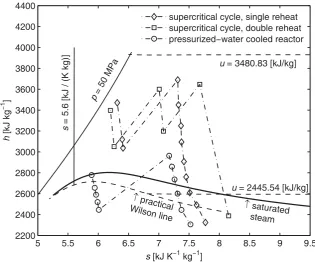
Figure 1: The required range of validity of the formulation in the entropy – enthalpy diagram.
id res
ref
ref
,
( )
ln
s u
U
s
u
R
U
s
u
,
U
U
. (11)As indicated in Eq. (11), the ideal-gas entropy at reference density only depends on the internal energy. The detailed forms of the ideal gas term and the residual term will be discussed in separate sections.
3. R
ANGE OFV
ALIDITYThe formulation is developed to cover completely the operation region of steam turbines, including supercritical cycles and nuclear cycles. It also covers the region of metastable supersaturated steam. The region is shown in Figure 1. The diagram shows expansion lines of typical modern steam cycles. The region of validity is limited by the following relations:
1
5.6 kJ K
kg
s
t
1, (12)50 MPa
p
d
(13)1
2445.54
3480.83
kJ kg
u
d
d
, (14)0.05
0 50 100 150 200 2400
2600 2800 3000 3200 3400 3600
U [kg m3
]
u
[kJ kg
1
]
u = 3480.83 [kJ/kg]
u = 2445.54 [kJ/kg]
s = 5.6 [kJ / (K kg)]
p = 50 MPa
U / [kg/m
3 ]
= 0.4897 u / [kJ/kg] 1181 U / [kg/m
3 ] = 0.1176 u / [kJ/kg] + 519
saturated steam n practical Wilson line
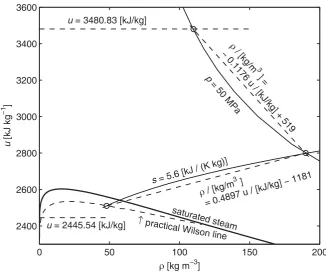
Figure 2: Region of validity in the density-internal energy diagram.
The last equation characterizes the extent to which the supersaturated steam is considered. In reality, the limit of supersaturation is given by the onset of nucleation which, however, depends on particular conditions. When plotted in a Mollier diagram, the locus of nucleation onset is called the Wilson line. In order to avoid the complexity of nucleation in specifying the range of validity, we accept the method given in the industrial formulation IF-97 [4]. The practical Wilson line is determined as line of equilibrium moisture of 5% in the pressure-enthalpy diagram. For a given pressure
p
and enthalpyh
of the supersaturated steam we compute the corresponding equilibrium moisturey
as( )
( )
( )
h h p
y
h p
h p
c
cc
c
, (16)where the saturated liquid enthalpy
h’
and the saturated vapor enthalpyh’’
are obtained for the actual pressure of the supersaturated steam.The range of internal energies (14) corresponds in the zero-density limit to temperatures 50°C and 700°C.
Figure 2 shows the region of validity in the variables of the formulation, density and internal energy. It was practical to replace the entropy limit given by Eq. (12) by a straight line
3
0.4897
11181
kg m
kJ kg
u
U
0.35 0.4 0.45 0.5 0.55 0.6 0.65 0.7 6.8
7 7.2 7.4 7.6 7.8 8 8.2 8.4 8.6 8.8
x
s id
[kJ K
1
kg
1
]
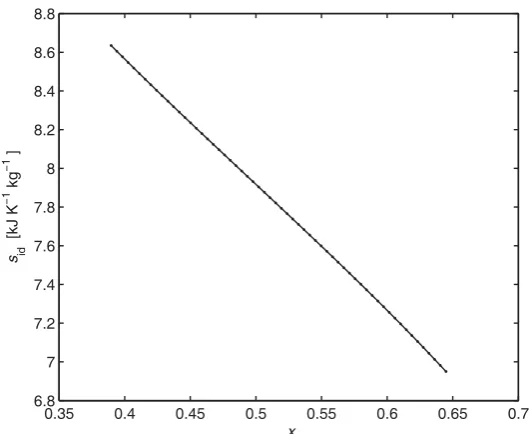
Figure 3: Ideal-gas entropy as function of variable x, given by Eq. (19)
Similarly the limitation to pressures up to 50 MPa, Eq. (13), was replaced by a straight line
3
0.1176
1519
kg m
kJ kg
u
U
d
. (18)4. I
DEALG
ASP
ROPERTIESThe ideal gas entropy at reference density
U
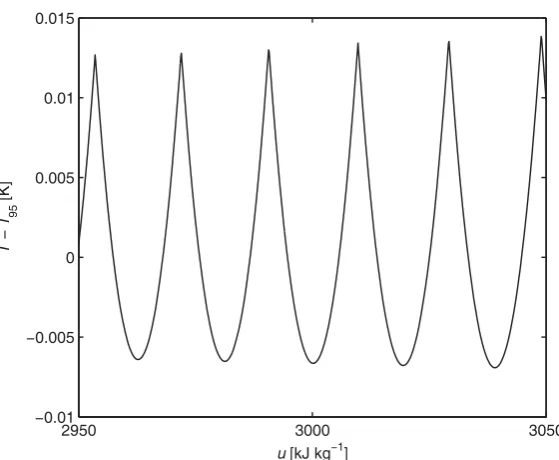
ref = 1 kg m-3 was generated from the IAPWS-95 formulation. We represented the generated data in form of a quadratic spline with continuous first derivatives. Using the internal energy as interpolation variable brought about a large scatter of the derivatives. Therefore, we introduced an energy parameterx
,6
1 5
10
J kg
9 10
/
x
u
{
ª
º u
¬
¼
. (19)
2950 3000 3050 0.01
0.005 0 0.005 0.01 0.015
T T
95
[K]
u [kJ kg1]
Figure 4: Deviation of the spline-interpolated temperature from the accurate value generated from the IAPWS-95 formulation
5. R
ESIDUALE
NTROPYF
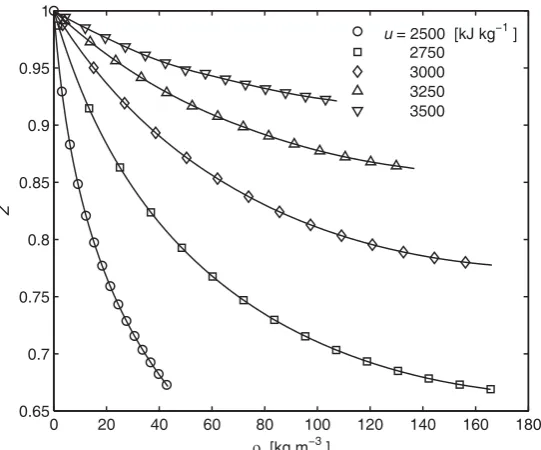
UNCTIONIn order to develop an appropriate expression for the residual entropy, we first analyzed the dependence compressibility factor
p
Z
RT
U
{
(20)on density for fixed values of internal energy, as shown in Figure 5. Data produced from the gas equation [1] were used for density up to 55 kg m-3 and the IAPWS-95 formulation was used for higher densities. The compressibility factor was expanded into a truncated virial series
7
1
1
i ii
Z
¦
a
G
, (21)where
G U U
{
/
c andU
c =322 kg m-3 is the density of water at the critical point. The virial coefficientsai
have alternating sings, starting from a negativea
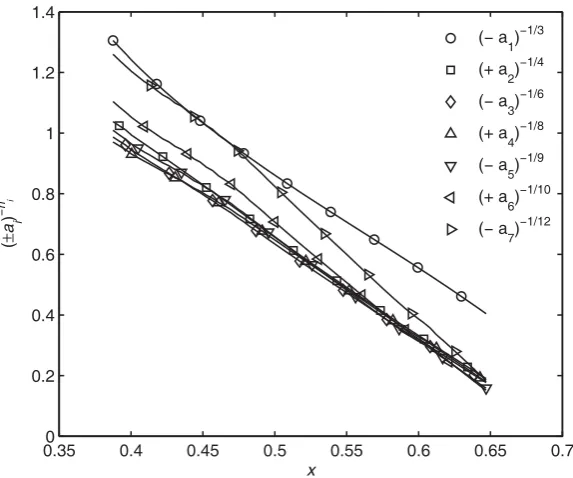
1. The coefficients very strongly increase with decreasing internal energy (corresponding to decreasing temperature at zero density). In order to provide an accurate spline-interpolation scheme, we scaled these dependencies as shown in Figure 6. The integer powersn
i were chosen such that the transformed coefficientsA
i, defined as, (22) 1/
( 1)
i nii i
A
{
ª
¬
a
º
¼
0 20 40 60 80 100 120 140 160 180 0.65
0.7 0.75 0.8 0.85 0.9 0.95 1
U [kg m3 ]
Z
u = 2500 [kJ kg1 ]
2750 3000 3250 3500
Figure 5: Compressibility factors for various internal energies as functions of density.
interpolation is needed to correctly represent the strong real-gas effects of saturated and supersaturated steam. In computations, the inverse function must be evaluated:
( 1)
i
i
i n
i
a
A
. (23)
This evaluation is fast when the integer powers are implemented via multiplication.
Now we develop a formula relating the residual entropy to the compressibility factor given by Eq. (21). From Eq. (11) we find for the dependence of the residual entropy on density
res
u u
s
s
R
U
U
U
§
w
·
§
w
·
¨
¸
¨
¸
¨
w
¸
©
w
¹
©
¹
. (24)
Further, using Eq. (4) at place of the entropy derivative and definition (20) of the compressibility factor
res
1
u
s
Z
R
U
U
§
w
·
¨
¸
¨
w
¸
©
¹
. (25)In the integration we use the fact that the residual entropy, by definition, vanishes at zero density:
res
0 0
( ,
) 1
( ,
) 1
Z u
Z u
s
R
UU
d
U
R
GG
d
G
U
G
c
c
c
c
c
c
³
³
. (26)0.350 0.4 0.45 0.5 0.55 0.6 0.65 0.7 0.2
0.4 0.6 0.8 1 1.2 1.4
x
(
r
a i
)
n i
( a
1)
1/3
(+ a
2)
1/4
( a
3)
1/6
(+ a
4)
1/8
( a
5)
1/9
(+ a
6)
1/10
( a
7)
1/12
Figure 6: Virial coefficients of Eq. (21) in a scaled plot.
7 7
1 res
0
1 1
i i i
i
i i
a
s
R
a
R
i
GG
c
G
³
¦
¦
. (27)Expansion (21) can be related to the conventional virial equation of state
1 2
1
i ii
Z
B
U
t
¦
. (28)The main difference between expansions (21) and (28) is that the conventional virial coefficients
B
i are functions of temperature, whereas coefficientsa
i depend on internal energy. Exact relations between coefficients of both series can be found if both series are considered as Taylor expansions about the zero-density point:1 c
a
U
B
2, (29)2 2
2 2
2 c 3 id
v
RT
dB
a
B
dT
c
U
ª
«
§
¨
·
¸
º
»
©
¹
«
»
¬
¼
. (30)
Relations (29) and (30) are valid only when both the constant-temperature expansion and the constant-internal-energy expansion are treated as Taylor expansions. In practice, these are rather polynomial fits to a range of densities. Therefore, the relations are valid only approximately.
6. C
ONCLUSIONSindependent variables. The present approach combines table look-up (in the
u
-direction) with a global equation (in theU
-direction). Pre-computed table of the ideal-gas entropy at the reference density and seven coefficients are tabulated in dependence on the internal energy. Quadratic spline interpolation is used, ensuring smoothness of the entropy function, given by Eq.id ref
s
a
1,
!
,
a
7(11), and continuity of the temperature and pressure functions, derived using relations (5) and (6). Quantities depending on second derivatives of the entropy (e.g. speed of sound, heat capacities) vary discontinuously, however in narrow tolerances. Smoothness of temperature and pressure, and continuity of second derivatives, can be provided by using a cubic interpolation method, at the cost of somewhat higher computing time.
The formulation is valid in a range exceeding the operation range of present steam turbines, including high-pressure turbines of supercritical cycles and PWR cycles. The formulation is also valid in the region of metastable supersaturated steam. Unlike the IAPWS-95 and IAPWS IF-97 formulations, both stable and metastable regions are described by a single formulation.
7. A
CKNOWLEDGMENTSThe author gratefully acknowledges a support by grant No. IAA200760905 of the Grant Agency of the Academy of Sciences of the Czech Republic and grant No. P101/11/1593 of the Grant Agency of the CR. Participation in IAPWS activities was supported by grant No. LA09011 of the Ministry of Education, Youth and Sports of the CR.
8. R
EFERENCES[1] W. Wagner W., Pruß A.: The IAPWS Formulation 1995 for the Thermodynamic Properties of Ordinary Water Substance for General and Scientific Use. J. Phys. Chem. Ref. Data 31 (2002) 387—535.
[2] International Association for the Properties of Water and Steam, Release on the IAPWS Formulation 1995 for the Thermodynamic Properties of Ordinary Water Substance for General and Scientific Use, available at http://www.iapws.org (September 1996).
[3] Wagner W., Coope, J. R., Dittmann A., Kijima J., Kretzschmar H.-J., Kruse A., Mareš R., Oguchi K., Sato H., Stöcker I., Šifner O., Takaishi Y., Tanishita I., Trübenbach J., Willkommen Th.: The IAPWS Industrial Formulation 1997 for the Thermodynamic Properties of Water and Steam, J. Eng. Gas Turbines & Power 122 (2000) 150-182.
[4] International Association for the Properties of Water and Steam, Revised Release on the IAPWS Industrial Formulation 1997 for the Thermodynamic Properties of Water and Steam, available at http://www.iapws.org (August 2007).
[5] Miyagawa K., Hill P.G.: Rapid and Accurate Calculation of Water and Steam Properties using the Tabular Taylor Series Expansion Method, ASME J. Eng. Gas Turbines & Power 123 (2001) 707-712.