Journal of
RANGE MANAGEMENT vozu~~~v,
zyber
1
Applied Landscape Management in Plant Control
Robert M. Williamson and W. F. Currier Grazing History of the Northwest __._ William A. Galbraith and E. William Anderson Grazing in the Middle East: Past, Present and Future _______._______.____ C. Kenneth Pearse Lehmann Lovegrass on the Santa Rita Experimental Range,
1937-1968RE ___________._______________________________._____-_--_____--___-_---_______---_-___--- Dwight R. Cable Increasing Utilization of Weeping Lovegrass by
Burningun ________________ W. Ellis Klett, Dale Hollingsworth, and Joseph L. Schuster Natural Reproduction of Winterfat (Eurotiu Zunata) in
New Mexico __________..______..________________ Robert G. Woodmansee and Loren D. Potter Soil and Grazing Influence on a Salt-desert Shrub Range
in Western ColoradoRE ____.__ __ _____.__ _____ ____.. _______._______ _.__ _____.___________ George T. Turner Monthly Variation in the Chemical Composition of Desert Saltbrush
N. J. Chatterton, J. R. Goodin, C. M. McKell, R. V. Parker, and J. M. Rible Response of Medusahead to Paraquat
James A. Young, Raymond A. Evans, and Burgess L. Kay Influence of Rootplowing and Seeding on Composition and Forage Production of Native Grassesun ____ Gary W. Mathis, Merwyn M. Kothman, and Wm. J. Waldrip Blue Grama Response to Nitrogen and Clipping Under Two
Soil Moisture Levels ______ ____._ _____ ____ _.____ _____ ____________ Jerry L. Reed and Don D. Dwyer Blue Grama Vegetation Responds Inconsistently to Cholla Cactus
Control ____________________---____________________.._________---_____----_-___________________--________ Rex D. Pieper Seasonal Trends in Herbage and Nutrient Production of Important Sandhill
Grasses ___._________.__________ Phillip L. Sims, Gilbert R. Lovell, and Donald F. Hervey Seasonal Variations of the In Vitro Dry-Matter Digestibility of
Three Sandhill Grasses ________________________________-_______--____________________________ D. F. Burzlaff Use of Radiophosphorus and Soil-Block Techniques to Measure
Root Development ________________________________________ R. D. Pettit and Chester C. Jaynes Rainfall Pattern and Monthly Forage Yields in Thal
Ranges of Pakistan ______________________________.____________________.________________ Ch. M. Anwar Khan
Technical Notes
Imbibition by Alkali Sacaton Seeds _______________________-__--______---_____--____---_ 0. D. Knipe Estimating Digestible Energy from Digestible Dry and Organic Matter in Diets
of Grazing Cattle ____ L. R. Rittenhouse, C. L. Streeter, and D. C. Clanton
Management Notes
Freeze vs. Fire Branding as Methods of Beef Cattle
Identification ___________.______________._________________________ F. A. Thrift and C. W. Absher
Book Reviews ______________________________-_-________________--__________.______-_______--______-____---_____--___________________________ RE = Con Resumen en Espaiiol.
2 6 13
17
22
24
31
37
41
43
47
52
55
60
63
66
71
73
75
79
Cover
Photo-
AppliedLandscape Management
in Pinyon- Juniper
Control, Carson National Forest.
Applied Landscape Management
in Plant Controll
ROBERT M. WILLIAMSON AND W. F. CURRIER
Chief, Branch of Range Inventory and Management Planning, and Chief, Branch of Management and Improvement, Division of Range and Wildlife,
Region 3, U.S. Forest Service, Albuquerque, New Mexico. Highlight
Plant control results in drastic abrupt changes in the dominating landscape of a site. To lessen this impact and create a pleasing aspect, the land manager must use his ingenuity in applying techniques that will result in coordinating basic data, soils, wildlife needs, esthetics, and range to arrive at an action plan that will maximize all resources and activities. Perhaps the most difficult land resource value to assess, maintain, and manage, is natural beauty. Thus, the application of a plant control project is a challenge in landscape manage- ment application. Experience has shown that, through a joint effort by all disciplines, it is possible to apply a practical form of landscape management that results in the retention and even enhancement of the natural beauty while accomplishing the basic resource objectives desired in a plant control program.
Grazing by domestic livestock in the Southwest dates back to its in- troduction by the Spanish in the 1600’s. By the beginning of the twentieth century, low value forage plants-pinyon, juniper, mesquite, chaparral, and in some cases pine, began to invade natural grass- lands. The invasion progressed very rapidly.
At present, there are 2,500,OOO acres of formerly open grasslands that have converted to low value forage plants in the Southwestern Region of the Forest Service. This change in vegetation has resulted in deterioration, loss of forage pro- duction, inferior wildlife habitat for certain species, and a change in the hydrologic water balance in affected sites.
Accelerated invasion by woody plant species has now progressed to the point where mechanical or chemical treatment must be applied. Control by these methods results in dramatic changes in the land- scape. Now that there is so much concern by so many people about the environment, the land manager, particularly the public land man- ager, must place high priority on developing techniques and proce- dures which make environmental
l Received February 13, 1970; accepted for publication April 25, 1970.
change acceptable to the public. Plant control treatments must be esthetically pleasing. The natural beauty of the landscape cannot be marred. Landscape management has become another of many re- sponsibilities of the land manager, to be fitted into all plant control projects along with range, water- shed, and wildlife considerations.
Project Planning and Objectives The first step in accomplishing a plant control project is assembling
basic resource data. Range analy- sis, soil classification maps, wild- life habitat inventories, sediment studies, and other hydro’logic data should be considered. These col- lectively determine the sites where plant control can be applied to provide overall benefit. Through joint effort with the landscape architect and other specialists, it is possible to blend this basic resource data with the concepts of wild land landscape management. This de- velops an overall plan that will ful- fill all of the multiple use manage- ment objectives. Experience shows that the quality of the end product is directly related to the quality of the planning effort. A sound plan cannot be built on assumptions. It must be based on facts and proved theory.
The Ranger District Multiple
2
Use Plan sets the coordination re- quirements and management deci- sions that apply to the management unit in which the control work is to be carried out. Soil scientists provide soils information. The wildlife biologists can point out key areas and predict what the effects of plant control will be on wildlife. Watershed specialists can tell what work is necessary to reduce soil loss and improve the hydrologic condition. The range manager can evaluate the existing situation, plan the necessary livestock controls dur- ing the action program, and define the management procedures neces- sary to maintain the site once a grassland type is restored. The landscape architect should provide the artistic perception to insure the natural appearance of the finished project. This last mentioned skill has not always been considered as necessary in plant control project planning. As a result, we have many horrible examples which continue to haunt us and are hindering the overall program because of adverse public opinion (Fig. 1). Natural beauty must be a primary objective in plant control project planning and must be considered in all as- pects of multiple use management of wild lands. Landscape manage- ment in plant control activities be- comes the application of many variables to a procedure that re- sults in a completed project that enhances all multiple use values (Fig. 2).
Soils
A detailed soil survey will iden- tify the soils with forage production potential and the areas that should not be treated. Where soils are highly variable, adhering to soil information will often produce ideal patterns. Where soils are homogeneous, large, open patterns could develop if all treatable soils are worked without considering other on-site values.
Wildlife
LANDSCAPE
MANAGEMENT
This is especially true in the pinyon-juniper type of the Soutlr- west. Cover, as well as food supplies must be considered. Where large ex- panses are worked without concern for wildlife cover, much acreage is lost from a wildlife point of view even though overall wildlife forage is improved. If cover is left at ir- regular intervals, not greater than % to ‘% mile apart and edges un- dulated, acreage can be added to the wildlife habitat. Small game and songbird species should not be neglected when prescribing plant control, although they often are. Scattered brush piles-one per acre or less-or individual tree carcasses will often meet the needs of these species and improve their habitat whiie not detracting from the esthetic value. Large, randomly spaced trees scattered throughout the project will aid in providing spring forbs and grasses which are extremely important to wildlife habitat in the Southwest (Fig. 3). At tire same time, these trees pro- vide a pleasing aspect to the land- scape.
Watershed
Much plant control work is un- dertaken to increase water produc- tion. One study in the chaparral
type in Arizona has indicated about 3.0 inches more water per year as a result of brush control. (Pax and 1Ilgel~o, 1965). Increased water loses much of its value if the quality has deteriorated as a result of soil mis- management. On some sites, re- moval of the over-story and expo- sure of the soil surface becomes a catastrophe from a soil stability
3
point of view. These untreatable areas can be used effectively in ar- riving at the final esthetic pat- terns. The opposite may also be true. By removing low value woody species and establishing a grass cover, active erosion can be arrested and soil stability developed. Gullies and polluted water detract from the esthetic values of the land.
Range
In range management the objec- tive of a plant control project is to develop the range x~~ource to its maximum, consistent with other Multiple Use values.
To blend these values, a range environmental analysis must be available. The analysis provides areas of higb priority for plant control and the plant species re- quiring control for range manage- ment purposes, and location for potential structural improvements, fences, and water developments that will be needed for management of livestock during and after the con- trol program.
4 WILLIAMSON AND CURRIER
.(.. :.I’“““?i:.:::- .,. .:.I’:‘.‘ ,.. ;~%.;’ ::’
/, ..,.. i.,
plant control project. The analysis and management plan becomes the basic range data to use in coordi- nating and planning a plant control program.
Natural Beauty
Until recently, natural beauty was not a major consideration. An example of this is in the plant con- trol work in travel influence zones.” Earlier plant control efforts left buffer strips for screening between roads and worked areas. However, experience over the years shows that bringing the control effort into the travel influence zone is much more pleasing than leaving a buffer zone along roads. By having this arbi- trary leave area, a false impression is left to the casual viewer, and draws attention to the control area. Many times when control work is brought into tire travel influence zone, the casual viewer will not be aware of the vegetative change.
*Travel Influence Zones are defined as areas in which beauty of the land- scape and other esthetic values are an important part of the outdoor en- vironment. These offer significant op. portunities for existing, planned, or anticipated recreational use and cn- joyment by people visiting or travel- ing through the mne.
In this day of air travel, the pat- tern as presented from an aerial view must also be considered. A considerable acreage is seen and observed by more people from the air than is ever seen via the ground route. Viewed from the air, straight edges and rectangular clearings are examples of objectionable patterns. However, if other guidelines are followed, the aerial view will be pleasing to the eye.
(-,‘_” ,,, , - . . (_,,“,‘
Existing vegetative distribution provides evidence of natural open- ings that once were present. Many times this existing pattern will coin- cide with the desirable pattern.
Where other factors do not create undulation in edges, it should be done artificially. Land patterns, in areas of varied ownership, must be supervised to hold straight lines to a minimum. Many times it will be necessary to coordinate new work with old work done under different standards.
Feathering can be accomplished in layout by taking advantage of various stand densities, or it can be created artificially. Feathering is perhaps one of the hardest practices to apply in pattern layout.
When applying these practices, it is very important to continually be aware of the dimensional aspects that are inherent in plant control work. Finished projects are viewed from all angles and should present the desired characteristics from any direction. A well broken up pat- tern from one view can become a wide open expanse from another angle, thus detracting from the nat- ural beauty.
LANIYX4PE MANAGEMENT
project from a landscape point of view. Cleanup of debris often pro- vides the finishing touches. Failure to clean up often results in criticism and adverse publicity for an “ther- wise successful project (Fig. 4). There are many methods of control, with no one best method that can be applied to all projects. It is im- portant t” consider cleanup require- ments in initial control method planning. Frequently, cleanup re- strictions will dictate the control method.
A pinyon-juniper control project is an example of how cleanup is structured into the overall project effort. Control of pinyomjuniper can be accomplished by pushing. Through development of a burning plan, fire can be used t” rem”ve the tree carcasses. (Southwest In- teragency Fire Council, 1968).
By using a helicopter, broadcast seeding can be accomplished. To prepare the seedbed, cover the seed, and smooth up the rough edges left from the burning, an anchor chain can be dragged over the area (Fig. 5). The results will be an esthetically pleasing project that meets the overall objectives. In some cases, trees are piled or wind- rowed prior to burning to insure a greater consumption of debris.
Wheu Itsing tire in the cleauup
sequence, it is extremely important t” time burning so that air pollu- tion is held t” a minimum. Many times other means of disposal will have to be used to prevent air pollution.
Control and cleanup can be done
5
in one operation with the “tree crusher” (Fig. 6). Such a machine uproots and crushes the trees in one operation. This control method has been extremely successful in dense, rock-free mature pinyon- juniper stands and especially where air pollution can be a factor.
Each species requires different approaches t” the cleanup task. Each stand or site can also require a different approach. The impor- tant thing is t” accomplish cleanup to a degree that is pleasing to the eye. Complete cleanup could result in a conflict with the determined needs of a basic resource. When this occurs, a coordinated level must be reached that will minimize all aspects of the cleanup phase.
6 GALBKAITH AND ANDERSON
Summary
Most of the factors involved in a successful multiple use plant con- trol project have been discussed. How are these meshed together into a simple set of clear-cut guide- lines that will guarantee the desired results in all situations? Experience shows that this is not possible. Each and every site has its own characteristics and must be treated individually.
How then are guidelines for in- dividual projects prepared? First, a multiple use survey and report is developed. This gives the line officer insight into the plant con- trol proposal and evaluates the ef- fects that alternatives of location, design and standards will have on existing and potential resources and activities. It goes on to accurately define the coordination opportu- nities to be included in the action
plan to enhance beneficial and minimize adverse aspects of the proposal. Once this is accomplished, guidelines can be developed that achieve the desired coordination.
Plant control itself will alter the ecosystem that is currently on the site. The land manager must be in a position t 0 insert offsetting in- fluences if he is to retain accom- plish ments. These influences can and should be built into the man- agement practices applied to the area following plant control.
Plant control projects go on after the initial on-the-ground work is done. Theie must be management and followup maintenance to in- sure that benefits are retained. All too often interest lessens with the completion of the plant control sequence. When management has not been pre-planned and re-
Grazing History of the Northwest1
WILLIAM A. GALBRAITH AND E. WILLIAM ANDERSON
Power Marketing Specialist, Bonneville Power Administration; and State Range Specialist, Soil Conservation Service, Portland, Oregon.
Highlight
The earliest grazing in the Northwest (which probably began about 1700) was by Indian horses. Livestock-a few head of cattle-were first brought to the Northwest at Nootka Bay on Vancouver Island, B.C., by Spaniards in 1789. By 1825, there were 27 head of cattle at Vancouver, Wash., near the mouth of the Columbia River. Marcus Whitman brought cattle to the area east of the Cascade Mountains in 1836. Mass movements of cattle took place from western Oregon to east of the Cascades during the 1860’s. Numbers skyrocketed which resulted in sizeable exportations of livestock in the late 1800’s to regions east of the Rocky Mountains, largely for building base herds. These drives con- tributed significantly to development of the livestock industry east of the Rockies, although they have been largely neglected by writers who chose, rather, to popularize the cattle drives from Texas and the Southwest.
Raising livestock on rangeland is still, and will continue to be, one of the major basic industries in the Pacific Northwest. There are many millions of acres of private and public rangeland and grazable woodland in the Pacific Northwest on which concurrent grazing by livestock and game shouJd continue to be one of the major uses of the resource.
The history of grazing seems to the greatest natural resources avail- have followed a similar pattern able to man-then deterioration or throughout the world. First, an
abundance of native forage-one of loss of that resource, followed by ef- forts for rehabilitation. This paper
l Received Sep tember 27, 1969; ac- summarizes the grazing history of cepted for publication June 8, 1970. Oregon, Washington, and British
lated development work, waters, and fences programmed and accom- plished simultaneously with plant control, the users cannot take the full advantage of the benefits, nor does the administrator fulfill his obligations.
A project is complete and suc- cessful only when a management plan is activated and followup ac- tion assured, resulting in the per- petuation of the acquired benefits. The critical factor of overall plan- ning cannot be neglected if land- scape management in plant control projects is to be successful.
Literature Cited
PASE, C. P., AND P. A. INGEBO. 1965.
Proceedings of the Arizona Water- shed Symposium, Sept. 22, 1965. Tempe, Arizona.
SOUTHWEST INTERAGENCY FIRE COUNCIL. 1968. Guide to Prescribed Fire in the Southwest. 58 p., illus.
Columbia. The history of grazing in this region is a very large part of the history of the people who developed the region.
In 1805 when Lewis and Clark reached the mouth of the Columbia River, completing their journey of exploration, the Northwest was a vast land untouched and unex- ploited by civilization. The natural resources were mainly timber, min- erals, water, and land. But before any of these could be developed and made to serve mankind, people had to be able to live from the land. An all-important resource, namely grass, made this possible. Here was a resource immediately necessary and immediately available.
6 GALBKAITH AND ANDERSON
Summary
Most of the factors involved in a successful multiple use plant con- trol project have been discussed. How are these meshed together into a simple set of clear-cut guide- lines that will guarantee the desired results in all situations? Experience shows that this is not possible. Each and every site has its own characteristics and must be treated individually.
How then are guidelines for in- dividual projects prepared? First, a multiple use survey and report is developed. This gives the line officer insight into the plant con- trol proposal and evaluates the ef- fects that alternatives of location, design and standards will have on existing and potential resources and activities. It goes on to accurately define the coordination opportu- nities to be included in the action
plan to enhance beneficial and minimize adverse aspects of the proposal. Once this is accomplished, guidelines can be developed that achieve the desired coordination.
Plant control itself will alter the ecosystem that is currently on the site. The land manager must be in a position t 0 insert offsetting in- fluences if he is to retain accom- plish ments. These influences can and should be built into the man- agement practices applied to the area following plant control.
Plant control projects go on after the initial on-the-ground work is done. Theie must be management and followup maintenance to in- sure that benefits are retained. All too often interest lessens with the completion of the plant control sequence. When management has not been pre-planned and re-
Grazing History of the Northwest1
WILLIAM A. GALBRAITH AND E. WILLIAM ANDERSON
Power Marketing Specialist, Bonneville Power Administration; and State Range Specialist, Soil Conservation Service, Portland, Oregon.
Highlight
The earliest grazing in the Northwest (which probably began about 1700) was by Indian horses. Livestock-a few head of cattle-were first brought to the Northwest at Nootka Bay on Vancouver Island, B.C., by Spaniards in 1789. By 1825, there were 27 head of cattle at Vancouver, Wash., near the mouth of the Columbia River. Marcus Whitman brought cattle to the area east of the Cascade Mountains in 1836. Mass movements of cattle took place from western Oregon to east of the Cascades during the 1860’s. Numbers skyrocketed which resulted in sizeable exportations of livestock in the late 1800’s to regions east of the Rocky Mountains, largely for building base herds. These drives con- tributed significantly to development of the livestock industry east of the Rockies, although they have been largely neglected by writers who chose, rather, to popularize the cattle drives from Texas and the Southwest.
Raising livestock on rangeland is still, and will continue to be, one of the major basic industries in the Pacific Northwest. There are many millions of acres of private and public rangeland and grazable woodland in the Pacific Northwest on which concurrent grazing by livestock and game shouJd continue to be one of the major uses of the resource.
The history of grazing seems to the greatest natural resources avail- have followed a similar pattern able to man-then deterioration or throughout the world. First, an
abundance of native forage-one of loss of that resource, followed by ef- forts for rehabilitation. This paper
l Received Sep tember 27, 1969; ac- summarizes the grazing history of cepted for publication June 8, 1970. Oregon, Washington, and British
lated development work, waters, and fences programmed and accom- plished simultaneously with plant control, the users cannot take the full advantage of the benefits, nor does the administrator fulfill his obligations.
A project is complete and suc- cessful only when a management plan is activated and followup ac- tion assured, resulting in the per- petuation of the acquired benefits. The critical factor of overall plan- ning cannot be neglected if land- scape management in plant control projects is to be successful.
Literature Cited
PASE, C. P., AND P. A. INGEBO. 1965.
Proceedings of the Arizona Water- shed Symposium, Sept. 22, 1965. Tempe, Arizona.
SOUTHWEST INTERAGENCY FIRE COUNCIL. 1968. Guide to Prescribed Fire in the Southwest. 58 p., illus.
Columbia. The history of grazing in this region is a very large part of the history of the people who developed the region.
In 1805 when Lewis and Clark reached the mouth of the Columbia River, completing their journey of exploration, the Northwest was a vast land untouched and unex- ploited by civilization. The natural resources were mainly timber, min- erals, water, and land. But before any of these could be developed and made to serve mankind, people had to be able to live from the land. An all-important resource, namely grass, made this possible. Here was a resource immediately necessary and immediately available.
were moved across the strait to Neah Bay, Washington. These were the iirst known cattle in the Northwest.
By 1825 cattle were beginning to be a factor in the economic life of certain is”!ated areas. By that time, there were 27 head at Van- c”uYer near the mouth or the Columbia River. The following year in what is now eastern Wash ington tllere were a few cattle in Okanogan Valley and 3 young cows at Fort Colville.
Marcus Whitman brought several
sheep, and horses all depended upon grass for their sustenance.
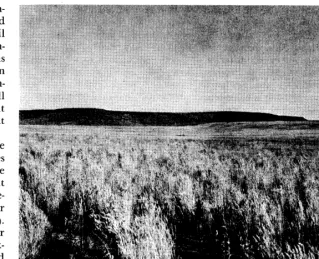
In the early 1800’s, this vast region produced some of the finest grassland in the world (Fig. 1). Component species collectively were called bunchgrass. Three major species were prominent in this vast sea of grass which lay east of the Cascade Mountains. These are bluebunch wheatgrass (Agro,bym .spicntum Pursh.), Idaho fescue
(Festucn idnhoensis Elmer.) and
Sandberg blueg-rass (Pea secunda Presl.). The larger grasses grew 18 to 36 inches tall and, either green or dry, were excellent forage ior livestock. In the valleys, on the hills and on the plains, these grasses extended like endless seas. Along with this seemingly unlimited sup- ply of food for livestock was also an abundance of water. Much of the water was poorly distributed, but over-all, Few places in the world had ever been endowed so lavishly with this essential resource.
Indians were making some use of the grass. In a Shoshone village, Lewis and Clark saw 700 horses. They estimated that there were thousands more in the hills. These
head of cattle across the country to ‘IVa!la Walla Valley, Washing- ton, in 1X36. By this time people in the little settlements throughout the Northwest were recognizing the importance of cattle and sheep and that there was iood in abundance for such livestock. The first re- corded kill of cattle specifically for beef was at Vancouver, Washington, in 1836. Up to this time, cattle
were descendants of Spanish horses were kept to produce milk and from the Southwest. It is believed cheese and to increase in numbers. that the Shoshone Indians acquired By the middle 1830’s, Oregon their first horses between 1690 and Territory was being recognized as 1700 from a Spanish mission at R land of opportunity. More and Santa Fe, N. Mexico (Haines, 1938). more the word was being spread By 1730, horses probably ranged in throughout the East that here was the Snake River Valley of southern a land from the west slope of the Idaho and throughout parts of east- Rockies to the Pacific Ocean where ern Oregon and Washington. When grass was never ending, where water the first white men came, these was in abundance, and where tim- horses along with game, mostly deer ber was available for cabins and and elk, were the only consumers other buildings, all free to men oi native forage. Very few buffalo with the courage to take it. More- moved into the Pacific Northwest over, it was accepted as a fact that region. A few sometimes entered the climate was such that livestock the Snake River Valley, and some could live on the “pen range may have moved as Ear west as throughout the winter and thrive. Wenatchee, Wash.; but they were Even in the face of early experi- never a factor in grass consumption ences to the contrary, this theory in the Northwest. was believed, a theory which was to
Probably unknown to I.ewis and prove disastrous in the years ahead. Clark when they reached the Pacific Newspapers in eastern towns and Ocean in 1805, was the fact that 16 cities published glowing accounts years before (in 1789) the Spaniards of this +-ion. It was a land where had brought a few head of cattle men and their families had only to their settlement at Nootka Bay to reach to become economically on Vancouver Island, B.C., some free and independent.
400 miles to the north. These cattle Consequently, people came-im- had been brought by sailing vessel migrants, soldiers, missionaries, and from the Hawaiian Islands. In fortune seekers.
8
GALBRAITH
AND ANDERSON
William A. Slacum on a mission of inquiry into Oregon Territory. Mr. Slacum considered the Willamette Valley of Oregon the finest grazing country in the world. He assisted in transporting men from the Wil- lamette Valley by ship to California to purchase and drive a herd of cattle back to Oregon. This was in January 1837. Late that summer the men returned with nearly 800 head of cattle.
Two years later a committee of the Hudsons Bay Company estab- lished the Puget Sound Agricul- tural Company. It established ex- tensive farms at Nisqually and Cowlitz in western Washington and imported cattle and sheep from California. The objective of the Company was to develop flocks and herds on an extensive scale to pro- duce wool, hides, and tallow for the British market.
By 1850, from small beginnings, herds were expanding throughout the Territory. Thousands of cattle were being driven across the plains to the Northwest. This region was on the eve of one of the most colorful, courageous, and finally, disappointing periods in American history. The day of the cattle king and the range baron, the day of exploitation of rangeland had ar- rived.
In 1860 there were 65,000 people in the new state of Oregon and the territory of Washington and nearly 200,000 cattle. Expansion in the use of rangeland had been fantastic.
Along with the growth of the cattle industry was the expansion of sheep raising. The Puget Sound Agricultural Company raised sheep on its Nisqually and Cowlitz farms. A few head were brought to the mission at Waiilatpu near Walla Walla, Washington, in 1841 from Hawaiian Islands. A flock of sheep was driven to the Willamette Valley in the wake of that first cattle drive from California in 1837. In 1844, the first sheep crossed the plains in to Oregon.
Emphasis usually is placed on cattle and sheep as the consumers and destroyers of grass, but it must
be remembered that horses also increased in great numbers. Every- one needed horses. In addition to those raised and used, there were thousands of wild horses on the range. This explosive expansion of livestock on the open range was soon to take its toll, but up to this time it was barely noticeable.
The oldtime cattleman, the rangeland operator of 1850-1890, was probably the toughest, most courageous, most independent, sometimes the kindest, and often the ornriest character this country ever produced. From where we are now, he appears to have been in some respects a man of vision and in others a man without foresight. The normal risks he accepted as part of his business would appear overwhelming to most people to- day. Let’s look at some of the facts of life that faced him. First, he had to acquire a few head of cattle and get them to the open range. Then his troubles really began. To name a few, there were marauding In- dians; rustlers (other men trying this method of getting a start for themselves) ; natural predators such as coyotes, wolves and cougars; poison weeds and roots which cat- tle often ate; rattlesnakes; natural disease; grass and forest fires; and bitter cold winters. These things the cattleman accepted, fought, and finally overcame. His real fight for existence was yet to come.
Despite these hazards, the cattle industry boomed. These were the days when the cattleman was king, the day of the cattle drive, the cow town and the cowboy-a colorful and interesting period.
Even in 1850, cattlemen were striving to improve the quality of their livestock. Purebred cattle, sheep, and horses were brought to the region.
Until about 1870, all the prod- ucts of the expanding cattle and sheep industry were utilized locally. lMining operations were extensive and thousands of miners through- out the Northwest required meat and other products. The booming Cariboo district in British Colum-
bia was one of the most notable markets for livestock. Soon after the discovery of gold in this region, miners came by the shipload from California to Victoria, then moved inland to the gold fields. In the summer of 1858, General Joel Palmer organized a cattle drive at Fort Okanogan in Washington Ter- ritory. This drive moved up the Okanogan River, across into British Columbia south of Osoyoos, and then to the vicinity of Kamloops, where the miners happily welcomed the General and his herd.
Later, one of the great cattle kings of the Northwest, Ben Snipes, drove herds from the Yakima Valley to the Cariboo mining area. Some cattle were even driven from Ore- gon to this lucrative market. Local men in British Columbia soon rec- ognized the possibility of raising cattle for this market on their own rangelands and, thus, the cattle industry in British Columbia was born.
The contribution of the North- west to the early expanding cattle business of the Great Plains has been given scant notice. Cattle drives from Texas and the South- west have been highly popularized by writers whereas the role of the Northwest, although prominent, has been neglected. It is important to the history of the great American West to recognize the contribution made by the cattle industry of the Pacific Northwest.
GRAZING IN THE NORTHWEST 9
their markets were glutted. At the beginning of 1872 the average price in Oregon for oxen and other cattle was $23.23 per head. In January
1877 it was $11.80. Prices remained low until 1880 when there was a slight increase which continued for about 5 years. This depressed price in Oregon was similar to that for the United States during the late 1870’s.
Relief came to these hard-pressed cattlemen from increasing contacts made with markets east of the Rocky Mountains where there was a growing demand for cattle (Oli- phant, 1946). In 1875 it was re- ported that hundreds of cattle were bought at Walla Walla, Washing- ton, and driven to the Wyoming Territory. This started a slight movement of cattle eastward from the Northwest. Year by year this movement increased after an effec- tive beginning in 1876. One buyer’s herd in 1877 reportedly numbered
16,000 head and there were other cattle buyers moving cattle eastward each year. Because of their quality, a large proportion of these cattle was being used to build base herds east of the Rocky Mountains.
The movement of cattle eastward from Oregon country reached its peak in 1880. It was estimated that about 200,000 head had moved east- ward from the Pacific Northwest that year. The winter of 1880-81 decimated herds throughout the Northwest but numbers built up again so that in 1882 a large num- ber of livestock, including sheep and horses, were trailed eastward. The drive in 1882 was the last im- portant one to be made from Ore- gon country because the great sur- plus of cattle had been moved out of this region. With the comple- tion of the Northern Pacific Rail- road in 1883, trailing livestock out of the far Northwest diminished and shipping by rail increased. A rail shipment of Oregon cattle was made from Winnemucca, Nev., to Chicago as early as 1878, and in 1879 shipments to feeding grounds in Nebraska and Iowa were re- corded. By 1885, the Utah and
Northern Railroad and the Oregon Short Line also were providing a market outlet.
It is noteworthy that the cattle from the Northwest were con- sidered by the Wyoming buyers to be superior to Texas cattle as a base upon which to build their herds. Before 1876 or 1878 the great bulk of cattle were brought to that area from Texas. After that, their cattle came from the North- west, Nevada, Utah, and Idaho until it was reported that they had “practically exhausted the supply of Nevada, Oregon and Washing- ton Territory.”
During this period of grazing on the open range, there was no such thing as ownership of land, except that the Indians actually owned all of it. It is true that cattle and sheep men often established a place as their general headquarters or home range, but livestock grazed without much control. A large cattle owner might consider that a certain general area, extending per- haps 50 to 100 miles or even more from his home range, was his range although he had no legal claim to the land. Under this method of management, cattle from two or more owners often mingled on the same range. A method of branding and marking the calves was estab- lished, but often a cattleman did not know, even at roundup time, how many cattle were actually his. Carlson (1940) reported that in 1865, a Mr. F. Fry, an early eastern Washington settler, said “The most of which (eastern Washington) is spread over with rich succulent grass, forming one of those grand natural pastures, whereon innumer- able herds of cattle might be raised with very little attention, the cli- mate being so mild as to allow their running at large during the win- ter-the grass matures in the early part of the season and cures while standing on the ground, making winter as well as summer pasture- no part of America is better adapted to the growing of wool and sheep.” Mr. Fry certainly was correct about the grand and natural pas-
ture. His statement about the need for little attention to the livestock was generally accepted throughout the region. One newspaper of that time stated that a steer worth $5 at birth was worth $45 after four or five years on the open range. This was sometimes true provided of course the steer was still around at the end of 4 or 5 years.
One of the hazards that caught up with the stockmen several times from 1850 to 1890 was the climate, which was anything but mild. It was commonly believed that there was no need to raise hay and store it for winter use because winters in the Northwest were such that livestock could take care of them- selves out in the open. Dry grass was available under the snow or sticking through it; temperatures were such that animals could live through winter in comparative com- fort.
Despite the warnings of the win- ter of 184748, cattlemen believed in the yearlong open-range idea, and they were fairly correct until the winter of 1861-62. Snow came early, it piled deep, temperatures fell to more than 30 degrees below zero in nearly all areas east of the Cascades. It stayed that way for weeks. Later a warm spell was fol- lowed by more subzero weather which caused a crust on the snow so hard that no animal could break through to find feed. Through starvation and exposure to subzero temperatures, cattle and sheep died by the thousands. Some large owners were wiped out completely. The range was a graveyard in the spring of 1862. A Walla Walla newspaper stated that a thousand yards from town, one could almost step from one dead cow to another throughout the whole valley.
’
10GALBRAITH
AND ANDERSON
lieved that it was necessary to provide supplemental feed. One rancher in the Yakima Valley of Washington put up stacks of hay in the middle 1860’s and did not use any of it during a 5 year period.
So the open range idea prevailed and was generally again successful until the winter of 1880-8 1, which was like the terrible winter nearly 20 years before. Although the in- dustry again suffered a devasting blow, it again came back and, as previously stated, the 1880’s were some of the finest years for North- west cattlemen. The cold waited for nearly nine years before it struck again. After the still-remem- bered winter of 1889-90, most cat- tlemen finally accepted the fact that shelter and feed were required for a good cattle operation.
When railroads came to the Northwest in the 1880’s, they pro- vided something new to stockmen. Here was something that opened up new vistas, new markets, and new opportunities. A statement in the Journal, Bismarck, No. Dak., announced that the Northern Pa- cific Railroad had contracted to bring 40,000 head of cattle from Washington Territory. The major market, however, continued to be Chicago. A peak price of $9.35 per hundred pounds was reached in
1882.
Things must have appeared rather rosey to cattlemen and sheepmen in the Northwest at that time. Local markets were increasing by virtue of a growing population. Foreign markets were improving, and now they had direct transpor- tation to the beef-hungry cities of America. They were seeing the brilliant sunset just prior to the night. Already some shadows were falling.
Here and there were complaints about deterioration of the range. Soil erosion was being noted. Cat- tle were not doing as well in cer- tain areas as previously. By 1885, two points were clear. First, cattle raising was no longer a frontier in- dustry. Secondly, it was a victim of overexpansion. This overexpan-
sion was notable at that time in Washington, Oregon, Idaho, and probably to a lesser degree in British Columbia.
The greatest blow to believers of the open-range concept was be- ginning to be felt-a blow to be delivered by those who believed in private ownership of land.
It must be remembered that up to this time there were few barriers that could actually prevent move- ment of cattle. While rivers slowed the progress of cattle, they could be crossed by swimming. Large herds often crossed from one shore of the Columbia River to the other. Large herds also were driven through mountain passes from one river basin to another. Through all of this, they had right-of-way. To obtain right-of-way across private property is often more difficult than overcoming physical obstacles. The stockman of the open range was one of the first major users of a natural resource in the North- west. He helped build and develop the country. He was generally a good citizen. Naturally, he felt that his way of life was good and that the open range was his. True, he and his cattle, sheep, and horses had taken it from the Indians and their horses, but he intended to keep it.
A new kind of immigrant was moving into the Northwest-people who wanted to own 160 acres to plow, plant, and harvest, to stay put and live at home. The Federal Homestead Act of 1863 gave these people the opportunity to select a homestead, improve it, and own it. As they moved in, land was fenced with barbed wire, water holes and streams were fenced from use by stock on the open range; plows turned grassland under to produce wheat, hay, and vegetables.
Railroads also took their chunk of rangeland. In order to induce and assist railroads to build into the Northwest, the Government made grants of land to railroad companies. In some cases, a com- pany was granted every odd-num- bered section (a square mile con-
taining about 640 acres) of land for 10 miles on each side of the right-of-way. One company received every odd-numbered section for 20 miles on each side of its right-of- way in states and 40 miles on each side in territories. For a number of years, such companies allowed these sections to be used as open range, but as it became evident that overgrazing was doing damage and that these lands could be leased or sold, they were gradually removed from the open range.
As time and experience pro- gressed, more and more was learned about grazing management. Cer- tainly, cattlemen from Texas and the Southwest had previously seen what overgrazing had done in those areas. But every area of rangeland has its own characteristics. On the fringe of the grasslands of the Northwest grew a rugged shrub called sagebrush (Artemisia tri- dentata Nutt.). Throughout the centuries bunchgrass had conquered its own domain, but always at hand, sometimes in rocky or shallow soil or other droughty situations, but sprinkled throughout the grassland area was the ever-present sage- brush. As soon as bunchgrass gave an inch, either through overgrazing, fire, drought or erosion, sagebrush moved in. After years of such treatment, where grass had domi- nated the land, sagebrush had taken over. As more people occupied the area, grass and forest fires became increasingly prevalent. It seems to be a way of nature in much of the Northwest for cheatgrass (Bromus tectorum L.) and rabbitbrush (Chry-
sothamnus spp) to take over the soil after bunchgrasses have been burned severely. Another plague that occasionally hit the rangeland was grasshoppers. In some districts they appeared in such hordes that they consumed every blade of grass. All this reduced the stockmen’s grazing resources.
GRAZING
IN THE NORTHWEST
11
waterholes, but most of their con- cern and hatred was directed towards sheep. From 1870 until the Government assumed some con- trol of grazing lands, there was constant friction between cattlemen and sheepmen. Cattlemen main- tained that sheep with their small hoofs stamped out grass and that the scent of sheep was repugnant to cattle and horses.
Following the unusually severe winter of 1889-90 and hard times of 1893, sheep began to increase rapidly. In 1892 sheep in great numbers moved into eastern Ore- gon and across the Columbia River into Washington (Carlson 1940).
Sheep could be fed and cared for on the range at a far smaller ex- pense than cattle. Times were hard so the sheep were left to multiply until an acceptable market was ready. Roving bands of sheep crossing the ranges of cattlemen, often before the range was ready to use and on ranges already over- stocked, led to the belief that sheep were the chief cause of range de- terioration.
Roving bands of sheep on al- ready overstocked ranges led to range wars in the 1900’s. These wars chiefly centered in Crook, Lake, Wheeler and Deschutes coun- ties in south central Oregon. The Sheep Shooter’s Committee of Crook County claimed to have killed eight to ten thousand sheep a sea- son for several years. On February 3, 1904, at Christmas Lake, Lake County, Oregon, 2,500 sheep were killed; and the remainder of a band of 3,000 were scattered. On January 1, 1905, 500 sheep were killed in Crook County.
Occasionally a sheepherder was killed. More often they were tied up and turned loose after their band was killed and scattered, with a warning not to come back. Re- prisals by sheepmen were frequent. The Winchester ruled the range. Except for local outbursts, this open-range war ended in April 1906 when the U.S. Forest Service began to allot separate ranges to cattle and sheepmen. By this time,
FIG. 2. An extensive range seeding on land too depleted for native within a reasonable time through resource management alone. Management photo)
species to recover (Bureau oE Land
conflicts of interest were so many and so complex that controls were necessary and inevitable.
The first real move on the part of the Federal Government to con- trol grazing was through creation of Forest Reserves in 1897. These were established under the Depart- ment of Interior where they re- mained until 1905 when the Forest Service was set up in the Depart- ment of Agriculture. By granting grazing permits, the Forest Service was able to limit the number of livestock on a given area and also limit the time that the range could be used. This reduced livestock on the range somewhat but gave more security to those who remained. Effective grazing laws were de- veloped and put into effect in Na- tional Forests in 19 10.
The World War I period has its effect on the range livestock in- dustry. In their endeavor to raise more wheat, ranchers broke new ground and plowed native pastures. Large acreages were taken from native grasslands. The price of cat- tle and sheep increased. It ap- peared that prosperity was here.
Good times that followed promoted a feeling of animosity toward the control of rangeland grazing. The depression of the 1930’s, the coun- try-wide drought, and the visible destruction of the range, however, brought about a change in at- titudes. By the middle 1930’s the public was ready for controls.
In 1933, the Soil Erosion Service was established in the Department of Interior. It was transferred to the Department of Agriculture in 1935 and renamed the Soil Conser- vation Service. Following a period of conservation demonstrations, soil conservation districts were gradu- ally established under state laws and with local leadership. These districts included farmland, range- land, woodland, and watersheds. Farmers and stockmen became co- operators in making long-range plans for conservation use, develop- ment and management of their range and related resources with technical help from the Soil Con- servation Service.
12
GALBRAITH
AND ANDERSON
public lands under the Division of Grazing, which later became the Grazing Service and then the Bureau of Land Management un- der the Department of Interior. This Act read in part as follows: “Administration of grazing lands . . . . insofar as grazing is consistent with the withdrawal . . . and to regulate occupancy and use of grazing land: to preserve the land and its resources from destruction or unnecessary injury, to provide for the orderly use, improvement and development of the range; and to continue study of erosion and flood control, and to perform such work as may be necessary to amply protect and rehabilitate the range.” This was one of the major laws passed by Congress in the interest of range rehabilitation and de- velopment (Fig. 2).
During World War II most of the regulatory and conservation agencies carried on although with limited manpower. Their con- tinued activity helped prevent un- wise use and exploitation such as had developed during World War I. Since the middle 1940’s, Federal, state, and local conservation and development agencies truly have become effective. State universities and experiment stations have con- tributed much to research, educa- tion, resource planning and de- velopment. Farmers, ranchers, and urban people have increased their participation in the conservation movement. The public has shared the cost of conserving the North- west’s resources through the Agri- cultural Conservation and Stabiliza- tion Service.
In British Columbia, there was no active control of grazing on
public lands until 1919 when the Grazing Act was passed. By then the preferred ranges were over- stocked and badly deteriorated. These problems were partially solved by opening up some less accessible lands which had been previously untouched. Grazing on all Crown lands, whether included in a provincial forest or not, is administered by the B.C. Forest Service under provisions of the Grazing Act. This is carried on by the Province rather than the Do- minion Government. In this re- spect the British Columbia Forest Service performs the combined functions of the U.S. Forest Service and the Bureau of Land Manage- ment. Assistance in rangeland con- servation to private land owners has been provided primarily by re- search workers and, only recently, by an extension range specialist.
In conclusion it may be said that at first there was the land, the grass, and the water. As time went on, rangelands became overgrazed, the forage dwindled because of con- flicts of interest and overexpansion of the livestock industry. To satisfy the many interests and to reha- bilitate the range and promote good conservation practices, Fed- eral, state, and private administra- tion, planning, development, and management became a necessity. Under public administration of these laws and through cooperation between stockmen, other users, and administrative agencies, livestock grazing on rangelands in the Pacific Northwest will continue to be one of the strong basic industries in the economy of the region. There are many millions of acres of private and public rangeland and grazable
woodland in the Pacific Northwest on which concurrent grazing of livestock and wildlife should con- tinue to be one of the major uses made of the resource.
Selected References
BOYCE, T. V. 1937. A history of the beef cattle industry in the Inland Empire. Thesis on file, Wash. State Univ., Pullman.
BRIGGS, H. E. 1934. The develop-
ment and decline of open range ranching in the Northwest. Mis- sissippi Valley Hist. Review 20:521- 536.
BRIGGS, H. E. 1937. The early de- velopment of sheep ranching in the Northwest. Agr. History Z(3). CARLSON, N. K. 1940. The history
of grazing and livestock develop- ment in the Pacific Northwest. U.S. Dep. Agr., Soil Conserv. Serv. Mimeo 19 p.
HAINES, FRANCIS. 1938. The north- ward spread of the horse among the plains Indians. Amer. Anthropol. July-Sept.
HAINES, FRANCIS. 1938. Where did the plains Indians get their horses? Amer. Anthropol. Jan-March. KINGSTON, C. S. 1923. Introduction
of cattle in the Pacific Northwest. Wash. Hist. Quart. 14: 163-185. OLIPHANT, J. ORIN. 1932. Winter
losses of cattle in the Oregon coun- try. Wash. Hist. Quart. 23:13-14. OLIPHANT, J. ORIN. 1933. The cattle
trade on Puget Sound, 1858-1890. Agr. Hist. 7: 129-149.
OLIPHANT, J. ORIN. 1933. A beef- canning enterprise in Oregon. Oreg. Hist. Quart. 34:24 l-254.
OLIPHANT, J. ORIN. 1946. The east- ward movement of cattle from the Oregon country. Agr. Hist. 20:
19-43.
OSGOOD, E. 0. 1929. The cattlemen
in the agricultural history of the Northwest. Agr. Hist. 3: 117-130.
1971 Summer Meeting July 29-31
Grazing in the Middle East: Past, Present,
_and Future1
C. KENNETH PEARSE2
Project Manager, Pasture and Fodder Crop Investigations Project, United Nations Development Program, Food and Agriculture Organization, Tehran, Iran
Highlight
Grazing of native range lands by domestic livestock began in the Middle East, probably about 11,000 years ago. Too early and too heavy grazing doubt- less occurred locally since earliest times but for many millennia the pressure of man and his animals had only limited impact on the environment. Within the last century unmanaged grazing increased greatly. Depletion is now serious over much of the area. Lack of management is not due to lack of a technical, legal, or administrative basis for action but rather to lack of appreciation of the seriousness of the problem and lack of desire to act. The primary aim of technical assistance should not be to provide more technical knowledge. Local understanding of the range problem and determination to find workable solu- tions are the urgent needs.
The Beginnings
The history of grazing of native forage producing lands by domestic livestock began in the Middle East. It was in the foothills or “hilly flanks” of this region that the domestication of grazing animals began probably about 11,000 years ago (Butzer, 1964; Ucko and Dim- bleby, 1969). There is good archeo- logical evidence that the goat existed as a domestic animal at many settlements in what is now Iran, Iraq, Jordan, and Israel be- fore the seventh millennium B.C. (Reed, 1959). Evidence indicates that sheep were first domesticated about 1,000 years later. Cattle were probably domesticated about 6200 B.C. in Greece and the horse and ass somewhat later. It is certain that all of these species were in widespread use from the Nile to the Indus more than 5,000 years ago. The domestication of herbivores was one part of the Neolithic Rev- olution which still ranks as one of the most significant events of history (Langer, 1952). Other es- sential aspects of this “Food Pro- ducing” revolution were the be- ginnings of crop agriculture through the domestication of wheat, barley
1 Received February 13, 1970; accepted for publication June 14, 1970. 2 Present address is Treasure Island
740, Laguna Beach, California.
and other food plants and the making of pottery. These three de- velopments made possible the pro- duction and storage of an assured food supply and freed man from the daily hunt and food gathering. They made a settled existence pos- sible and led to the establishment of villages.
No doubt prehistoric man began to graze too many goats and to practice too early grazing in the immediate vicinity of his camps as soon as he built up his first flock. But for thousands of years this mattered little. He and his animals were too few in number to have much impact on the vast reaches of virgin rangelands (Butzer, 1964). In this semi-arid region it was natural that early man would ob- serve the advantages of leading water from small springs to his croplands or of taking advantage of natural flooding of wadi bottoms to grow better crops. His knowl- edge of irrigation and water con- trol accumulated until he was finally able to move down to the fertile alluvial flood plains and to irrigate them with the ample waters of the great rivers. This set the stage for the Urban Revolution and the development of the cities and city-states in the many broad val- leys where large scale irrigated agriculture and stock raising could be practised. The great ancient
13
civilizations of the Indus valley, Mesopotamia, Syria, Palestine and Egypt were founded as early as 4000 B.C.
As a result of the growth in pop- ulation and its concentration in the cities, man began to have more impact on his environment. Tim- ber was cut for the construction of buildings, ships and other works and fuel was gathered for cooking, heating and the firing of bricks and pottery. Flocks must have been large enough to seriously deplete the range for scores of miles around the major cities.
The history of the ancient civili- zations of the Middle East is a re- curring pattern of great accomplish- ment and flourishing economies interrupted by decline and decay. This pattern has been repeated again and again, both in time and in space.
Some civilizations undoubtedly fell because of early man’s failure to adjust to his environment. In other cases historians are convinced that the fall of the cities was the result of internal strife, loss of au- thority of the ruler, economic crises and finally invasion by neighbor- ing peoples. Epidemic disease and famines also took their toll. All of these forces served to hold popula- tions in check enough to prevent the extreme damage to the range that otherwise would have oc- curred. Nevertheless populations built up slowly and pressure on the resources continued.
Over the centuries this pressure had its effect. Today’s traveller finds it almost impossible to be- lieve that most of the now barren slopes and mountains with annual precipitation in excess of 12 inches were once forested. Yet ecological studies have permitted the accurate tracing of the former extensive forests of oak, juniper, pistachio and almond where only a few stunted remnants are now found (Bobek, 1968).