Key recycling in authentication
Christopher Portmann∗1,2
1Institute for Theoretical Physics, ETH Zurich, 8093 Zurich, Switzerland. 2Group of Applied Physics, University of Geneva, 1211 Geneva, Switzerland.
May 31, 2012
Abstract
In their seminal work on authentication, Wegman and Carter pro-pose that to authenticate multiple messages, it is sufficient to reuse the same hash function as long as each tag is encrypted with a one-time pad. They argue that because the one-time pad is perfectly hiding, the hash function used remains completely unknown to the adversary.
Since their proof is not composable, we revisit it using a universally composable framework. It turns out that the above argument is insuffi-cient: information about the hash function is in fact leaked in every round to the adversary, and after a bounded finite amount of rounds it is completely known. We show however that this leak is very small, and Wegman and Carter’s protocol is stillε-secure, ifε-almost strongly universal2 hash functions are used. This implies that the secret key
corresponding to the choice of hash function can be recycled for any task without any additional error than thisε.
We illustrate this by applying it to quantum key distribution (QKD): if the same hash function is recycled to authenticate the classical communication in every round of a QKD protocol, and used`times per round, the total error afterrrounds is upper bounded byr(`ε+ε0), whereε0 is the error of one round of QKD given an authentic channel.
1
Introduction
If a player, say, Bob, receives a messagex that claims to come from Alice, he might wish to know if this is true, or if the message was generated or modified by some adversary. This task is calledauthentication, and in their seminal work [1], Wegman and Carter showed that it can be achieved with information-theoretic security by appending a tag tto the message (often called a message authentication code or MAC), wheret=hk(x),{hk}k∈K is
∗
a family of almost strongly universal2 (ASU2) hash functions1, and kis a
secret key shared by Alice and Bob.
There exist ASU2familiesHthat require log|H| ≈2 log log|X |+ 3 log|T |
bits of shared secret key [3], whereX is the message alphabet and T the tag alphabet. Wegman and Carter [1] propose a scheme to use even less bits of key when multiple messages are to be authenticated: each tag should be encrypted with a fresh one-time pad (OTP), but the same hash function can be used each time. Alice thus appends the tagti =hk1(xi)⊕k
i
2 to herith
message xi, wherek1 is used for all messages and k2i is a fresh key used only
in this round. Asymptotically this scheme consumes only log|T |bits of key per round.
To prove the security of this scheme, Wegman and Carter show that given any amount of message-tag pairs (x1, t1),(x2, t2), . . . , the secret key
k1 is still perfectly uniform. They then argue that the probability of an
adversary successfully falsifying any new message is the same in every round, and guaranteed to be small by the properties of the ASU2 hash functions.
However, proving that a protocol is secure in a stand-alone model does not necessarily guarantee that it is still secure when combined with other protocols, not even when combined with itself like Wegman and Carter’s scheme. A lot of research has gone into composability of cryptographic tasks in recent years. A general framework for proving composable security was developed by Canetti [4, 5], and dubbed Universally Composable (UC) security. Independently, Backes, Pfitzmann and Waidner [6, 7] introduced the equivalent notion of Reactive Simulatability. These security notions have been extended to the quantum setting by Ben-Or and Mayers [8] and Unruh [9, 10].
An essential application of information-theoretic authentication is in quan-tum key distribution (QKD) protocols.2 Every (classical) message exchanged between the two parties generating the key needs to be authenticated with information-theoretic security in order to guarantee the overall unconditional security of the protocol. Recycling the hash function is a practical way to save a large part of the secret key consumed in each round. And as Wegman and Carter’s security proof does not fit in any composable security framework, it raises the question of whether this QKD application is still secure.
1.1 Related work
Many works, e.g., [12–15], reuse Wegman and Carter’s authentication scheme with key recycling, and they all sketch the security using the same non-composable argument as Wegman and Carter. Composable security for key
1
ASU2 hashing was only formally defined later by Stinson [2]. A family of functions is
said to be ASU2 if any two different messages are almost uniformly mapped to all pairs of
tags. An exact definition is given in Definition 3.1 on page 7.
recycling in authentication has been studied in the case of quantum messages by Hayden, Leung and Mayers [16], but to the best of our knowledge has not been treated when the messages are classical.3 Computationally secure variants of Wegman and Carter’s scheme have been proposed [17, 18], but not analysed in a composable framework either.4
Some works [20, 21] have pointed out that information-theoretic authen-tication might not be composable with QKD. They attempt to study this problem by analyzing the security of authentication when the secret keys used are not perfect. In particular, Abidin and Larsson [21] suggest that when QKD and authentication with key recycling are combined recursively, and the (imperfect) secret key resulting from QKD is fed back into the next round of authentication and QKD, the total error could increase exponentially in the number of rounds.
Ben-Or et al. [22] and M¨uller-Quade and Renner [23] provide a detailed treatment of the composability of QKD. In particular, the latter show that if the authentication and QKD schemes are proven to be composable, and if a short initial key is available, a continuous key stream can be generated with arbitrarily small error.
1.2 New results
We therefore study Wegman and Carter’s authentication scheme with key recycling [1] using the UC framework from [5]. Even though we ultimately wish to show that this protocol is composable in a quantum world, it is sufficient to consider classical UC security, since Unruh’s lifting theorem [10] proves that classical UC security of a classical scheme implies quantum UC security.
We show that the recycled hash function is gradually leaked to the adversary, even when the key used for the OTP is perfect. This leakage is however very small: we prove that this scheme is indeedε-UC-secure if the hash functions used are ε-ASU2. Since for any good ASU2 hash function
constructionεdecreases exponentially fast in the size of the family, log|H|, it can easily be made arbitrarily small. As a consequence, the doubts of [20, 21] are unfounded for all ranges of the parameterε.
In fact, the hash functions used are slightly weaker than ASU2 hashing,
namely almost XOR universal2 (AXU2) hash functions.5 We show that the
3
Standard information-theoretic authentication — in which a different hash function is used for every new message — has not been explicitly proven to be composable either, but as we note in Remark 3.2 on page 8, it reduces to stand-alone security, and therefore is immediate from Stinson’s work [2].
4Though the composability of public-key authentication constructed from digital
signa-tures has been extensively studied [19].
5A family of functions is said to be AXU
2if the bitwise XOR of the hash of any two
recycled key is close to perfectly uniform and independent from all other random variables produced throughout the protocol. This means that the recycled key can be reused for any task, not only for subsequent rounds of authentication.
An immediate implication of this and the composition theorem [5] is6 that if this authentication scheme is used`times in each round of an ε0 -UC-secure QKD protocol, which is runr times, recycling the same hash function throughout, the final key has distance at mostr(`ε+ε0) from uniform.
1.3 Structure of this paper
In Section 2 we introduce the elements from the UC framework that we need in this work. We briefly define the security notion and state the universal composition theorem. In Section 3 we model the UC security for standard authentication without recycling. In Section 4 we then model authentication with key recycling, and prove that using ε-AXU2 hash functions and a OTP
results in a scheme which isε-UC-secure. In Section 5 we take a closer look at the secret key which is leaked to the environment, and show that an optimal attack over`rounds of authentication which takes advantage of this key leakage produces an error of size exactly`ε. And finally in Section 6 we illustrate the composition theorem by applying it to the case of many rounds of authentication with key recycling and QKD.
In Appendix A we give a proof of security of standard authentication, as defined in Section 3. And in Appendix B we provide some more details on impersonation attacks.
2
UC security
The UC framework is a very general method allowing arbitrary multipartite cryptographic protocols to be represented and analyzed. Here we focus only on the elements needed for our analysis of information-theoretic authentica-tion, e.g., we do not need to model corruption or consider the running time of the adversary or environment. In particular, it is sufficient to consider classical UC security, even though we need the scheme to be secure in a quantum world and composable with QKD. This is due to Unruh’s lifting theorem [10, Theorem 15], which shows that any classical protocol which is classically UC-secure is also quantum UC-secure. For a complete treatment of UC security we refer to [5] and [10] for the classical and quantum settings respectively.
The essence of UC security is to compare the real situation — involving players following the given protocol and an active adversary — to some ideal
6
process. If the two cannot be distinguished by the environment — in partic-ular, if the adversary cannot achieve something which is impossible within the ideal process — then one can be substituted for the other in any setting. For example, if a key distribution protocol is indistinguishable from the ideal setting in which the parties receive a perfect key from a trusted source, then any encryption protocol that is secure with a perfect key is also secure when this key distribution protocol is used instead, i.e., the two protocols can be composed. This gives rise to the universal composition theorem: any two protocols which are UC secure can be concurrently composed and remain secure.
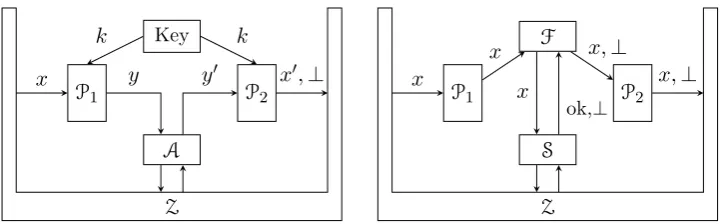
More precisely, for every task considered we need to define some ideal functionality F, which takes all the inputs from the parties and performs the desired task in an ideal way. For example, in the case of authentication analyzed in Section 3, it is always possible for an adversary to cut or jumble the line, making sure the original message is not received. The ideal functionality can thus at best guarantee that the receiver gets either the original message or an error. It receives a message x from the sender and either a block or a let through command from the adversary, and then delivers x to the receiver or produces an error message depending on the adversary’s choice.
The environment Zis allowed to choose the inputs given to every party, receives all outputs and can communicate freely throughout the protocol with the adversaryA. Since the communication between the adversary and the ideal functionalityF is different from when he interacts with the real players, he could immediately alert the environmentZ of this. In the ideal process we therefore replace A by a simulator S, which can be seen as a buffer between the environment and the ideal functionality. Soften internally simulatesA, from which it gets its name.
Definition 2.1 (UC security [5]). A protocol π ε-UC-realizes the ideal functionalityF, or, more succinctly, isε-UC-secure, if for all adversariesA there exists a simulatorSfor which no environment Zcan distinguish with probability more thanεif it is interacting withAand players running π or Sand players using the ideal functionalityF.
We illustrate this for the case of authentication in Figure 1.
The above definition can be simplified [5]: it is sufficient to consider a dummy adversary that forwards all messages to the environment and lets it decide what responses to send. Security against all other adversaries holds if it holds for the dummy adversary. In the next sections we therefore restrict our proofs to the dummy adversary.
The main composability theorem can now be stated:
Theorem 2.2 (Universal composition [5]). Let π and ρ be two protocols such that ρ ε1-UC-realizes F and πF ε2-UC-realizes G when using F as a
P1 P2
A
Key
Z
k k
y y0
x x0,⊥
P1 P2
S F
Z
x x,⊥
x
ok,⊥
x x,⊥
Figure 1 – On the left: the real situation. Players P1 andP2 run the au-thentication protocol using their shared keyk. The output ofP2 is either an error⊥if he detected some cheating, or the messagex0 which might or might not be equal to the inputx. On the right: the ideal situation. Some ideal functionalityFeither givesP2 the original messagexor an error⊥depending on the decision of the simulatorS.
3
Standard authentication
Information-theoretic authentication is usually considered in a setting where two players P1 and P2 share a secret key k ∈ K and are connected by a
channel under the control of an adversary. They wish to guarantee that a message received by P2 claiming to come from player P1 was neither
generated nor altered by the adversary. These two types of attacks are often calledimpersonation and substitution.
For any protocol which authenticates a message by appending a tag, i.e., sendsy = (x, t) when the message isx, security against impersonation attacks follows from security against substitution attacks. Since this is the only kind of protocol that we are concerned with, we only consider security against substitution attacks in the body of this paper, and refer to Appendix B for the proof of this reduction.
In Section 3.1 we define UC security for authentication, and in Section 3.2 we describe a secure authentication protocol, the proof of which is given in in Appendix A.
3.1 Security
To send a messagex,P1uses the keykto generate a new messageycontaining
some redundancy, e.g., y = (x, hk(x)) where {hk}k∈K is a family of hash functions. Upon receiving y0, P2 checks whether it is valid given the key
k, and if so, outputs the corresponding7 x0. In the previous example with y0 = (x0, t0), P2 checks that t0 = hk(x0) and accepts x0 if this is the case or produces an error⊥otherwise. This protocol is depicted on the left in Figure 1.
7The functiony=f
Since the channel is completely under the control of the adversary, he can always cut it or completely jumble the message. Hence in the ideal case it is not possible to guarantee that the original message is received, only that P2 is not tricked into accepting a falsified message. The ideal functionalityF
for authentication can be seen as a perfect channel with a switch controlled by the adversary: he can either switch it on and let the message through, or switch it off and let it produce an error. This is depicted on the right in Figure 1.
An authentication scheme is then ε-UC-secure if the environment Z cannot distinguish between these two situations. To get a more concrete security criterion, we need to define the simulator’s actions in the case of the dummy adversary A, who simply forwards y to Zand forwards the response y0 toP2.
After receiving the messagexfrom the ideal functionalityF, the simulator Smust send someytoZ. To do so, it picks a keyk∈ Kuniformly at random and runs the same protocol as P1 to generate y. When it gets y0 from Z,
it checks whether y = y0 and sends either ok or ⊥ to F. Note that this simulator always accepts if the message was not modified, i.e., the ideal case has perfect robustness.
Let X be the random variable describing the initial message x∈ X, Y the corresponding encoding generated byP1 in the real case and S in the
ideal case, and Y0 the response from Z. Let ˜X and ˆX be random variables over the alphabetX ∪ {⊥}describing the outputs ofP2 in the real and ideal
cases respectively. In the real caseZhas access to the joint random variable XY Y0X˜ and in the ideal case it sees XY Y0Xˆ. An authentication scheme is thenε-UC-secure if for anyX andY0 chosen by Z, the statistical distance between the real and ideal cases satisfies
1 2
X
x,y,y0,x¯
PXY Y0X˜(x, y, y0,x¯)−PXY Y0Xˆ(x, y, y0,x¯)
≤ε. (1)
Note that after rearranging the LHS of Eq. (1), we obtain the standard security criterion for authentication [1, 2], see also Remark 3.2.
3.2 Protocol
To satisfy Eq. (1) it is sufficient to use a family of strongly universal2 hash
functions {hk}k∈K and define y := (x, hk(x)) with the key k distributed uniformly overK. Then, as described above,P2 checks thatt0 =hk(x0) for they0 = (x0, t0) he receives, and acceptsx0 if this is the case or produces an error⊥otherwise.
Definition 3.1 (strongly universal2 hash function [2]8). A family of hash
8The more common definition of strongly universal
2 hashing [2, 3, 15, 24] has an extra
condition, namely that for allx∈ X andt∈ T, Pr [hk(x) =t] = |T |1 . This is however not
functions {hk : X → T }k∈K is said to be ε-almost strongly universal2 (ε
-ASU2) if fork chosen uniformly at random and all x1, x2∈ X withx16=x2
and allt1, t2 ∈ T,
Pr [hk(x1) =t1 and hk(x2) =t2]≤
ε
|T |. (2)
Remark 3.2. If we replace the authenticated messagey by its form (x, hk(x)) in Eq. (1), we recover the security condition used by Wegman and Carter [1] and Stinson [2]. It is therefore immediate that previous work on information-theoretic authentication (without key recycling) is composable. However, since we use a simplification of the more commonε-ASU2hashing definition8,
we cannot directly apply Stinson’s proof [2] here. We therefore provide a new proof in Appendix A that standard authentication withε-ASU2 hashing
results in an ε-UC-secure scheme.
4
Authentication with key recycling
If we wish to authenticate many messages and we use the protocol from Section 3, a new hash function and therefore a (completely) new key must be used in every round. This is however not necessary: as we show in Section 4.2, part of the key used to choose the hash function isε-close to uniform from the point of view of the environment, and can therefore be recycled for further use. Before proving this, we first model this new protocol and its ideal functionality in Section 4.1.
Like for standard authentication analyzed in Section 3, we consider only substitution attacks here, in which the adversary modifies a valid message and tag. For impersonation attacks we refer to Appendix B.
4.1 Security
To model the key recycling, we must view this recycled key as an extra output of the protocol. An authentication scheme with key recycling can be seen as a combination of a key distribution protocol — which only has one output, a secret key — and an authentication scheme — which only has one output, a message. For simplicity we also split the ideal secret key shared by the two players in two parts,k= (k1, k2), one which is recycled, k1, and one
which is consumed, k2. The rest of the model is the same as for standard
authentication described in Section 3.1: P1 uses the shared key (k1, k2) to
generate a new messagey containing some redundancy, P2 checks that y0 is
a valid message given (k1, k2) and accepts the corresponding x0 if that is the
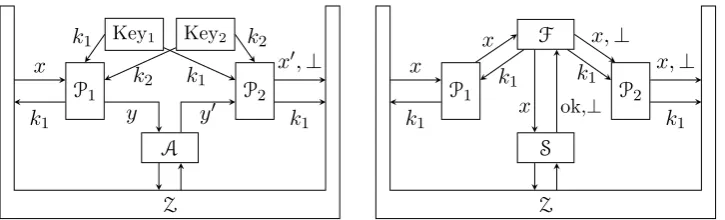
case. This is depicted on the left in Figure 2.
In the ideal case, the ideal functionality Fgenerates a new secret key k1,
P1 P2
A
Key1 Key2
Z k1
k2 k1
k2
y y0 x
k1
x0,⊥
k1
P1 P2
S F
Z
x x,⊥
k1 k1
x ok,⊥
x
k1
x,⊥
k1
Figure 2 – On the left: the real situation. Players P1 andP2 run the au-thentication protocol using their shared keysk1, k2. They both outputk1 for
recycling andP2additionally produces either an error⊥if he detected some cheating, or the messagex0 which might or might not be equal to the input x. On the right: the ideal situation. Some ideal functionalityF generates a perfect keyk1 and additionally either givesP2 the original message xor an
error⊥depending on the decision of the simulatorS.
also sends either the original messagex or an error ⊥toP2 depending on
the decision of the simulatorS. The simulatorS for the dummy adversary generates its own local keys k1 and k2 and runs the same protocol asP1 to
generatey. Upon receivingy0 from the environment it checks whethery0 =y and sends eitherokor ⊥to F. Here too, the simulator always accepts if the message was not modified, i.e., the ideal case has perfect robustness. This is depicted on the right in Figure 2.
Let X be the random variable describing the initial message x∈ X, Y the corresponding encoding generated byP1 in the real case and S in the
ideal case, and Y0 the response from Z. Let ˜X and ˆX be random variables over the alphabetX ∪ {⊥}describing the outputs ofP2 in the real and ideal
cases respectively. And finally let ˜K and K be the random variables for the distribution ofk1 in the real and ideal cases respectively. Thus, in the real
caseZhas access to the joint random variable XY Y0X˜K˜ and in the ideal case it seesXY Y0XKˆ . An authentication scheme is then ε-UC-secure if for any X and Y0 chosen by Z, the statistical distance between the real and ideal cases satisfies
1 2
X
x,y,y0,x,k¯
1
PXY Y0X˜K˜(x, y, y0,x, k¯ 1)−PXY Y0XKˆ (x, y, y0,x, k¯ 1)
≤ε. (3)
4.2 Protocol
The protocols we wish to analyze in this setting encode a message x as y= (x, hk1(x)⊕k2), where {hk1 :X → T }k1∈K is a family of hash functions that map the message to some bit stringt∈ T ={0,1}m,k
2∈ T and⊕ is
the bitwise XOR. Then, as described above,P2 checks thatt0 =hk1(x 0)⊕k
2
an error ⊥otherwise.
These hash functions do not need to be ε-ASU2, it is sufficient for
gk1,k2(x) = hk1(x)⊕k2 to have this property. The property needed for
{hk1}k1∈K has been dubbedε-almost XOR universal2 by Rogaway [14],ε-otp
secure by Krawczyk [12, 13], andε-∆universal by Stinson [24].9
Definition 4.1 (XOR universal2 hash function [14]). A family of hash
functions {hk : X → T }k∈K for T = {0,1}m is said to be ε-almost XOR universal2 (ε-AXU2) if for kchosen uniformly at random and allx1, x2∈ X
withx16=x2 and allt∈ T,
Pr [hk(x1)⊕hk(x2) =t]≤ε. (4)
It is immediate from this definition that the hash functiongk1,k2(x) := hk1(x)⊕k2 isε-ASU2, i.e., for allx1, x2 ∈ X withx16=x2 and allt1, t2 ∈ T,
Pr [gk1,k2(x1) =t1 andgk1,k2(x2) =t2]≤ ε
|T |.
Since XORing a uniform stringk2 to any value yields a uniform string we
also have
Pr [gk1,k2(x1) =t1] = Pr
h
gk1,k2(x1) =t1
˜ K =k1
i
= 1
|T |, (5)
where ˜K is the random variable for the recycled part of the key. Combining the two equations above gives
Pr [gk1,k2(x2) =t2|gk1,k2(x1) =t1]≤ε. (6)
We now have all the ingredients needed to prove the security.
Theorem 4.2. Letπ be an authentication scheme that encodes a message
x as y = (x, hk1(x)⊕k2) and recycles k1, where {hk1 :X → T }k1∈K is a
family of ε-almost XOR universal2 hash functions, and (k1, k2) are chosen
uniformly at random fromK × T. Then π is ε-UC-secure.
Proof. We need to show that Eq. (3) is satisfied for any distributions PX andPY0. First, for y= (x, t), if the environment chooses y0 = (x, t0), then
the real and ideal protocols both either acceptx if t0 =tor reject it if t0 6=t. This means that
PX˜|XY Y0(x0|x,(x, t),(x, t0)) =PXˆ|XY Y0(x0|x,(x, t),(x, t0))
=
(
0 ifx0 =⊥ XORt0=t, 1 otherwise,
9
hence ˜X and ˆX are completely determined byXY Y0 and can be dropped. The LHS of Eq. (3) thus reduces to
1 2
X
x,t,t0,k
1
PXY Y0(x,(x, t),(x, t0))
PK|XY Y˜ 0(k1|x,(x, t),(x, t0))−
1 |K| .
Furthermore, from Eq. (5) we know that ˜K is independent from XY, and therefore also fromXY Y0, hence PK|XY Y˜ 0(k1|x,(x, t),(x, t0)) = |K|1 . We can
thus assume w.l.o.g. that the adversary choosesx0 6=x.
For y0 = (x0, t0) andx06=x, the random variable ˜X can take two values,
⊥if cheating was detected orx0 if the players were fooled. ˆX however always produces an error⊥. Separating the summation in the LHS of Eq. (3) over these two values gives
1 2
X
x,t,x0,t0,k
1
PXY Y0(x,(x, t),(x0, t0))
PX˜K|XY Y˜ 0(⊥, k1|x,(x, t),(x, t0))−
1 |K| +1 2 X
x,t,x0,t0,k
1
PXY Y0X˜K˜(x,(x, t),(x0, t0), x0, k1). (7)
We show in the following that
PX˜K|XY Y˜ 0(⊥, k1|x,(x, t),(x0, t0))≤
1
|K| (8)
for all values ofx, t, x0, t0, k1. This implies that Eq. (7) sums up to twice the
value of the second term, which can be bounded in the following way:
X
x,t,x0,t0,k
1
PXY Y0X˜K˜(x,(x, t),(x0, t0), x0, k1)
= X
x,t,x0,t0
PXY Y0(x,(x, t),(x0, t0)) X
k1
PX˜K|XY Y˜ 0(x0, k1|x,(x, t),(x0, t0))
= X
x,t,x0,t0
PXY Y0(x,(x, t),(x0, t0))P˜
X|XY Y0(x0|x,(x, t),(x0, t0))
≤ X
x,t,x0,t0
PXY Y0(x,(x, t),(x0, t0))ε=ε,
where to reach the last line we used
PX˜|XY Y0(x0|x,(x, t),(x0, t0)) = Pr
hk1(x 0)⊕k
2 =t0
hk1(x)⊕k2 =t
and Eq. (6).
Finally, we show that Eq. (8) holds. The LHS can be decomposed as
PX˜K|XY Y˜ 0(⊥, k1|x,(x, t),(x0, t0))
Because (x0, t0) are chosen by the environment when holding (x, t), they do not influence the distribution of ˜K givenXY, so
PK|XY Y˜ 0(k1|x,(x, t),(x0, t0)) =PK|XY˜ (k1|x,(x, t)).
And as argued above in the case wherex0 =x, from Eq. (5) we know that ˜K is independent fromXY, soPK|XY˜ (k1|x,(x, t)) = |K|1 . Combining this with PX˜|XY Y0K˜(⊥|x,(x, t),(x0, t0), k1)≤1 and Eq. (9) proves Eq. (8).
5
Secret key leakage
An immediate application of the UC security of authentication with key recycling is to reuse the same hash function to authenticate multiple mes-sages, only renewing the part of the key XORed to the tag. The universal composition theorem (Theorem 2.2) says that if we do this` times and each individual protocol isε-UC-secure, then the composed protocol has error at most`ε.10
In this section we show that this composition theorem is tight for all protocols with ε = 1/|T |, where T is the alphabet for the tag, i.e., there exists an attack such that after ` rounds the adversary has probability at least`ε of having successfully forged a message, for any`≤1/ε.
Let us define {F`}` to be a sequence of random variables taking the value 1 if the adversary successfully falsifies a message in any of the first ` rounds, and 0 otherwise. Then a quick calculation shows us that for any 0≤`≤1/ε−1,
PF`+1|F`(1|0) =
PF`+1(1)−PF`+1F`(1,1)
PF`(0)
= (`+ 1)ε−`ε 1−`ε =
ε 1−`ε.
This means that in every successive round, the adversary’s probability of successfully forging a message increases. This happens because — as we show in Theorem 5.1 here below — some information about the hash function is leaked in every round, even if the key used for the OTP is perfectly uniform. The entropy of the hash function gradually decreases, until the adversary has enough information to successfully falsify a new message with probability 1.
This result contrasts strongly with the non-composable analysis found in [1]. There, the adversary simply collects the pairs of messages and tags (x1, t1),(x2, t2), . . ., and attempts to falsify a message in each round,
independently from the attempts in previous rounds. In this case, due to the hiding property of the OTP, the distribution of the hash function always remains perfectly uniform given these message-tag pairs.
10
Theorem 5.1. Letπ be an authentication scheme that encodes a message
x as y = (x, hk1(x)⊕k2) and recycles k1, where {hk1 :X → T }k1∈K is a
family of |T |1 -almost XOR universal2 hash functions. For any 1≤`≤ |T |,
let this protocol be used ` times with the same key k1 ∈ K initially chosen
uniformly at random, and a new uniformly random k2 ∈ T in each round.
Then, there exists an attack that allows the adversary to successfully falsify one of the first `messages with probability at least `/|T |. Furthermore, after
`rounds, the entropy of the recycled key K1 is bounded by
H(K1|Z`)≤log
|K|
|T |+
1− ` |T |
log (|T | −`),
where Z` consists of all the inputs and outputs of the protocol (except for
K1) and the communication with the dummy adversary from these `rounds.
Proof. Since the environment can choose the distribution of the messages to be authenticated in the ` rounds, we take them to always be the same messagex. The environment also always substitutes the same messagex06=x forx in each round. To be successful, it needs to guess correctly the value c=hk1(x)⊕hk1(x
0), sincet0 =t⊕c, wheret is the tag that comes withx andt0 is the correct tag for x0. The environment therefore makes a list of the|T | possible values forc, and in each round eliminates one from its list. In the first round the environment is given (x, t1) by the dummy adversary.
It picks ac1 from its list and sends (x0, t1⊕c1) back to the dummy adversary.
The legitimate player accepts the message received from the adversary only ifc1=hk1(x)⊕hk1(x
0), which happens with probabilityp
1 =|T |−1.
If the environment is unsuccessful at falsifying the message, it can cross c1 off its list. In the second round it then receives (x, t2), picks a newc26=c1,
and sends (x0, t2⊕c2). This time its success probability is p2= (|T | −1)−1,
since it only has|T | −1 elements c left on its list.
If we repeat this for each round, the success probability in the`th round given that the previous`−1 were unsuccessful isp` = (|T | −`+ 1)−1. We now prove by induction that the probability of successfully falsifying at least one message with this strategy is exactly`/|T |. LetF` be a random variable taking the value 1 if the adversary successfully falsifies a message in any of the first` rounds, and 0 otherwise. We havePF1(1) =p1 = 1/|T |. And if PF`−1(1) = (`−1)/|T |, then
PF`(1) =PF`−1(1) +PF`−1(0)p`= `−1
|T | +
1−`−1 |T |
1
|T | −`+ 1 =
`
|T |.
Let z0 represent any value of Z` in which the adversary fails to falsify any message, and z1 be the case where he does trick the players. If he is
successful, he immediately learns the correct valuec, and thus
H(K|Z` =z1) = log
If the adversary is not successful, he has still managed to cross`values for c off his list, so
H(K|Z`=z0) = log
|K|
|T |(|T | −`).
Combining the two equations above with the corresponding probabilities, we get
H(K|Z`) = `
|T |log
|K|
|T |+
1− ` |T |
log|K|
|T |(|T | −`).
6
Example: Layered QKD and authentication
As illustration of the universal composition theorem (Theorem 2.2) we sketch the security proof for a composition of quantum key distribution (QKD) and authentication with key recycling.
The two players must share an initial key which is long enough to select the hash function and encrypt the tags for every message exchanged during the first round of QKD. The recycled key and new key produced by the QKD protocol are then used for the authentication in subsequent rounds. W.l.o.g. we assume the initial key to be perfect. If the authentication scheme isε1-UC-secure, and is needed`times in each round of QKD, and the QKD
protocol is ε2-UC-secure and repeated r times, it is immediate from the
composition theorem that the final key — the concatenation of all unused secret key bits produced in each round and the recycled hash function — has distance at most r(`ε1+ε2) from uniform.
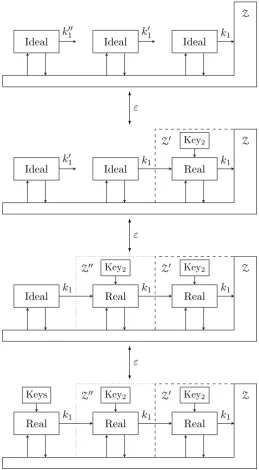
To sketch this, we first consider the composition of the ` rounds of authentication with key recycling, which we illustrate in Figure 3. In the ideal setting, the different rounds of the ideal authentication are all independent. So the statistical distance between the environment’s (Z) view of`rounds of ideal authentication and`−1 rounds of ideal authentication with 1 round of the real protocol is at mostε1. Likewise, if we compare the second and
third lines of Figure 3, the environment Z0 can notice a difference with probability at mostε1. SinceZ0 is simplyZwith an additional internal round
of authentication (which Zcan run on its own anyway), Z does not have an advantage greater thanε1 either. By repeating this reasoning and using
the triangle inequality for the statistical distance, we find that `rounds of authentication with key recycling have error at most`ε1.
Next, we look at the composition of ` rounds of authentication and 1 round of QKD. Let ˜K1 be the key recycled by the authentication protocols,
˜
K2the output of the QKD protocol, letK1andK2be their ideal counterparts,
Ideal Ideal Ideal
Z
Ideal Ideal Real
Z Z0
Ideal Real Real
Z Z0
Z00
Real Real Real
Z Z0
Z00
ε
ε
ε
Key2
Key2 Key2
Keys Key2 Key2
k1
k10 k001
k1
k1
k10
k1
k1
k1
k1
k1
k1
Figure 3 – The bottom line represents the environment’s (Z) view of the composition of many rounds of an authentication protocol with key recycling. Each boxReal contains the two legitimate players and the adversary, depicted separately in Figure 2. The recycled keyk1 is passed from one protocol to
the quantum channel. We need to show that the (trace) distance11 between the real and ideal situations is bounded by`ε1+ε2, i.e.,
1 2
ρK˜1K˜2E˜ −ρK1 ⊗ρK2 ⊗ρE
tr≤`ε1+ε2. (10)
Since the composition of authentication protocols is close to ideal for all environments, it is in particular secure for an environment that runs a QKD protocol and attempts to distinguish between the real and ideal settings by looking at the output of the QKD protocol. Hence
1 2
ρK˜1K˜2E˜ −ρK1 ⊗ρKˆ2E
tr ≤`ε1,
where ˆK2is the output of the QKD protocol run with the ideal authentication.
By the security definition of QKD [25], the protocol isε2-UC-secure if, when
using an ideal authentication protocol, we have
1 2
ρKˆ2E−ρK2⊗ρE
tr
≤ε2.
Combining the two equations above and the triangle inequality proves (10). The final step consists in showing that r rounds of QKD and authentica-tion has error at mostr(`ε1+ε2). The reasoning is however identical to the
`sequential compositions of just authentication depicted in Figure 3, so we omit it.
Acknowledgments
The author would like to thank Renato Renner and Christoph Pacher for valuable discussions.
This work has been funded by the Swiss National Science Foundation (via grant No. 200020-135048 and the National Centre of Competence in Research ‘Quantum Science and Technology’), the European Research Council – ERC (grant no. 258932) – and by the Vienna Science and Technology Fund (WWTF) through project ICT10-067 (HiPANQ).
Appendices
A
Security proof for standard authentication
We prove here the security of standard authentication with ε-ASU2 hashing
as defined in Definition 3.1. Note that this proof does not need the extra
11
The trace distance between two statesρandσis the quantum generalization of the statistical distance, and is given by 1
2kρ−σktr, wherekAktr:= tr
requirement that Pr [hk(x) =t] = |T |1 , which is often part of the ε-ASU2
definition (see Footnote 8 on page 7).
Lemma A.1. Let π be an authentication scheme that encodes a messagex
as y= (x, hk(x)), where {hk:X → T }k∈K is a family ofε-almost strongly
universal2 hash functions, and k is chosen uniformly at random from K.
Thenπ is ε-UC-secure.
Proof. We need to show that Eq. (1) is satisfied for any distributions PX andPY0. Let y= (x, t) and y0= (x0, t0). If the environment chooses x0 =x,
both the real protocol and ideal functionally behave identically and are indistinguishable — they both accept x if t0 = t and produce an error otherwise. We can therefore assume w.l.o.g. that the environment always chooses x0 6= x. In this case, the simulator in the ideal situation always outputs an error ⊥, i.e., PXˆ(⊥) = 1. The security criterion (1) therefore
reduces to
X
x,t,x0,t0
PXY Y0X˜(x,(x, t),(x0, t0), x0)≤ε.
Splitting the random variableY =XT in its two parts, and combining the following equations,
PXY Y0(x,(x, t),(x0, t0)) =PXT Y0(x, t,(x0, t0))
=PX(x)PT|X(t|x)PY0|XT(x0, t0|x, t),
PT|X(t|x) = Pr[hk(x) =t],
PX|XY Y˜ 0(x0|x,(x, t),(x0, t0)) = Pr[hk(x0) =t0|hk(x) =t],
we get
X
x,t,x0,t0
PXY Y0X˜(x,(x, t),(x0, t0), x0)
= X
x,t,x0,t0
PX(x)PY0|XT(x0, t0|x, t) Pr[hk(x) =t andhk(x0) =t0]
≤ X
x,t,x0,t0
PX(x)PY0|XT(x0, t0|x, t) ε
|T |
=X t
ε
|T | =ε.
B
Impersonation attacks
B.1 Security
case, the simulator then always sends an error⊥to the ideal functionality who transmits it to P2.
Since no inputx and corresponding y are present, the security criterion for standard authentication (Eq. (1)) then reduces to
1 2
X
y,x
PY0X˜(y, x)−PY0Xˆ(y, x)
≤ε, (11)
and we say that an authentication protocol is ε-UC-secure against imperson-ation attacks if Eq. (11) holds.
In the case of key recycling, the decision of P2 to accept or reject the
message might be correlated to the keyk1, i.e., the random variables ˜X and
˜
K can be correlated. It is therefore important that in this setting too, the ideal functionality produces a new key K which is perfectly uniform and independent fromY0Xˆ. The corresponding security criterion (Eq. (3)) then reduces to
1 2
X
y,x,k1
PY0X˜K˜(y, x, k1)−PY0XKˆ (y, x, k1)
≤ε, (12)
and we say that an authentication protocol with key recycling isε-UC-secure against impersonation attacks if Eq. (12) holds.
Although these might, at first look, seem like a simplification of their substitution-attack counterparts, it is in fact possible to construct (artificial) protocols that have an impersonation error roughly twice as large as the substitution error.12 However, in the special case where the encoding of the message x is of the form y = (x, t), we show in the following section that security against impersonation attacks follows from security against substitution attacks.
B.2 Reduction to substitution attacks
Lemma B.1. Let π be an authentication scheme (with or without key recy-cling) that encodes a message x as y= (x, t). If π is ε-UC-secure (against substitution attacks), then it is alsoε-UC-secure against impersonation at-tacks.
We prove this statement for a scheme with key recycling. The proof when no recycling is performed is identical except for the omission of the random variables K and ˜K.
12Let{h
k:{0,1} → {0,1}m}kbe a set of functions such that for allk,hk(0) = 0m, and 1
is uniformly mapped (over the choice ofk) to allt∈ {0,1}m\ {
0m}. Let the authentication protocol encode the messagex∈ {0,1}as (x⊕k1, hk2(x⊕k1)). If the environment performs
an impersonation attack by sending the messagey= (0,0m), this will be accepted with
Proof. We assume that the protocol is notε-UC-secure against impersonation attacks, and construct a substitution attack. Let
1 2
X
y,x,k1
PY0X˜K˜(y, x, k1)−PY0XKˆ (y, x, k1) > ε,
then there exists a specific y0 = (x0, t0) for which 1 2 X x,k1
PX˜K|Y˜ 0(x, k1|y 0)−P
ˆ
XK|Y0(x, k1|y0) > ε.
So w.l.o.g. we can takePY0(y0) = 1.
For the corresponding substitution attack, let the environment choose any distributionPX such that PX(x0) = 0. Then upon receivingy, it sends y0 = (x0, t0). In the ideal case, the simulator and ideal functionality therefore always transmit an error, and in the real case P2 accepts the message x0
with the same probability as for the impersonation attack. So PXK|Yˆ 0 and
PX˜K|Y˜ 0 have exactly the same distributions in the cases of substitution and
impersonation attacks. Hence
1 2
X
x,y,y0,x,k¯
1
PXY Y0X˜K˜(x, y, y0,x, k¯ 1)−PXY Y0XKˆ (x, y, y0,x, k¯ 1)
≥ 1
2
X
y0,¯x,k
1
PY0X˜K˜(y0,x, k¯ 1)−PY0XKˆ (y0,x, k¯ 1) > ε.
B.3 Tighter bound
The bound on the impersonation error from Lemma B.1 is not always tight. In particular, in the case of the authentication protocol with key recycling given in Section 4.2 it is possible to get a better result. Due to the tight bound in Eq. (5) we find that this scheme is |T |1 -UC-secure against impersonation attacks.
Lemma B.2. Let π be an authentication scheme that encodes a message x
asy= (x, hk1(x)⊕k2)and recyclesk1, where{hk1 :X → T }k1∈K is a family
ofε-almost XOR universal2 hash functions, and(k1, k2)are chosen uniformly
at random from K × T. Then π is |T |1 -UC-secure against impersonation attacks.
Proof. We need to show that for all distributions PY0, Eq. (12) holds for
ε= |T |1 . Since in the ideal case ˆX =⊥andK is independent fromY0Xˆ, the LHS of Eq. (12) reduces to
1 2
X
x,t,k1
PY0(x, t)
PX˜K|Y˜ 0(x, k1|x, t) +
PX˜K|Y˜ 0(⊥, k1|x, t)−
And because from Eq. (5),
PX˜K|Y˜ 0(x, k1|x, t) = Pr h
hk1(x)⊕k2 =t and ˜K =k1
i
=PK˜(k1) Pr h
hk1(x)⊕k2 =t
˜ K =k1
i
= 1
|K||T |,
Eq. (13) is equal to |T |1 .
Note that in the case of standard authentication with ε-ASU2 hashing, if
we had made the extra assumption that Pr [hk(x) =t] = |T |1 (see Footnote 8 on page 7), we would also have found that the corresponding scheme is
1
|T |-UC-secure against impersonation attacks. However, from Eq. (2) alone, we can at best get the bound
Pr [hk(x) =t] =X t0
Prhk(x) =t and hk(x0) =t0≤ε,
which only guarantees that the scheme is ε-UC-secure against impersonation attacks.
References
[1] Mark N. Wegman and Larry Carter. New hash functions and their use in authentication and set equality. Journal of Computer and System Sciences, 22(3):265–279, 1981.
[2] Douglas R. Stinson. Universal hashing and authentication codes.Designs, Codes and Cryptography, 4(3):369–380, 1994. A preliminary version appeared at CRYPTO ’91. [doi:10.1007/BF01388651].
[3] J¨urgen Bierbrauer, Thomas Johansson, Gregory Kabatianskii, and Ben Smeets. On families of hash functions via geometric codes and con-catenation. In Proceedings of the 13th Annual International Cryptology Conference on Advances in Cryptology, CRYPTO ’93, pages 331–342. Springer, 1994. [doi:10.1007/3-540-48329-2 28].
[4] Ran Canetti. Universally composable security: A new paradigm for cryptographic protocols. In Proceedings of the 42nd Symposium on Foundations of Computer Science, FOCS ’01, page 136. IEEE, 2001.
[5] Ran Canetti. Universally composable security: A new paradigm for cryptographic protocols. Updated version of [4], 2005. [IACR e-print: 2000/067].
[7] Michael Backes, Birgit Pfitzmann, and Michael Waidner. A general composition theorem for secure reactive systems. In Proceedings of the First Theory of Cryptography Conference, TCC ’04, pages 336–354. Springer, 2004. [doi:10.1007/978-3-540-24638-1 19].
[8] Michael Ben-Or and Dominic Mayers. General security definition and composability for quantum & classical protocols. eprint, 2004. [arXiv:quant-ph/0409062].
[9] Dominique Unruh. Simulatable security for quantum protocols. eprint, 2004. [arXiv:quant-ph/0409125].
[10] Dominique Unruh. Universally composable quantum multi-party com-putation. In Advances in Cryptology, Proceedings of EUROCRYPT ’10, pages 486–505. Springer, 2010. [doi:10.1007/978-3-642-13190-5 25, arXiv:0910.2912].
[11] Michael A. Nielsen and Isaac L. Chuang. Quantum Computation and Quantum Information. Cambridge University Press, 2000.
[12] Hugo Krawczyk. LFSR-based hashing and authentication. InProceedings of the 14th Annual International Cryptology Conference on Advances in Cryptology, CRYPTO ’94, pages 129–139. Springer, 1994. [doi:10.1007/3-540-48658-5 15].
[13] Hugo Krawczyk. New hash functions for message authentication. In
Advances in Cryptology, Proceedings of EUROCRYPT ’95, pages 301– 310. Springer, 1995. [doi:10.1007/3-540-49264-X 24].
[14] Phillip Rogaway. Bucket hashing and its application to fast message authentication.Journal of Cryptology, 12(2):91–115, 1999. A preliminary version appeared at CRYPTO ’95. [doi:10.1007/PL00003822].
[15] Mustafa Atici and Douglas R. Stinson. Universal hashing and multiple authentication. In Proceedings of the 16th Annual International Cryptol-ogy Conference on Advances in CryptolCryptol-ogy, CRYPTO ’96, pages 16–30. Springer, 1996. [doi:10.1007/3-540-68697-5 2].
[16] Patrick Hayden, Debbie Leung, and Dominic Mayers. The universal com-posable security of quantum message authentication with key recycling. Presented at QCrypt 2011, 2011.
[18] Daniel J. Bernstein. Stronger security bounds for wegman-carter-shoup authenticators. In Advances in Cryptology, Proceedings of EURO-CRYPT ’05, pages 164–180. Springer, 2005. [doi:10.1007/11426639 10].
[19] Ran Canetti. Universally composable signature, certification, and au-thentication. In Proceedings of the 17th IEEE Computer Security Foun-dations Workshop, page 219. IEEE, 2004. [doi:10.1109/CSFW.2004.24, IACR e-print: 2003/239].
[20] J¨orgen Cederl¨of and Jan-˚Ake Larsson. Security aspects of the authen-tication used in quantum cryptography. IEEE Transactions on Infor-mation Theory, 54(4):1735–1741, 2008. [doi:10.1109/TIT.2008.917697, arXiv:quant-ph/0611009].
[21] Aysajan Abidin and Jan-˚Ake Larsson. Security of authentication with a fixed key in quantum key distribution. eprint, 2011. [arXiv:1109.5168].
[22] Michael Ben-Or, Michael Horodecki, Debbie Leung, Dominic May-ers, and Jonathan Oppenheim. The universal composable security of quantum key distribution. In Proceedings of the Second Theory of Cryptography Conference, TCC ’05, pages 386–406. Springer, 2005. [arXiv:quant-ph/0409078].
[23] J¨orn M¨uller-Quade and Renato Renner. Composability in quantum cryp-tography.New Journal of Physics, 11(8):085006, 2009. [doi:10.1088/1367-2630/11/8/085006, arXiv:1006.2215].
[24] Douglas R. Stinson. On the connections between universal hashing, combinatorial designs and error-correcting codes. Electronic Colloquium on Computational Complexity (ECCC), 2(52), 1995.