ISSN 2348 – 7968
An Efficient Performance and Monetary Cost Optimization on
Resource Allocation in Cloud
V. Gayathri1, S. Selvi2 and Dr. B. Kalavathi3
1
Department of CSE, Angel College of Engineering and Technology, Tiruppur, Tamilnadu, India
2
Department of CSE, Angel College of Engineering and Technology, Tiruppur, Tamilnadu, India
3
Department of CSE, K.S.R Institute for Engineering and Technology, Thiruchengode, Tamilnadu, India
Abstract
Cloud computing has emerged as important computing technology and its pay-as-you-go cost structure enabled the providers to offer computing services on demand. The cloud consumer’s important challenge is to find the most efficient way to utilize the rented cloud resources. However many existing algorithms were developed to satisfies the optimization strategies which fails to utilizes the resources effectively based on the cost provided for the resources. This paper proposes the Transformation based Optimization technique which formulates six basic operations and Dynamic Proportional share model which efficiently handles the workload and significant amount of interactive jobs. It has unique optimization strategies and resource multiplexing strategies based on job requirements. In this proposed model, we focus on two key issues: 1) Resource discovery protocol which uses the multiattribute range query problem in a fully deentralized environment for locating a qualified node to satisfy a user task’s resource demand. 2) Dynamic proportional share model which optimize a task’s execution time by determining the optimal shares of the multiattribute resources to allocate to the tasks with expected time and limited budget. This process significantly reduce the resource usage cost by efficient resource allocation scheme. It has unique optimization strategies and resource multiplexing strategies based on job requirements which effectively reduce the resource provisioning cost and produce better optimization strategies.
Keywords: Scheduling, Workflows, Optimization, Deadline,
Virtualizatio, Resource Provisioning, Virtual machine,
Makespan.
1. Introduction
Cloud computing has emerged as important computing technology and its pay-as-you-go cost structure enabled the providers to offer computing service on demand and pay for the resources just as utility computing. The rapid
evolution of this technology makes the resources more cost effective consumer driven technology. The cloud consumer’s important challenge is to find the most efficient way to utilize the rented cloud resources. Virtualization is the important process which allows the sharing of computing resouces in online. The computing resources are of different types. These includes Infrastructure as a service(Iaas) which provides the capability to the consumer to provision network, storage and processing. It can include the operating system and applications. Eg., Amazon EC, OpenNebulla, Eucalyptus. Next one is Platform as a service(Paas) which provides the capability to the consumer to acquire applications created using programming languages, deploy onto the cloud infrastructure and tools supported by the provider. Eg., Hadoop, Microsoft Windows Azure, Google App Engine. Another one is Software as a service(Saas) which provides the capability to the consumer to use the applications of the provider which runs on cloud infrastructure. Eg., Google Apps, SalesForce.com, Eye OS. Cloud providers provides these resources on demand to the users. When there is any requirment for the users in the cloud, the cloud system provides the required resources to the users by creating virtual machines(VM) in the host machine. The tasks of the users are in the form of workflow. The workflow applications are executed by the workflow scheduling. The workflow scheduling is the process which needs to map the tasks on the resources for the execution process of the workflow. The effective scheduling results in improving the resource utilization, reduce capital expenditure and reduce initial investment.
ISSN 2348 – 7968
2. Related works
Many existing algorithms are reviewed and discussed in this section. These includes many workflow scheduling algorithms for workflow application scheduling. These section also discuss about the various methods to reduce the cost of resource provisioning of the cloud providers.
Y.C. Lee et al [1] proposed the Adaptive Dual Objective Scheduling algorithm which has the effort to minimize the completion time of the task and also optimize the resouce usage. It also manages the continuous workload.
E.K. Byun et al [2] proposed the algorithm called Partition Balanced Time Scheduling Algorithm which integrates the workflow with the resource provisioning to find the appropriate amount of resources needed to execute the task and reduce cost. This work satisfies the deadline and adapt to the flutuation of the tasks.
Mao and Humphrey [3] proposed the autoscaling mechanisms which consists of two plans includes scheduling plan and scaling plan. These plans are cost efficient and easily adaptable.
Malawski et al [4] proposed the Dynamic provisioning Dynamic Scheduling method that schedules the tasks and provisioning the resources at runtime which redues the provisioning delays.
Xiaofang Li et al[6] proposed the Max-Min Task Scheduling algorithm which results in allocation of the task to appropriate node with the help of task status table and virtual machine table. These process enhances the resource utilization and better allocation of tasks.
Nguyan Doan Man et al [7] proposed the Cost with Finished Time based algorithm which focuses on increasing the performance of process and to reduce the monetary cost for resources provided by the cloud. This process results in selection of best processing nodes.
Karthick et al [8] proposed the Multi-queue Job Scheduling results in satisfaction of users with better resource utilization. These algorithm categories the jobs as small, medium and long.
Tanyapom Tirapat et al [9] proposed the Genetic algorithm with Particle Swarm Optimization technique in which the selection and genetic operations are performed which results in new population. The best solution are placed for new population results in optimal solution.
Yogita Chawla et al[10] proposed the Dynamically Optimized Cost based task Scheduling which dynamically optimized resource allocation strategy aims to benefit the service provider by reduce cost and improves the resource utilization.
Bogdan Simion et al [11] proposed the Improved Critical Path using Descendent Prediction algorithm which
finds the schedule that results in makespan minimization and improve the utilization of resources.
3. Methodology
The cloud computing is the pay-as –you-go model which gives more important to metrics like cost and performance. This becomes the great challenge in the workflow and the performance system. Due to interconnected factors in the workflow, the performance and cost optimization became the important metrics. Requirements are differ based on the users which focus only on cost and compromise with performance. Some of them force on performance and compromise with budget. All these techniques lacks on optimization techniques on cost and performance. Then the transformation based optimization framework has been processed to optimize the performance and cost. The directed acyclic graph(DAG) model has been used to denote the workflow.
3.1 Transformation based Optimization Framework
1) Workflow
Workflow structures are generally represented as DAG is G(V,E). V denotes the set of vertices is the tasks. E denotes the set of edges in the data dependencies between the tasks.
2) Initial Assignment
Initially a task assigned to the instance type per execution in each workflow. Various heuristics based methods are has been used to assign the instances to task which also forms as DAG called instance assignment graph.
3) Transformation operation
ISSN 2348 – 7968
• Merge operation
The merge operation performs when two vertices are assigned to the instances of same type. The vertices are assigned to one after another. The instance node of the instance DAG are combined to form the super node and maintain the hierarchical relationship and structural dependencies among the nodes in DAG.
• Demote operation
The demote operation performs the execution of single vertex by assigning it to the cheaper instance which causes the longer execution time. The dependencies of the demote vertex also delayed by the demoted vertex also delayed by the demoted vertex.
• Move operation
The moving operation is used for moving one task after the end of another task to reduce the task. The dependencies of the moved vertex were also delayed by the moved vertex.
• Split operation
The split operation is performed when more urgent task need to run on the same type instance by pausing the current task for a particular time. The suspended technique can be resumed by the checkpoint technique after the completion of the urgent task.
• Promote operation
The promote operation is performed during the execution of the task to a better or costlier instance for decreasing the execution time. The promote operation are mainly performed to satisfy the deadlines. The promote operation continues with the merge operation to utilize the instances.
• Co-scheduling operation
The co-scheduling operation is performed when multiple tasks running at the same time. The multiple tasks which have similar start time and end time with similar leftover time for deadline can be run at the same instance type.
4) Optimization Sequence
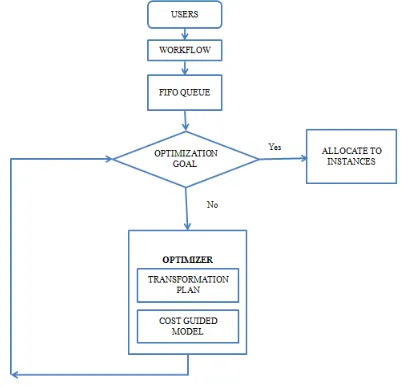
a) ToF Planner
This ToF planner helps to find the sequence of operation to be performed for cost and performance optimization. The planner has three designs. First the planner runs periodically. Second the main schemes and auxiliary schemes are performed alternatively and cost model avoids the unwanted transformation operations.
Third the rule is defined to achieve the performance and cost optimization goal.
Fig. 1 Transformation based Optimization
b) The Optimization process of ToF for workflows
All workflows are allowed in the form of queue. Each workflow is initially assigned with instance type. The selected main scheme and auxiliary scheme operations are performed for largest cost reduction without affecting the deadline of the workflow. If the time constraints are not violated then the cost has been estimated by cost model. If these transformation operation has no cost reduction then the initial assignment are executed to optimize the workflow. In this transformation based model few process have to increased like following process:
• This ToF Planning has tendency to make
administration inflexible.
• The resources are not utilized effectively.
• There is no scope for individual freedom on performance and cost of Workflows in the cloud.
•
Therefore they cloud service may be fail to takeup timely actions and an opportunity is lost. To overcome these problems and to utilize the resource effectively the new technique has been introduced in this paper.
3.2 Dynamic Proportional Share model and Resource
Discovery Protocol
ISSN 2348 – 7968
strategies and resource multiplexing strategies based on job requirements. In this proposed model, we focus on two key issues: 1) Resource discovery protocol which uses the multiattribute range query problem in a fully deentralized environment for locating a qualified node to satisfy a user task’s resource demand. 2) Dynamic proportional share model which optimize a task’s execution time by determining the optimal shares of the multiattribute resources to allocate to the tasks with expected time and limited budget.
1) Demand Sharing and Pointer Gossiping
This approach design a novel multiattribute range query protocol for locating qualified nodes. However due to dynamic resource provisioning technologies used in cloud, locating a node which contains a combination of available resources become the challenging problem due to frequent resources repartitioning and reallocation. To satisfy this problem the proposed Resources Discovery protocol has been included. This protocl aims to find the qualified resources with minimum contention among the users on task’s demand. It is unique among other methodology in which during the entire course of discovery there is only one query message proposed in the network. The procedure of resources query is, when a node generates a query message, it will first be routed to its duty node, on the node each stored record will be checked against the message’s demand. If the node keeps the enough qualified records for the query they will be returned to the requesting node and query will be terminated. If there are no matched records, a few other duty nodes pointed by the current duty node will be randomly selected and encapslated.
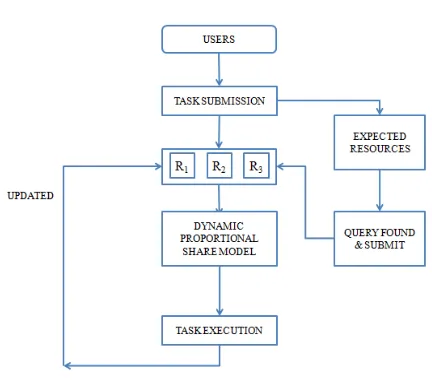
2) Dynamic Proportional Share Model
Then the process is further proposed with a dynamic proportional share model resource alocation. The key idea is to dynamically scale the amount of resources at each dimension among running tasks proportional to their demand, such that these tasks could use up the maximum capacity of each resource type at a node. For this the user will not be charged more even with any extra resource allocation. The execution time of a running tasks can be further reduced by allocating additional resources.
Fig. 2 Dynamic proportional share model
a) VM-aware Scheduling
The goal of the cloud provider is to minimize the infrastructure cost by minimizing the number of servers required to handle the data center workload. Typically the peak workload decides the infrastructure cost for the data center. The goal of VM-aware scheduling is to schedule all jobs within available VM pools to meet their deadlines while minimizing the overall resource usage in the data center reducing this total infrastructure cost. As jobs are incrementally submitted to the cloud, scheduling requires an online algorithm that can place one job at a time on an infrastructure already executing some jobs.
b) Online VM-aware Scheduling
ISSN 2348 – 7968
then uses the end time of that job’s reservation as the bound for limiting the number of reservations i.e. jobs in the job queue that are not schedulable (in terms of start time) within that reservation time window are not considered for reservation. This ensures that we are not unnecessarily creating a large number of reservations which may need cancellation and rescheduling after another job with more stringent deadline enters the queue.
4. Experimental Results
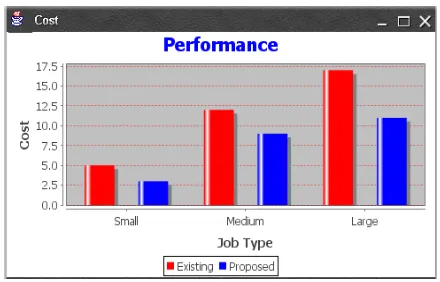
Fig. 3 presents the cost and performance ratio between the Transformation based Optimization Framework and Dynamic Proportional share model using Resource Discovery protocol.
Fig. 3 Transformation Based Optimization versus Dynamic Proportional share model
In dynamic proportional share model multiple types of resources can be shared by every task on the same node, so the resources can be utilized more effectively. This model is different from traditional resource allocation model. Aithough there many strategies for VM-multiplexing they are not suited to Dynamic proportional share model which focus on few attribues like CPU, IO speed, Bandwidth, Disk space amd Memory space. This model allows each tasks to utilize the resources dynamically and effectively.
5. Conclusions
This paper presents a new cloud service model, which has three contributions. 1) Efficient resource allocation to the tasks within user’s budget. This produces the solution which can enhance the task execution time based on resources assigned within the user’s budget. 2) Maximized resource utilization with Dynamic proportional share model which make use of the idle resources which means the incentives to the users by obtaining more share of
unused resources without more payment. 3) Resource Discovery Protocol which minimizes the contention among the virtual machines by providind sufficient and necessary conditions for getting optimal resource allocation. For this the user will not be charged more even with any extra resource allocation. The execution time of a running tasks can be further reduced by allocating additional resources. In contrast to existing services, this process automatically creates the best configuration for the jobs and leverages deadline awareness which, by delaying execution of certain jobs, allows the cloud provider to optimize its global resource allocation efficiently and reduce its costs. This process makes better result for resource provisioning and reduction in cost for resource usage.
References
[1] Y.C. Lee, R. Subrata, and A.Y. Zomaya, “On the performance of a Dual Objective optimization Model for Workflow Application for Grid platforms”, IEEE Trans. Parallel and Distributed Systems, vol. 20, no. 9, pp. 1273-1284, Sept. 2009.
[2] E.-K. Byun, Y.-S. Kee, J.-S. Kim, and S. Maeng, “Cost Optimized Provisioning of Elastic Resources for Application Workflows”, Future Generation Computer Systems, vol. 27, no. 8, pp. 1011-10261, 2011.
[3] M. Mao and M. Humphrey, “Auto-Scaling to Minimize Cost and Meet Application Deadlines in Cloud Workflows”,Proc. Int’l Conf. Grid Computing (GRID), pp. 41-48, 2010.
[4] M. Malawski, G. Juve, E. Deelman, and J. Nabrzyski, “Cost and Deadline-Constrained Provisioning for Scientific Workflow Ensembles in IaaS Clouds,” Proc. Int’l Conf. for High Performance Computing, Networking, Storage and Analysis (SC), pp. 22:1-22:11, 2012.
[5] Amelie Chi Zhou and Bingsheng He,“Transformation-Based Monetary cost Optimization for Workflows in the cloud,” IEEE transactions on cloud computing, vol. 2, no. 1, 2014.
[6] Xiaofang Li, Yingchi Mao, Yanbin Zhuang,”An Improved Max-Min Task-Scheduling Algorithm for Elastic Cloud”,International Symposium on Computer,Consumer and Control, 2014.
[7] Nguyen Doan Man, Eui-Nam Huh,”Cost and Efficiency-based Scheduling on a General Framework Combining between Cloud Computing and Local Thick Clients”, 2013. [8] AV.Karthick, Dr.E.Ramaraj, R.Ganapathy Subramanian,” An Efficient Multi Queue Job Scheduling for Cloud Computing”, World Congress on Computing and Communication Technologies, 2014.
[9] Tanyaporn Tirapat, Xiaorong Li, Tiranee Achalakul,”Cost Optimization for Scientific Workflow Execution on Cloud Computing”, IEEE International Conference on Parallel and Distributed Systems, 2013.
ISSN 2348 – 7968
Environment”, International Conference on Computing and information Technology, 2013.
[11] Yogita Chawla, Mansi Bhonsle,”Dynamically optimized cost based task scheduling in Cloud Computing”,International journal on emerging trends and technology,Volume 2, Issue 3, 2013.
[12] Fan Zhang,Junwei Cao,Kai Hwang,Keqin Li,Samee U.Khan,” Adaptive Workflow Scheduling on Cloud Computing Platforms with Iterative Ordinal Optimization”, 2014.
[13] Sheng Di, Cho-Li Wang,”Dynamic Optimization of Multiattribute Resource Allocation in Self-Organizing Clouds”, IEEE Transactions on Parallel and Distributed Systems, 2013.
[14] D. Li, J. Cao, X. Lu, and K.C.C Chen,”Efficient Range Query Processing in Peer-to-Peer Systems”, IEEE Trans. Knowledge and Data Eng., vol. 21, no. 1, pp. 78-91, Jan. 2009.
[15] S. Di, C.-L. Wang, W. Zhang, and L. Cheng,”Probabilistic Best-Fit Multi-Dimentional Range Query in Self-Organizing Cloud,” Proc. IEEE 40th Int’l Conf. Parallel Processing, pp. 763-772, 2011.
[16] M. Feldman, K. Lai, and L. Zhang, “The Proportional-Share Allocation Market for Computational Resources,” IEEE Trans. Parallel and Distributed Systems, 2009.
[17] L. Cherkasova, D. Gupta, and A. Vahdat, ”Comparison of the Three cpu Schedulers in Xen,” SIGMETRICS Performance Evaluation Rev, 2007.
[18] Balagi Planisamy, Aameek Singh, Ling Liu, ” Cost-effective Resource Provisioning for MapReduce in a Cloud,” 2014.
[19] Y. Drougas and V. Kalogeraki, “A Fair Resource Allocation Algorithm for Peer-to-Peer Overlays,” Proc. IEEE INFOCOM ’05, 2005.