ISSN 2286-4822
www.euacademic.org DRJI Value: 5.9 (B+)
Investigating the Effect of Cooperative Learning in
Maximizing Classroom Interaction at Secondary
Level
AMIR ABDALLA MINALLA Department of English Language, Faculty of Education
Blue Nile University, Damazin, Sudan MAHMOUD ALI AHMED College of Languages Sudan University of Science & Technology, Khartoum,Sudan
Abstract:
friendship and then members of each group should be assigned their own leader. This strategy of learning requires interesting learning materials that match the members` everyday interests. Also it requires the classroom to be organized in terms of face-to-face arrangement and teachers should play roles such as guides, advisers and overseers during groups interaction. In addition, it recommends that sufficient opportunities for classroom interaction should be provided by maximizing the allotted-time for the classroom interaction.
Key words: members, group, opportunity, communication, cooperation.
INTRODUCTION
It's extremely common for teachers to require students to work in groups. Dooly (2008) points out that, more importantly, that students to be responsible for one another`s learning as well as their own, and that reaching the goal implies that students have helped each other to understand and learn. So, students are actively exchanging, debating and negotiating ideas within their groups which increases students` interest in learning. By engaging in discussion and taking responsibility for their learning, students are encouraged to become critical thinkers. Many researchers have reported that students who work in small groups tend to learn more of what is being taught. Moreover, they retain the information longer and also appear more satisfied with their classes. So, it is motivating and appropriate for weaker students to learn from their friends.
STATEMENT OF THE PROBLEM
cooperative learning in their classes not for the purpose of classroom interaction. However, it is used for other reasons beyond classroom interaction, such as shortage of textbooks and/or to achieve class`s task as quickly as possible.
OBJECTIVE OF THE STUDY
This study aims at finding out techniques and strategies that can be adopted for establishing cooperative learning in order to maximize classroom interaction.
QUESTIONS OF THE STUDY
The study attempts to answer the following questions:
1. How effective is cooperative learning in maximizing classroom interaction?
2. What are the criteria that can be adopted for engaging English language classes in working cooperatively?
3. What are the difficulties of utilizing cooperative learning strategy in secondary school English language classes?
SIGNIFICANCE OF THE STUDY
This study is important because it helps teachers to be aware of how English language classes are designed to work cooperatively and also help them to deal with difficulties that may face them. As for learners, it helps them to have learning from each other cooperatively.
LITERATURE REVIEW
(2001) add that, cooperative learning is an approach of teaching that makes maximum use of cooperative activities involving pairs and small groups of learners in the classroom. And they define cooperative learning as it is group learning activity organized so that learning is dependent on the socially structured exchange of information between learners in groups and in which each learner is held accountable for his/her own learning and is motivated to increase the learning of other. On the other hand, Dooly (2008) states that, cooperative learning is a process meant to facilitate the accomplishment of a specific end product or goal through people working together in groups.
COOPERATIVE VERSE COLLABORATIVE LEARNING
ELEMENTS OF COOPERATIVE LEARNING
Crowell (2003) argues that, simply working in a group does not guarantee cooperative learning. There are five elements that define true cooperative learning in groups:
1. Face-to-face interaction 2. Positive interdependence 3. Individual accountability 4. Collaborative skills 5. Group processing
Face-to-face interaction is a bit counter-intuitive because it doesn't necessarily mean face-to-face as in 'in-person'. It actually just refers to direct interaction. So, it can be literally face-to-face, or it could be over the phone, on chat, via Skype, through email, etc. It just refers to the fact that group members have to actually interact in order to cooperate. The second element is positive interdependence, which means that the group members rely on each other and can only succeed together. This goes hand-in-hand with the third element, which is individual accountability. As an interdependent group, each individual is responsible for his or her own work and can be held accountable for that work. The fourth element of cooperative learning is collaborative skills. The group members must be able to work together, but the ability to do so doesn't always come naturally; sometimes these skills need to be taught. And the final element is group processing, which refers to the fact that the group needs to monitor itself to ensure that as a whole, it is working together effectively.
Jigsaw
and then teach it to the other members of the group. Just like a jigsaw puzzle, each piece or section is put together at the end, and only then does the entire picture makes sense.
For example, imagine X ` been placed in a group that has been tasked with researching the life of Sudanese international novelist El-Tayeb Salih. In jigsaw, X and the members of X`s group would each be responsible for researching certain periods of his life. Let's say there are four members of X`s group. X is responsible for researching his childhood, and the other members of X`s group are responsible for other periods of his life. When X one is done with his/her individual research, he/she reports what X`s learned to the other members of his/her group. Once everyone is done with their reports, X `s a complete picture of the novelist entire life.
COOPERATIVE LEARNING: POSSIBILITIES AND CHALLENGES
pointed out by Nunan (1992), are necessary for successful cooperative learning:
1- Positive interdependence, a sense of working together for a common goal and caring about each other`s learning.
2- Individual accountability, whereby every team member feels in charge of their own and their teammates` learning and makes an active contribution to the group. Thus there is no 'hitchhiking' or 'freeloading' for any one in a team – everyone pulls their weight;
3- Abundant verbal, face-to-face interaction, where learners explain, argue, elaborate and link current material with what they have learned previously;
4- Sufficient social skills, involving an explicit teaching of appropriate leadership, communication, trust and conflict resolution skills so that the team can function effectively.
5- Team reflection, whereby the teams periodically assess what they have learned, how well they are working together and how they might do better as a learning team.
CLASSROOM INTERACTION
lecturing, asking questions, giving instructions, and so on. The teacher does not only use language for these functions, but he or she demonstrates and uses mime a lot.
METHODOLOGY OF THE STUDY
The researcher adopts descriptive analytical method in order to investigate utilizing role-play as a learning strategy for developing oral classroom interaction.
Population of the Study
The population of the study consists of two groups. The first group is secondary school English language teachers (SSELT). The second group is the secondary school students. Both groups are intended to answer two different questionnaires.
Sample of the Study
The first group of sample is composed of fifty male and female secondary school English language teachers. The second group of sample consists of fifty secondary school students. The samples of the two groups are chosen from six secondary schools all in Damazeen city. The sample total is hundred.
Tool of Data Collection
For data collection the study used a questionnaire. The researcher designs two different questionnaires, one for the teachers and another for their students.
Design of Data Collection Tool
students, is designed to identify to what extent learners are satisfied with cooperative as a learning strategy for classroom interaction. In other words, it investigates learners` attitudes toward cooperative learning as a strategy for classroom interaction.
Procedures of Data Collection
In practice two different questionnaires are carried out in six secondary schools that intentionally use cooperative learning for three weeks successively in response to this study. The questionnaires were distributed by the end of the three weeks. The students receive some help from the researcher in filling out their questionnaire.
RESULTS AND DISCUSSION
English Language Teacher`s Questionnaire
This questionnaire contains six statements which investigate English language teachers` attitudes toward utilizing cooperative learning as a learning strategy for maximizing classroom interaction. The data of this questionnaire is presented in terms of tables accompanied with figures for each statement of the questionnaire.
Table (1) Majority of groups` members are from low level students.
Option Frequency Percent
Agree 45 90.0
Neutral 5 10.0
Disagree 0 00.0
Total 50 100.0
is from low achievers. The researcher suggests that group work should be grouped in a way that allows for low achievers to receive help from good students. In other words, group work should be grouped on the basis of mixed-ability.
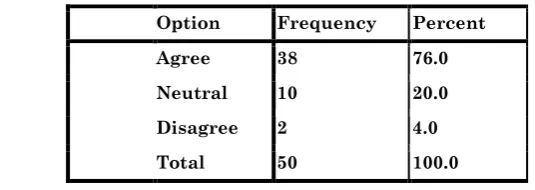
Table (2) Cooperative learning provides opportunities to develop social and communication skills.
Option Frequency Percent
Agree 38 76.0
Neutral 10 20.0 Disagree 2 4.0
Total 50 100.0
From table (2) it is clear that the majority (76%) of responses support the above statement which says that cooperative learning is an opportunity to develop social and communication skills. So, this helps learners to get involved in many social interactions.
Table (3) Cooperative learning increases opportunities for practicing English language orally.
Option Frequency Percent
Agree 40 80.0
Neutral 7 14.0
Disagree 3 6.0
Total 50 100.0
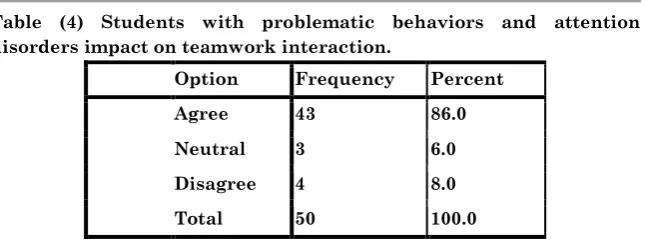
Table (4) Students with problematic behaviors and attention disorders impact on teamwork interaction.
Option Frequency Percent
Agree 43 86.0
Neutral 3 6.0
Disagree 4 8.0
Total 50 100.0
Table (4) displays that (86%) of the responses support the claim that says the students with problematic behaviors and attention disorders impact on team work learning. So, teachers should give this type of students special attention to change their conditions to positive ones. The teacher should assign them to very effectives groups.
Table (5) Cooperative learning is appropriate for enhancing interaction in crowded classes.
Option Frequency Percent
Agree 34 68.0
Neutral 1 2.0
Disagree 15 30.0
Total 50 100.0
Table (6) Cooperative learning helps learners gain enough confidence to get involved in classroom interaction.
Option Frequency Percent
Agree 30 60.0
Neutral 11 22.0 Disagree 9 18.0
Total 50 100.0
Table (6) illustrates that the majority (60%) of the responses agree that cooperative learning gives students enough confidence to get involved in classroom interaction. So, working in groups enables students to share their thoughts, gradually; first as a group, then as a class and eventually as a community.
Students` Questionnaire
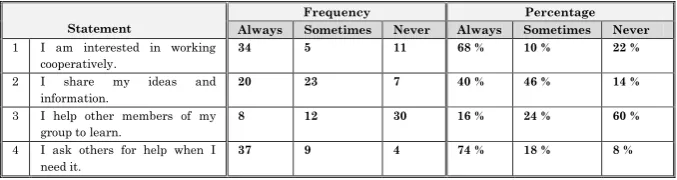
This questionnaire consists of four statements which are designed to identify learners` attitudes toward learning cooperatively. This questionnaire is only distributed to the students who had experience in learning cooperatively at the classes that employ this type of learning for three weeks successively.
Statement
Frequency Percentage Always Sometimes Never Always Sometimes Never
1 I am interested in working cooperatively.
34 5 11 68 % 10 % 22 %
2 I share my ideas and information.
20 23 7 40 % 46 % 14 %
3 I help other members of my group to learn.
8 12 30 16 % 24 % 60 %
4 I ask others for help when I need it.
37 9 4 74 % 18 % 8 %
Statement1: The result of this statement explains that most of
the students are in favour with cooperative learning. They are interested in working cooperatively to help one another.
ideas and information, (46%) of responses illustrate that students sometimes share their ideas and information and (14%) of the responses indicate that students never share their ideas while group tasks are being carried out. This means that students are improved after experience of working cooperatively. Their sharing progresses from never to sometimes to always.
Statement3: It is clear that the students who present help for
others represent less percentage because most members of the group are from weak students.
Statement4: The result of this statement obviously shows that
most students depend on asking their colleagues in the group to help them when they need it. This indicates that the students are really involved in cooperation.
CONCLUSION
This study is conducted to utilize cooperative learning for maximizing classroom interaction. The main findings and recommendations of this study can be briefly summed up below.
FINDINGS
The main findings of this study are summarized as follows: 1. Cooperative learning is an effective learning strategy in
increasing secondary English language classes` interaction.
2. The majority of the group members are from low level students.
3. Cooperative learning increases opportunities for practicing English language verbally.
5. Cooperative learning helps learners gain enough confidence to share their ideas.
6. Cooperative learning creates good relationships between learners.
RECOMMENDATIONS
Depending on the findings of the study, the researcher recommends the following:
1. Secondary school English language classes should be grouped into 3 - 4 persons and each group should be formed on the basis of mixed ability and ties of friendship and then members of each group should be assigned their own leader.
2. Interesting learning materials should be designed in accordance with everyday learners` situations.
3. Students with problematic behaviors and attention disorders should be assigned to effective groups and the teacher should help and support them continuously. 4. Opportunities for working cooperatively should be
maximized.
5. While cooperative learning activity is being carried out, teachers should vary their roles between advisors, overseers and guides.
6. Physical classroom arrangement should be redesigned in terms of face-to-face interaction.
REFERENCES
Dagarin, M. (2004). Classroom interaction and communication strategies in learning English as foreign , Birografika Bori, Ljubljana.
Dooly, M. (2008). Constructing knowledge together, Bern: Peter Lang.
Gillies, R. (2007). Cooperative Learning Project, Available from: <sydney.edu.au/education_social >. [Accessed 20 September 2014].
Nunan, D. (1992). Collaborative Language Learning and Teaching, Cambridge University Press.