Study of Partial shading effect on Solar
Module Using MATLAB
Satyendra Vishwakarma
Department of EN, Ajay Kumar Garg Engineering College, Ghaziabad, Uttar Pradesh, India
ABSTRACT: Solar cells are connected in series and parallel in order to generate high voltage and current respectively. Sometimes PV module is shaded due to nearby building, passing clouds. Solar cells arrays are subject to shadows from both predictable sources as well as from such unpredictable sources as bird droppings or fallen leaves. The percentage power loss is much greater than the percentage of array area which is shadowed; for smaller arrays with few or no parallel connections, one leaf could cause the system output. To reduce such effects bypass diodes are used. The bypass diode will make sure the operation of the module with partial or full shaded modules at reduced voltage [1]. However the number of bypass diodes used in a module is limited, so shading of one single cell will affect the system performance. In this paper, a PV module which is partially shaded is discussed. The different level of shading on current-voltage characteristics and power output of module are investigated.
KEYWORDS: PV array, partial shading, bypass diode, simulation.
I. INTRODUCTION
Solar, wind and hydro are renewable energy resources. It is pollution free, easily available and limitless. So they are reliable replacement of conventional energy resources like oil and natural gas. However the efficiency and performance are in developing stage. Among these PV systems are mostly used because they are clean and availability of source free of cost. However, a major challenge in using a PV sources, its nonlinear characteristics, which changes with temperature and solar irradiation. The characteristics get more complex if the entire PV array does not receive uniform irradiation, as in partially cloudy (shaded) conditions, results in multiple peaks. The presence of multiple peaks reduces the effectiveness of the existing maximum power point tracking (MPPT) schemes [1]–[3] due to their inability to discriminate between the local and global peaks. It is very important to understand and predict the PV characteristics in order to use a PV installation effectively, under all conditions. Over the years, several researchers have studied the characteristics of PV modules and the factors that affect them [4]–[7].
Researchers have studied the effects of fluctuations in PV power on the utility and other connected system. Kern et al. [8] have studied the consequences of the shading of PV, due to passing clouds, on the fluctuations of PV power generation, and therefore, on the performance of the electrical utility to which it is connected. It is not only the size (i.e., the total number of modules) of the PV array but also its configuration (i.e., the number of modules in series and parallel, respectively) that significantly affects its power output, and therefore, the performance of the system under partially shaded conditions.
II. PV ARRAY MODEL
The electrical equivalent model of a Photo-Voltaic cell consists of a current source and a diode connected in parallel (Fig. 1).The PV cell behaves as a highly nonlinear current source and its output voltage is limited. It is known from the PV-cell power versus voltage characteristics that the power generated reaches its maximum under a precise loading. Modules consist of a number of solar cells which are arranged in parallel and series to increase voltage and current levels of module. The electrical equivalent circuit of a solar cell is shown in Fig. 1. It is comprised of a series resistance, a parallel resistance, diode and light driven current source. Here I and V denote current and voltage generated by the solar cell, ℎ(A) denotes current generated by solar cell, represents series resistance (Ω), and ℎ
represents shunt resistance (Ω).
Fig.1. PV cell Equivalent circuit
When load connected to panel is changed, then corresponding value of voltage and current changes. Temperature, irradiation and internal characteristic of module affect the P-V characteristics of the module. Irradiation on a module directly affects charge carriers of module. So current generated by the module changes according to irradiation of the module. When intensity of light changes, its corresponding temperature of module changes. So current generated by the module also influenced by temperature.
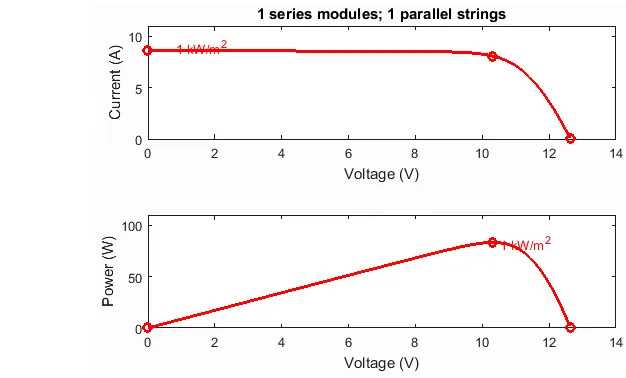
A PV array block available in library in MATLAB /SIMULINK has been used to study effects of shading.
Fig. 2 MATLAB block in Simulink library [13] and I-V & P-V characteristic of string 1
III. CAUSE OF PARTIAL SHADING ON PV
the current flow through all the cells remaining the same irrespective of shaded cells producing reduced photonic current.
Uniform Shading This type of shading occurs during sun set times where there is reduced solar irradiance on the panel. Under uniform shading condition, all of the cells are exposed to a uniform but reduced solar irradiance due to which there is a consistent decrease in the photonic currents in all the cells. Thus there is a uniform reduction in the output voltage and current of individual cells in the series string. The impact of uniform shading on the solar panel is minimal, although it comes with a reduced output power.
Non-Uniform / Partial Shading Unlike the case of uniform shading, partial shading occurs due to passing clouds, shadow cast by the adjacent buildings, trees, bird droppings, dust deposition, etc. The effect of partial shading on few cells is more detrimental to the solar panel operation when compared to uniform shading case. As a result the operation of the PV systems is severely affected with deterioration in the array characteristics.
Partial shading is a vital issue because: a) the shaded cells can get reverse biased and start consuming power instead of generating power resulting in a loss of total output power [9]. b) The power losses in the individual shaded cells would result in local heating and increase the temperature affecting surrounding cells. The increase in temperature creates thermal stress on the entire module and cause hot spots and local defects which potentially result in the failure of the entire array [10]. c) The reverse bias on the solar cell, under extreme cases of shading, might exceed its breakdown voltage. In such cases, the cell gets fully damaged, develops cracks and an open circuit can occur at the serial branch where the cell is connected [11]. A single solar cell operating in isolation when totally shaded may cause significant reduction in generated power. However the increase of irradiation and shadow rate in interconnected array of solar cells causes the shaded cell to dissipate power generated by other cells that would drastically reduce the peak power [9]. Typically PV modules/arrays comprise of several solar cells that are interconnected in one of the following forms to attain realizable levels of output voltage and current: purely parallel connection, purely series connection, parallel-series interconnections [12]. The effects of partial shading on parallel-series connected solar cells, and parallel connected solar cells are presented in the following sub-sections. The behaviour of solar cells under partial shading pattern has been validated with simulation results.
IV. SIMULATION RESULTS
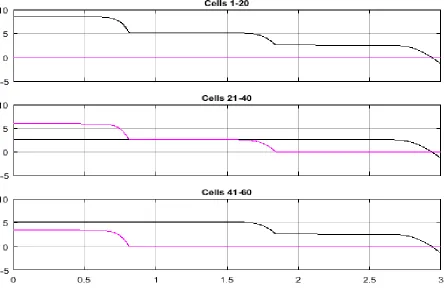
In this paper I used PV modules which are connected with a variable DC voltage source. This model helps to study photovoltaic I-V and P-V characteristics. There are three strings used. Each string has 20 series-connected cells in parallel along with bypass diodes. This bypass diode allows current flow when cells are shaded or damaged. Standard Test Condition (irradiance 1000 W/m2 & Temperature 250C) is applied on the first string while partial shading is applied on strings 2 and string 3, irradiances of 300 W/m2 and 600 W/m2 respectively. Fig. 3 Shows the MATLAB simulink modeling of PV module connected with dc source under partial shaded condition.
Simulation study carried out to analyze the effect of partial shading. A 160W solar array was considered. The system parameters used, are presented in Appendix. The I-V and P-V characteristics are obtained at the end of simulation. The P-V curve exhibits three maxima in fig. 5. Fig. 4 shows the IV & PV characteristics under partial shaded conditions. String 2 and string 3 have the irradiance of 300 KW/m2 and 600 KW/m2 respectively.
Fig.4. I-V & P-V characteristics of String 1 and string 2
Fig.6. I PV (black) and Idiode (magenta)
Fig.7. Power output of PV array
To obtain the overall resultant characteristics of all, a common voltage is assumed; while the current output of each of these groups is added to obtain the resultant current. The resultant characteristics of the PV array are shown in Fig. 5. The PV curves show multiple peaks under partially shaded conditions.
V. CONCLUSION
The effects of shading on the array and the use of bypass diodes are explored. The effects of partial shading on PV arrays are modeled and simulated using MATLAB Simulink®. The PV curves show multiple peaks under partially shaded conditions. The results obtained with this model can be used to investigate the MPPT methods working under different irradiance conditions. When this PV module is connected to a voltage-sourced converter, this may be challenging for the Maximum Power Point Tracking (MPPT) algorithm to converge on the highest peak. The Maximum Power Point indicated by a red circle on the fig. 5 is 34% lower than the expected maximum power.
Appendix
PV Module Parameters used in simulation study
Rating 84W Open circuit voltage 12.64 V Voltage at maximum power 10.32 V Short circuit current 8.62 A Current at maximum power 8.02 A
REFERANCES
1. L. Castaner and S. Silvestre, "Modelling photovoltaic systems using PSpice,", John Wiley & Sons, Ltd., 2002, New York
2. H. Patel and V. Agarwal, "MATLAB-based modeling to study the effects of partial shading on PV array characteristics,", IEEE Transactions on Energy Conversion, Vol. 23, pp. 302-31 0, 2008.
3. A. Mermoud and T. Lejeune, "Partial shading on PV arrays: bypass diode benefits analysis,", in 25th European Photovoltaic Solar Energy Conference, 2010, pp. 4654-4658.
4. S. Silvestre, A. Boronat and A. Chouder, "Study of bypass diodes configuration on PV modules,", Applied Energy, Vol. 86, pp. 1632-1640, 2009.
5. M. C. Alonso-Gracia, J. M. Ruiz, and F. Chenlo, “Experimental study of mismatch and shading effects in the,” Solar Energy Mater. Solar Cells, vol. 90, no. 3, pp. 329–340, Feb. 2006.
6. H. Kawamura, K. Naka, N. Yonekura, S. Yamanaka, H. Kawamura, H. Ohno, and K. Naito, “Simulation of I–V characteristics of a PV module with shaded PV cells,” Solar Energy Mater. Solar Cells, vol. 75, no. 3/4, pp. 613–621, Feb. 2003.
7. T. Shimizu, M. Hirakata, T. Kamezawa, and H. Watanabe, “Generation control circuit for photovoltaic modules,” IEEE Trans. Power Electron., vol. 16, no. 3, pp. 293–300, May 2001.
8. E. C. Kern, E. M. Gulachenski, and G. A. Kern, “Cloud effects on distributed photovoltaic generation: Slow transients at the Gardner, Massachusetts photovoltaic experiment,” IEEE Trans. Energy Convers., vol. 4, no. 2, pp. 184–190, Jun. 1989.
9. P. O. Singh, “Modeling of photovoltaic arrays under shading patterns with reconfigurable switching and bypass diodes” M.S. thesis, Department of Electrical Engineering and Computer Science, The University of Toledo, 2011.
10. R. E. Hanitsch, D. Schulz and U. Siegfried, “Shading effects on output power of grid connected photovoltaic generator systems,” in Revised. Energ. Ren. : Power Engineering, pp. 93-99, Berlin Germany, 2001.
11. S. Silvestre and A. Chouder, "Effects of shading on photovoltaic module performance," Progress in Photovoltaics: Research and Applications, no. 16, p. 141–149, 2008.
12. T. Maine, S. Martin and J. Bell, "Minimisation of power loss from partially shaded solar cell arrays," in Proceedings of ISES World Congress (Vol. I – Vol. V), pp. 1551-1555, 2009.