E-Government in Developed Countries,
The Case of Turkey
Recep Benzer# #
Information Institute, Gazi University
Gazi University, Tunus Cad. No: 35 Kavaklıdere Çankaya/Ankara, Turkey
Abstract— The world has gone through a very fast change
trend in the last century, and the borders all over the world have vanished with the effect of the globalization. In such an environment, the countries are also obliged to keep up with the change and modify their organizational structures in accordance with the requirements of the age. In this century when the phenomenon of technology makes its presence felt, the use of information technologies by the states has become compulsory for both ensuring the international competition and increasing the efficiency of national services as well as providing the public services. In such a context, the states should switch to the e - government approach leaving their traditional one. The fact that e-government practices have been adopted within the public administration and new state understanding is essential for ensuring the efficiency with regard to providing public services to the citizens. Within this context, the concept of e-state is defined, and information concerning its development process in Turkey is provided in this study.
Keywords— e-government, public services, Turkey.
I. INTRODUCTION
Today, we are living in a world where Information Communication Technology is being diffused into almost all spheres of human activity at an unprecedented rate. The rapid expansion of the knowledge economy and knowledge are key to the future rise of the phenomenon of the increasing competition in every field of life moved along with the globalization trends. In the competition, every individual, every company and institution globalized. Information technology investments for efficiency, competitiveness and increases the power of the production of knowledge and technology for developing countries in particular has been a key point. Nowadays, cheap labor, as well as traditional competitive elements of natural resources, the location of the production of knowledge and technology capabilities left. Knowledge-intensive economy of developing countries aims to recognize this fact.
The World Economic Forum acknowledges the role of Information and Communications Technologies (ICTs) as a critical enabler to sustainable socio-economic growth and also a vital ingredient for effective regional co-ordination in the creation of larger markets. Efforts to build infrastructure in the developing world, both by governments and development agencies, have predominantly focused on providing computer hardware, satellite connections and fibre-optic cabling, the Forum writes in its report on the Southern African Development Community's e-Readiness. [1].
The economy, the government has been one of the main players. In this context, governments can enter into an attitude change can intercept or able to see well as the support for creativity and development. In other words, government policies have an important role in the development of a country is.
Classical state mentality, the various services provided by the government, the citizens are facing a lot of bureaucracy process. Simple procedures for employees and it is becoming complex structures as a result of the implementation of the works are being recruited to carry out a large number of staff and officers. In addition, numerous forms and signatures for simple transactions may need, in some cases for months, ongoing operations and lead to a loss of time.
Today openness of information and communication channels over the world, which has become a giant village as a result of rapid changes and developments in information technologies, causes every important event to effect faraway places, and makes the concepts such as national and international non-functional. The phenomenon, making this entire order top to bottom is information and ease of accessing it [2].
Budd and Harris [3] had observed that e-Government in the UK often represented a change in status for government technology. There is no standard definition of e-government. Various academicians and researchers have attempted to define it based on their notion. For instance, e-Government is ‘the use of information and communication techniques to improve the activities of public sector organisations, of course impacts on the strategy and operations of our Agency”.
The evolution of government efforts to provide electronic services in this stage-by-stage manner has already been described by a number of authors (e.g. Layne and Lee [4], Moon [5], Rao et al.,[6], Ghasemzadeh and Sahafi [7]).
II. WHAT IS E-GOVERNMENT ?
e-Government or electronic government can be defined as government activities taking place through electronic communications among all levels of government, citizens, and the business community. These activities include acquiring and providing products and services; placing and receiving orders; providing and obtaining information; and completing financial transactions. In a broader sense, egovernment is the application of information and communications technologies (ICTs) to enhance the performance of government functions and services.
“E-Government” refers to the use by government agencies of information technologies (such as Wide Area Networks, the Internet, and mobile computing) that have the ability to transform relations with citizens, businesses, and other arms of government. These technologies can serve a variety of different ends: better delivery of government services to citizens, improved interactions with business and industry, citizen empowerment through access to information, or more efficient government management. The resulting benefits can be less corruption, increased transparency, greater convenience, revenue growth, and/or cost reductions [8].
It is understood that; technological development is one of the most important facors for having e-government as an element of administration. This development has raised the result of some transactions and operations to be presented in electronic form. In the process of e-government, governments digitise their services. But here arises a very important matter. Digitising services, is a means rather than goal of e-government, it is a factor of the revolutionary change, which e-government can emerge. Therefore, the digitising services should not be understood as a goal, it is a means for the goals. Attainment of this objective cannot be the end of the process of e-government [9].
Traditionally, the interaction between a citizen or business and a government agency took place in a government office. With emerging information and communication technologies it is possible to locate service centers closer to the clients. Such centers may consist of an unattended kiosk in the government agency, a service kiosk located close to the client, or the use of a personal computer in the home or office.
The electronic state on the basis of the definitions listed in the following headings:
Government ↔ Government (G ↔ G) (Government
to Government- G2G)
Government ↔ Citizen (G ↔ C) (Government to
Citizen- G2C)
Government ↔ Business (G ↔ B) (Government to
Business- G2B)
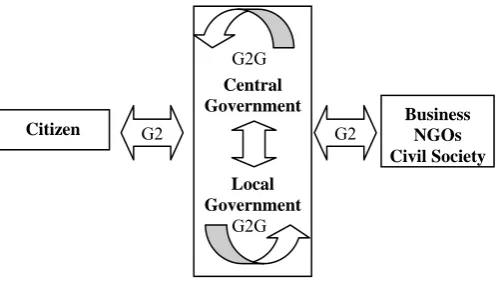
E-Government model flow system can be better understood through the following Figure 1.
Figure 1. Interactions between main groups in e-government.
2.1. Government to Government - (G2G)
Integrating service delivery programs across government agencies and between levels of government requires electronic information sharing and integration. Often called “horizontal government” these efforts support initiatives to provide citizens, most often communities of interest, with an integrated set of services [10].
2.2. Government to Citizen – (G2C)
Deals with the relationship between government and citizens. G2C allows citizens to access government information and services instantly, conveniently, from everywhere, by use of multiple channels [8].
2.3. Government to Business – (G2B)
Consists of e-interactions between government and the private sector. The opportunity to conduct online transactions with government reduces red tape and simplifies regulatory processes, therefore helping businesses to become more competitive [8].
2.5. e-Government Objectives
The use of ICT in government operations facilitates speedy, transparent, accountable, efficient and effective interaction with the public, citizens, business and other agencies. In the back-office, the internal objective of e-government in e-government operations is to facilitate a speedy, transparent, accountable, efficient and effective process for performing government administration activities. Significant cost savings (per transaction) in government operations could be the result (Table 1) [11].
Identifying potential gains from e-government is one thing; actually realising them is another. Implementing ICT projects, particularly large-scale projects that could have a major impact on service quality improvements or efficiencies, could raise a number of problems, many of which relate particularly to operating within government.
In order to examine the risk of implementing e-governance solutions the following factors have to be taken into account [11]:
• Political stability (democracy or dictatorial regime) • Adequate legal frame work
• Level of trust in government (perception of service levels)
Central Government
Local Government
G2G
G2G
Citizen Business NGOs Civil Society
• The importance of government identity (fragmentation or integration)
• Economic structure (education, agriculture, industry or service)
• Government structure (centralized or decentralized) • Different levels of maturity (weakest part of the chain determines speed)
• Constituent demand (push or pull)
e-Government, public institutions / organizations, citizens and business information between agencies, in exchange of goods and services through the use of information technology aims to increase performance and efficiency [12].
Table 1. Summary of objectives.
e-government E-administration E-governance
Policy coordination and implementation; delivery of services online
Internal and public sector management component
Facilitation of interactions between citizens, government organizations and elected offices including governing and policy-making process How technology (particularly the web) is transforming governing process
E-federalism: the changing relationship among the levels of government; and
E-democracy: enhancing citizen participation online voting, issue of ethic, security and privacy Legislative and policy-making environment framework; policy initiatives governments are taking: the regulatory framework, implications of initiatives like recognizing the legality of e-signatures, greater citizen participation in policy making environment (e-democracy)
International implications: lowering of borders through information exchanges-impacts and consequences; international standards and best practices; information management and e-government Developing citizen-centric programs Promoting and enhancing citizen participation
Strategic planning in transitioning to electronic delivery of services Quantifying cost-effectiveness of electronic service delivery Perfecting online service delivery through analysis evaluation; measuring efficiency and benchmarking against other forms of service delivery Benchmarking and performance measurement Country indexing measurement benchmarking) portal analysis, website analysis Human resource management issues like training and
recruitment, deployment of staff and maximizing existing
resources
Source: United Nations, DPEPA, ASPA [13]
2.6. Gains of e-Government
In addition, e-government applications are expressed -in terms of new public administration approach- to be able to close the deficits about budget, performance and trust, in the way of refreshing the eroded trust of the citizens in governments [14].
E-government, improve the quality of people's lives, social and economic organization has the potential to increase the efficiency [15].
Figure 2: Gains of e-Government. Source: John Tyreman and Peter Hocking [14]
2.7. Usage Areas of e-Government
Regarding public services provided electronically, the usage of e-government, as seen in Table 2, daily life, political participation and remote management is possible to classify under three headings as:
Table 2 - A typology of Electronic Government services. Information services Communication services Transaction services Everyday life Information on
work, housing, education, health, culture, transport, environment, etc.
Discussion for a dedicated to questions of everyday life ; Jobs or housing bulletin boards e.g. ticket reservation, course registration Tele-administration Public service directory Guide to administrative procedures Public registers and databases
e-mail contact with public servants electronic submission of forms Political participation Laws, parliamentary papers, political programmes, consultation documents Background information in decision making processes
Discussion for a dedicated to political issues e-mail contact with politicians referenda elections opinion polls petitions
Source: Institute of Technology Assessment, Austrian Academy of Sciences and Centre for Social, Background Paper to "the Information Society, Bringing Administration Closer to the Citizens Conference", November 1998.
http://cordis.europa.eu/econtent/publicsector/gp-chapter2.html#ii1 (10 December 2013)
Table giving information services, public institutions and organizations to provide information services. Communication services, public institutions and organizations with a unidirectional communication can provide (as printed form filling, e-petition, application forms, etc.). Bidirectional communication, also to allow services (institutions and organizations to connect and discuss issues related, on-line question asking someone to answer, etc.) covers.
III.E-GOVERNMENT APPLICATIONS IN TURKEY In our country, the first physical internet connection has been made between Netherlands Research Center (NIKHEF) and METU (Middle East Technical University) using x.25. The first e-Government applications began in 2000. In 2002, some government agencies only in terms of e-government process the information and began to give some simple e-services.
By the United Nations prepared and 4 November 2003 in Mexico City publicized the "2003 World Public Sector Report: E-Government" Research In Turkey every 100 people per number of computers is 4 and every 100 people, but 7 of them access to the internet can are indicated.
A. Existing and Ongoing Applications
Efforts to establish e-government should be initiated with the establishment of public information network. From this perspective, the development of our country for the establishment of public information highway should be given. E-government infrastructure in Turkey in terms of structuring the world fully prepared to say that the process is difficult. To this end a number of studies are in progress by Prime Management Information System (BYSB). Turkey has taken the lead in e-government but the important thing is to spread it to spread to the base.
All over the world as well as public institutions and organizations in our country, more and more taking advantage of information and communication technologies, decision support systems in order to strengthen, to speed up business processes, improve efficiency and savings in expenditure projects and application have developed.
Public institutions and organizations in many fields, have developed an electronic database and automation projects and have implemented a variety of applications over the internet. 55 In public institutions, operates over 100 e government project [17]. Ongoing government projects is shown in Table 3 [18].
Table 3. Ongoing main e-Government Projects in Turkey Ongoing main e-Government Projects
Citizenship Card Project
Electronic citizenship card including biometric elements
Pilot applications will continue in Bolu.
TAKBİS 379 Land Registry Offices and 30 cadastral unit installation completed
Accurate, current and reliable information
land records and cadastral maps to ensure their timely Electronic
Procurement
Online tender notices, tender documents to be supplied and delivered electronically, auction results Changes in December 2008 and the Public Procurement Law
State Materials Office for the sale of its catalogs and e-procurement system has improved the situation Legal Entity Central
Information System
The unique identification number for each legal entity and setting up new companies one-stop service Piloted in Mersin continues.
e-Correspondence Project of Public Institutions
The coordination of SPO, a pilot study of six institutions continues.
IV.EVALUATION OF E-GOVERNMENT APPLICATIONS IN
TURKEY
In a study conducted by the University Brown in 2004, Turkey, e-Government has been sixty-second in terms of performance [19]. Commencing the second half of 1998 without making much investment on e-Government studies, Turkey does not fall behind other countries too much. Established by Turkish Informatics Association in those years, with TBMM Information and Information Technologies Group, e-transformation process of Turkey has commenced. European Union established the objectives for the following decade in the meeting held on March 23-24, 2000 in Lisbon. The objective of “Making Europe the most competitive and dynamic information based economy in the world in ten years” was established and “e Europe + Initiative” was announced. Member and applicant states responded to this initiative and became members of that. E-Europe Action Plan is organized under four main topics. These are accelerating the works for establishing the main foundation stones of the information society, promoting internet usage by offering cheaper, faster and safer access; investing in human resource and ensuring widespread use of internet [20].
V. CONCLUSIONS
Information society is the most concrete image of communication-information revolution. In this understanding of society information production gained importance by the technology. The way to get away from bureaucracy is to offer public services to the citizens through online system.
Consequently, e-government’s having positive effects in increasing its public performance in a society by adopting a functional role at governmental effectiveness level is closely related to the level of importance paid to information and communication technologies by the governmental authorities and the width of the utilization area thereof within the society. E-governmentalization can only accelerate the government’s performance of responding to the social requests and improve the society and public administration to operate in a healthy manner and achieve the objective of becoming a more powerful government in the socio-economic context and a happier society this way.
Every new day in our lives bringing innovations of information and communication technology is developing rapidly and global competition, experiencing a second industrial revolution as we face the information age to fall behind the private and public sector, citizens from all countries by capturing as we need to all stages of life in the "E-Life" arrive, and it is to reach the level of consciousness.
ACKNOWLEDGMENT
REFERENCES
[1] World Bank, Information and communication technologies: A World Bank Group Strategy. Washington, DC: The World Bank. 2002.
[2] Şeker, N and Şeker G. E-Devlet Uygulamalarından İlsis’in Okul Yöneticileri Tarafından Değerlendirilmesi, Bilişim Teknolojileri Dergisi, 2 (2) 11-19. . (In Turkish) 2009.
[3] Budd L and Harris L. E-Economy: Rhetoric or Business Reality, Routledge, London. 2004.
[4] Layne, K.J.L. & Lee, J. “Developing fully functional E-government: A four stage model”, Government Information Quarterly, vol. 18, no. 2, pp.122-136. 2001.
[5] Moon, M.J. “The Evolution of E-Government Among Municipalities; Rhetoric or reality?”, Public Administration Review, vol. 62, no. 4, pp. 424-433. 2002.
[6] Rao, S. S., Metts, G. & Monge, C. A. M “Electronic commerce development in small and medium sized enterprises: A stage model and its implications”, Business Process Management, vol. 9, no. 1, pp. 11-32. 2003.
[7] Ghasemzadeh, F. & Sahafi, L. “E-Commerce Adoption: A Two Dimensional Maturity Model” 4th World Congress on the Management of Electronic Business, McMaster University, Hamilton, On., Canada. January 15 – 17. 2003.
[8] Worldbank, “Introduction to a e-Government”, http://web.worldbank.org. 2013
[9] Alper Tunga Alkan, Ali Sahin, Yunus Cerhan, E-Government Applications in SSI: an Evaluation of the Application Benefits to Citizens and Accountants, International Institute of Social and Economic Sciences, 6th International Academic Conference, June, 23–26, 63-73. 2013.
[10] Mark LaVigne, “Realizing the Promise of Digital Government: It’s More than Building a Web Site”, Center for Technology in Government, 2000.
[11] Subhajıt Basu, E-Government And Developing Countries: An Overview. International Review of Law Computers & Technology, 18(1):109–132. 2004.
[12] Yildirir, Hilal, E-Government and Applications. (In Turkish) The Journal of Industrial Relations & Human Resources, 1(3):205. 2004. [13] United Nations, DPEPA, ASPA, ‘Benchmarking e-government: a
global perspective—assessing the UN Member States’ United Nations Division for Public Economics and Public Administration, American Society for Public Administration publication, May 2002 at p 54. 2002.
[14] Tyreman, John, Peter HOCKING, “Benefits of Modernising Government”, Addressing The Challenges of E-Government, www.masoncom.com, 10.01.2012. 2001.
[15] Nusret Ekin, Productivity in the Age of Global Information Education Employment (In Turkish). İTO Publications, No:97-43, İstanbul, p.16. 1997.
[16] Muhammet Kösecik ve Naci Karkın, E-government: Objectives, Issues and Applications, Public Management (In Turkish). Gazi Publications, Ankara, pp.111. 2004.
[17] State Planning Organization, e-Government projects and applications. State Planning Organization, Ankara, Turkey. 2005. [18] N. Murat İnce, e-Transformation Turkey Project. State Planning
Organization Information Society Department. 2011,
[19] Brown Policy Reports, Global E-Government Press Release, http://www.insidepolitics.org/policyreports.html. 2004.