Effect of Gamma Rays on Germination and Photosynthetic Pigments of Maize (Zea Mays L.) Inbreds Page 511
Effect of Gamma Rays on Germination and Photosynthetic
Pigments of Maize (
Zea Mays
L.) Inbreds
S. Nepal1, B.R. Ojha2, A.J. Sánchez Meador3, S.P. Gaire4, and C. Shilpakar5
1
Technical Officer, Department of Plant Breeding, National Maize Research Program, Rampur, Chitwan, Nepal [email protected]
2Associate Professor of Plant Breeding, Agriculture and Forestry University, Rampur, Chitwan, Nepal
3Assitant Professor of Forest Biostatistics and Qualitative Ecology, Northern Arizona University, USA.
4 Head of Department, Department of Plant Pathology, Nepal Polytechnic Institute, Bharatpur, Chitwan
5Department of Plant Breeding, Institute of Agriculture and Animal Science, Rampur, Chitwan, Nepal
ABSTRACT
This investigation was carried out to determine the effects of gamma radiation on
germination and photosynthetic pigments of two maize inbred lines (RML-17 and RML-32).
The pure dry seeds were irradiated with variable dosages (200, 250, 300 and 350 Gy) at
the rate of 65cGy/min from 60Co source. The results showed that there was a significant
decreasing effect of the gamma rays on the final germination percentage (FGP) but the
rate of germination was not significantly affected by radiation dosages. However, a
decreasing trend was observed in general for the germination rate. The higher dose
(350Gy) of gamma rays was found to have the maximum inhibitory effect on FGP for both
inbreeds (31.2% for line RML-17 and 33.3% for RMl-32).The inhibitory effect of gamma
rays was seen for the photosynthetic pigments especially, the chlorophyll-a [minimum at
350 Gy( 6.25mg/gm Fw) for Rml-32].The non-irradiated samples in both inbreed exhibited
RML-Effect of Gamma Rays on Germination and Photosynthetic Pigments of Maize (Zea Mays L.) Inbreds Page 512
32). The effect of gamma rays on chlorophyll-b content was no significant but a decresing
effect was seen in higher radiation dosages. The total chlorophyll content was found
significantly affected by dosage for line RMl-32,it was found maximum (21.25gm/mg Fw)
for non-irradiated sample with the minimum total chlorophyll content occurring at
350Gy(13.47mg/gm FW).Furthermore, the concentration of chlorophyll-a was higher than
chlorophyll-b in both irradiated and non-irradiated plants except at 350Gy for line
RML-32 where b7(7.21mg/gm FW) was found maximum compared to
chlorophyll-a(6.25mg/gm FW). The overall effect of the gamma rays was inhibitory for all the traits
under the study.
Effect of Gamma Rays on Germination and Photosynthetic Pigments of Maize (Zea Mays L.) Inbreds Page 513
INTRODUCTION
Maize (Zea mays L.) is globally
important cereal crop, mostly being used for
food, feed and industrial purpose. The
developing countries cover about 73% of the
153 million ha of total maize cultivated
world wide, with annual increment in
production estimated to be 6% (Prasanna,
2011). In spite of large coverage of
cultivable area, the average productivity is
not satisfactory. The demand for Maize
consumption is expected to exceed that of
rice and wheat by year 2020 (Prasanna and
Hoisington, 2003) due to its variable use and
it is predicted to have highest production in
developing countries by 2050 (Prasanna,
2011).
Various approaches are carried out to
increase the production of maize including
nuclear techniques. Unlike conventional
breeding programs, nuclear techniques focus
on using physical mutagens to improve the
traits in a plant. Among various physical
mutagens, ionizing radiation (gamma rays)
is used as major tool for nuclear breeding
approach (Peri et al., 2011). Gamma rays
belong to the ionizing radiation which
interact with molecules in the cells and
produce the free radicals which have the
potential to damage or modify cell
characteristics (Minisi et al., 2013). Gamma
irradiation is widely used as modification
agent for improving genetic diversity in
agriculture due to its high penetration ability
as compared to other ionizing radiations
(Akshatha et al., 2013). Its exploitation in
agriculture is limited due to uncertainty in
the dose of irradiation which varies for
different crops and application (Peri et al.,
2011).
Previous studies have shown that application
of Gamma rays has reduced germination
percentage and plant survivals due to
gathering of phenolic compounds (Minisi et
Effect of Gamma Rays on Germination and Photosynthetic Pigments of Maize (Zea Mays L.) Inbreds Page 514 subjected to higher level of radiation results
in chromosomal injury responsible for less
germination and survival (Akshatha et al.,
2013).While higher dosages of Gamma ray
are known to be detrimental to plant DNA
due to their damaging effect, different plants
may exhibit different level of tolerance. The
physiological effect of gamma radiation is
due to the formation of free radicals by the
hydrolysis of water, which may result in the
modulation of an antioxidative system,
accumulation of phenolic compounds and
chlorophyll pigments (Kovacs and
Keresztes, 2002; Kim et al.,2004; Wi et al.,
2007 and Ashraf, 2009).However, low
dosages of Gamma radiation may be helpful
in improving the enzymatic activation of
young embryo, stimulating the rate of cell
division and enhancing the production of
plant metabolites for proper physiological
development of the plant (Moussa, 2011).
MATERIAL AND METHODS
2.1 Procurement of seeds and irradiationThe dry seeds of two maize inbreed
RML-17 and RML-32 which was procured
from National Maize Research Programme
(NMRP), Rampur, Chitwan, Nepal were
taken as the material for irradiation. Each
sample of 120 seeds/plate was taken in 8
plastic petri plates arranged in a single layer
and irradiated with different dosages of
gamma rays (200Gy, 250Gy, 300Gy and
350 Gy) at dose rate of 65cGy/min at room
temperature (25 ± 1 °C) from Co60 gamma
irradiator (Theraron Elite 100).the lab
portion of the experiment was conducted at
the Department of Radiation Oncology( B.P.
Koirala Memorial Cancer Hospital
,Chitwan) and the field portion was
conducted at a research field site located at
NMRP, Rampur, Chitwan using a
Randomize complete block design(RCBD)
with three replicates during the time period
Effect of Gamma Rays on Germination and Photosynthetic Pigments of Maize (Zea Mays L.) Inbreds Page 515 2.2 Field observation for final
germination percentage and germination
rate
Seed emergence was recorded after
7, 10 and 15 days of sowing. The emergence
of coleoptiles was used as the index of
germination. The germination percentage
was calculated using the following formula:
(FGP) = (Number of
germinated seeds after n days ̸ Total
number of seeds) X 100
Germination rate was calculated
according to the following formula (Hezagi
and Hamideldin, 2009):
Germination rate = ⋯………….
⋯………
Where: G =number of seeds germinated after n days
2.3 Extraction of photosynthetic pigments
Leaves from developing plants were
collected at three developmental stages:
pre-flowering (55 day after sowing, DAS),
flowering (65DAS) and post- flowering (90
DAS), to analyze the effects of the gamma
irradiation on photosynthetic pigment
contents. For different biochemical
estimation the irradiated and non-irradiated
plantlets were frozen in liquid nitrogen,
ground to a powder with a mortar and pestle
under chilled condition and kept in a freezer
(-25 °C) for further analyses. Lyophilized
leaf powder were homogenized in 80%
acetone (1gm powder/15ml acetone) and
centrifuged at 10,000×g for 10 min. The
supernatant was taken in 3ml cuvette and
subjected to spectrophotometer (Genesys
10S Series, Thermo scientific) for the
Effect of Gamma Rays on Germination and Photosynthetic Pigments of Maize (Zea Mays L.) Inbreds Page 516 and 663 nm, respectively. Chlorophyll-a
(Ca) and chlorophyll-b (Cb) content were
determined according to the following
equation and expressed in milligram per
gram fresh weight of plant material (Kiong,
2008):
Chlorophyll-a, Ca = 12.25
(OD663nm) – 2.79 (OD646nm),
Chlorophyll-b, C b = 21.50
(OD646nm) – 5.10 (OD663nm)
Total chlorophyll, Ca + C b = 7.15
(OD663nm) + 18.71 (OD646nm)
Where OD=optical density at given
wave length in nanometer (nm)
2.4 Statistical analysis
Statistical analysis were conducted
using R 3.0.3(R Core Team,2013) and the
agricolae v1.1-8 package(de Mendiburu,
2014).Two-away Analysis of and Tukey’s
test for comparisons of means(Steel et
al.,1997)was conducted to determine the
variety and dose which showed significant
differences. Regression curves were fit using
the Microsoft Excel-2007.
RESULTS AND DISCUSSION
3.1 Effect of gamma rays on finalgermination percentage (FGP) and
germination rate of RMl-17 and RML-32
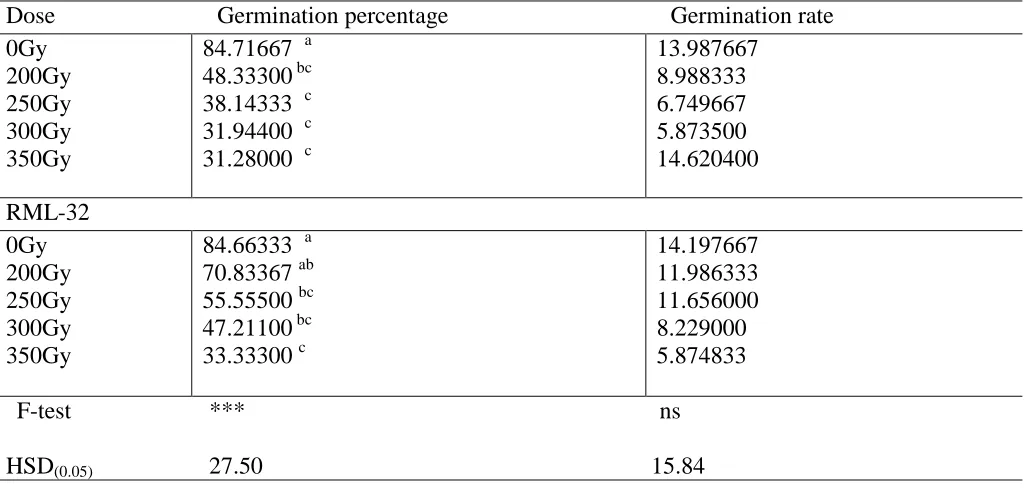
The final germination percentage
showed significant interaction with dose of
irradiation. The dose-dependent decrease in
final germination percentage was seen in
both inbred lines examined in the study
(Table1). The maximum FGP was found for
the non-irradiated samples (84.7% for
RML-17 and 84.66% for RML-32) for both the
lines .While the minimum germination
percentage (31.28% for RML-17
and33.333% for RML-32) was recorded at
the dose of 350 Gy (Table 1).
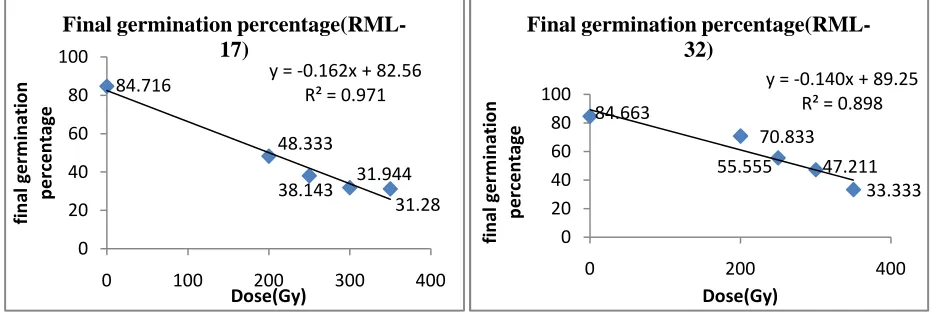
The linear regression line showed
Effect of Gamma Rays on Germination and Photosynthetic Pigments of Maize (Zea Mays L.) Inbreds Page 517 76.8 % of variation in final germination
percentage being explained by dosages.
Similar inhibitory effect of radiation was
seen for the line RMl-32, where the negative
slope (-0.13) explained the dose effect 78.1
% in decreasing the final germination
percentage (Figure1). A non-significant
effect was seen for the germination rate due
to the exposure of the seeds at various
dosages of radiation .The non-significant
effect was accounted for both inbreds.
However, in general there was the negative
or inhibition effect on the germination rate
as radiation dose was increased from 0 to
350 Gy. The inhibitory effect, revealed by
the regression analysis, tells us that there
was a strong relationship(R2=0.711 and
0.548 for RML-17 and RML-32
respectively) between the dose and the
germination rate for the inbreeds .
Table 1: Variation in final germination percentage and germination rate due to various dosages
of gamma rays.
RML-17
Dose Germination percentage Germination rate 0Gy
200Gy 250Gy 300Gy 350Gy
84.71667 a 48.33300 bc 38.14333 c 31.94400 c 31.28000 c
13.987667 8.988333 6.749667 5.873500 14.620400
RML-32 0Gy 200Gy 250Gy 300Gy 350Gy
84.66333 a 70.83367 ab 55.55500 bc 47.21100 bc 33.33300 c
14.197667 11.986333 11.656000 8.229000 5.874833
F-test *** ns
Effect of Gamma Rays on Germination and Photosynthetic Pigments of Maize (Zea Mays L.) Inbreds Page 518 CV% 18.08 53.64
HSD: Honestly significant difference, CV: Coefficient of variation, Gy=Grey, Significant codes: 0 ‘***’ 0.001 ‘**’ 0.01 ‘*’ 0.05, ns :non-significant, Means with same letter are not significantly different
Figure1: Effect of gamma rays on Final germination percentage (FGP) for line RML-17 and RMl-32.
Figure 2: Effect of gamma rays on Germination rate (GR) of RMl-17 and RML-32
The reason behind the decrease in
the final germination percentage could be
the failure in the proper development of the
plumule or the radicle in the course of the
germination of the seeds (Basi et al., 2005).
Raj et al. (1972) also reported a decrease in
growth of the plumule and the radicle of rice
with increases in irradiation dosage. These
results are in consistent with the study by
Kiong et al. (2008), who found that
84.716
48.333
38.143 31.944 31.28 y = -0.162x + 82.56
R² = 0.971
0 20 40 60 80 100
0 100 200 300 400
fi n al g e rm in at io n p e rc e n tag e Dose(Gy)
Final germination percentage(RML-17)
84.663
70.833 55.555 47.211
33.333 y = -0.140x + 89.25
R² = 0.898
0 20 40 60 80 100
0 200 400
fi n al g e rm in at io n p e rc e n tag e Dose(Gy)
Final germination percentage(RML-32)
13.987
8.988
6.749 5.873 14.620 y = -0.009x + 12.10
R² = 0.097
0 5 10 15 20
0 200 400
G e rm in at io n r at e Dose(Gy) Germination rate(RML-17) 14.197 11.986 11.656 8.229 5.874 y = -0.021x + 15.18
R² = 0.793
0 5 10 15 20
0 100 200 300 400
Effect of Gamma Rays on Germination and Photosynthetic Pigments of Maize (Zea Mays L.) Inbreds Page 519 radiation increases plant sensitivity to
gamma rays. They attributed this finding to
a reduction in the amount of endogenous
growth regulators, especially the cytokines,
as a result of breakdown, or lack of
synthesis, due to radiation. Similarly,
Hameed et al., 2008 found that final
germination percentage decreased
significantly after higher irradiation dosages
ranging from 350-500Gy. Maximum
decrease in germination percentage was
observed after 500Gy dosages. A similar
observation was reported by Jan et al.
(2011) that irradiation with lower dosages of
gamma rays significantly improved
vegetative traits while higher dosages
proved depressing for same parameters.
3.2 Effect of gamma rays on
photosynthetic pigments
The dose-dependent significant
difference was found in chlorophyll-a
content for both inbred lines. The maximum
chlorophyll-a content occurred in
non-irradiated samples(11.056mg/gm FW for
RMl-17 and 11.741mg/gm FW for RML-32)
while the application of gamma rays
decreased the chlorophyll-a content .In
context of RML-17 different gamma rays
dosages(200Gy, 250Gy, 300Gy and 350Gy)
on chlorophyll-a content are significant at
par. The dose-dependent decreasing trend
was found in line RML-32 for chlorophyll-a
content. The mean comparison for various
dosages revealed that there was significant
inhibition effect of radiation with minimum
(6.25 mg/gm FW) occurring at the dose of
350Gy. Chlorophyll-a content at a dose of
350 Gy was significantly different from any
other dosages (Table 2).
On contrary, the amount of
chlorophyll-b content did not vary
significantly with the increasing dosages of
radiation. Chlorophyll-a content was found
Effect of Gamma Rays on Germination and Photosynthetic Pigments of Maize (Zea Mays L.) Inbreds Page 520 both lines for all treatments including the
control. However, total chlorophyll content
varied significantly with increasing dosages
of radiation. In general the decreasing effect
was observed for all dosages of radiation. In
the case of RML-17, the decreasing effect
was significant at par. The mean comparison
between variable and treatment showed
significant differences with decreasing effect
of radiation for line RML-32.The none
irradiated samples exhibited maximum total
chlorophyll content (21.25mg/gm FW).
Minimum total chlorophyll content was
found at dose of 350Gy (13.47mg/gm FW)
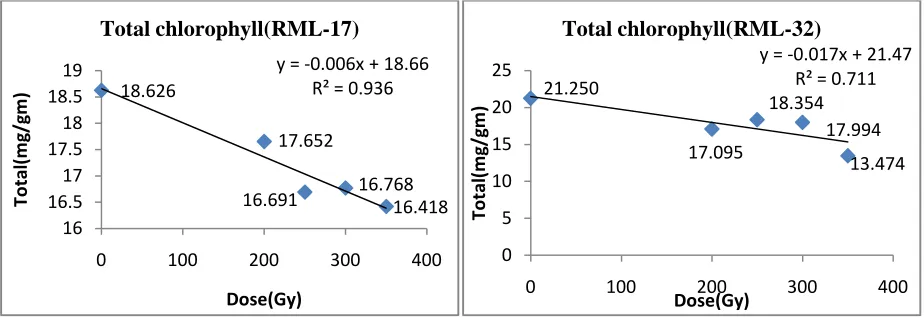
for RML-32(Table2). The linear regression
line for total chlorophyll showed the
negative slope for both inbreeds with 93.6%
and 71.1%of variation in final germination
percentage being explained by dosages for
RML-17 and RML-32 respectively
(Figure5).
Table 2: Effect of gamma rays on photosynthetic pigments (mg/gm FW) of line RML-17 and RMl-32
RML-17
Dose Chlorophyll-a Chlorophyll-b Total 0Gy
200Gy 250Gy 300Gy 350Gy
11.056543 a 9.777856 ab 9.876380 ab 9.665050 ab 9.998747 ab
8.848320 6.596437 7.103488 5.873500 6.419507
18.62618 ab 17.65298 ab 16.69179 ab 16.76854 ab 16.41825 ab
RML-32 0Gy 200Gy 250Gy 300Gy 350Gy
11.741833 a 10.940427 a 10.995534 a 9.749410 ab 6.255590 b
9.508494 6.154808 7.358851 8.244902 7.219100
21.25033 a 17.09523 ab 18.35439 ab 17.99431 ab 13.47469 b F-test * ns ***
HSD(0.05) 4.64 5.59 6.05
CV% 16.04 26.06 12.01
Effect of Gamma Rays on Germination and Photosynthetic Pigments of Maize (Zea Mays L.) Inbreds Page 521 The regression line showed steep
slope (-0.003 for chlorophyll-a and -0.007
for chlorophyll-b indicating a sharp decrease
in RML-17. It explained that contribution of
dosage for reducing chlorophyll-a content
was 72.4% while it was 83.3% for
chlorophyll-b content (Figure3).The trend
was similar for line RMl-32 as well. The
negative regression for line RML-32
suggested the strong cause for decrease in
constituent chlorophyll pigments due to
administration of radiation. It was 55.8 %
for a and 34.1% for
chlorophyll-b (Figure 4).
Figure 3: Effect of gamma rays on chlorophyll-a and chlorophyll-b content in line RML-17
11.056
9.777
9.876
9.665 9.998 y = -0.003x + 10.85
R² = 0.724
9.5 10 10.5 11 11.5
0 100 200 300 400
ch lo ro p h y ll -a( m g /g m ) Dose(Gy) Chlorophylla(RML-17) 8.84832 6.596437 7.103488 5.8735 6.419507 y = -0.007x + 8.659
R² = 0.830
0 2 4 6 8 10
0 100 200 300 400
ch lo ro p h y ll -b (m g /g m ) Dose(Gy) Chlorophyll-b(RML-17)
11.741 10.940 10.995 9.749
6.255 y = -0.012x + 12.58
R² = 0.557
0 2 4 6 8 10 12 14
0 100 200 300 400
ch lo ro p h y ll -b (m g /g m ) Dose(Gy) Chlorophyll-a(RML-32) 9.508 6.154 7.358 8.244 7.219
y = -0.005x + 8.891 R² = 0.341
0 2 4 6 8 10
0 200 400
Effect of Gamma Rays on Germination and Photosynthetic Pigments of Maize (Zea Mays L.) Inbreds Page 522 Figure 4: Effect of gamma rays on chlorophyll-a and chlorophyll-b content of line RML-32
Figure 5: Effect of gamma rays on chlorophyll-a and chlorophyll-b content of line RML-17 and RMl-32
In this present study the chlorophyll
content showed a regular decrement from
non- irradiated plants to irradiated plants
.These result are in accordance with the
findings of Ling et al. (2008).Similar results
were found in case of Cullen corylifolium
for total chlorophyll content at various
stages of plant growth by Jan et al.
(2013).Furthermore, a decrease in higher
dosages of gamma rays (20kGy) was found
for chlorophyll-a and chlorophyll-b content
in same research.
Similarly, in a study examining
lettuce (Lactuca sativa var. capitata) dry
seeds exposed to radiation dosages ranging
from 2-70 Gy and findings indicated that
seeds irradiated with dosages ranging from
2-30 Gy enhanced the photosynthetic
pigments (Chl-a, Chl-b, Car) content, while
higher dose (70 Gy) resulted in declines in
the assimilatory pigments (Marcu et al.,
2013b).
CONCLUSIONS
Our results presented above are
concerned with persistence of changes
prevalent from seed to seed cycle, where the
inhibition in germination percentage and
photosynthetic pigments were more
18.626
17.652
16.691 16.76816.418 y = -0.006x + 18.66
R² = 0.936
16 16.5 17 17.5 18 18.5 19
0 100 200 300 400
T
o
tal
(m
g
/g
m
)
Dose(Gy) Total chlorophyll(RML-17)
21.250
17.095
18.354 17.994
13.474 y = -0.017x + 21.47
R² = 0.711
0 5 10 15 20 25
0 100 200 300 400
T
o
tal
(m
g
/g
m
)
Dose(Gy)
Effect of Gamma Rays on Germination and Photosynthetic Pigments of Maize (Zea Mays L.) Inbreds Page 523 prevalent over the higher dosages around
300 to 350Gy. The morphological and
biochemical characteristics of plants have
been reported to be effected by gamma rays
.Hence the gamma rays can be utilized as
the modifying agents for certain plant
characteristics at appropriate dosages which
may provide a stimulatory effect.
ACKNOWLEDGEMENTS
Authors are thankful to National Maize Research Program, Rampur, Chitwan, Nepal
for providing research material and Gene Bank, Khumaltar, Lalitpur, Nepal for
accommodating space for laboratory analysis. Gratitude and sincere thanks to Keshav Babu
Koirala, Ph. D. Coordinator, National Maize Research Program, Rampur, Chitwan, Nepal
and Bal Krishna Joshi, Ph. D., Gene bank for their cardinal support.
REFERENCES
Akshatha, K., Chandrashekar, R., Somashekarappa, H., Souframanien, J. (2013), Effect of gamma
irradiation on germination, growth, and biochemical parameters ofTerminalia arjuna Roxb.
Ashraf, M. (2009). Biotechnological approach of improving plant salt tolerance using antioxidants as
markers. Biotechnol Adv 27:84‑93.
Basi, S., Subedi, L. P.,KC, G. B. and Adhikari, N. R. (2006). Cytogenetic effects of gamma rays on indica
rice radha-4.J. Inst. Agric. Anim. Sci. 27:25-36.
de Mendiburu, F. (2014). agricolae: Statistical Procedures for Agricultural Research. R package version
Effect of Gamma Rays on Germination and Photosynthetic Pigments of Maize (Zea Mays L.) Inbreds Page 524 Hameed, A., Shah T.M., Atta,B.M., Haq, M.A. and Syed, H. (2008). Gamma radiation effects on seed
germination and growth, protein content, peroxides and protease activity, lipid per oxidation in
desi and kabuli chickpea. Pak. J. Bot.40: 1033-1041.
Hegazi, A. Z. and Hamideldin, N. (2010). The effect of gamma irradiation on enhancement of growth and
seed yield of okra [Abelmoschus esculentus (L.) Monech] and associated molecular changes.
Journal of Horticulture and Forestry, 2(3): 038-051.
Jan, S., Parween, T.,Hameed, R.,Siddiqi, T. O., Mahmooduzzafar. (2013). Effects of presowing gamma
irradiation on the photosynthetic pigments, sugar content and carbon gain of Cullen corylifolium
(L.) Medik. Chilean Journal Of Agricultural Research 73(4) October-December 2013. Pp. 345.
Kim, J.H., Baek, M.H., Chung, B.Y., Wi, S.G. and Kim, J.S. (2004). Alterations in the photosynthetic
pigments and antioxidant machineries of red pepper (Capsicum annuum L.) seedlings from
gamma-irradiated seeds. J. Plant Biol. 47: 314- 321.
Kiong, A.,Ling Pick, A., Grace Lai, S.H., and Harun, A.R.(2008). Physiological responses of
Orthosiphon stamineus plantlets to gamma irradiation. Am-Eurasian J. Sustain. Agric., 2(2):
135-149.
Kovacs, E. and Keresztes, A. (2002). Effect of gamma and UV-B/C Radiation on Plant Cell. Micron 33:
199-210.
Ling, A.P.K., Sobri, J.Y.C., Harun, H., Harun, A.R. (2008) Physiological Responses of Citrus sinensis to
Gamma Irradiation. World Applied Sciences Journal 5 (1): 12-19, 2008
Marcu, D., V. Cristea, and L. Daraban. (2013). Dose-dependent effects of gamma radiation on lettuce
Effect of Gamma Rays on Germination and Photosynthetic Pigments of Maize (Zea Mays L.) Inbreds Page 525 Minisi, F. A., El-mahrouk, M. E., Rida, M. E. F. and Nasr, M. N. (2013). Effects of Gamma Radiation on
Germination, Growth Characteristics and Morphological Variations of Moluccella laevis L.
American-Eurasian J. Agric. & Enciron. Sci., 13 (5): 696-704.
Moussa, H.R. (2011) Low dose of gamma irradiation enhanced drought tolerance in soybean. Acta
Agronomica Hungarica 2011;59:1-12.
Prasanna B.M. and Hoisington D. (2003). Molecular breeding for maize improvement: An overview.
Indian Journal of Biotechnology 2: 85-98.
Prasanna, B.M. (2011). Maize in Asia: Challenges and Opportunities. In: Presentation de 11th Asian
Maize Conference 7-11 November 2011, Beijing, China.
Peri, I., Babayan,M., Tavassoli, A., Javaheri, M. (2011). The use of gamma irradiation in agriculture.
African Journal of Microbiology Research Vol. 5(32), pp. 5806-5811.
R Core Team (2014). R: A language and environment for statistical computing. R Foundation for
Statistical Computing, Vienna, Austria. URL http://www.R-project.org/
Raj, A.Y., Raj, A. S., Rao, G.M., (1972) Mutagenic studies of gamma rays on Oryza sativa L. Cytologia,
37, 469-477.
Steel, R.G.D.,Torrie, J.H., Dickey, D.A. (1997). Principles and Procedures of Statistics: A Biometrical
Approach. McGraw-Hill New York.
Wi SG, Chung BY, Kim JS, Kim JH, Baek MH, Lee JW, et al.(2007) Effects of gamma irradiation on