Usage of Nitrogen gas in different sections of tube annealing
furnace for creating internal atmosphere & improving
material quality
Rohit panchalP
1
P
, Vivek kumarP
2
1. Faculty of Mechanical Engineering, Mewar University, Chittorgarh, Rajasthan, India
2. Assistant Professor, Department of Mechanical Engineering, Mewar University, Chittorgarh, , Rajasthan, India
Abstract
Heat treating or annealing is the controlled heating and cooling of a material to achieve certain mechanical properties, such as hardness, strength and the reduction of residual stresses. Many heat treating processes require the precise control of temperature over the heating cycle, the energy used for process heating accounts for 2% to 15% of the total production cost. The objective of this work is to improve surface quality of MS-pipes and copper pipes and avoid, unwanted reaction such as oxidation, decarburization and reaction with residual lubricants can occur between the tube surface and the surrounding atmosphere. Proper selection and control of the annealing atmosphere is critical to produce a bright, high equality surface, with the help of using endo gas and nitrogen gas in different sections with different parameters in the furnace .The research methodology was based on GMBH LOI annealing furnace based on both experimental work and theoretical developments including modeling on annealing furnace. The real time furnace parameters determine from the experimental data.
Keywords: Drivers, Usage of Nitrogen gases in different sections of Furnace.
1. Introduction
Metal tubes are annealed to increase their ductility making them easier to bend machine and form. In the annealing process, the metal is heated above a critical temperature then slowly cooled to room temp. to obtain a softer and less distorted material structure. At these processing temperatures , unwanted reaction such as oxidation, decarburization and reaction with residual
lubricants can occur between the tube surface and the surrounding atm.
Proper selection and control of the annealing atmosphere is critical to produce a bright, high equality surface . Heat treating is the controlled heating and cooling of a material to achieve
certain mechanical properties, such as hardness, strength, flexibility, and the reduction of residual stresses. Many heat treating process Is require the precise control of temperature over the heating cycle. Heat treating is used extensively in metals production, and in the tempering and annealing of glass and ceramics products. Typically, the energy used for process heating accounts for 2% to15% of the total production cost.
The avoid oxidation and minimize safety risks, air must not enter the furnace either long the outside or entering through the inside of the tubing. In addition to keeping the opening as small as possible, flame or mechanical curtains can be used to restricted the air ingress. The atmosphere flow pattern should direct the atmosphere gases through the incoming tubes and purge the air, moisture and residual lubricant from the inner diameter and along the outer surface away from the furnace.
The main requirement on the furnace atmosphere is that it should be neutral with respect to the metal. three element oxygen (o), to eliminate oxidation, carbon (c), to eliminate decarburization of carbon steel.
The three element are present in the furnace atmosphere as the gas molecules oxygen (O2), and
nitrogen (N2) but preferentially as atoms in other molecules like carbon monoxide (CO)
water(H2O) or carbon dioxide (CO2)
A furnace atmosphere principally has two major parts, a neutral and an active gas.
2.
LITERATURE REVIEW
The essence of this literature review is to understand reduce some disadvantages and improve atmosphere within time limits as well as brightness of material surface with respected to our flow parameters of nitrogen gases and endo gases. In al the cases, the manufacturer’s recommendations should be followed for gas introduction, purging and removal since the original equipment manufacturer has taken these factor into account during the design of the equipment’s.
National fire protection association(NFPA) standered 86, “standard for industrial furnace using a special processing atmosphere,” applies to all furnace and the procedure listed within this standard must be followed. Furnace Atmosphere for tube annealing by R. Andersson, T Holm, T. Mahlo, S. Wiberg, Furnace Atmosphere Consideration for Fasteners by Richard D. Sisson, & Daniel H. Herring
Daniel H. Herring is president of HERRING GROUP, Inc. Elmhurst, IL while Richard D. Sisson, Jr. is George F. Fuller Professor and Director f Manufacturing Engineering, Mechanical Engineering Department, Worcester Polytechnic Institute, Worcester, MA, Herring, D.H., Understanding Furnace Atmospheres, Atmosphere Operation and Atmosphere Safety, Heat
treating hints, T. Philips, Air products & Chemical (31TUwww.airproducts.comU31T), private
correspondence.
They recommended the future work for the project is the incorporation surface quality optimization routine. Such a routines enables the furnace utilization and improve furnace efficiency. Also model is specially developed to different process enable more gas reactions and also useful for process optimization. In this annealing furnace metal is heated at 930C for increase their ductility and bright surface quality.
3. Methods/approach
Research methodology is based on data collected through tube annealing furnace technology. Furnace idea is applied practically in industries and this is important for increasing brightness and material surface quality. The problem was selected from gap found in literature. The data is collected through Gandhi special tubes ltd. Halol, Gujarat, India. Data collection procedure is reliable because instrument available is accurate regarding the furnace or their internal atmosphere measurement. Furnace is running but taking more time to create internal environment when its restart or sometimes material is not perfect on same parameters so we have
to change the parameter of nitrogen gas(-196P
◦
P
C) in different sections to reduce time and fasten the process.
4. Results and Discussion
The data is collected from Gandhi special tubes ltd. Halol Gujarat India. The LOI WESMAN furnace is used for that with dew point analyzer, oxygen analyze, internal gases for MESA software used for collecting data following result show:
4.1 Usage of Nitrogen gas
Applied nitrogen gas with different flow in three sections they are: (a.) inlet zone
(b.) Heating zone
(c.) cooling zone
Fig.4.1.1 New invention in annealing furnace This data is use for improvement
Nitrogen Flow(mP
3
P
/h)
Inlet 70
Heating zone 160
Cooling zone 70
Total 300
Endo gas is flowing at 100 M
P3
P
/H
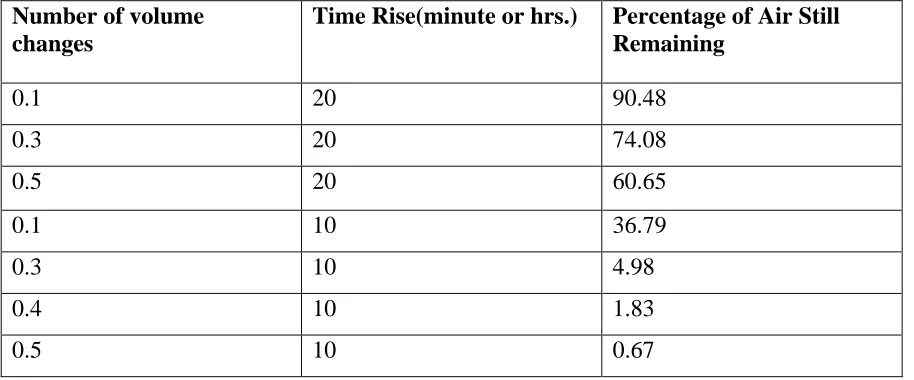
A “rule of thumb” to remember is that to purge air out of a furnace prior to introduction of combustible furnace atmosphere requires a minimum a five volume changes of the chamber (Table 3.3). This is to ensure that the oxygen content of the chamber is below 1% prior to the introduction of the atmosphere
.
Inlet section
Zone-1 Zone-2 Zone-3 Zone-4
Outlet with cooling zones
Nitrogen
Endo gas
Table 4.1.1 Volume Changes Required for safe purging of furnaces with time
Number of volume changes
Time Rise(minute or hrs.) Percentage of Air Still
Remaining
0.1 20 90.48
0.3 20 74.08
0.5 20 60.65
0.1 10 36.79
0.3 10 4.98
0.4 10 1.83
0.5 10 0.67
Graph 4.1 Graph b/w time and air changes with respected to volume
0 10 20 30 40 50 60 70 80 90 100
1 2 3 4 5 6 7
Number of volume changes
Time Rise(minute or hrs.)
Percentage of Air Still Remaining
4.2 Conclusion:
After applying we get some data, they are:
Table 4.2.1 Nitrogen Endo gas Atmosphere Field Data
Flow Data %NR2 %HR2 %COR2 %CO %CHR4 Dew
Point,P
◦
P
C(P
◦
P
F)
Nitrogen/Endogas With Natural Gas and Air
Enrichment
40-48 40-45 0.6-1.4 12-16.1 7-11.2 0P
◦
P
C to +15 (+30 to +65)
In all the cases, the manufacturer’s recommendations should be followed for gas introduction, purging and removal since the original equipment manufacturer has taken these factor into account during the design of the equipment’s.
National fire protection association(NFPA) standard 86, “standard for industrial furnace using a special processing atmosphere,” applies to all furnace and the procedure listed within this standard must be followed.
Table .4.2.2 Comparison of synthetic furnace atmospheres
Atmosphere Type %HR2 %NR2 %CO Dew
Point,P
◦
P
C(P
◦
P
F)
Hydrogen Pure 100 0 0 -70 to -85
(-95 to -120)
Nitrogen Blended 90 10 0 >-50(-50)
Endothermic Generated 40 40 20 3 to -23 (+40
to -10)
Nitrogen-Endo
Blended 14 80 6 < 0
Nitrogen - Hydrogen
Blended 5-75 95-25 0 -51 (-60)
Control Of Furnace Atmosphere
Good quality control must be ensured due to the fact that the composition of the furnace atmosphere constantly changing, so measurement and control devices must be used. In
particulars, for atmospheres design to run “neutral”, avoiding decarburization and/or carburization is critical to the proper functionality of the fastener. This is accomplished by making sure that one or several of the following control methods is monitoring and/or controlling the process:
• Dew point analyzers
• Oxygen (carbon) probe
Throughout the entire cycle it is critical to the process that we control the:
• Percentage of carbon dioxide, oxygen, and water vapor;
• Ratio of enriching gas (or air) to carries gas.
For example, surface carbon can be controlled within ±0.10 by measuring one or more of these constituents.
Dew point control
The temperature that water vapor starts to condense is known as the dew point. In the
simplest terms then, a dew point analyzer measures the amount of water vapor present in atmosphere of the furnace in (Table 4.2.3). This information can be used to determine the carbon potential of the atmosphere . Its possible with technical instrument.
Table 4.2.3 Typical dew point levels
Dew point,P
◦
P
C(P
◦
P
F) Water vapor (ppm)
+8 (+46) 10,590
-4 (+25) 4,320
-18 (0) 1,240
-40 (-40) 127
-68 (-90) 3.4
Note :
1% moisture = 127 ppm water vapor = +40P
◦
P
F dew point
Table 4.2.4 Dew point VS. surface carbon (%)
Dew point, P ◦ P F(P ◦ P C) 815P ◦ PC (1500P ◦ P F) 870P ◦ P C (1600P ◦ P F) 925P ◦ P C (1700P ◦ P F)
+30 (-1) 1.10 0.75 0.50
+40 (+4) 0.86 0.60 0.40
+50 (+10) 0.64 0.40 0.27
If performed properly dew point analyzer is a simple and accurate measurement technique and indicates the condition inside the atmosphere generator or heat treat furnace. It will tell you if the reaction is stable or unstable . It can tell you when the catalyst bed in your endothermic gas generator is starting to soot and if there is a water leak, an air leak or non-uniformly (“breathing”) of the atmosphere inside your furnace.
Different temperature with different zones.
Section Zone Temperature P
◦
P
C
Zone-1 880
Zone-2 900
Zone-3 930
Zone-4 930
Table 4.2.5 Atmosphere equilibrium oxygen partial pressure, and corresponding CO2/CO and
H2o/H2 volume concentration to yield a bright surface and no decarburization. The concentration
ratios are given for an atmosphere having 5 volume-% CO and 10 volume-% H2.
Zones CO% CO2
CH
4 Carbonlevel
O
2 level Dew pointZone-1 7.0% 0.065% 0.50% 0.08% 0.00 8.4
Zone-2 7.10% 0.071% 1.55% 0.19% 0.00 8.5
Cooling zone
7.0% 0.0.17% 2.10% 1.65% 0.00 8.5
When we are giving the inputs of nitrogen gas in different section of heating zones so oxygen level will be reduce with respect to time but when we are using flow according to above table reference so oxygen level or flue gas level will be reduce at exact time duration without any causes. When we are using nitrogen flow in different flow time will be reduces for creating furnace internal atmosphere.
After overall operation we are increasing quality of product and customer also need quality after they will decide cost of product so main motto of any industries is surface quality. when quality will be ok then cost of product will be automatically increase loss will be decrease.
Advantage
1. Oxygen level will be reduce within small time duration. 2. Time will be reduces of internal atmosphere generated. 3. Explosion(blasting) accident will be stop.
4. Quality of product will be good.
5. Remove flue gases from the furnace with the help of nitrogen pressure.
6. Reduce carbon level
7. Prevent firing at inlet or outlet curtains
8. After pressure generate inside of furnace we can detect external environment.
REFERENCES
1. Furnace Atmosphere for tube annealing by R. Anderson, T Holm, T. Mahlo, S. Wiberg.
2. Furnace Atmosphere Consideration for Fasteners by Richard D. Sisson, & Daniel H. Herring Daniel H. Herring is president of HERRING GROUP, Inc. Elmhurst, IL while Richard D. Sisson, Jr. is George F. Fuller Professor and Director f Manufacturing Engineering, Mechanical Engineering Department, Worcester Polytechnic Institute, Worcester, MA.
3. Herring, D.H., Understanding Furnace Atmospheres, Atmosphere Operation and Atmosphere Safety, Heat treating hints.
4. Mr. T. Philips, Air products & Chemical (31TUwww.airproducts.comU31T), private correspondence.
5. Mr. Oakes, Super system, Inc. (31TUwww.supersystem.comU31T), private correspondence.
Author Profiles
Rohit Panchal At present persuing (B.tech.+M.Tech.) intergarated dual degree in Manufacturing
System and Engineering at Mewar University, Chittorgarh, Rajasthan
Vivek Kumar received his M.Tech degree in Industrial Engineering from Lovely Professional
University, Punjab. Vivek Kumar is an Assistant Professor, with Department of Mechanical Engineering in Mewar University, Chittorgarh, Rajasthan