EFFECTIVENESS OF JATROPHA CURCAS LIVE FENCE IN MANAGING
HOUSEHOLD RISKS AND VULNERABILITY IN
KILIFI COUNTY
WANJAU MILLER
A RESEARCH PROJECT SUBMITTED TO THE DEPATMENT OF APPLIED
ECONOMICS
IN PARTIAL FULFILMENT
OF THE REQUIREMENTS
FOR
THE
AWARD
OF
THE
DEGREE
OF
MASTER
OF
ECONOMICS
(COOPERA TION
AND
HUMAN
DEVELOPMENT)
OF
KENYATTA
UNIVERSITY
DECLARATION
university: Signature
and has not been submitted for a degree in any other
~ Date
2----
/-07
/:J-
o
15I
Wanjau Miller (B.A. Economics)K 101/CTY /PT/23244/2013
This project has been submitte ni~ity
Supervisors: Signature --T~fl;;;r---:;::::::::::;::::v- Date
-L--...1lr--'----''--(-~---'-Dr. James Maingi
Lecturer, Department of Applied Economics
School of Economics
Kenyatta University.
Signature __
~~,
----
::::.
..
_~v
__
_
~
Date--J
f
---l--
I
---,
7
,----
'
{,;o
__
'
_~
__
Dr. Perez OnonoLecturer, Department of Applied Economics
School of Economics
Kenyatta University.
DEDICATION
I wish to
dedicate
this study
to my
loving
Parents,
Grandmother and all the people of
ACKNOWLEDGEMENT
My deepest appreciation goes to my supervisors Dr. James Maingi and Dr. Perez Onono
for their guidance, encouragement and availability throughout the study period.
I am also greatly indebted to CISP who granted me an internship and FAI who
supported me financially.
I wish to also acknowledge the support and responses given by the Jatropha hedgerow
farmers in Kilifi County without whom this work would not have been accomplished.
Lastly but most importantly, I thank God for His strength, inspiration and favor
throughout the study period. It is by His grace and mercy that I have come this far.
TABLE OF CONTENTS
DECLARATION .ii
DEDICATION iii
ACKNOWLEDGEMENT iv
LIST OF TABLES vii
LIST OF FIGURES viii
LIST OF ACRONYMS AND ABBREVIATIONS .ix
OPERATIONAL DEFINITION OF TERMS x
ABSTRACT xii
CHAPTER ONE: INTRODUCTION 1
1.1. Background 1
1.2.Statement of the Problem 12
1.3.Research Questions 13
1.4.Objectives of the Study 13
1.5. Significance ofthe study 14
1.6. Scope of the study 15
1.7.Organization of the Study 15
CHAPTER TWO:_LITERA TURE REVIEW 17
2.1. Introduction 17
2.2. Theoretical review 17
2.3. Empirical Review 22
CHAPTER THREE:_METHODOLOGY 25
3.1. Introduction 25
3.2. Research Design 25
3.4.Empirical Model 27
3.5. Definition and Measurement of variables 28
3.6.Data type and Sources 28
3.7. Target Population 29
3.8. Sampling Procedure and Sample Size 29
3.9.Data collection Instruments and Procedures 29
3.10. Data Analysis 30
CHAPTER FOUR: EMPIRICAL FINDINGS 31
4.1. Introduction 31
4.2. Factor Analysis 31
4.3. Empirical results 35
CHAPTER FIVE: SUMMARY, CONCLUSIONS AND POLICY IMPLICATIONS 43
5.1. Introduction 43
5.2. Summary of the major findings 43
5.3. Conclusions 44
5.4. Policy Implications 45
5.5. Recommendations for Further research 47
Appendix 1 52
Appendix 2 53
Appendix 3 54
Appendix 4 55
Appendix 5 56
Appendix 6 57
Appendix 7 58
Appendix 8 59
vi
LIST OF TABLES
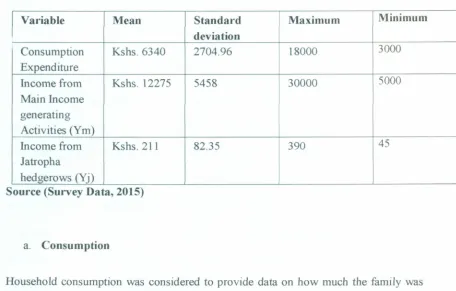
Table 4.1: Statistics on Household consumption expenditure, Income from Main
income generating activities and Income from Jatropha hedgerows 35
Table 4.2: Correlation coefficients between Household Consumption, Main income (Ym), Income from Jatropja hedges (Yj) and expenditure on fuel by households 38
Table 4.3: Model coefficients of Consumption, Income from main income generating activities (Ym) and income from Jatropha hedgerows (Yj) 39
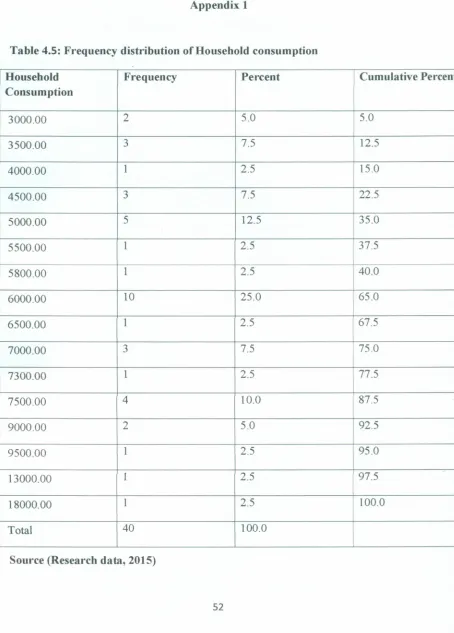
Table 4.4: Gender distribution of Jatropha hedgerow farmers .41 Table 4.5: Frequency distribution of Household consumption 56
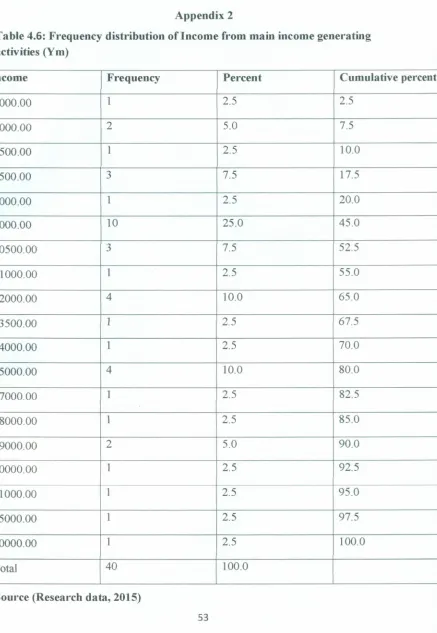
Table 4.6: Frequency distribution of Income from main income generating activities
(Ym) 57
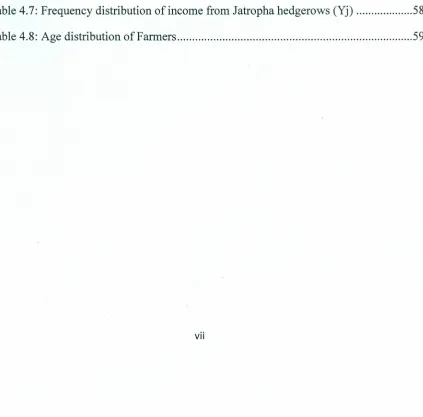
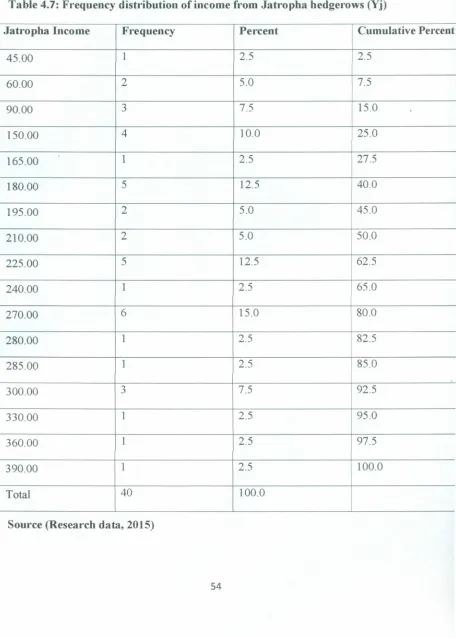
Table 4.7: Frequency distribution of income from Jatropha hedgerows (Yj) 58
Figure 1:
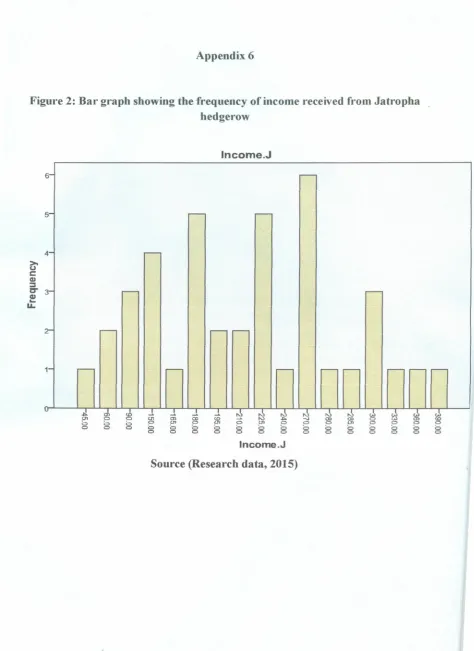
Figure 2:
LIST OF FIGURES
Bar graph of Household expenditure frequencies 56
Bar graph of income received from Jatropha hedgerow frequencies 57
eBD eDM eSD eISP EU EEP FAO FAI GDP GHG IEA
n-ee
KARl KEFRI KENGEN MDG's MoA MoE NEMA SPSS UNCED UNEP UNDP UNFCCC WAC WBLIST OF ACRONYMS AND ABBREVIATIONS
Convention on Biological Diversity
Clean Development Mechanisms
Commission on Sustainable Development
International Committee for the Development of Peoples
European Union
Energy and Environment Partnership
Food and Agriculture Organization of the United Nations
International Assistance Foundation
Gross Domestic Product
Greenhouse gases
International Energy Agency
International Panel on Climate Change
Kenya Agricultural Research Institute
Kenya Forestry Research Institute
Kenya Electricity Generating Company
Millennium Development Goals
Ministry of Agriculture
Ministry of Energy
National Environmental Management Agency
Statistical Package for Social Sciences
United Nations Conference on Environment and Development
United Nations Environment Programme
United Nations Development Programme
United Nations Framework Convention on Climate Change
World Agro Forestry Center
OPERATIONAL DEFINITION OF TERMS
Bio fuels: are liquid fuels derived from other materials such as waste plant in this case
from the Jatropha Curcas seeds
Biomass: is biological material derived from living, or recently living organisms that is
often used as fuel in rural areas
Climate Change: is the change in the state of the climate that can be identified by
changes in the mean and/or the variability of its properties.
Consumption smoothing: is the act of stabilizing consumption levels through the income
received from growing of the Jatropha hedgerow.
Efficiency; is the ratio of actual output to maximum potential output obtainable from a
given input level or the ratio of minimum potential input to actual input required to
produce the given output.
Energy Security: is the uninterrupted availability of energy sources at an affordable
pnce.
Financial Inclusion: delivery of financial services at affordable costs to the
marginalized parts of society
Food Security: is acondition related to the ongoing availability of food.
Hedgerows; these are live boundaries, limits or borders.
Informal Insurance schemes; an insurance system that isnot officially recognized and is
not legally binding
Pareto Efficiency: A reallocation of goods that allows more of something to be
produced without the sacrifice of something else.
Pro Poor Development: development aimed at increasing economic benefits to the
poorer members ofthe society
Renewable Bio mass: Biomass that IS sustainably produced with no harm to the
environment.
Rural Development: the process of improving the quality of life and economic
wellbeing of people living in rural areas.
Savings; is the proportion of income that is not consumed and can be used for other
activities.
Social Risk Management; elaborate mechanisms of self protection that households use
to mitigate idiosyncratic and covariate risks
Social Protection; policies and programs that guarantee a minimum standard of living
forthe needy in society
Sustainability: the ability to be use resources without completely using them up
ABSTRACT
Growing of Jatropha curcas has been received with mixed feelings in Kenya. The plant has tremendous potential to be Africa's most excellent bio-fuel feedstock. However,
there have been concerns that the plant is not commercially viable and that it negatively
affects food production and security. The lack of factual information coupled with politics surrounding the growth of the plant has compromised its uptake by local farmers. This has however not dampened the spirits of pro poor development supporters who view the plant as a potential solution to rural poverty. Live fences (Hedgerows) are a common occurrence in rural Kenya. They are frequently used as fences because of their low cost and aesthetic value. The growing of Jatropha as a hedgerow can easily be brushed off as a non beneficial undertaking considering the previous research findings on the non viability of the plant but inherent in it is a coping mechanism that households may use to mitigate against idiosyncratic and covariate income risks. The lack of risk mitigation mechanisms means that households prone to income shocks cannot smoothen consumption when faced with a risk.
In
the recent past, there has been a great emphasis on a social protection agenda that protects not just the chronically poor but also the vulnerable populations against idiosyncratic and aggregate shocks. A few households in coastal Kenya have embraced the technology but it is not clear whether there are any significant savings and benefits arising from the endeavor. The purpose of this study was therefore to analyze the effectiveness of the Jatropha hedgerows in managing household risks and vulnerability by first defining the relationship between household Consumption and income from Jatropha hedgerows and secondly by analyzing the effectiveness of the hedgerow in protecting the vulnerable society. The study employed a diagnostic research and involved the collection of primary data through questionnaires and schedules from forty pre selected households who had successfully grown the hedge to maturity and were receiving an income from the sale of seeds, oil and other by products from the hedge. Correlation and regression analysis were run to ascertain the relationship between household consumption and income from Jatropha hedgerows and a demographic analysis conducted to ascertain the participation of women and older members of society in the project. The results of the analysis show that Income from Jatropha hedgerows is positively correlated to household consumption proving that the Jatropha hedgerow is an effective tool for household consumption smoothing. The results also show that women and older members of society, who are the most vulnerable in the society, are participating and benefiting from the project. The findings of the study lead to the conclusion that Jatropha curcas hedgerows are effective in managing household risks and vulnerability. The study recommends that a comprehensive research on Jatropha curcas as a plant be carried out by KARl or any other relevant institution to verify claims such as low oil content and high toxicity that have surrounded the growing of the plant. The study also recommends that social protection be extended beyond financial and income related considerations to include investments that support informal arrangements and upgrade the nonprofit sector especially those that have sustainable development at their core.CHAPTER ONE
INTRODUCTION
1.1.Background
Two centuries after the agrarian and industrial revolution in Europe it would have been
organically expected that by now human beings could feed themselves and through
diffusion of various innovative technologies have tackled the problem of poverty as
well.
The United Nations in 2000 under the Millennium Declaration committed to achieving
eight goals by 2015 that would help improve the living standards of the poor in the
world and foster sustainable development (Persons, 2013). Fourteen years later, a report
of the high level panel for eminent persons on the post 2015 Development Agenda
reports that the Millennium Development Goals (MDG's) did not focus enough on
reaching the poorest and excluded people and that the MDG's fell short by not
integrating the economic, social and environmental aspects of sustainable development
(persons, 2013). The post 2015 global development agenda aims to rectify this and
carry forward the spirit of the MDG's that are centered on sustainable development and
Social exclusion has been a major huddle in the road to development. Exclusion on the
global level brought about categorization of countries, the first, second and third worlds
all with different quality of lives for their citizens. At country level, exclusion has led to
massive inequalities and detestable living standards for the poor. It is in this backdrop
that the international community has settled on the' leave no one behind' approach. This
approach emphasizes on global partnerships and cooperation to achieve sustainable
development and improved living standards for all (Persons, 2013). Though there have
been considerable efforts and tremendous good will from stakeholders a paradigm shift
is well over due in the development arena. Participatory development needs to be taken
a notch higher, pragmatism in the way projects are designed, implemented, monitored
and evaluated. Over reliance on farfetched foreign solutions to local problems and poor
policy implementation by governments have left the people disenfranchised. The formal
solutions, often mal diagnosed, have necessitated the birth of local, people centered,
informal solutions.
The concept of social risk management asserts that individuals, households, and
communities are exposed to multiple risks from different sources, both natural (such as
earthquakes, floods, and illness) and manmade (such as unemployment, environmental
degradation, and war). Poor people are typically more exposed to risk and have less
access to effective risk management instruments than people with greater assets and
endowments. This vulnerability makes individuals risk-averse and unwilling or unable
to engage in high-risk/return activities. Under these circumstances, poor people have
good times, diversification of income sources, and creation of informal family and
community "risk-pooling" arrangements. However, these arrangements are often
relatively expensive and inefficient, and the coping strategies available once a shock
occurs often reduce poor people's human capital (for example, cutting back on meals or
pulling children our of school to help generate income). This gives rise to the need for
public intervention (WorldBank, 2001).
Informal solutions though non conventional are playing a central role in helping the
rural poor cope with the ever increasing challenges of marginalization and social
exclusion. The rural population as a result of their high exposure to risk and lack of
adaptive capacity become the most vulnerable in the event of a shock. The lack of access to important services such as insurance and credit facilities robs the households
of tools to rightfully deal with shocks that interfere with their already paltry incomes
and low consumption levels. There are several sensible reasons why households cannot
fully insure consumption against income fluctuations. The well known problems of
moral hazard, information asymmetries, and deficient ability to enforce contracts may
result in no or incomplete insurance markets (Alderman, 1992).
According to FAO one in eight people in the world surfer from chronic hunger and
malnutrition. The situation is more prevalent in Africa where one in every four people
are under nourished (FAO, 2013).
In Sub Saharan Africa, climate change and other vagaries of weather have had adverse
livelihood. Erratic weather patterns, failed rams, crop diseases, pests and volatile
commodity pnces are just some of the risks that small holder farmers are facing
(Hoogeven, 2001). Differences in the timing, intensity and quantity of rainfall and other
weather phenomena like storms, precipitation and cloud cover, the incidence of disease,
pests, fire or attacks by wild animals cause yields to fluctuate unpredictably. Variations
in the price of inputs and marketed output cause farm profits to vary, and illness at the
moment of planting may seriously affect the household's income for that year
(Hoogeven, 2001).
Over the last few years a large literature has attempted to quantify the impacts of
climate change on agricultural productivity at the regional as well as at the country
level. The general consensus emerging from this literature is that climate change will
negatively affect agricultural productivity and yields, and that the impacts will vary
across countries as well as within countries. To the extent that yield changes are good
predictors of the changes in the welfare level of rural households, and ultimately of the
changes in the poverty rates at least in the rural areas, these findings suggest that
climate change would have significant effects on poverty rates (Skoufias, 2011).
According to (Morduch, 1995) if there are complete markets for credit, then transitory
income shocks that is shocks that differ from the average over time should be smoothed
away by borrowing and saving and should not affect consumption patterns. Most of
these rural small holder farmers have no access to complete markets for credit and even
if they do they simply cannot afford them and therefore it is no surprise the income
fluctuations they face when their expected outputs are compromised. Income risk
therefore becomes a central feature of rural farmers in developing countries.
According to Becker's 1965 model of household production Consumption levels are
sensitive to income (Baxter, 1999). Shocks on income translate to a drop in
consumption. Small holder farmers do not have the capacity to influence policy and
neither do they have ability to control world commodity prices let alone control the
vagaries of weather. Farmers have to come up with risk management strategies that will
protect their living standards against fluctuations in income as they way await the
implementation of institutional and policy reforms that were meant to formally insure
them from risks.
Consumption insurance therefore entails insuring household consumption from income
variability (Morduch, 1999). This would ensure Food and non food consumption levels
are smoothened over time regardless of the shocks in income. Growing of Jatropha as a
hedge becomes a coping mechanism households. The strategy is based on the premise
that in the event farm output is compromised due to any risk factor (poor rainfall, pests),
the household will still have income from the hedge to compensate for the lost income
thereby smoothening consumption.
(Alderman, 1992). Jatropha curcas L. is a bush or small tree (up to 5 m height) and
belongs to the euphorbia family. The genus Jatropha contains approximately 170 known
species. The genus name Jatropha derives from the Greekjatr6s (doctor) trophe (food),
which implies medicinal uses (Ltd).
Jatropha curcas L. (also called the physic nut) is found to be a potential alternative
source of renewable energy since its cultivation and oil extraction contribute to
sustainable development, poverty alleviation, combating of desertification and women
empowerment in developing countries (Cynthia, 2011).
Jatropha grows in the harshest of conditions and requires little amount of resources to
tend and therefore is not vulnerable to most of the risks that other plants face thus its
yield is almost guaranteed .. The seeds are crashed to produce oil which can be used as
a cheaper alternative to kerosene and paraffin. Families are able to save that portion of
income that they would have used to buy the fossil fuel while at the same time generate
extra revenue from the sale of the bio fuel (Tunje, 2014).
Hedgerows are limits, boundaries and borders. At the landscape level, hedgerows have
a major role in controlling physical, chemical and biological fluxes, as well as being
cultural indicators (Baudry, 2000). Jatropha hedges provide soil erosion control,
increase water entrapment and infiltration, and protect crops from wandering livestock
as well as oil production for local use (Brittaine, 2010). Population growth leads to
agricultural innovations that allow a growing rural population to sustain itself with the
live fences is a technological innovation, which creates a spatial division in the
production and allocation of ecosystem services. Live fences are a form of
ecology-as-technology, or in other words both human made and natural capital, because the plants
would not grow by themselves in such a manner, and yet they provide additional
ecosystem services by and of themselves (VanderHorst D, 2014). The cost of growing
the hedge is minimal and so is the labour input required and after two to three years
farmers are able to start harvesting the seeds. Income from the savings made from
using a cheaper alternative of fuel and income received from the sale of other Jatropha
by products (such as soap) can be used to smoothen consumption when there is a shock
in income anticipated from the farm output (Tunje, 2014)
The hedgerow not only acts as a risk management tool but also as a proponent for a
cleaner environment. Biomass energy provides 68% of Kenya's national energy
requirements and it is expected to remain the main source of energy for the foreseeable
future. In 2000, Kenya was reported to use 34.3 million tonnes of biomass for fuel of
which 15.1 million tonnes was in form of fuel wood while 16.5 million tonnes was
wood for charcoal processed in kilns with only 10% efficiency. Up to 43% of the
national consumption was from sustainable supplies while 57% was from unsustainable
supplies (Mugo, 2010).
The continued high dependence on wood fuel and other forms of biomass as the
dominant primary sources of energy largely to meet household energy needs has
the environment, which could be attributed to serious climate variability and associated
unpredictability in rainfall patterns. In addition, continued consumption of biomass
fuels contributes to poor health among users due to excessive smoke emissions in
poorly ventilated houses (Energy, 2004).
Key Policy Interventions
In Kenya the environment has also been recognized as an important pillar for
sustainable development. This can be witnessed through the various policy
interventions that the Government is putting in place in its quest of improving the
quality of lives of all its citizens. Some of the policy interventions include;
Vision 2030
Vision 2030 is Kenya' development blueprint that is meant to steer Kenya into a Middle
income country with a high quality of life for its citizens by the year 2030. Energy is
one of the infrastructural enablers of the three "pillars" of Kenya's Vision 2030. The
level and intensity of commercial energy use in a country is a key indicator of the
degree of economic growth and development (Planning, 2012). The need for clean
renewable sources of energy cannot be over emphasized.
National Energy Policy
According to Sessional Paper No. 4 of 2004 on Energy (Energy, 2004) the ational
Energy Policy seeks to encourage wider adoption of renewal energy technologies, and
the commitment that the government will promote the growing of appropriate tree
species (which can be grown on low and medium potential agricultural lands) for
production of feedstock to manufacture biodiesel. It recognizes the need to set aside land for production of energy crops from which bio fuels can be produced and calls for
the formulation of strategies to optimize land use, as well as to harmonize land use
policies with energy policy.
ational Bio fuel policy
A proposed Kenyan National Bio fuel Policy was released by the Ministry of Energy in
November 2009, and build upon a previous report commissioned by the German aid
agency, GTZ and the Ministry of Agriculture, and released in May 2008, entitled "A
Roadmap for Bio fuels in Kenya: Opportunities and obstacles." The Bio fuels policy
provides a basis for facilitating and economically viable and distributed bio fuels
industry in Kenya.
Its broad objectives are: Improving energy security by reducing reliance on imported
fossil fuel; Promoting sustainable local energy resource use to substitute or complement
imported fossil fuels; Facilitating access to clean energy for household use (heating,
lighting and cooking); Complementing and diversifying energy for transport, industries
household and off- grid electrification; Promoting rural development through
investment in bio fuels; Increasing income earning opportunities and alleviate poverty;
sustainably through optimal utilization of renewable energy resources; Promoting
research and development in bio fuels; and Contributing to the achievement of Vision
2030.
The policy has a clear preference for carefully selected drought-tolerant bio fuel feed
stocks which can be grown without damaging remaining forest or taking up
agriculturally productive land, and which can regenerate and develop marginal
non-food lands while maintaining wildlife, forests and other vital ecosystems services.
Jatropha and the planned development of the plantations of Jatropha as a hedge plant
proposed under this project are consistent with the preference.
The policy recognizes that bio fuels have the potential to unlock significant
socio-economic benefits in rural areas. It argues that a bio fuels industry could provide
important drivers for rural development, through the growing of feed stocks on
agriculturally marginal land and the labour-intensive production chain, which in turn
would help to alleviate poverty, stem rural urban migration, increase income generation
for poor families, create employment and reverse environmental degradation (Tunje,
2014).
In Kenya, the rural poor with their meager incomes are forced to bear with volatile
prices of fossil fuel. Most of the rural households heavily depend on wood fuel,
their meager incomes, the rural households are not able to save as most of their income
is spent on purchasing the fossil fuels (kerosene and Paraffin). The government under
the Rural Electrification Program has tried to connect rural households to the grid but
despite these efforts the cost of electricity is still too high and most of the households
prefer the traditional option of biomass (Energy, 2004).
This has led the UNFCCC to come up with the concept of Renewable Biomass.
Renewable Biomass isbiomass originating from areas where land remains a forest; and
Sustainable management practices are undertaken on these land areas to ensure, in
particular, that the level of carbon stocks on these land areas does not systematically
decrease over time (UNFCCC, 2005).
The rush for bio fuels has been largely driven by three main issues: climate-change
mitigation, energy security and agricultural development. The idea of producing energy
from a reproducible source is readily appealing. However, bio fuels relying on
large-scale adoption of intensive monoculture practices are almost certain to impact
negatively on people and livelihoods (Campion, 2014).
Land use is a sensitive matter especially for a country that aims at being food secure and
for one that heavily relies on Agriculture as its main source of income. Hedgerows are
an efficient way of planting Jatropha as there is no opportunity cost of land. Land is
used for farming other crops and farmers are assured of income from both the hedge
Income guarantee scheme for the household should Income from farm outputs be
impeded.
Consumption smoothing requires that consumption levels are insured from income
shocks. In the event, that the farm output is maximum, income from the hedgerow can
be saved for another season. Saving is an important component of poverty alleviation. It
is only through saving that households can smoothen their consumption when their farm
yield incomes are compromised due to poor rainfall, pest attacks and poor commodity
prices among other threats (Morduch J. ,1995).
1.2.Statement of theProblem
As the world moves towards a broader understanding of poverty reduction and the
relationship of risk to poverty, the standard concepts and interventions are no longer
sufficient. A paradigm shift that argues for the development of social protection
programs that not only help poor women and men cope with the result of downturns,
but proactively helps them take on higher return activities with less concem about the
risks (Worldbank, 2001). Social Protection policies and programs aim to guarantee a
minimum and stable level of income for the needy in society, while providing them
with the necessary means to smoothen income over time and eventually exit poverty.
Putting mechanisms in place for risk mitigation assists vulnerable households maintain
consumption levels potentially protecting them from falling into poverty. When full
markets for consumption smoothing do not exist, risk aversion can affect how
households decide both the composition and nature of income generating activities
(Morduch, 1995). Jatropha curcas is a bio fuel that requires minimal inputs such as
labour, pesticides and fertilizers to grow. It is considered a low risk plant and therefore
when grown as a hedge, it becomes the perfect risk mitigation tool.
Another problem envisioned in this study is the aspect of environmental degradation.
Biomass energy provides 68 percent of Kenya's national energy requirements and it is
expected to remain the main source of energy for the foreseeable future. In 2000, Kenya
was reported to use 34.3 million tonnes of biomass for fuel of which 15.1 million tonnes
was in form of fuel wood while 16.5 million tonnes was wood for charcoal processed in
kilns with only 10 percent efficiency (Mugo, 2010). Africa is the worst affected
continent by the effects of climate change. There is need to identify alternative
sustainable sources of energy that will contribute to environmental conservation.
1.3. Research Questions
The study sought to answer the following questions;
i.What is the effect of Income from Jatropha curcas hedgerows on household
consumption levels?
ii.What is the potential of Jatropha curcas hedgerows as a tool for social protection?
1.4. Objectives of the Study
Specific objectives of the study included:
l. To determine how the income from Jatropha curcas hedgerows affected
household consumption levels;
11. To establish the potential of Jatropha curcas hedgerows as a tool for
social protection.
1.5. Significance of the study
With most of the developing countries passmg through a demographic transition,
support to the vulnerable especially women and the elderly has become an increasingly
important issue in social protection. Studies on Jatropha curcas have focused on its
commercial viability when grown as a main crop by small holder fanners. 0study has
been done to analyze the hedgerow's effectiveness in dealing with household risk and
vulnerability. This constitutes the gap in knowledge that the study aims to fill.
The study was therefore useful in two tiers. The first tier being it provided information
on a potential solution to consumption smoothing for the rural poor. The rural poor who
mostly happen to be small scale farmers have no ways of cushioning themselves from
income volatility caused by phenomena such as climate change and unemployment. The
results of the study would be highly valuable to poor households that are keen on
insuring their consumption against income shocks.
The second being a source of information on a tool that Development partners, both
environmental conservation all of which are crucial for sustainable development. The
results of the study will be used by the International Committee for the Development of
People (CISP) in the design and implementation of social protection programmes that
are aimed at positively transforming the lives of the vulnerable in society. Kenya's
national biomass energy policy objective is to ensure sufficient supplies of the resource
to meet demand on a sustained basis while minimizing the environmental impacts
associated with biomass energy consumption. Specifically the policy provides for
increasing support for Research and Development, including capacity building for
technology transfer, support property rights and innovations (Energy, 2004). The study
also sought to complement the Government's aforementioned effort.
1.6. Scope of the study
The Study was done in 2015 and data was collected in the month of March 2015.The
study focused on 10 farmers from four clusters who had been pre selected on the basis
of the success of their hedges and were actually receiving an income from the sale of
Jatropha seeds, oil and other by products. The farmers were identified by CISP through
their Monitoring and Evaluation activities conducted at the end of 2014. Hedges had to
be producing a critical mass of seeds and farmers were already earning an income from
the sale of seeds, oil and other by products.
1.7. Organization of the Study
The project was organized into five chapters. Chapter one outlined the introduction of
three highlighted the research design and methodology that was adopted by the
researcher. Chapter four highlighted the empirical findings and Chapter five gave the
CHAPTER TWO
LITERATURE REVIEW
2.1.Introduction
This chapter presents a review of Consumption theories both classical and neo classical
in an attempt to understand the consumption behaviour of households. This is followed
by a literature review of Jatropha curcas growing and its role in pro poor development.
2.2. Theoretical review
The starting points for much neoclassical economic research on savmg and asset
accumulation have been the life cycle hypothesis (LCH) (Ando and Modigliani 1963;
Modigliani and Ando 1957; Modigliani and Brumberg 1954) and the permanent income
hypothesis (PIR) (Friedman 1957). Both of these theories assume that individuals and
households are concerned about long-term consumption opportunities and therefore
explain saving and consumption in terms of expected future income. These models
assume that saving is a way to "smooth" consumption in the face of income
fluctuations. Building up assets and avoiding excessive debt can help families insure
against unforeseen disruptions, increase economic independence and improve socio
economic status (Eds, 1989).
The following are consumption theories that have been formulated over the years all
1. Keynesian Theory of Consumption
According to John Maynard Keynes, an economic agent by natural instinct tend as a
rule on average, to increase his consumption as his income rises, but not byas much as
the increase in his income. Keynes postulates that as a rule households increase their
utility by consuming more of the produced goods and services as their income increases
(Alimi, 2013).
Based on Keynesian consumption function, aggregate consumption is a stable, linear
function of disposable income,
Ct= a+ ~Yt
where Ct and Yt denote the (real values of) total personal consumption expenditure and
total disposable income, respectively at time t. ~, the marginal propensity to consume
(MPC) is expected to be constant and positive but less than unity, so that higher income
leads to higher consumption. The autonomous component of consumption, a, is
2. Relative Income Hypothesis
James Duesenberry in 1949 challenged Keynes construction of consumption behaviour
by introducing psychological factors associated with habit formation and social
interdependencies based on relative income concerns (Palley, 2008).
Relative income hypothesis states that the satisfaction (or utility) an individual derives
from a given consumption level depends on its relative magnitude in the society (e.g.,
relative to the average consumption) rather than its absolute level. It is based on a
postulate that has long been acknowledged by psychologists and sociologists, namely
that individuals care about status (Darity, 2008). Status fortunately or unfortunately is
not an immediate concern for the rural poor.
3. Fisher's Model of Intertemporal consumption
Fisher makes the assumption that the consumer is forward-looking and chooses
consumption for the present and future to maximize lifetime satisfaction. Consumer's
choices are subject to an intertemporal budget constraint, a measure of the total
resources available for present and future consumption. The timing of income is
irrelevant since the consumer can borrow and lend across periods. Current consumption
depends onlifetime income not current income so long as the consumer can borrow and
save.
In his Theory of Interest, Fisher begins with the basic determinants of time preference
or impatience. He divides his discussion into two parts: the influence of economic
depends on four characteristics of his income stream: the size, its time shape, its
composition and its risk. The role of size is quite clear. In general it may be said that,
other things being equal, the smaller the income, the higher the preference for present
over future income that isthe great impatience. This claim is in direct contrast to the life
cycle and Permanent Income theories which postulate that all savers smooth their
consumption over their lifetimes regardless of their levels of income (Thaller, 1997).
Fisher theorises that, the poor are much more impatient than the middle class. Fisher is
clear that the effect of income or impatience is partly rational or irrational. The
irrational aspect ofthe matter is often to relax foresight and self control and to tempt us
to trust the 'luck of the future' if only the all engrossing need of the present necessities
can be satisfied (Thaller, 1997).
4. Permanent Income Hypothesis
The Permanent Income Hypothesis by Milton Friedman postulates that households
consumption at a point in time is determined not just by its current income but also by
the expected future income. If households have reason to believe that that their future
income may decline then they would take the available necessary measures to ensure
that their consumption is smoothened.
The simplest form of the Permanent Income Hypothesis (PIH) asserts that households
permanent income is the expected annuity obtainable from the discounted value of
lifetime resources (Friedman, 1957). The Pili has many powerful implications, one of
which is that the elasticity of consumption with respect to current income should vary
systematically with the degree of permanence in the changes to households' income
(Seater, 2006).
The magnitudes termed "permanent income" and "permanent consumption" that play
such a critical role in the theoretical analysis cannot be observed directly for any
individual consumer unit. The most that can be observed are actual receipts and expenditures during some finite period, supplemented, perhaps, by some verbal
statements about expectations for the future. The theoretical constructs are ex ante
magnitudes; the empirical data are ex post. Yet in order to use the theoretical analysis to interpret empirical data, a correspondence must be established between the theoretical
constructs and the observed magnitudes (Friedman, 1957).
According to the permanent income hypothesis with quadratic preferences, households
save for a rainy day the transitory component of income innovations and consume
entirely the permanent one (Pistaferi, 2001). Consumers use saving and borrowing to
smoothen consumption in the event of f1uctuations in income. The options of borrowing
5. Life cycle Hypothesis of Consumption and Saving
The Life Cycle hypothesis posits that the main motivation for saving is to accumulate
resources for later expenditure and in particular to support consumption at the habitual
standard during retirement. This implies that an essential observable implication of the
Life Cycle Hypothesis is the existence of phases of life, notably during the retirement
period, when consumption tends to exceed earned income finances by negative saving
in the form of a reduction in wealth accumulated in the earning span (Modigliani,
2005). Though the rural poor go through the same phases of life, the luxury of saving
when young is not available to them.
2.3. Empirical Review
A study conducted by (Tomomatsu, 2007) concluded that current market conditions
did not make Jatropha production an attractive investment for small holder farmers in
Kenya. This was based on the key assumption that farmers would engage in Jatropha
seed production in order to sell to private bio diesel enterprises that would compete with
whole sale supplies of diesel. The paper however adds that other value chains exist for
Jatropha bio diesel production in which small holder farmers might be able to attract
more attractive outcomes The study found that though Jatropha appears to be the
potential crop that enables "win-win" relationship among all the actors in the value
introduction of Jatropha production to local communities based on the low prices of
seed and feed stock. (Tomomatsu, 2007).
Kallback, M (2008) conducted a study on the feasibility of Jatropha curcas asa Bio fuel
feed stock in Kenya. He concluded that in order for the industry to be successful, the
productivity of Jatropha needs significant R&D to improve productivity in order to
reduce average costs of production. Also intensive research and development needs to
be undertaken to increase potential yields, and decrease average production costs so as
to lower farm gate price for the seed (Kallback, 2008).
The World Agro forestry Center in Nairobi in 2010 undertook a cost benefit analysis of
growing Jatropha in Kwale District. An Investment Rate of Return of eleven percent,
Benefit Core Ratio of 0.62 and a Net Present Value of (28267.56) showed that the
growing of Jatropha was not feasible. The group observed that the average acreage of
Jatropha is 0.5 acres per farmer with each farmer having around 1330 meters in mono
cropping and 1000 Jatropha plants in intercropping regimes. Low yields of up to 0.1
kilogram per plant proved to be a major drawback to farmers' expectations from
Jatropha (Mogaka et.al, 2010).
2.4. Overview ofLiterature
The authors reviewed above have highlighted the potential of Jatropha Curcas as an
Nonetheless, the authors have also expressed their reservations regarding the economic
viability of growing the plant for smallholder farmers mostly due to the high
opportunity cost of land and low rates of return. They however failed to explicitly
analyze the viability of growing the plant as a hedge and its ensuing effect in managing
household risks and vulnerability. Hence the study seeks to fill this gap byanalyzing the
effectiveness of the Jatropha hedgerows as a household consumption smoothing tool
and its broader potential as a tool for social protection .. This would be conducted by
analyzing how the income received from the hedgerows affects household consumption
and by conducting a demographic analysis to ascertain its effect on the welfare of
CHAPTER THREE
METHODOLOGY
3.1. Introduction
This chapter presents the research methodology. First a presentation of the research
design is provided. This is followed by an explanation on the target population,
description of research instruments, description of sample and finally, sampling
procedures, description of data collection procedures and a description of data analysis
procedures.
3.2. Research Design
The study employed a diagnostic research to identify the factors motivating households
to grow the hedgerow and the resulting relationship between the growing of the
hedgerow and household consumption.
33. Theoretical Framework
Poor rural households' consumption levels are dependent on the incomes they receive.
Since the levels of income are quite low it is no surprise that these households cannot
access the most basic of necessities. The quality of life of the rural poor is pegged on
the level of income the household can generate. The lack of credit and other crucial
financial services robs the households the ability to smoothen their consumption in
The Keynesian Theory of Consumption postulates that men are disposed, as a rule and
on the average, to increase their consumption, as their income increases, but not by as
much as the increase in their income (Keynes, 1936). According to the Keynesian
Theory of Consumption, an economic agent by natural instinct tends as a rule on
average, to increase his consumption as his income rises, but not as much as the
increase in his income. The theory postulates that as a rule households increase their
utility by consuming more of the produced goods and services as their income increases
(Alimi, 2013).
Based on Keynesian consumption function, the Absolute Income Hypothesis, aggregate
consumption is a stable, linear function of disposable income,
Ct =a
+
/3YtWhere Ct and Yt denote the (real values of) total personal consumption expenditure and
total
disposable income, respectively at time t. /3,the marginal propensity to consume (MPC)
is expected to be constant and positive but less than unity, so that higher income leads
to higher consumption. The autonomous component of consumption, a, is assumed to
be small but positive (Alimi, 2013). This research in line with Keynesian Theory of
Consumption aims to establish whether income from the Jatropha curcas hedgerows
significantly affects household consumption and therefore be regarded as a consumption
The effectiveness of the hedges would be corroborated by the ability of the income from
the Jatropha hedges to significantly affect household consumption. The absolute income
will be decomposed into income from main source (Ym) and income from Jatropha
curcas (lJ). The theoretical model from the Absolute Income Hypothesis takesthe form:
c
~
=0(+
fJy~
(1)li = Ym
+\
j
(2)C.•=( -~ I: YIll - Yj ) - e (3)
where C and Y represent current consumption and income, while the subscripts m andj
stand for the main income and Jatropha income components, respectively. The subscript
i indexes households. Equation (1) indicates that consumption is proportional to
income. Equation (2) defines absolute income which is the sum of their corresponding
main income and Jatropha income components. Equation (3) denotes the consumption
function with the two decomposed incomes as the explanatory variables
3.4. Empirtcal Model
The Empirical model in this study was developed in the theoretical framework. The
empirical model would have Household consumption as the dependent variable and
both incomes from main income generating activities and Jatropha hedgerows as the
absolute income into two; Income from main income generating activities and Income
from Jatropha hedgerows. Consumption would be a function of Income from main
income generating activities and Income from Jatropha hedgerows. The model
estimated wasgiven as:
c
,
.
..
p
'.
n •.;
=
j;c - 11m - P:l: - .e (4)where e is a random disturbance term.
3.5.Definition and Measurement of variables
Variable Definition Measurement
Consumption (dependent) Ci Value of goods and services Monthly expenditure onfood
consumed by ahousehold and non food items
Main Income Ym Income from Household's Monthly Income from main
main income generating sources of revenue e.g. farm,
activities employment
Jatropha Income
>j
Income from Jatropha Monthly Income fromJatrophahedgerows hedgerows products
Source (Researcher, 2015)
3.6.Data type and Sources
Primary data was collected from households bythe use of Questionnaires and Schedules
in situations where the respondents were illiterate. Monthly expenditures on food and
non food consumption was collected jointly with the household monthly income from
3.7. Target Population
1200 farmers from Malindi and Magharini districts in Kilifi County have been on a four
year European Commission funded project that is being implemented by CISP and
KEFRI since 2011. Under the project, Farmers have been grouped into 4 clusters of300
farmers based on the unique features of the project sites. The four clusters are namely
Mida, Mijomboni, Kakuyuni and Marekebuni. The study targeted Jatropha hedgerow
farmers in the four clusters.
3.8. Sampling Procedure and Sample Size
The study used Purposive sampling to identify the sample of interest. Following
monitoring and evaluation activities conducted by the proponents of the project 10
farmers from each cluster were identified as having grown the hedge successfully with a
critical mass of yield as at the end of2014 and had begun receiving an income from the
sale of seeds and other Jatropha by products. The study focused on the 40 farmers who
had been identified from the monitoring activity.
3.9. Data collection Instruments and Procedures
Quantitative and qualitative data was collected from households using questionnaires
3.10. DataAnalysis
The First objective which was to determine how the income from Jatropha hedgerows
affected household consumption was achieved by running a correlation and regression
analysis of income on consumption. A correlation analysis was conducted to identify any association between the variables and a regression analysis conducted to ascertain
the significance of the relationship. A positive association between Household
consumption and Income from Jatropha hedgerows was identified leading to the
conclusion that the hedgerow could be used in managing household risk.
The Second objective which was to evaluate the potential of Jatropha curcas hedgerows
as a tool for social protection was achieved by conducting a demographic analysis to
ascertain the age and gender distribution of the farmers who have adopted the practice.
CHA
P
TE
R
F
O
U
R
EMPIRICAL FINDINGS
4.1. Introduction
This chapter contains empirical findings from data collected and analyzed using SPSS
with respect to each of the individual research questions of the study. Tools such as
tables and charts are used to present the data with a brief summary of the main findings
given at the end of each analysis.
4.2. Facto.' Analysis
The factor analysis involved analyzing the variables of interest, that is, Consumption
and Income from main income generating activities and Income from Jatropha
hedgerows. The analysis would form a basis for the correlation and regression analysis
that would be useful in identifying a relationship between the variables. Statistics on the
factor analysis included the mean, standard deviation, maximum and minimum values
of Consumption, Income from main income generating activities and Income from
Table 4.1: Descriptive Analysis of Variable data.
I
Variable Mean Standard Maximum Minimumdeviation
Consumption Kshs.6340 2704.96 18000 3000
Expenditure
Income from Kshs.12275 5458 30000 5000
Main Income generating Activities (Ym)
Income from Kshs.211 82.35 390 45
Jatropha
hedgerows (Yj)
Source (Survey Data, 2015)
a. Consumption
Household consumption was considered to provide data on how much the family was
spending every month on food and non food items. This would be important in
analyzing the effect Income from Jatropha hedgerows has on household consumption.
The descriptive analysis shows that household's had a mean expenditure ofKshs. 6,340
($70) per month with a standard deviation of2704.96. This high amount is attributed to
the high cost of basic necessities such as food. Due to poor harvests caused by failed
rains most of the farmers are forced to spend a significant amount of their paltry
incomes on food. An average household was comprised of 8 members. The fact that
households are large in terms of size makes the situation more dire. Other than food,
expenses such school fees, transport, alcohol and tobacco also contributed to high
expenses. Households also spent some amount in the purchase of durable goods such as
standard deviation of Kshs. 2704.96 and huge range, that is between kshs. 18000 and
3000, is attributed to the huge disparities in consumption expenditure among
households.
b. Income from Main Income generating Activities
Income from the main income generating activities was considered to provide data on
how much the household was earning from their main income generating activities. The
descriptive analysis shows that the 40 households had a mean income of Ksh.12,275
with a standard deviation of Kshs. 5,458 with variables ranging between Kshs. 30,000
and Kshs. 5,000. The high standard deviation and huge range is attributed to the large
income disparities among households. Most of the farmers who depend on rain fed
agriculture have been forced to diversify their activities. Erratic weather patterns have
led to poor harvests that have consequently led to low incomes. This has forced farmers
to look for other income generating activities to supplement the household income.
Households had supplemented their incomes to include incomes from multiple
occupations such as Crop farming, Dairy keeping, Fish selling and selling of items
weaved from coconut palms. This situation had been necessitated by the poor returns
from farming and the lack of formal employment. The farmers had been turned into
c. Income from Jatropha curcas hedgerow
Data on monthly income from sale of Jatropha seeds, Oil and other by products was
collected from the farmers. A correlation and Regression analysis would be run to find
the relationship between the monthly income from Jatropha hedgerows and the
households consumption levels. The data on income was an aggregate of income from
the sale of Seeds, Oil, and Briquettes. The farmers were selling their Jatropha products
through the Community Business Organizations in their respective cluster areas.
The descriptive analysis shows that households had a mean income of ksh.211 with a
standard deviation of Kshs. 82.35 and a range of between Kshs. 390 and Kshs. 45.
Despite the incomes being low,the variable showed a relatively high standard deviation
and huge range, this can be attributed to the disparities in income among the
households. The incomes depended on the seed yield and thus the longer the perimeter
of the hedge the more the income. Seeds bought and sold through the CBO were
retailing at Kshs. 20 per Kilo while 1 litre of Jatropha Oil was retailing at Kshs. 165. It
takes roughly 5 kgs of seed to produce one litre of Oil. As the market for Jatropha
products continue to grow the prices will also increase. Demand for Jatropha by
products has been increasing as more and more households adopt the new fuel that is
clean, cheaper and accessible. Jatropha Oil bums three times as much as kerosene used
for lighting and from the seedcake, briquettes are formed that can be used in place of
43. Empirical results
The specific objectives of the study were to determine how the income from Jatropha
curcas hedgerows affected household consumption levels and to establish the potential
of Jatropha curcas hedgerows as a tool for social protection. Findings on each are
presented on the following section.
43.1. Effect of Jatropha Curcas on household consumption.
a. Correlation analysis
A Correlation analysis of monthly household expenditure on consumption, Income from
Main income generating activities and Monthly income from Jatropha by products was
conducted to identify any existing relationship between the three variables. The analysis
was specifically intended to identify any association between Income from Jatropha
Table 4.2: Correlation Analysis of Household Consumption, Main income (Ym), and Income from Jatropja hedges (Yj).
Variable Consumptio IncomeM IncomeJ
n
Consumptio Correlation Coefficient 1.000 .392* .332*
n
Sig. (2-tailed) 0.012 .037
N 40 40 40
Income. M Correlation Coefficient .392* 1.000 .182
Sig. (2-tailed) .012 .262
N 40 40 40
Income. J Correlation Coefficient .332* .182 1.000
Sig. (2-tailed) .037 .262
N 40 40 40
*
.
Correlation coeffcient is significant at the 0.05 level (2-tailed).Source (Research data, 2015)
Using the Spearman's rho test, at 5% level of significance, the results show that there
exists a positive correlation between Consumption and Income from main income
generating activity (Ym) and between Consumption and Income from Jatropha seeds,
Oil and other by products. The results suggest that household monthly consumption
expenditure could be dependent on the main income generating activities and also on
b. Regression Analysis
A regression analysis of Consumption on Incomes from Main income generating
activities and Jatropha by products was conducted to come up with a linear model that
could best describe the relationship between the variables. The results are presented in
table 4.3.
Table 4.3: Regression Analysis of Consumption on Income from main income generating activities (Ym) and income from Jatropha hedgerows (Yj)
Dependent Variable: Consumption
I
I
Independent Coefficient T -statistic Significance I Variable
Constant 3470.94 2.69 0.01
IncomeM 0.43 2.83 0.01
Income J 0.04 0.24 0.81
Adjusted R- squared 0.70823
F- statistic 2.339
Sig. ofF statistic 2.31
Source (Research data, 2015)
The adjusted R- squared measures the success of the regression in predicting the values
the variance of the dependent variable explained by the independent variables. The
adjusted R - Squared of 71 percent given by the results is fairly impressive implying
that most of the variations in household consumption expenditure is explained by the
variables in the model. The F- Statistic in the estimation results tests the hypothesis that all of the slope coefficients in a regression are zero. The computed F - value 2.339 is greater than the critical value of 2.31 implying that the slope of the coefficient of independent variables has taken none zero values. This is an indication that there exists
a meaningful relationship between dependent and independent variables and hence
statistical reliability of the model estimated. At 5 percent significance level, the constant
term has a positive coefficient, showing that if all independent variables remain
constant , the household would still consume. Income from main income generating
activities was found to have a positive coefficient and a t value of 2.83. This indicates
that income from the main income generating activities is significant in determining
household consumption. This is consistent with economic theory.
The analysis shows that income from Jatropha hedgerows had a positive coefficient of
0.04 and a t value of 0.24, the t value 0.24 is less than the critical value 0.81, meaning that the effect is not significantly different from zero. This indicates that income from
Jatropha hedgerows is not significant in determining household consumption. However,
the positive coefficient shows that should income from Jatropha hedgerows increase, so
will household consumption.
The findings are in line with those of Tomomatsu and Swallow who concluded that
small holder farmers in Kenya (Tomomatsu, 2007). Incomes from Jatropha curcas
though increasing are still low and cannot significantly affect household consumption
expenditure. However, the income from Jatropha hedgerows does have a positive
correlation to Household consumption meaning it can be used to smoothen household
consumption in times of income volatility.
4.3.2. The potential of growing Jatropha curcas as atool for Social Protection
A demographic analysis was conducted to answer the second research question which
was to evaluate the potential of the hedgerows as a tool for social protection. The
demographic analysis entailed analyzing the farmer's gender and age distribution to
ascertain whether women and the elderly were participating in growing the hedgerow. a. Gender of theFarmers
The analysis on Gender was considered to evaluate the potential impact of the Jatropha
hedgerow as a tool for gender promotion. This analysis would assist in establishing if
there were women growing the hedgerow and could therefore be viewed as a tool for
gender empowerment The analysis show that 52.5% of the respondents were male
Table 4.4: Gender distribution of Jatropha hedgerow farmers
Gender Frequency Percent Cumulative Percent
Female 19 47.5 47.5
Male 21 52.5 100.0
Total 40 100.0
Source (Research data, 2015)
The findings show that interest in growing of the Jatropha hedgerows is almost equally
represented by both genders. 47.5 percent of the farmers were women compared to 52.5
percent who were male. In previous times, participation of women in projects geared
towards socio economic transformation was very low due to societal practices and
beliefs that restricted their role to domestic affairs. Women's roles in the household
include collecting of firewood which at times had them walking for long distances to
make sure the family would have a cooked meal in the evening. Women were also
risking their lives by venturing deep into forests in search of firewood. It is of no
surprise then, when the findings show that women were strongly represented in growing
of the hedgerow. The hedgerow would ensure that they would not have to walk
kilometers damaging their backs by carrying loads of firewood and on top of that they
could earn an income from the sale of the byproducts.
b. Age of the Farmers
The age of the farmers was considered to ascertain who in the society was growing the
society on what their motivations and expectations were with regard to growing of the
hedgerow.
The farmers were grouped into three categories, Young, Middle aged, and old. The
results are shown in the table below
Category Age Frequency Percent
Young 18 - 29 1 2.5
Middle aged 30 - 49 17 42.5
Old 50 and above 22 55
Total 40 100
Source (Research data, 2015)
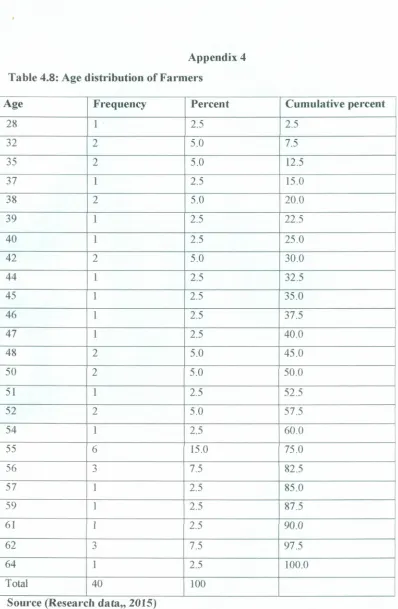
The results show that the farmers ages ranged between 28yrs to 64 yrs. 2.5 percent of
the farmers were between the ages of 18 and 29, 42.5 percent of the farmers were
between the ages of30 and 49 while 55 percent of the farmers were 50 years and above.
More than half of the total farmers growing the hedge were over 50 years old.
The findings show that growing of the hedgerow was popular among the older members
of the society. Contrary to expectations that farming was for the youthful and
physically strong, growing of the Jatropha hedgerows was an affair for the older
members of society. This finding could be used to imply that farmers viewed the
of income. At 50 years old the body cannot engage in labour intensive activities and
more so in areas where basic health care is nonexistent.
In Kenya, the Government does not have a social protection policy for the older
members of society. The older members of society in Kilifi county rely on their children
for their upkeep and should they fail for whatever reason they are left at the mercy of
well wishers. Jatropha curcas hedgerows require low labour and financial inputs and
thus provide a viable source of income that is not demanding for the older members of
CHAPTER FIVE
SUMMARY, CONCLUSIONS AND POLICY IMPLICATIONS
5.1. Introduction
This Chapter presents the summary, conclusion and Policy implications of the study.
First, a presentation of the summary of the major findings that includes a brief
description of the methodology is given. This is followed by a conclusion from the
findings and finally the policy implications.
5.2. Summary ofthe major findings
The study had set out to analyze the effectiveness of planting Jatropha curcas live fence
as a tool for managing household risks and vulnerability. The specific objectives were
to determine how the income from Jatropha hedgerows affects household consumption
levels and to establish the potential of the hedge as a tool for social protection.
The study was guided by the Keynesian theory on consumption which postulates that
household consumption is dependent on income. Primary data was collected on all the
variables on the empirical model using questionnaires
To meet the first research objective, income had to be decomposed into income from
main income generating activities and income from Jatropha hedgerows after which a
correlation and regression analysis was conducted. The analysis involved analyzing and
identifying how Household Consumption, Income from main income generating
activities and Income from Jatropha hedgerows were related. The findings showed that
hedgerows though the relationship was weak. However, when grown as a hedge the Income from Jatropha hedgerows could still be used to manage household risk as it
provides an extra source ofincome for the household.
To meet the second research objective, a demographic analysis was conducted to
ascertain who were the partakers of the project and whether there were vulnerable
members of the society being positively affected by the program. The findings would be
useful in establishing the potential of Jatropha curcas being grown as a tool for social
protection. The results showed that 2.5 percent of the farmers were between the ages of
18 and 29, 42.5 percent were between the ages of 30 and 49, and 55 percent of the
farmers were 50 years old and above. This indicates that growing of the hedgerow was
popular among the older members of the society. With regard to the gender of the
farmers, the findings show that 47.5 percent of the farmers were female compared to
52.5 percent who were male. Findings from the demographic analysis imply that
participation in the project was equally represented by both genders but more popular
with the older members of society.
5.3. Conclusions
From the findings, the Jatropha hedgerows do positively affect household consumption.
The relationship may be weak but it does affect consumption and hence can be used to
smoothen it in times of volatility. The hedgerow also affects both genders and the aging
members of the society and therefore validates its potential as a tool for social