ISSN 2286-4822
www.euacademic.org DRJI Value: 5.9 (B+)
Community Perception towards Tourism
Development and Peace Building Process:
A Study of Border Region
PRIYANKA SHARMA
Research Scholar School of Hospitality and Tourism Management University of Jammu, Jammu, Jammu & Kashmir, India
NIKHIL SINGH CHARAK
Programme Manager School of Vocational Studies, Ambedkar University, Delhi
AKHIL SINGH CHARAK
M Tech Scholar, IIT Kanpur
Dr. RITWIJ BHOWMIK
Faculty, Department of Humanities & Social Sciences, IIT Kanpur
Abstract:
The purpose of the study is to explore the community’s perceptions regarding tourism development and peace building process across the border areas in Jammu and Kashmir which could play significant role in destination development along with inducing peace perspectives across the nations. This study has been conducted on the local community who are presently residing along with the border areas of Jammu and Kashmir. The results of this study revealed that the positive perception of community about tourism creation and peace building process across borders. Further, practical implications have been discussed.
Key words: Community Perception, Tourism development, Peace building process, Border, International Relations, Kashmir.
INTRODUCTION
Hence, the purpose of this study is to explore an impact of tourist & community perception on peace building process across borders. Tourism growth relies on the community participation and community‟s attitude plays an imperative role in tourism development. Tourism has a significant power of change in the economy of the developed and least developed areas (Gumus, 2007). Tourism is defined as movement of persons involving the crossing of cultural boundaries for the purpose of business, study, pleasure or leisure. It “involves some form of culture contact, however transient and superficial.” This industry has a vast contribution to the regional, national and local economy as it offers both monetary expansion and employment opportunities.
In a competitive era, tourism is an approach for promoting peace and communal understanding. It is considered as a force to encourage social justice and resolution within a divided society (Desbiolles, 2003). Peace can‟t be definite as an exact situation. “Peace is a vital prerequisite for travel and tourism and all aspects of human growth and development.” The relationship between peace and tourism is very interesting because both are complimentary to each other. Tourism can be essential force for peace and alternatively tourism needs peace for its expansion and prosperity. Tourists are generally sensitive to event of war, violent behaviour because “such events risk a peaceful and undisturbed holiday.” They avoid visiting places with a negative reflection and simply switch to another destination when they find there is no serenity in their destination. There are many countries throughout the world where heinous violent incidents have resulted into negative impact on the tourist‟s inflow to those countries.
The role of community based approach (CBA) is to
management. Community perception can be considered in different stages of conflict and vulnerability. They can be used as a means for barrier, for example, the only solution of this process is to prepare local communities for peace building processes. There is an urgent need to promote tourism education among the local community that are residing in the border areas of India (Dar, 2014). Tourism education is an important approach to achieve the tourism developmental objectives along the border areas of the country in general and Jammu and Kashmir in particular, and should be promoted steadily and gradually. Although the community participation in peace building process requires more concerted efforts, intense consideration, their attitude towards border tourism is of foremost importance for futuristic approach. Understanding of community‟s perceptions regarding tourism development across border plays a pivotal role for booming and sustainable tourism development. It also suggests that community is the most important institution which cuts both ways, i.e. it affects positively or negatively in tourism planning and border tourism development. Tourist and community bring a host guest relation in a particular country and it is a step towards overall peace by understanding different cultural beliefs, harmony, cuisines, spiritual ceremonies (Villiers, 2003). It is an exchanging process through interacting with people to develop mutual sympathy and understanding and reduce their prejudices.
REVIEW OF LITERATURE
aware of their personalities, beliefs, aspirations, and culture and life perspectives. According to Andereck et al. 2005; Kiriakidou and Gore 2005; Kandampully (2000) tourism is considered as an economic development tool for the local community that provides many factors to improve the quality of life like employment opportunities, investments opportunities, tax revenues, restaurants, accommodation services, natural attractions, culture, and festivals. Many governments, local authorities, planners and host population support the development of tourism as a means to improve the quality of life of local people (Archer and Fletcher, 1996). As the development of tourism brings forth a number of impacts, that have been developed in order to calculate 'objectively' the impacts of tourism on the host population and destination.
Tourism expansion in border areas is generally connected to political and economic worldwide changes during the 20th century.(e.g. development in international trade and
paclakovich-kochi et al. 2004; Prescott, 1965; Sofield, 2006; Newman, 2011). Tourist sites located in border areas comprises of theme based attractions such as cross-border parks, natural attractions, heritage tourism (Timothy, 2001). Conflict-heritage tourism is an important aspect of border areas. This kind of tourism focuses on the concern of visitors in conflict zone of major importance or scope which become attached into people‟s significance and national awareness and which signify personal or communal cultural-national impact. It also includes visits to historical sites.
COMMUNITY PERCEPTION TOWARDS TOURISM
DEVELOPMENT AND PEACE BUILDING PROCESS
Different communities have their own culture and traditions. Tourism development leaves effects on them. In developing countries there is a need for local community to participate and manage tourist activities (Cater (1994). Community participation in the decision making process in developing countries is always limited or secondary (Dola and Mijan,
2006). Development of tourism through community
economic gain are most helpful for the tourism industry Harrill, 2004). The tourism development involves a trade off between economic benefits and environmental costs (Dyer et al., 2007; Cavus and Tanrisevdi, 2003; Faulkner and Tideswell, 1997). The interactions between the community and the tourists have positive impact in creating opportunities, bringing peace, integrating different cultures. Tourism helps to improve the quality of life in an area by increasing the number of tourist attractions, employment and recreational opportunities. It provides opportunity to local residents to interact with different people, make friends, learn about the world, and representing themselves to new perspectives (Kumar et al 2009).
RELEVANCE OF PEACE THROUGH TOURISM
Tourism plays a vital role in developing and promoting peace through cultural exchange, beliefs, lifestyles etc. and by exploring cuisines, traditions, monuments, hospitality and diversity of various places. It is not only a contributor of peace, but there is a symbiotic relationship between each other.
Tourism provides opportunities for promoting and
attempt to examine the satisfaction of the tourist‟s in relation to tourist infrastructure that includes accessibility lodgings, contact, and civic amenities available in the Jammu and Kashmir. They suggested measures to improve the available infrastructure in order to enhance the tourist satisfaction. However community forms a major portion for tourism development.
OBJECTIVES
To analyze perspective for across border destinations.
To study the importance of community perceptions
towards tourism development and peace building process.
To study community perception towards tourism
development in Jammu and Kashmir.
Research Methodology:
The sampling of this study took place in the destinations across borders of Jammu and Kashmir. The sample size of 328 samples was taken from the population residing near border areas of Jammu and Kashmir.
The structured questionnaire is used on the basis constructs required after applying the 5-Point Likert‟s Scale instrument. Whereas secondary data was collected from published journals, books, articles and reports.
Data Analysis and Interpretation:
Data collection with sample of 328 respondents took place at J&K state in which it was found that 68.51% are males while as 31.49% are females. In order to clarify the community perception towards border tourism promotion and peace building process. the descriptive analysis is applied i.e. mean value and standard deviation which signifies the variance of the
data and helps to perceived the impact of the tourism
development and peace building process across Indian borders.
Variables no
Items Average
Standard Deviation
V1 Tourism helps to build mutual understanding among people
4.19 0.55 V2 Border tourism will help to develop economy of
the community
4.31 0.60 V3 Border tourism will help to cross cultural
promotion of the nations
3.90 0.69 V4 Tourism across borders will help to raise the
quality of life of community
4.09 0.48 V5 Border tourism will promote peace process
among the nations
3.56 0.91 V6 Promotion of border tourism will broaden the
perspectives of political relations
3.56 0.79
V7 border tourism will help to fulfil infrastructure requirements of the destination across borders
3.51 0.77 V8 It will be safe if the border tourism is promoted
in India
3.47 0.59
V9 I will participate in the tourism activity across border if promoted
3.82 0.58 V10 It will promote trade relations among nations 3.68 0.78 V11 Border tourism will not hamper the sustenance
of destinations
3.46 0.58 V12 The term “border tourism” will grab the
attention of tourists towards concerned destination
3.56 0.62
V13 Governmental support should be provided to such tourism initiative
4.46 0.49 V14 Border tourism will increase the employment
opportunities among youth of the concerned destinations
Exploratory Factor Analysis
Exploratory Factor analysis is used to define the underlying constitution called factors among the variables in the analysis. For the purpose of this study, factor analysis was used on 14 variables. The result of initial (first run of) factor analysis on 14 independent variables showed KMO was 0.592 and significance level of Bartlett‟s test of sphericity was 0.00 (Table 1).
Table 1: KMO and Bartlett's Test
Kaiser-Meyer-Olkin Measure of Sampling Adequacy. .592 Bartlett's Test of Sphericity Approx. Chi-Square 1705.346
Df 91
Sig. .000
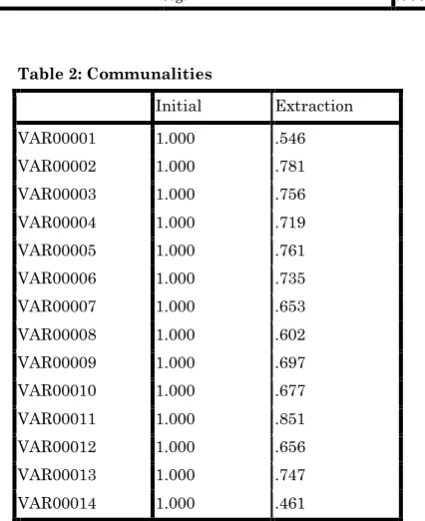
Factor analysis on all the selected 14 items was conducted using Varimax rotation. Four factors having eigen value above 1 was further found relevant for the study (Table 3). Total
Table 2: Communalities
Initial Extraction
VAR00001 1.000 .546
VAR00002 1.000 .781
VAR00003 1.000 .756
VAR00004 1.000 .719
VAR00005 1.000 .761
VAR00006 1.000 .735
VAR00007 1.000 .653
VAR00008 1.000 .602
VAR00009 1.000 .697
VAR00010 1.000 .677
VAR00011 1.000 .851
VAR00012 1.000 .656
VAR00013 1.000 .747
VAR00014 1.000 .461
variance explained was 31.074% with KMO value 0.592. Barlett‟s test of sphericity was significant (p<0.01).
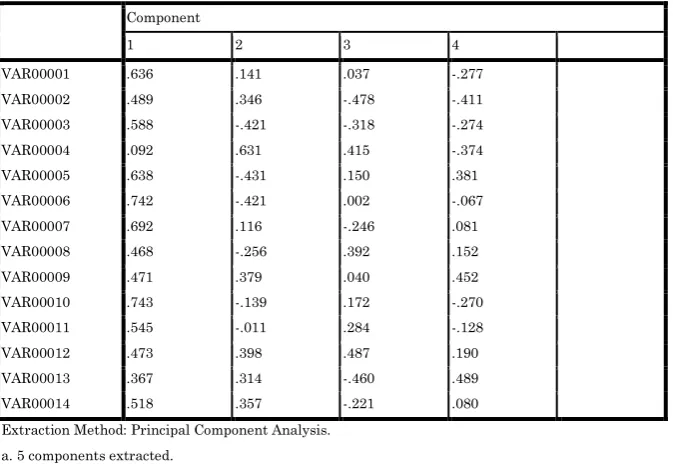
Factor analysis on perception about impact tourism development and peace building process across border derives, four factors which in turn may help to promote border areas in lieu of community interest (Table4). The mean value and standard deviation itself clears the above statement, as the mean value and standard deviation for the Economic benefits
(F1=3.81*/0.35**), Social benefit (F2=4.097*/0.48**),
Destination promotion (F3=3.56*/0.627**), Tourism support initiative (F4=4.46*/0.499**) (*= mean/ **= standard deviation of factors),
CONCLUSION:
From the present study we can say that peace is seen as a catalyst for tourism development in border areas. We observe
Table 4: Component Matrixa
Component
1 2 3 4
VAR00001 .636 .141 .037 -.277
VAR00002 .489 .346 -.478 -.411
VAR00003 .588 -.421 -.318 -.274
VAR00004 .092 .631 .415 -.374
VAR00005 .638 -.431 .150 .381
VAR00006 .742 -.421 .002 -.067
VAR00007 .692 .116 -.246 .081
VAR00008 .468 -.256 .392 .152
VAR00009 .471 .379 .040 .452
VAR00010 .743 -.139 .172 -.270
VAR00011 .545 -.011 .284 -.128
VAR00012 .473 .398 .487 .190
VAR00013 .367 .314 -.460 .489
VAR00014 .518 .357 -.221 .080
BIBLIOGRAPHY
1. Aghazamani, Y., Hunt, C. A. (2015). Beyond historical Adversaries: exploring new ground for peace through Tourism between Iran and the US. Tourism Culture & communication, 15, 59-64.
2. Chari, P. R., Chandra, S., Akhtar, S., (2011). Tourism and Peace building in Jammu and Kashmir. United States Institute of Peace.
3. Chauhan, V. Khanna, S. (2008). Tourism: A Tool for crafting peace process in Kashmir, J&K, India. Tourismos: an international multidisciplinary journal of Tourism, 4(2), 69-89.
4. Choudhary, S. (2014). Tourists Satisfaction Level of Holiday Tourism With Special Reference To Jammu. Abhinav International Monthly Refereed Journal of Research in Management & Technology. 3(3), 25-36.
5. Dar, Hafizullah. (2014). The potential of Tourism in border destinations: A study of Jammu and Kashmir. African Journal of Hospitality, Tourism and Leisure. 4 (2), 1-12. 6. Eshliki, S. A., Kaboudi, M (2011). Community Perception of
Tourism Impacts and Their Participation in Tourism Planning: A Case Study of Ramsar, Iran . Procedia - Social and Behavioral Sciences 36 333 – 341
7. Gelbman, A. Maoz, D. (2012). Islands of Peace or Island of War: Tourist Guiding. Annals of Tourism Research, vol 39- 108-133 DOI 10.1016/J.annals.2011.05.008
8. Kim, S. S., Prideaux, B.,Prideaux, J. (2007). Using tourism to promote peace on the Korean peninsula. Annals of Tourism Research, 34(2), 291-309.
9. Lankford, S.V. (1994). Attitudes and
perceptionstowardtourism and
ruralregionaldevelopment.Journal of Travel Research, 32, 35-43.
11. Monterrubio, J., C., Bello, A. (2011). Local Community Attitudes towards The Impact of Tourism On Prostitution.
Journal of Tourism.
12. Mir, H., A. (2014). Impact of Tourism Industry on Economic Development of Jammu and Kashmir International Journal of Scientific & Engineering Research, Volume 5, Issue 6, June-2014 592 ISSN 2229-5518.
13. Perez, E.A. and Nadal, J.R. (2005). Host community perceptions a cluster analysis. Annals of TourismResearch, 32(4), 925 - 941
14. Pratt, .S. Liu, A.(2015). Does Tourism Really Lead to Peace? A global View. International Journal of Tourism Research DOI: 10.1002/jtr.2035
15. Sheldon, P. and Var, T. (1984). Resident attitudes toward tourism in North Wales. Tourism Management, 5, 40-47. 16. Shin, Y., S. (2005). Safety, Security and peace Tourism: The
case of the DMZ area. Asia Pacific Journal of Tourism Research 10:4, 411-426, DOI: 10.1080/10941660500363777. 17. Timothy, D. (1999). Participatory planning: a view of tourism
from Indonesia. Annals of Tourism Research, 26, 371–391 18. Tosun, C. (2002). Host perceptions of impacts: a comparative
tourism study. Annals of Tourism Research, 29(1), 231–253. 19. Türker, N., Öztürk, S., (2013). Perceptions of Residents
Towards The Impacts of Tourism in the Küre Mountains National Park, Turkey. International Journal of Business and Social Science 4, (2)45-56.