Investigation on the Causes and Adverse
Effects of Reworks in Construction Projects
and Developing A Rework Reduction Model to
Mitigate Time and Cost
S.Raghuram1, R.Nagavinothini2
P.G. Student, Department of Civil Engineering, SRM University, Kattankulathur Campus, Kanchipuram, India1
Assistant Professor, Department of Civil Engineering, SRM University, Kattankulathur Campus, Kanchipuram, India2
ABSTRACT:Rework is a phenomena that has serious consequences in construction projects which includes various failures. It is one of the study area which needs more attention to identify the reasons for rework and to manage the problem effectively. Recent researchers also found out that rework is the primary cause for schedule and cost overruns in projects. Thus there is a need to study the impact of rework in construction projects to improve project performance. This study aims at investigating the important causes of rework which significantly affects the completion of the project. Through comprehensive literature and questionnaire survey method, the causes of rework in the completed and ongoing construction projects were investigated. The data collected established that the causes of rework differ according to project characteristics. From the major causes identified, 17 critical causes were prioritized based on its impact in causing rework. By recognizing the nature and sources of the critical factors, they were grouped into five major categories and rework reduction models were created for all the categories. Based on the study, it is suggested that the proposed models can be used at different stages of project to reduce the time and cost overrun in the projects.
KEYWORDS:rework, model, construction, reduction
I. INTRODUCTION
Rework is the major cause of time wastage and schedule overruns in the construction projects, which creates major impact on the cost and resources requires for the successful completion of the project. The major impacts of rework includes reduced profit, higher cost and costly litigation between participants. The cost of rework could be six times the cost of rectification. This also leads to poor project performance. But, the identification of major causes that influences rework in the construction projects remains an innate problem. The root causes of rework should be identified before managing them. Thus, there is a need to investigate the major causes of rework in the construction projects that creates cost and time overrun, eventually affecting the project performance.This study aims at identifying the major causes of rework in the construction projects through a questionnaire survey method. A comprehensive literature review and a questionnaire survey were carried to identify and prioritize the factors influencing the rework.
II. DATA COLLECTION
For investigating the causes of rework in construction projects, a comprehensive literature survey was carried out. From the literature review, 17 important factors causing rework, with major impacts on the cost and time overrun were identified. The factors are listed below:
1. Over excavation.
4. Displacement of formwork at the time of placing concrete.
5. Falling formwork materials from top storey that causes damage to them. 6. Bad appearance of concrete surface caused by deformation of formworks. 7. Fabricating inaccurately dimensioned concrete elements.
8. Damaging formwork materials due to irregular shapes with non-standard sized modular panels. 9. Leaking concrete from joints of the formwork.
10. Changing the designed steel bar diameters due to unavailability. 11. Wasting the reinforcement bars by wrong workmanship. 12. Remaining reinforcement bars at the end of construction. 13. Lacking reinforcement bars.
14. Using inappropriate head for poker vibrators.
15. Forming cold joint due to mismanagement of concrete delivering to the site. 16. Allocating inappropriate concrete materials.
17. Demolishing or repairing some parts of concrete due to non-conformance to the specification. The causes were grouped into five major categories based on their nature and sources such as:
Client related factors
Design related factors
Construction related factors
Site management related factors
Sub-contractor related factors.
III.QUESTIONNAIRE SURVEY
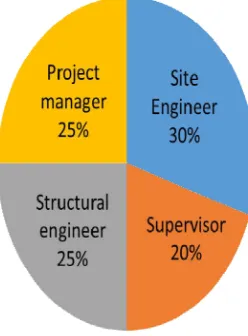
For the purpose of prioritizing the causes of rework, a questionnaire survey was developed by focussing on the major categories and its respective factors. The respondents were also asked to provide cost of the rework incurred during the project and they were also asked to provide the supplementary information about the causes of the rework at the end of the questionnaire survey. This survey was carried out from 20 construction projects and figure 1 shows the profession of the respondents. It can be seen that the survey was carried out from all the professionals involved in the construction project equally. Prior to the detailed analysis of the survey, the respondent’s background with respect to the years of experience and education was also given in table 1 and table 2 respectively. It can be seen that majority of the respondents has less than 10 years of experience and 40% of respondents has bachelor degree.
Table 1: Working Experience of respondents
Working Experience Value %
0-5 years 30
6-10 Years 35
11-15 years 25
10-15 Years 10
Table 2: Education background of respondents
Education Background Value %
Diploma 35
Bachelor Degree 40 Master Degree 20
Doctorate 5
IV.DATA ANALYSIS
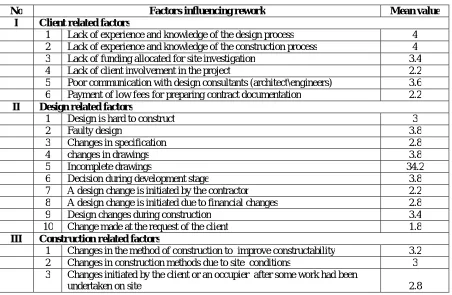
From the questionnaire survey, the mean value of all the critical factors were found out. The factors are ranked according to their mean value under five major categories.The variation of mean values of the critical factors causing rework in construction projects is given in table 3.
Table 3: Data Analysis of factors causing rework
No Factors influencing rework Mean value
I Client related factors
1 Lack of experience and knowledge of the design process 4 2 Lack of experience and knowledge of the construction process 4 3 Lack of funding allocated for site investigation 3.4 4 Lack of client involvement in the project 2.2 5 Poor communication with design consultants (architect\engineers) 3.6 6 Payment of low fees for preparing contract documentation 2.2
II Design related factors
1 Design is hard to construct 3
2 Faulty design 3.8
3 Changes in specification 2.8
4 changes in drawings 3.8
5 Incomplete drawings 34.2
6 Decision during development stage 3.8
7 A design change is initiated by the contractor 2.2 8 A design change is initiated due to financial changes 2.8
9 Design changes during construction 3.4
10 Change made at the request of the client 1.8
III Construction related factors
4 Changes initiated by the client or an occupier when a product or process
had been completed 3.4
5 Changes initiated by a contractor to improve quality 4 6 Errors due to inappropriate construction methods 4.4
7 Damages caused by a subcontractor 3
IV Site management
1 Ineffective use of quality management practices 2.4
2 Lack of training and experience 3
3 Setting-out errors 2.6
4 Constructability problems 2.6
5 Poor planning of resources 2
6 Poor coordination of resources(e.g. Subcontractors) 2.4 7 Failure to provide protection to constructed works 2.4
8 Lack of safety 2.2
9 Excessive overtime 1.8
V Sub-contractor
1 Unclear instruction to workers 3.6
2 Non-compliance with specification 4.2
3 Shortage of skilled supervisors 4.4
4 Shortage of skilled labour 4
5 Low labour skill level 4.4
6 Inadequate Supervisor 3.8
7 Defective workmanship 3.4
8 Damage to other trades work due to carelessness 3.4
V. REWORK REDUCTION MODEL
Based on the analysis of the critical factors, the factors are ranked according to the mean value. The rework reduction models were created based on the importance of the factors under five major categories.
1. Client related factors:
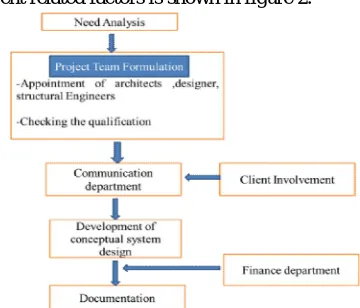
The rework reduction model for client related factors is shown in figure 2.
The reduction model shows that the team members must communicate and work together harmoniously if projects are to be delivered on or ahead of time. The client must involve in to the project. Client team factors that have been identified as contributing to rework include inadequate funding provided during site investigations, inadequate, payment of low fees for preparing contract documentation, ineffective use of information technology poor design coordination between design team members.
2. Design related factors:
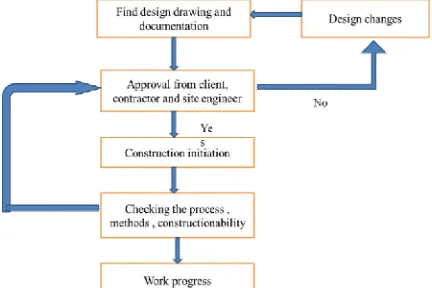
The rework reduction model for design related factors is shown in figure 3.
Fig. 3. Rework reduction model for design related factors
Design related rework in the form of change orders is the major source of rework in construction projects. A dearth in communication flow between the client and design team members can result in documentation errors and omissions occurring. Client and design team factors that have been identified as contributing to rework include Design is hard to construct, faulty design, Changes in specification, incomplete drawings , decision during development stage, a design change is initiated by the contractor, a design change is initiated due to financial changes, design changes during Construction, Changes made at the request of the client.
3. Construction related factors:
The rework reduction model for construction related factors is shown in figure 4.
Constructability is a strategy that can be used to achieve optimum integration of construction knowledge throughout the procurement process, as well as balance various project and environmental constraints so as to maximize project goals and building performance. This is done by using the knowledge and experience of key design and construction personnel during the design process so as to improve teamwork, and planning and scheduling of site operations, which in turn can translate into ameliorated project performance in terms of time, cost, and quality. Construction related factors must involve in Changes in the method of construction to improve constructability, Changes in construction methods due to site conditions, Changes initiated by the client or an occupier after some work had been undertaken on site, Changes initiated by the client or an occupier when a product or process had been completed, Changes initiated by a contractor to improve quality, Errors due to inappropriate construction methods, Damages caused by a subcontractor.
4. Site Management related Factors
The rework reduction model for site management related factors is shown in figure 5.
Fig. 5. Rework reduction model for site management related factors
Project success is depending upon the site management team. The team must work with their subcontractors to plan the work that needs to be undertaken. site management, other factors that contribute to rework in Ineffective use of quality management practices, Lack of training and experience, Setting-out errors, Constructability problems, Poor planning of resources, Poor coordination of resources(e.g. Subcontractors), Failure to provide protection to constructed works, Lack of safety, Excessive overtime.
5. Sub-contractor related factors
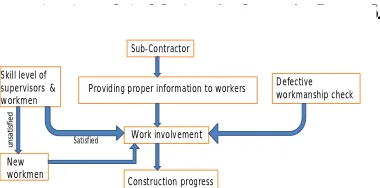
The rework reduction model for sub-contractor related factors is shown in figure 6.
Sub-Contractor
Providing proper information to workers Defective workmanship check Skill level of
supervisors & workmen
Work involvement
Construction progress New
workmen
u
n
sa
ti
sf
ie
d
Satisfied
Figure 6: Rework reduction model for sub-contractor related factors
Sub-contractor is responsible for giving proper instructions to the labours. Skilled labours must be hired and should not damage any materials during the construction work. The work specification must be explained to the workers.
VI. CONCLUSION
skilled labours and inadequate supervision. Based on the analysis results, rework reduction models were created for five major categories. When the construction is carried out in accordance with the rework reduction model at different stages of the project, the occurrence of rework can be reduced to a greater extent.
REFERENCES
[1] Peter E. D. Love., and David J. Edwards., “Forensic Project Management: The Underlying Causes of Rework In Construction Projects”,
Journal of Civil Engineering and Environmental Systems, Vol. 00, pp. 1-22, 2004.
[2] Peter E. D. Love., ZahirIrani., and David J.Edwards., “A Rework Reduction Model for Construction Projects”, IEEE transactions on
Engineering Management, Vol. 51, No. 4, pp. 426-440, 2004.
[3] Sughihartoalwi., Keith Hampson., and Sherif Mohamed., “Investigation into the relationship between rework and site supervision in high rise
building construction in Indonesia”, Proceedings of Second International Conference on Construction Process Re-engineering, pp. 189-195, 1999.
[4] L.O.Oyewobi., and D.R.Ogunsemi., “Factors influencing rework occurrence in construction: A study of selected building projects in Nigeria”,
Journal of Building Performance, Vol. 1, Issue. 1, 2010.
[5] Eric K.Simpeh., Ruben Ndihokubwayo., Peter E.D.Love., and Wellington DidibhukuThwala., “A rework probability model: a quantitative
assessment of rework occurrence in construction projects”, International Journal of Construction projects, 2015.
[6] EkambaramPalaneeswaran., MuthukaruppanRamanathan and Chi-mingTam., “Rework in Projects: Learning from Errors”, Journal of
Surveying and Built Environment, Vol. 18(2), pp. 47-58, 2007.
[7] Gui Ye., Zhigang Jin., Bo Xia., and Martin Skitmore., “Analysing Causes for Reworks in Construction Projects in China”, Journal of