Detection of Islanding in Micro-grid
Connected with Distributed Generation
Pal Shivamkumar S1, Singh Shailendra R2, Vishwakarma Shubham R3,
Savani Sagarkumar M4, Shani M Vaidya5
B.E Student, Department of Electrical Engineering, Vidhyadeep Institute of Engineering and Technology, Anita, KIM,
Gujarat, India.1
B.E Student, Department of Electrical Engineering, Vidhyadeep Institute of Engineering and Technology, Anita, KIM,
Gujarat, India.2
B.E Student, Department of Electrical Engineering, Vidhyadeep Institute of Engineering and Technology, Anita, KIM,
Gujarat, India.3
B.E Student, Department of Electrical Engineering, Vidhyadeep Institute of Engineering and Technology, Anita, KIM,
Gujarat, India.4
Assistant Professor, Department of Electrical Engineering, Vidhyadeep Institute of Engineering and Technology, Anita,
KIM, Gujarat, India.5
ABSTRACT:The advance and technology in and new innovation in power quality electronics. The consumer requires
better power quality and also continue power supply. This cannot achieve by convectional power grid so it's alternate option is micro grid. The micro grid is best option for continue power supply it is basically work on renewable source like wind energy photovoltaic etc. MG work on both mode standalone and interconnected mode. In standalone mode it works without any grid connection but in interconnected mode it is couple with main grid. In case of interconnected mode when it operates alone due to grid failure it is called islanding. But some issues come in islanding mode which are human safety, inverter safety and power quality disturbance like frequency variation, voltage swell and shrink harmonics distortion so, it important to detect islanding, power quality issues by various detecting methods.
KEYWORDS:Islanding, Islanding methods, Distributed generation, Micro grid.
I. INTRODUCTION
harmful for utility. This paper mainly focusing on the working of islanding detection technique.MG playing a key role in maintaining power quality (PQ) and reliable power supply.When connected with main grid, it introduced issues and the DG source energizes the critical load until the main grid is resynchronized with DG.
The situation of islanding can be distinguished in two types:
Intentional Islanding and Non-Intentional Islanding. In
caseofIntentionalislanding,whenthemaintenanceisnecessaryforthespecificpart or portion of micro-gridand it is disconnected from main grid it’s called Intentional Islanding. Where in Non-intentional islanding, it is not planned to disconnect intentionally but it is disconnect due to any types offault.
Section II The work in this paper is divided in Two stages. 1) Islanding Detection Technique 2) Islanding Protection Paper is organized as follows. Section IIIDescription about Distributed Generation and Section IV presents MATLAB SIMULATION showing results of images tested. Finally, Section V presents conclusion.
II. LITERATURESURVEY
1) ISLANDING DETECTIONTECHNIQUES
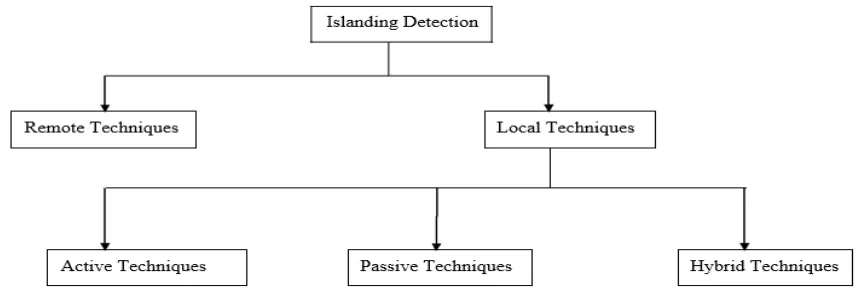
The main philosophy of detecting an islanding condition is to monitor DG output parameters and system parameters and to check whether islanding has occurred due to change in these parameters. Islanding detection techniques can be categorized as remote and local techniques. Local techniques can be subdivided into active, passive and hybrid techniques.
a) Remote Islanding Detection Technique
These techniques are based on communication between utility and DGs. But these are very expensive to implement. Traditionally only utility owned wires and channels subscribed from public telephone companies have been considered. Today radio transmitting (FM or AM) and optic fibres can be added to the list.
b) Local Islanding Detection Techniques
Local detection method is based on the measuring parameter like voltage & frequency; and it is use on the DGside. Local detection method is usually classified the (i) Active method, (ii) Passive method and (iii) Hybrid method.
Fig 1 : - Block Diagram of Islanding Detection Techniques
i) Active islanding detection techniques
the grid.
ii) Passive detection techniques
Passive methods work on measuring system parameters such as variation in voltage, frequency, harmonic distortion. The difference between the islanding and grid connected conditions is based on the threshold values set for these parameters. These techniques are fast and don’t introduce any disturbance in the system.
iii) Hybrid detection techniques
Hybrid methods employ both the active and passive detection techniques. The active technique is implemented only when the islanding is suspected by the passive technique.
2) ISLANDING PROTECTION
The principal objective for an islanding protection technique is to detect the condition where the DG unit is left connected to a portion of the utility's load network, but disconnected from the main source of utility power following a switching operation. When an islanding condition is detected, the protection should trip the inter-tie breaker between the generator's site and the utility. Once this has been done, the presence of the DSG unit will not impede the orderly restoration of the utility supply to the rest of the network. Since the intertie breaker is used to connect two active systems, once the network supply has been established, the DSG unit can be reconnected to the utility.
III.DISTRIBUTEDGENERATION
Distributed generation is any small-scale electrical power generation technology that provides electric power at or near the load site; it is either interconnected to the distribution system or directly to the customer's facilities or both. DG technologies include small Combustion Turbine Generators (including micro turbines), Internal Combustion Reciprocating Engines and Generators, Photovoltaic panels, and Fuel cells. Other technologies including solar thermal conversion, Stirling engines, and Biomass conversion are considered DG. DG has much potential to improve distribution system performance. The use of dg strongly contributes to a clean, reliable and cost effective energy for future. Distributed generation may also be referred to as “Dispersed generation”, “Embedded generation” or “Decentralized generation”. Some of the technical issues are Islanding of DG, Voltage regulation, Protection and Stability of the network.
Distribution system with multiple DG’s
Distributed or dispersed generation may be defined as generating resources other than central generating stations that is placed close to load being served, usually at customer site. It serves as an alternative to or enhancement of the traditional electric power system. The commonly used distributed resources are wind power, photo voltaic, hydro power. The figure shows the single line diagram of the distribution system with multiple DGs.
IV.MATLABSIMULATION
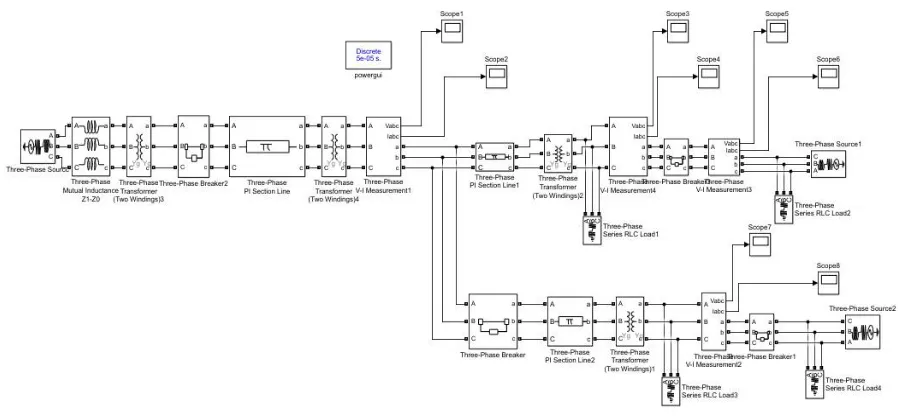
The performance of the proposed system for the Active Islanding Detection Technique is validated by MATLAB Simulink Software. Figure shows the simulated diagram of the system. Here sources are connected in the Secondary sides works as a DGs1 and DGs2.
This system was tested under following Values:
1) Switching frequency of the sources and DGs: 50 Hz; 2) Output frequency of sources and DGs: 50 Hz;
3) Switching time of Circuit breaker in Primary and Secondary side: 0.001s 4) Length of PI section line in Primary and Secondary side: 30 KM 5) Value of loads connected in the circuit:
Vrms: 25kv Active Power: 15mv
6) Source used in Primary side:
Vrms: 120kv Short Circuit Level: 1000mv
Base Voltage: 120e3 X/R ratio: 1.1
7) Source used in Secondary side: For both DGs
Vrms:25kv Short Circuit Level: 10mv
Base Voltage:120e3 X/R ratio: 1.1
Below Figure shows the Simulation diagram using MATLAB. This system works under Four Conditions:
Fig 2: - Simulation Fig for Conditions
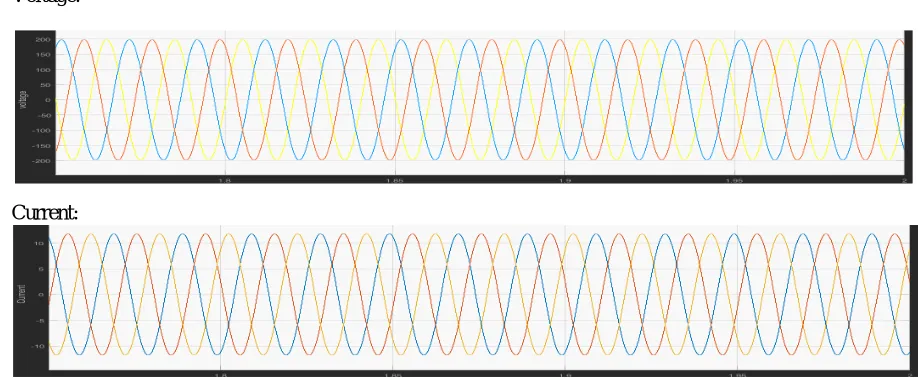
1) Condition 1: Normal Condition
Both sides three phase circuit breaker are in closed conditions. That is the normal condition. So the voltage& current waveforms found at any DG end is purely sinusoidal. Below figure 3 shows the waveform of Voltage and Current.
Current:
Fig 3:- Waveform of Voltage and Current.
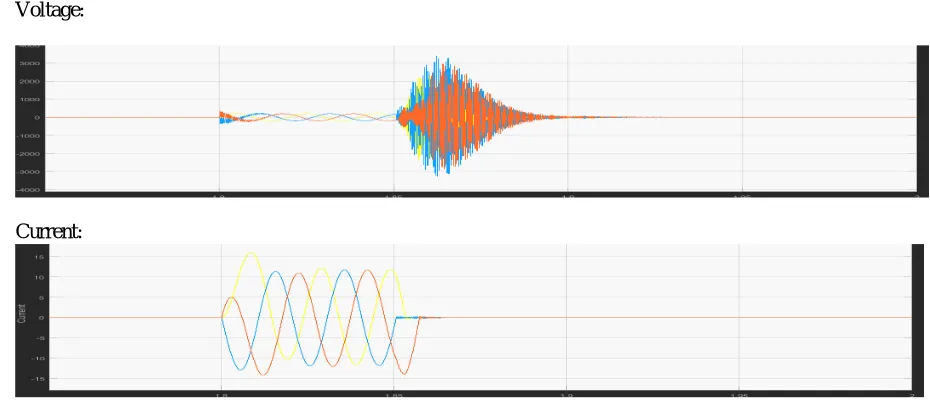
2) Condition 2: Islanding Condition
Three phase circuit breaker is initially close and is opened with transition time 1.8 to 1.85. Three phase circuit breaker 1 is permanently open. As after switching off the three phase breaker whole part of the distribution system is isolated from the remainder part of the power system. So this is the islanding condition.Below figure 4 shows the waveform of Voltage and Current.
Result: For Condition 2 Voltage:
Current:
Fig 4:- Waveform of Voltage and Current for Condition 2.
3) Condition 3: DG Line Trip Condition
Result: For Condition 3 Voltage:
Current:
Fig 5:- Waveform of Voltage and Current for Condition 3.
4) Condition 4: Suddenly Load Change Condition
This is the sudden load change condition. Where suddenly load is changed up to 50%. Below figure 6 shows the waveform of Voltage and Current.
Result: For Condition 4 Voltage:
Current:
Fig 6:- Waveform of Voltage and Current for Condition 4.
V. CONCLUSION
understanding of the actual history of islanding probability occurrence in a particular system.This is to ensure that the control system is reliable as well as achieving minimal compromising between cost, system quality and safety risks. In fact, the choice of active-islanding methods is dependent on national electrical rules and regulations, because every country has its own guidelines of DG interconnection requirements.
REFERENCES
1. Shyh-Jier Huang and Fu-Sheng Pai, “A New Approach to Islanding Detection of Dispersed Generators with Self-Commutated Static Power
Converters,” IEEE transactions on Power Systems, Vol. 15, Issue No. 2, pp 500-507, April 2000.
2. Sung-Il Jang and Kwang-Ho Kim, “Development of a Logical Rule-based Islanding Detection Method for Distributed Resources,” IEEE
transactions on Power Systems, July 2002.
3. Guo-Kiang Hung, Chih-Chang Chang and Chern-Lin Chen, “Automatic Phase-Shift Method for Islanding Detection of Grid-Connected
Photovoltaic Inverters, “IEEE transactions on Power Systems, Vol. 18, Issue No. 1, pp 169-173, March 2003.
4. Sung-Il Jang and Kwang-Ho Kim,” An Islanding Detection Method for Distributed Generations Using Voltage Unbalance and Total Harmonic
Distortion of Current,” IEEE transactions on Power Systems, Vol. 19, Issue No. 2, pp 745-752, April 2004.
5. Pukar Mahat, Zhe Chen and Birgitte Bak-Jensen,” A Hybrid Islanding Detection Technique Using Average Rate of Voltage Change and Real
Power Shift,” IEEE transactions on Power Systems, Vol. 24, Issue No. 2, pp 764-771, April 2009.
6. Wencong Wang, Jacek Kliber and Wilsun Xu, “A Scalable Power-Line-Signaling-Based Scheme for Islanding Detection of Distributed
Generators,” IEEE transactions on Power Systems, Vol. 24, Issue No. 2, pp 903-909, April 2009.
7. Jun Yin, Chris Peter Diduch and Liucheng Chang,” Islanding Detection Using Proportional Power Spectral Density,” IEEE transactions on
Power Systems, Vol. 23, Issue No. 2, pp 776-784, April 2008.
8. H. H. Zeineldin and James L. Kirtley,” A Simple Technique for Islanding Detection with Negligible Non detection Zone,” IEEE transactions on
Power Systems, Vol. 24, Issue No. 2, pp 779-786, April 2009.
9. Soo-Hyoung Lee and Jung-Wook Park, “New Islanding Detection Method for Inverter- Based Distributed Generation Considering Its
Switching Frequency,” IEEE transactions on Power Systems, Vol.46, Issue No. 5, pp 779-786, pp 2089-2098, September 2010.
10. S. R. Samantaray, Khalil El-Arroudi, Geza Joos and Innocent Kamwa, “A Fuzzy Rule- Based Approach for Islanding Detection in Distributed
Generation,” IEEE transactions on Power Systems, Vol.25, Issue No. 3, pp 1427-1433, July 2010.
11. David Díaz Reigosa, Fernando Briz, Cristian Blano Charro, Pablo Garcia and Juan Manuel Guerro,” Active Islanding Detection Using
High-Frequency Signal Injection,” IEEE transactions on Power Systems, Vol.48, Issue No. 5, pp 1588-1597, October 2012.
12. Waleed K. A. Najy, H. H. Zeineldin, Ali H. Kasem Alaboudy and Wei Lee Woon,” A Bayesian Passive Islanding Detection Method for
Inverter-Based Distributed Generation Using ESPRIT,” IEEE transactions on Power Systems, Vol.26, Issue No. 4, pp 2687-2696, October 2011.
13. Ankita Samui and S. R. Samantaray,” Assessment of ROCPAD Relay for Islanding Detection in Distributed Generation,” IEEE transactions on
Power Systems, Vol.2, Issue No. 2, 391-398, June 2011.
14. Hesan Vahedi, Reza Noroozian, Abolfazl Jalilvand and Gevorg B. Gharehpetian,” A New Method for Islanding Detection of Inverter-Based