ISSN(Online): 2319-8753 ISSN (Print): 2347-6710
I
nternational
J
ournal of
I
nnovative
R
esearch in
S
cience,
E
ngineering and
T
echnology
(A High Impact Factor, Monthly, Peer Reviewed Journal)
Visit: www.ijirset.com
Vol. 7, Issue 4, April 2018
Low Cost Smart Electric Switch Board
Ashwini Karkhanis1, Trupti Khatavkar2, Ameya Adhyapak3, Sameer Kulkarni4,
B.E Student, Department of Computer Engineering, Marathwada Mitra Mandal’s College of Engineering, Pune,
Maharashtra, India1
B.E Student, Department of Computer Engineering, Marathwada Mitra Mandal’s College of Engineering, Pune,
Maharashtra, India2
B.E Student, Department of Computer Engineering, Marathwada Mitra Mandal’s College of Engineering, Pune,
Maharashtra, India3
B.E Student, Department of Computer Engineering, Marathwada Mitra Mandal’s College of Engineering, Pune,
Maharashtra, India4
ABSTRACT: In this era of digitization and automation, the life of human beings is getting simpler as almost everything is automatic, replacing the old manual systems. Now-a-days humans have made internet an integral part of their everyday life without which they are helpless. Internet of things (IoT) provides a platform that allows devices to connect sense and control remotely across a network infrastructure. This prototype uses NodeMCU interfaced with the relay circuit using GPIO pins to control domestic appliances such light, fans, air conditioner and so on remotely. The web app created provides graphical user interface containing graphical buttons for controlling respective appliance. The main intent of this prototype is to provide a low cost, user friendly and scalable system.
KEYWORDS:IoT, NodeMCU, Wi-Fi, Web App, MQTT protocol.
I.INTRODUCTION
In this world with fast implementation of internet in each and every daily appliance, we aim at increasing the ease of using the day-to-day appliances. It becomes difficult for the handicapped people to operate these appliances. Also if the person is not physically present he cannot either control or know the status of the appliance. This may result in wastage of electricity. So we provide a solution by developing a Smart switch board which provides control over accessing all household appliances. In this smart board we can control fans, tube lights, etc., over a web application. IoT provides an easy way of implementing this smart switch board concept. NodeMCU sends signals on cloud and further these readings are used to check the status of the appliances. With the help of these monitored results, user can analyze power consumption by the appliances.
II.LITERATURE SURVEY
ISSN(Online): 2319-8753 ISSN (Print): 2347-6710
I
nternational
J
ournal of
I
nnovative
R
esearch in
S
cience,
E
ngineering and
T
echnology
(A High Impact Factor, Monthly, Peer Reviewed Journal)
Visit: www.ijirset.com
Vol. 7, Issue 4, April 2018
implemented using ESP8266. MQTT works on TCP. MQTT is well suited for IoT based sytems which have limited nodes. MQTT is thus a light weight protocol that occupies low bandwidth and consumes less power [3].
III.HARDWARE COMPONENTS
2.1 Relay Module
A relay functions as a switch that has the capacity of switching multiple circuits which can be either individual, simultaneous or in sequence.
The proponents use a relay to accommodate 3 output devices. NodeMCU’s output pins are connected to each of the input pins of the relay module.
Fig. 1.1 Relay Module
2.2 Node MCU
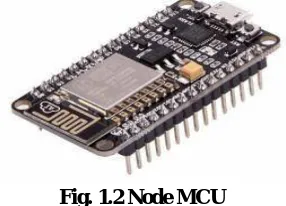
Node MCU is an open source IOT platform. It includes firmware which runs on the ESP8266 Wi-Fi SoC, and hardware which is based on the ESP-12 module.
Node MCU is used to establish internet connection between the module and cloud. It is a microcontroller specific to the network layer.
Fig. 1.2 Node MCU
III. SYSTEM ARCHITECTURE
ISSN(Online): 2319-8753 ISSN (Print): 2347-6710
I
nternational
J
ournal of
I
nnovative
R
esearch in
S
cience,
E
ngineering and
T
echnology
(A High Impact Factor, Monthly, Peer Reviewed Journal)
Visit: www.ijirset.com
Vol. 7, Issue 4, April 2018
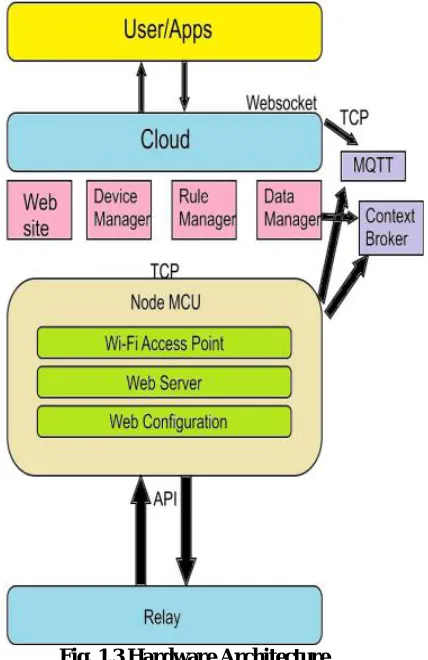
Context Broker is used as an implementation of the Publish/Subscribe Protocol. It helps in sending data from the device to the IoT stack and it also sends command from application to the device. The relay module is used to trigger the appliances as per the instructions received through the NodeMCU. As per Fig.1.3.
Fig. 1.3 Hardware Architecture
IV.ALGORITHM
1. Start
2. Turn on the smart board (connected with NodeMCU). 3. Connect to the internet connection (Wi-Fi router). 4. Start web application using VPS (host IP). 5. Login through the Web application.
6. Establish connection with the server and cloud (database). 7. Take user input through web application. 8. Web application sends commands to the board.
9. Relay will trigger devices.
10. User send stop command to board (stop working of devices). 11. Close the web application.
ISSN(Online): 2319-8753 ISSN (Print): 2347-6710
I
nternational
J
ournal of
I
nnovative
R
esearch in
S
cience,
E
ngineering and
T
echnology
(A High Impact Factor, Monthly, Peer Reviewed Journal)
Visit: www.ijirset.com
Vol. 7, Issue 4, April 2018
V.HARDWARE ARCHITECTURE
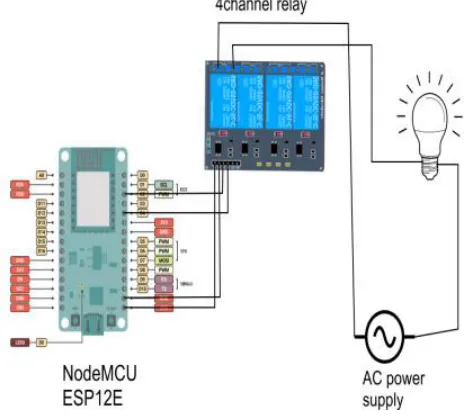
The hardware architecture of the system consists of NodeMCU that is USB powered and is interfaced with 4 channel relay module by means of 230V power supply. Various home appliances can be connected through the relay. The NodeMCU has been programmed to act as a web server with port address 80. The client can upload the data to it and the status of the GPIO pins is modified. This result in controlling the relay connected to the corresponding GPIO pin.
Fig. 1.4 Hardware Architecture
VI.RESULTS
The Fig. 1.5 shows the initial circuit when the bulb is off. A bulb is connected to the relay module. Any appliance can be connected to it. This is a 4-channel relay module, thus, maximum four appliances can be connected. If number of appliances exceeds, then relay modules are available in sizes such as 8-channel, 16-channel, and so on.
ISSN(Online): 2319-8753 ISSN (Print): 2347-6710
I
nternational
J
ournal of
I
nnovative
R
esearch in
S
cience,
E
ngineering and
T
echnology
(A High Impact Factor, Monthly, Peer Reviewed Journal)
Visit: www.ijirset.com
Vol. 7, Issue 4, April 2018
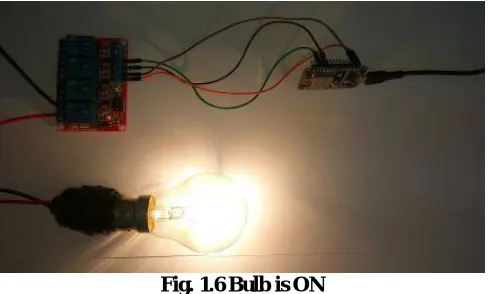
Fig. 1.6 shows the on state of the bulb after the user clicks the ON button. When user clicks on the ON button the NodeMCU triggers the specific relay and thus the appliance connected to it is switched ON. The circuit contains a NodeMCU that controls the system and sends data values from hardware circuit to the web app and vice versa.
Fig. 1.6 Bulb is ON
The user has to login from the login page provided in the web app as in Fig. 1.7. When user opens the web app this will be the first page that appears on to the screen. Then user has to enter the credentials provided to them i.e. username and password. Passwords are stored in encrypted format.
Fig. 1.7 Login Page
ISSN(Online): 2319-8753 ISSN (Print): 2347-6710
I
nternational
J
ournal of
I
nnovative
R
esearch in
S
cience,
E
ngineering and
T
echnology
(A High Impact Factor, Monthly, Peer Reviewed Journal)
Visit: www.ijirset.com
Vol. 7, Issue 4, April 2018
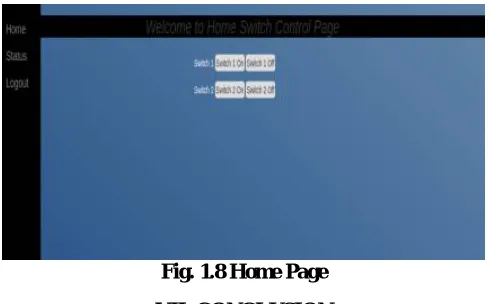
Fig. 1.8 Home Page
VII. CONCLUSION
Using IoT based Smart Switch Board user can control the home appliances. Web application provides platform for controlling the home appliances. The smart board uses the NodeMCU for controlling all components inside the smart board. The NodeMCU is low cost and powerful board. Compared with existing home automation systems, this system has following characteristics: Low cost, other home automation system is costlier. It is simple and portable board, which can control basic home appliances like fan, tube light. The smart board analyses use of electricity parameters and create an electricity usage report. The smart board is controlled through web application which can work in mobile phones, browsers etc. We have built the smart board which can control the basic home appliances. In future, we plan to extend the board which can be accessed through the iOS application as well as through smart wearable devices.
REFERENCES
[1] S. M. Shaheed, M. S. B. Ilyas, J. A. Sheikh, and J. Ahamed, “Effective smart home system based on flexible cost in pakistan,” in 2017 Fourth
HCT Information Technology Trends (ITT), pp. 35–38, Oct 2017.
[2] R. K. Kodali and K. S. Mahesh, “Low cost implementation of smart home automation,” in 2017 International Conference on Advances in
Computing, Communications and Informatics (ICACCI), pp. 461–466, Sept 2017.
[3] R. K. Kodali and S. Soratkal, “Mqtt based home automation system using esp8266,” in 2016 IEEE Region 10 Humanitarian Technology
Conference (R10- HTC), pp. 1–5, Dec 2016.
[4] P. S. N. Reddy, K. T. K. Reddy, P. A. K. Reddy, G. N. K. Ramaiah, and S. N. Kishor, “An iot based home automation using android application,” in 2016 International Conference on Signal Processing, Communication, Power and Embedded System (SCOPES), pp. 285–290, Oct 2016. [5] R. B. Caldo, D. Castillo, J. T. Seranilla, J. M. T. Castillo, I. C. C. Largo, M. A. T. Latayan, and M. Gabat, “Development of wi-fi- based switch control system for home appliances using android phone,” in 2015 International Conference on Humanoid, Nanotechnology, Information Technology,Communication and Control, Environment and Management (HNICEM), pp. 1–6, Dec 2015.
[5] A. Adriansyah and A. W. Dani, “Design of small smart home system based on arduino,” in 2014 Electrical Power, Electronics,
Communicatons, Control and Informatics Seminar (EECCIS), pp. 121–125, Aug 2014.
[6] N. Dickey, D. Banks, and S. Sukittanon, “Home automation using cloud network and mobile devices,” in 2012 Proceedings of IEEE