ISSN(Online): 2319-8753 ISSN (Print): 2347-6710
International Journal of Innovative Research in Science,
Engineering and Technology
(An ISO 3297: 2007 Certified Organization)
Website: www.ijirset.com
Vol. 6, Issue 6, June 2017
Proxy Oriented Data Uploading and Auditing
for Regenerating-Code-Based Cloud
Surekha Jadhav1, Sathish K Penchala2
P.G. Student, Department of Computer Engineering, Dr.D.Y.Patil School of Engineering and Technology,
Charoli (Bk), via Lohegaon, Pune, India1
Associate Professor, Department of Computer Engineering, Dr.D.Y.Patil School of Engineering and Technology,
Charoli (Bk), via Lohegaon, Pune, India2
ABSTRACT: Increasingly additional purchasers would love to store their knowledge to PCS (public cloud servers) beside the speedy development of cloud process. New security troubles ought to be solving so as to assist additional purchasers method their knowledge publicly cloud. Once the shopper is proscribed to access PCS, he will delegate its proxy to method his knowledge and transfer them. On the opposite hand, isolated knowledge integrity checking is additionally a very important security drawback publicly cloud cupboard space. It makes the purchasers check whether or not their outsourced knowledge is unbroken in one piece while not downloading the complete knowledge. Within the security issues, we have a tendency to propose Identity-Based Proxy-Oriented knowledge Uploading with identity based mostly and time server on cloud and proxy serve in encrypted format victimization isobilateral secret writing and send knowledge verification request to TPA, conjointly regenerate knowledge from proxy. During this paper knowledge owner transfer file on cloud with time and identity hold on cloud and proxy server in encrypted victimization isobilateral secret writing AES formula with public key from PKG and if knowledge Owner desires to update the file content on cloud its hold on updated content hold on cloud and proxy server. And so if knowledge owner desires to verify the cloud file is hack or corrupt from cloud victimization TPA, then send Verification request to TPA, then TPA auditor Send Verification response to knowledge owner and Proxy Server, if verification result's hack then proxy regenerate the content from proxy to Cloud. And each knowledge User transfer enter decoding format victimization secret key.
KEYWORDS: Cloud computing, Identity-based cryptography, Proxy public key cryptography, Remote data integrity checking, Time Server access Control, Encryption, Decryption.
I. INTRODUCTION
ISSN(Online): 2319-8753 ISSN (Print): 2347-6710
International Journal of Innovative Research in Science,
Engineering and Technology
(An ISO 3297: 2007 Certified Organization)
Website: www.ijirset.com
Vol. 6, Issue 6, June 2017
of knowledge process and uploading to the third party, as an example the proxy server. On the opposite half, the remote knowledge sincerity checking protocol should be economical to create it suited to capacity-limited finish devices. As a result, supported identity-based general public cryptography and proxy general public key cryptography, we'll study ID-PUIC protocol. Found during this paper if knowledge Owner needs to publish knowledge send request to PKG for public key for keep knowledge over time server and Identity on cloud and knowledge is keep on cloud in encrypted format victimization Symmetrical secret writing and conjointly keep on proxy server, data owner before downloading examine the remote knowledge integrity victimization the TPA auditor once checking integrity auditing TPA send the integrity react to requested Owner and Proxy server. If proxy server get response from TPA file is hack or corrupt then Proxy produce the knowledge from Proxy to Cloud server and so knowledge owner transfer the info, knowledge user before transfer knowledge send secret key request to PKG and transfer knowledge in cryptography Format in victimization radials symmetrical cryptography Technique..
II. LITERATURESURVEY
Hyman Suresh Vasamsetty et al.[10] proposed, Many customers would possibly wish to store their info on cloud service suppliers (CSPs) at the side of the quick improvement of distributed computing. New security problems need to be unravelled with a specific finish goal to assist more customer’smethod their informationbrazenly cloud. At the purpose once the client is confined to get to key updated cloud service suppliers, designate its negotiator to method his info and transfer them. Then once more, remote info honesty checking is in addition an important security issue move into the open distributed storage. It makes the customers check whether or not their outsourced info is unbroken in situ while not downloading the nut info. Main issue is that computation and communication prices square measure above previousreversible IBE schemes. The other security issue is lack of measurability within the sense that the key updated supplier should keep a secret value for every user. From the security problems, in this project propose new reversible identity based encoding schema commissioned military officer knowledge uploading and remote knowledge integrity checking model in identity based public key cryptography.
Yongjun RenJian Shen et al.[7]proposed, Cloud storage brings security considerations. One major concern is concerning the information integrity. During this paper, we have a tendency to extend the static or theme to dynamic state of affairs. We have a tendency to propose a brand new authentication organization known as Cloud Merle B+ tree (CMBT). Compared with the present dynamic Poor theme, our worst case communication quality is O (long) rather than O (n).
Elaine Shi et al.[11] proposed, Cloud storage is currently a hot analysis topic in data technology. In cloud storage, date security properties such as information confidentiality, integrity and handiness become more and additional necessary in several business applications. Recently, several demonstrable information possession (PDP) schemes areprojected to shield information integrity. In some cases, it has to delegate the remote information possession checking task to some proxy. However, these PDP schemes are not secure since the proxy stores some state data in cloud storage servers. Hence, in this paper, we tend to propose associate efficient mutual verifiable demonstrable information possession theme, which utilizes Diffie-Hellman shared key to construct the homomorphism critic. Especially, the admirer in our scheme is homeless and freelanceof the cloud storage service. It's price noting that the given theme is extremely efficient compared with the previous PDP schemes, since the additive operation isn't needed.Shai Haleviet al.[13] proposed, the notion of proof of ownership, by that a consumer will sway a server that it's a replica of a file while not truly causation it. This permits to counter attacks on file reduplications systems wherever the assaulter obtains a “short summary” of the file and uses it to fool the server into thinking that the assaulter owns the complete file.
ISSN(Online): 2319-8753 ISSN (Print): 2347-6710
International Journal of Innovative Research in Science,
Engineering and Technology
(An ISO 3297: 2007 Certified Organization)
Website: www.ijirset.com
Vol. 6, Issue 6, June 2017
III.PROPOSEDSYSTEM
Data owner transfer plaintext file with time and keep on cloud in encrypted format, and send verification request to TPA, then verify(performed integrity Auditing) the requested file on cloud file is hack or not , and if file is hack from cloud then send the internally request to proxy server for regenerate knowledge from proxy server to cloud server, and additionally TPA delegates are used, for performing the Integrity auditing, then knowledge Owner access the verified file Or Regenerated knowledge from cloud server in decrypted format and knowledge User access cloud file victimization Identity based mostly in barely knowledge Owner assign among time server.
In this, planned System knowledge Owner get p k (public key) from PKG for transfer file on cloud and proxy with time server, Attribute (Identity) in Encrypted Format mistreatment AES rule, Generate tag on file mistreatment MD5 rule and sent Tag to TPA for file Verification. And knowledge are hold on cloud and proxy server in encrypted format mistreatment bilaterally symmetric secret writing rule, knowledge Owner sent verification Request to TPA then TPA verify knowledge hold on cloud and send the response to requested knowledge Owner and Proxy Server if knowledge is Corrupt or hack the mistreatment Proxy Regenerate knowledge to cloud server. knowledge User and cloud file with matches attribute and time server, if knowledge user desires to transfer these file from cloud sent s k (Secret key) request to PKG and mistreatment public key transfer move into decoding format mistreatment AES rule with sk. And PKG send public key to knowledge Owner for store file on Cloud in encrypted format, and sent secret key to knowledge user for file transfer in decoding format.
Figure: architecture
IV .MATHEMATICAL MODEL
Phase 1: Transfer File:
Step 1: transfer Plain computer file
ISSN(Online): 2319-8753 ISSN (Print): 2347-6710
International Journal of Innovative Research in Science,
Engineering and Technology
(An ISO 3297: 2007 Certified Organization)
Website: www.ijirset.com
Vol. 6, Issue 6, June 2017
Step 2: Request for Public key
File keep on cloud and proxy, knowledge owner want a public key then knowledge Owner get the general public key from PKG and verify the info Owner public key if public secret is with success verified by knowledge Owner then file keep on cloud in Encrypted format on cloud and proxy server.
Phase 2: Dynamic Operation on Cloud Data:
during this section knowledge Owner desires to performed dynamic operation on the File on cloud, and changed the file content and updated file content is keep on cloud and proxy server in encrypted format.
Phase 3: verification Step 1: Request to TPA.
If knowledge Owner desires to verify the cloud keep knowledge then send the Request to faucet. Step 2: verification
During this step TPA verify the cloud keep file and send the verification response to knowledge owner and Proxy Server.
Phase 4: Regenerate knowledge From Proxy:
During this section if Get Response from Proxy server is cloud file is hack, then proxy server regenerate the file from proxy to Cloud server.
Phase 5: transfer file. During this section knowledge user access the file with identity and time and transfer the get in secret writing format victimization the key.
Output: during this System knowledge Owner and knowledge User transfer the file from cloud it’s verified, and knowledge owner share their knowledge with time server and Identity based mostly.
B. Result of Practical Work:
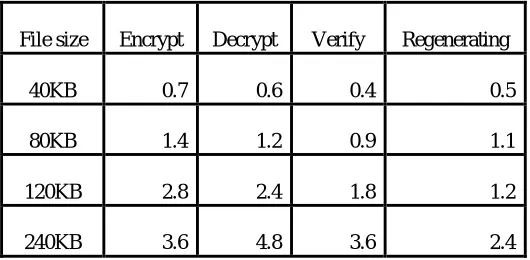
Table I: Performance of File Size with Time
Result of Practical Work:
File size Encrypt Decrypt Verify Regenerating
40KB 0.7 0.6 0.4 0.5
80KB 1.4 1.2 0.9 1.1
120KB 2.8 2.4 1.8 1.2
240KB 3.6 4.8 3.6 2.4
ISSN(Online): 2319-8753 ISSN (Print): 2347-6710
International Journal of Innovative Research in Science,
Engineering and Technology
(An ISO 3297: 2007 Certified Organization)
Website: www.ijirset.com
Vol. 6, Issue 6, June 2017
Fig: Graph of File Size with Time
VI. CONCLUSION
In this paper, proposed system will audit the data of client.it eliminate the involvement of client by auditing that whether his data stored on the cloud are indeed intact. Which can be important in achieving economics of scale for cloud computing. The released report would help owner to evaluate the risk of subscribed cloud data services. Focusing on the recovery server if file is corrupt or hack, using recovery server files can be regenerate .Also providing support for data dynamic handling operation. To achieve the security and integrity of data we are using the MD5 and AES algorithm. MD5 used for generating the tag for file block and AES algorithm used for encryption and decryption process. The proposed system can realize the private remote data integrity checking, delegated remote data integrity checking and public data integrity checking based on the original client’s authorization.
REFERENCES
[1] Haunt Wang, Debbie He, Shohola Tang “Identity-Based Proxy-Oriented Data Uploading and Remote Data Integrity Checking in Public blur DOI 10.1109/TIFS.2016. 2520886, IEEE Transactions on Information Forensics and Security.
[2] X. Liu, J. Ma, J. Xiong, T. Zhang, Q. Li, “Personal health records integrity verification using attribute based proxy signature in cloud computing”,
Internet and Distributed Computing Systems, LNCS 8223, pp. 238-251, 2013.
[3] B. Chen, H. Yeh, “Secure proxy signature schemes from the weil pairing”, Journal of Supercomputing, vol. 65, no. 2, pp. 496-506, 20
[4] E. Yoon, Y. Choy, C. Kim, “New ID-based proxy signature scheme with message recovery”, Grid and Pervasive Computing, LNCS 7861, pp. 945-951, 2013.
[5] P. X u, H. Chen, D. Z o u, H. Jin, “Fine-grained and heterogeneous proxy re-encryption for secure cloud storage”, Chinese Science Bulletin, vol.59, no.32, pp. 4201-4209, 2014.
[6] Z. Fu, X. Sun, Q. Liu, L. Zhou, J. Sh u, “Achieving efficient cloud search services: multi-keyword ranked search over encrypted cloud data supporting parallèle comptant , ” IEICE Transactions on Communications, vol. E98-B, no. 1, pp.190-200, 2015.
[7] Y. Ren, J. She n, J. Wang, J. Han, S. Lee, “Mutual verifiable provable data auditing in public cloud storage,” Journal of Internet Technology, vol. 16, no. 2, pp. 317-323, 2015.
[8] M. Mambo, K. Used, E. Okamoto, “Proxy signature for delegating signing operation”, CCS 1996, pp. 48C57, 1996.
[9] E. Yoon, Y. Chui, C. Kim, “New ID-based proxy signature scheme with message recovery”, Grid and Pervasive Computing, LNCS 7861, pp. 945-951, 2013.
[10]Enhanced ID-PUIC Protocol forCloud Data Integrity Checking By Proxy. [11] Practical Dynamic Proofs of Retrievability.
[12] H. Goo, Z. Zhang, J. Zhang, “Proxy re-encryption with unforgivable encryption keys”, Cryptology and Network Security, LNCS 8813, pp. 20-33, 2014.
0 1 2 3 4 5 6
40KB 80KB 120KB 240KB
Chart Title
ISSN(Online): 2319-8753 ISSN (Print): 2347-6710
International Journal of Innovative Research in Science,
Engineering and Technology
(An ISO 3297: 2007 Certified Organization)
Website: www.ijirset.com
Vol. 6, Issue 6, June 2017
[13]Proof of Ownership inRemote Storage Systems.
[14]Dynamic Proofs of Retrievability for CodedCloud Storage Systems.
[15] Q. Zheng and S. Xu, “Fair and Dynamic Proofs of Retrievability,”Proc. First ACM Conf. Data and Application Security and Privacy(CODASPY’11), pp. 237-248, 2011.
[16] S. Wang, D. Chen, Z. Wang, and S. Chang, “Public Auditingfor Ensuring Cloud Data Storage Security with Zero KnowledgePrivacy,” Report 2012/365, Cryptology ePrint Archive, 2012.
[17] B. Chen, and R. Curtmola, “Towards Self-Repairing Replication-Based Storage Systems Using Untrusted Clouds,”Proc. third ACMConf. Data and Application Security and Privacy (CODASPY’13), pp.377-388, 2013.
[18] Q. Wu, Y. Mu, W. Susilo, B. Qin, and J.D. Ferrer, “AsymmetricGroup Key Agreement,”Proc. 28th Annual Int’l Conf. Theory andApplications of Cryptography Techniques (EUROCRYPT’09), pp. 153-170, 2009.
[19] Y. Hu, H.C.H. Chen, P.P.C. Lee, and Y. Tang, “NCCl cloud: ApplyingNetwork Coding for the Storage Repair in a Cloud-of-Clouds,”Proc. 10th USENIX Conf. File and Storage Technologies (FAST’12),pp. 265-273, 2012.
[20] H.P.Anvin,“TheMathematicsofRAID-6,”http://kernel.org/pub/linux/kernel/people/hpa/raid6.pdf,2007.
[21] K.D. Bowers, A. Jules, and A. Oprea, “HAIL: A High-Availabilityand Integrity Layer for Cloud Storage,”Proc.16th ACM Conf.Computer and Comm. Security (CCS’09),pp. 187-198, 2009.
[22] D. Boneh, B. Lynn, and H. Shacham, “Short Signatures from the Weil Pairing,”Journal of Cryptology,vol. 17, no. 4, pp. 297-319,2004 [23] D. Cash, A. Kupcu, and D. Wichs, “Dynamic Proofs of Retriev-ability via Oblivious RAM,”Proc. 32nd Annual Int’l Conf. Theoryand Applications of Cryptographic Techniques (EUROCRYPT’13), pp.279-295, 2013.