Improving IT Governance Maturity: Key
Determinants of Effective IT Governance
Humam Alagha1
Assistant Professor, College of Information Technology, Royal University for Women, Riffa, Bahrain1
ABSTRACT: Information Technology has become pervasive in current dynamic and often turbulent business environments. While in the past, business executives could delegate, ignore or avoid IT decisions, this is now impossible in most sectors and industries. This pervasive use of technology has created a critical dependency on IT that calls for a specific focus on establishing and implementing effective IT governance. Rarely do organizations directly recognize a need for improving their organization’s IT governance maturity. The need to improve IT governance can often be signaled by issues involving efficiency, control and value. This paper interprets important existing theories, models and practices in the IT governance domain and examines empirically the key determinants that influence the overall effectiveness of IT governance. Using data from twenty firms, this paper found robust empirical evidence that the most influential determinant for increasing the level of IT governance maturity is Monitoring of IT Performance Measurement. Also, the most influential determinants for increasing the overall effectiveness of IT governance are the implementation of Corporate Communication Systems and the existence of IT Steering Committee.
KEYWORDS: IT Governance, Maturity, IT Governance Domains, Mechanisms, Effective IT Governance, Determinants.
I. INTRODUCTION
IT governance is the structure of relationships, processes and mechanisms used to develop, direct and control IT strategy and resources so as to best achieve the goals and objectives of an enterprise. It is a set of processes aimed at adding value to an organization while balancing the risk and return aspects associated with IT investments. IT governance is ultimately the responsibility of the board of directors and executive management. In a broader sense, IT governance encompasses developing the IT strategic plan, assessing the nature and organizational impact of new technologies, developing the IT skill base, aligning IT direction and resources, safeguarding the interests of internal-external IT stakeholders as well as taking into account the quality of relationships between stakeholders.To implement IT governance in practice, IT Governance framework can be deployed using a mixture of various structures, processes and relational mechanisms which form the element of IT Governance (Peterson, 2004a; Van Grembergen, De Haes, &Guldentops, 2004; Wiell& Ross, 2005).
business / IT alignment maturity compared to other organizations (De Has & Van Grembergen, 2008). They concluded in their research that Business/IT alignment maturity is likely to be higher when organization are applying a mix of mature IT governance practices and likely to be lower in organizations with a more poor mix of IT governance practices.Peterson presented a holistic view of IT governance, in which structural, process, and relational capabilities are an integral part of an effective IT governance architecture (Peterson, 2004a). According to him, IT governance structures include “structural (formal) devices and mechanisms for connecting and enabling horizontal, or liaison, contacts between business and IT management (decision-making) functions” (e.g. steering committees). IT governance processes refer to “formalization and institutionalization of strategic IT decision making or IT monitoring procedures” (e.g. IT balanced scorecard). The relational mechanisms finally are about “the active participation of, and collaborative relationship among, corporate executives, IT management, and business management” (e.g. training). Relational mechanisms are crucial in the IT governance framework and paramount for attaining and sustaining business/IT alignment, even when the appropriate structures and processes are in place (De Has & Van Grembergen, 2008).
II. THEORETICALBACKGROUND
Based on their research, (Weill & Ross, 2004) developed the framework for IT governance, presented in skeletal form so it can be completed for any firm. Effective governance requires the harmonization (i.e., the horizontal arrows) of business objectives, IT governance style and business performance goals. For example, the critical business objectives for the firm (e.g., grow existing business, sharing and reuse, and reduce time to market) need to be harmonized with the archetypes of IT governance (e.g., federal archetype for IT investments) and business performance goals (e.g., targets and time frames). In addition, the governance framework must harmonize the achievement and measurement of these (vertical arrows): business objectives and desirable behavior; IT governance archetype and mechanisms; and business performance metrics and goals. In a study of 250 organizations in 23 countries, Weill and Ross proposed a Matrix that maps six mutually exclusive organization structures, or “archetypes” against five key IT decision domains (Wiell& Ross, 2005). The matrix is called the Governance Arrangements Matrix. The five major decision domains are IT principles, IT architecture, IT infrastructure, Business application needs, and prioritization and investment decisions.
IT principles comprise the high-level decisions about the strategic role of IT in the business. IT architecture includes an integrated set of technical choices to guide the organization in satisfying business needs. IT infrastructure consists of the centrally coordinated, shared IT services that provide the foundation for the enterprise’s IT capability and were typically created before precise usage needs were known. Business application needs are the business requirements for purchased or internally developed IT applications. Last, prioritization and investment decisions determine how much and where to invest in IT. The six archetypes to IT decision making are ranging from highly centralized to highly decentralize.
Most companies employ a variety of them, using different approaches for different decisions. In a business monarchy — the most centralized approach — a senior business executive or a group of senior executives, sometimes including the CIO, makes all the IT related decisions for the enterprise. In an IT monarchy, those decisions are made by an individual IT executive or a group of IT executives. In a federal system, C-level executives and business representatives of all the operating groups collaborate with the IT department. This is equivalent to the central government and the states working together. In an IT duopoly, a two-party decision-making approach involves IT executives and a group of business leaders representing the operating units. In a feudal system, business unit or process leaders make separate decisions on the basis of the unit or process needs. And, finally, the most decentralized system is anarchy, in which each individual user or small group pursues his, her or their own IT agenda.
They concluded that enterprises with effective governance have actively designed a set of IT governance mechanisms (e.g., committees, budgeting processes, approvals, IT organizational structure, chargeback, etc.) that encourage behaviors consistent with the organization’s mission, strategy, values, norms and culture.
III.RESEARCHFRAMEWORKANDHYPOTHESES
In this research, the researcher assumes that IT governance maturity is closely affected by IT governance domains (i.e. IT governance Pillars or Focus area). These domains were identified by using the integrated IT governance framework of Dahlberg and Kivijärvi (2006). Dahlberg &Kivijärvi presented an Integrated IT Governance Framework and introduced related IT governance maturity assessment instrument (Dahlberg &Kivijärvi, 2006). The framework can be used to develop an IT governance maturity assessment instrument. The framework builds on the integration between the structural and processes perspectives of IT governance, business-IT alignment, and senior executives’ needs.
The framework is aimed to help board members, general managers, business line and IT executives to understand, measure, and manage IT governance in their respective organizations as a part of corporate governance (Dahlberg &Kivijärvi, 2006). It is called integrated, since it claims to incorporate the structural, process, and relational mechanisms of IT governance. The framework consists of five IT governance steps / sub-processes. IT governance process starts with the alignment of business and IT, that is, the planning phase. The alignment of business and IT step / sup-process includes the structures, activities and relational mechanisms by which an enterprise aligns its business and IT, sets targets for IT, defines principles for organizing IT activities, resource usage, risk management, governance structures, and performance measures. Several contingency factors influence the alignment of business and IT (Dahlberg &Kivijärvi, 2006). The monitoring of IT resources, IT risks and IT management step / sup-process includes the structures, activities and relational mechanisms by which an enterprise monitors its IT resources, IT risks, and IT management. The monitoring of IT performance measurement step / sup-process includes the structures, activities and relational mechanisms by which an enterprise sets targets for its IT resource, IT risk and IT management performance, measures the achievement of those targets, and/or provides other performance measures.
The monitoring of IT resources, IT risks and IT management with the monitoring of IT performance measurement form the operating phase of the IT governance process (Dahlberg &Kivijärvi, 2006).IT value to business step / sup-process evaluated on the basis of benefits and costs includes strategic, economic, risk management, technical, social, and quality benefits (revenues minus costs) delivered to current business. IT value to business step / sup-process evaluated as opportunities and risks includes new IT enabled business opportunities minus their risk costs for the development of current and new businesses and potential new risk costs. These two steps or sub-processes for IT business value delivery comprise the evaluation phase of the IT governance process (Dahlberg &Kivijärvi, 2006).
The final step of the IT governance process is the feedback step / sub-process. IT governance development includes the structures, activities and relational mechanisms by which an enterprise improves its IT governance process and related practices by providing evaluative feedback information, by taking actions to improve IT governance process and activities based on prioritized needs, and by developing IT governance competencies and skills (Dahlberg &Kivijärvi, 2006).Using the Integrated IT Governance Framework, Dahlberg &Lahdelma examined empirically how IT governance maturity evaluations of 109 senior executives in 20 enterprises differ, between those enterprises that have outsourced their IT function selectively and those enterprises that have conducted total outsourcing of their IT function (Dahlberg &Lahdelma, 2007). They found several differences between selective and total IT outsourcers.
governance is affected by five IT governance domains. The five IT governance domains include Alignment of Business and IT (ABIT), Monitoring of IT Resources, Risks and Management (MITRRM), Monitoring of IT Performance Measurement (MITPM), Evaluation of Value Delivery (EVD), and IT Governance Development (ITGD). Based on our research framework, the research aims at testing the formulated hypotheses in (Alagha, 2013) for the purpose of identifying the most influential IT governance domain for increasing the level of IT governance maturity and identifying the most influential IT governance mechanism for increasing the overall effectiveness of IT governance.
IV.METHODOLOGY
The instrument used in this study is the questionnaire to measure the research’s different variables. A 5-point likert scale is used to increase distinction between different levels. The survey instrument was validated through a pilot test with a sample of 30 organizational participants who were not included in the sample frame for the subsequent data collection. Using the sample data from twenty Emirati organizations within financial services, manufacturing, telecommunications and public service, with a 60% response rate, the collected data was analyzed using SPSS and SmartPLS 2.0 software. Different methods of analysis were used to assess the data gathered through the questionnaire. The main method used is the Partial Least Squares (PLS) Path Modeling. Other methods used are Descriptive Statistics, Internal Consistency Reliability, Exploratory Factor Analysis (EFA), Composite Variables, Tests for Normality, Transformation, Test for Outliers, and Correlation Analysis.
V. DATAANALYSISANDRESULTS
Visual comparison of the frequency distribution histograms of the variables representing the ten constructs against the overlying normal distribution function curves indicated that the variables appeared to depart from normality. Visual tests for normality e.g., observing the shapes of frequency distributions and Q-Q plots (the measured values plotted against the expected values corresponding to a standard normal distribution) are intuitively appealing but are subjective. Although widely used, they rely on informal human judgment to accept or reject the null hypothesis of normality (Hair et al., 2010; Tabachnik&Fidell, 2007).
Since there was statistical evidence of departures from normality which could potentially compromise the use of parametric statistics, consideration was given to normalizing the variables by transformation. Attempts were made to normalize the left skewed distributions using SQRT (K – X) transformations where SQRT = square root; X = the score to be transformed; K = a constant from which each score was subtracted so that the smallest score was 1 i.e., K = the largest score + 1 (Tabachnik&Fidell, 2007). The transformation converted the ordinal scores into continuous scale variables ranging between 1 and 5 measured to an accuracy of 3 decimal places, which was beneficial for parametric statistical analysis. The frequency distribution histograms of the transformed variables approximated normality. The transformation helped to correct for the left skewed distributions, indicated by skewness statistics closer to zero, within the prescribed limits of ± .3. The transformations also corrected for deviations from normality. The K-S statistics for eight of the ten transformed variables indicated no significant departures from normality at p < .001.
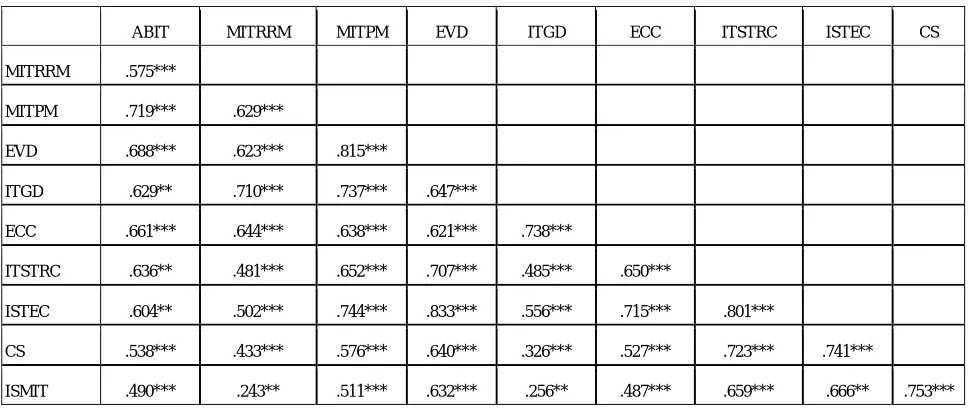
The linear relationships between the ten reliably measured composite variables were explored using a correlation matrix. The decision rule was to reject the null hypothesis of no correlation using the untransformed variables if p < .05 for Spearman’s Rho Non-Parametric Correlation Coefficient (See Table 1) or if p < .05 for Pearson’s Correlation Coefficient using the transformed variables (See Table 2). The magnitudes of the correlation coefficients could potentially range from -1.000 (perfect negative correlation, reflecting a downward sloping scatter plot) through 0.000 (no correlation, reflecting a random scatter of points) to + 1.000 (perfect positive correlation, reflecting an upward sloping scatter plot). Although a correlation coefficient may be statistically significant at p < .05 this does not imply axiomatically that the correlationhas any practical or theoretical importance in reality. Cohen’s (1988) interpretation
Using the untransformed variables, 44 of the correlation coefficients were significant at p < .001 and 1 was significant at p < .01. Forty of the correlation coefficients were > .5 (See Table 1). Using the transformed variables, 42 of the correlation coefficients were significant at p < .001 and 3 were significant at p < .01. Forty three of the correlation coefficients were >.5 (See Table 2). It is concluded that a high level of correlation existed between the ten variables i.e., they were multi-collinear. The linear relationships were generally strong enough to have practical and theoretical importance. The transformed variables produced the strongest correlation coefficients.
Table 1: Matrix of Spearman’s Rho Correlation Coefficients using Untransformed Variables
ABIT MITRRM MITPM EVD ITGD ECC ITSTRC ITSTEC CS
MITRRM .622***
MITPM .724*** .616***
EVD .712*** .643*** .811***
ITGD .653*** .693*** .765*** .692***
ECC .681*** .614*** .638*** .641*** .715***
ITSTRC .625*** .524*** .636*** .674*** .516*** .715***
ITSTEC .595*** .521*** .689*** .764*** .564*** .760*** .798***
CS .532*** .420*** .555*** .630*** .317*** .555*** .698*** .730***
ISMIT .477*** .232** .480*** .609*** .230*** .504*** .604*** .638*** .727***
Table 2: Matrix of Pearson’s Correlation Coefficients using Transformed Variables
ABIT MITRRM MITPM EVD ITGD ECC ITSTRC ISTEC CS
MITRRM .575***
MITPM .719*** .629***
EVD .688*** .623*** .815***
ITGD .629** .710*** .737*** .647***
ECC .661*** .644*** .638*** .621*** .738***
ITSTRC .636** .481*** .652*** .707*** .485*** .650***
ISTEC .604** .502*** .744*** .833*** .556*** .715*** .801***
CS .538*** .433*** .576*** .640*** .326*** .527*** .723*** .741***
ISMIT .490*** .243** .511*** .632*** .256** .487*** .659*** .666** .753***
VI.THERESULTSDISCUSSION
The results of the statistical analysis indicate that there is a significant positive relationship (Path Coefficient = .791, t = 21.383, p < .001) between IT Governance Maturity and IT Governance Performance. This means that IT Governance Maturity positively influences IT Governance Performance within organizations. The squared Path Coefficient (R2) reflects the proportion of the variance in one variable explained by another variable. R2 = .626 indicated that 62.6% of the variance in IT Governance Performance (ITGP) was explained by IT Governance Maturity (ITGM). The effect size computed by f2 = R2/ (1- R2) was 1.673 (See Table 7.4). According to Cohen’s (1992; Table 1, p. 157) criteria, f2 = .02 indicates a small effect, f2 = .15 indicates a medium effect, and f2 = .35 indicates a large effect. The effect of ITGM on ITGP indicated by f2 = 1.673 reflected a relationship with a high practical and theoretical importance. This result is consistent with many recent studies results. Schlosser et al. (2010) found that good internal control processes embedded within IT governance process leads to better firm performance in terms of service quality in IT outsourcing arrangements. Simonsson& Johnson (2008) found a positive correlation between IT Governance Maturity and IT Governance Performance. Wiell& Ross (2005) contend that top-performing enterprises succeed in obtaining value from IT where others fail, in part, by implementing effective IT governance to support their strategies and institutionalize good practices. De Haes& Van Grembergen (2005a) argue that the implementation of IT Governance Structures, Processes and Relational Mechanisms will ensure that money spent in IT is delivering value for the business. Rau (2004) assures that effective governance of IT improves the value realized from the organization’s investment in IT, provide improved service to customers, and achieve or enhance competitiveness.So, the researcher can conclude that organizations that display a high IT governance maturity also benefit from a good IT governance performance.
VII. CONCLUSION
This paper interpreted important existing theories, models and practices in the IT governance domain and examined empirically the key determinants that influence the overall effectiveness of IT governance. Using data from twenty firms, this paper examined the roles of IT governance domains and their impact on the level of IT governance maturity. In particular, this study found robust empirical evidence that the maturity of Alignment of Business and IT; Monitoring of IT Resources, Risks and Management; Monitoring of IT Performance Measurement; Evaluation of Value Delivery; and IT Governance Development greatly enhance the level of IT Governance Maturity. Moreover, this paper examined the roles of IT governance mechanisms and their impact on the overall effectiveness of IT governance. In particular, this study found robust empirical evidence that the implementation of Communication Systems; the existence of Ethics/Culture of Compliance in IT; IT Steering Committee; and IT Strategy Committee greatly enhance the overall effectiveness of IT governance. Also, the findings suggest that the involvement of senior management in IT positively influences the overall effectiveness of IT governance.This paper found robust empirical evidence that the most influential determinant for increasing the level of IT governance maturity is Monitoring of IT Performance Measurement. Also, the most influential determinants for increasing the overall effectiveness of IT governance are the implementation of Corporate Communication Systems and the existence of IT Steering Committee.
REFERENCES
[1] Alagha, H. (2013). Examining the Relationship between IT Governance Domains, Maturity, Mechanisms, and Performance: An Empirical Study toward a Conceptual Framework. Proceedings of the 10th International Conference on Information Technology: New Generations (ITNG 2013). Las Vega: IEEE Computer Society. Conference Publishing Services.
[2] Creswell, J. (2003). Research Design: Qualitative, Quantitative and Mixed Method Approaches. California: Sage Publications.
[3] Cronbach, L. J., &Shavelson, R. J. (2004). My Current Thoughts on Coefficient Alpha and Successor Procedures. Educational and Psychological Measurement , 64 (3), 391-418.
[4] Dahlberg, T., &Kivijärvi, H. (2006). An Integrated Framework for IT Governance and the Development and Validation of an Assessment Instrument. Proceedings of the 39th Hawaii International Conference on System Sciences. Hawaii.
[6] De Haes, S., & Van Grembergen, W. (2005a). IT Governance Structures, Processes and Relational Mechanisms:Achieving IT/Business Alignment in a Major Belgian Financial Group. Proceedings of the 38th Hawaii International Conference on System Sciences. Hawaii. [7] De Has, S., & Van Grembergen, W. (2008). Analysing the Relationship Between IT Governance and Business/IT Alignment Maturity.
Proceedings of the 41st Hawaii International Conference on System Sciences. Hawaii.
[8] De Has, S., & Van Grembergen, W. (2005b). Measuring and Improving Information Technology Governance Through the Balanced Scorecard. Information Systems Control Journal , 2, 35-42.
[9] Debreceny, R. (2006). Re-engineering IT Internal Controls: Applying Capability Maturity Models to the Evaluation of IT Controls. Proceedings of the 39th Hawaii International Conference on System Sciences. Hawaii.
[10] Hair, J., Anderson, R., Babin, B., Tatman, R., & Black, W. (2010). Multivariate data analysis (7 ed.). New Jersey: Prentice Hall. [11] Hardy, G. (2003). Coordinating IT Governance - A New Role for IT Strategy Committees. Information Systems Control Journal , 4.
[12] Henderson, J., &Venkatraman, N. (1993). Strategic Alignment - Leveraging Information Technology for Transforming Organizations. IBM Systems Journal , 32 (1), 4-16.
[13] Henderson, J., &Venkatraman, N. (1993). Strategic Alignment: Leveraging Information Technology for Transforming Organizations. IBM Systems Journal , 32 (1), 4-16.
[14] Henseler, J., Ringle, C. M., &Sinkovics, R. R. (2009). The use of partial least squares path modelling in international marketing. Advances in International Marketing , 20, 277-319.
[15] Hogan, T. P., Benjamin, A., &Brezinski, K. L. (2000). Reliability Methods: A Note on the Frequency of Use of Various Types. Educational and Psychological Measurement , 60 (4), 523-531.
[16] IT Governance Institute. (2003). Board Briefing on IT Governance. Rolling Meadows: IT Governance Institute.
[17] IT Governance Institute. (2004b). COBIT and IT Governance a Case Study: Allstate. Rolling Meadows: IT Governance Institute.
[18] IT Governance Institute. (2007a). Control Objectives for Information and related Technology (COBIT) (4.1 th ed.). Rolling Meadows: IT Governance Institute.
[19] IT Governance Institute. (2006). Information Security Governance: Guidance for Boards of Directors and Executive Management. Rolling Meadows: IT Governance Institute.
[20] IT Governance Institute. (2004a). IT Control Objectives for Sarbanes-Oxley. Rolling Meadows: IT Governance Institute. [21] IT Governance Institute. (2007b). The Val IT Framework. Rolling Meadows: IT Governance Institute.
[22] itSMF. (2007). IT Infrastructure Library: An Introductory Overview of ITIL V3. UK Chapter of the itSMF.
[23] Jarvenpa, S., & Staples, D. (2000). The use of collaborative electronic media for information sharing: an exploratory study of determinants. Journal of Strategic Information Systems , 9 (2), 129-154.
[24] Karimi, J., Bhattacherjee, A., Gupta, Y. P., & Somers, T. (2000). The Effect of MIS Steering Committees on Information Technology Management Sophistication. Journal of Management Information Systems , 17 (2), 207-230.
[25] Nolan, R., & McFarlan, F. (2005). Information Technology and the Board of Directors. Harvard Business Review , 83, 96-106. [26] Peterson, R. (2004a). Crafting Information Technology Governance. Information System Management , 21 (4), 7-22.
[27] Peterson, R. (2004b). Information strategies and tactics for information technology governance. In W. Van Grembergen, Strategies for information technology governance. Idea Group Publ.
[28] Ragunathan, B., &Ragunathan, B. (1989). MIS Steering Committees: Their Effect on Information Systems Planning. Journal of Information Systems , 104-116.
[29] Rau, K. G. (2004). EFFECTIVE GOVERNANCE OF IT: DESIGN OBJECTIVES, ROLES, AND RELATIONSHIPS. Information Systems Management , 21 (4), 35-42.
[30] Reich, B., &Benbasat, I. (2000). Alignment between Business and IT Objectives. MIS Quarterly , 24 (1), 81-113.
[31] Ringle, C., Wende, S., & Will, A. (2010). Smart PLS – Version 2.0. User Instruction Manual. Institute of Marketing. Humboldt-Universitatzu Berlin.
[32] Salmela, H., Lederer, A., &Reponen, T. (2000). Information systems planning in a turbulent environment. European Journal of Information Systems , 9 (1), 3–15.
[33] Schlosser, F., Wagner, H.-T., Beimborn, D., &Weitzel, T. (2010). The Role of Internal Business/IT Alignment and IT Governance for Service Quality in IT Outsourcing Arrangements. Proceedings of the 43rd Hawaii International Conference on System Sciences. Hawaii: IEEE Computer Society.
[34] Schwartz, M. (2004). Effective Corporate Codes of Ethics: Perceptions of Code User. Journal of Business Ethics , 55, 323-343.
[35] Sherer, S. (2004). IS Project Selection: The Role of Strategic Vision and IT Governance. Proceedings of the 37th Hawaii International Conference on System Sciences. Hawaii.
[36] Simonsson, M. (2008). PREDICTING IT GOVERNANCE PERFORMANCE: A METHOD FOR MODEL-BASED DECISION MAKING. Royal Institute of Technology, Industrial Information and Control Systems KTH. Stockholm: Royal Institute of Technology.
[37] Simonsson, M., &Ekstedt, M. (2006). Getting the Priorities Right – Literature vs Practice on IT Governance. The Portland International Center for Management Engineering Research. Istanbul.
[38] Simonsson, M., & Johnson, P. (2008). The IT Organization Modeling and Assessment Tool: Correlating IT Governance Maturity with the Effect of IT. Proceedings of the 41st Hawaii International Conference on System Sciences. Hawaii.
[39] Sohal, A., & Fitzpatrick, P. (2002). IT Governance and Management in Large Australian Organisations. Production Economics , 75, 97-112. [40] Syaiful, A., Peter, G., & Michael, P. (2009). The role of a culture of compliance in information technology governance. International
Workshop on Governance, Risk and Compliance (pp. 1-14). Amsterdam: CEUR Workshop Proceedings .
[42] Van Grembergen, W., De Haes, S., &Guldentops, E. (2004). Structures, processes and relational mechanisms for Information Technology Governance: Theories and practices. In W. Van Grembergen, Strategies for information technology governance. Idea Group Publishing. [43] Vaswani, R. (2003). Determinants of Effective Information Technology (IT) Governance. Unpublished Thesis. School of Business, University
of Queensland, Australia.
[44] Webb, P., Pollard, C., & Ridley, G. (2006). Attempting to define IT Governance: Wisdom or Folly? 39th Hawaii International International Conference on Systems Science. Kauai: IEEE Computer Society.
[45] Weill, P. (2004). Don't Just Lead, Govern: How Top-Performing Firms Govern IT. MIS Quarterly Executive , 3 (1), 1-17.
[46] Weill, P., & Ross, J. (2004). IT governance: How Top Performers Manage IT Decision Rights for Superior Results. Watertown: Harvard Business School Press.