Regression Problem Using Nerul Network to
Predict Real-Value Output
1
Rishabh Sharma, 2 Sudhanshu Sharma
1
Research Scholar, Dept. of Computer Science &Engineering, ITM University, Gwalior, India
2
Assistant Professor, Dept. of Computer Science &Engineering, ITM University, Gwalior, India
ABSTRACT: the essence of artificial intelligence is Machine learning. From past experiences Machine Learning learns to make better thesmart programs performances. Machine learning system constructs the learning model which effectively “learns” how to predict from training data of given example. IT denotes a group of topics which mainly deals with the formation and calculations of algorithms which make the pattern recognition, prediction and classification, easy depend on the models which are derived from existing data. In this new period, to demonstrate the promise of producing consistently accurate estimatesMachine learning is frequently in use. The keycontribution and purposeof this review paper is to represent the overall analysis of the machine learning and provides machine-learning techniques. This paper also studies the benefitsand drawbacksin different approachesof various machine learning algorithms.
KEYWORDS: unsupervised learning, machine learning, supervised learning
I. INTRODUCTION
The multi-disciplinary domain in statistics, artificial intelligence,probability, information theory, psychology, philosophy and neurobiology is Machine learning. Machine learning solves the real world problems by building a model that is good and useful estimate to the data. The analysis of the Machine learning has risen from the efforts of examining whether computers could learn to copycat the human brain, and a field of statistics to a wide discipline that has created basic statistical computational theories of learning procedure. The first computer system named ENIAC was developed in 1946. The idea at that time was that human learning and thinking could be rendered logically in such a machine. In 1950 Alan Turing suggested a test to measure its presentation. The Turing test is mainly depended on the idea that we can only find if a machine can actually learn if we interact with it and cannot differentiate it from another human. Arthur Samuel (IBM) wrote the first game-playing program, for organizers, to attainadequate skill which can challenge the world champion in around 1952. Frank Rosenblatt developed the perceptron in 1957 that associates a web of points where simple decisions are made which combine in the bigger program to solve more complex difficulties. In 1967, pattern recognition is developed when first program able to recognize arrangements were designed depended on the type of algorithm called the nearest neighbor. In 1981, GeroldDejong introduced description based learning where prior data of the world is provided by training examples which uses the administered learning. Machine learning has becomefamous againbecause of the intersection of Statistics and Computer Science in the early 90’s.
Within the general areas of unsupervised and supervised learning advances proceeded in the machine learning algorithm. In the present time, adaptive programming is in explored which uses machine learning where programs are capable of identifying patterns, learning from experience, abstracting new information from data and optimizing the efficiency and correctness of its processing and output. In the discovery of knowledge from the multidimensional data existing in a diverse amount of application areas, machine learning procedures are used.
to mechanically apply difficult mathematical computations to large data – over and over, faster and faster is therecent development in machine learning.
Due to raisingvarieties andvolumes of data which is available, computational processing whichis more powerful and cheaper affordable data storage,more interest is advanced in machine learning nowadays. All these things mean it's likely to automatically and quickly make models that can examine bigger, more complicated data and deliver quicker, more correct results even on a very huge scale. Machine learning model produces high-value predictions which can guide good smart and decision actions in actual time with no human intervention.
Machine learning doesnot only answer to current demand, but to be capable to predict demand in real time. As computation gets machine learning, cheaper makes the impossible things possible and people tend to start doing them and finish up with creation intelligent infrastructure. It is the required to produce newer algorithms to progress the science of machine huge and learning amount of work that requires to be done to replace existing algorithms from new algorithms. To make the existing algorithms more consumable and robust it is not significant to expand a perfect model algorithm because a perfect model will not be the absolute products data often has only a temporal charge.
The paper is organization as follows Unit II describes the machine learning model. Unit III provides the overview of the machine learning methods. Section IV discusses the various learning algorithms used to perform learning process. Section V explains the application based on kind of learning instances and separate machine learning tools. Section VI ends the manuscript.
II. MACHINE LEARNING MODEL
Learning process in machine learning model is classified into two steps as
• Training
• Testing
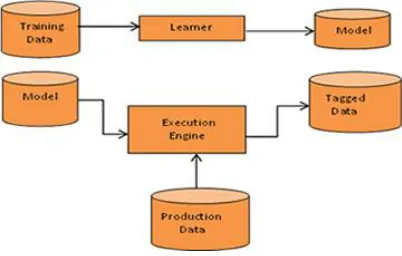
In training process, samples in training data are taken as input where features are learned by learning algorithm or learner and build the learning model. In the testing process, the learning model uses the implementation engine to do the prediction for the production or test data. Tagged data is the output of learning model which gives the final classified or prediction data.
Figure 1. Operational model of machine learning
III. MACHINE LEARNING TECNIQUES
A. SUPERVISED LEARNING
This learning is taught using labeled instances, like an input where the desired output is known. Supervised learning provides dataset comprising of both features and labels. For example, a piece of apparatus could have training data points labeled either asasR (runs) or asF (failed). The job of supervised learning is to build an estimator that is capable to forecast the label of an object given the set of characteristics. The learning algorithm accepts a set of characteristics as inputs with the matchingright outputs, and the algorithm learns through comparing its real output with right outputs to determineerrors. It thenaccordinglyenhances the model. This model isn’t required until the inputs are available, but if any of the inputs are missing, it is not possible to deduce anything about the outputs.
Supervised learning is generally used in applications where historical data predicts likely future events. For instance, it can predict when credit card transactions are probable to be fraudulent or which insurance customer is probable to file a claim. Another application is to predict the varieties of iris given a set of measurements of its flower. Other more complex examples contains recognition system as provided a multicolor image of an object by a telescope, decide whether or not that object is a quasar ,a star , or a galaxy, or given a record of movies a person has watched and their personal rating of the movie, suggest a list of movies they would like.
Supervised learning tasks are sectioned into two categories they areregression andclassification. Inregression, the label iscontinuous, on the other hand in case of classification, the label is discrete. For instance, in astronomy, the job of finding whether an object is a galaxy, quasar, or anastaris a classification trouble where the label is from three distinct categories. Conversely, in the regression problem, the label (age) is a continuous quantity, for example, determining the age of an object depend on observations.
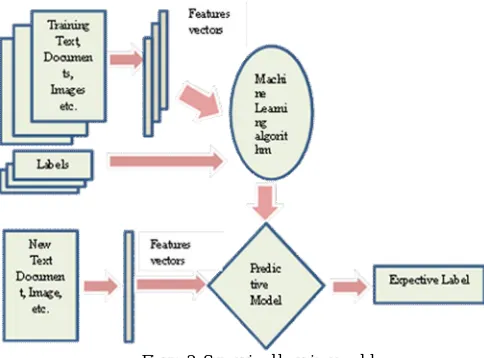
Supervised learning model is given in figure 2 which shows that algorithmconstructs the differentiation between the raw observed data X that is training data which may be text or documentimage,and some label given to the model during training.Supervised learning algorithm forms the predictive modelin the procedure of training. After training, the matched model will attempt to forecast the probable labels for new a set of examples X in test data. Depending on the character of the target variable y, supervised learning iscategorized as follows:
• If y has floating point values (e.g. to represent a price, a temperature, a size...), the task to predict y is known as regression.
• If y has values in a stablegroup of categorical results (denoted by integers) the job to predict y is known as classification.
B. UNSUPERVISED LEARNING
Unsupervised learning uses datawhich has no historical labels and the purpose is to discover the data and find similarities among the objects. This is a technique of discovering labels from the data itself. Unsupervised learning works fine on transactional data likerecognizesections of customers with alike attributes which can then be treated in the similar manner in marketing operations. Or it can find the main characteristics that separatecustomer segments from each other.
Other unsupervised learning problems are:
• Provided detailed observations of far-away galaxies, determine which features or group of features are most important in differentiating between galaxies.
• Provided a video, separate a moving object and classify in relation to other moving objects which have been seen.
.
• Provided a mixture of two sound sources for instance, a person speaking over some music, divide the two which is called as the blind source separation problem.
Typical unsupervised job is clustering where a group of inputs is divided into groups, different from classification, the groups are unknown before. Famous unsupervised techniques comprise self-organizing maps, k-means clustering, nearest-neighbor mapping, and single value decomposition.These algorithms are used to sectionrecommend, items text topics, and recognize data outliers.
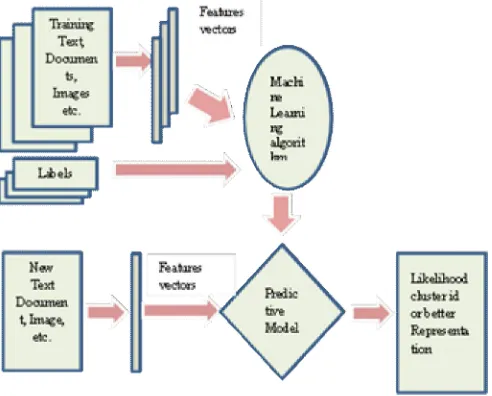
The unsupervised learning model is demonstrated in figure 3 which shows that unsupervised learning algorithm only uses a single set of observations X with n samples and n features and does not use any kind of labels. In the training process, unsupervised learning algorithm figures the predictive model that will try to fit its parameters so as to best summarize regularities found in the data.
Figure 3. Unsupervised learning model
C.SEMI-SUPERVISED LEARNING
marked training process. Suchkind of learning may be used with methods like regression,classification and prediction. Early examples of this learning include identifying a person's face on a web cam. Instance algorithms are extensions to other bendable methods that make suppositions about how to model the unlabeled data.
D.REINFORCEMENT LEARNING
It is frequently used for robotics, navigation and gaming. It is the learning technique which communicates with a dynamic environment where it must perform a definiteobjectivewith not any teacher unambiguously telling it whether or not it has come near to its objective. With reinforcement learning, the algorithm determinesby trial and error which actions yield the greatest rewards. So in chess playing, reinforcement learning learns to play a game by playing against an opponent which performs trial and error actions to win.
This kind of learning has three basicmodules: the learner, the environment and actions. The purpose is for the learner to choose actions which enlarge the expected reward over a given amount of time. The learner will arrive at the target much quicker by following anexcellent policy. Thus theobjective in reinforcement learning is to learn the top policy.
IV.MACHINE LEARNING ALGORITHM
A large set of machine learning algorithms are developed to build the machine learning models and implement an iterative machine learning procedureOn the basis of learning style these algorithms can be divided as follows:
A. REGRESSION ALGORITHMS
Regression is basically concerned with displaying the relationship among variables that is repeatedlyfiltered by using a measure of error in the predictions that are made by the model. Regression is the job of predicting the value of a constantlydiffering variable like atemperature, a price, if provided some input variables like features and regression. The popular regression algorithms are as follows:
• Ordinary Least Squares Regression (OLSR)
• Linear Regression
• Locally Estimated Scatterplot Smoothing (LOESS)
• Logistic Regression
• Multivariate Adaptive Regression Splines (MARS)
• Stepwise Regression
B. INSTANCE-BASED ALGORITHMS
Instance based learning model a decision problem with instances of training data that are deemed significant or to the model. This type of methods typically construct a record of training data and compare the test data to the record using a matching measure to determine the best match and do a prediction. Instance-based methods are also called lazy learner. Lazy learning simply contains training data and waits till it is provided a test data then performs the learning. So lazy learner takes small time in training but more time in predicting. The most popular instance-based algorithms are as follows:
• Locally Weighted Learning (LWL)
• k-Nearest Neighbor (kNN)
• Learning Vector Quantization (LVQ) Self
• Organizing Map (SOM)
C.DECISION TREE ALGORITHMS
signify conjunctions of characteristics whichdirected to those class labels. Decision trees in which the destination variable can take continuous values (in generalreal numbers) are known as regression trees.
The experts on data for regression andclassification problems are Decision trees. Decision trees are often veyquick and exact and a big favorite in machine learning. The most popular decision tree algorithms arenamed as follows:
• M5
• Chi-squared Automatic Interaction Detection (CHAID)
• C4.5 and C5.0 (different versions of a powerful approach)
• Classification and Regression Tree (CART)
• Decision Stump
• Conditional Decision Trees
D.BAYESIAN ALGORITHMS
Thecombination of algorithmic ComputerScience and Statistics is Machine Learning. Statistics is about managing and quantifying uncertainty. To represent all the forms of uncertainty, Bayesian algorithms are used which depend on probability theory. Bayesian methods are the methods that are explicitly apply Bayes’ Theorem for troubles such as regression andclassification. The famous Bayesian algorithms are as follows:
• Bayesian Belief Network (BBN)
• Gaussian Naive Bayes
• Naive Bayes
• Multinomial Naive Bayes
• Averaged One-Dependence Estimators (AODE)
• Bayesian Network (BN)
E. CLUSTERING ALGORITHMS
Clustering is the method of classification of objects into different groups. It partitions the data set into subsets or clusters, in such a manner that the data in every subset share some ordinary trait often in accordance with some defined distance measure. Clustering is a type of unsupervised learning. Clustering like regression explains the class of method and the class of problems. Its methods are divided aspartitioned clustering and hierarchical clustering. K-means is patronal clustering algorithms which uses centroid-based approach. The famous clustering algorithms are given as follows:
• k-Medians
• Expectation Maximisation (EM)
• k-Means
• Hierarchical Clustering
F. ASSOCIATION RULE LEARNING ALGORITHMS
A method which extracts rules that best explain observed relationships amongthe variables in datais called Association rule learning. These rules can determinesignificant and commercially valuable associations in big multidimensional datasets that can be exploited through the organization. The famous association rule learning algorithms are as follows:
• Apriori algorithm
G.ARTIFICIAL NEURAL NETWORK ALGORITHMS
Artificial neural networks are models which uses supervised learning that is constructed is mainly based on the structure of biological neural networks. It has artificial neurons which has highly weighted interconnections amongst units and learns by tuning the connection weights to perform parallel distributed processing. Hence artificial neural networks are also known as parallel distributed processing networks. The most popular artificial neural network algorithms are given as follows:
• Perceptron
• Back-Propagation
• Hopfield Network
• Radial Basis Function Network (RBFN)
H.DEEP LEARNING ALGORITHMS
A modern apprise to artificial neural networks are Deep Learning methods which exploit plentiful cheap computation. They are basically concerned with constructing morecomplex and muchlarger neural networks, as many techniques are concerned with semi-supervised learning problems where large datasets hold very little labeled data. The most popular deep learning algorithms aregiven as follows:
• Deep Belief Networks (DBN)
• Convolutional Neural Network (CNN)
• Deep Boltzmann Machine (DBM)
• Stacked Auto-Encoders
I. DIMENSIONALITY REDUCTION ALGORITHMS
Dimensionality reduction is an adequateanswer to the problem of curse of dimensionality. When the count of dimensions incremented, the volume of the area also incremented so quickly that the available data become light. This growth is problematic for any method that requires statistical important. To obtain areliable and statistically sound outcome, the quantity of data required to support the outcome often sparse exponentially with the dimensionality. The study of procedures for decreasing the count of dimensions describing the object is calledDimensionality reduction. Its general objectives are to remove unrelated and redundant data to decrease the computational cost and to improvethe quality of data for efficient data organization strategies. As clustering methods, dimensionality reduction seeks and exploits the inherent arrangement in the data in an unsupervised way. Many of these methods can be acclimatized for use in regression andclassification. The dimensionality reduction algorithms are:
• Principal Component Regression (PCR)
• Principal Component Analysis (PCA)
• Partial Least Squares Regression (PLSR)
• Sammon Mapping
• Multidimensional Scaling (MDS)
• Projection Pursuit
• Linear Discriminant Analysis (LDA)
• Flexible Discriminant Analysis (FDA)
• Quadratic Discriminant Analysis (QDA)
J. ENSEMBLE ALGORITHMS
Ensemble methods are models which are based on unsupervised learning comprised of multiple weak learner models which are individually trained and whose predictions are merged in such a manner so as to make the overall prediction. It partitions the training data into number of subsets of data for which independent learning models are constructed. All learning models are combined to make correct hypothesis. This is a very dominant class of techniques and as such is very popular. The popular ensemble algorithms are
• Bagging
• Bootstrapped Aggregation
• Boosting
• Gradient Boosted Regression Trees (GBRT)
• AdaBoost
• Gradient Boosting Machines (GBM)
• Stacked Generalization (blending)
• Random Forest
V.APPLICATION AND TOOLS
The Machine learning applications are broadly classified based on learning techniques: unsupervised and supervised learning. Classification applications make use of supervised learning that are pattern recognition, face recognition, character recognition, medical diagnosis, web advertising. Unsupervised learning applications are clustering, summarization, association analysis, customer segmentation in CRM, image compression, bioinformatics. The example functions of reinforcement learning are Robot control and game playing.
The largefraction of machine learning is tools and it is required to choose the correct tool which is as significant as working with the top algorithms. The tools ofMachine learning make employed machine learning,easier,quicker and more enjoyment. The tools of Machine learning provide capabilities to deliver outcomes in the machine learning project. Also it is used as a filter to decide whether to examine a new tool or new featureor not. The tools ofthis learningprovide an intuitive interface onto the sub-tasks of the employed machine learning procedure. There’s anexcellent mapping and suitability in the interface for the task. Great machine learning tools embody best practices for process, configuration and implementation. Examples include automatic combination of machine learning algorithms and good procedureconstructed into the arrangement of the tool. The toolsof Machine learning are divided into platformsandlibraries. A platform provides all capabilities needed to run a project, whereas a library only provides distinct capabilities or parts needed to complete a project. Instances of machine learning platforms are:
• R Platform.
• Subset of the Python SciPy like Pandas and scikitlearn.
• WEKA Machine Learning Workbench.
Library may provide a collection of modeling algorithms. Instances of the machine learning libraries are as follows:
• scikit-learn in Python.
• JSAT in Java.
VI.CONCLUSION
This paper provides ananalysis of machine learning techniques. Machine learning model is given which describes the overall view of machine learning process. Also describes the various machines learning algorithm which are based on types of machine learning styles. Instances of machine learning applications and need of tools are provided.
REFERENCES
[1] Stefan F, Frauke G (2015) CRAN package “neuralnet”. . [2] Christoph B, Benítez JM (2015) CRAN package “RSNNS”.
[3] Braglia L (2015) CRAN package “aprean3”. Datasets from Draper and Smith “Applied Regression Analysis”. [4] Draper NR, Smith H (1998) Applied Regression Analysis.
[5] Yogesh Singh, Pradeep Kumar Bhatia &OmprakashSangwan “A review of studies in machine learning technique”. International Journal of Computer Science and Security, Volume (1) : Issue (1) 70 – 84, June 2007
[6] http://www.mlplatform.nl/what-is-machine-learning/
[7] Petersp,”The Need for Machine Learning is everywhere” March 10, 2015. [8] Jason Brownlee,”Machine Learning Tools”, December 28, 2015
[9] TaiwoAyodele,”Types of Machine Learning algorithms”, FEBRUARY 2010
[10] Pedro Domingos, , “A Few useful Things to Know about Machine Learning”.2012. Department of Computer Science and Engineering University of Washington Seattle
[11] H. X. H. Bao and A. T. K. Wan, “On the use of spline smoothing in estimating hedonic housing price models: empirical evidence using Hong Kong data”, Real Estate Economics. vol. 32, issue 3, (2004), pp. 487-507.