QoS Assurance and Energy Conservation
Using DSR-TDMA Protocol and Leach
Algorithm in MANETs
Shruti Tripathi, Prof. Avinash RaiM. Tech. Scholar, Department of Electronics & Communication, University Institute of Technology, Bhopal, India
Assistant Professor, Department of Electronics & Communication, University Institute of Technology, Bhopal, India
ABSTRACT: MANETS are attracting a lot of attention for various applications like Multimedia,Defence, Security Services and much more.Assuring the Quality of services in the Mobile Ad-Hoc Networks is always a matter of concern. Due to high mobility and changing topology in the MANETs, the job becomes tedious.The quality of services includes the parameters like Bandwidth, packet delivery ratio, packet loss,Delay, throughput etc. This requires wide ranging collaboration between the nodes, in order to establish the route and to secure the resources necessary to achieve the QoS. In this paper, we present an overview of concept of QoS and its related issue.In the proposed paper DSR Based routing algorithm is used with TDMA Scheduling.Another aspect of Energy Conservation is also focused in the proposed paper. The proposed scheme is simulated on the MATLAB software.The proposed scheme implements the LEACH algorithm which provides the energy conservation. The obtained results are evaluated in the form of Average Energy of Nodes, Packet Delivery Ratio, Throughput, Active and Dead Nodes.
KEYWORDS: Qos, MANET, Routing, TDMA, LEACH Algorithm, Energy Conservation, DSR
I. INTRODUCTION
Mobile Ad-Hoc network are always been area of research since long years. The reason behind it,is that MANET provide wireless mobile nodes to exchange, send and receive the data without establishing any wired medium or any predefined medium. Several protocols are required to route the data packets to be delivered at the receiver without having any predefined infrastructure [1]. It is main area of interest that it should ensure the quality of services. There are several parameters of QoS are Throughput, Jitter, Packet Delivery Ratio, Network Span, Energy and more.The proposed paper has used the TDMA scheme along with the DSR Algorithm by making use of LEACH algorithm. Also, the present challenges and future aspects involved in the MANET and are discussed in the paper. MANETS has variety of features which has always attracted the user to build it architecture.
Some features[2] related to MANETs are Dispersed Functions, Dynamic topology, Changing capacity, Low-power Elements,
Hidden and Exposed nodes. Since MANETs is self-building network so there is no fixed architecture and it needs to be routed. There are many routing protocols which have been proposed for MANETs. Some of the challenges that relates the design, deployment, & performance of Mobile ad hoc network system are Medium Access Scheme, Routing, Energy Management, Self-Organization, Scalability, Deployment considerations, QoS Provisioning [3-4]
I. Technical Background
a. There are some parameters which must be required before knowing the proposed scheme like routing and its types.
b. TDMA synchronization [5] c. Leach Algorithm
details, searching a easy and reliable path to a receiver. There are various classification shown in the figure below Out of above mentioned four classification, the paper makes the use of routing protocol based on the update mechanism. There are of following types:
i. Table-Driven routing protocol ii. On demand routing protocol iii. Hybrid routing protocol
The proposed scheme is based on DSR On demand routing Protocol.
Dynamically source routing protocol is defined as part of a reactive link-state routing protocol. It does not possess a routing table. It is designed for hop-by-hop, multi-hop wireless networks. It can hold two basic phases: Route Discovery and Route Maintenance [6].
TDMA Synchronisation When TDMA is used, the device can switch between slots and hence use the same transmitter for receiving also. Hence, the equipment cost in TDMA is less. TDMA is widely used in second-generation cellular systems such as GSM.Time division multiple access (TDMA) technique is used to improve data rate and reduce control and data overhead collisions. TDMA has advantage that it easily allow a number of clients to have control over a single radio-frequency channel without interference by allocating unique time slots to each user within each available channel, reducing the loss of packets and improving the data rate thereby delivering QoS to the clients. This is the Reason for the use of TDMA with DSR Algorithm in proposed paper [7-8].
LEACH ALGORITHM
LEACH is clustering based routing protocol which reduces global energy usage by distributing load to all other nodes at different instant of point. It will overcome the drawbacks of static clustering algorithm & it require nodes to be vigilant & high energy cluster head that choose to be CH at a given point of time. In this routing protocol, nodes have capability to get self-organize themselves into several local clusters, each of which has one node acting as the cluster-head. In order to enhance the overall lifetime of the Mobile Ad-Hoc and sensor networks, LEACH changes cluster heads periodically after certain iterations.
After receiving the join message, the cluster-heads establishes a time division multiple-access (TDMA) schedule for data exchange with non-cluster sensor nodes.
At the set up duration each node selects an arbitrary number between 0 and 1.If the selected number is less than the threshold for node ‘n’, T(n), the node will be treated as cluster head(CH).The value of Threshold T(n) is calculated as:
T(n)= /(1− [ ∗ ] ;if n€G 0 ; Otherwise
Where,
P is the desired percentage of nodes which are cluster-heads, ris the current round, and
G is the set of nodes that has not been cluster-heads in thepast 1/P rounds.
This ensures that all sensor nodes eventually spend same amount of energy. Once the Set-Up phase is executed,the steady phase is executed as said above.
II. PROPOSED SCHEME
i. QoS PROVISIONING using TDMA SCHEDULLING
Thispaper work follows the track to reserve the quality of aware services path.
a. When the source node (So) wants to save a QoS assured route to transmit data to the destination node (Dt), it will transmit the QREQ message that contains the number of slots (bandwidth), b needed for the requested QoS route.
b. As and when the QoS request message is received by the destination node, it indicates that there must be a path which exists between the source and destination, which is discovered now.
c. This confirms that there are certain fixed number of free slots so that data can be transmitted over those slots along the discovered path. Then theses slots are termed as allocated by those corresponding nodes.
d. As a return the destination node will send QREP reply message to the source node. The reply message will travel along the allocated slots. The confirmation of reservation of the corresponding allocated slots is done by the intermediate nodes.
ii. COMBINED SCHEME WITH THE LEACH ALGORTIHM
Once the route has been established and he synchronization is assured, then another aspect is groomed in this paper work i.e. Energy Conservation in terms of Average energy, Active and Dead nodes. This is accomplished by using LEACH Algorithm. The flow chart shows the cluster head formation. Then starts the steady phase.
a. Steady-state phase: Once the clusters are build and the TDMA schedule is decided, data transmission will begin. Assumption is made about the nodes that they always have data to transmit. This transmission will begin during their allocated transmission time to the cluster head. This transmission makes use of a minimal amount of energy (selected in the basis of the received strength of the cluster-head advertisement). The radio of each non-cluster-head node is switched off until the nodes allocated transmission time, thus reducing energy dissipation in these nodes. When all the data has been aggregated, the cluster head node initiates the signal processing functions to generate the composite single signal. In this way the proposed scheme is carried out and the results are obtained in the form of Average Energy, Active and Dead nodes, Variable Count.
iii. PROPOSED IMPPLEMENTATION ALGORITHM
The following steps are the track followed in the Final implementation of the research work:
1. Construct the Initial network 2. Select the number of nodes 3. Perform DSR clustering 4. Choose number of clusters
5. Choose the initial cluster centre based on DSR results. 6. Run the Do loop
8. For each node a. Calculate the distance
b. Mark each node to their closest cluster
c. Each non-cluster head transmission a Combine or join-request message (join-REQ) back to its selected cluster head using a CSMA MAC protocol.
9. Put the node in cluster with least distance 10. For each recalculateUpdate distance 11. While (lifetime over)
Following are the final steps followed in the proposed Methodology. The further coming chapter will now elaborate the results obtained by using the DSR routing with TDMA scheduling and leach algorithm.
III. SIMULATION & RESULTS
Simulation parameters
Simulator MATLAB
No. Of Nodes 50
No. Of CH 5
Simulation Area 200*200
No. Of Rx 2
Simulation Time 15s Tx Antenna Gain 3db Rx Antenna gain 4db
The Results have been evaluated in the following manner: i. Architectural Implementation: This includes:
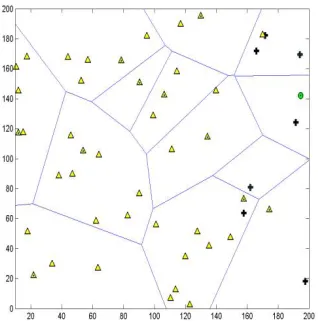
1. Node deployment: This is placing of simulation parameter i.e nodes in the simulation area.
2. Cluster-Heads: Theses are head nodes with lowest energy consumption for the LEACH Algorithm Application.(shown on the MATLAB window)
3. Transmitted Data: This is the data which is sent during the simulation in area of 200*200. ii. Final obtained parameters:
These are explained as follows:
1. Average Energy: This is energy consumed for the data packets extracted successfully. The total Energy can be calculated as:
E(Total)=nodes*starting energy –Residual Energy
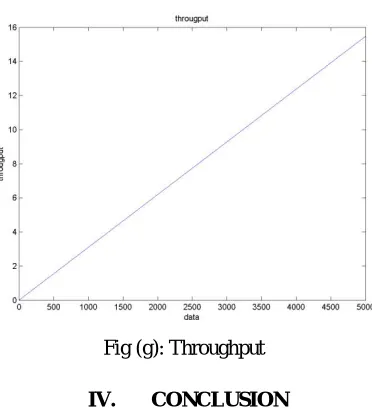
2. Throughput: It can be defined as the amount of bytes in the data packet extracted from the source node during the simulation.
Throughput=
3. Packet Delivery Ratio: It is defined as the desired data packets received at the destination node divided by the total number of data packet transmitted from the source.
4. Active Nodes:
Fig (a):Node Deployment in MANET Architecture
Fig (b): Cluster Head Formation
Fig (d): Average energy of the node VS rounds(less)
Fig (e): Average Energy of the Node Vs Rounds(more)
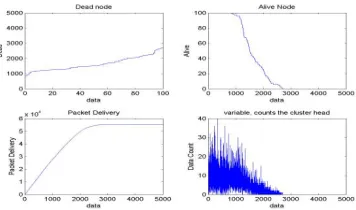
Below is the combined graphical Result of the following Parameter: Active nodes, Dead nodes, Packet delivery ratio, Variable count,cluster head in figure (f).
Fig (g): Throughput
IV. CONCLUSION
The various issues which were becoming hurdle in the path of assuring the quality of services in mobile ad-hoc network architecture like less packet delivery ratio, throughput etc. has been tried to improve in the proposed scheme .Due to high mobility and changing topology in the network it has become complicated to guarantee the QoS parameters. Not only is this, due to limited Resources and fast energy dissipation problems at the transmitting nodes the Energy Conservation Approach employed so that the better energy utilization can be achieved. By making use of the LEACH low energy adaptive clustering hierarchical algorithm the energy conservation is carried out. From the results obtained it is clear that as the traffic grows the applied algorithm adjusts the energy consumption and improves the network efficiency. The need of synchronization is well carried out by making use of time division multiple access in the combination with the DSR routing algorithm. In this way the proposed work has improves the Quality of services and the Energy Conservation.
REFERENCES
[1] 1.Hanif Maleki, Mehdi Kargabi, Sam Jabbehdari, “RTLB-DSR:A Load –Balancing DSR Based QoS Routing Protocol in MANETs”,
IEEE,2014
[2] ImadJawhar and Jie Wu, “QoS Support in TDMA-Based Mobile Ad-Hoc Networks, Journal .Computer science and Technology,2005.
[3] Bandana Bhatia, “Performance Analysis of AODV Based Congestion Control Protocol in MANET.IEEE,2015.
[4] Manu J Pillai, M P Sebastian,S D Madhukumar, “Dynamic Multipath Routing for MANETs-A QoS Adaptive Approach” IEEE,2013.
[5] C.Siva Ram Murthy, B.S Manoj, “AD-HOC WIRELESS NETWOKS”.25th Edition.
[6] Park V D, Corson M S. A highly adaptive distributed routing algorithm for mobile wireless networks. In INFOCOM'97, Proc. Sixteenth
Annual Joint Conference of the IEEE Computer and Communications Societies, April 1997, 3: 1405–1413.
[7] Al-Karaki J N, Kamal A E. Quality of service routing in mobile ad hoc networks: Past and future. Mobile Computing Handbook, Ilyas
M, Mahgoub I (eds.), CRC Publishers, December 2004, pp.569–609.
[8] Ekici E. QoS-based routing in wireless mobile networks. Resource Management in Wireless Networking, Cardei M, Cardei I, Du D-Z
(eds.), Springer, 2005.
[9] Murthy C S R, Manoj B S. Quality of service in ad hoc wireless networks. Ad Hoc Wireless Networks, Architectures and Protocols.
Prentic Hall., May 2004, pp.505–583.
[10] Zhu H, Chlamtac I. QoS for multimedia services in wireless networks. Resource Management in Wireless Networking, Cardei M, Cardei