Optimization of CNC Turning Parameters on
EN36B Steel Using Taguchi Method
P.Surulimani1, A.Karthikraja2, V.Sivaganesan3, J.Gowthaman4, M.Yojiith5
Assistant Professor, Department of Mechanical Engineering, Nadar Saraswathi College of Engineering and
Technology, Theni, Tamilnadu, India1,2,3,4
UG Student, Department of Mechanical Engineering, Erode Sengunthar Engineering College, Erode, Tamilnadu, India5
ABSTRACT: The main objective of today's manufacturing industries is to produce low cost, high quality products in short time. The selection of optimal cutting parameters is a very important issue for every machining process in order to enhance the quality of machining products and reduce the machining costs. This paper investigates the machining of EN36B steel to find optimal parameters for CNC turning process. The Taguchi’s L9 Orthogonal array is used to formulate the experimental layout, to analysis the effect of each parameter on the machining characteristics and to predict the optimal choice for each turning parameters such as Speed, Feed and Depth of cut. It is found that these parameters have a significant influence on machining characteristics such as Material removal rate (MRR) and Surface roughness (SR). The Analysis of Variance (ANOVA) and Signal-to-Noise ratio are used to study the performance characteristics in turning operation.
KEYWORDS: CNC Turning, EN36B Steel, ANOVA, Material removal rate, Surface roughness .
I. INTRODUCTION
Machining by turning involves the use of a lathe and is used primarily to produce cylindrical or conical parts. It is valuable to increase tool life, to improve surface roughness, to reduce cutting force and material removal rate in turning operations through an optimization study. Among these four characteristics, surface roughness and material removal rate play the most important roles in the performance of a turning process. Cutting speed, feed rate, depth of cut, tool-work piece material, tool geometry, and coolant conditions are the turning parameters which highly affect the performance measures. In order to improve machining efficiency, reduce the machining cost, and improve the quality of machined parts, it is necessary to select the most appropriate machining conditions. The setting of turning parameters relies strongly on the experience of operators. It is difficult to achieve the highest performance of a machine because there are too many adjustable machining parameters. In order to minimize these machining problems, there is a need to develop scientific methods to select cutting conditions for free machining of metals.
II. LITERATURE REVIEW
Paramasivam et al.[1]. They investigated the optimization of turning process parameters for EN24 steel based on
Regression analysis. The L9 orthogonal is used for the experiment cutting speed, feed rate and depth of cut are
Aravindkumar. [4].He has optimized the turning parameters for mild steel 1018. He used three cutting parameters to find out the maximum metal removal rate from the manufactured component. The CNC turning machine was used for this study. For the optimization purpose the Taguchi approach with L27 orthogonal array is used. He revealed, that the feed rate in influence the material removal rate.Anand S. Shirade et al.[5].The experiment was conducted to determine the optimum cutting parameters setting for minimizing surface roughness when turning of EN8 steel material. The L9 orthogonal array design is used for design the experiments. The analysis of variance (ANOVA) employed to analysis the influence of performance parameters during turning.
Shreemoykumarnayaket al.[6].TheInvestigation was carried outthe effect of machining parameters during dry turning of AISI 304 austenitic stainless steel. For this study HMT heavy duty lathe machine was used. They have adopted L27 orthogonal array with three machining parameters like cutting speed, feed rate and depth of cut and three importance characteristics of machinability such as material removal rate (MRR), cutting force and surface roughness (Ra) were measured. For the optimization of machining parameters, Grey relational analysis was used.
Sschin C Borse. [7]. He was focused on optimizing turning parameters based on the Taguchi method to minimize the surface roughness and maximize the metal removal rate by using SAE 52100 steel with carbide inserts. Results of this study indicate that the feed rate is mostly influencing the surface roughness of the machined surface.
Neerajsaraswat et al.[8].They determined the optimal cutting parameters for EN9 steel in turning operation. The analysis of variance (ANOVA) and signal to noise ratio (S/N ratio) were used to study the performance characteristics in turning operation. The cutting speed, feed rate and depth of cut were selected as a input parameters to optimize the surface roughness.
Balaraju et al. [9]. The research was analyzed the effect of cutting parameters on surface roughness and cutting force in turning of mild steel and aluminium material. They have used factorial technique to optimize the cutting parameters. For this study they have used universal lathe machine. For this study they have concluded that cutting forces increase with fed rate keeping other parameters constant, cutting forces decreases with spindle speed keeping other parameters constant, cutting forces increases with spindle speed keeping other parameters constant.Jakhaleprashant et al. [10].They have used L9 orthogonal array, signal to noise ratio and ANOVA for optimizing the surface roughness value of alloy steel in turning operation. Four input parameters were selected for finding the surface roughness value for reducing the cost of product.VikasB.magdum et al.[11].The experiment was conducted for evaluation and optimization of machining parameter for turning of EN8 steel. In this study the conventional lathe is used for turning operation. They were selected tool shape and material, cutting speed, depth of cut and feed rate as process parameters to find out the optimum cutting parameters for minimizing the cutting force.RK Suresh et al.[12] conducted he optimization process for EN41B steel in turning operation by using Taguchi method. In this study L27 orthogonal array is used experiment. Three process parameters used for maximizing the material removal rate of the manufactured component.
III.TAGUCHIMETHOD
Taguchi method is a powerful tool for the design of high quality systems. It provides simple, efficient and systematic approach to optimize design for performance, quality and cost. Taguchi method is efficient method for designing process that operates consistently and optimally over a variety of conditions.Taguchi approach to design the experiments easy to adopt and apply for users with limited knowledge of statics, hence gained wide popularity in the engineering and scientific community. The desired cutting parameters determined by handbook. Cutting parameter is reflected on surface roughness, surface texture and dimensional deviation on turned product. Taguchi method is especially suitable for industrial use but can also be used for scientific research.
IV.EXPERIMENTAL RESULTS
A. Material
The work piece used for the concluded experiment was EN 36B steel. It is used in the field of heavy vehicle
transmission components, engineering machinery gearbox parts and chuck jaws. The Table I and Table II show the chemical and mechanical properties of EN36B steel.
TABLE I
CHEMICAL COMPOSITION OF EN 36B STEEL
Elements Percentage (%)
Carbon 0.12 to 0.16
Silicon 0.10 to 0.35
Manganese 0.35 to 0.60
Nickel 3.0 to 3.75
Chromium 0.70 to 1.0
Sulphur 0.035 Max
Phosphorus 0.040 Max
The EN36 is a 3% nickel, chromium, molybdenum grade. Carburized EN36 gives a hard case with a strong core, whilst retaining a remarkable degree of toughness.
TABLE II
MECHANICAL PROPERTIES OF EN36B STEEL
Property Value
Yield strength 540MPa
Tensile strength 700/770MPa
Elongation 25%
Hardness 255 HB Max
B. Machine Details:
(1)
Fig 1 Horizontal ACE DESIGNER CNC lathe
The ACE Designer lathe is widely used in many of the industry because of this machine convenience and its performance. So that the reason we have selected this machine for our research.
C. Cutting Parameters and Their Levelb
The main cutting parameters are speed, Feed and depth of cut. The factors and the levels are given the Table II.
TABLE III
PARAMETERS AND LEVELS
Sl.No FACTORS LEVEL 1 LEVEL 2 LEVEL 3
1 Speed (rpm)-A 500 750 1100
2 Feed (mm/rev)-B 0.1 0.35 0.5
3 Depth of cut (mm)-C 0.5 0.8 1.0
D. Select the Appropriate Orthogonal Array
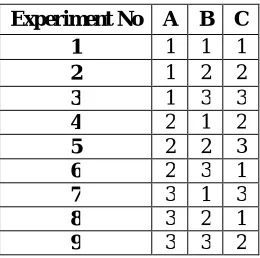
Selecting an orthogonal array depends on the total degrees of freedom for the corresponding factors. For factor with level of 3, the degree of freedom is 2.
The experimental table is shown in Table IV.
TABLE IV ORTHOGONAL ARRAY
Experiment No A B C
1 1 1 1
2 1 2 2
3 1 3 3
4 2 1 2
5 2 2 3
6 2 3 1
7 3 1 3
8 3 2 1
9 3 3 2
In this experiment, there are three factors with level number 3 consequently, the total degrees of freedom is 6. In mean time, the interaction between the cutting parameters is neglected here. There by L9 orthogonal array is used.
E. Experimental Data
TABLE V
EXPERIMENTAL RESULTS
Sl.No Speed (rpm)
Feed (mm/rev)
Depth of cut (mm)
Metal removal rate (mm3/min)
Surface roughness, Ra (µm)
1 500 0.1 0.5 1347.50 40.90
2 500 0.35 0.8 7215.13 32.50
3 500 0.5 1.0 12655.49 23.15
4 750 0.1 0.8 3351.21 41.10
5 750 0.35 1.0 14590.29 21.12
6 750 0.5 0.5 13277.16 27.85
7 1100 0.1 1.0 6510.91 35.11
8 1100 0.35 0.5 12894.17 38.12
9 1100 0.5 0.8 22979.70 34.89
I. DATA ANALYSIS BY USING TAGUCHI METHOD
(2)
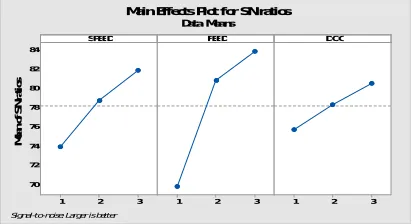
Fig 2 Effect of Speed, Feed and Depth of Cut on Metal Removal Rate.
The Figure 2 shows that the three parameters were how influencing the material removal rate. From the graph the feed rate is mostly influencing the material removal rate.
1. Taguchi Analysis: MRR versus SPEED, FEED, DOC
TABLE VI
RESPONSE TABLE FOR SIGNAL TO NOISE RATIOS (LARGER IS BETTER)
LEVEL SPEED FEED DOC
1 73.93 69.79 75.75
2 78.75 80.88 78.30
3 81.90 83.91 80.53
Delta 7.97 14.12 4.78
Rank 2 1 3
This responsible table is created from Minitab 16 software, the table VI shows the ranks created from three input parameters. In MRR we have to select the conditions as larger the better.
3 2 1 84
82
80
78
76
74
72
70
3 2
1 1 2 3
SPEED
M
e
an
o
f
S
N
r
at
io
s
FEED DOC
Main Effects Plot for SN ratios
Data Means
TABLE VII
ANOVA FOR MATERIAL REMOVAL RATE
Source DF Seq SS Adj SS Adj MS % Of Contribution Rank
Speed (A) 2 74746706 74746706 37373353 21.23 2
Feed (B) 2 241697471 241697471 120848735 68.64 1
Depth of cut(C) 2 8364728 8364728 4182364 2.38 3
Error 2 27320459 27320459 13660230 7.75
Total 8 329129365 100
This ANOVA table is used to find out the individual input parameters contribution on material removal rate. From the table feed rate is contributing 68.64% on material removal rate
(3)
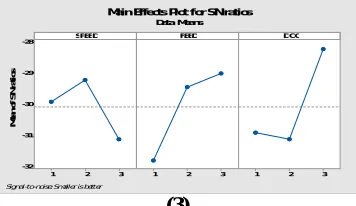
Fig 3 Effect of Speed, Feed and Depth of cut on Surface roughness
The Fig 3 shows that the three parameters were how influencing the surface roughness. From the graph depth of cut is mostly influencing the surface roughness.
2. Taguchi Analysis: SR versus SPEED, FEED, DOC
TABLE VIII
RESPONSE TABLE FOR SIGNAL TO NOISE RATIOS (SMALLER IS BETTER)
Level SPEED FEED DOC
1 -29.92 -31.81 -30.92
2 -29.22 -29.45 -31.12
3 -31.13 -29.01 -28.23
Delta 1.91 2.79 2.89
Rank 3 2 1
This responsible table is created from Minitab 16 software, the table VI shows the ranks created from three input parameters. For SR we have to select the conditions as smaller the better.
TABLE IX
ANOVA FOR SURFACE ROUGHNESS
Source DF Seq SS Adj SS Adj MS % Of Contribution Rank
Speed (A) 2 55.74 55.74 27.87 13.07 3
Feed (B) 2 183.6 183.6 91.81 43.04 1
Depth of cut(C) 2 178.4 178.4 89.21 41.82 2
Error 2 8.851 8.851 4.426 2.07
Total 8 426.620 100
3 2 1 -28
-29
-30
-31
-32
3 2
1 1 2 3
SPEED
M
e
a
n
o
f
S
N
r
a
ti
o
s
FEED DOC
Main Effects Plot for SN ratios
Data Means
V. CONCLUSION
The present work shows the use of Taguchi method to find out optimal machining parameter. The S/N ratio for the test results were found out using the Taguchi method. The machining parameters namely Speed, Feed rate and Depth of cut is optimized to meet the objectives. As a result of the study the following conclusions are drawn: (i) The results reveal that the primary factor affecting the Material removal rate is feed rate, subsequently followed by speed and depth of cut. (ii) The results reveal that the primary factor affecting the surface roughness is feed rate, subsequently followed by depth of cut and speed
REFERENCES
[1] V.Paramasivam, B.Moinudeen, P.Premkumar, Optimization of turning process parameters for EN-24 steel using Taguchi method and Regression
Anlaysis, Global Journal Of Engineering Science and Researches, pp 31-38, Oct 2014.
[2] NarayanaReddy. A R1 Gantisatyaprakash, Optimization of Machining Parameters of 20MnCr5 Steel in Turning Operation using Taguchi
technique, International Journal Of Modern Engineering Research, Vol.4, pp.50-60, Sep 2014.
[3] Shumugesh k, Panneerselvam K, Pramod M and AmalGeorge,Optimization of CNC Turning Parameters with carbide tool for surface roughness
analysis using Taguchi Analysis, Research Journal Of Engineering Science, Vol.3, pp.01-07, June 2014.
[4] Arvind Kumar, Optimization of Material Removal Rate in CNC Turning of Mild Steel 1018 using Taguchi method, IJITKM Special Issue, pp.
231-237, May 2014.
[5] AnandS.Shivade, ShivrajBhagat, SurajJagdale, AmitNikam, Pramodlondhe, Optimization of Machining Parameters for Turning using Taguchi
Approach, International Journal Of Recent Technology and Engineering, Vol.3, Issue.1, pp.145-149, March 2014.
[6] SheermoykumarNayak, Jatinkumarpatro, ShaileshDewangan, SoumyaGangopadhyay, Multi objective optimization of machining parameters
during dry turning of AISI 304 Austenitic stainless steel using Grey Relational Analysis,www.sciencedirect.com, pp.701-708, 2014.
[7] Sachin C Borse, Optimization of turning parameters in dry turning of SAE52100 steel, International Journal Of Mechanical Engineering and Technology, Vol.5, Issue.12, pp.01-08, Dec 2014.
[8] NeerajSaraswat, Ashok Yadav , Anil Kumar and BhanuPrakeshSrivastava , Optimization of Cutting Parameters in Turning Operation of Mild
Steel, International Review Of Applied Engineering Research, Vol.4, pp.251-256, 2014.
[9] BalarajuJ, Leelakrishna J, Tejomurthy,effect and optimization of machining parameters on cutting force and surface finish in turning of mild steel and aluminum, International Journal of Research in Engineering and Technology, Vol.02, Issue.11, pp.135-141, Nov 2013.
[10] Jakhaleprashant p, jadhav b. R., Optimization of surface roughness of alloy” steel by changing operational parameters and insert geometry in the
turning process, International Journal of Advanced Engineering research and Studies,Vol.2,Sep 2012.
[11] Vikas B. Magdum, Vinayak R. Naik, Evaluation and Optimization of Machining Parameter for turning of EN 8 steel, International Journal of
Engineering Trends and Technology, Vol.4, Issue.5, May 2013.
[12] R.K.Suresh and G. Krishnaiah, Parametric Optimization on single objective Dry Turning using Taguchi Method, International Journal of
Innovation in Engineering and Technology, Vol.2 Issue.2, April 2013.
[13] Rahul Davis, Jitendra Singh Madhukar, Vikash Singh Rana, Prince Singh (Oct 2012) “Optimization of Cutting Parameters in Dry Turning
Operation of EN24 Steel, International Journal of Emerging and Advanced Technology, Vol.2, Issue.10, pp.559-563, Oct 2012.
[14] NiravM. Kamdar, Prof. Vipul K. Patel, Experimental Investigation of Machining Parameters of EN 36 Steel using Tungsten Carbide Cutting Tool during Hot Machining, International Journal of Engineering research and Applications, Vol.2, Issue.3, pp.1833-1838, June 2012.
[15] AshishYadav, Ajay Bangar, Rajan Sharma, Deepak Pal, Optimization of Turning Process Parameters for Their Effect on En 8 Material Work
piece Hardness by Using Taguchi Parametric Optimization Method, International Journal Mechanical and Industrial Engineering, Vol.1, Issue.3, 2012.
[16] Suleiman abdulkareem, Usmanjibrinrumah and Apasiadaokoma, Optimizing machining parameters during turning process, International Journal
of Integrated engineering, Vol.3, pp-23-27, Sep 2011.
[17] M. Kaladhar, K. Venkatasubbaia, CH. Srinivasaraoand K. Narayanarao, Optimization of process parameterturning of AISI 202 austenitic
stainless steel, APRN Journal of Engineering and Applied Sciences, Vol.5, Issue.9, pp.79-87, Sep 2010.
[18] SudhansuRanjanjan Das, Dr.Amaresh Kumar and Dr.DebabrataDhupal , Estimating the Effect of Cutting Parameters on Tool Wear and
Workpiece Surface Temperature in Turning of AISI D2 Steel.
BIOGRAHY
Mr.A.Karthikraja has completed Bachelor degree in Mechanical Engineering at SSM College of engineering and Technology, Erode and Master Degree in Manufacturing Engineering at Chendruran college of Engineering and Technology, Pudukottai. He has four years of industrial experience in the field of power plant equipment manufacturing. Now he is working as an Assistant professor in the Department of mechanical engineering at Nadar Saraswathi college of Engineering and Technology, Theni.
Mr.V.Sivaganesan has completed Bachelor degree in Mechanical Engineering at Kurinji College of Engineering and Technology, Manaparai and Master degree Engineering Design at Kurinji College of Engineering and Technology, Manaparai. He has two years of industrial experience and three years of teaching experience. Now he is working as an Assistant professor in the Department of mechanical engineering at Nadar Saraswathi college of Engineering and Technology, Theni.
Mr.J.Gowthaman has completed Bachelor degree in Mechanical Engineering at SACS M.A.V.M Engineering College, Madurai, Master Degree in Production Engineering at Thiagarajar College of Engineering, Madurai and he also completed MBA at Velammal College of Management and Computer Studies, Chennai. He has two years of industrial experience and two years of teaching experience. Now he is working as an Assistant professor in the Department of mechanical engineering at Nadar Saraswathi College of Engineering and Technology, Theni.