Evidence for Recurrent Paralogous Gene Conversion and Exceptional Allelic
Divergence in the
Attacin
Genes of
Drosophila melanogaster
Brian P. Lazzaro and Andrew G. Clark
Institute of Molecular Evolutionary Genetics, Department of Biology, Penn State University, University Park, Pennsylvania 16802 Manuscript received February 8, 2001
Accepted for publication July 23, 2001
ABSTRACT
Insects produce a limited variety of antibacterial peptides to combat a wide diversity of pathogens. These peptides are often conserved across evolutionarily distant taxa, but little is known about the level and structure of polymorphism within species. We have surveyed naturally occurring genetic variation in the promoter and coding regions of three Attacin antibacterial peptide genes from 12 lines of Drosophila melanogaster. These genes exhibit high levels of silent nucleotide variations (1–3% per nucleotide heterozy-gosity), but are not excessively polymorphic at the amino acid level. There is extensive variation in the Attacinpromoters, some of which may affect transcriptional efficiency, and one line carries a deletion in theAttacin Acoding region that renders this gene nonfunctional. Two of the genes,Attacins AandB, are arranged in tandem and show evidence of repeated interlocus gene conversion.Attacin C, more divergent and located 1.3 Mbp upstream of Attacins A and B, does not appear to have been involved in such exchanges. All three genes are characterized by divergent haplotypes, and oneAttacin ABallele appears to have recently increased rapidly in frequency in the population.
I
NSECTS fight bacterial infection, in part, through et al. 2000; Hedengren et al. 2000). Mature Attacin the generation and extracellular circulation of a vari- peptides are typicallyⵑ190 amino acids in length (Sar-ety of short, general antibacterial peptides. Although cophaga peptides are longer) and adopt a “random over 400 different innate immune peptides have been coil” structure in solution (Gunne et al. 1990). This identified in eukaryotes (Hoffmann et al. 1999), most loose, flexible structure is devoid of disulfide bonds and insects produce fewer than 10 peptide classes. This rela- does not take a rigid conformational shape. This lack tively small number of peptides must effectively combat of strict structural constraint may allow relatively free a wide range of potential and actual pathogens. The amino acid substitution, explaining the low level of conservation of antibacterial peptides, in amino acid amino acid identity betweenAttacinhomologs in distant sequence and in three-dimensional structure, has been taxa. There is, however, conservation of general struc-well documented across evolutionarily distant taxa (Bulet ture and functional activity. Attacins are lethal toGram-et al. 1999). However, relatively little work has examined negative bacteria, and H. cecropia Attacins have been
genetic variation within taxa. What studies have been shown to affect the growth rates of some Gram-positive done focus almost exclusively on theCecropincluster of bacteria (Engstro¨ m et al. 1984). H. cecropia Attacins
Drosophila melanogaster(ClarkandWang1997;Dateet directly bind lipopolysaccharides in the outer
mem-al. 1998;Ramos-OnsinsandAguade´1998). Here, we brane of Gram-negative bacteria, disrupting membrane present data on the quantity and origin of polymor- integrity and leading to increased permeability ( Eng-phism in theD.melanogaster Attacin genes. stro¨ met al. 1984). This binding also leads to the specific Attacins represent one of the most taxonomically inhibition of several bacterial outer membrane pro-widespread classes of antibacterial peptides. Families teins, probably through feedback inhibition, which limits of Attacin-like peptides (usually two to four functional the bacterium’s ability to restore membrane function genes per haploid genome) have been identified in the (Carlssonet al. 1991, 1998). The permeabilization of lepidopteran speciesHyalophora cecropia(Hultmarket the bacterial outer membrane by Attacins allows large al. 1983),Bombyx mori(Sugiyamaet al. 1995),Hyphantria molecules such as Cecropins and lysozymes to more
cunea (Shin et al. 1998), Trichoplusia ni (Kang et al. easily access the inner membrane, setting up a
syner-1996), andHeliothis virescens(Ourthet al. 1994), as well gistic interaction between these antibacterial peptides as in the dipteran speciesSarcophaga peregrina(Andoet
(Engstro¨ met al. 1984). At sufficiently high concentra-al. 1987) andD. melanogaster(A˚ slinget al. 1995;Dushay
tions, Attacins can cause bacterial cell lysis (Engstro¨ m
et al. 1984).
We identified two novel D. melanogaster Attacins by Corresponding author:Brian Lazzaro, Department of Biology, Penn
performing a BLAST query ofAttacin Aagainst the
ge-State University, University Park, PA 16802.
E-mail: [email protected] nome sequences released by the Berkeley Drosophila
wild population of North AmericanD.melanogaster. The overall level of nucleotide diversity is quite high in each of these three genes, but there is not an excess of amino acid polymorphism. We find thatAttacins AandBhave experienced multiple paralogous gene conversion events and that a recent conversion has created a novel haplo-type that subsequently increased rapidly in frequency. We also note a number of polymorphisms, including a null allele of Attacin A, that may affect the functional capacity of the immune response.
MATERIALS AND METHODS
Line construction:All polymorphism data were determined
in 12 lines derived from a natural population ofD. melanogaster in State College, Pennsylvania. Individual females were col-lected in the wild in 1998 and allowed to oviposit in vials containing standard cornmeal medium. F1or F2male progeny
Figure1.—Amino acid alignment of the consensusAttacin were mated to females carrying the second chromosome
bal-A,Attacin B, andAttacin Cgene products. Strict amino acid ancer CyO. Individual male progeny from this cross were back-identities are highlighted. The shaded triangle indicates the crossed to the CyO stock. CyO/⫹ backcross progeny were site of a polymorphic insertion of Pro-Ser-Leu inD.melanogaster then sib-mated and the CyO chromosome was eliminated in Attacin A. This polymorphism may predate the species diversi- the following generation. The remaining wild-type progeny fication of themelanogastersubgroup. were recurrently sib-mated, establishing stocks that are homo-zygous for a single, naturally occurring second chromosome that has experienced a minimum of recombination and selec-tion in the laboratory. These stocks have been named “2CPA” Genome Project (BDGP) and Celera Genomics
(Rock-for “2nd chromosome, Central Pennsylvania.”
ville, MD; B. P.Lazzaroand A. G.Clark, unpublished D. simulanswas used as an outgroup for the sequence analy-data; Flybase Report FBrf0126873, http://flybase.bio. ses. Sequence was obtained from aD. simulansisofemale line established in 1992 from a natural population in Winters, inidiana.edu). One of these, the most similar toAttacin
California. A, is the same sequence isolated byDushayet al. (2000;
Sequence analysis:We surveyed nucleotide sequence
varia-GenBank accession no. AF220547) and probably repre- tion among all 12 2CPA lines in the coding and promoter sents the cross-hybridizing sequence inferred byA˚ sling regions of Attacins A, B, and C. The survey region for the
et al. (1995) in the identification ofAttacin A. This gene Attacin Aupstream begins 1215 bp upstream of theAttacin A
start codon (this is the first nucleotide following theDrosocin
has been namedAttacin B. The second match that we
stop codon) and ends 151 bp upstream of theAttacin Astart pursued is the same sequence identified byHedengren
(1064 bp total). The surveyedAttacin Acoding region begins
et al. (2000) asAttacin C. A fourth match, termedAttacin at the 33rd nucleotide following the start codon and ends 16
D byHedengren et al. (2000), was deemed too diver- bp before the stop codon (682 bp total, including the 64 bp intron). Attacins A and B are separated by ⵑ1.1 kb, which gent (33% amino acid identity toAttacin A) to be
consid-must include theAttacin B promoter. A total of 1091 bp of ered here.
this region was sequenced, beginning 62 bp after theAttacin
Attacins A and B are 96 and 97% identical at the
Astop codon and continuing to theAttacin Bstart codon. All nucleotide and amino acid levels, respectively. They are 721 bp of theAttacin Bgene, including the 64-bp intron, plus arranged head-to-tail, separated by just under 1.1 kb, 37 bp downstream of theAttacin Bstop codon, was surveyed as theAttacin Bcoding region (758 bp total). A total of 3104 at cytological position 51AB on chromosome 2R. The
bp of theAttacin Cregion also was sequenced. Of this 3104 antibacterial peptide geneDrosocinlies 1.2 kb upstream
bp, 2024 bp is 5⬘of the start codon, 726 bp is coding, 63 bp
ofAttacin A.Attacin C is located at cytological position
is intronic, and 291 bp is 3⬘of the stop codon. A small window, 50A and shows only 67% nucleotide and 70% amino beginning 84 bp and ending 54 bp upstream of theAttacin C acid identity toAttacin A. Although the mature peptides start codon, was not surveyed.
DNA was isolated from pools of 100–200 flies using a standard are similar in length, the propeptide region ofAttacin
phenol-chloroform extraction followed by ethanol precipitation. C is 27 amino acids long compared to 11 amino acids
Gene-specific PCR was carried out using oligonucleotide primers
inAttacin A, and the signal peptides are identical at only that were designed from sequences deposited in GenBank
6 of 20 positions, including the N-terminal methionine by D. Hultmark, the Berkeley Drosophila Genome Project, (Figure 1). Therefore, we suggest thatAttacin Cmay be and Celera Genomics (accession nos. Z46893, AE003813.2, and AE003818.2). Primer sequences corresponding to the sequenced differently targeted or processed thanAttacins AandB,
regions are available as supplemental material at http:// although the high degree of similarity among the
ma-www.genetics.org/supplemental/ or can be obtained from the ture peptides implies a commonality of function. authors upon request. All amplifications were carried out with We have surveyed natural genetic variation in alleles at least one primer annealing to noncoding DNA to prevent accidental nonspecific amplification of gene paralogs.
fication products were purified by ethanol precipitation and unique among the sequenced lines and was not detected directly sequenced on either an ABI 373 or a Beckman CEQ among an additional 85 central Pennsylvania chromo-2000 automated sequencer, using slight modifications of the
somes screened by PCR. manufacturers’ protocols. The entire survey region was
se-Although the level of polymorphism in theAttacin A quenced on both strands in each line, except in rare instances
where sequencing reactions failed to give reliable sequence gene is quite high, the substitutions are not distributed reads long enough to reach the next primer on the strand. evenly among the sampled alleles. Twenty-six polymor-In these instances, sequence was inferred from the comple- phisms are unique to one line, 2CPA 129 (Figure 2B). mentary strand. All sequences have been deposited in
Gen-Fu and Li (1993) showed that, under neutrality, the Bank under accession nos. AY056843–AY056902.
expected number of singletons in a sample is equal to the per-base estimate of multiplied by the length in base pairs of the region surveyed. Our estimate offor RESULTS
the entireAttacin Acoding region is 21.5. Thus, the 26
Polymorphism in and gene conversion between the unique polymorphisms contributed to the sample by
Attacin AandBgenes:For the purpose of analyzing the line 2CPA 129 alone exceeds the total number of
single-Attacin A and Attacin B polymorphism data, we have tons expected in the sample under neutrality, and all
broken theAttacin ABarray into four segments. These but one of these 2CPA 129-specific mutations are found will be referred to as the Attacin A upstream region in the second exon. Lines 2CPA 7 and 2CPA 14 contrib-(1064 bp), theAttacin Acoding sequence (682 bp), the ute nearly all of the remaining segregating sites. If these
Attacin ABintergenic spacer (1091 bp), and theAttacin three lines are excluded,ˆ drops from 0.0315 (⫾1.29⫻
Bcoding sequence (758 bp). Although these units will 10⫺2) for the entire data set to 0.0091 (⫾4.29⫻ 10⫺3) be referred to as discrete segments, it is important to for the more homogenous set of alleles. We applied the keep in mind that they are adjacent in the genome. haplotype test ofHudsonet al. (1994) to estimate the The level of nucleotide variability is strikingly high probability that the extreme haplotype divergence ob-in the Attacin A coding region (Figure 2B). Without served in theAttacin Aregion was generated by a neutral distinguishing between silent and replacement substitu- process. This test specifically measures the probability, tions, we obtained per-base estimates (⫾1 SD, assuming under neutrality, that a subset of alleles in a sample is no recombination) ofˆ⫽0.0315 (⫾1.29⫻10⫺2) from
monomorphic for a high proportion of the sites that the number of segregating sites in the sample andˆ ⫽ segregate in the complete data set. We simulated sets 0.0243 (⫾7.10 ⫻ 10⫺3) from the average pairwise
dis-of 10,000 neutral genealogies conditioning on the em-tance between alleles in the sample (Table 1). We uncov- pirical sample size of 11 (the null allele was excluded ered 13 amino acid replacement polymorphisms within from this analysis) and the observed number of
polymor-theD.melanogaster Attacin Acoding region, 7 of which are phisms (64). Three out of 10,000 genealogies simulated
concentrated in exon 2 of line 2CPA 129 (Figure 2B). under the conservative assumption of no recombination We also detected two insertion/deletion polymor- had subsamples of seven alleles with 15 or fewer sites phisms in the Attacin Acoding sequence. The first of segregating, as is observed in the empirical data (P⫽ these is a 9-bp insertion (relative toD.simulans) in the 0.0003).
Attacin Apro-peptide sequence. This polymorphism re- Although we found theAttacin Bcoding region to be
sults in the insertion of three amino acids (Pro-Ser-Leu) less variable than theAttacin Acoding region, the same after position 21 (Figure 1) in lines 2CPA 7 and 2CPA 14. pattern of haplotype structure exists there (Figure 2D).
Attacin A sequences obtained from theD. melanogaster In the Attacin B gene, line 2CPA 51 contributes most
sibling speciesD. simulans,D. sechellia, andD. mauritiana of the polymorphisms, carrying 15 unique nucleotide suggest that this polymorphism may be as old as the substitutions, although only 24 sites segregate in the origin of those species. We found thatD.simulansand entire sample. Only 4 out of 10,000 simulated samples
D.sechelliacarry the deletion state for thisD.melanogaster of 12 alleles with a total of 24 segregating sites had a
polymorphism, while D. mauritiana has the insertion clade of 9 alleles segregating for 9 or fewer sites (P⫽ (B. P.Lazzaroand A. G.Clark, unpublished results). 0.0004).
unique to line 2CPA 129 in theD.melanogaster Attacin A conversion product has reached high frequency in the sample. In an independent conversion event, sequence sample are identical in state to theD.simulanssequence,
including 5 of the 7 positions that cause amino acid was exchanged between theAttacin AandBgenes, creat-ing the partial haplotype that lines 2CPA 7 and 2CPA replacements in the 2CPA 129 allele (Figure 2B).
Like-wise inAttacin B, line 2CPA 51 is identical in state toD. 14 in Attacin Ashare with line 2CPA 51 in Attacin B. It is not clear whether this sequence originated inAttacin
simulansat 8 of the 19 positions at which 2CPA 51 carries
a rare or unique substitution (Figure 2D). Such a large AorAttacin B. It is also noteworthy that theD.simulans
Attacin AandAttacin Bgenes share several substitutions
number of high frequency, derived polymorphisms are
unexpected under a neutral process (Fay and Wu relative to the D.melanogastersequences at both genes (Figure 3), which could result from intergenic exchange 2000), and the excess inAttacins AandBis statistically
significant (H⫽ ⫺31.254,P⫽0.0054 inAttacin A;H⫽ in either or both species. Such recurrent paralogous gene conversions tend to homogenize the genes within ⫺9.848, P ⫽ 0.0188 in Attacin B; critical values
deter-mined by simulation) (Fu1997;FayandWu2000). a species and obscure the phylogenetic relationships of homologous genes across species (Figure 4).
Alignment of all of the Attacin A sequences with all
of theAttacin Bsequences shows that many of the high The degree of nucleotide homology between the
At-tacin AandBgenes drops off sharply outside the peptide
frequency, derived sites inAttacin Aare identical in state
to the commonAttacin Bsequence (Figure 3). We also coding region, making it unlikely that paralogous gene conversion events extend beyond the boundaries of cod-note that theAttacin A outlier haplotypes 2CPA 7 and
2CPA 14 share state at several positions with theAttacin ing sequence. Nevertheless, the four alleles that have apparently participated in paralogous exchange events Boutlier haplotype 2CPA 51 (Figure 3). The sharing
of polymorphisms between Attacins A and B suggests also display divergent haplotypes in the Attacin AB in-tergenic spacer (which must include theAttacin B pro-that paralogous gene conversion may be acting to
ex-change sequence between the two genes. Gene conver- moter; Figure 2C). Lines 2CPA 7, 2CPA 14, and 2CPA 129 are distinguished from the remaining alleles by 27 sion can be identified from aligned sequences by the
clustering of sites that share different phylogenetic par- nucleotide substitutions. The intergenic spacer in line 2CPA 129 additionally carries a series of unique dele-titions (Stephens1985). In applying this method to the
Attacin ABdata, we find that a set of 12 segregating sites tions, the largest of which is 250 bp and which sums to
331 bp. Line 2CPA 51 contributes the vast majority of involved in the partition of lines 2CPA 7, 2CPA 14 (in
Attacin A), and 2CPA 51 (inAttacin B) are significantly the remaining polymorphisms segregating in theAttacin
AB intergenic spacer, including 15 unique nucleotide clustered. The probability of a span of sites sharing this
partition by chance is extremely unlikely [P(d ⬍ d0)⫽ substitutions and a series of unique deletions that range in size from 9 to 58 bp and total 95 bp. Line 2CPA 51 0.00096;Stephens1985]. Similarly, the method of
Saw-yer (1989) yields a probability of 0.006 that a larger also carries a large, complex mutation. This mutation reduces a 69-bp window (843–774 bp upstream of the sum of squared lengths of shared sequence runs could
be obtained by chance without recombination or gene Attacin Bstart codon) to 31 bp, although those 31 bp are completely unalignable with the remaining sequences. conversion.
These observations lead us to a model where recur- The mechanism for generating such a mutation is not clear, but we consider this as a single evolutionary event rent paralogous gene conversion shapes the pattern of
polymorphism in theAttacin AandBgenes. Specifically, in our analyses. Notably, there are several deletions and polymorphic sites among lines 2CPA 7, 2CPA 14, 2CPA in a recent event, the 3⬘end of the Attacin Bgene has
converted the 3⬘ end of the Attacin A gene and the 129, and 2CPA 51 that overlap each other, creating
Figure2.—Aligned polymorphic sites segregating in theAttacin ABgene region of 12 lines ofD. melanogasterand 1 line ofD.
many positions in the sequence at which more than two nucleotide states exist. There are several additional positions in theAttacin ABdata set where three nucleo-tide states are segregating at a position inD.melanogaster or whereD.simulansdisplays a third state at a position that is polymorphic inD.melanogaster(Figure 2). Through gene conversion and multiple hits, theAttacin AB empir-ical data set shows departure from the theoretempir-ical model of independent mutations and infinite sites in which mutations may occur.
Interestingly, the strong haplotype structure observed in the Attacin A and B coding regions and in the in-tergenic spacer is apparently absent upstream of the
Attacin Agene, although variability is not greatly
dimin-ished. We found 52 nucleotide polymorphisms in the
Attacin A upstream region (Figure 2A), yielding
esti-mates of ˆ ⫽ 0.0162 (⫾6.53 ⫻ 10⫺3) and ˆ ⫽ 0.0149 (⫾1.78⫻10⫺3). We also detected five small insertion/ deletion polymorphisms, ranging in size from 2 to 12 bp. Considering the high level of variability and apparent lack of haplotype structure in the Attacin Aupstream region, the alleles that have the common haplotype in both the Attacin A andAttacin B coding regions show a curious deficiency of polymorphism in both coding regions and in the intergenic spacer. The paucity of variation could possibly be explained if the common
Attacin AB allele has only recently expanded to high
frequency, such that there has not been time for it to accumulate mutations or to recombine appreciably. Rapid expansion models predict that most polymor-phisms within the expanding clade should be rare, a prediction that is borne out in the empirical data.T aji-ma’s D (Tajima 1989), a measure of skew in the site frequency spectrum, is negative for the region begin-ning with the Attacin Acoding region and continuing through theAttacin Bcoding region (D⫽ ⫺0.613) when alleles 2CPA 7, 2CPA 14, 2CPA 129, and 2CPA 51 (and also the Attacin Anull allele, 2CPA 43) are excluded. The negative value ofDindicates an excess of rare poly-morphisms, although the skew is not statistically signifi-cant (P ⫽0.312; determined by simulation). If the
At-tacin Aupstream region is included in the calculation,
D for the putatively expanding clade is ⫺0.746 (P ⫽ 0.271).FayandWu(2000) show that the rapid rise in frequency of an allele results in an excess of high fre-quency, derived polymorphisms within the expanding clade.Fay andWu’s statistic,H, assumes that mutations are independent (Fayand Wu 2000), an assumption that is violated by the gene conversions in the coding regions. However, the noncoding flanking regions are free from this violation. Unfortunately, in some se-quence windows (including that containing the com-plex mutation in 2CPA 51), the D.melanogaster Attacin ABintergenic spacer is unalignable with theD.simulans sequence, making it impossible to infer the ancestral state of the D. melanogaster polymorphisms. Even so, in both flanking noncoding regions there is a nearly
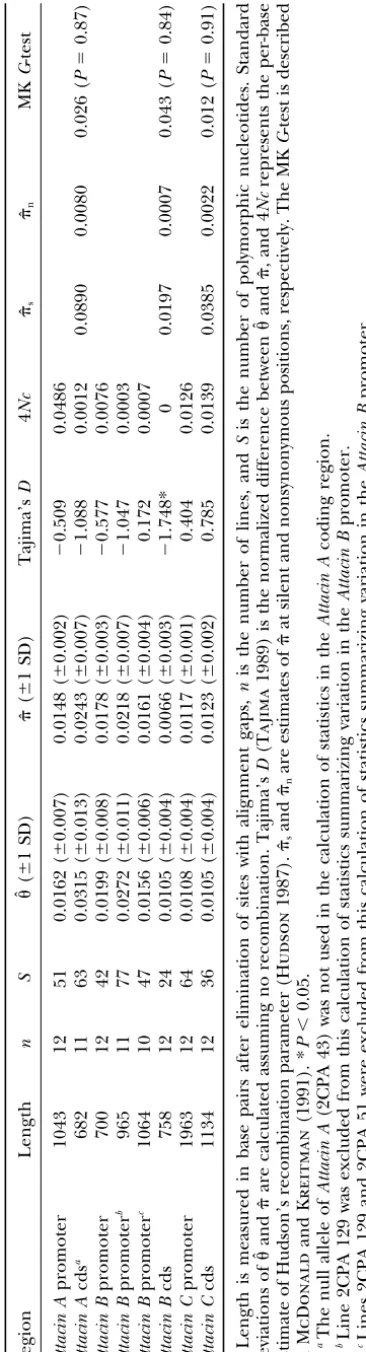
TABLE 1 Summary statistics describing polymorphism in D. melanogaster Attacin genes Region L ength nS ˆ( ⫾ 1S D ) ˆ ( ⫾ 1 S D) Tajima’s D 4 Nc
ˆs ˆn
MK G -test Attacin A promoter 1043 12 51 0.0162 ( ⫾ 0.007) 0.0148 ( ⫾ 0.002) ⫺ 0.509 0.0486 Attacin A cds a 682 1 1 6 3 0.0315 ( ⫾ 0.013) 0.0243 ( ⫾ 0.007) ⫺ 1.088 0.0012 0.0890 0.0080 0.026 ( P ⫽ 0.87) Attacin B promoter 700 1 2 4 2 0.0199 ( ⫾ 0.008) 0.0178 ( ⫾ 0.003) ⫺ 0.577 0.0076 Attacin B promoter b 965 1 1 7 7 0.0272 ( ⫾ 0.011) 0.0218 ( ⫾ 0.007) ⫺ 1.047 0.0003 Attacin B promoter c 1064 10 47 0.0156 ( ⫾ 0.006) 0.0161 ( ⫾ 0.004) 0.172 0.0007 Attacin B cds 7 58 12 24 0.0105 ( ⫾ 0.004) 0.0066 ( ⫾ 0.003) ⫺ 1.748* 0 0 .0197 0.0007 0.043 ( P ⫽ 0.84) Attacin C promoter 1963 12 64 0.0108 ( ⫾ 0.004) 0.0117 ( ⫾ 0.001) 0.404 0.0126 Attacin C cds 1134 12 36 0.0105 ( ⫾ 0.004) 0.0123 ( ⫾ 0.002) 0.785 0.0139 0.0385 0.0022 0.012 ( P ⫽ 0.91) Length is measured in base pairs after elimination o f sites with alignment gaps, n is the number o f lines, and S is the number of polymorphic nucleotides. Standard deviations of ˆand ˆ are calculated assuming no recombination. Tajima’s D ( Tajima 1989) is the normalized difference b etween ˆand ˆ ,a n d 4 Nc represents the per-base estimate of Hudson’s recombination p arameter ( Hudson 1987).
ˆs
and
ˆn
Figure3.—Alignments of the variable sites within and betweenD. melanogasterandD. simulans Attacins AandB. The most common nucleotide state in theAttacin Agene at each position is shaded. A paralogous gene conversion event that subsequently rose in frequency has homogenized exon 2 ofAttacins AandB, but has not disrupted sequence divergence in exon 1. The large number of sites line 2CPA 129 shares withD.simulansin exon 2 ofAttacin Asuggests that this allele was not affected by gene conversion and probably is ancestral to the remainingD. melanogaster Attacin Asequences. The number of positions at which lines 2CPA 7 and 2CPA 14 inAttacin Ashare state with line 2CPA 51 inAttacin Bsuggests that these alleles reflect an independent exchange event betweenAttacins AandB.
significant excess of derived polymorphisms at high fre- ⫺0.667, P ⫽ 0.298 in the Attacin A upstream; H ⫽ ⫺4.364,P ⫽ 0.132 in the intergenic spacer, complete quency within the expanding clade (H⫽ ⫺9.500,P⫽
0.0748 in theAttacin Aupstream;H⫽ ⫺3.142,P⫽0.080 deletion analysis). The power of this calculation is ham-pered in the intergenic spacer, the region that would in the intergenic spacer; critical values determined by
simulation) when only sites where confident inference be expected to show the strongest effect, by the small number of sites for which ancestry can be inferred. Still, of the ancestral state is possible are considered. When
dow of the level of nucleotide diversity along theAttacin C gene region reveals a region ofⵑ200 bp beginning 400 bp upstream of the translational start codon where nucleotide heterozygosity is increasedⵑ10-fold (Figure 6A). The polymorphic sites within this region are in strong linkage disequilibrium with one another and with several sites flanking the window of elevated diversity (Figure 6B). Comparison to the D. simulans Attacin C sequence reveals that neither of the two primary haplo-types generated by this linkage disequilibrium is obvi-ously more ancestral than the other, but instead that both are composed of a combination of apparent ances-tral and derived sequence states (Figure 5). A sliding window analysis of the divergence between the D.
sim-ulansandD.melanogaster Attacin Csequences shows an
ⵑ4-fold increase in divergence overlying the peak ofD.
melanogaster variability (Figure 6). This spike in
diver-Figure4.—Neighbor-joining tree (SaitouandNei1987) gence is preceded by a 31-bp insertion in theD.simulans
of the alignedAttacin AandAttacin Bcoding sequences from sequence (the insertion does not compromise the ability D.melanogasterandD.simulans. Indicated nodes have⬎85%
to align theD.melanogasterandD.simulanssequences). bootstrap support, as determined using 1000 bootstrap
repli-The window of high polymorphism and divergence is cates in the MEGA2 software (http://www.megasoftware.net).
relatively AT-rich (ⵑ20% GC compared to ⵑ43% GC Recurrent gene conversion events obscure the phylogenetic
ancestry of alleles ofAttacins AandB, causing mostD.melano- over the entireAttacin Cregion) and is mildly repetitive, gaster Attacin A alleles to cluster significantly with Attacin B but does not have any characterized function.
alleles, instead of with D. simulans Attacin A. Similarly, line 2CPA 51 inAttacin Bfalls outside the mainAttacin Bclade by
virtue of shared polymorphisms withAttacin Aalleles 2CPA 7 DISCUSSION and 2CPA 14.
The predominant pattern that emerges from the Dro-sophilaAttacinsequence data is the presence of highly divergent haplotypes in alleles sampled from a single logous gene conversion has recently increased rapidly
in frequency. population. The most divergent haplotypes in the
At-tacin AandAttacin Bcoding sequences have apparently
Polymorphism in the Attacin C gene: The Attacin C
promoter and coding sequences are less variable at the been generated by paralogous gene conversion events that have introduced tracts of segregating sites into the nucleotide level than are Attacins A and B, with ˆ ⫽
0.011 (⫾4.20⫻ 10⫺3) andˆ ⫽ 0.012 (⫾1.07⫻ 10⫺3). converted locus. Most dramatically, the 3⬘end ofAttacin B has converted the 3⬘ end of Attacin A, introducing This relative reduction in variability may partially be
due to the fact thatAttacin Cis far enough fromAttacins ⵑ30 segregating sites and seven amino acid replace-ments into the second exon ofAttacin A. The converted AandBon the chromosome (and sufficiently divergent
at the nucleotide level) to escape any paralogous ex- allele is found at a frequency of 0.92 in our sequence sample, effectively displacing the unconvertedD. melano-changes. There are five sites in the Attacin C survey
region at which theD. simulanssequence displays a third gaster Attacin Aallele in the sampled population (and establishing itself as theAttacin Areference sequence). nucleotide state in a position that is polymorphic inD.
melanogaster, again showing multiple mutational hits at TheAttacingenes reside in a region of the Drosophila
second chromosome that experiences high levels of mei-a position mei-and mei-a depmei-arture from the infinite sites model.
Interestingly, the Attacin C sequences we obtained otic recombination (KlimanandHey1993;Carvalho
andClark1999). Given the relative sequence homoge-were fixed for an 8-bp coding region insertion relative
to the BDGP genome sequence. This insertion retains neity and the absence of apparent historical recombina-tion between conversion types, the rise in frequency the open reading frame, whereas the BDGP allele
should terminate in a premature stop, supporting the of the converted allele must have been rapid. Precise estimates of the age of the conversion event are difficult assertion ofHedengrenet al.(2000) that they;cn bw;
sp stock (iso-1) used by the genome project probably to make, as tests of allele age and the rate of clade expansion rely on assumptions of independent muta-carries a null allele of theAttacin Cgene.
As in theAttacin ABregion, we see marked haplotype tion and infinite sites. Both of these assumptions are clearly violated in ourAttacin ABdata. Some resolution dimorphism among theAttacin Calleles. In theAttacin
Ccase, however, the two common allelic classes are at may be provided by examining associations between sites in theAttacin AandBcoding regions and sites in intermediate frequency and line 102G is an apparent
Figure6.—(A) A sliding window analysis of Attacin Cshows that nucleotide heterozygosity within D. melanogaster () and divergence of D. melanogasterfromD. simulans(d) both peak in a short windowⵑ200 bp upstream of the translational start codon. Thex-axis is labeled with the midpoint of each window, relative to theAttacin Cstart codon. The short gap in the plot represents a 30-bp region that was not surveyed for sequence variation. The second, smaller peak in divergence occurs downstream of theAttacin Cstop codon in the putative 3⬘ UTR. The sliding window analysis was performed with the DnaSP 3.14 software package (Rozasand Rozas1999) using a 50-bp window taking 10-bp steps. (B) Linkage disequilibrium between sites present in two or more alleles was measured using Fisher’s exact test, uncorrected for multiple comparisons. There is a general lack of significant disequilibrium across theAttacin Cregion, except among closely linked sites in the coding region and among the sites that underlie the spike in polymorphism and divergence, where linkage disequilibrium is strong.
be subject to the same intergenic conversion events that spacer. However, the presence of 10 fixed or nearly fixed differences between exon 2 of Attacin A and B affect the coding regions. Forces, such as natural
selec-tion, that cause rapid changes in allele frequency in the (Figure 3) and the imperfect haplotype sharing of
At-tacin Aalleles 2CPA 7 and 2CPA 14 withAttacin Ballele
coding sequences should cause perturbations in the site
frequencies and associations in the noncoding regions. 2CPA 51 argue against the young conversion hypothesis. Rather, the relative homogeneity of the intergenic The four lines that have aberrant haplotypes in the
Attacin Aor Bcoding regions, lines 2CPA 7, 2CPA 14, spacer in the other eight lines, the lines that are also
homogeneous in the Attacin A and B coding regions, 2CPA 129, and 2CPA 51, also have divergent haplotypes
in the intergenic spacer. The continued association of probably reflects the fact that thisAttacin ABallele has increased in frequency sufficiently recently that there the outlier coding region haplotypes with the outlier
haplotypes in the intergenic spacer, despite a high rate has not been time for it to recombine or accumulate novel mutations. It is not clear why the Attacin A 5⬘ of meiotic recombination, could indicate that the
Drosocingene, immediately upstream of theAttacin A5⬘ Since intergenic exchange is known to occur among tandemly repeated genes (Leigh Brownand
Ish-Hor-survey region, affects the pattern of polymorphism in
theAttacin A5⬘region. owicz1981;Melloret al. 1983), we favor paralogous
gene conversion as the logical mechanism for creating One alternative mechanism for generating the deep
genealogical branches we observe in our data could be the pattern we observe in the Attacin A and Attacin B genes.
provided if chromosomal inversions segregated among
the lines in our sample. Inverted chromosomes are Gene conversion, however, cannot explain the haplo-type dimorphism we observe in Attacin C. For most of known to segregate in naturalD. melanogaster
popula-tions (Ashburner1989). These rearrangements disrupt the 2 kb that we surveyed upstream of theAttacin Cstart codon, the level of nucleotide heterozygosity is low and the gene order along the chromosome and prevent
homologous recombination during meiosis. If theAt- there is little association among sites. Then, for a window beginning 400 bp upstream of the translational start
tacingenes were locked up in such an inversion,
muta-tions could accumulate independently and without re- and continuing forⵑ200 bp, the level of polymorphism increases 10-fold fromⵑ0.015 to a peak of 0.15. Linkage combination between the two inversion types. For
instance, if line 2CPA 129 was inversion type “A” and disequilibrium is strong in this region, generating two primary haplotypes that are at frequencies of 0.58 and the remainder of the lines were inversion type “B,”
muta-tions could accumulate and fix in inversion type B with- 0.42 in the sample (Figures 5 and 6). There is no clear explanation for this pattern. Nucleotide divergence out ever influencing the sequence of line 2CPA 129. In
this way, line 2CPA 129 could continue to maintain the from D. simulans is also substantially increased in this region fromⵑ0.15 for the remainder of the region to ancestral sequence (as inferred fromD.simulans) while
the other lines (inversion type B) could diverge mark- a remarkable peak of 0.62, consistent with a sharply localized increase in the mutation rate. However, an edly. However, the inversion hypothesis cannot explain
how lines 2CPA 7 and 2CPA 14 atAttacin A share site increase in mutational pressure alone should not create the degree of linkage disequilibrium observed in the state at so many positions with line 2CPA 51 atAttacin
B. The only inversion on the right arm of the second region. A balanced polymorphism might create such a pattern (KreitmanandHudson1991), but this would chromosome that segregates in natural populations with
any appreciable frequency is In(2R)NS, which spans not explain the increase in interspecific divergence, and the spike in diversity is too sharply defined for the bal-cytological positions 52A to 56F (LindsleyandGrell
1967). This inversion is near, but does not include, the ancing selection explanation to be likely. There are no identified regulatory elements under the spike in either
Attacingenes. Furthermore, the fact that the haplotype
structure observed in theAttacin ABregion is not main- haplotype. There are three amino acid polymorphisms in the 5⬘end of theAttacin Ccoding sequence (Figure tained in the nearby Attacin C region argues for
in-tergenic recombination, which is inconsistent with the 5), but none of these is at an appropriate frequency in the sample or in adequate linkage disequilibrium with inversion hypothesis. The lack of strong associations
between polymorphic sites in the Attacin A promoter the promoter haplotypes to be a good candidate for involvement in the maintenance of the observed haplo-region also argues for free recombination between
al-leles in the sample and against the inversion hypothesis. type dimorphism. The effects of natural selection acting on a linked locus outside the survey region could con-A second alternative explanation for the divergent
haplotypes in the second exon ofAttacin Ainvolves the ceivably have generated the observed data, but there is no independent evidence suggesting such a selected introgression of a segment of theD.simulans Attacin A
gene into its D. melanogaster homolog. Under this sce- locus. It is possible that such a pattern could be generated by an extremely local increase in mutation rate coupled nario, all of the sampled alleles except 2CPA 129
repre-sent the “true”D.melanogaster Attacin Asequence, which with strong population subdivision, but such severe subdi-vision should be detectable at other, unrelated loci, and no is highly divergent from theD.simulans Attacin Agene
sequence. Interspecific hybridization betweenD.melano- such population structure has been documented. Further study will be required to explain the structure of
haplo-gaster and D. simulans would have introduced the D.
simulans Attacin Asequence into theD.melanogasterge- types inAttacin C.
Despite the fact that there is not an excess of amino nome, where it has since attained polymorphic
fre-quency in theD.melanogasterpopulation. Such an intro- acid substitutions in the Attacin genes, we have uncov-ered a number of polymorphisms that are likely to have gression event has been proposed in the history of the
DrosophilaCecropingene family (Dateet al. 1998). Like some functional effect. In particular, the seven amino acid changes segregating between the converted and the inversion hypothesis, however, the introgression
hy-pothesis fails to explain the allele shared betweenAttac- unconverted alleles in the second exon of Attacin A may be functionally important. The observation that
ins AandB. The lack of a clear mechanism for
hybridiza-tion between these two species (hybrid females are the converted allele is rapidly increasing in frequency, perhaps through the action of natural selection, bolsters sterile, and hybrid males are inviable; Sturtevant
dis-Ashburner, M., 1989 Drosophila: A Laboratory Handbook. Cold Spring
covered null allele ofAttacin Ashould prove insightful
Harbor Laboratory Press, Cold Spring Harbor, NY.
with respect to the functional redundancy of antibacte- A˚ sling, B., M. S. DushayandD. Hultmark, 1995 Identification
of early genes in theDrosophilaimmune response by PCR-based
rial peptides. The fact that the null allele occurred on
differential display: theAttacin Agene and the evolution of
at-the background of at-the most commonAttacin AB
haplo-tacin-like proteins. Insect Biochem. Mol. Biol.25:511–518.
type (which we infer to be young) suggests that this Bulet, P., C. Hetru, J.-L. DimarqandD. Hoffmann, 1999
Antimi-crobial peptides in insects: structure and function. Dev. Comp.
mutation is probably recent, and our failure to detect
Immunol.23:329–344.
a second occurrence in a much larger sample indicates
Carlsson, A., P. Engstro¨ m, E. T. PalvaandH. Bennich, 1991
At-that it may be in mutation-selection balance. As pointed tacin, an antibacterial protein fromHyalophora cecropia, inhibits
synthesis of outer membrane proteins inEscherichia coliby
in-out byHedengrenet al. (2000), theD.melanogasterstock
terfering withompgene transcription. Infect. Immun.59:3040–
used for sequencing by the Berkeley Drosophila
Ge-3045.
nome Project carries a probable null allele ofAttacin C. Carlsson, A., T. Nystro¨ m, H. de CockandH. Bennich, 1998
At-tacin—an insect immune protein—binds LPS and triggers the
H. cecropia carries the nonfunctional remnants of two
specific inhibition of bacterial outer-membrane protein synthesis.
Attacingenes (Sunet al. 1991), andD.melanogaster
har-Microbiology144:2179–2188.
bors pseudogenes derived from twoCecropinantibacte- Carvalho, A. B., andA. G. Clark, 1999 Intron size and natural
selection. Nature401:344.
rial peptide genes (Kylstenet al. 1990). Additionally,
Clark, A. G., andL. Wang, 1997 Molecular population genetics of
D.simulans,D.mauritiana, andD.sechellia each carry a
Drosophila immune system genes. Genetics147:713–724.
third young Cecropin pseudogene (Clark and Wang Date, A., Y. Satta, N. TakahataandS. I. Chigusa, 1998 Evolution-ary history and mechanism of theDrosophila Cecropingene family.
1997; Date et al. 1998; Ramos-Onsins and Aguade´
Immunogenetics47:417–429.
1998). Therefore, it seems loss-of-function mutations
Dushay, M. S., J. B. Roethele, J. M. Chaverri, D. E. Dulek, S. K. may be relatively common in antibacterial peptide Syedet al., 2000 TwoAttacinantibacterial genes ofDrosophila
melanogaster. Gene246:49–57.
genes. More subtle phenotypic effects may result from
Engstro¨ m, P., A. Carlsson, A. Engstro¨ m, Z. J. TaoandH. Bennich,
mutations in regulatory regions, especially in light of
1984 The antibacterial effect of attacins from the silk moth
the need for antibacterial peptide genes to be rapidly Hyalophora cecropiais directed against the outer membrane of Escherichia coli. EMBO J.3:3347–3351.
transcribed upon infection. A complex series of
inser-Fay,J. C., and C.-IWu, 2000 Hitchhiking under positive Darwinian
tion/deletions and substitutions in the Attacin B
pro-selection. Genetics155:1405–1413.
moter, which may not directly eliminate or create tran- Fu, Y. X., 1997 Statistical tests of neutrality of mutations against
population growth, hitchhiking and background selection.
Ge-scription factor binding sites, may alter tranGe-scription
netics147:915–925.
factor binding efficiency through changes in chromatin
Fu, Y. X., andW.-H. Li, 1993 Statistical tests of neutrality of
muta-structure or physical spacing between bound factors. tions. Genetics133:693–709.
Gunne, H., M. HellersandH. Steiner, 1990 Structure of
preproat-The picture that emerges from this analysis is that
tacin and its processing in insect cells infected with a recombinant
Attacinantibacterial peptide genes retain high levels of
baculovirus. Eur. J. Biochem.187:699–703.
polymorphism inD. melanogasterpopulations by exhib- Hedengren, M., K. BorgeandD. Hultmark, 2000 Expression and
evolution of theDrosophila Attacin/Diptericingene family.
Bio-iting an unusual level of genomic instability, including
chem. Biophys. Res. Comm.279:574–581.
paralogous gene conversion, insertion/deletion events,
Hoffmann, J. A., F. C. Kafatos, C. A. JanewayandR. A. B.
Ezeko-and gene duplication Ezeko-and loss. The ramifications of this witz, 1999 Phylogenetic perspectives in innate immunity. Sci-instability on the flies’ capacity to mount an effective ence284:1313–1318.
Hudson, R. R., 1987 Estimating the recombination parameter of a
antibacterial response is not easy to determine, but some
finite population model without selection. Genet. Res.50:45–50.
of the observed variation is likely to have a functional Hudson, R. R., K. Bailey, D. Skarecky, J. KwiatowskiandF. J. effect. Several features of the data suggest departures Ayala, 1994 Evidence for positive selection in thesuperoxide ismutase (Sod) region of Drosophila melanogaster. Genetics 136:
from simple neutral evolution. Ultimately, the most
con-1329–1340.
vincing assessment of the functional consequences of Hultmark, D., A. Engstro¨ m, K. Andersson, H. Steiner, H. Bennich polymorphism in insect antibacterial response genes et al., 1983 Insect immunity. Attacins, a family of antibacterial
proteins fromHyalophora cecropia. EMBO J.2:571–576.
will come from careful studies associating genotypic with
Kang, D., G. Liu, H. GunneandH. Steiner, 1996 PCR differential
phenotypic variation. display of immune gene expression inTrichoplusia ni. Insect
Bio-chem. Mol. Biol.26:177–184. We thank Manolis Dermitzakis and Malia Fullerton for insightful
Kliman, R. M., andJ. Hey, 1993 Reduced natural selection
associ-discussion regarding the frequencies and allelic distributions of
poly-ated with low recombination inDrosophila melanogaster. Mol. Biol. morphic sites. Comments from M. Dermitzakis, K. Montooth, M.
Evol.10:1239–1258.
Aguade´, and two anonymous reviewers improved the quality of the Kreitman, M., andR. R. Hudson, 1991 Inferring the evolutionary manuscript. This work was supported by grant AI46402 to A.G.C. from histories of theAdhandAdh-duploci inDrosophila melanogaster the National Institutes of Health and by a Dissertation Improvement from patterns of polymorphism and divergence. Genetics127: Award DEB0073598 to B.P.L. and A.G.C. from the National Science 565–582.
Foundation. B.P.L. is supported by a National Science Foundation Kylsten, P., C. SamakovlisandD. Hultmark, 1990 TheCecropin
Graduate Research Fellowship. locus inDrosophila: a compact gene cluster involved in the
re-sponse to infection. EMBO J.9:217–224.
Leigh Brown, A. J., andD. Ish-Horowicz, 1981 Evolution of the
87A and 87C heat-shock loci inDrosophila. Nature290:677–681.
Lindsley, D. L., andE. H. Grell, 1967 Genetic Variations of Drosophila
LITERATURE CITED
melanogaster. Carnegie Institution of Washington, Washington, DC.
Ando, K., M. OkadaandS. Natori, 1987 Purification of Sarcotoxin
Mellor, A. L., E. H. Weiss, K. RamachandranandR. A. Flavell, fall webworm,Hyphantria cunea, using PCR-based differential dis-play and subtractive cloning. Insect Biochem. Mol. Biol.28:827– 1983 A potential donor gene for thebmlgene conversion event
in the C57BL mouse. Nature306:792–795. 837.
Stephens, J. C., 1985 Statistical methods of DNA sequence analysis:
Ourth, D. D., T. D. LockeyandH. E. Renis, 1994 Induction of
cecropin-like and attacin-like antibacterial but not antiviral activ- detection of intragenic recombination or gene conversion. Mol. Biol. Evol.2:539–556.
ity inHeliothis virescenslarvae. Biochem. Biophys. Res. Commun.
200:35–44. Sturtevant, A. H., 1920 Genetic studies onDrosophila simulans. I.
Introduction. Hybrids with Drosophila melanogaster. Genetics5:
Ramos-Onsins, S., andM. Aguade´, 1998 Molecular evolution of
theCecropinmultigene family in Drosophila: functional genesvs. 488–500.
pseudogenes. Genetics150:157–171. Sugiyama, M., H. Kuniyoshi, E. Kotani, K. Taniai, K. Kadono
-Rozas, J., andR. Rozas, 1999 DnaSP Version 3: an integrated pro- Okuda et al., 1995 Characterization of a Bombyx mori cDNA
gram for molecular population genetics and molecular evolution encoding a novel member of the Attacin family of insect antibacte-analysis. Bioinformatics15:174–175. rial peptides. Insect Biochem. Mol. Biol.25:385–392.
Saitou, N., andM. Nei, 1987 The neighbor-joining method: a new Sun, S. C., I. Lindstrom, J. Y. LeeandI. Faye, 1991 Structure and
method for constructing phylogenetic trees. Mol. Biol. Evol.4: expression of the Attacingenes in Hyalophora cecropia. Eur. J.
406–425. Biochem.196:247–254.
Sawyer, S., 1989 Statistical tests for detecting gene conversion. Mol. Tajima, F., 1989 Statistical method for testing the neutral mutation
Biol. Evol.6:526–538. hypothesis by DNA polymorphism. Genetics123:585–595.
Shin, S. W., S. S. Park, D. S. Park, M. G. Kim, S. C. Kimet al., 1998