PROBABILISTIC AND DETERMINISTIC SEISMIC IN-STRUCTURE
RESPONSE SPECTRA OF REACTOR BUILDINGS KKB AND KKG
(SWITZERLAND)
Rainer Zinn1, Michael Borgerhoff 1, Urs Bumann2, Christian Schneeberger2, and Tadeusz
Szczesiak2
1
Stangenberg und Partner Consulting Engineers, Germany ([email protected]) 2
Swiss Federal Nuclear Safety Inspectorate ENSI, Switzerland
ABSTRACT
This paper compares deterministic and probabilistic soil structure interaction (SSI) analyses for the reactor buildings Beznau (KKB) and Gösgen (KKG) in Switzerland. The seismic input ground response spectra are UHS at an annual probability of exceedance of 10-4 defined at the surface of the KKB and KKG sites, obtained from Probabilistic Seismic Hazard Analysis (PSHA). For the probabilistic SSI analysis, the structural properties (Young’s modulus, damping) and the soil properties (shear modulus, damping) of the structural and soil models are scaled by a series of 30 scaling factors randomly generated according to a Latin Hypercube procedure in order to generate an ensemble of 30 soil-structure models. The 30 input motions of the study are generated taking the uncertainty of the ground UHS into account, alternatively without the UHS uncertainty; results are presented from the latter computations. For the deterministic SSI analysis, only the mean soil shear modulus G is varied with a coefficient of variation (COV) of 0.5. COV = 0.5 is justified since the sites are well investigated.
The deterministic and probabilistic seismic SSI analyses have been performed by use of the SASSI2010 software. ISRS were developed at foundation level, level of reactor vessel support, and crane runway level. The deterministic spectra are compared to the probabilistic spectra.
INTRODUCTION
Currently most seismic response analyses for the evaluation of in-structure response spectra (ISRS) are performed deterministically, incorporating a range of variation in soil properties, but only limited or no variation of structural properties. The results from computations with different soil properties are enveloped. The probabilistic analysis takes into account the uncertainty in the soil and structural properties and – optionally – also in the input motion and provides estimates for the statistical distribution of the ISRS. In the context of reassessment of the seismic safety of existing Swiss NPPs, the use of the probabilistic ISRS for deterministic verification of systems and components is currently being examined.
SEISMIC HAZARD, NUMERICAL MODELS, AND SELECTED OUTPUT LOCATIONS
The seismic input ground response spectra are the 10-4/a UHS obtained from Probabilistic Seismic Hazard
Analysis (PSHA) which were used in the Seismic Fragility Analyses, see ENSI (2012a, 2012b). These spectra were used as the seismic hazard actually accepted by the Swiss Federal Nuclear Safety Inspectorate (ENSI) independently from current discussions in the frame of the PEGASOS Refinement
Project (PRP). In Figure 1, the 10-4/a UHS at soil surface for the sites Beznau (KKB) and Gösgen (KKG)
Figure 1. 10-4/a UHS (horizontal components) at the sites KKB (left) and KKG (right)
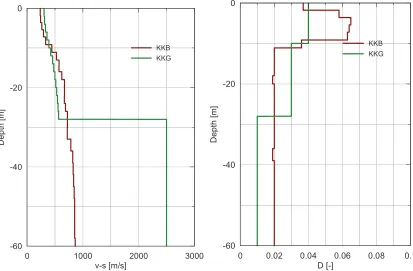
The soil characteristic were varied in a reasonable range regarding that both sites are well investigated. Figure 2 shows the variation of best estimate (BE) values of shear wave velocity and damping versus depth until -60 m for both sites. For the KKG site, a firm rock formation is found at a depth of approximately 28 m beneath soil surface.
Figure 2. Soil profiles until depth -60 m below surface. BE values of shear wave velocity v-s (a) and damping D (b). The curves show the stepwise idealization for the SASSI2010 input.
1 10 100
Frequency [Hz] 0
0.4 0.8 1.2 1.6 2
A
c
c
e
le
ra
ti
o
n
[g
]
84th Percentile Mean 50th Percentile
1 10 100
Frequency [Hz] 0
0.4 0.8 1.2 1.6 2
A
c
c
e
le
ra
ti
o
n
[g
]
84th Percentile Mean 50th Percentile
0 1000 2000 3000
v-s [m/s] -60
-40 -20 0
D
e
p
th
[m
]
KKB KKG
0 0.02 0.04 0.06 0.08 0.1
D [-] -60
-40 -20 0
D
e
p
th
[m
]
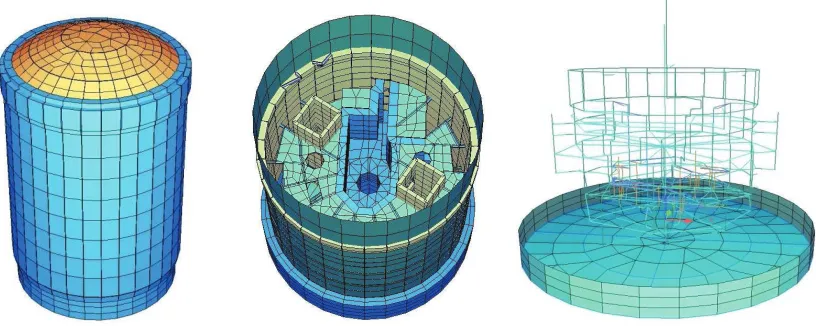
Three-dimensional finite element analysis models of the KKB and KKG reactor building (RB) structures were developed by the plant operators and used in the seismic SSI analysis. The models consist of 3-D solid elements, 3-D shell elements, 3-D beam elements, and spring elements. Based on the SASSI formulation, the excavated soil volume replaced by the embedded part of the structure (KKB 13 m, KKG 6 m) is part of the model. At the bottom and lateral surfaces of the excavated soil volume, the excavated soil and RB structure share the same nodes. Figure 3 presents different views of the finite element SSI models for the KKB and KKG reactor buildings, respectively.
Figure 3. Shell FE Model of the KKB RB (left and middle). Stick Model of the KKG RB used for SASSI analysis (right).
For both RB models, three typical locations for the output of ISRS were selected: 1) crane runway, 2) location near reactor pressure vessel (RPV) support, and 3) foundation level. The crane runway is located in both cases at nearly the same height above the foundation level.
DETERMINISTIC SEISMIC SSI ANALYSIS
The deterministic seismic SSI analysis is carried out according to the German KTA rules KTA 2201 (2011). For the two RB models, uncracked structures with a full concrete elastic modulus and a damping ratio of 7 % were considered for deterministic SSI analysis in accordance with KTA 2201. This procedure is also in accordance, for example, with ASN (2006). However ASCE (2005) recommends effective cracked concrete stiffness. For the deterministic SSI analysis, the BE soil shear modulus GBE is varied with a coefficient of variation (COV) of 0.5 according to KTA 2201, i.e. the upper (UB) and lower bound (LB) values of soil/rock shear modulus GUB and GLB are defined as given in formulas (1) and (2), respectively.
GLB = GBE / (1+COV) (1)
GUB = GBE × (1+COV) (2)
According to USNRC (2013), for well-investigated sites, the COV should be no less than 0.5, and for sites that are not well investigated, the COV for shear modulus shall be at least 1.0. Since both sites KKB and KKG are well investigated, the used COV is justified.
buildings. The time histories are applied as outcrop motions at the soil surface level. In the case of linear analyses of components and building structures these shall be based on at least 3 statistically independent acceleration time histories (TH). On the base of these THs, at least 3 sets consisting of acceleration TH in x-, y- and z-direction shall be formed and applied to the individual structure. The results of these analytical procedures may be averaged. Recorded acceleration time histories as specified in KTA may be used as alternative to the artificial time histories; however, at least 5 time sets shall be applied in this case.
The SASSI2010 modified subtraction method (MSM) is used in this study with additional interaction nodes at the top (ground) surface of the excavated soil volume, see Ostadan (2010). Transfer functions have been reviewed and compared with transfer functions derived by the direct method (DM) indicating that MSM is a robust method for the models investigated in this paper.
The floor response spectra need to be broadened and smoothed in order to achieve a robust design of the relevant components. This is carried out in accordance with the German KTA-rules KTA 2201 for the design of nuclear power plants against seismic events, which recently have been revised. The minimum broadening shall be ±15 % at each frequency in the amplified response region for the BE soil shear modulus case. The final spectra shall envelop the spectra from computations for the upper and lower bounds of the soil stiffness, too. The aforementioned procedure is similar to the regulations ASN (2006) and ASCE (2000). In the USNRC (1978), an acceptable method for determining the amount of peak broadening associated with each of the structural frequencies is described.
A new proposal in the KTA 2201 is that needle peaks may be cut where the width of their basis is not greater than 10 % of their centre frequency. In the paper Henkel (2011), a justification for this procedure is given. Furthermore, “valleys” of spectra are recommended to be closed if the width is smaller than 20% of their centre frequency.
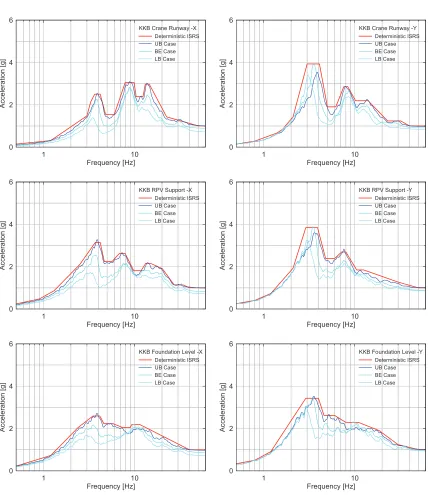
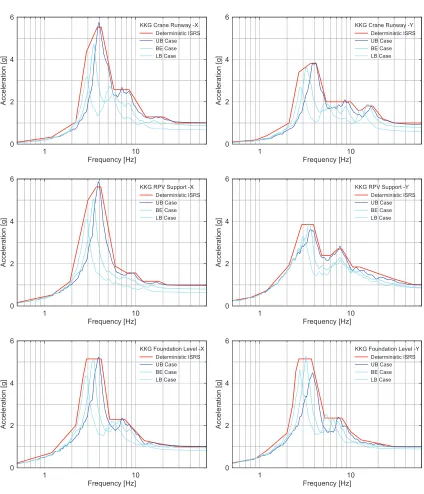
Figures 4 and 5 show examples of horizontal deterministic ISRS obtained from the three SSI cases considered (LB, BE, and UB) and enveloped ISRS broadened by 15 % for BE soil properties. The ISRS for the three reference levels are normalized to the deterministic ZPA = 1.0 g. From the figures it follows that for most of the cases, the UB case leads to the maximum ISRS, but this is not necessarily the case: in some cases the maximum spectral acceleration value is related to the BE case, too.
Figure 4. Deterministic in-structure response spectra KKB (normalized), damping 5 % Smoothed and enveloped spectra from UB, LB and BE cases. X-direction (left), Y-direction (right)
1 10 Frequency [Hz] 0 2 4 6 A c c e le ra ti o n [g ] Deterministic ISRS UB Case BE Case LB Case
KKB Crane Runway -X
1 10 Frequency [Hz] 0 2 4 6 A c c e le ra ti o n [g ] Deterministic ISRS UB Case BE Case LB Case
KKB Crane Runway -Y
1 10 Frequency [Hz] 0 2 4 6 A c c e le ra ti o n [g ] Deterministic ISRS UB Case BE Case LB Case
KKB RPV Support -X
1 10 Frequency [Hz] 0 2 4 6 A c c e le ra ti o n [g ] Deterministic ISRS UB Case BE Case LB Case
KKB RPV Support -Y
1 10 Frequency [Hz] 0 2 4 6 A c c e le ra ti o n [g ] Deterministic ISRS UB Case BE Case LB Case
KKB Foundation Level -X
1 10 Frequency [Hz] 0 2 4 6 A c c e le ra ti o n [g ] Deterministic ISRS UB Case BE Case LB Case
Figure 5. Deterministic in-structure response spectra KKG (normalized), damping 5 % Smoothed and enveloped spectra from UB, LB and BE cases. X-direction (left), Y-direction (right)
1 10 Frequency [Hz] 0 2 4 6 A c c e le ra ti o n [g ] Deterministic ISRS UB Case BE Case LB Case
KKG Crane Runway -X
1 10 Frequency [Hz] 0 2 4 6 A c c e le ra ti o n [g ] Deterministic ISRS UB Case BE Case LB Case
KKG Crane Runway -Y
1 10 Frequency [Hz] 0 2 4 6 A c c e le ra ti o n [g ] Deterministic ISRS UB Case BE Case LB Case
KKG RPV Support -X
1 10 Frequency [Hz] 0 2 4 6 A c c e le ra ti o n [g ] Deterministic ISRS UB Case BE Case LB Case
KKG RPV Support -Y
1 10 Frequency [Hz] 0 2 4 6 A c c e le ra ti o n [g ] Deterministic ISRS UB Case BE Case LB Case
KKG Foundation Level -X
1 10 Frequency [Hz] 0 2 4 6 A c c e le ra ti o n [g ] Deterministic ISRS UB Case BE Case LB Case
PROBABILISTIC SEISMIC SSI ANALYSIS AND COMPARISON TO DETERMINISTIC CASE
For the probabilistic SSI analysis, the structural properties (Young’s modulus, damping) and the soil properties (shear modulus, damping) of the structural and soil models are scaled by a series of 30 scaling factors randomly generated according to a Latin Hypercube procedure in order to generate an ensemble of 30 soil-structure models. The engineering parameters (variables) are defined each by BE value and COV, assuming log-normal distribution, as presented in Table 2. BE and COV reflect the expected magnitude and variability/uncertainty of the considered parameters. Since some authors use the logarithmic standard deviation (ȕ) instead of COV, see, for example, Elkhoraibi et al. (2011), the values ȕ are also tabulated in
brackets (). The values ȕ are typically slightly less than COV for the case of log-normal distribution:
ܥܱܸ ൌ ඥ݁ఉ;െ ͳ (3)
Table 2. Summary of selected engineering parameters (variables) for uncertainty modelling
Engineering Parameter (Variable)
Best Estimate (BE) KKB / KKG
COV (Log-Standard Deviation ȕ)
KKB / KKG
Concrete Young’s Modulus 35 GPa/30 GPa 0.25 (0.246)
Concrete Damping 0.07 0.35 (0.34)
Soil Shear Modulus Derived from Figure 2a 0.50 (0.47)
Soil Damping Figure 2b 0.50/0.35 (0.47/0.34)
The COV assigned to the concrete Young’s modulus represent the modelling uncertainty as well as the uncertainty related to the quality and accuracy of construction for concrete structural elements. The variation in the dynamic soil profile properties are implemented by the dynamic shear modulus and the soil damping ratio. The parameters for uncertainty modelling as shown in Table 2 are in satisfactory agreement with parameters published by other authors, see Elkhoraibi et al. (2011), Ghiocel et al. (2011).
The 30 input motions of the current study are generated taking the uncertainty of the ground UHS into account. An alternative definition of the input motion without the UHS uncertainty has also been investigated. The seismic input for the probabilistic computation was scaled to different values. Since the seismic input for the probabilistic computation is still under discussion, in the following only ISRS are shown where both probabilistic and deterministic earthquake input motions are scaled to the mean UHS level and uncertainty of UHS is not included in probabilistic input motions. That means that each of 30 sets of artificial input time histories match the mean UHS. In other publications, the uncertainty of UHS is included – see Ghiocel et al. (2011) – or not included – see Elkhoraibi et al. (2011).
A procedure for constructing a set of artificial time histories matching a prescribed ground response spectrum with its uncertainty is described by Zentner et al. (2014).
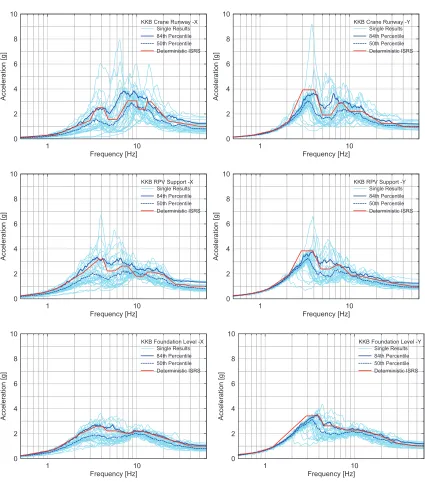
Figure 6. Probabilistic and deterministic ISRS KKB (normalized), damping 5 % Both probabilistic and deterministic earthquake input motions scaled to mean UHS
Uncertainty of UHS not included in probabilistic input motions
1 10 Frequency [Hz] 0 2 4 6 8 10 A c c e le ra ti o n [g ] Single Results 84th Percentile 50th Percentile Deterministic ISRS
KKB Crane Runway -X
1 10 Frequency [Hz] 0 2 4 6 8 10 A c c e le ra ti o n [g ] Single Results 84th Percentile 50th Percentile Deterministic ISRS
KKB Crane Runway -Y
1 10 Frequency [Hz] 0 2 4 6 8 10 A c c e le ra ti o n [g ] Single Results 84th Percentile 50th Percentile Deterministic ISRS
KKB RPV Support -X
1 10 Frequency [Hz] 0 2 4 6 8 10 A c c e le ra ti o n [g ] Single Results 84th Percentile 50th Percentile Deterministic ISRS
KKB RPV Support -Y
1 10 Frequency [Hz] 0 2 4 6 8 10 A c c e le ra ti o n [g ] Single Results 84th Percentile 50th Percentile Deterministic ISRS
KKB Foundation Level -X
1 10 Frequency [Hz] 0 2 4 6 8 10 A c c e le ra ti o n [g ] Single Results 84th Percentile 50th Percentile Deterministic ISRS
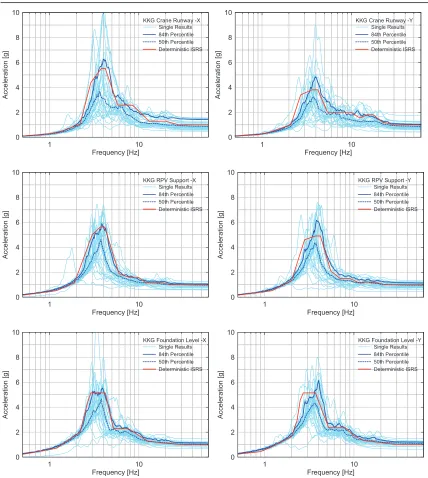
Figure 7. Probabilistic and deterministic ISRS KKG (normalized), damping 5 % Both probabilistic and deterministic earthquake input motions scaled to mean UHS
Uncertainty of UHS not included in probabilistic input motions
1 10 Frequency [Hz] 0 2 4 6 8 10 A c c e le ra ti o n [g ] Single Results 84th Percentile 50th Percentile Deterministic ISRS
KKG Crane Runway -X
1 10 Frequency [Hz] 0 2 4 6 8 10 A c c e le ra ti o n [g ] Single Results 84th Percentile 50th Percentile Deterministic ISRS
KKG Crane Runway -Y
1 10 Frequency [Hz] 0 2 4 6 8 10 A c c e le ra ti o n [g ] Single Results 84th Percentile 50th Percentile Deterministic ISRS
KKG RPV Support -X
1 10 Frequency [Hz] 0 2 4 6 8 10 A c c e le ra ti o n [g ] Single Results 84th Percentile 50th Percentile Deterministic ISRS
KKG RPV Support -Y
1 10 Frequency [Hz] 0 2 4 6 8 10 A c c e le ra ti o n [g ] Single Results 84th Percentile 50th Percentile Deterministic ISRS
KKG Foundation Level -X
1 10 Frequency [Hz] 0 2 4 6 8 10 A c c e le ra ti o n [g ] Single Results 84th Percentile 50th Percentile Deterministic ISRS
CONCLUSIONS
From the performed computations and comparisons it follows that, in the case of the two investigated reactor buildings, the deterministic ISRS, computed as the envelope ISRS for the three deterministic soil profiles LB, BE and UB is of same magnitude as the 84 % probabilistic response computed under the assumption that both probabilistic and deterministic earthquake input motions are scaled to the mean UHS level and uncertainty of UHS is not included in probabilistic analysis. This demonstrates that the
probabilistic 84th percentile ISRS on this basis could be a robust method for the deterministic verification
of the seismic safety of systems and components. In further studies, it has to be checked if the probabilistic 84th percentile ISRS computed including the uncertainty of the UHS in probabilistic input motions and without scaling to the mean UHS level could also be used.
ACKNOWLEDGMENT
The authors wish to express their thanks to AXPO Power AG, CH-5401 Baden, and Kernkraftwerk Gösgen-Däniken AG, CH-4658 Däniken, for the permission to use their structural and load models.
REFERENCES
American Society of Civil Engineers (ASCE) (2000). “Seismic Analysis of safety-related nuclear
structures and commentary, ASCE 4-98.
American Society of Civil Engineers (ASCE) (2005). “Seismic Design Criteria for Structures, Systems,
and Components in Nuclear Facilities, ASCE 43-05.
ASN (2006), ”Prise en compte du risque sismique à la conception des ouvrages de genie civil d’installations nucléaires de base à l’exception des stockages à long terme des déchets radioactifs”, ASN/Guide/2/01.
Elkhoraibi, T., Hashemi, A., Ostadan, F. (2011). “Probabilistic and Deterministic Soil Structure
Interaction Analysis Including Ground Motion Incoherency Effects”. SMiRT 21,New Delhi, India.
ENSI (2012a). „Stellungnahme des ENSI zum deterministischen Nachweis des KKB zur Beherrschung
des 10‘000jährlichen Erdbebens“, Verfügung Fukushima, Swiss Federal Nuclear Saferty
Inspectorate ENSI, ENSI 14/1658, 07.07.2012.
ENSI (2012b). „Stellungnahme des ENSI zum deterministischen Nachweis des KKG zur Beherrschung
des 10‘000jährlichen Erdbebens“, Verfügung Fukushima, Swiss Federal Nuclear Saferty
Inspectorate ENSI, ENSI 17/1370, 07.07.2012.
Ghiocel, D. M., Stoyanow, G. (2011). “Comparative Probabilistic-Deterministic Investigations for
Evaluation of Seismic Soil-Structure Response. Transactions, SMiRT 21,New Delhi, India.
Henkel, F.-O. (2011): “Broadening/Smoothing of Floor Response Spectra – How to deal with ‘Needle
Peaks’”, Transactions, SMiRT 21, New Delhi India.
KTA 2201 (2011). KTA Safety Standard KTA 2201.1, „Design of Nuclear Power Plants against Seismic Events, Part 1: Principles“.
KTA 2201 (2013). KTA Safety Standard KTA 2201.3, „Design of Nuclear Power Plants against Seismic Events, Part 3: Civil Structures“.
Ostadan, F., Dang, N. (2010). “SASSI2010: A System for Analysis of Soil-Structure Interaction
Systems”, Updated Version of SASSI2000.
USNRC (1978). U.S. Nuclear Regulatory Commission: Regulatory Guide 1.122, “Development of Floor Design Response Spectra for Seismic Design of Floor Supported Equipment or Components”. USNRC (2013). U.S. Nuclear Regulatory Commission: NUREG-0800, Standard Review Plan, 3.7.2.
“Seismic System Analysis”.
Zentner, I., Allain, F., Humbert, N., Caudron, M. (2014). „Generation of spectrum compatible ground motion and its use in regulatory and performance-based seismic analysis”, Proceedings of the 9th