Analysis of Structural Response for Regular
Buildings on Dynamic Input on Sloped
Ground With Different Soil Structures
Rushikesh Tilekar, Prof. Vinesh Thorat
M.Tech. Student, Department of Civil Engineering, G.H. Raisoni College of Engineering and Management
Pune, India
Assistant Professor, Department of Civil Engineering, G.H. Raisoni College of Engineering and Management
Pune, India
ABSTRACT: Earthquake creates considerable damage to structure, its behavior is not predictable and it is very dangerous. If the structure is subjected to seismic forces and if the structure is on sloped ground, then the response of structure creates more damage to structure as well as human life. Due to sloped ground some columns may be short and some columns may be long, hence there is always uneven force distribution within structure. At some locations shear forces, bending moments, torsion having more magnitude than structure on flat ground. In northen India about 130 million years ago due to tectonic actions Himalayan mountainous range formed. In this region soil diversity can be observed
In In this paper, G+5 regular building with different slopes are analyzed with the help of numerical analysis. Different soil structures in Central western Himalayan forest will be considered. Forest type having clayey soil or loam is considered and final consolidation settlement is used for finding out subgrade modulus. Structural response will be obtained by performing linear time history analysis in STAAD Pro. Comparison will be made for buildings on slopes with spring stiffness and same buildings without spring stiffnes
KEYWORDS: Building on different slopes; soil structure; regular buildings; numerical analysis
I. INTRODUCTION
Earthquake creates considerable damage to structure, its behavior is not predictable and it is very dangerous. When a structure is subjected to earthquake forces it cause loss to human lives due to the damage cause to the structures that leads to the collapse of the building. Major destruction of the low and high rise buildings in the recent earthquakes leads to the need of investigation. When the earthquake occurs at a sloped building which is rested on hill and having some inclination to the ground, the chances of damage increases much more due to increased lateral forces on short columns. It may leads to the formation of plastic hinges.
In northen India about 130 million years ago due to tectonic actions Himalayan mountainous range is formed. In this region soil diversity can be observed. Due to erosion of soil there is different soil structures. Mostly soils are clayey in nature, which can be created differential settlement and with combination with earthquake it may create more hazard to human life. Now a day, due to the scarcity of the plain terrain there is a need of the construction of the buildings on the sloping ground.
II. METHODOLOGY
A. Introduction to Consolidation of Soil
In the present study, long term deflection of clayey soil is considered and respective stiffnesses will be applied to support system.
Consolidation is the compression of soil mass due to expulsion of water from the voids under steady static and long term pressure.It is a slow long term process and it is experienced in clays or loam soils.
Fig. 2.1 Soil model
When a steady constant load ‘q’ is applied on soil, immediately after applying load, u’ = q and effective pressure σ’
= 0. Hence following equation can consider,
u’ + σ’ = q (2.1)
Where u is the hydrostatic pressure or static pore water pressure, u’ is the hydrodynamic pressure or Excess pore
water pressure and σ’ is the effective pressure.
After long duration when soil is not fully consolidated, some excess pore water pressure released, u’ < q and σ’ > 0. At the time of consolidation excess pore water pressure removed u’ = 0 and σ’ = q.
B. Formulation of Consolidation
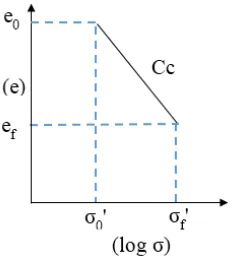
The graph below represents logarithmic variation of effective stress and void ratio. In the consolidation process void ratio decreases from initial void ratio e0 to final void ratio ef, for initial effective stress σ0’ to final effective stress σf’ respectively.
Fig. 2.2 Coefficient of Compressibility
= (2.2)
= (2.3)
∆ = (2.4)
Where, Cc = 0.009 (WL – 10) for natural undisturbed soil
For laterally confined soil, final settlement is formulated as below
∆ = (2.5)
C. Case Study
For the study of consolidation, Himalayan region is considered due to clayey soil or loam is present at most of location. Research paper by C.M. Sharma et.al.[5] is referred for the present study. There are five forest types (FT1 to FT5), which has loam soil texture. Hence these soil data are considered for study.
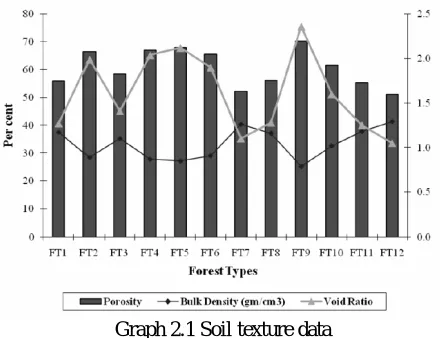
Graph 2.1 Soil texture data
Above graph represents relation between different forest types and void ratio, bulk density and porosity. For the forest types FT1 to FT5 Final settlements are shown below.
Forest Types
Soil Consolidation settlement
Spring Stiffness
FT1 Loam 25 mm 2256kN/m2/m
FT2 Loam 21 mm 2652
kN/m2/m
FT3 Loam 21 mm 2620
kN/m2/m
FT4 Loam 22 mm 2502
kN/m2/m
FT5 Loam 19 mm 2857
For calculation of consolidation settlement footing size of 3m X 3m and depth of footing is 2m below ground surface is considered. Column reaction of 500kN is considered.
D. Structural Modelling
RCC medium rise building of G+5storeyes with floor height 3 m subjected to earthquake loading in V has been considered. In this regard STAAD Pro V8i software has been considered as tool to perform. Effect of sloping effect of the ground on behavior of structural frames is analyzed by considering minimum stiffness of support. Displacements have been calculated for top floor.
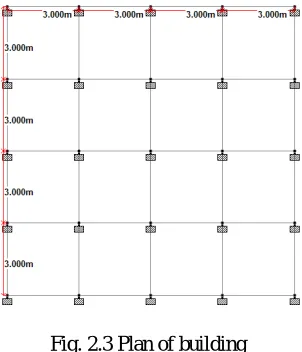
Fig. 2.3 Plan of building
The plan for the above building shown in figure has been considered to carry out the study the dimension of the building are 12m x 12m.A regular G+5 building is considered for analysis such that its center of mass and center of rigidity coincides. Hence torsional forces are neglected from analysis. 10 different models having slopes varying from 0 to 45 degrees have modelled in STAAD Pro.
For analysis of structure, stiffness due to consolidation (Soft support) is considered in three cases, as shown below.
Case 1 – Half supports of structure at downward side of slope are considered as soft support, and remaining supports are considered as fixed support
As per analysis of structure where supports are considered as fixed support, reaction at each end node is known. By considering worst reaction in hatched portion, stiffness is considered for analysis of case 1.
Case 2 – Half supports of structure at upward side of slope are considered as soft support, and remaining supports are considered as fixed support.
Fig. 2.5 Case2
As per analysis of structure where supports are considered as fixed support, reaction at each end node is known. By considering worst reaction in hatched portion, stiffness is considered for analysis of case 2.
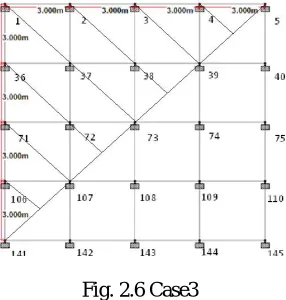
Case 3 –Diagonally half supports of structure at downward side of slope are considered as soft support, and remaining supports are considered as fixed support
Fig. 2.6 Case3
As per analysis of structure where supports are considered as fixed support, reaction at each end node is known. By considering worst reaction in hatched portion, stiffness is considered for analysis of case 3.
Storey Height- 3.0 m
Column Size- 0.4 m x 0.4 m Beam size- 0.3 m x 0.3 m
Live load- 4kN/m2
Fig. 2.7(0 degrees slope) Fig. 2.8(5 degrees slope)
Fig 2.9(10 degrees slope) Fig.2.10(15 degrees slope) .
Fig.2.13 (30 degrees slope)Fig.2.14 (35 degrees slope) .
Fig.2.15 (40 degrees slope) Fig.2.16 (45 degrees slope)
III. RESULTSANDCONCLUSIONS
3.1Results:
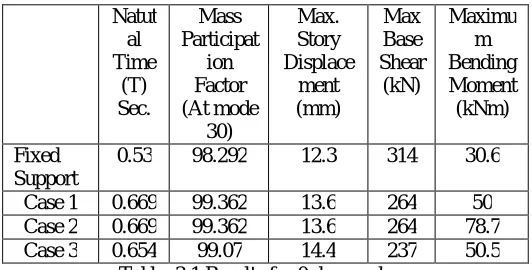
Due to consolidation of soil and sloped ground, responses of structure are compared and represented as belowfor 0 degree and 10 degree slope.
A. For 0 degree slope
Natut al Time
(T) Sec.
Mass Participat
ion Factor (At mode
30)
Max. Story Displace
ment (mm)
Max Base Shear (kN)
Maximu m Bending Moment (kNm)
Fixed Support
0.53 98.292 12.3 314 30.6
Case 1 0.669 99.362 13.6 264 50 Case 2 0.669 99.362 13.6 264 78.7 Case 3 0.654 99.07 14.4 237 50.5
B. For 10 degree slope Natut al Time (T) Sec. Mass Participat ion Factor (At mode 30) Max. Story Displace ment (mm) Max Base Shear (kN) Maximu m Bending Moment (kNm) Fixed Support
0.494 92.68 7.79 300 42.88
Case 1 0.6 94.55 12.3 283 116 Case 2 0.57 94.7 13.1 275 100 Case 3 0.584 94.15 12.8 278 146.3
Table. 3.2 Results for 10 degree slope
3.2 Observations
Natural time period of structure is dependent on mass, structural stiffness and stiffness of support. By considering soft supports, natural time period increases.
Mass participation factor (MPF) is dependent on support conditions also.
Maximum storey deflection is observed in soft supports than fixed end supports.
Maximum base shear is observed in fixed supports than soft supports.
Maximum bending moments are observed in cases where soft supports are considered.
REFERENCES
1. B.G. Birajdar and S.S. Nalawade et.al. “Seismic Analysis of Buildings Resting on Sloping Ground” (August-2004),Paper No-1472,13th World Conference on Earthquake Engineering,Vancouver,B.C.,Canada.
2. Julio J. Hernandez and Oscar A. Lopez et.al., “Dependence of Accidental Torsion on Structural System Properties” (August-2004), Paper No-1165, 13th World Conference on Earthquake Engineering Vancouver,B.C.,Canada.
3. J.F. Rave-Arango and C.A. Blandon-Uribe et.al., “Structural Response of Buildings on Mountain Slopes Subjected to Earth Pressure Under Seismic Conditions” (2012),15 WCEE,Lisboa.
4. M.K. Kumar, V.S.Rao, K.S.Kumar et.al,, “Study on Earthquake Resistant Buildings on Ground Surface By Using E-Tabs” (March-2016),IJLRET.ISSN-2454-5031
5. C.M. sharma, SumeetGairola, S.K. Ghadiyal and SarveshSuyal, “Physical Properties of Soils in Relation to Forest Composition in Moist Temperate Valley Slopes of the Central Western Himalaya” (2010)
6. DevdasMenon and Meher Prasad et.al., “Simplified Procedure For Displacement-based design of Stepped Building,”(2012) ,ISSN-2405-1245 7. Shaikh Imran et.al., “Earthquake Analysis of RCC Building on Hilly”(January-2017), ISSN-2395-1052.
8. A.R. Vijaya Narayanan, RupenGoswami and C.V.R Murty “Performance of RC Buildings along Hill Slopes of Himalayas during 2011 Sikkim earthquake” (2012), 15 WCEE LISBOA 2012.
9. P.K. Das, S.K. Gangopadhyay, S. Nath and S.K. Banerjee “Characteristics and Pedogenic Evolution of N-E Himalayan Forest Soils” (1986), Proc. Indian Nature Science Academy B52 No. 6 767-777 (1986)
10. Inger Elisabeth Måren, SikhaKarki, ChandaPrajapati, Ram KailashYadav and Bharat BabuShrestha “Facing north or south: Does slope aspect impact forest stand characteristics and soil properties in a semiarid trans-Himalayan valley?” (2015), Journal of Arid Environments 121 (2015) 112-123
11. Girish C.S. Negi “Hydrological research in the Indian Himalayan mountains: Soil and water conservation” (2002), Current Science, Vol 83, No 8, 25 October 2002.
12. A.S. Patil and P. D. Kumbhar “Time History Analysis of Multistoried Rcc Buildings for different Seismic Intensities” (2013), ISSN 2319-6009, Vol 2, No 3, August 2013.