DOI: 10.1534/genetics.110.115188
Caenorhabditis elegans
TRPV Channels Function in a Modality-Specific
Pathway to Regulate Response to Aberrant Sensory Signaling
Meredith J. Ezak
,
Elizabeth Hong
,
1Angela Chaparro-Garcia
1,2and
Denise M. Ferkey
3Department of Biological Sciences, State University of New York, Buffalo, New York 14260 Manuscript received February 4, 2010
Accepted for publication February 20, 2010
ABSTRACT
Olfaction and some forms of taste (including bitter) are mediated by G protein-coupled signal transduction pathways. Olfactory and gustatory ligands bind to chemosensory G protein-coupled receptors (GPCRs) in specialized sensory cells to activate intracellular signal transduction cascades. G protein-coupled receptor kinases (GRKs) are negative regulators of signaling that specifically phosphorylate activated GPCRs to terminate signaling. Although loss of GRK function usually results in enhanced cellular signaling,Caenorhabditis elegans lackingGRK-2function are not hypersensitive to chemosensory stimuli. Instead,grk-2mutant animals do not chemotax toward attractive olfactory stimuli or avoid aversive tastes and smells. We show here that loss-of-function mutations in the transient receptor potential vanilloid (TRPV) channelsOSM-9andOCR-2selectively restoregrk-2behavioral avoidance of bitter tastants, revealing modality-specific mechanisms for TRPV channel function in the regulation ofC. eleganschemosensation. Additionally, a single amino acid point mutation in OCR-2that disrupts TRPV channel-mediated gene expression, but does not decrease channel function in chemosensory primary signal transduction, also restoresgrk-2 bitter taste avoidance. Thus, loss ofGRK-2 function may lead to changes in gene expression, viaOSM-9/OCR-2, to selectively alter the levels of signaling components that transduce or regulate bitter taste responses. Our results suggest a novel mechanism and multiple modality-specific pathways that sensory cells employ in response to aberrant signal transduction.
T
O survive, organisms must be able to recognize and respond appropriately to chemical cues in their environment that indicate the presence or absence of food, reproductive partners, or predators. Chemo-sensation is the fundamental process by which chemical signals, in the form of gustatory (taste) and olfactory (smell) stimuli, are detected. The sense of taste is par-ticularly vital to ensure survival as it confers the ability to distinguish favorable food sources from hazardous compounds before they are ingested (Herness andGilbertson1999; Perezet al.2003). Bitter or sour tastes
usually indicate the presence of toxic compounds that would be rejected, whereas salty, sweet, and umami (amino acid) reflect the presence of valuable nutrients (Hernessand Gilbertson1999).
Olfaction and gustatory responses to bitter, sweet, and umami stimuli are generally mediated by G protein-coupled signal transduction pathways that are conserved across species (Dryerand Berghard1999; Chandrashekar
et al.2006; Palmer2007). Signaling is initiated when a
ligand (odorant or tastant) binds to a seven-transmembrane
G protein-coupled receptor (GPCR), inducing a con-formational change in the receptor that activates the associated heterotrimeric G proteins. The Ga subunit exchanges GDP for GTP and, now activated, dissociates from the Gb and Gg (Gbg) subunits. Both the free Ga-GTP and Gbg subunits can stimulate intracellular signaling cascades by interacting with downstream effec-tors such as adenylate cyclases, phospholipases, and ion channels (McCuddenet al.2005).
Following the activation of G protein-coupled signal-ing, a negative feedback mechanism known as desensiti-zation is initiated (Hausdorffet al.1990; Metayeet al.
2005).Gprotein-coupled receptorkinases (GRKs) rec-ognize and phosphorylate activated GPCRs (Freedman
and Lefkowitz 1996; Pitcheret al. 1998; Penn et al.
2000; Premontand Gainetdinov2007). The
phosphor-ylated GPCRs can then be bound by cytosolic arrestin proteins (Freedmanand Lefkowitz1996; Metayeet al.
2005; Premont and Gainetdinov 2007). GRK
phos-phorylation and arrestin binding result in the cessation of G protein signaling, even in the continued presence of agonist (Freedman and Lefkowitz 1996; Penn et al.
2000; Premontand Gainetdinov2007). This
desensi-tization process is necessary to avoid the potentially harmful effects that can result from excessive stimula-tion through activated GPCRs (Metayeet al.2005). For
example, loss-of-function mutations in human GRK1 (rhodopsin kinase) lead to Oguchi disease (Cideciyan
et al.1998; Yamadaet al.1999). GRK1 is required for rod
Supporting information is available online athttp://www.genetics.org/ cgi/content/full/genetics.110.115188/DC1.
1These authors contributed equally to this work.
2Present address: Sainsbury Laboratory, John Innes Center, Norwich
Research Park, Norwich NR4 7UH, UK.
3Corresponding author: Department of Biological Sciences, 109
Cooke Hall, State University of New York, Buffalo, NY 14260. E-mail: [email protected]
recovery after photoactivation, and in patients with this disease, prolonged rod photoreceptor responses and slow recovery following light exposure result in night blindness. In a mouse model for Oguchi disease, loss of GRK1 func-tion leads to retinal degenerafunc-tion (Chenet al.1999).
In most instances, the absence of GRK-mediated de-sensitization causes prolonged, exaggerated responses to GPCR agonists ( Jaber et al. 1996; Rockman et al.
1998; Gainetdinov et al. 1999, 2003; Premont and
Gainetdinov2007). However, there are unique
situa-tions in which loss of a particular GRK can lead to de-creased signaling and responsiveness in a cell-specific manner. For example, while GRK6/mice are
hypersen-sitive to psychostimulants such as cocaine (Gainetdinov
et al. 2003), T cells from GRK6-deficient mice are sig-nificantly impaired in their chemotactic response to CXCL12, a stimulatory chemokine that wild-type T cells migrate toward (Fonget al.2002). Additionally, loss of
GRK3, which is highly expressed in mouse olfactory epithelium (Schleicher et al. 1993), significantly
re-duces odorant-induced generation of the second mes-senger cAMP in cilia preparations (Peppelet al.1997),
in addition to the expected lack of agonist-induced de-sensitization following odorant exposure (Schleicher
et al.1993; Boekhoffet al.1994; Peppelet al.1997).
As soil dwelling nematodes, Caenorhabditis elegans de-pend heavily upon their ability to detect volatile (olfac-tory) and soluble (gusta(olfac-tory) chemicals to find food, avoid noxious environments, develop appropriately, and mate (Bargmann 2006a). Despite their small nervous
system, consisting of just 302 neurons,C. eleganshave a remarkable chemosensory repertoire. Using a limited number of head and tail sensory neurons,C. elegansare able to detect hundreds of chemicals as well as discrim-inate among multiple chemosensory stimuli when they are presented simultaneously (Bargmannand Horvitz
1991; Bargmannet al.1993; Troemel1999; Bargmann
2006a). The 11 pairs of chemosensory neurons located in the head each respond to a defined subset of stimuli (Bargmann2006a). TheAWAandAWColfactory
neu-rons detect chemicals thatC. elegansare attracted to and chemotax toward, while theASH,ADL,AWB, andASK sensory neurons detect aversive odorants and tastants thatC. elegansavoid by initiating backward locomotion upon stimulus detection (Bargmann2006a).
Further-more, the ASH nociceptive neurons are polymodal and detect a range of aversive stimulants, including the odorant octanol, the bitter tastant quinine, SDS, high osmolarity, heavy metals such as copper, and light touch to the nose (Bargmannet al.1990; Kaplanand
Horvitz1993; Hartet al.1999; Sambongiet al.1999;
Troemel1999; Hilliardet al.2002, 2004, 2005).
The C. elegansgenome encodes.500 predicted che-mosensory GPCRs (Bargmann2006a) and 21 Ga, 2 Gb,
and 2 Ggsubunits (Jansenet al.1999; Cuppenet al.2003).
The Ga proteinsODR-3and GPA-3 have a stimulatory role in chemical detection in AWA, AWC, and ASH
(Roayaie et al. 1998; Troemel 1999; Hilliard et al.
2004; Lanset al.2004; Bargmann2006a). Downstream
of G proteins, two distinct channels appear to be involved in chemosensory signal transduction. A cyclic nucleotide-gated channel encoded by thetax-2andtax-4
genes is a sensory transduction channel in the AWC neurons (Coburnand Bargmann1996; Komatsuet al.
1996). In contrast, the OSM-9 and OCR-2 transient receptorpotential vanilloid (TRPV) channel subunits participate in primary signal transduction in theAWA andASHneurons (Colbertet al.1997; Hilliardet al.
2002, 2005; Tobin et al. 2002). Accordingly, loss of
OSM-9 or OCR-2 results in mild to severe defects in
AWA-mediated olfactory responses and ASH-mediated
avoidance behaviors (Colbertet al.1997; Tobinet al.
2002; Hilliardet al. 2004, 2005). In addition,
FRET-based imaging revealed that Ca21transients, which are likely downstream of GPCR signaling in all sensory neurons, are reduced or eliminated inASHin response to a variety of stimuli (including quinine) inosm-9 mu-tants (Hilliardet al. 2005). However, osm-9and ocr-2
mutants retain a substantial behavioral response to the bitter tastant quinine (Hilliardet al.2004; this work),
which is detected primarily byASH. This indicates that while OSM-9/OCR-2 contribute to bitter taste trans-duction, other channels are also likely involved.
Although GRKs have classically been described as negative regulators of GPCR signal transduction, C. elegans lacking GRK-2 function are not hypersensitive to chemical stimuli due to increased sensory signal-ing (Fukutoet al.2004). Instead,grk-2mutant animals
neither chemotax toward attractive odorants detected by AWA and AWC nor avoid aversive odorants and tastants detected primarily byASH(Fukutoet al.2004).
Consistent with defective chemosensory behavioral re-sponses, loss of GRK-2 function leads to a decrease in stimulus-evoked Ca21
signaling in the ASHsensory neurons (Fukuto et al. 2004). Taken together, loss of
GRK-2function leads to decreased signaling inC. elegans
sensory neurons, similar to loss of mammalian GRK3 in olfactory epithelia (Peppelet al.1997; Fukutoet al.
2004). However, the mechanism by which loss of mam-malian GRK3 leads to decreased stimulus-induced cAMP levels is not known.
It was proposed that loss of C. elegans GRK-2 may initially result in excessive chemosensory signaling, but that this activates compensatory mechanisms to down-regulate G protein-coupled signal transduction and terminate signaling (Fukuto et al. 2004) (supporting
(AWA) (Fukutoet al.2004). However, loss ofEAT-16has
no effect onASH-mediated behaviors.grk-2;eat-16 dou-ble mutants remain defective for octanol (odorant) and quinine (tastant) avoidance. Furthermore, we found that loss of the other neuronally expressed RGS proteins,
EGL-10, RGS-1, RGS-2, RGS-3, RGS-6, or RGS-10/11
(Koelleand Horvitz1996; Donget al.2000; Kunitomo
et al. 2005; Ferkey et al. 2007; M. Koelle, personal
communication), does not restore ASH-mediated be-haviors (data not shown). These results indicate that there are diverse, cell-specific responses to aberrant G protein-coupled signaling.
We sought to identify mechanisms responsible for regulating chemosensory GPCR signaling in the ab-sence of GRK function in the ASH sensory neurons. UsingC. elegansgrk-2mutant animals, we performed a forward genetic screen to isolate animals with the restored ability to respond to quinine, an aversive bitter tastant detected byASH(Hilliardet al.2004). We
iso-lated eight mutants in which the quinine response of
grk-2animals was restored; three of the mutations were found to be in the TRPV-related channelsOSM-9and OCR-2. Surprisingly, we find that complete loss of
OSM-9/OCR-2 channel function restores response of grk-2
mutants in both a cell-specific and modality-specific manner, asgrk-2;TRPVdouble mutants have a wild-type response to bitter tastants, but remain defective for other chemosensory stimuli detected byASHandAWA. Downstream of their roles in primary signal trans-duction, OSM-9 and OCR-2 affect activity-dependent gene expression pathways to regulate the long-term transcriptional levels of sensory genes. Loss of these TRPV channels reduces expression ofODR-10, a GPCR expressed in the AWA olfactory neurons that detects diacetyl (Senguptaet al.1996; Tobinet al. 2002) and
selectively decreases expression of the serotonin bio-synthetic enzyme TPH-1 in the ADF sensory neurons (Zhanget al.2004). Furthermore,OCR-2appears to use
distinct structural motifs for primary chemosensory signal transduction and modulation of pathways that control transcriptional activity (Sokolchiket al.2005).
Specifically, theOCR-2(G36E) N-terminal point muta-tion, encoded byocr-2(yz5), results in decreasedTPH-1 expression inADF, but does not diminishAWAolfaction (Sokolchiket al.2005). Unexpectedly, we also find that
theOCR-2(G36E) point mutation is sufficient to restore the response of grk-2 mutants to bitter tastants. This suggests that a unique output of TRPV function, trans-mitted via theOCR-2(G36) N-terminal structural motif, leads to the bitter taste defects ofgrk-2animals.
MATERIALS AND METHODS
Strains:Strains were maintained under standard conditions on NGM agar plates seeded withOP50Escherichia colibacteria (Brenner1974). Strains used in this study include:N2Bristol wild
type,CB4856Hawaiian,FG7grk-2(gk268), FG78grk-2(gk268);
ocr-2(ud21), FG87grk-2(gk268);osm-9(ud23), FG91grk-2(gk268); osm-9(ud19),CX10osm-9(ky10), FG60grk-2(gk268);osm-9(ky10), CX4544ocr-2(ak47), FG99grk-2(gk268);ocr-2(ak47), LX748 osm-9(ky10)ocr-2(ak47), FG118 grk-2(gk268);osm-9(ky10)ocr-2(ak47), JY243 ocr-2(yz5), FG140 grk-2(gk268);ocr-2(yz5), CX7265 osm-9(ky10);yzEx53[osm-10Tosm-9,elt-2Tgfp], FG130 grk-2(gk268); osm-9(ky10);yzEx53[osm-10Tosm-9,elt-2Tgfp], FG166 udEx15 [osm-10Tocr-2,elt-2Tgfp], FG167udEx16[osm-10Tocr-2,elt-2Tgfp], FG168 udEx17[osm-10Tocr-2,elt-2Tgfp], FG169 grk-2(gk268); ocr-2(yz5);udEx18[osm-10Tocr-2,elt-2Tgfp], FG170grk-2(gk268);ocr-2(yz5 );u-dEx19[osm-10Tocr-2,elt-2Tgfp], FG171 grk-2(gk268);ocr-2(yz5);udEx20 [osm-10Tocr-2,elt-2Tgfp], FG173udEx22[srb-6Tocr-2,elt-2Tgfp], FG174 udEx23[srb-6Tocr-2,elt-2Tgfp], FG175 udEx24[srb-6Tocr-2,elt-2Tgfp], FG176grk-2(gk268);ocr-2(yz5);udEx25[srb-6Tocr-2,elt-2Tgfp], FG177 grk-2(gk268);ocr-2(yz5);udEx26[srb-6Tocr-2,elt-2Tgfp], FG179 grk-2 (gk268);ocr-2(yz5);udEx28[srb-6Tocr-2,elt-2Tgfp], FG180 grk-2 (gk268);ocr-2(ak47);udEx29[osm-10Tocr-2,elt-2Tgfp], FG181 grk-2(gk268);ocr-2(ak47);udEx30[osm-10Tocr-2,elt-2Tgfp], FG182grk-2 (gk268);ocr-2(ak47);udEx31[osm-10Tocr-2,elt-2Tgfp], FG184 grk-2 (gk268);ocr-2(ak47);udEx33[srb-6Tocr-2,elt-2Tgfp], FG185 grk-2(gk268);ocr-2(ak47);udEx34[srb-6Tocr-2,elt-2Tgfp], FG186 grk-2(gk268);ocr-2(ak47);udEx35[srb-6Tocr-2,elt-2Tgfp], FG187 udEx36[sra-6Tocr-2,elt-2Tgfp], FG188 udEx37[sra-6Tocr-2,elt-2Tgfp], FG189udEx38[sra-6Tocr-2,elt-2Tgfp], FG190grk-2(gk268); ocr-2(ak47);udEx39[sra-6Tocr-2,elt-2Tgfp], and FG191 grk-2(gk268); ocr-2(ak47);udEx40[sra-6Tocr-2,elt-2Tgfp].
Plasmid construction: osm-10Tocr-2 (pFG14): The ocr-2 promoter was removed frompAJ35(gift of Cori Bargmann) using SphI and XmaI, leaving theocr-2 cDNA in the vector backbone. The900-bp upstream promoter region ofosm-10 was removed fromCR142(Rongoet al.1998) usingSphI and
XmaI and was placed into these sites upstream of the ocr-2 cDNA in the remaining fragment ofpAJ35.
srb-6Tocr-2 (pFG15): The1.3 kbsrb-6promoter was first isolated from pHA#355(Fukutoet al.2004) usingPstI and
BamHI and inserted into the same sites of Fire vector pPD49.26 to create pFG10. The srb-6 promoter was then removed from pFG10usingSphI andXmaI and was placed into these sites upstream of the ocr-2 cDNA (remaining fragment ofpAJ35, as described above).
hspTocr-2 (pFG16): The hsp16-2 promoter was removed from Fire vectorpPD49.78usingSphI andXmaI and was placed into these sites upstream of the ocr-2 cDNA (remaining fragment ofpAJ35, as described above).
sra-6Tocr-2: This construct was the kind gift of Cori Bargmann and was described previously (deBonoet al.2002). Genetic analysis: grk-2(gk268) animals were mutagenized with EMS (ethyl methanesulfonate) as previously described (Brenner 1974). Using this deletion allele decreased the
likelihood of isolating intragenic suppressors or revertants, as might have been more likely if thegrk-2(rt97)animals, which contain a single point mutation, were used. F2animals were assayed for avoidance of 10 mmquinine using the drop assay
with the quinine drop placed in front of the animal (Hilliard
et al.2002; Fukutoet al.2004). Animals that responded by
initiating backward locomotion within 4 sec of encountering the drop were selected. A total of 25,000 F2 animals were screened. Eight mutant strains were isolated.
animals that were used in the EMS screen and in the mapping strain, it remained homozygous during all mapping crosses. This allowed the use of the CB4856 restriction fragment length polymorphisms (RFLPs) to map the grk-2(gk268) suppressor mutations. In genetic mapping experiments, ud19andud23were linked to LG IV near SNPC09G12and ud21was linked to LG IV between the two SNPsC06A6and D2096. Following genetic linkage analysis, complementation assays using the previously defined alleles ofosm-9(ky10)and ocr-2(ak47)confirmed thatud19andud23were alleles ofosm-9, while ud21 represented an allele of ocr-2. All subsequent behavioral experiments were performed with previously char-acterized alleles ofosm-9andocr-2, and the molecular lesions in ud19,ud23, andud21have not been determined.
Behavioral assays: Well-fed young adult animals were used for analysis, and all behavioral assays were performed on at least 2 separate days, along with controls. Behavioral assays were performed as previously described. Response to octanol was scored as the amount of time it took an animal to initiate backward locomotion when presented with a hair dipped in octanol (Troemelet al.1995; Hartet al.1999). (Assays were
stopped at 20 sec.) Response to soluble tastants was scored as the percentage of animals that initiated backward locomotion within 4 sec of encountering a drop of tastant placed on the agar plate (Hilliardet al.2002, 2004; Fukutoet al.2004). Tastants
were dissolved in M13, pH 7.4 (Wood1988). The drop was
placed in front of a forward moving animal. For octanol and taste avoidance assays, animals were tested 10–20 min after transfer to NGM plates lacking bacteria (‘‘off food’’). Chemo-taxis assays were performed as previously described (Bargmann
et al.1993). After 1 hr, the chemotaxis index (C.I.) was calculated as the number of animals that had accumulated at the attrac-tant, minus the number of animals at the control, divided by the total number of animals (Bargmannet al.1993). For
heat-shock experiments, animals were raised to young adulthood and then shifted to 33°for 2 hr. They were allowed to recover for 4 hr at 25°prior to testing. All data are presented as 6 standard error of the mean (SEM). Student’st-test was used for statistical analysis.
RESULTS
Loss of OSM-9 or OCR-2 TRPV channel function restores quinine response togrk-2mutant animals:To identify the mechanisms that regulate sensory signal-ing in the absence ofGRK-2function, we performed a forward genetic screen to identify second-site suppres-sor mutations that restored the response ofgrk-2animals to quinine. We usedgrk-2(gk268), a deletion allele that removes 608 nucleotides of the 59untranslated region and the first three exons ofgrk-2coding sequence (930 additional nucleotides); it is a predictedgrk-2null and animals are phenotypically identical to the previously characterizedgrk-2(rt97)severe loss-of-function animals (Fukutoet al.2004).
grk-2(gk268)mutant animals were EMS mutagenized by standard protocol (Brenner1974) and second
gen-eration (F2) progeny of mutagenized animals were
tested for restoration of normal quinine response. Sin-gle nucleotide polymorphism (SNP) mapping (Wicks
et al.2001) and genetic complementation analysis iden-tifiedud19 andud23as alleles of osm-9andud21 as an allele of ocr-2. The previously defined null alleles of
these genes, osm-9(ky10) (Colbert et al. 1997) and ocr-2(ak47)(Tobinet al.2002), were used in subsequent
experiments. Loss of either OSM-9 or OCR-2 TRPV channel function restored the response ofgrk-2mutants to 10 mm quinine to wild-type levels (Figure 1A). In
addition, becauseOSM-9andOCR-2require each other for their mutual subcellular localization and function, simultaneous loss of OSM-9 and OCR-2should affect behavioral responses similarly to the individual loss of these channels (Tobinet al.2002). Consistent with this
prediction,grk-2;osm-9ocr-2triple mutants responded to 10 mm quinine similarly to grk-2;osm-9 and grk-2;ocr-2
double mutants (Figure 1A).
Loss of TRPV channel function restores bitter taste response generally: C. elegans show an avoidance re-sponse to several soluble, bitter chemicals in addition to quinine (Hilliardet al.2004). We therefore tested
whether loss of the TRPV channelsOSM-9andOCR-2 selectively restored quinine avoidance (Figure 1A) or whether decreased TRPV channel function could re-store grk-2 bitter taste response more generally. We assayed the response ofgrk-2;osm-9,grk-2;ocr-2, and grk-2;osm-9ocr-2 animals to five additional bitter tastants. Similar to quinine, loss ofOSM-9andOCR-2, alone or in combination, completely or partially restored the re-sponse of grk-2 animals to primaquine (Figure 1B), amodiaquine (Figure 1C), quinacrine, chloroquine, and shikimic acid (data not shown). Taken together, de-creased TRPV channel function broadly restored bitter taste response togrk-2mutant animals.
Loss of TRPV channel function does not restore grk-2response to other ASH-detected stimuli:Loss of
OSM-9 or OCR-2 TRPV function in grk-2 mutant animals
restored response to soluble bitter compounds that likely act through G protein-coupled receptors (Chandrashekar
et al.2006; Palmer2007) expressed in theASHsensory
neurons. Olfactory receptors are also G protein-coupled receptors (Dryerand Berghard1999) andgrk-2
ani-mals are severely defective in their response to the aversive odorant octanol (Fukutoet al.2004). Octanol
is detected primarily byASH, with contributions from theADLandAWBneurons (Troemelet al.1995; Chao
et al.2004). However, unlike bitter taste response, loss of the OSM-9/OCR-2TRPV channels did not restore the octanol response ofgrk-2mutants back to wild-type levels (Figure 2A).
grk-2animals are also partially defective for avoidance of several soluble, ASH-detected stimuli that are not thought to be detected by G protein-coupled recep-tors (Fukuto et al. 2004), including copper and SDS
(Sambongiet al.1999; Hilliardet al.2002, 2005). As
selec-tively restores the response ofgrk-2animals to soluble, bitter tastants, and does not restore ASHsignaling in general.
Loss of TRPV channel function does not restore chemotaxis toward attractive odorants: The ASHand AWA sensory neurons share a common signal trans-duction pathway, withOSM-9andOCR-2being part of the primary signaling cascade in both neurons (Colbert
et al. 1997; Tobin et al. 2002; Hilliard et al. 2004).
Having established that loss of eitherOSM-9orOCR-2 function restored ASH-mediated avoidance of bitter tastants togrk-2mutant animals, we wondered whether the loss of either TRPV channel would restore AWA-mediated attractive chemosensory behavior.grk-2;osm-9
and grk-2;ocr-2 double mutant animals and grk-2; osm-9ocr-2 triple mutants were assayed for their ability to chemotax toward theAWA-detected attractive odorants diacetyl and pyrazine (Bargmannet al.1993). A range
of concentrations for each odorant was tested (diacetyl, 10°–104; pyrazine, 100 mg/ml–1 mg/ml). Loss of neither TRPV channel, alone or in combination, restored AWA-mediated chemotaxis to grk-2 mutant animals at any concentration (Figure 3 and data not shown). We con-clude that although theASHandAWAsensory neurons utilize many of the same primary signal transduction components, includingOSM-9andOCR-2, the mecha-nism by which decreased TRPV channel function re-stores chemosensory behavior togrk-2mutants is unique to theASH-mediated avoidance of bitter tastants.
The TRPV channels function in the ASH sensory neurons: The OSM-9andOCR-2TRPV channels have very restricted expression patterns (Colbertet al.1997;
Tobin et al.2002). OSM-9is expressed in 10 pairs of
head neurons, withOCR-2being coexpressed in only 4 pairs of head sensory neurons: ASH, ADL, ADF, and AWA(Tobinet al.2002). AlthoughGRK-2is expressed
throughout theC. elegansnervous system, it appears to function in the sensory neurons to regulate chemo-sensory signaling (Fukutoet al.2004). Importantly, loss
of GRK-2 severely diminishes or eliminates
stimulus-evoked Ca21
fluxes in theASHsensory neurons (Fukuto
et al.2004). In addition, laser ablation studies revealed that ASH is the main sensory neuron responsible for quinine detection, although the ASK sensory neurons also contribute (Hilliardet al.2004).
As GRK-2 and the TRPV channels function in the
sensory neurons (Colbertet al.1997; Tobinet al.2002;
Fukutoet al.2004; Hilliardet al.2005), it suggests that
loss of TRPV channel function in the ASH neurons themselves may restore quinine avoidance togrk-2;osm-9
and grk-2;ocr-2 double mutant animals. To determine where TRPV function contributes to the defective qui-Figure1.—Loss of TRPV channel function restoresgrk-2
bitter taste response. Whilegrk-2mutant animals do not re-spond to bitter taste stimuli, loss of OSM-9 and OCR-2 TRPV channel function, alone or in combination, restored re-sponse to (A) 10 mmquinine, (B) 10 mmprimaquine, and
(C) 10 mm amodiaquine (P # 0.001 when compared to
grk-2for each). Loss of OSM-9 and OCR-2 also partially or completely restored response to 10 mmquinacrine, 10 mm
chloroquine, and 10 mmshikimic acid (not shown). Alleles
used:grk-2(gk268), osm-9(ky10), andocr-2(ak47). WT, the N2 wild-type strain. All tastants were dissolved in M13 buffer,
nine avoidance response of grk-2mutant animals, the
osm-10 promoter (Hart et al. 1999), srb-6 promoter
(Troemel et al. 1995), and sra-6 promoter (Troemel
et al. 1995;de Bonoet al. 2002) were used to express
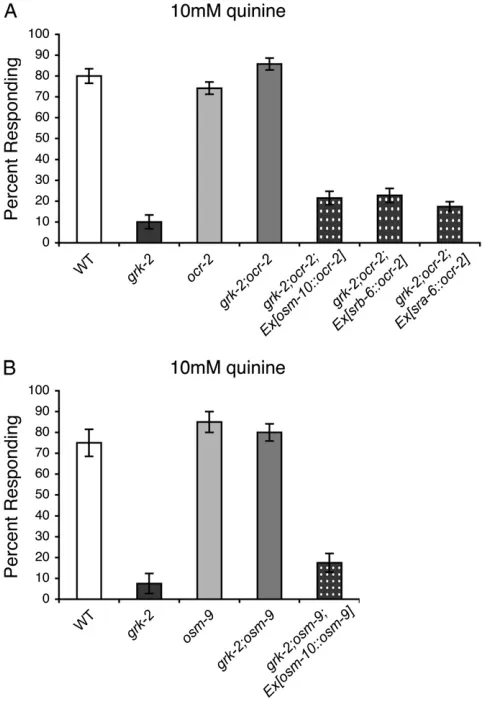
wild-typeocr-2ingrk-2;ocr-2null mutant animals.ASHis the only sensory neuron in which all three promoters are expressed. Whilegrk-2;ocr-2double mutant animals respond robustly to quinine (Figure 4A), double mu-tant animals expressing theosm-10Tocr-2,srb-6Tocr-2, or
sra-6Tocr-2transgene were returned to thegrk-2quinine response defective phenotype (Figure 4A). Transgene expression had no effect in wild-type animals, indicating that transgene expression did not disruptASHfunction (data not shown). In addition, the osm-10 promoter (Hartet al.1999) was used to expressosm-9cDNA in the
ASHsensory neurons ofgrk-2;osm-9animals. While grk-2;osm-9double mutants also respond robustly to quinine (Figure 4B), double mutant animals expressing the osm-10Tosm-9 transgeneyzEx53(Zhanget al.2004; Chang
et al.2006) were defective in their response to quinine (Figure 4B). We conclude that TRPV channel function in the ASH sensory neurons is sufficient for the de-fective quinine response ofgrk-2mutant animals, and that grk-2;TRPV animals may have restored bitter tastant chemosensory responses due to changes inASH sensory neuron signaling in the absence of OSM-9/
OCR-2TRPV channel function.
The OCR-2(G36E) point mutation restores grk-2
bitter taste response: The ocr-2(yz5)mutation encodes a single nucleotide change that creates a glycine-to-glutamate (G36E) substitution in the N-terminal cyto-plasmic tail ofOCR-2 (Zhang et al.2004; Sokolchik
et al.2005). While the product of theocr-2(ak47) dele-tion allele cannot form a funcdele-tional channel, leading to severe disruption of AWA-mediated chemosensory transduction (Tobinet al.2002), the G36E substitution
produces a protein with correct subcellular localization and ocr-2(yz5) mutants have wild-type AWA-mediated chemotaxis (Sokolchiket al.2005). Interestingly, the ocr-2(yz5)point mutation decreases expression oftph-1, which encodes a serotonin biosynthetic enzyme, in the ADF neurons as strongly as the ocr-2(ak47) predicted null (Zhang et al. 2004). Thus, the N-terminal G36E
mutation appears to selectively disrupt the ability of
the OCR-2 TRPV channel to direct changes in gene
Figure 2.—Loss of TRPV channel function does not
restore grk-2 response to other ASH-detected stimuli. The ASH sensory neurons also detect the volatile odorant octanol, the heavy metal copper, and the detergent SDS.grk-2mutant animals are defective in their avoidance response to each of these stimuli. (A) Loss of OSM-9 and OCR-2 TRPV channel function had only a minimal, although statistically significant (P#0.01 when compared togrk-2) effect on 100% octanol response. However,grk-2;osm-9, grk-2;ocr-2, and grk-2;osm-9ocr-2responses were not restored to the level of wild-type animals or to that of the TRPV channel mutants (P#0.00001). Time to respond is shown.N$40. (B) Loss of the OSM-9 or OCR-2 TRPV channels, alone or in combination, did not restoregrk-2
response to 10 mmcopper (P$0.1 when compared togrk-2).
expression, while leaving channel function in primary chemosensory signal transduction intact (Zhanget al.
2004; Sokolchiket al.2005). In addition, theOCR-2N
terminus is sufficient to increase TPH-1 expression when it is part of a chimeric channel (Sokolchiket al.
2005).
To determine whether theocr-2(yz5)mutation was also able to suppress the bitter tastant avoidance defects of
grk-2 animals, grk-2(gk268);ocr-2(yz5) double mutants were assayed for their response to quinine and prima-quine. Theocr-2(yz5)single mutants have a wild-type re-sponse to these bitter tastants, and in thegrk-2mutants, theocr-2(yz5)point mutation completely restored bitter tastant avoidance (Figure 5, A and B). Importantly, the mechanism by which theOCR-2N-terminal G36E mutation restores quinine response appears to operate within the ASH sensory neurons. Similar to the ASH rescue of ocr-2 in grk-2;ocr-2 null animals (Figure 4A), expression of wild-type ocr-2 in the ASH neurons of
grk-2(gk268);ocr-2(yz5)animals resulted in defective qui-nine responses (Figure 5A). Furthermore, the OCR-2 N-terminal point mutation appears to selectively restore
the response to ASH-detected bitter tastants, as grk-2(gk268);ocr-2(yz5) double mutants remained defective for chemotaxis toward diacetyl and pyrazine (Figure 5, C and D), mediated by theAWAneurons, although ocr-2(yz5) animals displayed wild-type chemotaxis toward both odorants (Sokolchiket al.2005).
By decreasing expression ofTPH-1, mutations in the TRPV channels would also cause a reduction in seroto-nin levels. To ensure that disruption of TRPV channel function did not restoregrk-2bitter tastant avoidance by decreasing serotonin levels in a non-cell-autonomous manner, we assayed tph-1(mg280);grk-2(gk268) double mutants for their response to quinine. Loss of serotonin synthesis, via thetph-1mutation, did not restore the re-sponse ofgrk-2(gk268)mutants to quinine (percentage responding to 10 mmquinine:N2¼8562.9%,grk-2¼
565%,tph-1¼7562.9%, andtph-1;grk-2¼7.564.9%). Taken together our results suggest that alterations in downstream regulatory pathways that couple to the N terminus of OCR-2 in the ASH sensory neurons may account for the restored response to bitter stimuli in grk-2;TRPVdouble mutant animals.
Figure3.—Loss of TRPV channel function does not restore AWA-mediated chemotaxis. The ASH and AWA sensory neurons
share common signaling molecules to transduce chemosensory signals. The OSM-9 and OCR-2 TRPV channels are part of the primary signal transduction cascade in both neurons. (A and B) Loss of the OSM-9 or OCR-2 TRPV channels, alone or in com-bination, did not restoregrk-2chemotaxis toward diacetyl over a range of concentrations tested. Chemotaxis to 1ml of (A) 1:100 and (B) 1:1000 diacetyl is shown; 100%, 1:10 and 1:10,000 not shown. (C and D) Loss of the OSM-9 or OCR-2 TRPV channels, alone or in combination, did not restoregrk-2chemotaxis toward any concentration of pyrazine tested. Chemotaxis to 1ml of (C) 100 mg/ml and (D) 10 mg/ml pyrazine is shown; 1 mg/ml not shown. Chemotaxis index¼(number of animals at odorant
DISCUSSION
AsC. eleganslack the ability to see and hear, they have evolved to rely heavily on their ability to detect chemical cues to successfully navigate their environment. This is reflected in the fact that .5% of their genome is dedicated to recognizing environmental chemicals (Bargmann 2006a).C. elegans must properly respond
to gustatory and olfactory cues to initiate chemotaxis toward favorable conditions or rapid avoidance to evade harmful environments. Therefore, signals through chemosensory GPCRs must be precisely transduced and regulated to ensure continued survival.
Loss of the GPCR negative regulatorGRK-2 results in an intriguing phenotype; grk-2mutant animals are defective in chemosensory signaling and behavioral responses both to attractive and aversive chemosensory stimuli (Fukuto et al. 2004). To better understand
how loss of receptor regulation can lead to decreased signaling in different cell types, we sought to identify mechanisms responsible for dampeningASHsignaling in the absence ofGRK-2function. Three of the muta-tions found in ourgrk-2suppressor screen were identi-fied as alleles of the TRPV channels encoded byosm-9
andocr-2. Using the previously characterized null alleles
osm-9(ky10)andocr-2(ak47), we found that complete loss
of OSM-9/OCR-2channel function fully restored the
response ofgrk-2mutant animals to quinine and other bitter tastants. This suggests that these channels con-tribute to multiple bitter taste responses, in addition to quinine (Hilliard et al. 2004, 2005). Surprisingly,
though, grk-2;TRPV mutants remain defective in their avoidance of octanol, an odorant detected by ASH, the same neuron primarily responsible for quinine detection. In addition, loss of these TRPV channels failed to restore grk-2 responses to attractive chemo-sensory stimuli detected by the AWAsensory neurons. Together, these results reveal that C. elegans TRPV channels can regulate chemosensory signaling in both a cell-specific and modality-specific manner.
Furthermore, the ability of theocr-2(yz5) N-terminal point mutation to restore bitter taste response ingrk-2
mutants suggests that it may not be loss of TRPV channels as primary signal transduction components that restores grk-2 bitter taste avoidance. Rather, loss of a downstream function or pathway coupled to the N-terminal structural motif ofOCR-2may restore bitter responses in the absence of GRK-2 function. For ex-ample, the G36E change may disrupt interactions with adaptor proteins or signaling components required for TRPV-modulated changes in gene expression (Sokolchik et al. 2005); to date, no other function
has yet been ascribed to this region ofOCR-2. There-fore, one possibility is that loss of TRPV channels may decrease the expression of components used in primary signal transduction, thereby reducing the strength of signals being transduced (Figure S1). Reducing neuro-Figure4.—The OSM-9/OCR-2 TRPV channels function in
ASH. The ASH sensory neurons are the primary neurons used to detect quinine. OSM-9/OCR-2 TRPV channel function is required in ASH for the defective quinine avoidance response of grk-2 animals. (A) The osm-10 (Hart et al. 1999), srb-6
(Troemel et al. 1995), and sra-6 (Troemel et al. 1995; deBonoet al.2002) promoters were used to drive expression
of wild-type ocr-2 in the quinine-detecting ASH neurons of grk-2;ocr-2double mutant animals. Theosm-10 promoter ex-presses in ASH, ASI, PHA, and PHB, while thesrb-6promoter drives expression in ASH, ADL, ADF, PHA, and PHB and the sra-6promoter expresses in ASH, ASI, and PVQ. ASH is the only sensory neuron common to all three promoters. While grk-2;ocr-2 animals avoid 10 mm quinine, restoring OCR-2
function in ASH returnedgrk-2;ocr-2animals to the quinine response defective phenotype (P#0.0001 for each transgene when compared to grk-2;ocr-2). (B) The osm-10 promoter (Hartet al.1999) was used to drive expression ofosm-9cDNA
in the quinine-detecting ASH neurons ofgrk-2;osm-9 double mutant animals. Whilegrk-2;osm-9animals avoid 10 mm
qui-nine, restoring OSM-9 function in ASH returnedgrk-2;osm-9 animals to the grk-2 quinine response defective phenotype (P¼ 0.2 when compared togrk-2).Ex[osm-10Tosm-9]¼ the extrachromosomal transgenic array yzEx53 (Zhang et al.
2004; Changet al.2006). The percentage of animals
nal activity in this manner could circumvent the acti-vation of inhibitory pathways that act to dampen signaling in the absence of GRK-2, thus restoring behavioral response. The Gaproteins are one possible target for transcriptional regulation. ODR-3 Ga and
GPA-3Gacontribute to a broad range of chemosensory
responses, including bitter taste avoidance. However,
ODR-3protein levels are not altered in grk-2mutants
and loss of neither ODR-3 nor GPA-3 restores grk-2
response to bitter tastants (Fukutoet al.2004; Ferkey
et al. 2007). In addition, TRPV channel-mediated reg-ulation of transcription in theADFneurons was shown to occur independently of Ga activity (Zhang et al.
2004).
As loss of TRPV channel function selectively restored bitter taste response, and not chemosensory responses
in general, it suggests that signaling components spe-cific to bitter taste response may be regulated by the
OSM-9/OCR-2channels in theASHsensory neurons.
For example, the expression levels of the receptors for bitter tastants could be regulated by TRPV channels. If loss of TRPV channel function decreases expression of bitter GPCRs, then perhaps a signal being transduced through a reduced number of GPCRs would no longer be perceived as aberrant. This could also avert activation of compensatory inhibition in the absence of GRK-2 function, thereby restoring behavioral response in grk-2;TRPVdouble mutants.
Modulation of GPCR expression by sensory activity is a well-documented phenomenon inC. elegans(Lanjuin
and Sengupta2002; Nolanet al.2002; van der Linden
et al. 2008). Unlike vertebrates, C. elegans express Figure5.—The OCR-2(G36E) point mutation functions cell autonomously to restoregrk-2bitter taste responses mediated by
ASH. (A and B) The OCR-2(G36E) point mutation, encoded by theocr-2(yz5)allele, restoredgrk-2mutant animals’ response to (A) 10 mmquinine and (B) 10 mmprimaquine (P#0.001 when compared togrk-2for each). Theosm-10(Hartet al.1999) andsrb-6
(Troemelet al.1995) promoters were used to drive wild-typeocr-2expression in the ASH sensory neurons ofgrk-2(gk268);ocr-2(yz5)
double mutant animals. Althoughgrk-2;ocr-2animals avoid 10 mmquinine, restoring OCR-2 function in ASH returnedgrk-2;ocr-2
multiple receptors in each chemosensory neuron (Bargmann 2006b). To selectively modify behavioral
response to a single chemical, C. elegans may rely on changing the expression of a particular chemoreceptor gene, rather than altering signaling efficacy of the entire neuron, which would inadvertently affect the response to many chemicals (Peckol et al. 2001; Nolan et al.
2002). Selectively modulating distinct populations of receptors in this manner may allow C. elegans to fine tune their chemosensory GPCR repertoire and respond appropriately to their environment. This may be partic-ularly important in a polymodal sensory neuron like ASH, which detects diverse stimuli including odorants, tastants, high osmolarity, and mechanical touch. Al-though the C. elegans genome encodes 500 chemo-sensory GPCRs (Bargmann2006a), no receptors have
yet been identified as bitter responsive. Thus, we were not able to directly examine the expression levels of this receptor class in animals lacking OSM-9 or OCR-2 function. However, we note that although levels of the diacetyl receptor ODR-10 are regulated by OSM-9/ OCR-2(Tobinet al.2002), loss of neither TRPV channel
restoredgrk-2chemotaxis toward diacetyl (Figure 3). Another possible target of TRPV-mediated transcrip-tional regulation is a compensatory pathway. Loss of GRK-2may initially result in increased, aberrant signal-ing that is translated, via the TRPV channels, into changes in gene expression of inhibitory molecules (Figure S1). TRPV-mediated transcriptional upregula-tion of a compensatory pathway, which specifically damp-ens signals being transduced through bitter GPCRs, would result in the loss of behavioral response to bitter tastants. Loss of TRPV channel-regulated gene transcrip-tion could prevent the increased expression of an in-hibitory molecule(s), thereby restoring bitter GPCR signal transduction and behavioral response in the absence of GRK-2 function. Interestingly, prior studies have not identified a role for the OSM-9 and OCR-2 TRPV channels in regulating expression of sensory components inASH (Sokolchiket al. 2005). Perhaps
TRPV channels do not affect expression of primary signal transduction molecules, but rather only regulatory com-ponents necessary to maintain normal signaling. Thus, it may be only in a sensitized background, likegrk-2where ordinary signaling has been compromised, that a role for the TRPV channels in modulating expression of ASH sensory components can be revealed.
Although regulated expression of sensory signaling components has not yet been described in mammals, exposure to chemosensory stimuli has been shown to activate the transcription factor CREB in both rat olfac-tory receptor neurons and taste receptor cells (Moon
et al.1999; Caoet al.2002). CREB is a key mediator in
translating transient neuronal activity into long-term changes in gene expression (Ooi and Wood 2008).
Therefore, it has been proposed that in addition to initiating the immediate response of membrane
de-polarization, gustatory and olfactory stimuli also gen-erate a delayed response that may modulate gene transcription in their respective sensory neurons (Moonet al. 1999; Cao et al.2002). Thus, in addition
to sharing components of chemosensory signal trans-duction, the long-lasting cellular consequences of odorant and tastant detection may also be conserved among invertebrates and vertebrates.
While it is possible that the N terminus ofOCR-2may have additional roles in cellular events downstream of the TRPV channels that have not yet been identified, our results suggest that misregulated signaling, such as in the absence ofC. elegansGRK-2function, may also lead to long-term transcriptional changes that alter signaling levels and behavioral responses. Importantly, temporal rescue ofGRK-2function in adultgrk-2mutant animals is sufficient to restore chemosensory response to octanol and quinine (Fukutoet al.2004 and data not
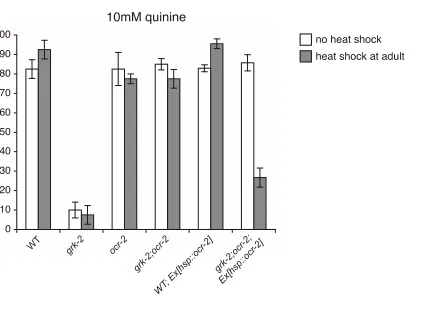
shown), indicating that the mechanisms that dampen signaling in the absence of GRK-2function are under ongoing regulatory control. Similarly, adult rescue of OCR-2 function in grk-2;ocr-2 double mutants is suffi-cient to return animals to the grk-2 quinine response defective phenotype within hours (Figure S2). It will be interesting to determine whether similar TRPV-mediated mechanisms are at work in mammalian cells that show decreased signaling and responsiveness in the absence of GRK function (Peppel et al. 1997;
Fong et al. 2002). Future studies to identify OCR-2
interacting proteins and the downstream targets regu-lated by activity through the TRPV channels will also further our understanding of the modality-specific mechanisms used by cells to modulate intracellular signaling.
We thank Richard Gronostajski, Douglas Portman, Sean M. Rumschik, and Jordan Wood for valuable feedback on this manuscript. We thank Cori Bargmann, Michael Chao, Anne Hart, Andrew Fire, Michael Koelle, Noelle L’Etoile, and the Caenorhabditis Genetics Center for reagents, and we are grateful to Marina Ezcurra and William Schafer for help with experiments not included in this manuscript. This work was supported by the National Science Foundation (MCB-0917896, to D.M.F.).
LITERATURE CITED
Bargmann, C. I., 2006a Chemosensation in C. elegans. WormBook, 1–29.
Bargmann, C. I., 2006b Comparative chemosensation from recep-tors to ecology. Nature444:295–301.
Bargmann, C. I., and H. R. Horvitz, 1991 Chemosensory neurons with overlapping functions direct chemotaxis to multiple chem-icals inC. elegans.Neuron7:729–742.
Bargmann, C. I., J. H. Thomasand H. R. Horvitz, 1990 Chemosensory cell function in the behavior and development ofCaenorhabditis elegans.Cold Spring Harb. Symp. Quant. Biol.55:529–538. Bargmann, C. I., E. Hartwiegand H. R. Horvitz, 1993
Odorant-selective genes and neurons mediate olfaction inC. elegans.Cell
74:515–527.
Boekhoff, I., J. Inglese, S. Schleicher, W. J. Koch, R. J. Lefkowitz
Brenner, S., 1974 The genetics ofCaenorhabditis elegans.Genetics
77:71–94.
Cao, Y., C. Shrefflerand S. Herness, 2002 Localization and func-tional investigation of the transcription factor CREB in taste re-ceptor cells. Neuroreport13:1321–1325.
Chandrashekar, J., M. A. Hoon, N. J. Ryba and C. S. Zuker, 2006 The receptors and cells for mammalian taste. Nature
444:288–294.
Chang, A. J., N. Chronis, D. S. Karow, M. A. Marlettaand C. I. Bargmann, 2006 A distributed chemosensory circuit for oxy-gen preference in C. elegans. PLoS Biol.4:e274.
Chao, M. Y., H. Komatsu, H. S. Fukuto, H. M. Dionneand A. C. Hart, 2004 Feeding status and serotonin rapidly and reversibly modulate a Caenorhabditis elegans chemosensory circuit. Proc. Natl. Acad. Sci. USA101:15512–15517.
Chen, C. K., M. E. Burns, M. Spencer, G. A. Niemi, J. Chenet al., 1999 Abnormal photoresponses and light-induced apoptosis in rods lacking rhodopsin kinase. Proc. Natl. Acad. Sci. USA
96:3718–3722.
Cideciyan, A. V., D. C. Hood, Y. Huang, E. Banin, Z. Y. Liet al., 1998 Disease sequence from mutant rhodopsin allele to rod and cone photoreceptor degeneration in man. Proc. Natl. Acad. Sci. USA95:7103–7108.
Coburn, C. M., and C. I. Bargmann, 1996 A putative cyclic nucleotide-gated channel is required for sensory development and function in
C. elegans.Neuron17:695–706.
Colbert, H. A., T. L. Smithand C. I. Bargmann, 1997 OSM-9, a novel protein with structural similarity to channels, is required for olfaction, mechanosensation, and olfactory adaptation in Cae-norhabditis elegans.J. Neurosci.17:8259–8269.
Cuppen, E., A. M.van derLinden, G. Jansenand R. H. Plasterk, 2003 Proteins interacting withCaenorhabditis elegans Ga sub-units. Comp. Funct. Genomics4:479–491.
deBono, M., D. M. Tobin, M. W. Davis, L. Averyand C. I. Bargmann, 2002 Social feeding in Caenorhabditis elegans is induced by neu-rons that detect aversive stimuli. Nature419:899–903.
Dong, M. Q., D. Chase, G. A. Patikoglou and M. R. Koelle, 2000 Multiple RGS proteins alter neural G protein signaling to allowC. elegansto rapidly change behavior when fed. Genes Dev.14:2003–2014.
Dryer, L., and A. Berghard, 1999 Odorant receptors: a plethora of G-protein-coupled receptors. Trends Pharmacol. Sci.20:413–417. Ferkey, D. M., R. Hyde, G. Haspel, H. M. Dionne, H. A. Hesset al., 2007 C. elegansG protein regulator RGS-3 controls sensitivity to sensory stimuli. Neuron53:39–52.
Fong, A. M., R. T. Premont, R. M. Richardson, Y. R. Yu, R. J. Lefkowitz et al., 2002 Defective lymphocyte chemotaxis in b-arrestin2- and GRK6-deficient mice. Proc. Natl. Acad. Sci. USA99:7478–7483.
Freedman, N. J., and R. J. Lefkowitz, 1996 Desensitization of G protein-coupled receptors. Recent Prog. Horm. Res. 51:319– 351; discussion 352–313.
Fukuto, H. S., D. M. Ferkey, A. J. Apicella, H. Lans, T. Sharmeen
et al., 2004 G protein-coupled receptor kinase function is essen-tial for chemosensation inC. elegans.Neuron42:581–593. Gainetdinov, R. R., L. M. Bohn, J. K. Walker, S. A. Laporte, A. D.
Macraeet al., 1999 Muscarinic supersensitivity and impaired receptor desensitization in G protein-coupled receptor kinase 5-deficient mice. Neuron24:1029–1036.
Gainetdinov, R. R., L. M. Bohn, T. D. Sotnikova, M. Cyr, A. Laakso
et al., 2003 Dopaminergic supersensitivity in G protein-coupled receptor kinase 6-deficient mice. Neuron38:291–303. Hart, A. C., J. Kass, J. E. Shapiroand J. M. Kaplan, 1999 Distinct
signaling pathways mediate touch and osmosensory responses in a polymodal sensory neuron. J. Neurosci.19:1952–1958. Hausdorff, W. P., M. G. Caronand R. J. Lefkowitz, 1990 Turning
off the signal: desensitization of beta-adrenergic receptor func-tion. FASEB J.4:2881–2889.
Herness, M. S., and T. A. Gilbertson, 1999 Cellular mechanisms of taste transduction. Annu. Rev. Physiol.61:873–900.
Hilliard, M. A., C. I. Bargmannand P. Bazzicalupo, 2002 C.
ele-gansresponds to chemical repellents by integrating sensory in-puts from the head and the tail. Curr. Biol.12:730–734. Hilliard, M. A., C. Bergamasco, S. Arbucci, R. H. Plasterkand P.
Bazzicalupo, 2004 Worms taste bitter: ASH neurons, QUI-1,
GPA-3 and ODR-3 mediate quinine avoidance inCaenorhabditis elegans.EMBO J.23:1101–1111.
Hilliard, M. A., A. J. Apicella, R. Kerr, H. Suzuki, P. Bazzicalupo
et al., 2005 In vivo imaging ofC. elegansASH neurons: cellular re-sponse and adaptation to chemical repellents. EMBO J.24:63–72. Jaber, M., W. J. Koch, H. Rockman, B. Smith, R. A. Bondet al., 1996 Essential role ofb-adrenergic receptor kinase 1 in cardiac development and function. Proc. Natl. Acad. Sci. USA93:12974– 12979.
Jansen, G., K. L. Thijssen, P. Werner, M.van derHorst, E. Hazendonk
et al., 1999 The complete family of genes encoding G proteins of
Caenorhabditis elegans.Nat. Genet.21:414–419.
Kaplan, J. M., and H. R. Horvitz, 1993 A dual mechanosensory and chemosensory neuron inCaenorhabditis elegans.Proc. Natl. Acad. Sci. USA90:2227–2231.
Koelle, M. R., and H. R. Horvitz, 1996 EGL-10 regulates G protein signaling in theC. elegansnervous system and shares a conserved domain with many mammalian proteins. Cell84:115–125. Komatsu, H., I. Mori, J. S. Rhee, N. Akaike and Y. Ohshima,
1996 Mutations in a cyclic nucleotide-gated channel lead to abnormal thermosensation and chemosensation in C. elegans.
Neuron17:707–718.
Kunitomo, H., H. Uesugi, Y. Koharaand Y. Iino, 2005 Identification of ciliated sensory neuron-expressed genes inCaenorhabditis elegans
using targeted pull-down of poly(A) tails. Genome Biol.6:R17. Lanjuin, A., and P. Sengupta, 2002 Regulation of chemosensory
re-ceptor expression and sensory signaling by the KIN-29 Ser/Thr kinase. Neuron33:369–381.
Lans, H., S. Rademakersand G. Jansen, 2004 A network of stimu-latory and inhibitory Ga-subunits regulates olfaction in Caeno-rhabditis elegans.Genetics167:1677–1687.
McCudden, C. R., M. D. Hains, R. J. Kimple, D. P. Siderovskiand F. S. Willard, 2005 G-protein signaling: back to the future. Cell. Mol. Life Sci.62:551–577.
Metaye, T., H. Gibelin, R. Perdrisotand J. L. Kraimps, 2005 Patho-physiological roles of G-protein-coupled receptor kinases. Cell Sig-nal17:917–928.
Moon, C., Y. K. Sung, R. Reddyand G. V. Ronnett, 1999 Odorants induce the phosphorylation of the cAMP response element bind-ing protein in olfactory receptor neurons. Proc. Natl. Acad. Sci. USA96:14605–14610.
Nolan, K. M., T. R. Sarafi-Reinach, J. G. Horne, A. M. Safferand P. Sengupta, 2002 The DAF-7 TGF-beta signaling pathway reg-ulates chemosensory receptor gene expression in C. elegans. Genes Dev.16:3061–3073.
Ooi, L., and I. C. Wood, 2008 Regulation of gene expression in the nervous system. Biochem. J.414:327–341.
Palmer, R. K., 2007 The pharmacology and signaling of bitter, sweet, and umami taste sensing. Mol. Interv.7:87–98. Peckol, E. L., E. R. Troemeland C. I. Bargmann, 2001 Sensory
ex-perience and sensory activity regulate chemosensory receptor gene expression in Caenorhabditis elegans. Proc. Natl. Acad. Sci. USA98:11032–11038.
Penn, R. B., A. N. Proninand J. L. Benovic, 2000 Regulation of G protein-coupled receptor kinases. Trends Cardiovasc. Med.10:
81–89.
Peppel, K., I. Boekhoff, P. McDonald, H. Breer, M. G. Caronet al., 1997 G protein-coupled receptor kinase 3 (GRK3) gene disrup-tion leads to loss of odorant receptor desensitizadisrup-tion. J. Biol. Chem.272:25425–25428.
Perez, C. A., R. F. Margolskee, S. C. Kinnamonand T. Ogura, 2003 Making sense with TRP channels: store-operated calcium entry and the ion channel Trpm5 in taste receptor cells. Cell Cal-cium33:541–549.
Pitcher, J. A., N. J. Freedmanand R. J. Lefkowitz, 1998 G protein-coupled receptor kinases. Annu. Rev. Biochem.67:653–692. Premont, R. T., and R. R. Gainetdinov, 2007 Physiological roles of
G protein-coupled receptor kinases and arrestins. Annu. Rev. Physiol.69:511–534.
Roayaie, K., J. G. Crump, A. Sagastiand C. I. Bargmann, 1998 The Gaprotein ODR-3 mediates olfactory and nociceptive function and controls cilium morphogenesis in C. elegans olfactory neu-rons. Neuron20:55–67.
b-adrenergic receptor kinase 1 in gene-targeted mice. J. Biol. Chem.273:18180–18184.
Rongo, C., C. W. Whitfield, A. Rodal, S. K. Kimand J. M. Kaplan, 1998 LIN-10 is a shared component of the polarized protein localization pathways in neurons and epithelia. Cell 94: 751– 759.
Sambongi, Y., T. Nagae, Y. Liu, T. Yoshimizu, K. Takeda et al., 1999 Sensing of cadmium and copper ions by externally ex-posed ADL, ASE, and ASH neurons elicits avoidance response in Caenorhabditis elegans. Neuroreport10:753–757.
Schleicher, S., I. Boekhoff, J. Arriza, R. J. Lefkowitzand H. Breer, 1993 Ab-adrenergic receptor kinase-like enzyme is in-volved in olfactory signal termination. Proc. Natl. Acad. Sci. USA90:1420–1424.
Sengupta, P., J. H. Chouand C. I. Bargmann, 1996 odr-10encodes a seven transmembrane domain olfactory receptor required for responses to the odorant diacetyl. Cell84:899–909.
Sokolchik, I., T. Tanabe, P. F. Baldiand J. Y. Sze, 2005 Polymodal sensory function of the Caenorhabditis elegans OCR-2 channel arises from distinct intrinsic determinants within the protein and is selectively conserved in mammalian TRPV proteins. J. Neu-rosci.25:1015–1023.
Tobin, D., D. Madsen, A. Kahn-Kirby, E. Peckol, G. Moulderet al., 2002 Combinatorial expression of TRPV channel proteins defines their sensory functions and subcellular localization in
C. elegansneurons. Neuron35:307–318.
Troemel, E. R., 1999 Chemosensory signaling inC. elegans. Bioes-says21:1011–1020.
Troemel, E. R., J. H. Chou, N. D. Dwyer, H. A. Colbertand C. I.
Bargmann, 1995 Divergent seven transmembrane receptors
are candidate chemosensory receptors in C. elegans. Cell 83:
207–218.
van derLinden, A. M., S. Wiener, Y. J. You, K. Kim, L. Averyet al., 2008 The EGL-4 PKG acts with KIN-29 salt-inducible kinase and protein kinase A to regulate chemoreceptor gene expression and sensory behaviors in Caenorhabditis elegans. Genetics180:
1475–1491.
Wicks, S. R., R. T. Yeh, W. R. Gish, R. H. Waterstonand R. H. Plasterk, 2001 Rapid gene mapping inCaenorhabditis elegans using a high density polymorphism map. Nat. Genet.28:160–164.
Wood, W. B., 1988 The Nematode Caenorhabditis elegans. Cold Spring Harbor Laboratory Press, Cold Spring Harbor, NY.
Yamada, T., M. Matsumoto, C. Kadoi, Y. Nagaki, Y. Hayasakaet al., 1999 1147 del A mutation in the arrestin gene in Japanese pa-tients with Oguchi disease. Ophthalmic Genet.20:117–120. Zhang, S., I. Sokolchik, G. Blancoand J. Y. Sze, 2004 Caenorhabditis
elegans TRPV ion channel regulates 5HT biosynthesis in chemo-sensory neurons. Development131:1629–1638.
Supporting Information
http://www.genetics.org/cgi/content/full/genetics.109.115188/DC1
Caenorhabditis elegans
TRPV Channels Function in a
Modality-Specific Pathway to Regulate Response to Aberrant Sensory
Signaling
Meredith J. Ezak, Elizabeth Hong, Angela Chaparro-Garcia and Denise M. Ferkey
M. J. Ezak et al.
2 SI
effectors
2nd messengers
channels
Ca2+
G
α
Gβ
Gγ
GRK-2
ligand
P
behavioral response
effectors
2nd messengers
channels
Ca2+
G
α
Gβ
Gγ
effectors
2nd messengers
channels
Ca2+
G
α
Gβ
Gγ
GPCR GPCR
ligand
compensatory mechanisms
behavioral response
GRK-2 P
A
B
initial response net effect
FIGURE S1.–Proposed model for the cellular response to loss of GRK-2 function. (A) Wild-type chemosensory signaling is initiated when a ligand binds to a GPCR expressed by a sensory neuron, activating the associated G proteins. The activated G proteins interact with downstream effectors to generate second messengers and subsequent activation of channels allows Ca2+ to enter the cell. Through connections with interneurons and motor neurons, this activity in the sensory neuron is ultimately translated into a behavioral response. Signaling is terminated when GRK-2 phosphorylates the GPCR, rendering it incapable of further G protein activation. (B) It has been proposed that early in the life of the animal, the initial cellular response to sensory stimulation in the absence of GRK-2 function is an increased, exaggerated signal that triggers protective compensatory mechanisms to inhibit signaling (left side of panel B) (FUKUTO et al. 2004). The net result of this response to aberrant signaling is loss of chemosensory signal transduction in the sensory neurons of adult animals (right side of panel B), as illustrated by diminished Ca2+ fluxes and lack of behavioral response to chemosensory stimuli (FUKUTO et al. 2004 and this work). In theory, mutations that decrease primary signal transduction could prevent activation of the compensatory inhibitory mechanisms early on and restore behavioral response to grk-2 mutant animals. Alternatively, loss of inhibitory proteins/pathways that act in the absence of GRK-2 function could permit sufficient chemosensory signaling to restore behavioral responses (FUKUTO et al. 2004).
M. J. Ezak et al. 3 SI
0 10 20 30 40 50 60 70 80 90 100
1 2 3 4 5 6
FIGURE S2.–OCR-2 function in adulthood contributes to the defective quinine avoidance response of grk-2 mutant animals. To establish when TRPV channel function contributes to the defective quinine response of grk-2 animals, the wild-type ocr-2 cDNA was placed under the control of a heat shock inducible promoter (STRINGHAM et al. 1992) and temporally expressed in adult grk-2;ocr-2 null mutant animals. Animals were tested as adults without heat shock (white bars) or with heat shock treatment (gray bars). While grk-2;ocr-2 double mutants have a wild-type response to quinine, heat shock induced expression of ocr-2 in adult grk-2;ocr-2 mutant animals results in a defective quinine response that resembles the grk-2 phenotype (p < 0.0001 when compared to grk-2;ocr-2 transgenic animals without heat shock). Heat shock induced expression of ocr-2 did not decrement the responses of wild-type animals expressing the transgene. The percentage of animals responding is shown. n ≥ 51 transgenic animals. The pooled F2 data of 7 transgenic grk-2;ocr-2 lines is shown. Alleles used: grk-2(gk268) and ocr-2(ak47). WT = the N2 wild-type strain. Error bars represent the standard error of the mean (SEM).
Percent Responding
WT grk-2 ocr-2
grk-2;ocr -2
WT
; Ex[hsp::ocr -2]
grk-2;ocr -2;
Ex[hsp::ocr -2]
10mM quinine
no heat shock
heat shock at adult