DOI: 10.1534/genetics.106.057562
A Nonself Recognition Gene Complex in
Neurospora crassa
Cristina O. Micali
1and Myron L. Smith
2Biology Department, Carleton University, Ottawa, Ontario K1S 5B6, Canada
Manuscript received February 23, 2006 Accepted for publication May 30, 2006
ABSTRACT
Nonself recognition is exemplified in the fungal kingdom by the regulation of cell fusion events between genetically different individuals (heterokaryosis). Thehet-6locus is one of10 loci that control hetero-karyon incompatibility during vegetative growth ofN. crassa.Previously, it was found thathet-6-associated incompatibility in Oak Ridge (OR) strains involves two contiguous genes,het-6andun-24. The OR allele of either gene causes ‘‘strong’’ incompatibility (cell death) when transformed into Panama (PA)-background strains. Several remarkable features of the locus include the nature of these incompatibility genes (het-6is a member of a repetitive gene family andun-24also encodes the large subunit of ribonucleotide reductase) and the observation thatun-24andhet-6are in severe linkage disequilibrium. Here, we identify ‘‘weak’’ (slow, aberrant growth) incompatibility activities by un-24PAand het-6PAwhen transformed separately into OR strains, whereas together they exhibit an additive, strong effect. We synthesized strains with the new allelic combinationsun-24PAhet-6ORandun-24ORhet-6PA, which are not found in nature. These strains grow nor-mally and have distinct nonself recognition capabilities but may have reduced fitness. Comparing the Oak Ridge and Panamahet-6regions revealed a paracentric inversion, the architecture of which provides insights into the evolution of theun-24–het-6gene complex.
A
process analogous to somatic nonself recognition is fundamental to all living organisms and has been well characterized at the molecular level in fungi (heterokaryon incompatibility: Glass and Kaneko 2003; Micaliand Smith2005), in invertebrates (histo-compatibility system controlling colony fusion: Grosberg and Quinn1986), and in mammals (major histocompat-ibility complex: Hughesand Yeager1998). The diversity of recognition mechanisms and the pervasiveness of rec-ognition phenomena across taxa suggest that nonself recognition has emerged independently several times in evolutionary history and is therefore of biological sig-nificance. In filamentous fungi, as elsewhere, distinct non-self recognition mechanisms operate during the sexual and asexual phases of the life cycle. During the sexual phase, cell fusion between genetically different individ-uals is promoted by the mating-type system (Glassand Kaneko 2003). In contrast, during asexual (vegetative) growth, cell fusion and the establishment of cells con-taining genetically different nuclei (heterokaryons) is limited to interactions among individuals that are geneti-cally very similar or identical. Controls on the formation and proliferation of heterokaryotic cells are thought to bemodulated by the interaction of protein products of the same (allelic) or different (nonallelic)het(heterokaryon incompatibility) or vic (vegetative incompatibility) loci (Saupe2000). One of the best-characterized fungal sys-tems is represented byNeurospora crassawhere at least 10 hetloci andmat(mating type) control heterokaryon for-mation during vegetative growth (Beadleand Coonradt 1944; Perkins1988). Strains must bear compatible alleles at all incompatibility loci to fuse and form stable hetero-karyons. Genetic differences at any one of these het -associated loci lead to incompatibility reactions expressed phenotypically as inhibited, abnormal growth, breakdown of the heterokaryotic products, and in certain cases cell death (Glasset al.2000).
The function of vegetative nonself recognition in fungi has been debated for some time (Caten 1972; Hartlet al.1975; Wuet al. 1998; Saupe2000). A favored explanation is that nonself recognition reduces the transmission of potentially deleterious genetic elements (organelles, viruses, plasmids) from one individual to another. Evidence in support of this hypothesis includes direct observation of reduced transmission of infectious agents between incompatible fungal strains (Debets and Griffiths1998; Cortesiet al. 2001). InOphiostoma
novo-ulmi, the causative agent of Dutch elm disease, a shift to greater diversity in vegetative incompatibility groups is associated with increased virus abundance in populations (Paoletti et al.2006). In another study, the frequency of programmed cell death (PCD) associ-ated with vegetative incompatibility was found to be
1Present address:Department of Plant-Microbe Interactions, Max-Planck
Institute for Plant Breeding Research, Carl-von-Linne´ Weg 10, 50829 Cologne, Germany.
2Corresponding author:Biology Department, Carleton University, 1125
Colonel By Dr., Ottawa, Ontario K1S 5B6, Canada. E-mail: [email protected]
negatively correlated to virus transmission in Cryphonec-tria parasitica (Biella et al. 2002). Such observations provide a potential adaptive explanation for the main-tenance of heterokaryon incompatibility in fungi.
Among the incompatibility factors inN. crassa, differ-ences at het-6 cause one of the most intense hetero-karyon incompatibility reactions. Initially identified as a single locus (Mylyk1975), thehet-6 region comprises two tightly linked genes,un-24 and het-6, each having two allelic variants, Oak Ridge (OR) and Panama (PA). The two loci are in severe linkage disequilibrium such that they have been found in only two of four possible allelic combinations,un-24ORhet-6OR andun-24PAhet-6PA (Mir-Rashedet al.2000; Smithet al. 2000b), referred to as OR and PA haplotypes, respectively. In addition to its function in heterokaryon incompatibility, un-24 en-codes the large subunit of ribonucleotide reductase, an essential enzyme that converts ribonucleotides to the deoxyribonucleotides required for DNA synthesis and repair (Smithet al. 2000a). In contrast,het-6appears to be a member of a repetitive gene family and to encode a pro-tein with no known function aside from nonself recogni-tion. OR alleles at bothhet-6andun-24were previously characterized and shown to elicit incompatibility reac-tions when introduced separately or together into PA recipient cells; however, failure to detect reciprocal incompatibility reactions from the PA allelic counterparts suggested thatun-24andhet-6incompatibility reactions may involve nonallelic interactions with additional factors in thehet-6region (Smithet al. 2000b).
This article reports on the isolation and characteri-zation of functional PA alleles ofun-24 and het-6 and describes a paracentric inversion polymorphism that pro-vides a proximate reason for decreased recombination within the region and linkage disequilibrium of these two genes. The inversion breakpoints are immediately adjacent to regions in bothun-24andhet-6that appear to be under diversifying selection. We constructed strains that express the novel allelic combinations un-24PA
het-6ORorun-24ORhet-6PAand observed that, unlike their naturally occurring counterparts, these strains have lower fitness and compromised incompatibility function. Our observations suggest that evolution within theun-24–het-6 gene complex has had an adaptive role in heterokaryon incompatibility function in the species.
MATERIALS AND METHODS
Strains and growth conditions: Laboratory-derived (Table 1) and wild-collected (listed in Figure 6)N. crassastrains were cultured with Vogel’s sucrose medium with supplements as required (DavisanddeSerres1970). Heterokaryon incom-patibility tests and DNA transformations intoN. crassa were done as described previously (Smithet al.2000b). Crosses were performed on synthetic crossing medium with 0.13 supple-ments at 25°(DavisanddeSerres1970).
Molecular biology methods:Neurospora genomic DNA was isolated by the method of Oakleyet al.(1987). Plasmid and
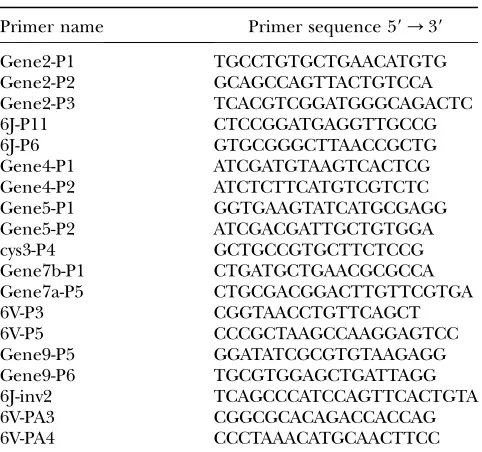
cosmid DNAs were obtained by Wizard miniprep (Promega, Madison, WI) and lDNA was obtained by the liquid lysis method (Sambrooket al.1989). Oligonucleotides used for PCR amplification (Table 2) were synthesized by Invitrogen (Carlsbad, CA) and PCR amplifications were done with Taq DNA polymerase (Invitrogen) or an Expand High Fidelity PCR system (Roche, Laval, PQ, Canada). When required, PCR products were cloned into pCRII or TOPO pCRII (Invitrogen) and subclones were prepared in pUC118 and pCB1004, which carries hygromycin resistance (Carrolet al. 1994). Southern hybridizations with [a-32P]dCTP-labeled probes were by standard methods (Sambrooket al.1989). For al -library of FGSC1131, genomic DNA was partially digested with
MboI and separated on a 10–40% sucrose gradient by ultra-centrifugation at 26,000 rpm for 42 hr in a Beckman swinging bucket SW27 rotor. Fragments between 10 and 20 kbp in length were ligated into Lambda FixII arms and packaged into al-phage according to the manufacturer’s recommendations (Stratagene, La Jolla, CA).
Data analysis: DNA sequences in thehet-6ORregion were obtained from the Munich Information Center for Protein Sequences (MIPS) (Schulteet al.2002) and theNeurospora Genome database at the Broad Institute (Cambridge, MA) (Galaganet al. 2003). Gene/open reading frame designa-tions used in this article are cross-referenced to contig and gene number at the MIPS site as: Gene 2, b2a19 020;un-24, b2a19 030; Gene 4, b2a19 040; Gene 5, b2a19 050;cys-3, b2a19 070; Gene 7a, b2a19 080; Gene 7b, b2a19 090;het-6, b2a19 100; and Gene 9, b2a19 160. BLAST searches were performed at the National Center for Biotechnology Information (http:// www.ncbi.nlm.nih.gov/blast/). DNA sequencing of PA-derived clones was carried out at Canadian Molecular Research Services (Ottawa). DNA sequence alignments were done using the software ClustalX and ClustalW (http://clustalw.genome. ad.jp/; Thompsonet al.1997) with manual adjustments. The distribution of synonymous substitutions per synonymous site
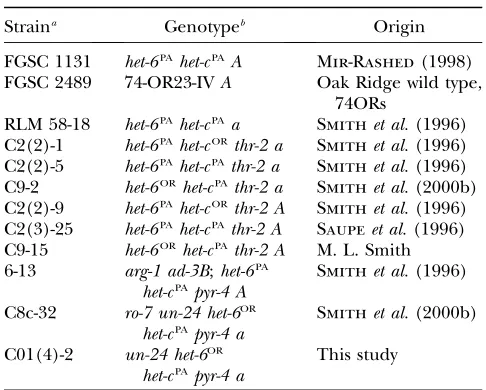
TABLE 1
Laboratory strains used in this study
Straina Genotypeb Origin
FGSC 1131 het-6PAhet-cPAA Mir-Rashed(1998) FGSC 2489 74-OR23-IVA Oak Ridge wild type,
74ORs
RLM 58-18 het-6PAhet-cPAa Smithet al.(1996) C2(2)-1 het-6PAhet-cORthr-2 a Smithet al.(1996) C2(2)-5 het-6PAhet-cPAthr-2 a Smithet al.(1996) C9-2 het-6ORhet-cPAthr-2 a Smithet al.(2000b) C2(2)-9 het-6PAhet-cORthr-2 A Smithet al.(1996) C2(3)-25 het-6PAhet-cPAthr-2 A Saupeet al.(1996) C9-15 het-6ORhet-cPAthr-2 A M. L. Smith 6-13 arg-1 ad-3B;het-6PA
het-cPApyr-4 A
Smithet al.(1996)
C8c-32 ro-7 un-24 het-6OR het-cPApyr-4 a
Smithet al.(2000b)
C01(4)-2 un-24 het-6OR het-cPApyr-4 a
This study
a
FGSC, Fungal Genetics Stock Center, University of Kansas Medical Center.
bThe
un-24allelic designation is the same as that given for
(dS) and nonsynonymous substitutions per nonsynonymous
site (dN) was calculated according to the method of Nei and
Gojobori (Neiand Gojobori1986; Korber2000). Aligned se-quences were submitted to the Synonymous/Non-synonymous Analysis Program (http://hiv-web.lanl.gov/content/hiv-db/ SNAP/WEBSNAP/SNAP.html).dSanddNwere averaged for 10
codons and were plotted against codon number, and statistics were done with JMP (v5.1, SAS Institute, Cary, NC).
RESULTS
Isolation of functional PA incompatibility alleles from thehet-6region:The localization of thehet-6locus within theT(IIL/IIIR)AR18translocated region was previously determined by partial diploid analyses (Mylyk 1975; Smith et al. 1996). Colonies with heterozygous dupli-cations of the region [Dp(AR18)] display inhibited growth due to het-6 self-incompatibility. Escape from self-incompatibility byDp(AR18)colonies was associated with deletions within either the OR or the PA haplotype DNA of at least an35-kbp region that includes both un-24andhet-6(Smithet al.2000b). However, PCR products
obtained from PA strains that were equivalent to active un-24ORandhet-6ORPCR products did not have incom-patibility activity when transformed into OR spheroplasts, suggesting thatun-24PA andhet-6PA do not have incom-patibility activity.
Using a different approach to isolate the PA-specific incompatibility factor(s) in the 35-kbp region, a l -library of strain FGSC1131 was constructed. l-Clones from thehet-6PAregion were identified by hybridization to probes corresponding tohet-6OR,het-6PA, andun-24OR and a chromosome walk was done from het-6PA both toward and away from the centromere (Figure 1). Within this walk, clonelB was found to hybridize to bothun-24 andhet-6and was chosen for further study. ThelB insert was subcloned using NotI into pCB1004 as plB and transformed into C9-2 (het-6OR) and C2(2)-1 (het-6PA) spheroplasts (Figure 2). plB caused an83% decrease (616% in four independent transformation experi-ments) in the number of C9-2 (OR haplotype) trans-formants recovered as compared to the pCB1004 vector control, but no decrease in the number of transform-ants when introduced into PA-haplotype C2(2)-1 sphe-roplasts. This indicated that plB has PA-specific incompatibility activity. Subclones of plB were con-structed and tested in transformation assays to further define the incompatibility region, as summarized in Figure 2. The incompatibility activity associated with un-24PAis notably weaker than that ofun-24OR, which yields no, or few, viable colonies when transformed into un-24PAstrains (Smithet al.2000b). Construct plBP/C con-tains the entireun-24PAcoding region along with 550-bp upstream and 380-bp downstream regions. When trans-formed into OR spheroplasts, on average52% (620% in three independent trials) fewer colonies were ob-served as compared to the pCB1004 vector control. Of these plBP/C transformants,63% appeared inhib-ited in their growth with a star-like appearance on the original transformation plates (Figure 2C). The remain-ing colonies had a cloud-like morphology characteristic of compatible transformants. When plBP/C transform-ants were transferred to 13Vogel’s medium containing no sorbose, the star-like colonies grew significantly more slowly, did not conidiate, and displayed a ‘‘spidery’’ mor-phology whereas cloud colonies grew at wild-type rates
Figure1.—Chromosomal walks across theun-24–het-6
region for OR (top) and PA haplotypes (bottom). TABLE 2
PCR primers used in this study
Primer name Primer sequence 59/39
Gene2-P1 TGCCTGTGCTGAACATGTG Gene2-P2 GCAGCCAGTTACTGTCCA Gene2-P3 TCACGTCGGATGGGCAGACTC
6J-P11 CTCCGGATGAGGTTGCCG
6J-P6 GTGCGGGCTTAACCGCTG
Gene4-P1 ATCGATGTAAGTCACTCG Gene4-P2 ATCTCTTCATGTCGTCTC Gene5-P1 GGTGAAGTATCATGCGAGG Gene5-P2 ATCGACGATTGCTGTGGA
cys3-P4 GCTGCCGTGCTTCTCCG
Gene7b-P1 CTGATGCTGAACGCGCCA Gene7a-P5 CTGCGACGGACTTGTTCGTGA
6V-P3 CGGTAACCTGTTCAGCT
6V-P5 CCCGCTAAGCCAAGGAGTCC
Gene9-P5 GGATATCGCGTGTAAGAGG Gene9-P6 TGCGTGGAGCTGATTAGG 6J-inv2 TCAGCCCATCCAGTTCACTGTA
6V-PA3 CGGCGCACAGACCACCAG
and conidiated normally. A similar spidery morphology is typical of incompatibility due to heteroallelism atmat and het-c in N. crassa (Beadle and Coonradt 1944; Saupeet al.1996). Early escape events or disruption of theun-24PAgene during integration of the transforming DNA may account for the cloud colonies obtained when un-24PAis transformed into OR cells. Within3–6 days after transfer to Vogel’s medium, the self-incompatible transformants were observed to give rise to fast-growing sectors, indicative of escape (Figure 2D). Thus, incom-patibility activity is evident whenun-24PAis transformed into un-24OR spheroplasts by a modest reduction in transformant numbers but a high frequency of transformants that are self-incompatible and conse-quently undergo escape.
Whether un-24PA complements a temperature-sensi-tive (ts) mutation in ribonucleotide reductase was also assayed (Figure 2A). Strain C8c-164 grows at wild-type rates at 30°but is unable to grow at 37°or above, due to a mutation that likely disrupts the allosteric activity site encoded in the 59-end ofun-24OR(Smithet al.2000a). This ts mutant, designatedun-24, was derived from un-24ORand maintains OR incompatibility activity. Trans-formation with wild-type un-24OR DNA enables un-24 strains to grow at 37°. When un-24PAwas transformed into C8c-164 spheroplasts, growth of colonies with a
star-like morphology was observed after 4–5 days of in-cubation at 37°, indicating that un-24PA is capable of complementing theun-24ts mutation in spite of the PA-specific incompatibility activity. Therefore,un-24PA car-ries both incompatibility and catalytic functions, as does un-24OR.
Overall, the un-24PA (accession DQ525966) and
un-24ORDNA sequences are 95% identical; however, they differ significantly at the 39-end wherein the specificity region for nonself recognition is likely encoded (Smith
et al. 2000b). Deletion analysis and transformation as-says were used to delimit the incompatibility function ofun-24PAto an1.6-kbp region within the 39-coding region (e.g., plBX/C, Figure 2A). Loss of both incom-patibility and catalytic functions are observed for the plBP/Nr construct, which has a small 34-nucleotide re-gion of 39-coding sequence deleted. Similar to deletions within un-24OR (Smithet al. 2000b), the 1.6-kbp 39 -coding sequence with incompatibility activity does not have ribonucleotide reductase catalytic function. This provides further evidence that incompatibility function involves a mechanism that is independent of ribonucle-otide reductase activity for the UN-24 protein.
Construct plBC/N was derived from plB and used to further test whetherhet-6PAhas incompatibility activity (Figure 2A). This construct carries a full-length copy of
Figure 2.—Incompatibil-ity activ2.—Incompatibil-ity of constructs from the het-6 region. (A) Map at top gives selected restriction sites and loca-tions of PCR primers used for making PA-haplotype constructs. Orientations of
un-24PAandhet-6PAare indi-cated by arrows. Restriction sites are A,ApaI; B,BamHI; Bg, BglII; C, ClaI; N, NotI; Nr, NarI; P, PstI; and X,
het-6PAflanked by 3030 bp of 59upstream and 880 bp of 39downstream noncoding sequences. Transformation of plBC/N into OR cells resulted in an average69% (610% in three independent trials) decrease in the number of OR transformants compared to the pCB1004 vector control but did not cause a significant decrease in the number of transformants when PA cells were used as recipients (Figure 2B). Therefore, plBC/N was consid-ered to carry het-6PA-associated incompatibility activity that is notably weaker than that ofhet-6OR, which, when introduced into PA spheroplasts, results in a nearly complete absence of transformants. Construct 6VPA3/ 6VPA4 spans the entire coding region ofhet-6PAas well as 340 bp upstream of the translation initiation site, but lacks heterokaryon incompatibility activity. In contrast, clone plBBg/A carries an additional 1097 bp in the 59 region upstream from the start codon and displays heterokaryon incompatibility activity. Thus, a minimum region required for het-6PAincompatibility activity en-compasses1100 bp upstream from the start codon and
110 bp downstream from the stop codon (Figure 2A). In contrast, the additional noncoding sequences out-side of the 6VPA3/6VPA4 primer sites are not required for het-6OR activity, accounting for the lack incompati-bility activity reported earlier for het-6PA(Smith et al. 2000b). This observation also suggests that OR and PA forms ofhet-6have distinct mechanisms of gene regula-tion since the addiregula-tional 59- and 39-untranslated regions required for het-6PA activity do not appear to contain additional genes.
Thehet-6PAsequence was reported previously (Smith
et al.2000b). The OR and PA alleles athet-6share 78% identity at the nucleotide level and only 68% identity at the amino-acid level. Nucleotide sequence differences are spread over the entire length of the het-6 open reading frame. As is the case forhet-6OR, no intron con-sensus sequences occur inhet-6PA(Bruschezet al.1993; Edelman and Staben 1994). The gene putatively en-codes a 680-amino-acid peptide with three regions of identity to at least 13 other putativeN. crassaproteins of unknown function (Blast cutoff score.38,E,13 104; Broad Institute). The three common regions of 10, 27, and 21 amino acids in length form the HET do-main identified in other heterokaryon incompatibility-associated proteins fromN. crassa(TOL) andPodospora anserina(HET-E) (Smithet al.2000b). Genes similar to
het-6are also found inAspergillus nidulans,Magnaporthe grisea,C. parasitica, andFusarium graminearumsequence databases, for example, but not in theSaccharomyces cere-visiaegenome, suggesting that this gene family may be restricted to filamentous fungi. In addition to the HET domain, there is a region bound by amino acids 434–516 inhet-6that displays amino acid similarity (50%) to a domain of unknown function in bacterial aconitases (data not shown).
un-24 and het-6 show evidence of diversifying selec-tion:The isolation of active PA alleles atun-24andhet-6
suggests that allelic interactions are responsible for in-compatibility function, rather than nonallelic interac-tions as previously hypothesized (Smith et al. 2000b). Therefore, the allelic specificity domains ofun-24and het-6may be recognized by comparing the respective OR and PA forms since nonself recognition loci are often subject to diversifying selection (Apanius et al. 1997; McDowellet al. 1998; Roalsonand McCubbin2003). Under diversifying selection, substitutions leading to amino-acid changes are favored to presumably allow for broader specificity of nonself recognition during pro-tein interactions (Hughes 1999) as exemplified with the MHC in humans (Aguilaret al. 2004), the S locus in plants (Roalson and McCubbin 2003), and the het-c locus inN. crassa(Wuet al. 1998). This is in contrast to most genes undergoing neutral or directional selection, where the rate of synonymous substitutions typically exceeds that of nonsynonymous substitutions.
We tested for indicators of diversifying selection at un-24 and at het-6 by determining the number of syn-onymous and nonsynsyn-onymous nucleotide substitutions in the OR and PA alleles for each gene. For this analysis, DNA sequences corresponding to the entire coding region of OR and PA alleles of both genes were used (GenBank accession nos. AF206700, AF208542, AF171697, and DQ525966). Intron sequences were re-moved fromun-24sequences and pairwise alignments in all combinations were done using ClustalW (http:// clustalw.genome.ad.jp/), adjusted by hand and analyzed for the distribution of synonymous and nonsynonymous substitutions.
P,0.016; Kruskal–Wallis test,x2¼3.71, d.f.¼1,P ¼ 0.05). Thus, bothun-24andhet-6display high levels of nonsynonymous substitutions in regions that are likely associated with heterokaryon incompatibility function, consistent with the view that diversifying selection is operating within both genes.
Fitness reduction is associated with un-24PA het-6OR andun-24ORhet-6PAallelic combinations:In addition to these patterns of nonsynonymous substitutions,un-24 andhet-6appear to be inherited as a block (either OR or PA) in population samples and across the species range (Mir-Rashedet al. 2000; Smithet al. 2000b). To explain this linkage disequilibrium, we explored the possibility that the missing allelic combinations ofun-24PAhet-6OR andun-24ORhet-6PAmay have a negative effect on fitness since vegetative incompatibility and/or sexual dysfunc-tion have been associated with specific allelic combina-tions at unlinkedhetloci (i.e., nonallelic incompatibility) inP. anserina(Saupe2000). We generated novel genetic combinations atun-24andhet-6by transformation of un-24PAor het-6PAinto the OR-haplotype strains C9-2 and C01(4)-2. As described above, self-incompatible trans-formants that are heteroallelic atun-24orhet-6escape to wild-type growth rates within a few days after transfer to Vogel’s medium. Escape from self-incompatibility re-sults in the loss of either PA or OR incompatibility func-tionality and the recovery of some strains with the novel incompatibility specificities of un-24PA het-6OR and
un-24ORhet-6PA. The specificity of these escape strains can be inferred from heterokaryon incompatibility tests with OR and PA standard strains. In one such experiment, 15 escape strains were isolated from a transformation of strain C9-2 withun-24PA. To determine the heterokaryon
incompatibility allele expressed at un-24, each escape strain was confronted in heterokaryon incompatibility tests to the OR strain C8c-32 (un-24 het-6OR). Eight of the escape strains formed vigorous heterokaryons with C8c-32 and were considered functionallyun-24OR
het-6ORwhereas 7 escape strains produced spidery, self-incompatible heterokaryons and thus appeared to be functionallyun-24PAhet-6OR. All 15 escape strains were heteroallelic atun-24on the basis of PCR analysis with primers 6JP11/6JP6 and digestion with MboI (Mir -Rashedet al. 2000). Thus, the functionally PA and OR escapes were all partial diploids with silenced incom-patibility activity of either the endogenous (un-24OR) or the ectopic (un-24PA) copy, respectively. The silencing mechanism in these cases is not known. All escape strains displayed wild-type growth rates and conidiated, indicating that the novelun-24PAhet-6OR allelic combi-nation has no deleterious effect on vegetative growth. Each escape strain was subsequently mated with each of fourmat-Astrains C9-15 (un-24ORhet-6OR), 6-13 (un-24PA
het-6PA), C2(3)-25 (un-24PAhet-6PA), and C2(2)-9 (un-24PA
het-6PA). A majority of these crosses produced perithecia (90% of matings involving OR-compatible and 85% with OR-incompatible escape strains) and ascospores (89% matings involving compatible and 87% OR-incompatible escape strains). However, ascospores de-rived from functionallyun-24PAhet-6ORparents showed a significantly lower germination frequency (22629%; 17 crosses analyzed) compared to progeny of function-allyun-24ORhet-6ORescapes (63 617%; 9 crosses ana-lyzed;P,0.001, two-tailedt-test of arcsine-transformed frequencies) and this difference was observed whether or not the mating partner of the escape strain carried
Figure 3.—Frequencies of synony-mous and nonsynonysynony-mous substitu-tions between alleles of het-6 and
un-24. Plotted are the synonymous sub-stitutions per synonymous site (dS, solid
bars) and nonsynonymous substitu-tions per nonsynonymous site (dN,
shaded bars) in comparisons between PA and OR alleles at het-6 (A) and
un-24 (B) in N. crassa. dS anddN
the OR or PA haplotype. Thus,N. crassastrains carrying the allelic combinationun-24PAhet-6ORare predicted to have reduced fitness, since they give rise to relatively few viable progeny.
In addition to mating capacity, we evaluated hetero-karyon incompatibility characteristics of escape strains. If heterokaryon incompatibility has an adaptive func-tion in maintaining individuality and in preventing the transmission of infectious elements, strong incom-patibility reactions would presumably have a selective advantage. To assess the strength of heterokaryon in-compatibility reactions, heterokaryon inin-compatibility tests were done with all possible allelic combinations at un-24andhet-6(Table 3). For these experiments, func-tionallyun-24PAhet-6ORandun-24ORhet-6PAstrains were derived through escape as described above. The re-sulting heterokaryons were assessed for growth rate, colony morphology, and conidiation. As shown in Table 3, strains with the novel allelic combinations,un-24PA
het-6ORandun-24ORhet-6PA, displayed weak incompatibility reactions with strains that had differences at one or both hetgenes. These novel haplotypes are apparently com-promised for nonself recognition and, in this context, individuals with these genetic combinations at un-24 andhet-6may be selected against in nature.
Comparison of OR and PA un-24–het-6 regions: Previously, it was suggested that linkage disequilibrium in theun-24–het-6 region may be due to sequence dis-similarity and low homologous recombination rates (Mir-Rashedet al. 2000). The isolation of plB, encom-passing both un-24 andhet-6 PA alleles, allowed us to address this hypothesis through structural comparisons of OR and PA haplotypes. The cosmid G8:G1 (which spans theun-24OR–het-6OR region) and DNA sequence from contig B2A19 (MIPS, http://mips.gsf.de/proj/ neurospora/) were used as reference points for the OR haplotype. l-Clones from the FGSC1131 library were
used to study the structure of the PA haplotype. plB and pA3 (derived from FGSC1131 via FGSC2190; Smithet al. 1996; Mir-Rashed et al. 2000) were sequenced in the
un-24PA–het-6PAregion and used for RFLP analyses. Southern hybridizations were done to compare the marker distribution and general structure of clones carrying PA- or OR-derived sequences (Figure 1). Hy-bridization membranes containing DNA from clones pA3,lB,lTLP131, andl11-1 (PA haplotype) and G8:G1 (OR haplotype) were probed sequentially with radioac-tively labeled PCR products of primer pairs 6J-P11/6J-P6 (un-24OR) and cys3-P1/cys3-P2 (cys-3OR). Hybridization of the un-24OR probe to G8:G1, pA3, and lB was ob-served and RFLP patterns were consistent with pre-viously published restriction maps (Mir-Rashedet al. 2000; Smithet al. 2000b). On the basis of hybridization to the cys-3OR probe, neither pA3 norlB harbors this gene and this was verified by the absence of a PCR amplicon from either clone withcys-3-specific primers. However, cys-3 amplicons were obtained from G8:G1 (OR) and from the lTLP131 (PA) clone that maps centromere distal toun-24PA(Figure 1). Given that the intergenic distance betweenun-24andhet-6is5.2 kbp in the PA haplotype compared to 19 kbp in the OR haplotype, these results suggested the presence of an inversion in the region. This inversion, designated here asIn(IIL)1131 het-6, for inversion associated withhet-6, was verified by determining the DNA sequences of the termini of pA3. In pA3 (PA haplotype),un-24andhet-6 are transcribed from the same strand of DNA whereas in the OR haplotype (MIPS database) the genes are transcribed from opposite strands.
Characterization of inversion breakpoints brk-1 and
brk-2:The location of theIn(IIL)1131 het-6[abbreviated asIn(het-6)hereafter] breakpoints were determined by comparisons of the OR and PA haplotypes. On the basis of the map data (above), we surmised that brk-1, the
TABLE 3
Relative strength of heterokaryon incompatibility reactions in strains with different allelic combinations ofun-24 and het-6
C01(4)-2
un-24 het-6OR
RLM58-18
un-24PAhet-6PA
C01-PA1 (un-24PA)het-6OR
C01-6PA
un-24OR(het-6PA)
C9-2un-24ORhet-6OR Nonea Strongb Weakc Weak
C2(2)-5un-24PAhet-6PA Strong None Weak Weak
C9-2 E18 (un-24PA)het-6OR Weak Weak None Weak C9-2-6PAun-24OR(het-6PA) Weak Weak Weak None
Escape strains C01-PA1 and C01-6PA were derived from C01(4)-2, C9-2 E18, and C9-2-6PA from C9-2. Allelic designation of the transgene expressed in the escape strain is in parentheses.
a
None, no heterokaryon incompatibility. Heterokaryons grow at wild-type rates of30 mm/day and conidi-ate profusely.
bStrong, pronounced incompatibility. No, or slight, growth of heterokaryons, no conidiation, escape
infre-quent even after2 weeks.
cWeak, weak incompatibility evident by slow growth rates (3 – 8 mm/day), abnormal ‘‘flat’’ morphology,
centromere-proximal breakpoint, was located close to Gene7aorGene7bwith respect to the OR map (Figure 4A). The location of the distal breakpoint,brk-2, had to ac-count for the shorter distance betweenun-24andhet-6 in PA relative to OR haplotypes and was inferred to be just downstream ofun-24OR, likely betweenun-24ORand
Gene2relative to the OR map. We sought confirmation of these hypothetical maps by designing PCR primers based on the contig B2A19 sequence (MIPS) that would
differentially amplify across the OR and PA configura-tions of brk-1 and brk-2 (Table 2 and Figure 4A). Ge-nomic DNAs from RLM58-18 (PA) yielded amplicons with primer pairs Gene7b-P1/6J-P11 (brk-1PA) and Gene2-P3/Gene7a-P5 (brk-2PA), while 74-OR23-1V (OR) DNA produced amplicons with primers Gene7b-P1/cys3-P4 (brk-1OR) and Gene2-P3/6J-inv2 (brk-2OR). On the basis of these inversion breakpoint positions,In(het-6)spans an18.6-kbp region from4.2 kbp upstream ofhet-6
Figure4.—Sequence comparisons atIn(het-6)breakpoints. Schematic (not to scale) of inversion loop expected during meiosis whenIn(het-6)is heterozygous (A) and sliding-window analyses of sequence identities between OR and PA haplotypes nearbrk-1
to 100 bp upstream of Gene 2 (based on the OR haplotype).
To characterize the inversion breakpoints in the PA haplotype, the entire pA3 clone was sequenced to cover brk-1PA, andbrk-2PAwas isolated by PCR from clonelG12 (Figure 1) using primers cys3-P4 and Gene2-P1, sub-cloned and sequenced.brk-1PAandbrk-2PAsequences were compared to the OR genomic sequence available at MIPS. Sequence comparisons around the two inversion breakpoints are summarized in Figure 4 using sliding-window analyses. For the analyses, OR and PA sequences were aligned and sequence identity was calculated as the number of identical nucleotides in a window of 60 bp. Successive identity values were calculated as the window was incrementally shifted by 30 bp until the breakpoint region was covered. The inversion breakpoints are charac-terized by regions of sequence dissimilarity between OR and PA haplotypes of2 kbp (brk-1) and 0.6 kbp (brk-2), flanked by regions of significant sequence identity. The sequence identity patterns to the right ofbrk-1in Figure 4B suggested that an additional small inversion poly-morphism just off the 59-end ofhet-6also differentiates the OR and PA haplotypes (Figure 4B).
A BLAST analysis ofbrk-1OR and brk-1PA revealed se-quence identity to regions located elsewhere within the N. crassagenome. Notably, withinbrk-1PA, but not within
brk-1OR, a 397-bp stretch of sequence shows75% iden-tity to at least 14 different regions within theN. crassa genome. This sequence also contains53-bp inverted repeats that share 88% identity. Among these 14 re-gions, contigs 3.213 (mapping to LGVI), 3.622 (mapping to LGII), and 3.400 (LGVII) also carry similar inverted repeats (Figure 5). The remaining 11 sequences lack the inverted repeats but otherwise share significant se-quence identity to the 397-bp internal sese-quence. In
summary, this 397-bp sequence has several features that qualify it as abona fiderepetitive sequence (RS): inverted terminal repeats, short imperfect direct repeats (CC TAACC), and its presence in multiple (at least 14) copies in the genome ofN. crassa. A BLAST survey indi-cated that neither the inverted repeats nor the internal repeated sequence matched any known mobile genetic elements or repeated sequences in the databases and that the region had no similarity to known transposases, which suggests that this is a novel RS element. Several RS elements and transposons have been implicated in chro-mosomal rearrangements in maize, Drosophila, and Anopheles species (Mathiopouloset al.1998; Ca´ ceres
et al. 1999; Zhangand Peterson1999). In a majority of cases, inversion breakpoints were associated with mo-bile genetic elements, suggesting that recombination between the two homologous mobile genetic element sequences was responsible for the genetic rearrange-ment. The close spatial association of a repetitive genetic element,brk-1, and incompatibility genes under diversifying selection suggests a role for RS elements in the evolution of nonself recognition inN. crassa.
Evidence for recombination withinIn(het-6):In(het-6) may partially account for some of the unusual character-istics of theun-24–het-6region. For example, mutations may accumulate readily at inversion breakpoints due to low rates of recombination (Dobzhansky 1951) and could give rise to rapidly diverging sequences in the neighboringun-24andhet-6sequences. Likewise, linkage disequilibrium of genes within inversions is predicted. Single crossover events between inverted/noninverted heterozygotes will cause dicentric bridges and acentric chromatid fragments during meiosis. Such aberrant chromatids are often lethal and result in an apparent absence of recombination within the inverted region
Figure5.—A 397-nucleo-tide sequence withinbrk-1PA has significant identity to
14 regions elsewhere in theN. crassagenome. Align-ment shown is of thebrk-1PA element and three sequen-ces within contigs 3.213 (contig 7.12), 3.622 (contig 7.81), and 3.400 (contig 7.32) (Neurospora Genome Sequence Project, Broad Institute). Inverted repeats are indicated by arrows and direct repeats in the brk-1
(Perkins1997). We surveyed the extent of genetic ex-change between the inverted and noninverted hap-lotypes in PA and OR haplotype strains to test the hypothesis thatIn(het-6)blocks recombination in the re-gion. In addition, we were interested in surveying the prevalence and correlation, if any, of inversion forms and genotypes atun-24andhet-6. If linkage disequilib-rium at un-24 and het-6 is due to the In(het-6) poly-morphism, inversion form and genotype at un-24 and het-6are expected to be perfectly correlated. If either inversion form exists in both OR and PA haplotypes, then recombination within theun-24–het-6region is possible as long as it occurs between identical inversion forms. Should this be the case, the inversion may not be a source of observed linkage disequilibrium atun-24andhet-6.
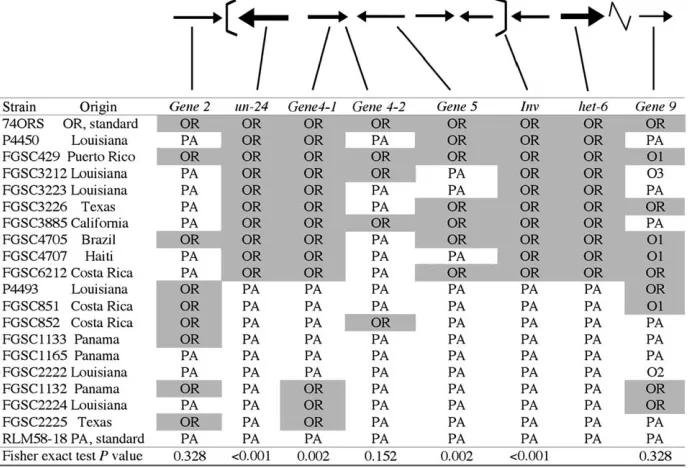
To explore this, 20N. crassastrains (10un-24ORhet-6OR and 10 un-24PA het-6PA) were selected from different geographic origins to represent strains that have likely been separated by many generations (Figure 6). The het-6 and un-24 genotype of each strain was verified using a PCR–RFLP-based assay as described previously (Mir-Rashed et al. 2000). Inversion forms were de-termined using primers designed for the isolation of brk-1and/orbrk-2and, in all strains tested, there was a perfect correlation between genotypes athet-6andun-24 and inversion type (P,0.001, Figure 6). This strongly supports the idea that theIn(het-6) is responsible for linkage disequilibrium of the two incompatibility genes, het-6andun-24.
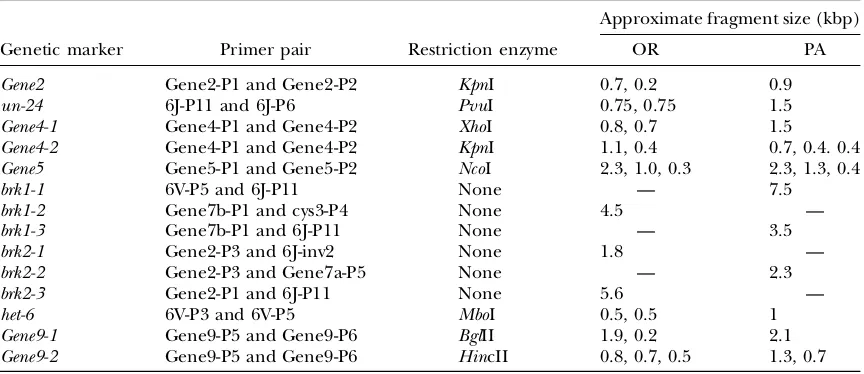
To establish the extent of recombination within the inverted region, additional polymorphic markers (Table 4) were analyzed inside and outside of the inversion for each of the 20 strains, including the two standard strains. For all but one of these markers,Gene9, only two RFLP forms, either PA like or OR like, were detected.
ForGene9, two adjacent PCR–RFLP markers identified five different variants, two corresponding to OR (O1 and OR) and three corresponding to PA (O2, O3, and PA) tester strains (Figure 6). The two Gene9 markers were congruent and are shown in a single column in Figure 6.
To test whether there is a correlation between ge-notype athet-6and genotype at each of the other mark-ers, pairwise allelic associations were calculated using Fisher’s exact test (Figure 6; http://www.physics. csbsju.edu/stats/exact.html; Jerrold 1984). Polymor-phisms at het-6, un-24, and In(het-6) are perfectly cor-related with no exceptions, as described previously. Other markers within the inversion breakpoints were significantly correlated to the allelic form of het-6 ex-cept for markerGene4-2(P¼0.152), which is situated toward the center of the inverted region. Markers out-side the inverted region were not correlated to thehet-6 genotype (P ¼0.328 for Gene2, P ¼0.328 for Gene9). Therefore, polymorphisms are more frequently shared between PA- and OR-haplotype strains toward the center of, and outside of, the inverted region. The presence of the shared polymorphisms at markers within In(het-6) is consistent with the view that gene conversion events and double crossovers are possible in the center of inversions, where chromosomal pairing is more efficient than at inversion breakpoints (Chovnik 1973). Apparently, as one approaches the breakpoints, and homologous pairing is not possible due to divergent sequences at each breakpoint, the correlation between markers increases to unity. Therefore, the proximity of theun-24andhet-6incompatibility genes to theIn(het-6) breakpoints, rather than the inversionper se, is respon-sible for linkage disequilibrium of un-24 and het-6 in N. crassa.
DISCUSSION
Significant linkage disequilibrium of loci associated with inversions is well documented in Drosophila (re-viewed in Strobeck 1983), but not in Neurospora where only six pericentric inversions have been analyzed (Perkins1997). Dobzhansky(1951) pointed out that inversions could have selective advantages in preserving gene complexes (called ‘‘supergenes’’ by Darlington and Mather1949) since nondisjunction resulting from single crossovers between inverted and noninverted haplotypes will tend to suppress recombination and preserve allelic combinations of gene clusters within the inverted region. In N. crassa, a paracentric inversion, In(het-6), appears to be involved in the origin and/or maintenance of a nonself recognition gene complex consisting ofun-24andhet-6.The two genes, although distinct in sequence, share a common incompatibility function and are inherited together as a functional incompatibility unit. The complete disequilibrium of these two genes is best explained by an absence of significant sequence identity in the regions between each gene and the inversion breakpoints. Thus, genes that are tightly linked to breakpoints of an inversion may be in severe linkage disequilibrium regardless of the physical distance between the genes. For example, we found that PA- and OR-specific polymorphisms at brk-1,brk-2,het-6, andun-24are in complete linkage dis-equilibrium even though recombination in the central portion ofIn(het-6)has likely occurred.
Sequence differences in alleles ofun-24andhet-6are found mainly adjacent to theIn(het-6)breakpoints and are characterized by highdN/dSratios inun-24andhet-6, suggesting that diversifying selection is operating within the gene complex. The signature of diversifying
selec-tion is particularly apparent in the 39coding sequence ofun-24, where the encoded protein sequences of OR and PA alleles are only 70% similar. Moving toward the 59-end of the gene, an abrupt shift to high sequence similarity between the OR and PA alleles corresponds to the ribonucleotide reductase catalytic domain that is conserved across taxa (Smithet al. 2000a). Thus, the
un-24 locus represents a battlefield between opposing selection pressures: diversifying selection acting in the incompatibility domain and purifying selection acting in the rest of the gene. Similarly, distinct selection pres-sures on various domains of nonself recognition loci were described in R-genes of plants and in MHC loci in vertebrates. In plants, protein domains involved in direct or indirect interactions with pathogen protein moieties [e.g., the ligand-binding leucine-rich repeat (LRR)] are hypervariable and carry the mark of di-versifying selection, whereas structural domains and domains involved in host signaling are highly conserved (Noe¨ l et al. 1999; Bergelson et al. 2001). Given the conserved nature of the large subunit of ribonucleotide reductase across diverse taxa, it would appear that non-self recognition function byun-24is a derived character in Neurospora.
The un-24–het-6 region also appears to be under balancing selection, which helps to maintain variability at nonself recognition loci over long time periods (Richman2000). Two characteristics of balancing selec-tion, which are not necessarily observed with diversify-ing selection, are balanced frequencies of alleles within populations and the preservation of specific polymor-phisms across different species. Previous studies showed that the PA and OR haplotypes occur at about equal frequencies inN. crassapopulations (Mir-Rashedet al. 2000; Smith et al. 2000b). In addition, evidence for TABLE 4
Diagnostic markers for allele typing in theun-24/het-6region
Approximate fragment size (kbp)
Genetic marker Primer pair Restriction enzyme OR PA
Gene2 Gene2-P1 and Gene2-P2 KpnI 0.7, 0.2 0.9
un-24 6J-P11 and 6J-P6 PvuI 0.75, 0.75 1.5
Gene4-1 Gene4-P1 and Gene4-P2 XhoI 0.8, 0.7 1.5
Gene4-2 Gene4-P1 and Gene4-P2 KpnI 1.1, 0.4 0.7, 0.4. 0.4
Gene5 Gene5-P1 and Gene5-P2 NcoI 2.3, 1.0, 0.3 2.3, 1.3, 0.4
brk1-1 6V-P5 and 6J-P11 None — 7.5
brk1-2 Gene7b-P1 and cys3-P4 None 4.5 —
brk1-3 Gene7b-P1 and 6J-P11 None — 3.5
brk2-1 Gene2-P3 and 6J-inv2 None 1.8 —
brk2-2 Gene2-P3 and Gene7a-P5 None — 2.3
brk2-3 Gene2-P1 and 6J-P11 None 5.6 —
het-6 6V-P3 and 6V-P5 MboI 0.5, 0.5 1
Gene9-1 Gene9-P5 and Gene9-P6 BglII 1.9, 0.2 2.1
Gene9-2 Gene9-P5 and Gene9-P6 HincII 0.8, 0.7, 0.5 1.3, 0.7
linkage disequilibrium of the PA and OR haplotypes was also found in N. intermedia and N. tetrasperma (Mir -Rashed1998; Powell 2002). These observations pro-vide support for the trans-species maintenance of OR and PA alleles at un-24 and het-6 and for balancing selection acting on the gene complex. Significantly, the maintenance of linkage disequilibrium of the PA and OR haplotypes would suggest thatIn(het-6) also has a trans-species distribution.
ThatIn(het-6)is old is suggested by two observations in addition to its inferred trans-species distribution. First is the extensive sequence divergence between PA and OR haplotypes immediately adjacent toIn(het-6)breakpoints. While this may suggest an ancient haplotype split, strong diversifying selection could also result in rapid sequence divergence at the breakpoints. The second observation is that disequilibrium is limited to markers close to the inversion breakpoints. Since regional decay of linkage disequilibrium at neutral markers is expected to occur through time (Sabetiet al.2002), the presence of shared polymorphisms in and around the inversion suggests that In(het-6)is old. A comprehensive taxonomic analysis of the distribution of In(het-6) would provide additional insight into the evolution of the incompatibility gene complex. In this context, it would be interesting to ask whether the association ofun-24with this inversion breakpoint marks the acquisition of heterokaryon in-compatibility function or whether the two events are independent, with, perhaps, the inversion event locking a beneficial allelic combination ofun-24andhet-6into a supergene configuration inN. crassa. As for the former of these two possibilities, genetic rearrangements such as gene duplications, inversions, and somatic recom-bination are responsible for generating diversity at non-self recognition loci in other organisms. In tomato, for example, unequal crossing over betweenCf-2 and Cf-5 R-genes can lead to deletions or duplications of open reading frames that affect plant disease resistance. In addition, intragenic recombination between repeated LRR domains within R-genes generates variation that directly affects R-gene function (Hammond-Kosackand Jones1997). TheMLAlocus involved in powdery mildew resistance in barley is another example of a gene cluster that has undergone multiple rearrangements (Weiet al. 2002). A final extreme example is evident in somatic recombination within V, D, and J gene segments of B-lymphocytes (class switch recombination) to generate antibody diversity and thus increase nonself recognition potential in mammals (Li et al. 2004). Additional re-arrangements aroundun-24–het-6, aside from the inver-sions described herein, are suggested by a general lack of synteny around the large subunit of ribonucleotide reductase amongN. crassa and the other Sordariomy-cetes,F. graminearum,Chaetomium globosum, andM. grisea (S. Qadriand M. L. Smith, unpublished results).
An argument in favor of the second possibility—that the inversion locked together a beneficial combination
of preexisting alleles—takes into consideration that a striking characteristic of theun-24–het-6gene complex is its symmetric incompatibility function, as opposed to the asymmetry of activities by either gene alone. The molecular basis for this asymmetry is not known, but it seems to be a common feature of heterokaryon incom-patibility genes (Williamsand Wilson 1966; Biella
et al. 2002), and a transition from asymmetric to sym-metric incompatibility may have driven the establish-ment of theun-24–het-6incompatibility gene complex. Recent studies support the idea that heterokaryon in-compatibility is a gatekeeper of fungal individuality. Fungal heterokaryon incompatibility genes were shown to cause cell death in a structured, organized manner analogous to PCD (Biellaet al. 2002; Dementhonet al. 2003; Glass and Kaneko 2003). Furthermore, incom-patibility is negatively correlated to the probability of transmission of viruses in the chestnut blight fungus, C. parasitica(Biellaet al.2002). In this sense, cell death caused by heterokaryon incompatibility is analogous to the hypersensitive response in plants that limits patho-gen infection and to the apoptotic response induced by killer T lymphocytes in response to viral infection (Kagi
et al. 1996; Greenbergand Yao2004). Here, however, heterokaryon incompatibility represents a preventive strategy in the battle against viral infection, rather than a direct response to pathogen attack. One would predict that strong incompatibility reactions would be more effective in limiting the transfer of infectious elements between incompatible individuals of Neurospora, as was observed forC. parasitica(Biellaet al.2002). Assuming that there is a selective advantage to incompatibility, then a gene complex that provides a strong, symmetric incompatibility reaction could provide the selective force to maintainIn(het-6)as a balanced polymorphism. The adaptive significance of theun-24–het-6gene com-plex requires further investigation. In particular, the observation that escape strains that were functionally un-24PAhet-6ORhave low fitness, as measured by the fre-quency of viable ascospore progeny produced, suggests that specific interactions may have developed within the respective OR and PA gene complexes. These interac-tions apparently do not result in incompatibility of par-ticular combinations ofun-24 andhet-6, as is observed with nonallelic heterokaryon incompatibility loci in P. anserina, for example (Saupe 2000), since, in this study,un-24PAhet-6ORescape strains do not exhibit slow growth or reduced conidiation, two characteristics of self-incompatibility (Newmeyer and Galeazzi 1977; Smithet al.1996). The low fecundity ofun-24PAhet-6OR escapes is also distinct from the barren phenotype ob-served when Neurospora strains with segmental dupli-cations are mated to wild-type strains. In contrast to the barren condition, all un-24PA het-6OR escapes that we tested produced abundant perithecia and ascospores after mating. However, unlike functionally un-24OR
theun-24PAhet-6ORescapes, which have theun-24ORcopy silenced, produce a significantly lower frequency of spores that are viable. Furthermore, the inability of escape strains with eitherun-24PAhet-6ORorun-24OR
het-6PA phenotypes to undergo strong incompatibility reactions with any of the other haplotypes suggests that these combinations are also impaired in nonself recog-nition function. Such strains could provide a hub for the propagation of infectious elements in the population at large and may have been selected against.
Finally, the repetitive element noted in the vicinity of brk-1 has interesting implications for the evolution of incompatibility function. Similar elements are of-ten associated with genome instability and rearrange-ment (Kazazian and Goodier 2002). For example, a variety of transposon types are associated with inversion breakpoints in Drosophila (Galileo, Ca´ cereset al. 1999;
Hobo, Lyttleand Haymer1993), mosquito (Odysseus, Mathiopouloset al. 1998), and maize (Ac, Zhangand Peterson1999). Inversions can occur by homologous recombination between two similar mobile elements sit-uated on the same chromosome or may be the second-ary consequence of a double-stranded break associated with a transposition event. It is therefore possible that the putative repetitive element associated withIn(het-6) may have had a direct involvement in the inversion event. The incidence of a putative repetitive element betweenbrk-1andhet-6, which itself is found in multiple copies in Neurospora and other genomes, is particularly interesting since it suggests that there may be a direct role for mobile elements in the origin of nonself recog-nition in fungi as is now hypothesized for mosquitoes (Sinkinset al.2005).
The work described in this article was made possible through a Discovery Grant to M.L.S. from the Natural Sciences and Engineering Research Council of Canada.
LITERATURE CITED
Aguilar, A., G. Roemer, S. Debenham, M. Binns, D. Garcelonet al.,
2004 High MHC diversity maintained by balancing selection in an otherwise genetically monomorphic mammal. Proc. Natl. Acad. Sci. USA101:3490–3494.
Apanius, V., D. Penn, P. R. Slev, L. R. Ruff and W. K. Potts,
1997 The nature of selection on the major histocompatibility complex. Crit. Rev. Immunol.17:179–224.
Beadle, G. W., and V. I. Coonradt, 1944 Heterokaryosis in
Neuros-pora crassa.Genetics29:291–307.
Bergelson, J., M. Kreitman, E. A. Stahland D. Tian, 2001
Evolu-tionary dynamics of plantR-genes. Science292:2281–2285. Biella, S., M. L. Smith, J. R. Aist, P. Cortesiand M. G. Milgroom,
2002 Programmed cell death correlates with virus transmission in a filamentous fungus. Proc. R. Soc. Lond. B Biol. Sci.269:
2269–2276.
Bruschez, J. J. P., J. Eberleand V. E. A. Russo, 1993 Regulatory
sequences in the transcription ofNeurospora crassagenes. Fungal Genet. Newsl.40:89–96.
Ca´ ceres, M., J. A. Ranz, A. Barbadilla, M. Long and A. Ruiz,
1999 Generation of a widespreadDrosophilainversion by a trans-posable element. Science285:415–418.
Carrol, A. M., J. A. Swiegardand B. Valent, 1994 Improved
vec-tors for selecting resistance to hygromycin. Fungal Genet. Newsl.
41:22.
Caten, C. E., 1972 Vegetative incompatibility and cytoplasmic
infec-tion in fungi. J. Gen. Microbiol.72:221–229.
Chovnik, A., 1973 Gene conversion and transfer of genetic
infor-mation within the inverted region of inversion heterozygotes. Genetics75:123–131.
Cortesi, P., C. E. McCulloch, H. Song, H. Linand M.G. Milgroom,
2001 Genetic control of horizontal virus transmission in the chestnut blight fungus, Cryphonectria parasitica. Genetics 159:
107–118.
Darlington, C. D., and K. Mather, 1949 The Elements of Genetics.
Macmillan, New York.
Davis, R. H., and F. J.deSerres, 1970 Genetic and microbiological
techniques forNeurospora crassa.Methods Enzymol.17A:79–143. Debets, A. J. M., and A. J. F. Griffiths, 1998 Polymorphism ofhet
genes prevents resource plundering inNeurospora crassa.Mycol. Res.102:1343–1349.
Dementhon, K., M. Paoletti, B. Pinan-Lucarre´, N. Loubradou
-Bourges, M. Sabourinet al., 2003 Rapamycin mimics the
in-compatibility reaction in the fungusPodospora anserina.Eukaryot. Cell2:238–246.
Dobzhansky, T., 1951 Genetics and the Origin of Species, Ed. 3, revised.
Columbia University Press, New York.
Edelman, S., and C. Staben, 1994 A statistical analysis of sequence
features within genes from Neurospora crassa. Exp. Mycol. 18:
70–81.
Galagan, J. E., S. E. Calvo, K. A. Borkovich, E. U. Selker, N. D.
Readet al., 2003 The genome sequence of the filamentous
fun-gusNeurospora crassa.Nature422:859–868.
Glass, N. L., and I. Kaneko, 2003 Fatal attraction: nonself
recogni-tion and heterokaryon incompatibility in filamentous fungi. Eukaryot. Cell1:1–8.
Glass, N. L., D. J. Jacobsonand P. K. Shiu, 2000 The genetics of
hyphal fusion and vegetative incompatibility in filamentous asco-mycete fungi. Annu. Rev. Genet.34:165–186.
Greenberg, J. T., and N. Yao, 2004 The role and regulation of
programmed cell death in plant-pathogen interactions. Cell. Microbiol.6:201–211.
Grosberg, R. K., and J. F. Quinn, 1986 The genetic control and
consequences of kin recognition by the larvae of a colonial marine invertebrate. Nature322:456–459.
Hammond-Kosack, K. E., and J. D. G. Jones, 1997 Plant disease
resistance genes. Annu. Rev. Plant Physiol. Plant Mol. Biol.48:
575–607.
Hartl, D. L., E. R. Dempsterand S. R. Brown, 1975 Adaptive
significance of vegetative incompatibility in Neurospora crassa.
Genetics81:553–569.
Hughes, A. L., 1999 Adaptive Evolution of Genes and Genomes.Oxford
University Press, New York.
Hughes, A. L., and M. Yeager, 1998 Natural selection at major
histocompatibility complex loci of vertebrates. Annu. Rev. Genet.
32:415–435.
Jerrold, H. Z., 1984 Biostatistical Analysis, Ed. 2. Prentice-Hall,
Engelwood Cliffs, NJ.
Kagi, D., B. Ledermann, K. Burki, R. M. Zinkernagel and
H. Hengartner, 1996 Molecular mechanisms of
lymphocyte-mediated cytotoxicity and their role in immunological protec-tion and pathogenesisin vivo.Annu. Rev. Immunol.14:207–232. Kazazian, H. H., and J. L. Goodier, 2002 LINE drive:
retrotrans-position and genome instability. Cell110:277–280.
Korber, B., 2000 HIV signature and sequence variation analysis,
pp. 55–72 in Computational Analysis of HIV Molecular Sequences, edited by A. G. Rodrigoand G. H. Learn. Kluwer Academic
Publishers, Dordrecht, The Netherlands.
Li, Z., C. J. Woo, M. D. Iglesias-Ussel, D. Ronaiand M. D. Scharff,
2004 The generation of antibody diversity through somatic hy-permutation and class switch recombination. Genes Dev.18:1–11. Lyttle, T. W., and D. S. Haymer, 1993 The role of the transposable
elementhoboin the origin of endemic inversions in wild popu-lations of Drosophila melanogaster, pp. 201–214 in Transposable Elements and Evolution, edited by J. F. McDonald. Kluwer
Aca-demic Publishers, Dordrecht, The Netherlands.
Mathiopoulos, K. D., A. DellaTore, V. Predazzi, V. Petrarcaand
M. Coluzzi, 1998 Cloning of inversion breakpoints in the
McDowell, J. M., M. Dhandaydham, T. A. Long, M. G. Aarts, S.
Goff et al., 1998 Intragenic recombination and diversifying
selection contribute to the evolution of downy mildew resistance at the RPP8 locus of Arabidopsis. Plant Cell10:1861–1874. Micali, O. C., and M. L. Smith, 2005 Biological concepts of
vege-tative self and nonself recognition in fungi, pp. 63–86 in Evolu-tionary Genetics of Fungi, edited by J. Xu. Horizon Bioscience,
Norfolk, UK.
Mir-Rashed, N., 1998 Molecular and functional analyses of
in-compatibility genes athet-6as genetic markers in populations ofNeurospora.M.Sc. Thesis, Carleton University, Ottawa. Mir-Rashed, N., D. J. Jacobson, M. R. Dehghany, O. C. Micaliand
M. L. Smith, 2000 Incompatibility genes at het-6as genetic
markers in a population ofNeurospora crassa.Fungal Genet. Biol.
30:197–205.
Mylyk, O. M., 1975 Heterokaryon incompatibility genes in
Neuros-pora crassadetected using duplication-producing chromosome rearrangements. Genetics80:107–124.
Nei, M., and T. Gojobori, 1986 Simple methods for estimating the
numbers of synonymous and nonsynonymous nucleotide substi-tutions. Mol. Biol. Evol.3:418–426.
Newmeyer, D., and D. R. Galeazzi, 1977 The instability of
Neu-rospora duplication Dp(IL IR)H4250, and its genetic control. Genetics56:461–487.
Noe¨ l, L., T. L. Moores, E. A.van derBiezen, M. Parniske, M. J.
Danielset al., 1999 Pronounced intraspecific haplotype
diver-gence at the RPP5 complex disease resistance locus of Arabidop-sis. Plant Cell11:2099–2111.
Oakley, C. E., C. F. Weil, P. L. Kretz and R. B. Oakley,
1987 Cloning of theribo Blocus ofAspergillus nidulans.Gene
53:293–298.
Paoletti, M., K. W. Buckand C. M. Brasier, 2006 Selective
acqui-sition of novel mating type and vegetative incompatibility genes via interspecies gene transfer in the globally invading eukaryote
Ophiostoma novo-ulmi.Mol. Ecol.15:249–262.
Perkins, D. D., 1988 Main features of vegetative incompatibility in
Neurospora.Fungal Genet. Newsl.35:44–46.
Perkins, D. D., 1997 Chromosome rearrangements in Neurospora
and other filamentous fungi. Adv. Genet.36:239–398. Powell, A. J., 2002 Non-self recognition and population biology in
Neurospora tetrasperma.Ph.D. Thesis, University of New Mexico, Albuquerque, NM.
Richman, A., 2000 Evolution of balanced genetic polymorphism.
Mol. Ecol.9:1953–1963.
Roalson, E. H., and A. G. McCubbin, 2003 S-RNAses and sexual
incompatibility: structure, functions and evolutionary perspec-tives. Mol. Phylogenet. Evol.29:490–506.
Sabeti, P. C., D. E. Reich, J. M. Higgins, H. Z. P. Levine, D. J.
Richteret al., 2002 Detecting recent positive selection in the
human genome from haplotype structure. Nature419:832–837.
Sambrook, J. E., F. Fritschand T. Maniatis, 1989 Molecular
Clon-ing, Ed. 2. Cold Spring Harbor Laboratory Press, Cold Spring Harbor, NY.
Saupe, S. J., 2000 Molecular genetics of heterokaryon
incompatibil-ity in filamentous ascomycetes. Microbiol. Mol. Biol. Rev. 64:
489–502.
Saupe, S. J., G. A. Kuldau, M. L. Smithand N. L. Glass, 1996 The
product of thehet-cheterokaryon incompatibility gene of Neuros-pora crassahas characteristics of a glycine-rich cell wall protein. Genetics143:1589–1600.
Schulte, U., I. Becker, H. W. Mewes and G. Mannhaupt,
2002 Large scale analysis of sequences fromNeurospora crassa.
J. Biotechnol.94:3–13.
Sinkins, S. P., T. Walker, A. R. Lynd, A. R. Steven, B. L. Makepeace
et al., 2005 Wolbachiavariability and host effects on crossing type inCulexmosquitoes. Nature436:257–260.
Smith, M. L., C. J. Yang, R. L. Metzenberg and N. L. Glass,
1996 Escape from het-6 incompatibility in Neurospora crassa
partial diploids involves preferential deletion within the ectopic segment. Genetics144:523–531.
Smith, M. L., S. P. Hubbard, D. J. Jacobson, O. C. Micali and
N. L. Glass, 2000a An osmotic-remedial temperature-sensitive
mutation in the allosteric activity site of ribonucleotide reductase inNeurospora crassa.Mol. Gen. Genet.262:1022–1035. Smith, M. L., O. C. Micali, S. P. Hubbard, N. Mir-Rashed, D. J.
Jacobsonet al., 2000b Vegetative incompatibility in thehet-6
region of Neurospora crassa is mediated by two linked genes. Genetics155:1095–1104.
Strobeck, C., 1983 Expected linkage disequilibrium for a neutral
locus linked to a chromosomal arrangement. Genetics 103:
545–555.
Thompson, J. D., T. J. Gibson, F. Plewniak, F. Jeanmouginand D. G.
Higgins, 1997 The ClustalX windows interface: flexible
strate-gies for multiple sequence alignment aided by quality analysis tools. Nucleic Acids Res.24:4876–4882.
Wei, F., R. A. Wingand R. P. Wise, 2002 Genome dynamics and
evo-lution of theMla(powdery mildew) resistance locus in barley. Plant Cell14:1903–1917.
Williams, C. A., and J. F. Wilson, 1966 Cytoplasmic
incompatibil-ity reactions inNeurospora crassa.Ann. NY Acad. Sci.129:853– 863.
Wu, J., S. J. Saupeand N. L. Glass, 1998 Evidence of balancing
se-lection operating at thehet-cheterokaryon incompatibility locus in a group of filamentous fungi. Proc. Natl. Acad. Sci. USA95:
12398–12403.
Zhang, J., and T. Peterson, 1999 Genome rearrangement by
non-linear transposons in maize. Genetics153:1403–1410.