Studies on Self Compacting Concrete
Priyanka N1, Shanmugavelu V A2, Dr.Ambalavanan.R3
P.G. Student, Department of Civil Engineering, Periyar Maniammai University , Vallam, Thanjavur, Tamilnadu, India1
Assistant Professor (Selection Grade), Department of Civil Engineering, Periyar Maniammai University , Vallam,
Thanjavur, Tamilnadu, India2
Professor, Department of Civil Engineering, Periyar Maniammai University , Vallam, Thanjavur, Tamilnadu, India3
ABSTRACT: The studies on self-compacting concrete (SCC), a new kind of high performance concrete (HPC) with excellent deformability and segregation resistance, for durable concrete structures. Self-compacting concrete is different from the normal conventional concrete. In this papers replaced 30% of Fly ash in place of cement. Our trial mix is M30 grade concrete and the super plasticizer used in this project is PCE. An experimental program to study the mechanical property of self-compacting concrete with replacement of Fly ash is studied and the results are obtained. Fresh property test such as slump cone and L-box testing is done. It is found that during the L-box testing due to rod size bending is seen and so new mix is made and the results are obtained. Viscosity modifying admixture VMA and Poly carboxlate ether PCE is used and the testing is done as it alters the consistency of concrete. The compressive strength and split tensile strength duration of 7days and 28days.
KEYWORDS: SCC, PCE,VMA, L-box testing, Fly ash, Workability, Compressive and Split Tensile strength.
I.INTRODUCTION
Self-Compacting Concrete (SCC), which flows under its own weight and does not require any external vibration for compaction, has revolutionized concrete placement. SCC, was first introduced in the late 1980’s by Japanese researchers , is highly workable concrete that can flow under its own weight through restricted sections without segregation and bleeding. Self-compacting concrete (SCC) represents one of the most significant advances in concrete technology for decades. SCC has been developed to ensure adequate compaction and facilitate placement of concrete in structures with congested reinforcement and in restricted areas. SCC can also be used in situations where it is difficult or impossible to use mechanical compaction for fresh concrete, such as underwater concreting, cast in-situ, pile foundations, machine bases and columns or walls with congested reinforcement. The new properties of concrete that is very workable, flow able, self-compacting. The high flow ability of SCC makes it possible to fill the formwork without vibration. The successful development of SCC must ensure a good balance between deformability and stability. Researchers have set some guidelines for mixture proportioning of SCC, which include,
Reducing the volume ratio of aggregate to cementitious material (i) Increasing the paste volume and water-cement ratio (w/c)
(ii) Carefully controlling the maximum coarse aggregate particle size and total volume (iii) Using various viscosity enhancing admixtures (VEA)
(iv) For SCC, it is generally necessary to use super plasticizers in order to obtain high mobility. Adding a large volume of powdered material or viscosity modifying admixture can eliminate segregation. The powdered materials that can be added are fly ash, silica fume, lime stone powder, glass filler and quartzite filler.
segregation resistance all need to be carefully controlled to ensure that its ability to be placed remains acceptable. To study the characteristics of Self – Compacting Concrete when the size of coarse aggregates are 20mm. To compare the flowing ability, passing ability and workability of Self – Compacting Concrete with Fly ash(Class C) with 20mm sized aggregates. To compare the hardened properties of SCC with Fly ash(Class C) with 20mm sized aggregates. The self – compacting concrete make use of super plasticizer as an admixture which increases the flowing ability of the concrete along with which the viscosity modifying agent also acts as an admixture, this combination will result in very lower stability, hence any powdery material has to be added, and this study deals with replacement of cement by Fly ash(Class C). The SCC satisfies the passing ability condition only if the aggregate size is reduced, hence this study also includes the study of concrete when aggregate size is changed. Fineness and spherical particle shape improves the workability of SCC.
II. TEST METHODS
Slump Flow Test
The slump flow test is done to assess the horizontal flow of concrete in the absence of obstructions. It is a most commonly used test and gives good assessment of filling ability. It can be used at site. The test also indicates the resistance to segregation.
Fig.1 Slump flow
The usual slump cone having base diameter of 200mm, top diameter 100mm and height 300mm is used. A stiff base plate square in shape in shape having at least 700mm side. Concentric circles are marked around the centre point where the slump cone is to place. A firm circle is drawn at 500mm diameter.
L-box Test
Fig.2 L-box
About the 48kg of concrete is required for this test. Ensure that sliding gate can open freely and then close it. Fill the vertical section of the apparatus with concrete. Leave it standing for one minute. Lift the sliding gate and allow the concrete to flow out into the horizontal section. When the concrete stops flowing the height H1and H2 are measured.
Calculate H1/ H2 the blocking ratio. The concrete flows as freely as water at rest it will be horizontal. Therefore H1/ H2
will be equal to 1. Then the European union research team suggested a minimum acceptable value of 0.8.
III. MATERIALS TEST FOR SCC
Cement: Normally available Portland cement of 43 grade or 53 grade can be used for concrete. The specific gravity of cement 3.05
Fly Ash(CLASS C): The burning of harder, older anthracite and bituminous coal typically produces Class C fly ash. The addition of a chemical activator such as Sodium Silicate (water glass) to a Class C fly ash can lead to the formation of geo polymer. The specific gravity of fly ash 2.72
Coarse Aggregate: construction aggregate or simply aggregate is a broad category of coarse particulate material used in construction, including sand, gravel and geosynthetic aggregate. Aggregates are the most mined material in the world. Aggregate are the component of composite materials such as concrete and asphalt concrete, the aggregate serves as reinforcement to add strength to the overall composite material. Due to the relatively high hydraulic conductivity value as compared to most soils. Maximum coarse aggregate size used is 20mm and the minimum coarse aggregate size used is 10mm. The specific gravity of coarse aggregate 2.77
Fine Aggregate: fine aggregate is the inert or chemically inactive material, most of which passes through a 4.75mm sieve. The specific gravity of fine aggregate 2.61 and fineness modulus Zone II.
Super Plasticizer: super plasticizer is essential for the creation of SCC. BOSCOPLAST SP300 is specially formulated for high degree of workability and slump retention and high quality of concrete of reduced permeability. The specific gravity of 1.17 to 1.19. The addition of BOSCOPLAST SP300 to a dry mix is not recommended. At the batching plant, introduce SP300 at the specified dosage directly into the mixer through a dispenser along with mixing water, when the concrete is thoroughly wetted(after adding at least 75% of the mixing water) and mix for at least 2 minutes after the addition.
IV. EXPRIMENTAL STUDIES
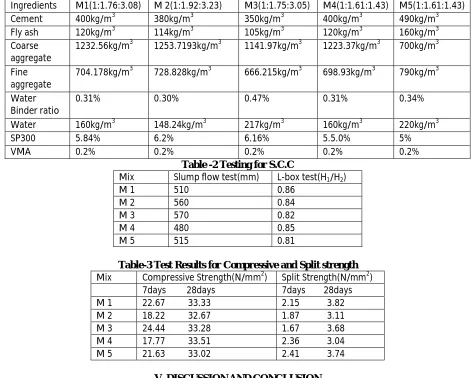
affected by the physical characteristics of materials and mixture proportioning. The characteristics of the powder, super plasticizer and VMA largely affect the mortar property and so the proper water powder ratio and super plasticizer and VMA dosage cannot be fixed without trial mixing at this stage. Therefore, once the mix proportion is decided, self-compact ability has to be tested by slump flow, l-box test.
Table -1 Different Proportions of S.C.C
Ingredients M1(1:1.76:3.08) M 2(1:1.92:3.23) M3(1:1.75:3.05) M4(1:1.61:1.43) M5(1:1.61:1.43)
Cement 400kg/m3 380kg/m3 350kg/m3 400kg/m3 490kg/m3
Fly ash 120kg/m3 114kg/m3 105kg/m3 120kg/m3 160kg/m3
Coarse aggregate
1232.56kg/m3 1253.7193kg/m3 1141.97kg/m3 1223.37kg/m3 700kg/m3
Fine aggregate
704.178kg/m3 728.828kg/m3 666.215kg/m3 698.93kg/m3 790kg/m3
Water Binder ratio
0.31% 0.30% 0.47% 0.31% 0.34%
Water 160kg/m3 148.24kg/m3 217kg/m3 160kg/m3 220kg/m3
SP300 5.84% 6.2% 6.16% 5.5.0% 5%
VMA 0.2% 0.2% 0.2% 0.2% 0.2%
Table -2 Testing for S.C.C
Mix Slump flow test(mm) L-box test(H1/H2)
M 1 510 0.86
M 2 560 0.84
M 3 570 0.82
M 4 480 0.85
M 5 515 0.81
Table-3 Test Results for Compressive and Split strength
Mix Compressive Strength(N/mm2) Split Strength(N/mm2)
7days 28days 7days 28days
M 1 22.67 33.33 2.15 3.82
M 2 18.22 32.67 1.87 3.11
M 3 24.44 33.28 1.67 3.68
M 4 17.77 33.51 2.36 3.04
M 5 21.63 33.02 2.41 3.74
V. DISCUSSION AND CONCLUSION
1. The 7 days compressive strength of SCC comes around 21.63N/mm² and 28 days compressive strength of SCC comes around 33.02. The 7days compressive strength of conventional concrete comes around 26.48N/mm² and 28days compressive strength of conventional concrete comes around 36.45N/mm².
2. The 7 days split strength of SCC comes around 2.41N/mm² and 28 days split strength of SCC comes around 3.74 N/mm². The 7days split tensile strength of conventional concrete comes around 2.89N/mm² and 28days compressive strength of conventional concrete comes around 3.90 N/mm².
REFERENCES
1. IRC-456-2000 Indian Standard for Plain and Reinfsorced Concrete
2. Okamura H., Ozawa K., Mix Design for Self-Compacting Concrete, Concrete Library of Japanese Society of Civil Engineers, June 25, 1995, p.
107-120.
3. EFNARC (2002) ‘Specification and Guidelines for Self Compacting Concrete’
4. IS 10262:2009 ‘Concrete Mix Proportioning’ – Guidenlines
5. Vipulkumar ‘Study Of Mix Design Of Self Compacting Concrete’ Aug 2015
6. Rafatsiddique ‘Self Compacting Concrete- Procedure for Mix Design’ 12 Jan-June 2008