Multiple star systems observed with CoRoT and
Kepler
John Southworth
Astrophysics Group, Keele University, Staffordshire, ST5 5BG, UK
Abstract. The CoRoT andKeplersatellites were the first space platforms designed to perform high-precision photometry for a large number of stars. Multiple systems dis-play a wide variety of photometric variability, making them natural benefactors of these missions. I review the work arising from CoRoT andKeplerobservations of multiple sys-tems, with particular emphasis on eclipsing binaries containing giant stars, pulsators, triple eclipses and/or low-mass stars. Many more results remain untapped in the data archives of these missions, and the future holds the promise of K2, TESS and PLATO.
1 Introduction
The CoRoT andKeplersatellites represent the first generation of astronomical space missions capable of large-scale photometric surveys. The large quantity – and exquisite quality – of the data they pro-vided is in the process of revolutionising stellar and planetary astrophysics. In this review I highlight the immense variety of the scientific results from these concurrent missions, as well as the context provided by their precursors and implications for their successors.
CoRoT was led by CNES and ESA, launched on 2006/12/27, and retired in June 2013 after an irre-trievable computer failure in November 2012. It performed 24 observing runs, each lasting between 21 and 152 days, with a field of view of 2×1.3◦×1.3◦, obtaining light curves of 163 000 stars [33].Kepler
was a NASA mission, launched on 2009/03/07 and suffering a critical pointing failure on 2013/05/11. It observed the same 105 deg2 sky area for its full mission duration, obtaining high-precision light curves of approximately 191 000 stars. The remainder of the spacecraft is fully functional and has now been reincarnated as the K2 survey instrument, which is sequentially observing ten fields on the ecliptic for approximately 75 days each with a reduced photometric precision [27].
The high-precision photometric capabilities of CoRoT andKeplermean their primary contribution to the study of multiple stars is obtaining light curves of eclipses, plus proximity-induced phenomena such as the reflection, ellipsoidal and Doppler beaming effects. Intrinsic stellar variability such as pulsations are also detected in abundance, including for many components of multiple systems.
2 Eclipses in binary stars
The importance of eclipsing binaries (EBs) is that it is possible to measure the masses and radii of their components directly from light and radial velocity curves, and to high precision (e.g. [47]). Measure-ment of theTeffvalues of the stars enables luminosity to be calculated directly, making them excellent distance indicators (e.g. [46, 21]). These properties are useful in critiquing predictions from thereoti-cal stellar models [35, 34], investigating star and binary formation scenarios [1] and galactic chemithereoti-cal evolution [41], establishing empirical relations for use in stellar physics [56], and determining the properties of transiting extrasolar planets (e.g. [44, 20]).
The study of EBs is a mature field: the term “binary star” was christened by William Herschel in 1802 [26]. Eclipses were proposed by John Goodricke in 1783, as a possible explanation forβPer. Stebbins [50] attained the first direct measurement of the masses and radii of stars in an EB,βAur.
DOI: 10.1051/
C
Owned by the authors, published by EDP Sciences, 2015
/201
epjconf 51010 001
7KLVLVDQ2SHQ$FFHVVDUWLFOHGLVWULEXWHGXQGHUWKHWHUPVRIWKH&UHDWLYH&RPPRQV$WWULEXWLRQ/LFHQVHZKLFKSHUPLWV XQUHVWULFWHGXVHGLVWULEXWLRQDQGUHSURGXFWLRQLQDQ\PHGLXPSURYLGHGWKHRULJLQDOZRUNLVSURSHUO\FLWHG
3 The CoRoT and
Kepler
era
These two satellites have allowed significant advances to be made for a wide variety of stellar types and physical phenomena. Below I highlight some of the most influential and intriguing results conerning multiple stars, made possible by the unprecedented quality of the data harvested by CoRoT andKepler.
Giant stars in eclipsing binaries
Arguably the most valuable EBs are well-detached: those whose components’ evolution has been negligibly affected by the presence of their companion are more representative of single stars and best suited to comparision with single-star evolutionary theory. This presents a problem in the study of evolved stars in EBs, because their swollen radii mean orbital periods must be long for them to remain in a detached state. This in turn makes photometric follow-up extremely expensive in terms of telescope time and human effort. Prior to CoRoT andKeplerthe only detached EB with a component with logg <3 was TZ For, a 75-d period system studied using a semi-autonomous photometer [2].
Keplerhas been used to discover many EBs containing giants. The first of these, KIC 8410637, showed a total eclipse of depth 0.1 mag and duration 2.2 d in the Q0 data [25]. As further quarters of data accumulated, a secondary eclipse of depth 0.03 mag and duration 8.1 d materialised. Further eclipses fromKeplerestablished its orbital period as 408 d. In combination with RV follow-up from terrestrial telescopes, these data enabled measurement of the physical properties of the system [17]. The more massive star is an 11 Rgiant with aTeffof 4800 K, showing stochastic oscillations, whereas its companion is a 6500 K F-dwarf. A detailed study of this oscillating giant of precisely known mass and radius will enable a check on the predictive power of asteroseismology. A further 12 promising candidates have been found in theKeplerdataset [18].
Multiply-eclipsing systems
One of the most critical benefits of near-continuous high-precision photometry is the ability to detect – and study in detail – unusual and particularly interesting objects. KOI-126 turned out to be a triple system composed of a short-period EB containing two 0.2 Mstars, itself eclipsing and being eclipsed by a slightly evolved G-star (1.3 M, 2.0 R, 5875 K) [8]. Although the two M-dwarfs are spectroscop-ically undetectable, the system could be characterised to high precision (masses to 1%, radii to 0.5%) by modelling the continually-changing duration, depth and complex shapes of the mutual events.
HD 181068 (KIC 5952403), a bright star observed with Kepler, exhibits shallow eclipses on a 0.9 d period attributable to an EB containing two K-dwarfs which in turn transit and occult a G-giant (3.0 M, 12.5 R) on a 42 d period [15]. The very unusual eclipse morphology for this object, where the short and shallow eclipses disappear during alternate long and deep eclipses, is caused by the very similarTeffs of the three stars (5100 K for the giant, and 5100 K and 4675 K for the dwarfs) [6]. Another stunning example of tertiary eclipses is displayed by KIC 2856960 [3].
Low-mass systems
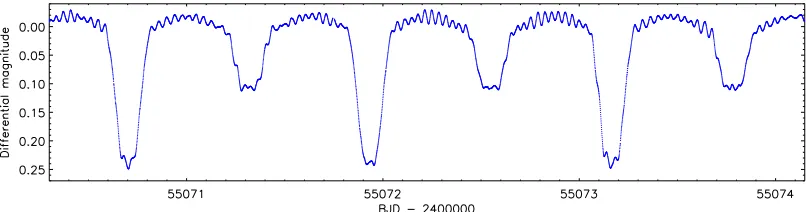
Fig. 1.Excerpt from theKeplershort-cadence light curve of theδScuti eclipsing system KIC 10661783.
Pre-main-sequence stars are short-lived objects for which theoretical models are very poorly con-strained. CoRoT was enlisted to help this issue through observations of the young open cluster NGC 2264, which is known to contain many young stars. Several tens of EBs were identified, and CoRoT 223992193 has been studied in detail [19]. Its light curve shows well-defined eclipses plus large and slower stochastic variations attributed to the occultation of material near the inner edge of a circumbi-nary disc. The masses and radii of the two stars have been measured precisely and provide important constraints in a previously empty tract of of the mass–radius diagram.
δScuti stars in eclipsing binaries
δScuti stars are a relatively familiar class of pulsating A-type stars, showing periodic radial and non-radial pulsations at frequencies 3–70 d−1. A significant number have been observed in EBs using CoRoT andKepler. An early result was for KIC 10661783, a totally-eclipsing Algol system whose primary component shows over 50 pulsational frequencies in the range 18–31 d−1 [49] (see Fig. 1). Follow-up spectroscopy [29] facilitated the measurement of masses and radii precise to 1%, which are inconsistent with the mass ratio required to fit the light curve if the secondary star fills its Roche lobe. Definitive conclusions await the construction of more sophisticated light curve synthesis codes.
CoRoT 105906206 is a detached EB for which precise masses and radii were measured, a process which required the inclusion of Doppler beaming in the light curve model [13]. The promise of such work is the possibility to perform mode identification on aδScuti star, enabled by precise knowledge of its mass and radius [12]. This is notoriously tricky to achieve. Another possibility enabled by eclipses is obtaining spatial information for the pulsations on the surface of the star [5].
γDoradus stars in eclipsing binaries
CoRoT 102918586 is a detached EB whose primary component is an example of theγDor variability class – late-A to early-F dwarfs which show high-order non-radial g-mode pulsations with typical frequencies 0.3-3 d−1 [24]. The CoRoT light curve and ground-based ´echelle spectroscopy yielded mass and radius measurements to 1% precision and accuracy [31]. The pulsations are consistent with high-order=1g-modes for the measured mass and radius of the primary star.
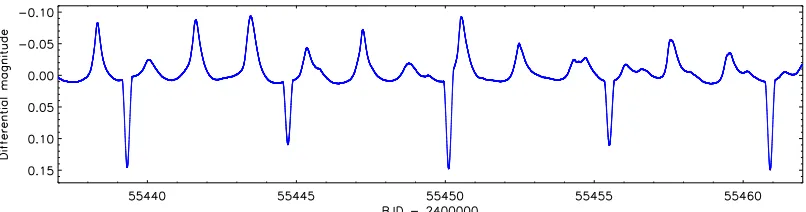
KIC 11285625 is a spectacular example of a pulsating star in an EB (Fig. 2), showing pulsations of up to 0.1 mag amplitude overlaid with 0.15 mag deep eclipses on a 10.8 d period [14]. By twinning a simple light curve code [45] with pulsational modelling, [14] measured the physical properties of the stars and found amplitude modulation and frequency splittings at the orbital and rotational periods.
Hybrid δSct/γDor stars exist in the region of overlap between the pulsation classes [22]. Such objects are also apparent in EBs, for example CoRoT 100866999 [9]. KIC 4544587 also shows both
p-mode andg-mode pulsations superimposed on deep eclipses in an eccentric orbit [23]; in this case it is likely that the primary star is aδSct and the secondary star is aγDor. Such a situation highlights the difficulty in assigning oscillation frequencies to individual components of an unresolved binary.
Heartbeat stars and tidally-induced pulsations
Fig. 2.Excerpt from theKeplerlong-cadence light curve of theγDoradus eclipsing system KIC 11285625.
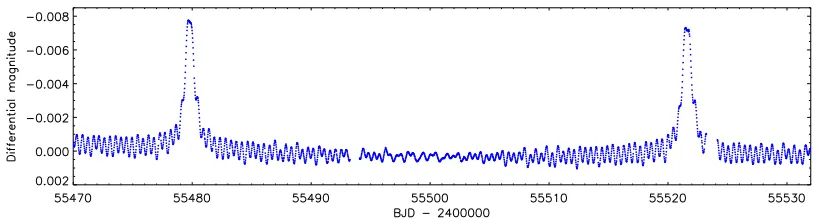
spectroscopic radial velocity measurements the brightening was explained as resulting from the ellip-soidal and irradiation effects during periastron passage of two A-stars in a highly eccentric (e=0.83)
binary system. Over 30 oscillation periods were detected at integer multiples of the orbital frequency ranging from 23 to 91 forb, a clear indication of tidal excitation. Over 100 of these objects are now known ([52], K. M. Hambleton, priv. comm.), and some are also eclipsing.
Tidally-induced pulsations have been seen before in several EBs. The first clear detection was from the CoRoT light curve of HD 174884, which has an orbital period of 3.6 d and oscillations at 8 and 13
forb[30]. HD 181068 (see above) also shows oscillations which are probably tidally induced [15].
Stochastic oscillations in V380 Cygni
Stochastic (solar-like) oscillations are a fundamental component of modern stellar astrophysics, due in large part to the capabilities of CoRoT andKepler. They were an integral part of the strategy for characterising the transiting planets discovered usingKepler(e.g. [11, 32]) and will repeat this role for the forthcoming PLATO mission [40]. The goal of validating asteroseismic results, using empirically-measured properties of stars in EBs, has not yet been possible due to a lack of available targets. This is because tidal effects in many EBs cause them to rotate faster, thus suppressing stochastic oscillations. Stochastic oscillations have, however, been detected in the more massive and evolved (11.4 M, 15.7 R) component of the eccentric EB V380 Cyg [53]. A detailed analysis of this system [54] found that evolutionary models for massive stars predict insufficient mixing near the convective core.
Circumbinary planets
The possibility of planets orbiting binary stars has a long history, especially in science fiction. Whilst there have been several claims based on eclipse timing variations, the first unarguable case was that of Kepler-16 [16]. This system consists of a 41-d EB with 0.7 Mand 0.2 Mcomponents orbited by a 0.33 MJuptransiting planet. The timing and duration of the transits vary greatly due to the orbital motion of the stars in the binary. At the time of writing ten transiting circumbinary planets are known, in eight systems, the most recent being KIC 9632895 [59]. A huge advantage of these objects is that dynamical interactions affect the transits, offering a way to measure the masses of the stars and planets to sometimes high precision without extensive follow-up observations. In the case of Kepler-16, the stellar masses and radii are known to 0.5%, and the planetary mass and radius to 5% and 0.3%.
Interacting binaries
Fig. 3.Excerpt from theKeplerlong-cadence light curve of the heartbeat star KOI-54.
4 Outlook and future missions
Although the CoRoT and mainKepler missions have both concluded due to hardware issues, their archives hold a huge amount of untapped data. The current version of theKeplereclipsing binary cat-alogue [38] contains over 2000 objects of which only a small fraction have been subjected to detailed analysis. The primary bottleneck to this work is a lack of manpower. Both missions therefore continue to yield new results which further our understanding of multiple and single stars.
Space-based photometry continues to be available from several missions of more limited scope.
Kepler itself continues to observe at reduced photometric precision in its reincarnation as the K2 mission, and has already observed a significant number of EBs. Most of the BRITE constellation of small satellites [57] have now been launched and are returning data. BRITE will obtain multi-colour light curves of some of the brightest objects in the sky, although the number of targets is low due to limitations on the rate at which data can be transferred to the ground.
The next landmark mission is TESS [42], which will photometrically observe 12 fields covering most of the sky. TESS will solve some of the acknowledged problems ofKepler(a limited field of view containing relatively faint stars) but at the expense of coarser spatial resolution and much shorter light curve durations (one month near the ecliptic ranging to one year around the celestial poles). It is slated for launch in 2017 and will observe for two years with the possibility of a mission extension.
Further ahead, the ESA PLATO mission [40] is planned for launch in 2024 as a precision photom-etry survey instrument. PLATO will solve the´etendue conundrumby consisting of 32 small telescopes on a common platform, enabling it to achieve a high photometric precision on many bright stars over a large field of view. An additional huge advantage is onboard data reduction, which will enable higher time resolution compared to CoRoT andKepler (25 s versus mostly 512 s or 1765 s sampling) and allow data to be obtained for all point sources in the field of view. The author will lead the eclipsing binary working group for PLATO; please contact me if you wish to be involved.
In conclusion, CoRoT andKeplerhave caused a fundamental change in the study of multiple stars by providing light curves of unprecedented quality and quantity. An impressive number and variety of results have been gathered, and the immense databases from these missions will power stellar and planetary physics for many more years. Work remains to be done on our understanding of high-mass and low-mass stars, on asteroseismology via pulsating stars in EBs, on the effective temperature scale, and on progressively finer tests of the predictions of theoretical models.
References
1. Albrecht S., et al., Nature,461, (2009) 373 2. Andersen J., et al., A&A,246, (1991) 99 3. Armstrong D., et al., A&A,545, (2012) L4 4. Bass G., et al., ApJ,761, (2012) 157
17. Frandsen S., et al., A&A,556, (2013) 138 18. Gaulme P., et al., ApJ,767, (2013) 82 19. Gillen E., et al., A&A,562, (2014) A50 20. Gillon M., et al., A&A,562, (2014) L3 21. Graczyk D., et al., ApJ,780, (2014) 59 22. Grigahc`ene A., et al., ApJ,713, (2010) L192 23. Hambleton K. M., et al., MNRAS,434, (2013) 925 24. Handler G., MNRAS,309, (1999) L19
25. Hekker S., et al., ApJ,713, (2010) L187
26. Herschel W., Phil. Trans. Roy. Soc. London,92, (1802) 477 27. Howell S. B., et al., PASP,125, (2014) 398
28. Kondo Y., et al., ApJ,421, (1994) 787 29. Lehmann H., et al., A&A,557, (2013) A79 30. Maceroni C., et al., A&A,508, (2009) 1375 31. Maceroni C., et al., A&A,552, (2013) A60 32. Marcy G., et al., ApJS,210, (2014) 20 33. Moutou C., et al., Icarus,226, (2013) 1625 34. Pavlovski K., et al., MNRAS,400, (2009) 791 35. Pols O. R., et al., MNRAS,289, (1997) 869
36. Połubek G., Advances in Space Research,31, (2003) 393 37. Pribulla T., et al., Astronomische Nachrichten,331, (2010) 397 38. Prˇsa A., et al., AJ,141, (2011) 83
39. Ramsay G., et al., MNRAS,425, (2012) 1479 40. Rauer H., et al.,arXiv:1310.0696
41. Ribas I., et al., MNRAS,313, (2000) 99 42. Ricker G. R., et al., SPIE,9143, (2014) E20 43. Rucinski S. M., et al., MNRAS,380, (2007) L63 44. Southworth J., MNRAS,394, (2009) 272
45. Southworth J., Maxted P. F. L., Smalley B., MNRAS,351, (2004) 1277 46. Southworth J., Maxted P. F. L., Smalley B., A&A,429, (2005) 645 47. Southworth J., et al., MNRAS,363, (2005) 529
48. Southworth J., Bruntt H., Buzasi D. L., A&A,467, (2007) 1215 49. Southworth J., et al., MNRAS,414, (2011) 2413
50. Stebbins J., ApJ,34, (1911) 112 51. Still M., et al., ApJ,717(2010) L113 52. Thompson S. M., et al., ApJ,753, (2012) 86 53. Tkachenko A., et al., MNRAS,424, (2012) L21 54. Tkachenko A., et al., MNRAS,438, (2014) 3093 55. Torres G., Astronomische Nachrichten,334, (2013) 4 56. Torres G., Andersen J., Gim´enez A., A&AR,18, (2010) 67 57. Weiss W. W., et al., PASP,126, (2014) 573