Neutron Cross Section Processing Methods for Improved
Integral Benchmarking of Unresolved Resonance Region
Evaluations
Jonathan A. Walsh1,2,a, Benoit Forget1, Kord S. Smith1, and Forrest B. Brown2 1Department of Nuclear Science & Engineering
Massachusetts Institute of Technology
77 Massachusetts Avenue, 24-107, Cambridge, MA, USA 02139
2XCP-3, Monte Carlo Methods, Codes, & Applications
Los Alamos National Laboratory Los Alamos, NM, USA 87545
Abstract.In this work we describe the development and application of computational methods for processing neutron cross section data in the unresolved resonance re-gion (URR). These methods are integrated with a continuous-energy Monte Carlo neutron transport code, thereby enabling their use in high-fidelity analyses. Enhanced understand-ing of the effects of URR evaluation representations on calculated results is then obtained through utilization of the methods in Monte Carlo integral benchmark simulations of fast spectrum critical assemblies. First, we present a so-called on-the-fly (OTF) method for calculating and Doppler broadening URR cross sections. This method proceeds directly from ENDF-6 average unresolved resonance parameters and, thus, eliminates any need for a probability table generation pre-processing step in which tables are constructed at several energies for all desired temperatures. Significant memory reduction may be real-ized with the OTF method relative to a probability table treatment if many temperatures are needed. Next, we examine the effects of using a multi-level resonance formalism for resonance reconstruction in the URR. A comparison of results obtained by using the same stochastically-generated realization of resonance parameters in both the single-level Breit-Wigner (SLBW) and multi-level Breit-Wigner (MLBW) formalisms allows for the quantification of level-level interference effects on integrated tallies such askeff and
en-ergy group reaction rates. Though, as is well-known, cross section values at any given incident energy may differ significantly between single-level and multi-level formula-tions, the observed effects on integral results are minimal in this investigation. Finally, we demonstrate the calculation of true expected values, and the statistical spread of those values, through independent Monte Carlo simulations, each using an independent real-ization of URR cross section structure throughout. It is observed that both probability table and OTF treatments reproduce the true expected values, calculated by averaging the results of many independent simulations, quite well. However, the spread of indepen-dent calculation results is shown to be relatively significant. Thekeffeigenvalues for fast
spectrum systems can differ by more than 250 pcm from one simulation to the next.
1 Introduction
At the intermediate energies between the well-defined resonance structure of neutron cross sections in the resolved resonance region and the broad, smoothed fluctuations in the fast energy region, res-onances do exist, but are so closely-spaced in energy that their individual parameters (i.e. resonance energy and partial widths) cannot be determined. A nuclide’s unresolved resonance region (URR) is composed of the energies characterized by this phenomenon [1].
Treatment of the URR is of particular importance to the modeling of fast spectrum reactors and critical assemblies which often have a significant neutron flux in the URR of many of their con-stituent nuclides. Because simply using averaged cross sections is tantamount to neglecting energy self-shielding effects and results in over-predicted reaction rates, URR resonance structure must be ac-counted for. Implemented in many nuclear data processing codes such as NJOY [2], CALENDF [3], and here, as part of this work, the probability table method [4] is the most widely-used approach for incorporating this structure. Using the average URR resonance parameters contained in an ENDF-6 format [5] evaluation file and the theoretical distributions of those parameters, the method proceeds by generating many realizations of resonance structure and then tabulating the probabilities of observ-ing various cross section magnitudes. This tabulation is performed at several URR energies for each desired temperature.
This work examines alternate methods for processing URR neutron cross sections and their use in integral benchmark simulations. Specifically, in Sec. 2, we start by presenting applications of an on-the-fly (OTF) cross section calculation method which eliminates the need for the pre-generation of probability tables. Next, in Sec. 3, the effects of using a multi-level resonance formalism for represent-ing URR cross sections are analyzed. Then, in Sec. 4, the use of srepresent-ingle, independent URR realizations throughout their own independent Monte Carlo simulations is investigated to test the ability of the probability table method to produce true expected value tallies and the spread of independent tally realizations. Lastly, concluding remarks are offered in Sec. 5.
All of the presented methods are implemented in the continuous-energy neutron transport code OpenMC [6]. Except where noted, results are obtained from OpenMC simulations utilizing ENDF/B-VII.1 nuclear data evaluations [7].
2 On-the-Fly Cross Sections
One drawback of the probability table method is that data must be pre-generated at multiple energies for each desired temperature. In simulations of systems with many temperatures (e.g. fast reactor multiphysics analyses), this can result in a large memory requirement. Calculating URR cross sec-tions OTF (i.e. within the Monte Carlo transport calculation) directly from temperature-independent average resonance parameters can reduce this burden significantly [8]. As an additional benefit, the need for performing the sensitivity studies that are typically required to ensure that probability tables are generated with a fine enough phase-space mesh is also eliminated because the OTF method is continuous in the energy, temperature, and cross section magnitude variables.
Here, we use the OTF method to illustrate the testing of pre-generated probability tables and also demonstrate the significance of varying the URR energy bounds in simulations of the Zero Energy Breeder Reactor Assembly, core 8H (ZEBRA-8H)1,2. Fig. 1a shows the flux computed with both
the OTF method and the probability tables of the ENDF71x ACE-format processed nuclear data li-brary [11]. Agreement between the two flux spectra is an indication that the probability tables are
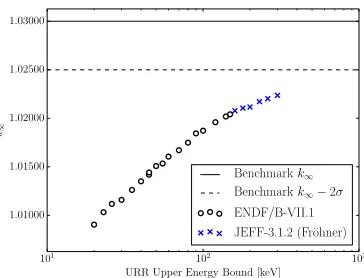
erated with a phase-space mesh that is sufficiently fine to produce accurate tallies for the ECCO-33 en-ergy group structure that is used in these simulations. Fig. 1b plots thek∞eigenvalues computed with varying URR upper energy bounds. The upward trend ofk∞with increasing upper bound suggests that resonance structure may be important at energies above the current238U ENDF/B-VII.1 URR
evaluation. As further indication of this, simulations utilizing Fröhner’s complete evaluation [12], up to 300 keV, result ink∞eigenvalues that are 200 pcm closer to the benchmark value than those computed using the truncated ENDF/B-VII.1 evaluation.
10−3 10−2 10−1 100 101
10−3
10−2
10−1
100
101
102
In
tegrated
Flux
Prob. Tables On-the-Fly
10−3 10−2 10−1 100 101
Energy [MeV]
0.980
0.985
0.990
0.995
1.000
1.005
1.010
1.015
1.020
Prob.
T
ables/OTF
Ratio±1σ
(a) Probability table mesh refinement studies
101 102 103
URR Upper Energy Bound [keV] 1.01000
1.01500 1.02000 1.02500 1.03000
k∞
Benchmarkk∞
Benchmarkk∞−2σ
ENDF/B-VII.1 JEFF-3.1.2 (Fr¨ohner)
(b) Energy range sensitivity studies
Figure 1: URR evaluation benchmarking applications with ZEBRA-8H.
3 Multi-Level Resonance Representation
As is prescribed by the ENDF-6 format, the probability table method is typically implemented using the single-level Breit-Wigner (SLBW) resonance formalism to generate URR cross section realiza-tions3. Here, we investigate the use of the multi-level Breit-Wigner (MLBW) resonance formalism
for OTF URR cross section calculations4and compare the results to those obtained using the standard
SLBW model in simulations of the Big Ten critical assembly5. Flux and238U scattering rate spectra
for both formalisms are shown in Figs. 2a and 2b, respectively. Close agreement between the SLBW and MLBW spectra suggest that the use of a multi-level resonance formalism may not be necessary to reproduce many tallies of interest. This is further supported by the agreement between SLBW and MLBWkeffvalues that is seen in Table 1.
Table 1: Big Tenkeffeigenvalues.
Method ENDF71x prob. tables OpenMC prob. tables OTF SLBW OTF MLBW
keff(1σ×105) 1.00467(10) 1.00466(10) 1.00461(10) 1.00453(9)
3One exception is CALENDF which allows SLBW, multi-niveau Breit-Wigner, and Reich-Moore formalisms. 4In this preliminary study we investigate only the MLBW formalism as specified by the ENDF-6 format.
10−3 10−2 10−1 100 101
10−3
10−2
10−1
100 101 102 In tegrated Flux MLBW SLBW
10−3 10−2 10−1 100 101
Energy [MeV]
0.980
0.985
0.990
0.995
1.000
1.005
1.010
1.015
1.020
MLBW/SLBW
Ratio±1σ
(a) Flux
10−3 10−2 10−1 100 101
10−3
10−2
10−1
100 101 102 In tegrated Scatter R ate MLBW SLBW
10−3 10−2 10−1 100 101
Energy [MeV]
0.980
0.985
0.990
0.995
1.000
1.005
1.010
1.015
1.020
MLBW/SLBW
Ratio±1σ
(b)238U scattering rate
Figure 2: SLBW and MLBW Big Ten tally spectra.
1.00300 1.00400 1.00500 1.00600 1.00700 1.00800
keff 0 100 200 300 400 500 600 700 800 900 P ( keff )
SamplekeffDistribution±1σ Gaussian Fit
(a)keffeigenvalues
0.22000 0.22100 0.22200 0.22300 0.22400 0.22500 0.22600
238U URR Absorption Rate
0 200 400 600 800 1000 P ( 238 U U RR Absorption Rate)
Sample Absorption Rate Distribution±1σ
Gaussian Fit
(b)238U URR absorption rate
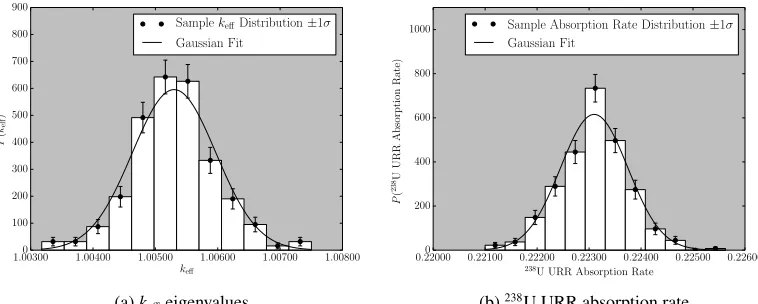
Figure 3: Big Ten tally distributions from independent realizations.
4 Independent Resonance Realizations
The distributions ofkeffand238U URR absorption rate from 350 simulations of the Big Ten critical
assembly are displayed in Figs. 3a and 3b, respectively. The centers of these distributions, which are the true expected values, agree very well with the results produced using the probability table and OTF methods6. However, the spread of individual tally results, each corresponding to a valid realization of
nature, is notable with the middle 95% ofkeffvalues spanning a range of 275 pcm.
5 Conclusions
This work demonstrates the use of various neutron cross section processing methods which allow for enhanced analyses of URR evaluations with integral benchmark simulations. An OTF cross section calculation approach is used to compute continuous phase-space results directly from resonance parameters. Further, it is used to demonstrate the variation ofkeffwith increasing URR upper energy
bound. This variation indicates a possible need for modeling resonance structure at energies above the upper bounds of the238U URR evaluations that are currently available. The ENDF-6 version
of the MLBW resonance formalism is also used to calculate OTF URR cross sections. Differences in bothkeff and spectral tallies between simulations using the two formalisms are observed to be
insignificant. Finally, independent simulations, each utilizing a single, independent URR realization, are used to compute true expected value tallies. The spread of tally realizations arising from unknown URR resonance structure is also demonstrated to be significant for a fast spectrum system with individualkeffvalues showing differences greater than 250 pcm.
This work is funded by a U.S. Department of Energy (DOE) Nuclear Energy University Programs Graduate Fellowship, the Consortium for Advanced Simulation of Light Water Reactors (CASL), and the DOE National Nuclear Security Administration (NNSA) Advanced Simulation and Computing (ASC) program.
References
[1] A. Foderaro,The Elements of Neutron Interaction Theory(MIT Press, 1971)
[2] R. Macfarlane, D. Muir, Tech. Rep. LA-12740-M, Los Alamos National Laboratory (1994) [3] J.C. Sublet, P. Ribon, M. Coste-Delclaux, Tech. Rep. CEA-R-6277, French Alternative Energies
and Atomic Energy Commission (2011) [4] L. Levitt, Nucl. Sci. Eng.49, 450 (1972)
[5] A. Trkov, M. Herman, D. Brown, Tech. Rep. BNL-90365-2009 Rev.2, Brookhaven National Laboratory (2012)
[6] P.K. Romano, B. Forget, Ann. Nucl. Energy51, 274 (2013)
[7] M. Chadwick, M. Herman, P. Obložinský, M. Dunn, Y. Danon, A. Kahler, D. Smith, B. Prity-chenko, G. Arbanas, R. Arcilla et al., Nucl. Data Sheets112, 2887 (2011)
[8] J.A. Walsh, B. Forget, K.S. Smith, B.C. Kiedrowski, F.B. Brown,Direct, On-the-fly Calculation
of Unresolved Resonance Region Cross Sections in Monte Carlo Simulations, inProc. M&C
2015,Nashville (2015)
[9] NEA Nuclear Science Committee, Tech. Rep. NEA/NSC/DOC(95)03, OECD NEA (2013) [10] NEA Nuclear Science Committee, Tech. Rep. NEA/NSC/DOC(2006)1, OECD NEA (2014) [11] J.L. Conlin, D.K. Parsons, S.J. Gardiner, M. Gray, A. Kahler, M.B. Lee, M.C. White, Tech. Rep.
LA-UR-13-20137, Los Alamos National Laboratory (2013) [12] F.H. Fröhner, Nucl. Sci. Eng.103, 119 (1989)