Educational Management and Administration in St. Lucia: Policy,
Practice and Challenges for Small Education Systems.
Benoit Charles
Thesis Submitted in fulfilment of the requirement for the degree of
Doctor of
Philosop~y2000
Educational Administration and Management in St. Lucia: Policy, Practice and Challenges for Small Education Systems.
Thesis submitted in fulfilment of the requirement for the degree of Doctor of Philosophy.
Benoit Charles
Institute of Education, University of London
Abstract
The administration of education in St. Lucia has recently come under increasing scrutiny and criticism in the attempt to improve the quality of education as increasing demand for secondary education, and selection, which pervades the education system have increased pressures for improved student performance. Policymakers and practitioners believe that improved management of the education system is the key to improving performance. Consequently, there has been a raft of policies aimed at improving the management ofthe education system.
The central argument of this dissertation is that poor policy analysis, inappropriate strategies such as decentralisation, outdated management practices and inappropriate training of educational administrators, combined with the impact of scale, isolation and dependence, adversely affect the ability to meet the challenges of effective and efficient management of the education system. It charts the development of education from Pre-Emancipation to contemporary times. It critically examines the factors that influence educational policy and practice and examines contemporary educational policies to assess their ability to meet the challenges of a modem education system
is essentially narrative, and uses both qualitative and quantitative data, gathered from a questionnaire survey and interviews with senior education officials.
The findings confirm that the operation of policy and practice is problematic, and unlikely to achieve improvements in the performance of the education system without major reforms. The analysis contributes to improved understanding ofthe complexities of educational administration in a small state, and shows the need for significant changes in the organisation of the education system and in policy analysis, especially policy implementation.
TABLE OF CONTENTS
Title Page
1
Abstract
2
List of Tables
9
List of Figures
10
List of Appendices
11
Acknowledgements
12
Dedication 13
Chapter 1: Overview of the Study
1.1
Introduction14
1.2
Developing Interest in the Research Problem15
1.3
Introducing the Research Problem16
1.4
Statement of the Problem19
1.5
Study Objectives20
1.6
Conceptual Framework21
1.7
Theoretical Frameworks24
1.8
The Geopolitical Framework28
1.9
The Thesis Structure29
1.10
Limitations of the Study33
1.11
Significance of the Study34
Chapter 2. Methodological Approach
2.1
Introduction36
2.2
Purpose of the Study36
2.3
Methodological Perspectives37
2.4
Qualitative Research in Education39
2.5
A Policy-oriented Research Perspective41
2.6
Research Methods44
2.61
Historical Research44
2.6.2
Survey47
2.7
Procedures49
2.7.1
Sources of Data50
2.7.2
Sample50
2.7.3
Postal Questionnaire51
2.7.4
Documentary Information52
2.7.5
Interviews53
2.7.6
Focus Group Discussions54
2.8
Data Analysis55
Chapter 3 Development of Small States: A Critical Review of the Literature.
3.1
Introduction58
3.2
Education and Development58
3.3
Dependency Theory60
3.3.1
Dependency as a Theory of Development62
3.3.2
Dependency as an Obstacle to Development62
3.3.3
Dependency s a Concept and Analytical Tool63
3.3.4
A Critique of Dependency Theory63
3.4
The Rise of Interest in the Development of Small States66
3.4.1
The Economic Dimension66
3.4.2
Educational Development in Small States69
3.5
Characteristics of Small States: Conceptual and DefinitionalIssues
71
3.5.1
The Measuring Smallness72
3.5.2
Economic Constraints73
3.5.3
Demographic Constraints76
3.5.4
Sociological Constraints78
3.6
Advantages of Smallness80
3.7
Dependence in Education82
3.8
Educational Dependence in Small States86
3.9
Educational Administration89
3.10
Limitations of the Existing Literature92
3.11
Study Perspective93
Chapter 4 Development Issues in Small States:
The Organisation of Eastern Caribbean States
4.1
Introduction95
4.2
The World of Small States95
4.3
The Organisation of Eastern Caribbean States (OECS)101
4.3.1
Diversity102
4.3.2
Impact of Scale103
4.3.3
Proneness to Natural Disasters104
4.3.4
Isolation105
4.3.5
Dependence106
4.3.6
Globalisation108
4.4
Opportunities Presented by Small Scale110
4.5
Responses to the Challenges and opportunities presentedby Small Scale.
111
4.5.1
Regional Co-operation111
4.5.2
Local Capacity Building112
4.6
Issues of Efficiency and Effectiveness in Education:114
4.6.1
Efficiency in Education114
4.6.2
Effectiveness in Education115
4.7
Development Imperatives117
Chapter 5: The Development of Education in the Caribbean 5.1 Introduction
5.2 An Overview of the Caribbean 5.3 Slavery in the Caribbean 5.4 The Abolition of Slavery
5.5 Education in the Pre-Emancipation Period 5.6 Education in the Post-Emancipation Period
5.6.1 The Apprenticeship System' 5.6.2 The Mico Charity
5.6.3 The Negro Education Grant
5.7 The Development of Secondary and Tertiary Education 5.8 Teachers in the Post-Emancipation Period
5.9 Teacher Training
5.10 20th Century Development in Education. 5.10.1 Primary and Secondary Education 5.10.2 Vocational and Tertiary Education 5.10.3 Teacher Training
5.10.4 Curricula Reform
5.11 The Administration of Education in the Colonial Period 5.11.1 Organisation and Structure
5.12 5.13. Chapter 6 6.1 6.2 6.3 6.4 6.5 6.6 6.7 6.8 6.9 6.10
5.11.2 The Evolution of Administrative Control 5.11.3 Social Unrest and Civil Disturbances
Modem Developments and Achievements in Education Conclusion: Links Between Contemporary Issues in
Education and History
Education in St. Lucia Introduction
An Overview
The Economic Background
Organisation and Structure of the Education System 6.4.1 Ministry of Education, Culture and Labour 6.4.2 The School System
Policy Making and Control Management at School Level Selection, Equity and Access Expenditure on Education
Performance of the Education System 6.9.1 Efficiency
6.9.2 Effectiveness
Factors Influencing Educational Management &Administration 6.10.1 Perspectives from Public Administration
6.10.2 The Colonial Inheritance
6.10.3 Policy Borrowing and Transferability of Educational Models 6.10.4 Educational Dependence
6.10.5 Regional Developments 6.10.6 Economic Globalisation
6.10.7.1 The Problems ofSER 191 6.10.7.2 The Adoption ofSER in S1. Lucia 194 6.11 The Challenges of Educational Management & Administration 196
6.12 Human Resource Development 197
6.13 The Training of Educational Administrators 199
6.14. Policy Reforms 201
6.15 Conclusions 205
Chapter 7:Educational Decentralisation in Small States
7.1 Introduction 208
7.2 Educational Decentralisation: An International Perspective 208
7.3 The Meaning of Decentralisation 210
7.4 The Arguments for Decentralisation 211
7.4.1 The Efficiency Argument 212
7.4.2 Redistribution of Political Power Argument 212
7.4.3 The Financial Argument 213
7.5 Experiences of Decentralisation 213
7.6 The Effectiveness of Decentralisation 215 7.7 Measuring Educational Decentralisation 217 7.8 The Locus of Decision Making in S1. Lucia 220
7.9 Decentralisation and Small States 223
7.9.1 Size and Isolation 223
7.9.2 Socio-Political Factors 226
7.9.3 Resources: Human and Financial 227 7.9.4 Development Strategy and Public Administration 230
7.10 Decentralisation in St. Lucia 231
7.10.1 Regional Authorities 231
7.10.2 School Districts 235
7.11 Conclusions 239
Chapter 8: 8.1 8.2 8.3 8.4 8.5 8.6 8.7 8.8 8.9 8.10 8.11 8.12
Management and Administration of Education in St. Lucia. Introduction
The Policy Context
Data Analysis and Discussions Sample Characteristics
The Control of Education
Community Involvement in Education School Governance
School Planning, Organisation & Management 8.8.1 Communication of Policy
8.8.2 Planning at School Level
8.8.3 School Organisation and Management Performance Measurement and management School Performance Review
Chapter 9 Responding to the Challenges of Educational Management: An Organisational and Policy Framework
9.1 Introduction 298
Part 1. Summary of Main Conclusions and Implications
9.2 Overview and Rationale 298
9.3 Factors Influencing Policy and Practice 300 9.4 Implications of Scale for Educational Development 302
9.5 Decentralisation in Small States 302
9.6 Policy and Practice in Educational Management and
Administration 304
Part 2. Organisational and Policy Frameworks
9.7 Towards an Organisational and Policy Framework 306 9.8 The Proposed Framework: An Overview 306 9.9 The Structural and Organisational Framework 307
9.10 Policy Directions 313
9.1 0.1 Educational Research 313
9.10.2 School Performance Measurement 9.10.3 School Performance Review 9.10.4 Human Resources
9.10.5 Training & Professional Development of Principals 9.10.6 Managing Dependence in Education
9.11 A Framework for Policy Analysis 9.12 A New Vision for Education
Bibliography
Appendix 1: Questionnaire
Appendix 2: Personnel Interviewed
Appendix 3: Implementation Schedule for Recommendations
LIST OF TABLES
Page
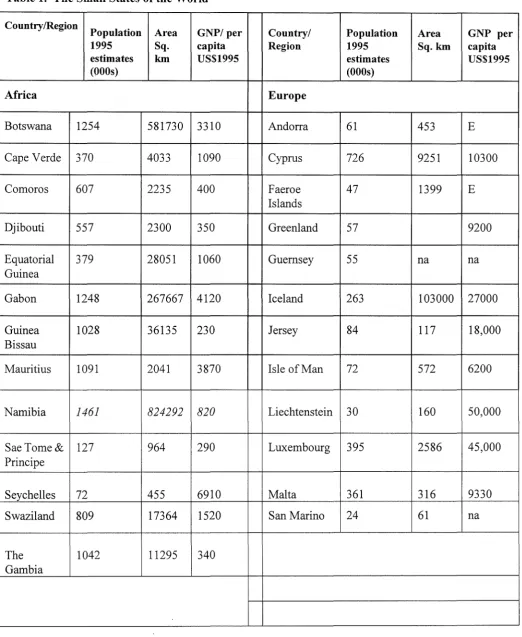
Table l. The W orId of Small States 96
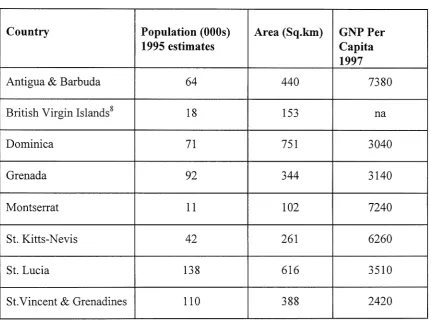
Table 2. Selected Data on OECS States 102
Table 3. Multi-Level, Multi-Faceted Institutions in Small States. 113
Table 4. Proportion of Primary Trained Teachers 142
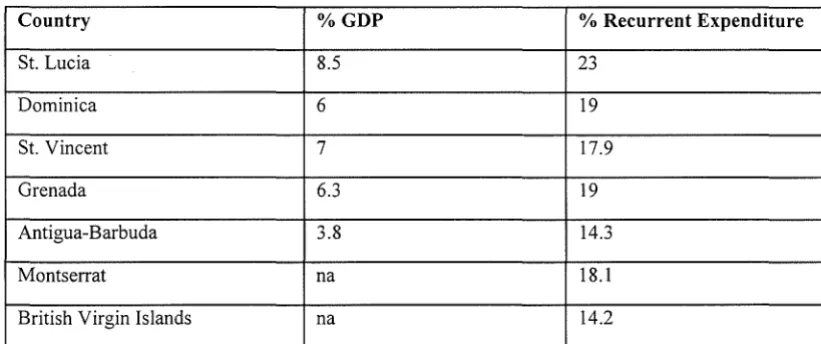
Table 5. Allocation of Expenditure to Education (OECS) 171 Table 6 Budget Allocated to Education in St. Lucia (1992/93) 172 Table 7 Proportion of Entrants Gaining 5+passes and
2 A levels by Country 175
Table 8 Centralisation-Decentralisation Topography 219 Table 9 Topography of Decision-Making in the Education System ofSt. Lucia 220 Table 10 The Locus of Decision Making in St. Lucia 222 Table 11 Distribution of Primary and Pupils by District (1997/98) 236 Table 12 Effect of School District on Services to Schools 236 Table 13 Responses by School District as a Percentage of Total Responses 246 Table 14 Proportion of Schools from Each District Responding (Primary) 246 Table 15 Satisfaction with Dual Church and State Control of Education 247 Table 16 Understanding of the Role of Boards of Management
of Management 257
Table 17 Effects of Boards of Management on Operation of Schools 259 Table 18 Principals' Perceptions of the Powers of Boards 260 Table 19 Principals' Understanding of Government Priorities
For Education 262
Table 20 Familiarity with OECS Reform Strategy 263
Table 21 To Whom Principals Think They are Accountable 265
Table 22 Working to Annual Plans 267
Table 23 Setting Annual Targets 267
Table 24 Monitoring Performance 267
Table 25 Extent to Which The Quality of Management Affects
School Performance 272
Table 26 Decentralising More Authority to Schools 273 Table 27 Management Functions That Should be Devolved to Schools 274 Table 28 Barriers to Effective School Management 277
Table 29 School Performance Indicators 281
Table 30 Principals' Routes into Teaching 285
Table 31 Highest Qualifications Gained by Principals 286 Table 32 Cross-tabulation of Routes into Teaching by Highest Qualification Held 286 Table 33 Qualifications in Management and Administration 287 Table 34 Need for Training in Management Among Principals 290
Table 35 Age Group of Principals 292
Table 36 Cross-tabulation of Age of Principals with Highest Qualification Held 292
Table 37 Length of Service of Principals 293
Figure 1.
Figure 2.
Figure 3.
Figure 4.
Figure 5
Figure 6.
Figure 7
LIST OF FIGURES
Conceptual Framework for the Study of Educational Administration & Management in St. Lucia
Map of the Caribbean
Map of St. Lucia
Organisation Structure of the Ministry of Education, Culture Culture and Labour
Structure of the Education System
Structural and Organisational Framework for Education in St. Lucia
A Framework for Policy Analysis
22
122
154
159
161
308
LIST OF APPENDICES
Appendix 1 Survey Questionnaire 357
Appendix 2 List of Personnel Interviewed. 367
ACKNOWLEDGEMENTS
This study was a marathon. It required stamina, courage and dedication in great abundance over the six-years that it took to complete, combining the research with full-time employment.
I am delighted that it is now all over, but it would not have been accomplished without the unstinting support and indulgence from my wife and daughter.
I am extremely grateful and appreciative of my supervisors: Dr. Janet Ouston who provided a great deal of encouragement, advice and guidance, especially in the early years, and Dr. Chris Williams for his support and guidance in the latter years and helping me see the study through to its completion.
Special thanks to my friend George James at the Ministry of Education, Culture and Broadcasting in St. Lucia for his many helpful comments on my drafts. A very big thank you to my former colleague Elspeth Yates for showing great interest in my work by always asking how the "Magnus Opus" was going. Unknowingly, she was a great source of encouragement, which helped strengthened my determination.
To my wife Faith for her unstinting support and patience over the years, when I disappeared in the study until the early hours.
DEDICATION
This study is especially dedicated to
My beloved wife, Faith;
and
Darling daughter Simone
Also to
1.
1 Introduction
CHAPTERl
Overview of the Study
This study was undertaken during a period of major educational reform in St. Lucia and growing influence of the grouping of Caribbean countries called the Organisation of Eastern Caribbean Statesl (OECS). The OECS had recently agreed an Education Reform Strategy (ERS) in 1993, and St. Lucia was implementing a Basic Education Reform Project as part of that strategy. It was also a time of emerging local concern about the quality of education and recognition of the need to improve the efficiency and effectiveness of the education system. It was also a time of increasing economic globalisation, which was blurring national boundaries and undermining the ability of countries to take independent action2.
St. Lucia, like other Commonwealth Caribbean countries, inherited from the colonial era an education system based largely on the British system of education. It could be argued, however, that there was never a single system of education in the former British colonies but rather, several systems with common organisational and structural elements. Although St. Lucia has been an independent country since 1979, the ties with Britain
1.1. The member states are: Antigua & Barbuda, British Virgin Islands, Montserrat, Dominica, St. Kitts
Nevis, St. Lucia, St. Vincent & the Grenadines and Grenada.
remain very strong, especially in the field of education. Many of those links reflect a high degree of continuing reliance on Britain for financial and technical assistance for education projects.
People in St. Lucia, as in other parts of the Caribbean, hold education in the highest regard. It would not be an overstatement to suggest that education is seen as a panacea for underdevelopment and poverty.
Until recently, reforms in Caribbean education focused on the expansion of educational provision, especially in basic education. As primary enrolments rose towards universal coverage, increased attention was given to the expansion of secondary and tertiary education. However, since the early 1980s a combination of factors, including fiscal constraints, poor examination results and pressures from donor agencies have caused the government to focus on the quality of education and the management of the education system in particular.
The potential impact of management on the quality of education and school performance in particular is being increasingly acknowledged, and great emphasis is being placed on the management of the education system, particularly at the level of the school. There is a particular recognition of the role of principals, their potential impact on school performance and the contribution that staff trained in management and administration can make towards improving the performance of schools.
The need to improve efficiency, effectiveness and provide value for money, especially at a time when governments are under increasing fiscal constraints, is emerging as an urgent priority.
1.2
Developing Interest in the Research Problem
Lucia) where he trained as a teacher and taught for many years. Britain, because at the
time the study was conceived, he was a middle manager at a college of further education in London. It was also a time of increasing attention to management training for college managers in Britain, to equip them to manage the newly incorporated colleges of further education, which had previously been under the control of Local Education Authorities.
At a very early stage in the literature search, it became clear that the issue of scale and dependency were major strategic issues affecting educational development in the Caribbean. It was felt therefore, that a study on the management of education in small states that made recommendations for improving the performance on the education system would be far more valuable as a major contribution to educational development in St. Lucia.
1.3
Introducing the Research Problem
Despite continuing attempts at reform, educational development in St. Lucia still faces many difficult problems and challenges. They include: insufficient numbers of qualified and trained teachers, inadequate secondary school provision, a curriculum not geared to meeting the perceived needs of the region, poor student attainment in schools, a lack of systematic measurement and evaluation of performance, deficiencies in the professional training and development of educational administrators, especially principals and centralised decision making by a few officials. There is still heavy reliance on assistance from aid agencies and foreign governments for resourcing development projects in education.
The control of education in St. Lucia is a matter of concern to educational policy makers, practitioners and the church. Most primary schools are denominational and operate under a system of dual state and church control. There is a lack of clarity of understanding and differentiation between the role of the church and that of the state in education. Consequently, a state of continuous tension persists, often erupting in conflict between church and state, causing confusion about accountability of schools. This dual control of education, which stems from the historical involvement of the church in education, remains unresolved.
A major strategy to improve the management of the education system since the early 1990s has been to train educational administrators, especially principals in educational management and administration. However, there are major deficiencies in the existing training strategy and programmes in terms ofthe broad approach, content, relevance and orientation. There is a further related issue regarding the scope and opportunities for those who have been trained in administration to apply the techniques and practices that they have learned. While this phenomenon is quite common in other countries, it is of greater significance in small states like St. Lucia with limited resources that cannot afford to be wasteful: there is constant pressure to maximise the benefits by making every cent count.
Effective School Principles3 have been adopted as a policy initiative for improving the performance of schools, despite the shortcomings of that model. There are two main problems with this approach: culture and process. Culture in the sense that the research has been conducted largely in Europe, North America and Australia, and policies based on them are unlikely to be appropriate to St. Lucia, which has a very different educational environment and culture. Process, in the sense that the model provides no clear analysis of the process for embedding 'school effectiveness principles' in schools to improve pupil achievement. Very important too, is the issue of how school effectiveness is to be measured in a meaningful way to facilitate continuous improvement.
3 These are based on Schools Effectiveness Research (SER). Twelve features of effective schools were
The shortage of trained teachers remains a problem and has been a feature of the education in St. Lucia for some considerable time. There are problems in attracting and retaining high quality staff to teaching, and teacher-training capacity is limited. Many stay in teaching only for a few years, do not bother becoming teacher-trained and leave teaching when something better turns up. Typically, it has meant teachers going overseas and continuing their studies. There is also a high outflow of trained teachers.
The lack of appropriately trained personnel is widespread and not just in education. It is somewhat paradoxical that, while the system produces the skilled people it needs, the limited capacity of the economy to absorb them causes many people to emigrate to North America and to a lesser extent, the United Kingdom in search of better opportunities.
The curriculum is generally regarded as not being sufficiently geared to meeting local human resource needs, despite several reforms intended to achieve greater relevance. The curriculum is largely academic with little vocational content, especially at the technician level, resulting in acute shortages of qualified technicians. There is preponderance for those undertaking higher education to study for degrees, and in the social sciences and business and management at the expense of science, technology and engineering.
The education system in St. Lucia displays a high degree of dependence. There is heavy reliance on foreign curricula and examinations, reliance on international organisations for financial and technical assistance for most education projects. Many staff are trained at foreign institutions and even where local staff training programmes exist, they are both financed and run by foreign agencies. The textbooks used in post primary education are largely imported, as is pedagogy. The dependence on foreign sources for assistance has resulted in the government following policies, which may not be even in their interest, but do so because donors insist on them as a pre-condition for receiving assistance.
currently attend secondary school, generally languish in "all age" schools and a few in "senior primary" schools from the age of 13 until they reach the school leaving age of 15.
There is an emerging literature, which suggests that smallness imposes certain constraints on educational development in small states like St. Lucia. This has been acknowledged largely at the regional level, where governments undertake joint initiatives and collaborative projects, in an attempt to remove the constraints imposed by smallness. Notable examples are University of West Indies (UWI) , The Caribbean Community (CARICOM), Organisation of Eastern Caribbean States (OECS), and Caribbean Examinations Council (CXC).
Many policy initiatives are being implemented to address the problems in education. Policies aimed at addressing the particular problems of educational management and administration include: the establishment of School Districts, the setting up of Boards of Management for Schools, adoption of Effective Schools Principles, the training of principals in management & administration, implementing a system of school performance review and a 'Basic Education Reform Project', which has the training of educational administrators in management and administration as a major component.
1.4
Statement of the Problem
The effective and efficient management of schools, use of resources, good governance, highly trained, qualified and motivated staff, have been identified as essential to improving the quality of education and student performance. Consequently, recent policy initiatives have concentrated on improving the management and administration of the education system at all levels. The government of St. Lucia has placed great store in these policy reforms to achieve its educational objectives and produce the outcomes that will ensure that the necessary skills are available to meet the broader challenges of development in the context of globalisation in the new millennium.
efficient, effective and responsive to local needs, many problems and challenges persist. The question is, given that so much depends on the success of those initiatives, whether the current policies and prevailing management practices have the potential and capability to meet the challenges of educational management and administration in 8t. Lucia successfully. There are two other very important dimensions to the problem: the implications of smallness and dependence: financial, psychological and cultural. There is evidence to suggest that smallness imposes certain constraints on educational development and that some policies being adopted, largely borrowed from the West and designed for large developed countries, may not be appropriate for small states. Dependence on external sources for financial and technical expertise for education projects is also thought to undermine the ability of the government in a small state to take autonomous action and pursue policies of its choice. The further question is, given the perceived significance of scale and dependence for educational management and administration, whether current policies and practice reflect the implications of smallness and embrace strategies to reduce and counter the effects of educational dependence?
1.5
The Study Objectives
Against the above background this study sets out to:
1. Identify the forces that have and continue to influence and shape educational policy and practice in 8t. Lucia.
2. Examine the implications of smallness and dependency for educational management and administration in 8t. Lucia
3. Analyse the education system in 8t. Lucia focusing on its organisation, structure, management, policy formulation and implementation, performance, school management & governance and the training of educational administrators.
5. Develop a framework for formulating responses to the challenges of educational management and administration in St. Lucia.
1.6
The Conceptual Framework
The conceptual framework for conducting the study is shown in Figure 1 on page 22. The study considers how the various factors and forces have shaped the current education system in St. Lucia, and assesses the potential of policy and practice to meet predetermined educational objectives in the context of a small post-colonial state.
The study starts with an examination of the forces that have influenced and shaped education in Commonwealth Caribbean and St. Lucia in particular, to provide context and background to the study. This takes the form ofan examination of the history, which is intertwined with the development of education in the region. Colonialism is linked to the history and is still a dominant force that continues to influence developments in education. The contributions by the Mico Charity, the Church and the Negro Education Grant were all significant forces in shaping education in the region.
Policy and Practice
•
Decentralisation•
School Effectiveness•
School Governance•
Curriculum•
Human ResourceFactors and Development
Influencing Education System
•
PerformanceEducational Development
~r
•
Historical•
Ministry of EducationPolicy Formulation &
•
Colonialism"""
.
School DistrictImplementation
Cultural ~
•
Teaching ServiceAre they the right
•
•
penetration Commission
policies?
•
Globalization•
School•
Are they being Educational Outcomes•
Dependency--....
implemented?•
Efficiency•
Demand for ~•
Sufficient capacity?•
Effectiveness Education•
Implementation•
Economy•
Proximity to Northstrategies
•
Relevance America• Monitoring and
•
Equity-•
ChurchEvaluation
..
The role of the Catholic Church in education is assessed. While its involvement has been very important historically, it continues to exert control over primary education, which is a source of much conflict between church and state.
The current education system is a product of the various forces that have shaped it, of which the Ministry of Education is the key player. How the Ministry is organised, structured, policymaking and implementation are vital determinants of a successful education system. Equally important however, is the operation of the school system and individual schools. The school is arguably the most critical component of the education system, because that is where pupil learning and teaching take place, and it is the output of the school that is used as a measure of the performance of the whole education system.
While the school is a significant unit, policy and practices are vitally important for setting the framework within which teaching and learning take place. The performance of the system including staff and students depends largely, on the policy framework and educational practices stipulated at ministerial level.
Other components of the education system, especially the School District and Teaching Service Commission play important roles in its functioning. The role of the Teaching Service Commission in staffing appointments and deployment is of particular significance in ensuring the availability of appropriately trained and qualified teaching staff.
1.7
Theoretical Frameworks
This section introduces the theoretical frameworks, and the main theories and concepts are examined in the next chapter, which critiques the literature.
Theoretically, the study draws on different perspectives and disciplines. Education is considered a necessary, but not necessarily a sufficient condition for development. Consequently, the links between education and development are explored, drawing on several strands of development theory, especially human capital theory.
Human capital theory attributed the rise in income and economic growth to increase in investment in human capital. Therefore, investment in education and training was seen as the major determinant of development. Schultz has been credited with seminal work on human capital theory. In 1980, he reflected that:
of human-capital skills and knowledge. (Schultz, 1980:2)
While this proposition may be dated, it is still influential and continues to be reflected in development policy in many developing countries including St. Lucia. The validity ofthis proposition can be seen from the increasing importance of human resource development, exemplified by the increasing growth in influence and importance of the 'knowledge' occupations. The continuing influence of human capital theory is due in part, to the "impasse" in development theory and its failure to fulfil the development aspirations of developing countries. (Schuuman, 1993; Leys, 1996)
The analysis of educational development in St. Lucia is also conducted within the framework of the dependency theory developed in Latin America through the works of Prebisch (1950), Frank (1967), Furtado (1976) and Cardoso & Faletto (1979)4.
4 Dependency Theory is examined in full in Chapter Three, which critiques the literature.
Dependency theory sought to explain the state of persistent underdevelopment in Latin America, in rejection of the modernisation theories, which dominated thinking on development then. Dependency theory attributed the underdevelopment in Latin America to the dependent structural economic relationship between the economies of Latin America and the metropolitan powers. The main thesis is that the relationship led to persistent underdevelopment in the dependent countries.
Although dependency theory was developed for economic analysis it has influenced writing on educational dependency about the whole of the education system to include: structures, content, pedagogy, objectives, staff training and financing of educational developments. Sander (1985) sees evidence of dependence in educational administration in Latin America:
cultural dependence. (Sander, 1985:201).
Dependency as a theory of underdevelopment came under severe criticism, resulting in the loss of influence, and probably has few fervent supporters today. The major criticism has been its apparent failure to adequately explain patterns of development and provide appropriate policy prescriptions. The application of dependency theory to education, like the economic dependency from which it stems, has also been criticised. For example, McLean (1983) maintained that:
1983:26)
However, some of the perspectives of dependency remain valid, and if used as an analytical tool, can provide a very useful framework to provide a better understanding of the phenomenon of educational dependence, and its impact on education in ex-colonial small states like
st.
Lucia.TEXT REDACTED DUE TO THIRD PARTY RIGHTS OR OTHER LEGAL ISSUES
As Leys (1996) observed:
situations of dependency) remains valid. (Leys, 1996:31)
This observation reflects the current situation in St. Lucia and much of the analysis will
focus on dependency as an analytical tool.
Educational development is also considered from the perspective of colonialism, focusing
on the educational legacy of colonialism. This is particularly relevant to this study, given
that St. Lucia became independent from Britain only in 1979.
Brock (1982) suggested that:
culture and initiative. (Brock, 1982:119).
Beckford (1972), the celebrated Caribbean scholar remarked that
mind of the people '. (Cited in Brock, 1982: 119).
Moreover, neo-colonialism has developed in the post-independence period. Although the
countries are independent, their economy is being driven from outside.
Educational developments in small states are analysed within the context of scale,
isolation and dependence as the major defining characteristics of small states. (Brock,
1984; Bray, 1984; Lillis 1993). Given that the study focuses on a small island state, the
issue of "islandness" , a geographical characteristic of Caribbean states and any
implications for educational development are also considered.
TEXT REDACTED DUE TO THIRD PARTY RIGHTS OR OTHER LEGAL ISSUES
TEXT REDACTED DUE TO THIRD PARTY RIGHTS OR OTHER LEGAL ISSUES
Educational policy is examined within the context of development administration, which has become well established as a field of study. The following definitions of the discipline, explain the usefulness of the framework:
1986: 74).
Schaffer's definition is particularly relevant:
capacities and severe obstacles in meeting them. (Cited in Luke, 1986: 75).
This definition seems an accurate description of the educational challenges in small states.
Two themes of development administration are particularly useful for the analysis in this study: (1) building effective administrative capacity and (2) responsiveness and accountability: both help provide a framework for examining the administrative policies and practices in St. Lucia.
The analysis of educational management and administration, while drawing on the limited available literature with small state perspectives, makes extensive use of the literature emanating from small states and the perceptions of policy makers and practitioners in small states. This is deliberate, and an attempt to acknowledge and promote the contributions from indigenous practitioners and policy makers in small states.
Different management traditions provide the theoretical basis for studying educational administration in small states. Management as a branch of organisational theory, very
TEXT REDACTED DUE TO THIRD PARTY RIGHTS OR OTHER LEGAL ISSUES
much underpins the discussions and perceptions of management at school level. Organisational analysis of educational institutions is often conducted within the Weberian bureaucratic framework. Management at institutional level is conducted within the framework of management theories, focusing particularly on organisational theory, and using ideas and tools such as leadership, motivation, empowerment and managerial competence.
1.8
The Geopolitical Framework
The study refers to several geopolitical groupings in the Caribbean and the main ones are explained to provide clarity of understanding.
Association of Caribbean States (ACS)
This is a grouping of islands from all the different language traditions in the Caribbean. It consists of Dutch, English, French and Spanish speaking countries. It is a forum for discussing issues of the wider regional interest.
CARICOM (Caribbean Community)
This is the Common market of the countries of the Commonwealth Caribbean. It was formed in 1979 to facilitate greater and free trade between its members and serves as a major international trade negotiating body.
Commonwealth Caribbean
The term Commonwealth Caribbean is used to refer to all former and remaining British Colonies in the Caribbean that are members ofthe Commonwealth. These countries also share a common history, culture and language. There are no statutory links at this level but the common bond is the sharing of a common colonial history. The term is used in this study interchangeably with Caribbean.
Organisation of Eastern Caribbean States (GECS)
Lucia, St. Vincent & the Grenadines and Grenada) formed in 1981. It was established as a mechanism for enhancing co-operation among its member states.
The OECS is not a political or legislative body. Each member state retains its full sovereignty and OECS decisions have no legislative force.
1.9
The Thesis Structure
This study on educational management and administration in small states examines educational practices from colonial to contemporary times, to assess the extent to which contemporary policy and practice, have the potential to meet the challenges of educational management and administration in S1. Lucia. This introductory chapter has provided an overview of the study.
The research methodology employed in the study is presented in Chapter Two. The chapter provides the rationale and justification for the eclectic approach adopted, which combines quantitative with a highly qualitative research. The research design is explained, sources of data identified, and data collection, organisation and analysis explained.
Chapter Three provides a critical review of the literature on development in small states.
It begins with an account of the development of small states. The characteristics of small states are examined focusing on the issues of scale, isolation and dependence. The constraints and opportunities presented by smallness are considered, followed by an examination of conceptual problems surrounding the meaning of smallness. Educational dependence and its impact on policymaking are then critically examined.
The final section examines the literature on educational management and administration in small states.
independence. It is further noted that, while the concept of educational dependency is now widely used, suggesting acceptability of the broad framework at least, it is argued that there is not a clear distinction between the development features and characteristics are that are a consequence of size and those that are a consequence of other factors.
It is argued that interest in education in small states has focused too much on the characteristics, constraints and problems resulting from smallness. It is contended that, while smallness imposes certain constraints, it also presents great challenges and opportunities that must be explored to provide useful insights and concrete suggestions for tackling the developmental issues. The study argues for greater contribution by practitioners in small states to provide a local and different perspective to the burgeoning literature in the field.
Chapter Four sets the small states' context with reference to the Organisation of Eastem Caribbean States and examines the major development issues and their implications for educational management and administration.
The world of small states is introduced, followed by a critical examination of how the issues of scale, isolation, dependence and globalisation impinge on educational development in the OECS. The concepts of efficiency and effectiveness are examined, as they pertain to education, followed by a consideration of the development imperatives for the OECS.
It is argued that the diversities among small states have not received sufficient coverage, and that research is lacking on the usefulness of existing grouping to develop a useful analytic framework for understanding the development process. It is contended that the features presented as characteristics and unique to small states are often present in large states.
to cont~mporary times.
It is shown that there was no educational provision to speak: of before Emancipation and that even after Emancipation, educational development was haphazard, inadequate and of poor quality. It is also shown that the educational provision for the masses in the colonial period was aimed solely at producing people with the clerical skills required to support the colonial administration. It is also argued that the system of education that subsequently developed was an attempt to reflect educational development in Britain.
Chapter 6 examines the education system in St. Lucia and the major factors that influence policy and practice. The chapter starts with an overview of st. Lucia to set the context. The education system is then critically assessed focusing on the school system, teacher education, educational expenditure, performance measurement and management at school level.
The factors that have and continue to influence and shape policy are examined focusing the colonial inheritance, transferability of educational models, international assistance and dependence, regional developments, globalisation and school effectiveness research. This is followed by a critique of school effectiveness research, as a major influence on educational policy in St. Lucia. The challenges facing educational management and administration are considered, followed by an overview of recent policy reforms.
It is argued that such factors as the colonial ties, reliance on the West for educational materials and research, technical and financial resources and globalisation, combined with limited domestic capacity are major influences on domestic policy and practice.
Chapter 7 exammes decentralisation in small states. The chapter begins with an international perspective on decentralisation, and examines the experiences of countries that have decentralised their education systems. The factors influencing decentralisation in small states are identified and applied to St. Lucia to determine its appropriateness and implications for small states. The final part assesses the attempts at decentralisation by establishing Regional Authorities and School Districts in St. Lucia.
It is shown that small compact states with well-developed infrastructure and communications have fewer pressures for and are less likely to decentralise, concluding that conditions in small states do not favour decentralisation.
Evidence is provided to show that conditions in St. Lucia do not favour decentralisation of the educational system. It is argued that, while the decentralisation policies being followed in St. Lucia may be well intentioned with commendable objectives, they have inherent weaknesses, which are exacerbated by poor implementation strategies.
Chapter 8 is the critical examination of educational policy and practice in St. Lucia to assess their potential to meet the challenges of educational management and administration. It is based largely on field research carried out in St. Lucia.
The chapter starts by setting the context within which educational policyrnaking takes place, followed by the analysis of data from the field research: a survey questionnaire, interviews, focus group discussions and document analysis.
A structural and policy framework is proposed to respond to the challenges in managing the education system. It includes changes to the organisational structure of the education system, a policy analysis framework and policy directions for the future.
1.10
Limitations
of the Study
While the study focuses on administration and management of the education system in St. Lucia, it does not examine the administrative and management competence of individual administrators. The focus on the organisation, structure and management of the system, policy, administrative practices at the different tiers of education the education. Emphasis is placed on management functions and processes such as decision-making, authority, responsibility, accountability, leadership, review and evaluation and strategic planning. However, the extent to which administrators are trained in management and administration is taken as a rough guide to managerial competence and an indicator of training needs.
The study does not adopt an objective-oriented approach to policy evaluation in that it does not focus on completed programmes or policy initiatives and the extent to which specific, pre-determined objectives have been achieved. This is largely due to the lack of clearly stated objectives of policy initiatives and the unavailability of adequate data. Instead, the focus is on policy orientation, in an attempt to contribute information for improved decision-making in educational management and administration.
Where information was incomplete or unavailable, some reconstruction was undertaken. However, this is not thought to affect the validity of the study since these were more matters of detail than substance.
The study does not take into account any developments beyond the middle of 1998. This was because of the practical necessity, in terms of time and finance, to have a cut-off point to allow sufficient time for any new data to be collected and analysed. However, reference is made to developments after mid-1998 that are of particular relevance to this study.
1.11 Significance of the Study
There is little existing literature on educational management and administration in small states and this study adds to the literature in this increasingly important area.
The study gives prominence to the experiences and perceptions of educational policy makers and practitioners in small states. In that context, the views at local level provide much needed balance and thus make an original contribution to knowledge in the field.
The analysis of the operation of the education system and the management of schools in particular from the perspectives of decision makers, practitioners and other infiuencers, is a significant contribution to the literature. This is also the first detailed study of the way in which the education system in St. Lucia is managed and the very first detailed study to examine management at the level of the school from the perspective of practitioners and principals in particular and suggesting ways in which current educational concerns might be addressed.
A unique contribution to literature in the field is provided by critically examining policies and practices to assess the extent to which they reflect the implications of smallness and respond to the causes and impact of educational dependency. This is an intractable problem for St. Lucia, which has been exacerbated by globalisation and power politics.
Man has long been concerned to come to grips with his environment and to understand the nature of the phenomena it presents to his senses. (Mouly, 1978).
CHAPTER 2
Methodological Approach
2.1
Introduction
This Chapter explains the research methodology and approaches that underpin the study. The purpose of the study is restated and the appropriateness of the research methods considered in the light of the research objectives restated below.
2.2
Purpose of the Study
To reiterate, this study is a critical examination of policy and practice in educational management and their potential to improve the performance of the education system.
Recent educational reforms in St. Lucia have been concerned with the efficiency and effectiveness of the education system and policies have been aimed at bringing about much needed improvement. Policy reforms have been focusing on the role of educational administrators and the particular role of principals in improving the quality of education and pupil attainment. Despite these policies, major challenges in education persist. Not only has there been no attempt to systematically evaluate policies, but also there are concerns about the extent to which the policies address the impact of small scale and dependency.
2.3
Methodological Perspectives
Human beings have long been concerned to understand and come to terms with the environment and the nature of the phenomena it presents to the senses. Several approaches have been developed to help understand and interpret the environment.
The literature on research methods (Keeves, 1988; Cohen & Manion, 1989; Anderson, 1990; Miles & Huberman, 1994, Gubba & Lincoln, 1994) acknowledges the existence of several paradigms competing for acceptance of choice in educational enquiry. Guba and Linclon (1994) identify at least four such paradigms: positivism, postpositivism, critical theory and related ideological positions and constructivism. Among the different approaches, two main or classical paradigms have emerged to compete for choice in educational enquiry. Each of these two main approaches reflects a particular view of social reality. One is a traditional approach, based on the natural sciences in which, studies are conducted according to a plan aimed at discovering laws governing behaviour. The other approach is more flexible and is adjusted according to what happens during the investigation. While this approach accepts that there may be general laws governing behaviour, it accepts that human behaviour differs from that of inanimate phenomena. This is sometimes called the naturalistic approach to research.
Cohen & Manion (1989) clarified the distinctions between these two approaches, describing the traditional approach as 'normative' and the naturalistic approach as
'interpretative' paradigms.
Manion, 1989:38).
In conducting educational enquiry, researchers are therefore confronted with two main methodological approaches competing for their favours. Heusen (1988) drew attention to
information and other interpretative approaches (Heusen in Reeves, Ed,
1988:17).
Eisner (1985) in his inimitable style distinguished between these approaches and expressed support for the interpretative approach to educational research.
sees with the kind of qualification that the situation warrants. (Eisner, 1985:2.)
Writers are increasingly cautioning against confining the research methodology to one or the other approach and suggest the use of both approaches where appropriate. Depending on the objective of the research, emphasis will be placed more on one than the other. However, the choice of mix of paradigm will be determined by the type of knowledge that is being sought, bearing in mind that the ultimate purpose of research knowledge in education is to provide a basis for action.
Keeves (1988) also argues that the various research paradigms are complementary to each other and calls for a "unity of educational research".
The nature of the research problem and the objective of the study can help to determine the methodology and techniques to be used. The choice of approach to this study was influenced by several factors. Whilst the project is aimed at extending the corpus of knowledge in the area under investigation, it was primarily concerned with providing understanding and prescriptions for future policy. Another factor was recognition that educational policy and practice are not independent ofthe socio-cultural contexts, which
TEXT REDACTED DUE TO THIRD PARTY RIGHTS OR OTHER LEGAL ISSUES
needs to be examined to contextualise the development of educational policy and practice. However, the study draws more heavily on the interpretative paradigm, accepting the theoretical position that there is a fundamental difference between the study of natural objects and human beings in that, the latter interpret situations themselves and give meaning to it.
2.4
Qualitative Research in Education
The two principal paradigms examined above are generally associated with particular research methods and techniques. There is a tendency for the positivist approach to use quantitative research methods and the anti-positivist or interpretative paradigm approach to use qualitative research methods, but the association of research paradigms with techniques is not mutually exclusive as to research techniques.
As Miles & Huberman (1984) argue
community. '(Miles & Huberman, 1984:20)
Miles & Huberman (1994) also concluded "good qualitative research requires an interactive mix of the two views oflife"
Qualitative research techniques also underpin 'grounded theory' (Glasser & Strauss, 1967), which is derived from the analysis of data systematically obtained from social research. According to Glasser & Strauss (1967)
generation of the ory. (Glasser & Strauss, 1967; 17-18).
TEXT REDACTED DUE TO THIRD PARTY RIGHTS OR OTHER LEGAL ISSUES
There has been a growing interest in the use of qualitative methods in educational research, product of epistemological critiques of the positivist tradition. In educational research, the interpretative paradigm usually combines an interpretative theoretical framework with the use of qualitative techniques. The distinctive features of qualitative research concern matters of both research techniques and epistemology. In terms of technique, qualitative research encompasses techniques that are not statistically based. They would include techniques such as participant observation, interviewing, case studies, documentary sources and surveys. The underlying logic of quantitative research is generally deductive, in that hypotheses are formulated and tested by empirical research. Qualitative research draws on different philosophical traditions and theoretical perspectives. The perspective sees events as being constructed by actors, rather than external forces, which mould the individual human beings. Another focus draws on phenomenology, involving the meanings that people attribute to their actions and the processes by which actions are given meaning in the course of human interaction. This methods looks, not so much for causes but meaning, rejecting the methods of the natural sciences and seeing the task of the educational researcher as uncovering meaning of events. The logical procedure tends to be inductive rather than deductive, in that data is used to develop, not just test generalisations.
(Lewin 1990:47).
2. 5. A Policy-Oriented Research Perspective.
This study can also be described as being policy-oriented, in that it attempts to gather evaluative data to contribute to improved decision-making and programme implementation.
The term policy-oriented research is generally used to refer to research that is designed with the specific purpose of informing policy decisions or assisting in their implementation. It is to distinguish it from fundamental research, which is primarily designed to extend knowledge. The function of such research is to provide a corpus of information for decision-making by politicians, administrators and policy-makers.
Policy-oriented research is seen as consisting of careful, systematic attempts to understand the educational process. Nisbet (1997) has provided a comprehensive definition, worth quoting at length.
better policy decisions in the future. (Nisbet, 1997,139).
TEXT REDACTED DUE TO THIRD PARTY RIGHTS OR OTHER LEGAL ISSUES
Majchrak (1984 defined policy research as:
ndamental atic action (Cited in Anderson, 1990: 186).
Policy analysis is also closely linked with policy evaluation and according to Anderson (1990).
a new programme or activity. (Anderson, 1990: 165)
Policy-oriented research can also be construed in terms of 'policy scholarship' (Grace, 1988 & 1995). Grace uses the term policy scholarship as distinct from policy science. Policy science is described as a form of social and educational analysis, which attempts to extract a social phenomenon from its relational context in order to subject it to close analysis. Grace (1988) argues that this approach is devoid of historical or cultural dimensions of the subject under investigation. The main concern here is to understand present phenomena in order to formulate rational recommendations for action.
Grace (1995) argues that this perspective is limited, because it often excludes the relationship between social phenomena and the structure of historical, cultural, political and ideological and value issues in education since many problems in education are manifestations of these ideological, historical and cultural contradictions in society.
Policy scholarship on the other hand, implies a mode of analysis, which goes beyond policy science and takes into account historical, cultural contexts and value relations.
TEXT REDACTED DUE TO THIRD PARTY RIGHTS OR OTHER LEGAL ISSUES
According to Grace (1995)
schooling. (Grace, 1995,3).
The concept of 'policy scholarship' as described by Grace is particularly relevant to this study. In the context ofthe Caribbean and S1. Lucia in particular, many of the educational problems are manifestations of structural, historical, cultural and ideological values. These problems cannot be appreciated and addressed satisfactorily, unless they are contextualised.
In terms of analysis, this study could also be said to have adopted a policy scholarship approach, as opposed to a policy science approach, given the significance of the socio-cultural and historical context in the development of education in S1. Lucia.
The study intends to provide valuable information and make recommendations to policy makers to correct any deficiencies in the system and modify policies and practice where necessary. This is achieved through an assessment of policies and practices in educational management and administration, which serve as the basis for formulating appropriate recommendations. The use of policy evaluation in achieving these objectives seems most appropriate and justified.
The approach is used to critically examine educational policies, practices and their implementation in S1. Lucia. The policies are examined through the study of policy documentation, reports produced by external consultants, focus group discussions and interviews with education officials. The evaluation was based largely on the discussions that took place with officials and the limited published information available on review and evaluation of policies. The assessment was based largely on information pieced together from various sources such as annual education reports, annual work plans, statistical reports and any other information on performance and output to enable a judgement to be formed about the effectiveness of actions taken. This was particularly so
with decentralisation, which had been operating for quite some time but for which there was no published review or evaluation.
2.6
Research Methods
This section discusses the choices of research techniques used in this study. These include historical research, surveys and interviews.
2.6.1 Historical Research
Historical research has been defined as a process of systematically searching for data to answer questions about past phenomena for the purpose of gaining a better understanding of present institutions, practices, trends (Gall et aI, 1996). Historical research in education can be distinguished from other types of educational research in that, it aims to discover data through the search of historical sources such as documents and relics, whereas, other types of educational research tend to create data, by making observations and carrying out tests to describe events and present performance.
Epistemologically, historical research tends to be interpretative as opposed to positivist in that, it acknowledges bias and the fallibility in human judgement. However, it is thought that careful analysis and multiple data sources such as triangulation can discover the historical truth. Historical research methods can also be said to contain an element of revisionism, insofar as it attempts to reinterpret events surrounding particular developments in education. Interpretation is quite an important process because history necessarily deals with events that have occurred, so there is reliance on records made by others, which may reflect biases, value judgements and omissions.
In terms of research methodology, there are similarities between historical methods and other qualitative research methodologies. Edson (1986) identified four such similarities:
1. emphasis on the study of context
2. the study of behaviour in a natural rather than contrived or theoretical setting 3. appreciation of the wholeness of the experience, and
Historical research can be of great value. As Cohen & Manion (1989) argued
educational practices and theories developed. (Cohen & Manion, 1989:49).
The product of this type of research can be of particular benefits to educationalists, policymakers and the community at large. It can also provide insight into problems and provide better understanding of educational institutions, educational ideas, movements and whole education systems.
Historical research must also be considered against the uncertain nature of historical generalisations, which has led to increasing criticisms of the traditional assumptions and methodology. Kaestle (1997) advised that:
historians. (Kaestle, 1997: 76)
The assumptions underpinning the traditional framework for historical research has come under increasing attack. Its two key assumptions: first that the history of education was based on, and was concerned centrally and indeed, exclusively with the history of school systems and; and second, that state-regulated, tax supported universal schooling was a good thing. The first critique broadened the focus of educational history to consider various agencies of learning, other than schools, bringing learning as a wider process of socialisation. The other critique questions the assumption that state-regulated schooling has been motivated by democratic humanitarian impulses and that it has led to democratic opportunity. The critique emphasises the culturally abusive nature of values asserted by the schools and the exploitative nature of capitalism.
TEXT REDACTED DUE TO THIRD PARTY RIGHTS OR OTHER LEGAL ISSUES
However, historical methods are not without their methodological problems, as Kaeste (1997) explains
art. (Kaeste, 1997: 75).
There are further problems in conducting historical research in that; historical events are not subject to direct observation by the researchers. There is total reliance on the observations and interpretations by others, which can reflect biases, socio-cultural values biases, which can be compounded by inadequate information. However, such a situation provides an opportunity for the reinterpretation of historical events. This is the situation in St. Lucia where, the developments of education and administrative practices are not well documented and available information is incomplete or non-existent. Information about the administrative structures of early Caribbean education was often inadequate or missing and some reconstruction was done.
While the historical research of educational development in St. Lucia has been based on the traditional assumptions, this study recognises the value and contribution of non-school agencies to learning. It also recognises the increasing bureaucratic nature of educational management and administration, and asks questions about the motivation behind the proliferation of such bureaucracy. While the research acknowledges that there can be alternative arrangements and different motivations for providing education, state education in St. Lucia is seen as having a central and critical role to play in the island's development.
The study is also concerned with the evaluation of the development of education in the Caribbean in order to draw conclusions, which can serve as a basis for current and future policy. The use of historical research provides an insight into the development of education in the region in an attempt to develop an understanding and appreciation of the current state of education in St. Lucia.